Chapter 8 The houses in Altona; the end of Emden's text, and Kahana's continuation to his death
Jacob Emden, Megillat Sefer · Hebrew (Kahana, Warsaw 1896/97) with an English draft translation · work in progress
Pages in this chapter
Chapter 8 The houses in Altona; the end of Emden's text, and Kahana's continuation to his death · from p. 189
p. 190 · p. 191 · p. 192 · p. 193 · p. 194 · p. 195 · p. 196 · p. 197 · p. 198 · p. 199 · p. 200 · insert · p. 201 · p. 202 · p. 203 · p. 204 · p. 205 · p. 206 · p. 207 · p. 208 · p. 209 · p. 210 · p. 211 · p. 212 · p. 213 · p. 214 · p. 215 · p. 216
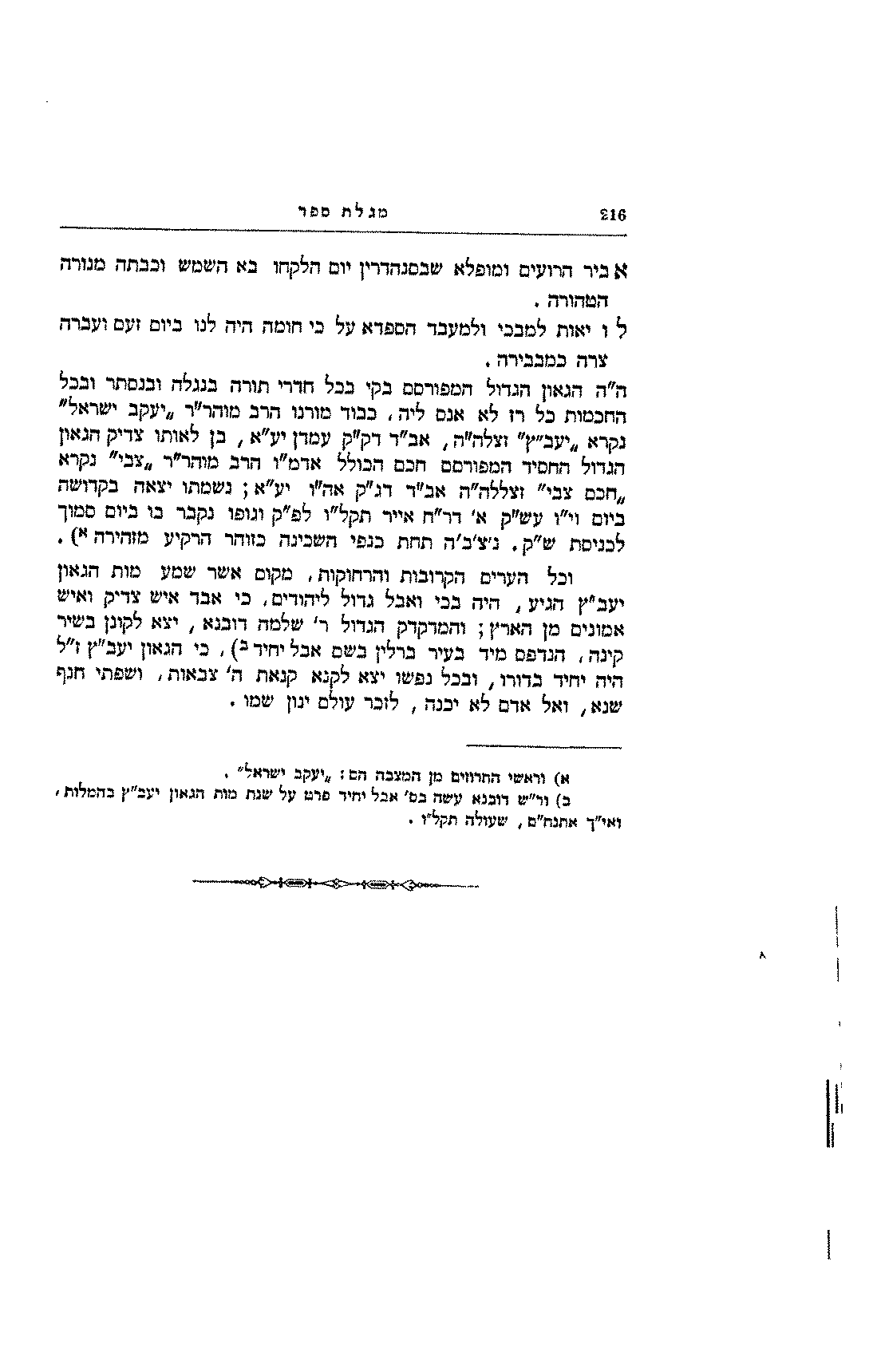
Page 190 (scan 212)
Therefore I agreed to buy the houses adjoining mine, and I sank into them almost all the money in my hand, about fifteen hundred Sh.K.; and I still lacked four thousand for the first payment. For half a year I sought them and did not find them, as it seems because of my enemies without cause, who had made my savour stink with all the gentile moneyed men who lend their money on houses. When the time came and I could not raise it, I had to seek a loan for the time being from my friends. I took great trouble with them and begged them to save me from the disgrace of the court and from useless expense, but their ear was too heavy to hear, although in truth it was a small matter for them. For there were at least four men, distinguished leaders, whom I asked for this, namely the parnas and leader R. G[ershon] K[at]z, may he live, the parnas and leader R. Y. Hozen, may he live, the parnas and leader R. M. G. Sh., and the leader R. Y. Göttingen, may he rest in peace. I wanted to do it with them by way of a permitted partnership (heter iska), and for a short time, until I found a gentile lender; but they would not. All of them hung it on the last of the said men, for he was "rich in public" and "master of wheat", for whom everyone needs to produce cash (cf. b. Horayot 14a), while for him it was a light and small thing, especially on so secure a pledge, with God's help. Yet all the requests and intercessions, mine and others', were in vain, for he was a hard man — saving his honour — and he left me in this great distress, so that I was close to losing the money I had already sunk into this purchase, besides the contempt and the shame and the joy of my opponents; until he saw that "the waters had come up to the soul" (Ps. 69:2), for the date of payment had already passed and I was summoned to court. Then his compassion was kindled; but in anger and wrath he forced himself to grant me my request this time, after he had caused a needless expense of about twenty Reichstaler. Then the said four men gave the said sum in partnership at interest of "4 p.c." [a], and I repaid them the thousand Reichstaler; and of this loan of theirs a thousand Sh.K. remained [owing] to the said four men, without payment of interest.
At that time rows of stones fell from the top of the wall of my dwelling house on the street side, and I made a great new expense on my house, to renew it completely inside and out, and to set at the edges of the roof on the street side gutters of hewn stone with a fine iron railing, in place of the wooden gutters and railing it had before, so that the new expense on it alone came to about a hundred Reichstaler; besides what I also spent on the houses I had recently bought, to repair all their breaches as needed. In the first two years after buying these houses they gave a proper income, thank God, so that I could pay the interest on the first capital on time, and gain for my own capital about four or five hundred Sh.K. a year, after all I spent on them for repairs and for the king's portion on landed property; so that in those two years I had an income from my money
על כן הסכמתי לקנות הבתים הסמוכים אלי, ותקעתי בהם כמעט כל כספי אשר בידי כט"ו מאות שו"ק, ועדיין היו חסרים לי ארבעת אלפים מעות הראשונות, וחצי שנה בקשתים ולא מצאתים, כמדומה בסבת אויבי חנם שהבאישו ריחי אצל כל בעלי כיסים נכרים המלוים מעותיהם על בתים, וכשבא הזמן ולא השיגה ידי, הוצרכתי לבקש הלואה לפי שעה מאוהבים שלי, והרבה טרחתי עמהם והתחננתי להצילני מזילותא דדינא והוצאה לריק, וכבדה אזנם משמוע, אף שבאמת מילתא זוטרתא היא לגבייהו, כי היו לפחות ארבעה אנשים קצינים מסוימים שבקשתי מהם דבר זה, ה"ה הק' פו״מ ר"ג כ"ץ שי', ופו"מ ר״י הוזן שי', ופו"מ רמג"ש, והמנהיג ר"י געטינגען ע"ה, ורציתי לעשות עמהם דרך היתר עיסקא, ועל זמן קצר עד שאמצא מלוה נכרי, ולא אבו לי, כולם תלו באחרון שבהם הנ"ל, כי הוא היה עתיר פומבי ומרא חיטא, שהכל צריכין להמציא מעות בעין, ואצלו הוא דבר קל ומצער הוא, מה גם על משכון בטוח כזה בעזה"י; מ"מ כל הבקשות והמליצות ממני ומאחרים היו בחנם, כי היה אדם קשה, חוץ מכבודו, והניחני בצער גדול הלז שכמעט היה קרוב להפסד מעותי שתקעתי בקנין זה כבר, מלבד הבוז והקלון ושמחת המתנגדים לי, עד שראה כי באו מים עד נפש שכבר עבר מועד הפרעון ונתבעתי לדין, אז נכמרו רחמיו, אבל בכעס ובקצף אמצי לי נפשיה לתת לי את שאלתי בפעם הזאת, אחרי שגרם הוצאה של חנם כעשרים ר"ט; אז נתנו ד' אנשים הנ"ל בשותפות סך הנ"ל על רוחים ד"ל א, ופרעתי להם האלף ר"ט, ונשאר מהלואתם הללו אלף שו"ק, על ד' גברים הנ"ל בלי נתינת רוחים. בפרק הנ"ל נפלו שורות אבנים מראש כותל בית דירתי בצד הרחוב, ועשיתי הוצאה חדשה רבה על ביתי לחדשו לגמרו מבית ומחוץ, ולהניח בצדי הגג שעל הרחוב מרזבי אבני מחצב עם מעקת ברזל יפים, תחת מרזבות ומעקה של עץ שהיה לו קודם זה, באופן שעלו עליו לבד כמאה ר"ט הוצאה חדשה, מלבד שהוצאתי גם על הבתים שקניתי מקרוב לחזק בדקם כל הצריך. והנה בשתי שנים הראשונות אחר קנין הבתים הללו, היתה להם הכנסה כהוגן ת"ל, שהייתי יכול לפרוע רבית מקרן ראשון בזמנו, ולהותיר בעד קרני כארבע וכחמש מאות שו"ק לשנה, אחר כל מ"ש עליהם בתקון ובמנת המלך מאחוזת נחלה, באופן שבאותן שתי שנים היתה לי הכנסה ממעותי
- [א] ר"ת : ד' למאה.
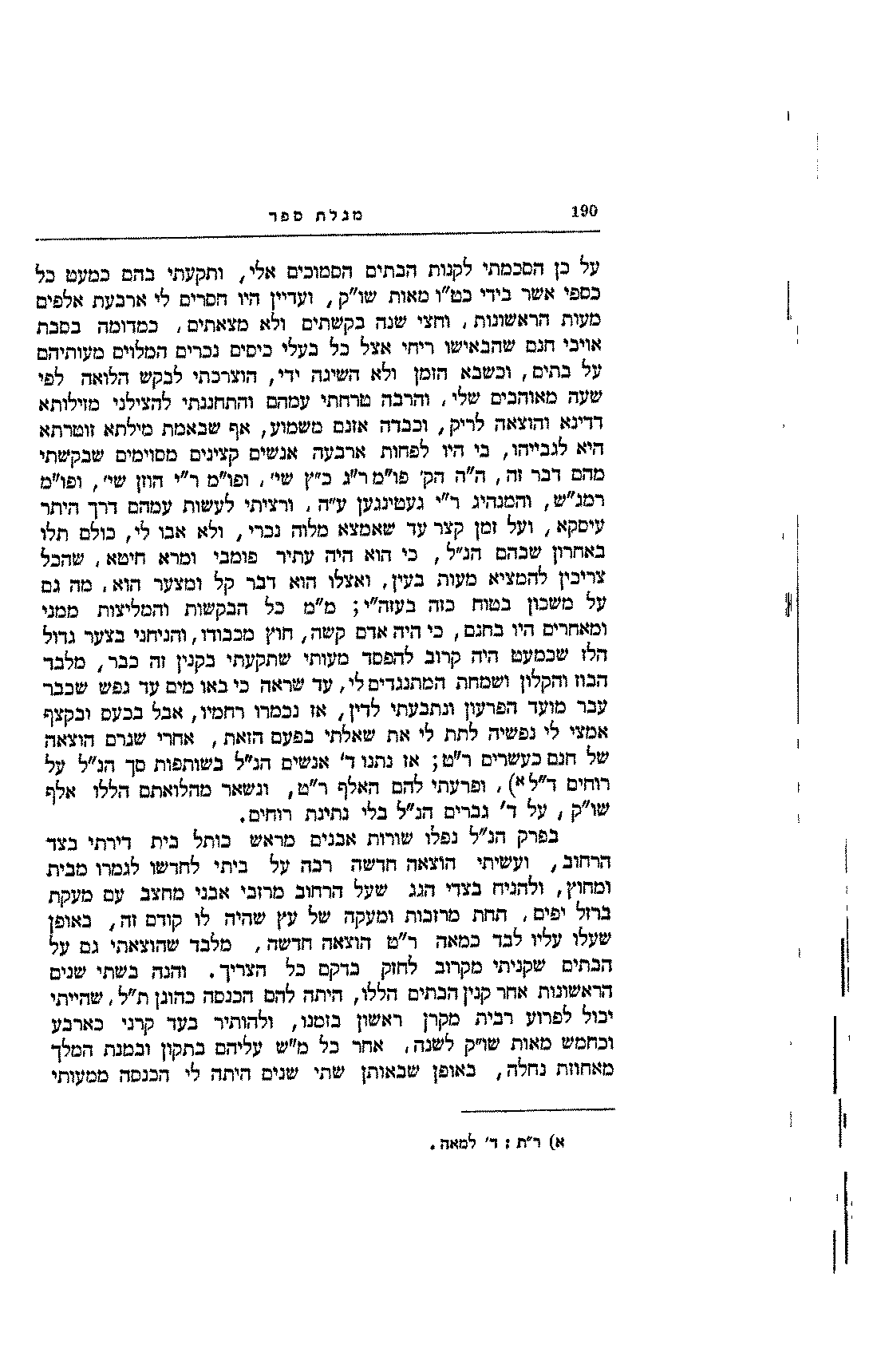
Page 191 (scan 213)
that I had sunk into the said real estate: about five hundred Sh.K., or about four hundred, a year, comfortably. But in the year 5517 [1757] and the winter of 5518 [1757/58] much of this income of mine was lost. May the Lord fill my lack and send His blessing on my house and on the work of my hands, and strengthen my strength, my vigour and my wealth for His service, blessed be He, to "honour the Lord with my substance" (Prov. 3:9) and my money, and to multiply commandments and charities in Israel as I desire. May He, blessed be He, fulfil the requests of my heart, to do His will as I long and wish!
Here I will tell the praises of the Lord, His might and His wonders that He did with me, especially on the third of Av 5515 [1755], when the men of Eybeschütz fell upon me ⟨S: a five-line note, partly read: "suddenly a band of ruffians, …(?) of vermin, hanging(?) behind … of the abominable Eybeschütz, m[ay the name of the wicked] rot"⟩ to search my house, [to see] whether they would find the A[kitzat] A[krav] [a]. The matter was thus. The said ⟨S: "gaon"⟩ had already schemed to obtain my book, clearly and with witnesses, as coming from my hand, in order to sue me for his insult. He tried several ways and could find no way, except through the hypocrite, the pupil Mordecai Hene, judge in Hamburg — to whom I had done good: even when I was in Amsterdam, a wanderer from my place, I sent money to Hamburg as a gift from my own purse, and what [I raised] from other merchants, to distribute to the needy and to those who toil in Torah; and this bound one received a fixed portion, although he did not need it, and he also had an income from our friends who value us, namely the house of the parnas and leader R. M. G. Sh. and others. Even so, love of gain and lust for money overcame him — he had long been suspected of it, yet the "precious ones" drew him near. And he hired himself out to the said [man], who promised him, or gave him, a large bribe for himself and his sons, "a lad shaken out and empty" of commandments (cf. Neh. 5:13), to contrive to get my book from my hand openly, so that it would be in his power to prove the matter against me and to set me up "as a mark for the arrow" (Lam. 3:12) in the gentile courts, God save us. And he succeeded in obtaining his desire through a flatterer and evil-doer, a hypocrite like himself, who seemed to me a faithful friend. So he "pledged his heart" (Jer. 30:21) to send his son, a lad, together with another lad, so that there would be two witnesses against me; and he gave into his son's hand a letter of request and recommendation signed by his own hand, asking me to sell the A. A. to these two lads. He assured me with soft words and mighty promises that there was no cause for worry here, for they needed it to fulfil the wish of one of my friends in the land of Denmark, who had asked and begged them for this, so that he might see the matters set out clearly, to strengthen his hand and his view in the affair, and that his heart should not faint so as to be drawn after my opponents; and he had gone so far as to pay a high price for the book and also to do them a favour. Therefore he asked me not to send them away disappointed: "withhold not good from them to whom it is due" (Prov. 3:27), so that the wickedness of the man may be made known, for which purpose the book was composed and printed; and he could be relied on that no mishap would come out from under his hand, God forbid. Thus and thus he sent me in writing, and by word of mouth much more than this, so
Kahana's notes
- [a] See what he related before (p. 180).
שתקעתי בקרקעות הנ"ל, כחמש מאות שו"ק או כארבע מאות לשנה בשופי, אך בשנת תקי"ז וחורף תקי"ח נפסדה הרבה מהכנסתי הלז. ה' ימלא חסרוני וישלח ברכתו בביתי ובמשלח ידי, ויחזק כחי ואוני והוני לעבודתו ית', לכבד ה' מהוני וממוני, ולהרבות מצות וצדקות בישראל כחשקי; הוא ית' ימלא משאלות לבבי לעשות רצונו כתאותי וכרצוני! כאן אספר תהלות ה' ועזוזו ונפלאותיו אשר עשה עמדי, ביחוד בשלשה לאב תקט"ו כשנפלו עלי אנשי אייבשיצר, לחפש את ביתי אם ימצאו סע"ע א. הענין כך היה, כבר התחבל הנ"ל, להשיג ספרי יוצא מתחת ידי בבירור ובעדות, כדי לתבוע עלבונו ממני, וחזר על כמה צדדים ולא יכול למצא צד, כי אם אצל הצבוע התלמיד מרדכי הענא דיין בהב', אשר גמלתיו טובה גם בהיותי באמשטרדם נודד ממקומי, שלחתי להב' מעות מתנה מכיסי, ומ"ש אצל סוחרים אחרים, כדי לחלוק לנצרכים ולעמלי תורה, וקבל זה האסור חלק מסוים ואע"פ שאינו צריך לכך, וגם י"ל הכנסה מאוהבינו החפצים ביקרנו, ה"ה בית פו"מ רמג"ש וזולתם, עכ"ז גבר עליו אהבת הבצע וחמוד ממון, שכבר היה חשוד עליו מימים רבים, עכ"ז קרבוהו היקרים; ונשכר להנ"ל אשר הבטיחו או נתן לו שוחד רב לו ולבניו נער מנוער ממצות, שיתחכם להשיג ספרי מידי בגלוי, שיהא בידו לברר הדבר לנגדי ולהציבני כמטרה לחץ בעש"ג ר"ל, ועלתה בידו להשיג מבוקשו ע"י חנף ומרע צבוע שכמותו, ואשר היה נראה כאוהב נאמן לי, על כן ערב את לבו לשלוח בנו נער בצירוף נער אחר, למען יהיו שני עדים עלי, ומסר ביד בנו כתב בקשה ומליצה חתום מידו, לבקש ממני שאמכור הסע"ע לשני נערים הללו, והבטיחני בדברים רכים והבטחות עצומות, שאין כאן בית מיחוש כי הם צריכים לכך, למלא רצון אחד מאוהבי במדינת דענימארק, שבקש והתחנן אליהם על זאת, למען יראה דברים מבוארים, לחזק ידו ומחשבתו בענין, ולא יפוג לבו להמשך אחר מתנגדי, והפריז על כך לשלם בעד הס' בדמים יקרים, וגם לעשות להם חטיבה; על כן בקשתו שלא להוציאם בפחי נפש, בל אמנע טוב מבעליו הראוי לכך, למען תתפרסם רעתו של האיש, שלתכלית זו נתחבר ונדפס הספר, וכדאי לסמוך עליו שלא תצא תקלה מתחת ידו ח"ו. כזאת וכזאת שלח אלי בכתב ובע"פ הרבה יותר מזה, מה
- [א] עיין מה שהגיד מקודם (צד 180).
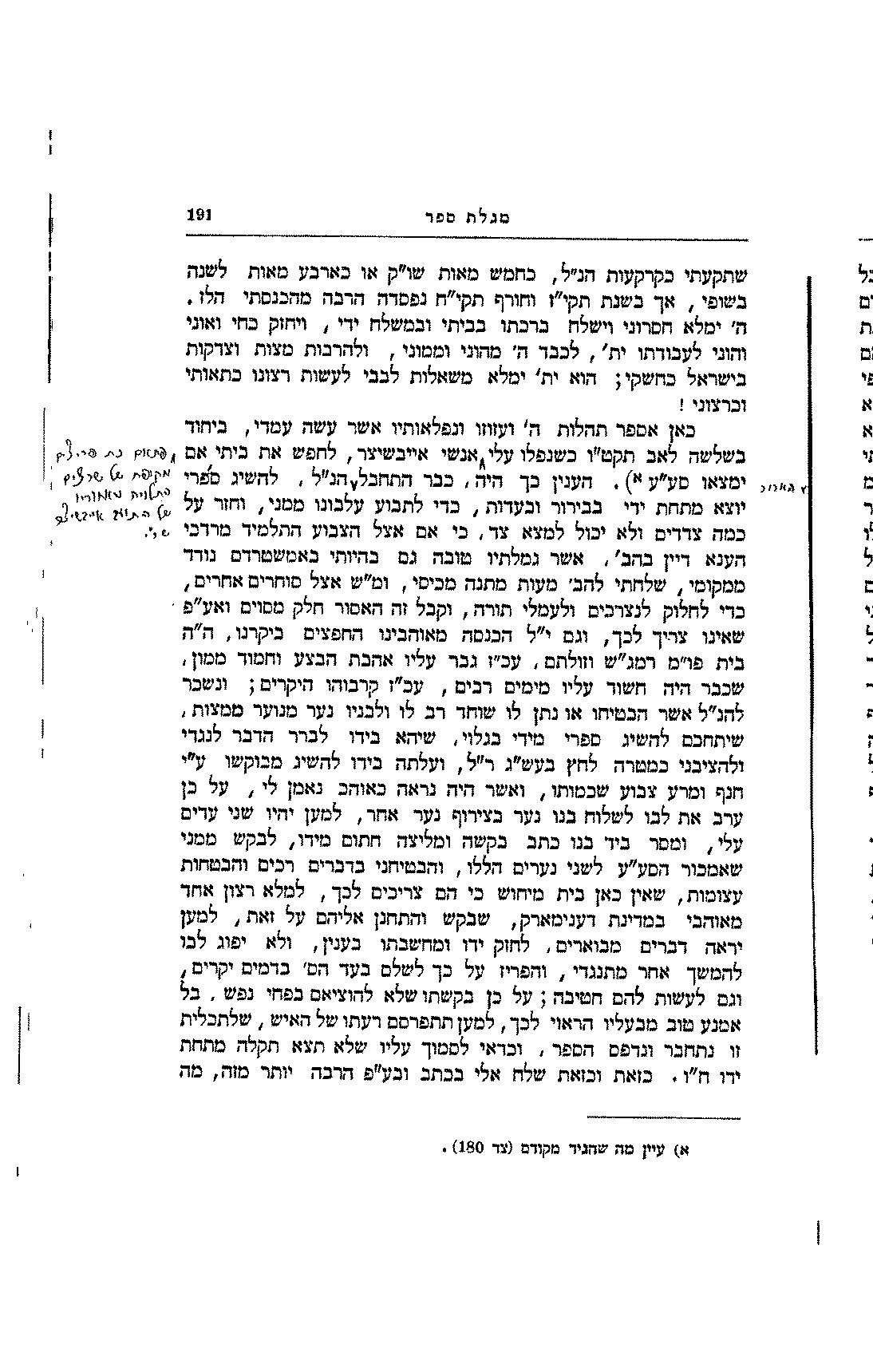
Margin readings in Scholem's copy (2)
| Printed anchor | Type (key sheet) | Mark | Reading | Certainty |
|---|---|---|---|---|
| ביחוד בשלשה לאב תקט"ו כשנפלו עלי ^ אנשי אייבשיצר | V: omission | caret; 5-line note in the margin beside lines 7-11 | פתאום כת פריצים / מקופת(?) של שרצים / התלוית(?) מאחורי / של התועב אייבשיצר / ש"י(?) | partial |
| העניין כך היה, כבר התחבל ^ הנ"ל | V: omission | caret; one word in the other margin | הגאון | fairly sure |
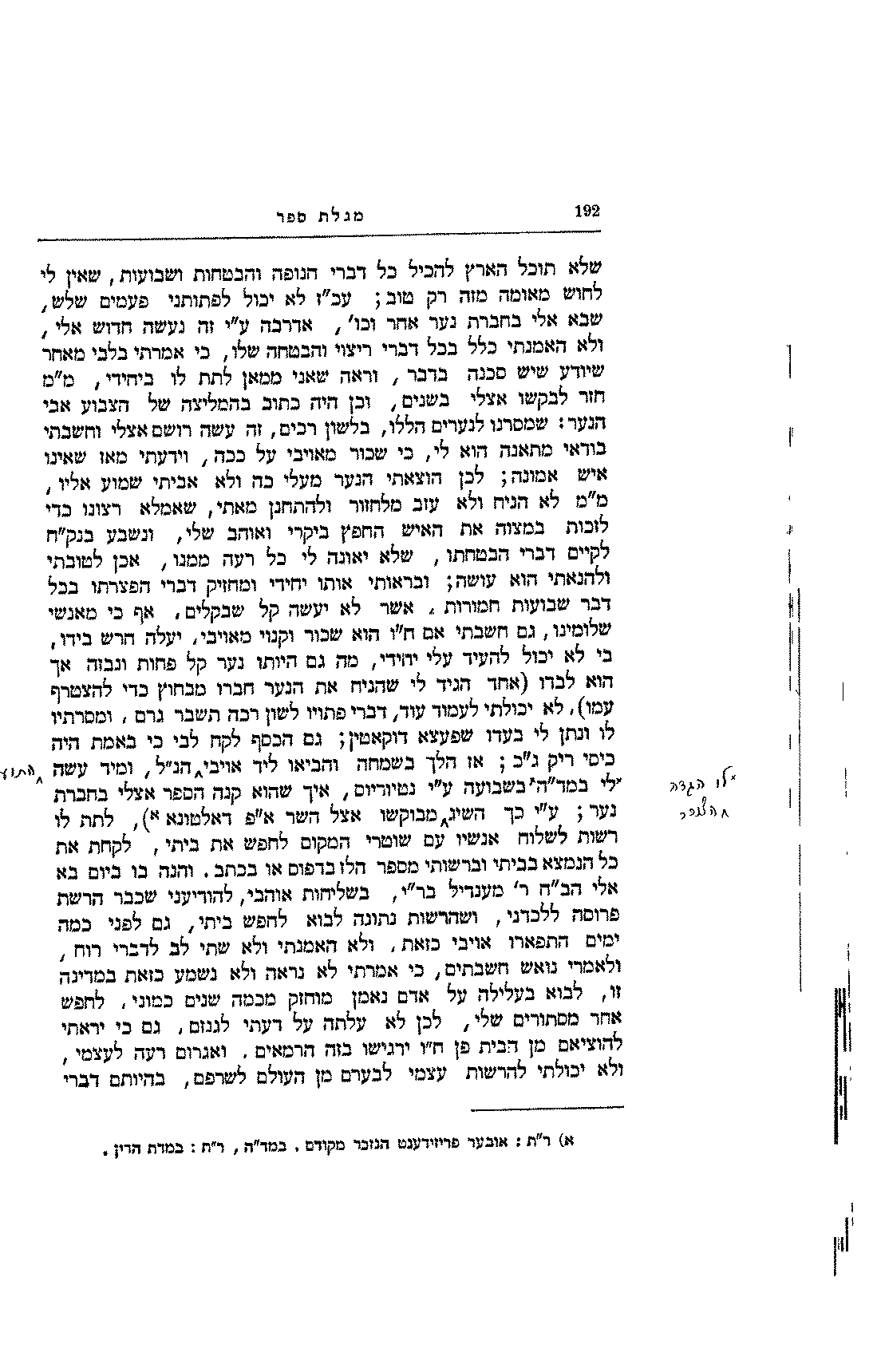
Page 192 (scan 214)
that the earth could not contain all the words of flattery, promises and oaths, that I had nothing at all to fear from it, only good. Even so he could not persuade me "three times", when he came to me in the company of another lad, etc.; on the contrary, through this it struck me as strange, and I did not believe at all in all his words of appeasement and promise. For I said in my heart: since he knows that there is danger in the matter, and saw that I refused to give it to him alone, why did he come back to ask it of me with two? And so it was written in the letter of the hypocrite, the father of the lad: "Give it to these lads", in soft language. This made an impression on me, and I thought he was surely "seeking a quarrel against me" (2 Kgs. 5:7), for he was hired by my enemies for this; and I had known long since that he was not a man of faith. So I sent the lad away from me thus and would not listen to him. Yet he did not let up or cease from coming back and begging me to fulfil his wish, so as to give the merit of a commandment to the man who values me and is my friend; and he swore with an object held in his hand to keep the words of his promise, that no harm would befall me from him; rather, he was acting for my good and my benefit. And when I saw him alone, pressing his pleas with grave oaths at every word, such as the lightest of the light would not do, let alone one of our own people; and I also thought: if, God forbid, he is hired and bought by my enemies, he will come up with a potsherd in his hand, for he cannot testify against me alone, especially as he is a light, mean and despised lad — and he was alone (someone told me afterwards that he had left the lad his companion outside, so as to join him) — I could hold out no longer: his words of persuasion, "a soft tongue breaks the bone" (Prov. 25:15). I handed it to him, and he gave me specie ducats for it; the money too took my heart, for in truth my purse was also empty. Then he went off joyfully and brought it into the hand of my said enemy, and at once ⟨S: "the abominable one"⟩ made ⟨S: "for himself a deposition"⟩ against me in the court, under oath, through a notary, that he had bought the book from me in the company of a lad. Through this he ⟨S: "the scoundrel"(?)⟩ obtained his desire from the lord O. P. of Altona [a], to give him permission to send his men with the officers of the place to search my house and to take all that was found in my house and in my possession of this book, in print or in writing.
And behold, on that very day the ḥaver R. Mendel son of R. Y. came to me, sent by my friends, to let me know that the net was already spread to catch me, and that permission had been given to come and search my house. A few days before, my enemies had boasted of this, but I did not believe it and paid no heed to "words of wind" (Job 16:3), and thought them "words of one that is desperate" (Job 6:26). For I said: such a thing has not been seen or heard in this country, to come with a false charge against a trusted man of established standing for some years like me, to search my hidden things. So it did not occur to me to hide [them]; I also feared to take them out of the house, lest, God forbid, the deceivers notice it and I bring harm on myself; and I could not allow myself to destroy them from the world by burning them, since they were words of
Kahana's notes
- [a] The abbreviation [stands for] Ober-Präsident, mentioned before. במד"ה, abbreviation: במדת הדין ("in the court of law").
שלא תוכל הארץ להכיל כל דברי חנופה והבטחות ושבועות, שאין לי לחוש מאומה מזה רק טוב; עכ"ז לא יכול לפתותני פעמים שלש, שבא אלי בחברת נער אחר וכו', אדרבה ע"י זה נעשה חדוש אלי, ולא האמנתי כלל בכל דברי ריצוי והבטחה שלו, כי אמרתי בלבי מאחר שיודע שיש סכנה בדבר, וראה שאני ממאן לתת לו ביחידי, מ"מ חזר לבקשו אצלי בשנים, וכן היה כתוב בהמליצה של הצבוע אבי הנער: שמסרנו לנערים הללו, בלשון רכים, זה עשה רושם אצלי וחשבתי בודאי מתאנה הוא לי, כי שכור מאויבי על ככה, וידעתי מאז שאינו איש אמונה; לכן הוצאתי הנער מעלי כה ולא אביתי שמוע אליו, מ"מ לא הניח ולא עזב מלחזור ולהתחנן מאתי, שאמלא רצונו כדי לזכות במצוה את האיש החפץ ביקרי ואוהב שלי, ונשבע בנק"ח לקיים דברי הבטחתו, שלא יאונה לי כל רעה ממנו, אכן לטובתי ולהנאתי הוא עושה; ובראותי אותו יחידי ומחזיק דברי הפצרתו בכל דבר שבועות חמורות, אשר לא יעשה קל שבקלים, אף כי מאנשי שלומינו, גם חשבתי אם ח"ו הוא שכור וקנוי מאויבי, יעלה חרש בידו, כי לא יכול להעיד עלי יחידי, מה גם היותו נער קל פחות ונבזה אך הוא לבדו (אחד הגיד לי שהניח את הנער חברו מבחוץ כדי להצטרף עמ ו, לא יכולתי לעמוד עוד, דברי פתויו לשון רכה תשבר גרם, ומסרתיו לו ונתן לי בעדו שפעצא דוקאטין; גם הכסף לקח לבי כי באמת היה כיסי ריק ג"כ; אז הלך בשמחה והביאו ליד אויבי הנ"ל, ומיד עשה עלי במד"ה בשבועה ע"י נטיוריוס, איך שהוא קנה הספר אצלי בחברת נער; ע"י כך השיג מבוקשו אצל השר א"פ דאלטונא א, לתת לו רשות לשלוח אנשיו עם שוטרי המקום לחפש את ביתי, לקחת את כל הנמצא בביתי וברשותי מספר הלז בדפוס או בכתב. והנה בו ביום בא אלי הב"ח ר' מענדיל בר"י, בשליחות אוהבי, להודיעני שכבר הרשת פרוסה ללכדני, ושהרשות נתונה לבוא לחפש ביתי, גם לפני כמה ימים התפארו אויבי כזאת, ולא האמנתי ולא שתי לב לדברי רוח, ולאמרי נואש חשבתים, כי אמרתי לא נראה ולא נשמע כזאת במדינה זו, לבוא בעלילה על אדם נאמן מוחזק מכמה שנים כמוני, לחפש אחר מסתורים שלי, לכן לא עלתה על דעתי לגנזם, גם כי יראתי להוציאם מן הבית פן ח"ו ירגישו בזה הרמאים, ואגרום רעה לעצמי, ולא יכולתי להרשות עצמי לבערם מן העולם לשרפם, בהיותם דברי
- [א] ר"ת: אובער פריזידענט הנזכר מקודם. במד"ה, ר"ת: במדת הדין.
Margin readings in Scholem's copy (4)
| Printed anchor | Type (key sheet) | Mark | Reading | Certainty |
|---|---|---|---|---|
| והביאו ליד אויבי ^ הנ"ל | V: omission | caret; no note seen beside it (perhaps the note "התוע..." below belongs here) | - | - |
| ומיד עשה ^ | V: omission | caret; one word in the margin, cut off | התוע[ב] (cut off) | fairly sure |
| x עלי במד"ה בשבועה ע"י נטיוריוס | X: substitution | x mark over the word; 2 words in right margin | לו הגדה (for עלי: "made for himself a deposition") | fairly sure |
| ע"י כך השיג ^ מבוקשו | V: omission | caret; one word in right margin | הנבל(?) | uncertain |
Page 193 (scan 215)
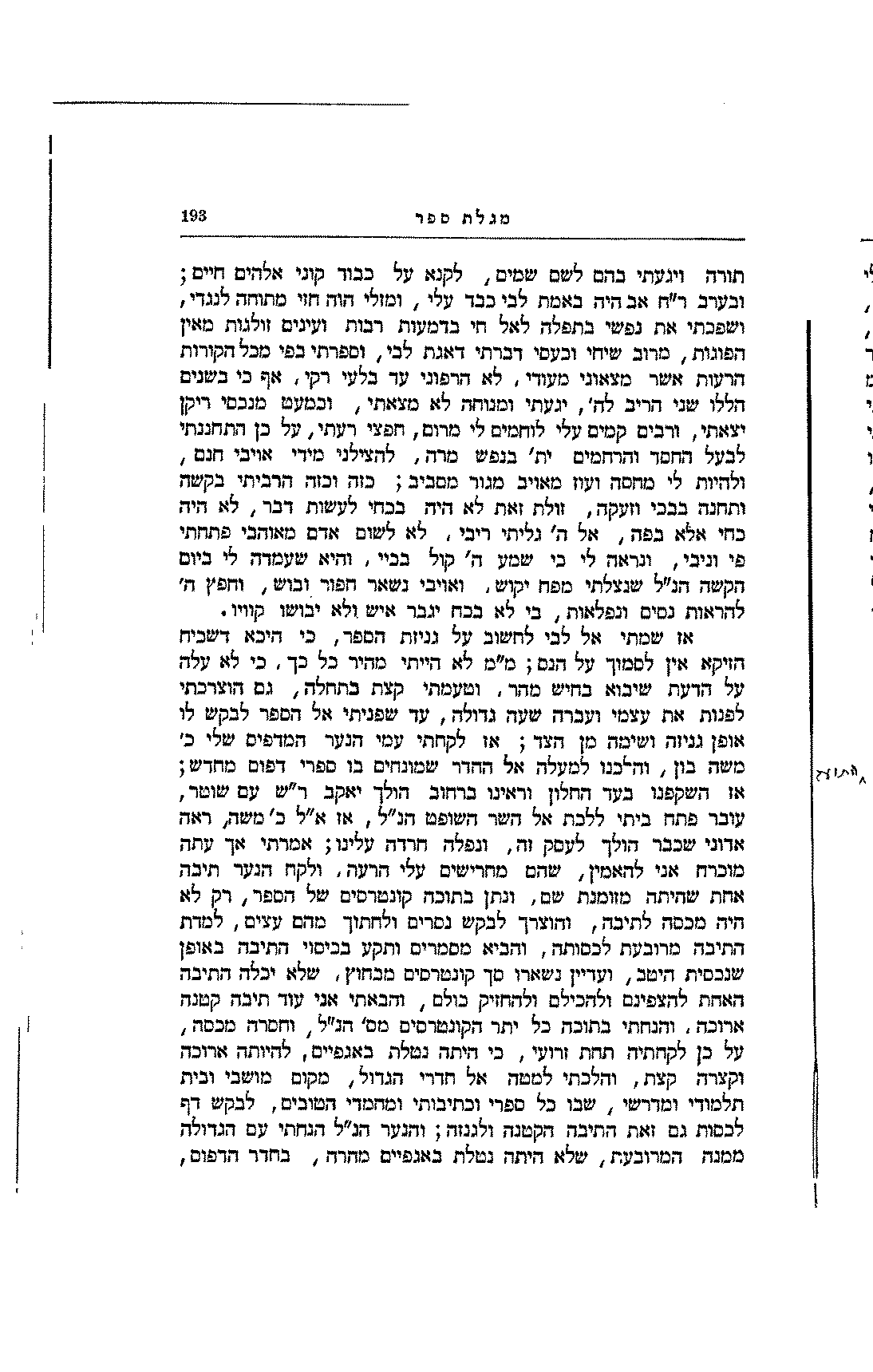
Torah, over which I had toiled for the sake of Heaven, to be zealous for the honour of my Maker, the living God.
On the eve of the New Moon of Av my heart was truly heavy within me, and "my star saw" (cf. b. Megillah 3a) the danger stretched against me; I poured out my soul in prayer to the living God, with many tears and eyes running without ceasing; "out of the abundance of my complaint and grief" (1 Sam. 1:16) I spoke the anxiety of my heart, and told with my mouth all the evil events that had found me from my youth: "they have not let me alone till I swallowed down my spittle" (Job 7:19). Especially in these two years, the years of the Lord's quarrel (cf. Isa. 34:8), "I laboured and found no rest" (cf. Jer. 45:3), and almost went out empty of my possessions; "many are they that rise up against me" (Ps. 3:2), "many fight against me, O Most High" (Ps. 56:3), seeking my harm. Therefore I besought the Master of kindness and mercy, blessed be He, with a bitter soul, to save me from the hand of my enemies without cause, and to be for me "a refuge and strength" (Ps. 46:2) against the enemy, "terror on every side" (Jer. 6:25). Thus and thus I multiplied petition and supplication with weeping and crying; apart from this I had no strength to do anything — I had no strength except in my mouth. To the Lord I revealed my cause; to no man of my friends did I open my mouth and lips. And it seemed to me that "the Lord has heard the voice of my weeping" (Ps. 6:9), and this stood by me on the said hard day, so that I escaped "the snare of the fowler" (Ps. 124:7), and my enemies were left ashamed and confounded. And the Lord was pleased to show miracles and wonders, "for by strength shall no man prevail" (1 Sam. 2:9), and "they shall not be ashamed that wait for Me" (Isa. 49:23).
Then I set my heart to think about hiding the book, for "where damage is common one does not rely on a miracle" (cf. b. Pesaḥim 8b). Even so I was not so very quick about it, for it did not occur to me that it would come so soon, and I delayed a little at first. I also had to relieve myself, and a long hour passed, until I turned to the book, to seek a way of hiding it and setting it aside. Then I took with me the lad, my printer, Mr. Moses Bonn, and we went up to the room in which my books of the new printing are placed. Then we looked out through the window and saw in the street Jacob R. Sh. walking with an officer, passing the entrance of my house to go to the said lord judge. Then Moses said to me: "My lord sees that he is already going about this business," and trembling fell upon us. I said: Now I am forced to believe that they are plotting evil against me. The lad took a box that happened to be there and put into it quires of the book; only the box had no lid, and he had to look for boards and cut from them, to the measure of the box, a square piece to cover it; and he brought nails and fixed them in the cover of the box, so that it closed well. And quires were still left outside, for that one box could not hide and hold them all. So I brought another small, long box and put into it all the rest of the quires of the said book, and it lacked a lid. Therefore I took it under my arm, for it could be carried in the arms, being long and a little narrow, and I went down to my large room, the place of my seat and the house of my study and my midrash, in which are all my books and writings and my precious things, to look for a board to cover this small box too and to hide it. And the said lad I left with the large square one, which could not be carried quickly in the arms, in the printing room;
תורה ויגעתי בהם לשם שמים, לקנא על כבוד קוני אלהים חיים; ובערב ר"ח אב היה באמת לבי כבד עלי, ומזלי הוה חזי מתוחה לנגדי, ושפכתי את נפשי בתפלה לאל חי בדמעות רבות ועינים זולגות מאין הפוגות, מרוב שיחי וכעסי דברתי דאגת לבי, וספרתי בפי מכל הקורות הרעות אשר מצאוני מעודי, לא הרפוני עד בלעי רקי, אף כי בשנים הללו שני הריב לה', יגעתי ומנוחה לא מצאתי, וכמעט מנכסי ריקן יצאתי, ורבים קמים עלי לוחמים לי מרום, חפצי רעתי, על כן התחננתי לבעל החסד והרחמים ית' בנפש מרה, להצילני מידי אויבי חנם, ולהיות לי מחסה ועוז מאויב מגור מסביב; כזה וכזה הרביתי בקשה ותחנה בבכי וזעקה, זולת זאת לא היה בכחי לעשות דבר, לא היה כחי אלא בפה, אל ה' גליתי ריבי, לא לשום אדם מאוהבי פתחתי פי וניבי, ונראה לי כי שמע ה' קול בכיי, והיא שעמדה לי ביום הקשה הנ"ל שנצלתי מפח יקוש, ואויבי נשאר חפור ובוש, וחפץ ה' להראות נסים ונפלאות, כי לא בכח יגבר איש ולא יבושו קוויו. אז שמתי אל לבי לחשוב על גניזת הספר, כי היכא דשכיח הזיקא אין לסמוך על הנס; מ"מ לא הייתי מהיר כל כך, כי לא עלה על הדעת שיבוא בחיש מהר, וטעמתי קצת בתחלה, גם הוצרכתי לפנות את עצמי ועברה שעה גדולה, עד שפניתי אל הספר לבקש לו אופן גניזה ושימה מן הצד; אז לקחתי עמי הנער המדפיס שלי כ' משה בון, והלכנו למעלה אל החדר שמונחים בו ספרי דפוס מחדש; אז השקפנו בעד החלון וראינו ברחוב הולך יאקב ר"ש עם שוטר, עובר פתח ביתי ללכת אל השר השופט הנ"ל, אז א"ל כ' משה, ראה אדוני שכבר הולך לעסק זה, ונפלה חרדה עלינו; אמרתי אך עתה מוכרח אני להאמין, שהם מחרישים עלי הרעה, ולקח הנער תיבה אחת שהיתה מזומנת שם, ונתן בתוכה קונטרסים של הספר, רק לא היה מכסה לתיבה, והוצרך לבקש נסרים ולחתוך מהם עצים, למדת התיבה מרובעת לכסותה, והביא מסמרים ותקע בכיסוי התיבה באופן שנכסית היטב, ועדיין נשארו סך קונטרסים מבחוץ, שלא יכלה התיבה האחת להצפינם ולהכילם ולהחזיק כולם, והבאתי אני עוד תיבה קטנה ארוכה, והנחתי בתוכה כל יתר הקונטרסים מס' הנ"ל, וחסרה מכסה, על כן לקחתיה תחת זרועי, כי היתה נטלת באגפיים, להיותה ארוכה וקצרה קצת, והלכתי למטה אל חדרי הגדול, מקום מושבי ובית תלמודי ומדרשי, שבו כל ספרי וכתיבותי ומחמדי הטובים, לבקש דף לכסות גם זאת התיבה הקטנה ולגנזה; והנער הנ"ל הנחתי עם הגדולה ממנה המרובעת, שלא היתה נטלת באגפיים מהרה, בחדר הדפוס,
Page 194 (scan 216)
and he took that box and put it in the upper storey at the front of the room, among goose feathers that were lying there in a chest at the side. While I was still busy shutting the door behind me, so as to put the box out of my hands and think about covering and hiding it — I had set it on a low chest in my room that stands by the wall — these men were running up, knocking on the door, and they came near to break the door. So I hurried to open the door before they broke it; and the small box lay open, the leaves sticking up out of it, visible, with nothing covering them; and I stood in my place by this uncovered box, to see what its end would be and what these robbers would do. And behold, the officer opened the way for them at first, saying to me that he was carrying out the command of the lord judge; then at once he passed on and went away. And there leapt into my room "vain and reckless fellows" (Judg. 9:4), sons of Belial, the "thorns in the camp" of Altona, namely Mendel Speyer, Jacob Rothschild, Yozpa Hollander, Moses Kobes, Aaron Zetzer — these five, chiefs of the craftsmen of destruction, who sought to uproot everything, "had it not been the Lord who was for us… then they had swallowed us up alive" (Ps. 124:1–3) [a]. These went up to my room suddenly, besides those who stayed below in the house, in the lower storey; they chose the hour when most people were in Hamburg. In the middle of the day more men ⟨S: "ruffians, abominable"⟩ came to plunder my house and my tent, with the help of four officers, who left the house to all the will of the said men, for they had hired them at a high price. My wife, who was pregnant, fell into a faint, and so did the maidservant, and both of them had to be bled; the said serving lad was also bled, after he [had fainted] [b]. The chief of the ruffians upstairs in my room was Speyer, and after him Rothschild and Hollander ⟨S: "m[ay the name of the wicked] r[ot]"⟩, and Aaron Zetzer showing them the way, because he was at home in my house, for he had been a printer and had committed thefts against me
Kahana's notes
- [a] At the end of the introduction to his book Mor u-Ketzi'ah, part 1, the gaon Ya'avetz says as follows: "And from the horns of the ראמי"ם (רו"ש, אר"ו, מו"ש, יו"ז, מע"נ) You have answered me (cf. Ps. 22:22); in famine You fed me", etc. The scholar Abraham Wagenaar already asked the sages of the generation, in Ha-Maggid, fourth year (no. 47), what these abbreviations mean, but there was none to answer or interpret; see his book Toledot Ya'avetz (p. 62). But in my opinion the matter is now clear: the gaon Ya'avetz means these five sons of Belial who came to search his house. רו"ש is Jacob Rothschild; אר"ו is Aaron Zetzer (Ya'avetz put the vav in place of the ḥolam in the word Aharon, as he did in the name Moshe); מו"ש is Moses Kobes; יו"ז, Yozpa Hollander; מע"נ, Mendel Speyer; and the initials of their names together are ראמי"ם, that is: Rothschild, Aaron, Moses, Yozpa, Mendel. Understand this! But in his book Edut be-Ya'akov (fol. 17b) the gaon Ya'avetz made another acrostic of their names, in these words: "On the eve of the holy Sabbath, 3 Av 5515, a band of ruffians came to my house, etc., five swindlers (רמאי"ם), mark the initials"; and he also means the scoundrels Rothschild, Moses, etc., mentioned before. Only for fear of the king did the gaon Ya'avetz not dare to publish their names in print.
- [b] See the book Edut be-Ya'akov (fol. 18).
והוא לקח אותה התיבה והניחה בעליה של פני החדר בתוך נוצות של אוז, שהיו מונחים שם בתוך שידה אחת מן הצד; ובעודני עסוק בכך לסגור הדלת בעדי, להניח התיבה מידי לחשוב על כסויה והצנעתה, והצגתיה על ארגז נמוך שבחדרי העומד אצל הכותל, ואלה האנשים רצים למעלה מתדפקים על הדלת, ויגשו לשבור הדלת, על כן מהרתי לפתוח הדלת בטרם ישברוה, והתיבה הקטנה מונחת פתוחה, הדפין יוצאים למעלה נראים מבלי דבר מכסה עליהם, ואנכי עמדתי על עמדי אצל התיבה הגלויה הלזו, לראות מה יהא בסופה ומה יעשו השודדים הללו; והנה השוטר פתח להם הדרך בתחלה לאמר אלי, כי מצות השר השופט הוא עושה; כך מיד חלף והלך לו, וקפצו אלי לחדרי אנשים ריקים ופוחזים בני בליעל, קוצים שבמחנה אלטונא, ה"ה מענדל שפייאר, יאקוב רויטשילד, יוזפא האלענדר, משה קובעס, אהרן זעצר, אלה החמשה ראשי חרשי משחית, אשר בקשו לעקור את הכל, לולי ה' שהי"ל אזי חיים בלעוני א; ואלה אשר עלו אלי לחדרי פתאום לפתע, מלבד אשר נשארו למטה בבית במדור התחתון, כיונו השעה שרוב האנשים בהמבורג. בעצם היום באו יותר אנשים, לשדוד את ביתי ואהלי, בעזרת ארבעה שוטרים אשר עזבו הבית לכל חפץ האנשים הנ"ל, כי שכרום בדמים יקרים; ואשתי היתה מעוברת נפלה בחולשה וכן המשרתת, והוצרכו שתיהן להקיז דם, גם הנער המשרת הנ"ל הקיז אחר שהוא [נתעלף] ב. אמנם ריש בריוני למעלה בחדרי היה שפייאר, ואחריו רויטשילד והולנדר, ואהרן זעצר מורה להם הדרך, לפי שהיה רגיל בביתי, שהיה הוא מדפיס ועשה לי גנבות
- [א] בסוף הקדמת ספרו מור וקציעה ח"א, יאמר שם הג' יעב"ץ בזה"ל: ומקרני ראמי"ם (רו"ש, אר"ו, מו"ש, יו"ז, מע"נ) עניתני, ברעב זנתני וכו'; וכבר שאל החכם אברהם וואגנה בהמגיד שנה רביעית (נו' מ"ז) מאת חכמי הדור כונת הר"ת האלה, אך אין משיב ואין פותר, עיין בספרו תולדות יעב"ץ (צד ס"ב); אבל לדעתי הדבר ברור כעת, שכונת הג' יעב"ץ על החמשה בני בליעל האלה שבאו לחפש בביתו, רו"ש, הוא יאקוב רויטשילד, אר"ו, הוא אהרן זעצר, והציג יעב"ץ הו"ו במקום החולם במלת אהרן, כמו שעשה בשם משה, מו"ש, הוא משה קובעס, יו"ז, יוזפא האלענדר, מע"נ, מענדל שפייאר, והר״ת משמותם ביחד הוא ראמי"ם, ר"ל: רוט- שילד, אהרן, משה, יוזפא, מענדל, והבן! אך בספרו עדות ביעקב (דף י"ז ע"ב) עשה הג' יעב"ץ על שמותם ר"ת אחר, וז"ל: בעש"ק ג' אב תקט"ו באו לביתי כת של פריצים וכו', חמשה רמאי"ם סימן ר"ת; וכונתו ג"כ על הנבלים רוטשילד, משה וכו', הנזכרים מקודם ורק מטעם המלך ירא הג' יעב"ץ לפרסם בדפוס את שמותם.
- [ב] עיין בס' עדות ביעקב (דף י"ח).
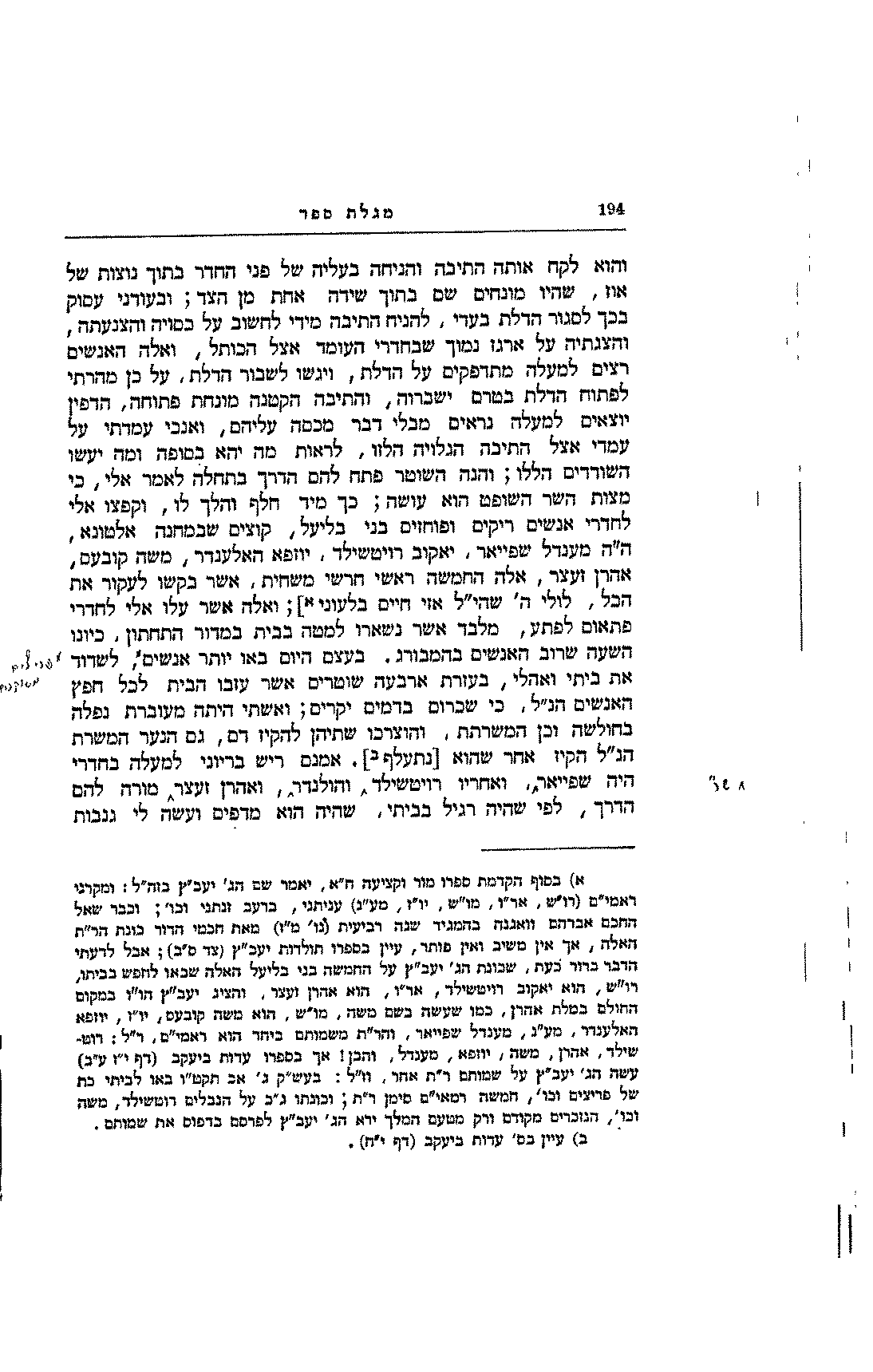
Margin readings in Scholem's copy (2)
| Printed anchor | Type (key sheet) | Mark | Reading | Certainty |
|---|---|---|---|---|
| בעצם היום באו יותר אנשים x, לשדוד את ביתי | X: substitution | x mark after the word; 2-word note in the margin | פריצים / משוקצים (for אנשים) | fairly sure |
| היה שפייאר ^, ואחריו רויטשילד ^ והולנדר ^, ואהרן זעצר ^ מורה להם | V: omission | caret after each of the four names; one abbreviation in the margin, apparently for all of them | שר"י(?) | uncertain |
Page 195 (scan 217)
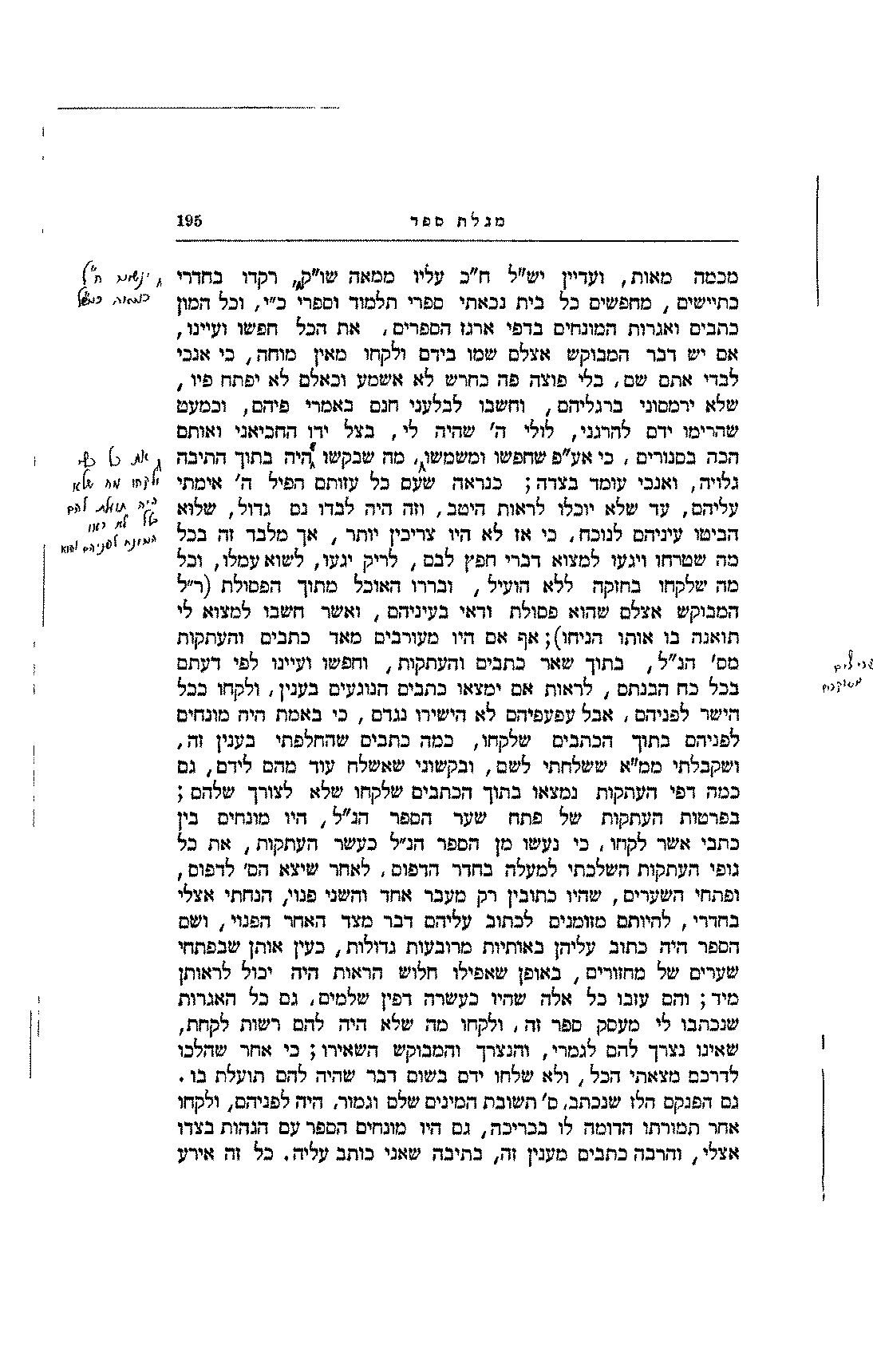
of several hundred, and I still have a debt [owed] by him of more than a hundred Sh.K. ⟨S: a two-line note, partly read: "and they carried(?) … like a parable(?)"⟩. They danced about in my room like he-goats, searching all my treasure-house, the books of Talmud and the manuscripts, and the whole mass of writings and letters lying on the shelves of the bookcase. They searched and examined everything; if there was anything they were after, they put it in their hand and took it, with none to protest; for I was alone with them there, without opening my mouth, "as a deaf man I hear not, and as a dumb man that opens not his mouth" (Ps. 38:14), so that they should not trample me with their feet. They thought to swallow me up without cause with the words of their mouth, and they almost raised their hand to kill me, had it not been for the Lord who was with me: "in the shadow of His hand He hid me" (Isa. 49:2), and smote them with blindness. For although they searched and felt about ⟨S: a five-line note, partly read: "but so much(?) … and they took what was of no use to them, and did not see at all(?) what lay before them, and it …"⟩, what they sought was in the uncovered box, and I standing beside it. It seems that with all their insolence the Lord cast my terror upon them, so that they could not see well; and this alone was a great miracle, for had their eyes looked straight ahead, they would have needed nothing more. But besides this, in all they toiled and laboured to find what their heart desired, "they laboured in vain, for nothing they toiled" (cf. Isa. 49:4), and all that they took by force was of no use. They "picked the food out of the refuse" (cf. b. Shabbat 74a) — that is, what they were after, which was surely refuse in their eyes, and in which they thought to find a pretext against me, that they left. Even though writings and copies from the said book were much mixed up among other writings and copies, and they searched and examined, as they saw fit, with all the power of their understanding, to see whether they would find writings touching the matter, and took all that seemed right to them, yet "their eyelids did not look straight before them" (cf. Prov. 4:25). For in truth there lay before them, among the writings they took, several writings I had exchanged on this matter, and that I had received from M. A. whom I had sent there, and they asked me to send more of them into their hands; also several leaves of copies were found among the writings they took, which were no use to them. In particular, copies of the title page of the said book lay among my writings that they took; for about ten copies had been made of the said book. All the copies themselves I had thrown up into the printing room after the book had gone to press, and the title pages, which were written only on one side, the other being blank, I kept by me in my room, so that they would be ready to write something on the other, blank side; and the name of the book was written on them in large square letters, like those on the title pages of festival prayer books, so that even a weak-sighted man could see them at once. And they left all these, which were about ten whole leaves, and also all the letters written to me about the business of this book, and took what they had no permission to take, which they did not need at all, and what was needed and sought they left. For after they had gone their way I found everything, and they had not laid their hand on anything that would have been of use to them. Also this notebook that was written, the book Teshuvat ha-Minim, whole and complete, was before them, and they took instead of it another that resembled it in binding. The book with glosses at its side also lay by me, and many writings on this matter, in the box on which I write. All this happened
מכמה מאות, ועדיין יש"ל ח"כ עליו ממאה שו"ק, רקדו בחדרי כתיישים, מחפשים כל בית נכאתי ספרי תלמוד וספרי כ"י, וכל המון כתבים ואגרות המונחים בדפי ארגז הספרים, את הכל חפשו ועיינו, אם יש דבר המבוקש אצלם שמו בידם ולקחו מאין מוחה, כי אנכי לבדי אתם שם, בלי פוצה פה כחרש לא אשמע וכאלם לא יפתח פיו, שלא ירמסוני ברגליהם, וחשבו לבלעני חנם באמרי פיהם, וכמעט שהרימו ידם להרגני, לולי ה' שהיה לי, בצל ידו החכיאני ואותם הכה בסנורים, כי אע"פ שחפשו ומשמשו, מה שבקשו היה בתוך התיבה גלויה, ואנכי עומד בצדה; כנראה שעם כל עזותם הפיל ה' אימתי עליהם, עד שלא יכלו לראות היטב, וזה היה לבדו נס גדול, שלוא הביטו עיניהם לנוכח, כי אז לא היו צריכין יותר, אך מלבד זה בכל מה שטרחו ויגעו למצוא דברי חפץ לבם, לריק יגעו, לשוא עמלו, וכל מה שלקחו בחזקה ללא הועיל, ובררו האוכל מתוך הפסולת (ר"ל המבוקש אצלם שהוא פסולת ודאי בעיניהם, ואשר חשבו למצוא לי תואנה בו אותו הניח ו; אף אם היו מעורבים מאד כתבים והעתקות מס' הנ"ל, בתוך שאר כתבים והעתקות, וחפשו ועיינו לפי דעתם בכל כח הבנתם, לראות אם ימצאו כתבים הנוגעים בענין, ולקחו ככל הישר לפניהם, אבל עפעפיהם לא הישירו נגדם, כי באמת היה מונחים לפניהם בתוך הכתבים שלקחו, כמה כתבים שהחלפתי בענין זה, ושקבלתי ממ"א ששלחתי לשם, ובקשוני שאשלח עוד מהם לידם, גם כמה דפי העתקות נמצאו בתוך הכתבים שלקחו שלא לצורך שלהם; בפרטות העתקות של פתח שער הספר הנ"ל, היו מונחים בין כתבי אשר לקחו, כי נעשו מן הספר הנ"ל כעשר העתקות, את כל גופי העתקות השלכתי למעלה בחדר הדפוס, לאחר שיצא הס' לדפוס, ופתחי השערים, שהיו כתובין רק מעבר אחד והשני פנוי, הנחתי אצלי בחדרי, להיותם מזומנים לכתוב עליהם דבר מצד האחר הפנוי, ושם הספר היה כתוב עליהן באותיות מרובעות גדולות, כעין אותן שבפתחי שערים של מחזורים, באופן שאפילו חלוש הראות היה יכול לראותן מיד; והם עזבו כל אלה שהיו כעשרה דפין שלמים, גם כל האגרות שנכתבו לי מעסק ספר זה, ולקחו מה שלא היה להם רשות לקחת, שאינו נצרך להם לגמרי, והנצרך והמבוקש השאירו; כי אחר שהלכו לדרכם מצאתי הכל, ולא שלחו ידם בשום דבר שהיה להם תועלת בו. גם הפנקס הלז שנכתב, ס' תשובת המינים שלם וגמור, היה לפניהם, ולקחו אחר תמורתו הדומה לו בכריכה, גם היו מונחים הספר עם הגהות בצדו אצלי, והרבה כתבים מענין זה, בתיבה שאני כותב עליה. כל זה אירע
Margin readings in Scholem's copy (3)
| Printed anchor | Type (key sheet) | Mark | Reading | Certainty |
|---|---|---|---|---|
| ועדיין יש"ל ח"כ עליו ממאה שו"ק ^, רקדו בחדרי | V: omission | caret; 2-line note in the margin | ונשאו(?) ח"ל(?) / כמוה(?) כמשל(?) | partial |
| כי אע"פ שחפשו ומשמשו ^, מה שבקשו היה בתוך התיבה | V: omission | caret; 5-line note in the margin | אלא כל כך(?) / ולקחו מה שלא / היה תועלת להם / [ו]כל[ל](?) לא ראו / המונח לפניהם והוא | partial |
| מה שבקשו ^ היה בתוך התיבה גלויה | V: omission | caret; no separate note seen (perhaps the end point of the note above) | - | - |
Page 196 (scan 218)
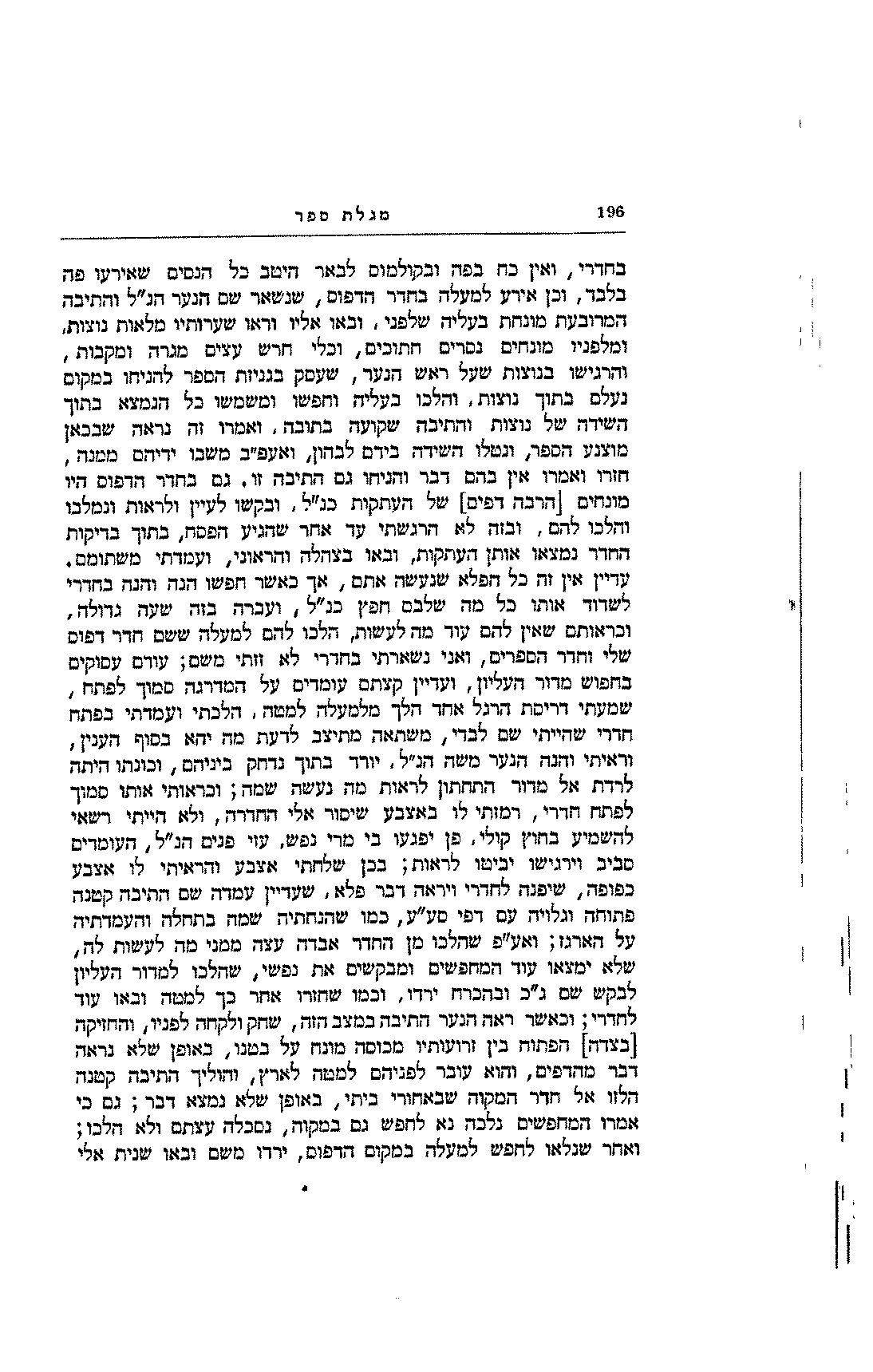
in my room; and there is no strength in mouth or pen to explain well all the miracles that happened here alone. So too it happened upstairs in the printing room, where the said lad had stayed, with the square box lying in the front loft. They came to him and saw his hair full of feathers, and before him lay sawn boards and carpenter's tools, a saw and hammers; and they noticed the feathers on the lad's head, [and thought] that he had been busy hiding the book, to put it in a hidden place among feathers. They went into the loft and searched and felt all that was in the chest of feathers, with the box sunk in it, and said: it looks as if the book is hidden here. They took the chest in their hands to examine it, and although they drew their hands back from it, they came back and said there was nothing in them, and left this box too. Also in the printing room there lay [many leaves] of copies, as said, and they wanted to examine and look, but they took counsel and went away. I did not notice this until after Passover, when in the cleaning of the room those copies were found; they made me glad and joyful, and I stood astonished.
Yet this is not all the wonder done with them. But when they had searched here and there in my room, to plunder all their heart desired, as said, and a long hour passed in this, and they saw that there was nothing more for them to do, they went up to where my printing room and the book room are; and I stayed in my room, I did not move from there. While they were still busy searching the upper storey, and some of them still standing on the stairs near the door, I heard the tread of someone's foot going down from above. I went and stood in the doorway of my room, where I had been alone, waiting to know what the end of the matter would be; and I saw the said lad Moses coming down, pushing his way among them; his intention was to go down to the lower storey to see what was happening there. When I saw him near the door of my room, I beckoned to him with a finger to turn aside to me into the room; I did not dare to make my voice heard outside, lest bitter-souled men, the said insolent ones standing round about, should fall upon me and notice and look. So I stretched out a finger and showed him a bent finger, that he should turn into my room and see a wonder: the small box was still standing there open and uncovered with the leaves of the A. A., as I had set it at first on the chest. And although they had gone from the room, I was at a loss what to do with it, so that the searchers and seekers of my soul should not find it again; for they had gone to the upper storey to search there too, and they were bound to come down, as indeed they came back and came down and came again to my room. When the lad saw the box in this state, he laughed and took it in front of him, and held it [at its side], open, between his arms, resting covered on his belly, so that nothing of the leaves was visible; and he passed before them down to the ground floor, and carried this small box to the room of the ritual bath behind my house, so that nothing was found. Even when the searchers said, "Let us go and search in the ritual bath too", their counsel was foiled and they did not go. And after they had wearied themselves searching upstairs in the printing place, they came down from there and came to me a second time
בחדרי, ואין כח בפה ובקולמוס לבאר היטב כל הנסים שאירעו פה בלבד, וכן אירע למעלה בחדר הדפוס, שנשאר שם הנער הנ"ל והתיבה המרובעת מונחת בעליה שלפני, ובאו אליו וראו שערותיו מלאות נוצות, ומלפניו מונחים נסרים חתוכים, וכלי חרש עצים מגרה ומקבות, והרגישו בנוצות שעל ראש הנער, שעסק בגניזת הספר להניחו במקום נעלם בתוך נוצות, והלכו בעליה וחפשו ומשמשו כל הנמצא בתוך השידה של נוצות והתיבה שקועה בתוכה, ואמרו זה נראה שבכאן מוצנע הספר, ונטלו השידה בידם לבחון, ואעפ"כ משבו ידיהם ממנה, חזרו ואמרו אין בהם דבר והניחו גם התיבה זו. גם בחדר הדפוס היו מונחים [הרבה דפים] של העתקות כנ"ל, ובקשו לעיין ולראות ונמלכו והלכו להם, ובזה לא הרגשתי עד אחר שהגיע הפסח, בתוך בדיקות החדר נמצאו אותן העתקות, ובאו בצהלה והראוני, ועמדתי משתומם. עדיין אין זה כל הפלא שנעשה אתם, אך כאשר חפשו הנה והנה בחדרי לשדוד אותו כל מה שלבם חפץ כנ"ל, ועברה בזה שעה גדולה, וכראותם שאין להם עוד מה לעשות, הלכו להם למעלה ששם חדר דפוס שלי וחדר הספרים, ואני נשארתי בחדרי לא זזתי משם; עודם עסוקים בחפוש מדור העליון, ועדיין קצתם עומדים על המדרגה סמוך לפתח, שמעתי דריסת הרגל אחד הלך מלמעלה למטה, הלכתי ועמדתי בפתח חדרי שהייתי שם לבדי, משתאה מתיצב לדעת מה יהא בסוף הענין, וראיתי והנה הנער משה הנ"ל, יורד בתוך נדחק ביניהם, וכונתו היתה לרדת אל מדור התחתון לראות מה נעשה שמה; וכראותי אותו סמוך לפתח חדרי, רמזתי לו באצבע שיסור אלי החדרה, ולא הייתי רשאי להשמיע בחוץ קולי, פן יפגעו בי מרי נפש, עזי פנים הנ"ל, העומדים סביב וירגישו יביטו לראות; בכן שלחתי אצבע והראיתי לו אצבע כפופה, שיפנה לחדרי ויראה דבר פלא, שעדיין עמדה שם התיבה קטנה פתוחה וגלויה עם דפי סע"ע, כמו שהנחתיה שמה בתחלה והעמדתיה על הארגז; ואע"פ שהלכו מן החדר אבדה עצה ממני מה לעשות לה, שלא ימצאו עוד המחפשים ומבקשים את נפשי, שהלכו למדור העליון לבקש שם ג"כ ובהכרח ירדו, וכמו שחזרו אחר כך למטה ובאו עוד לחדרי; וכאשר ראה הנער התיבה במצב הזה, שחק ולקחה לפניו, והחזיקה [בצדה] הפתוח בין זרועותיו מכוסה מונח על בטנו, באופן שלא נראה דבר מהדפים, והוא עובר לפניהם למטה לארץ, והוליך התיבה קטנה הלזו אל חדר המקוה שבאחורי ביתי, באופן שלא נמצא דבר; גם כי אמרו המחפשים נלכה נא לחפש גם במקוה, נסכלה עצתם ולא הלכו; ואחר שנלאו לחפש למעלה במקום הדפוס, ירדו משם ובאו שנית אלי
Page 197 (scan 219)
to the large room; they searched and felt about again, and forced me to open for them the chest on which the said small box had lain at first, when they did not see it, as said. Now they compelled me to take a key and open this nearby chest, and again they took writings they did not need, and what they were after they left, and their hand did not get hold of it. After two or three hours had passed in this, they went their way ⟨S: a note, partly read: "and in their opinion(?) …"⟩; they thought they had found much, and not even one driven leaf came into their hands ⟨S: "including this"(?)⟩. After they had gone, the said square box was also found lying in the loft in its place; their hand had not touched it, and it became a miracle.
On the night of the holy Sabbath the lad took the quires out of these boxes and hid them in my neighbour's house. But he feared that perhaps they would search the neighbours' houses too, as they had let it be heard; so he took them under the skirts of his clothes and carried them and brought them to the house of A. G., and he sent them to Hamburg, to the house of the parnas and leader R. M. G. Sh. Some of them also remained in A. G.'s house, and he burnt them; some were burnt also in the house of Mendel Bonn; and likewise those brought to the house of the said leader became fuel for the fire, out of their great fear that the search would come upon them too, and "the sound of a driven leaf" (Lev. 26:36) pursued them even in Hamburg. So after all the miracles and wonders that the Blessed Name showed us in His kindness with these quires, which escaped from their hands and became a sign and a wonder, they were burnt and lost through our friends; over this "let all the sick be sick at heart". Nothing remained of them except those few that I had sent abroad, and some of them that escaped the fire through R. A. Schiser(?), who gathered about four or five out of the flame of the fire, for his eye pitied it and could not bear to see the destruction of so precious a thing; so he snatched and took by force what he could, to save a little, and it was "as a brand plucked out of the fire" (Zech. 3:2). Apart from this nothing was harmed, thank God — in particular my pregnant wife and the other souls of my household, whose breath had almost flown away; she had to be bled after her spirit returned. I too, with all the weakness of my strength, stood in my place and bowed my shoulder to bear so hard an event, the like of which I had not experienced before, nor did I know its fellow among happenings. Blessed be He who gives strength to the weary, to stand through all these: "is my strength the strength of stones?" (Job 6:12). "Sing unto the Lord, praise ye the Lord, for He has delivered the soul of the needy from the hand of evil-doers" (Jer. 20:13)!
Yet over this my heart is faint: that they took from my house my writings, more precious to me than fine gold, especially what belongs to my collection Beit Middot, on which I toiled for several years. They put them in their hands and carried them off in barrels that they took from the lofts of my house, in which lay quires of the book T[orat] ha-K[ena'ot], which they had no permission from the gentile courts to take ⟨S: a five- line note, partly read: "and since they gave … for he does not distinguish(?) … and in robbery how much money … that they received … lost"⟩ — they who "rejoice at calamity" (Prov. 17:5). And the matter still hangs and stands on the mercy of Heaven. May He, blessed be He, who "cut asunder the cords of the wicked" (Ps. 129:4), who conspire against me "when they strove against the Lord" (Num. 26:9), in whom my soul takes refuge, let me see His vengeance on them, and return to me my loss and the plunder they robbed and spoiled from me!
But before I continue the story of what befell the large barrel [that they took] from my house, I will tell what Mendel Speyer ⟨S: "m[ay the name of the wicked] r[ot]"(?)⟩ did. When he came into my room suddenly with the said fellow-thieves — I had not seen him or known him before — the enemy opened his mouth
לחדר הגדול, וחפשו ומשמשו עוד והכריחוני לפתוח להם הארגז, שהיתה תיבה קטנה הנ"ל מונחת עליה בתחלה ולא ראוה כנ"ל, עתה כפו אותי לקחת מפתח, ולפתוח ארגז זה הסמוך, וחזרו לקחת כתבים שאינם צריכים להם, ואת המבוקש אצלם הניחו ולא שלטה ידם בו, ואחר שעברו בזה שתים שלש שעות, הלכו לדרכם; חשבו שמצאו הרבה ולא עלתה בידם אפילו עלה נדף אחד. אחר שהלכו נמצאה גם התיבה המרובעת הנ"ל, מונחת בעליה במקומה לא נגעה ידם בה ותהי לנס. ובליל ש"ק לקח הנער הקונטרסים מתוך התיבות הללו והצניעם בבית שכני, אך הוא ירא פן ואולי יחפשו גם בבתי שכנים, כאשר השמיעו, לכן לקחם תחת כנפי מלבושיו והוליכם והביאם לבית א"ג, והוא שלחם להמבורג לבית פו"מ רמג"ש, גם קצתם נשארו בבית א"ג ושרפם, גם בבית מענדל בון נשרפו קצתן, וכן אשר הובאו לבית הק' הנ"ל היו למאכולת אש, מיראתם הגדולה שגם עליהם יבוא החיפוש, ורדף אותם קול עלה נדף אפילו בהמבורג; על כן אחר כל הנסים והנפלאות שהראנו הי"ת בחסדו, בקונטרסים הללו אשר נמלטו מידם ויהי לאות ולמופת, נשרפו ונאבדו ע"י אוהבינו, ע"ז ידוו כל הדווים; לא נשארו מהם רק אותן מעטים ששלחתי למ"א, ואיזה מהם נמלטו מן האש ע"י ר"א שיסר שלקטו כארבעה וחמשה מתוך להב האש, כי חסה עינם עליו ולא יכלה לראות בהשחתת כלי נחמד כזה, על כן שמטו ולקחו בחזקה מה שיכלו להציל דבר מועט, ויהי כאוד מוצל מאש. זולת זה לא נזוק דבר ת"ל; בפרטות אשתי המעוברת ושאר נפשות ביתי, אשר כמעט פרחה נשמתם, והוצרכה להקזה אחר שוב רוחה; גם אנכי עם בל תשות כחי עמדתי על עמדי, והטיתי שכמי לסבול מאורע קשה כזה, אשר לא נסיתי מקודם ולא ידעתי לו חבר במקרה. ב"ה הנותן ליעף כח לעמוד בכל אלה, הכח אבנים כחי, שירו לה' הללו את ה', כי הציל נפש אביון מיד מרעים! אכן על זה דוה לבי על שלקחו מביתי כתבי היקרים מפז אצלי, ביחוד מה ששייך לילקוט "בית מדות" שלי, שיגעתי בו כמה שנים, שמו בידיהם והוליכו בחביות שלקחו מעליות ביתי, שבתוכה מונחים קונטרסי הספר תה"ק, אשר לא היתה להם רשות ללקחו בעש"ג השמחים לאד, ועדיין הדבר תלוי ועומד ברחמי שמים. הוא י"ת אשר קצץ עבות רשעים הקושרים עלי בהצותם על ה', בו חסיה נפשי יראני נקמתו מהם, ויחזיר לי אבדתי והגזלה שגזלוני ושללוני! אך טרם שאמשיך הספור מה שקרה בחבית הגדולה [שלקחו] מביתי, אספר את אשר עשה מענדל שפייאר; בבואו אלי החדרה פתאום עם חברי גנבים הנ"ל, אשר לא ראיתיו ולא ידעתיו מלפנים, פתח פיו אויב
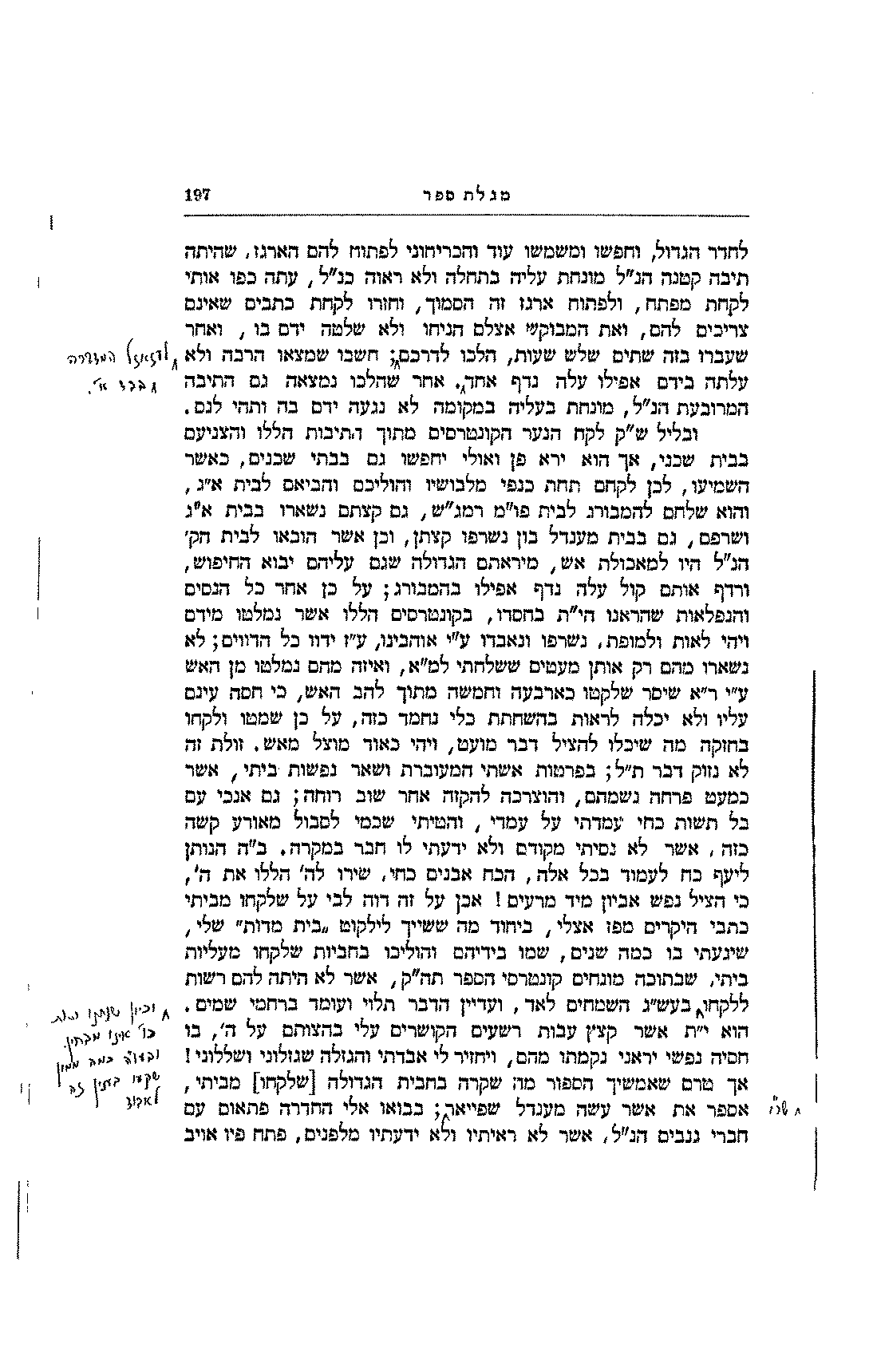
Margin readings in Scholem's copy (4)
| Printed anchor | Type (key sheet) | Mark | Reading | Certainty |
|---|---|---|---|---|
| ואחר שעברו בזה שתים שלש שעות, הלכו לדרכם ^; חשבו שמצאו | V: omission | caret; 2-word note in the margin | ולדעתם(?) המ... | partial |
| ולא עלתה בידם אפילו עלה נדף אחד ^, אחר שהלכו | V: omission | caret; 2-word note in the margin | בכלל זה(?) | uncertain |
| אשר לא היתה להם רשות ללקחו, בעש"ג ^ השמחים לאד | V: omission | caret; 5-line note in the margin | וכיון שנתנו ... / כי אינו מבחין(?) / ובגזלה כמה ממון / שקבלו ... זה(?) / לאיבוד | partial |
| אספר את אשר עשה מענדל שפייאר ^; בבואו אלי | V: omission | caret; one abbreviation in the margin | שר"י(?) | uncertain |
Page 198 (scan 220)
the scoundrel, and cursed. Thus were his words to me: "You are in our hands, to do with you as we please; and if we tore your flesh off you it would still not be enough at all. Who are you and what are you? Do you think to compare yourself to our Rabbi (Eybeschütz) ⟨S: "m[ay the name of the wicked] r[ot]"⟩? Why, you are not worth his dung, and it is better than you!" Thus and thus "he opened his mouth without measure" (Isa. 5:14) ⟨S: "this scoundrel"(?)⟩; I have set down here only the gist of his speech and his language as it was. And I, "as a ewe before her shearers is dumb" (Isa. 53:7), heard my reproach and answered nothing, only stood listening and attending to his words with a pleasant countenance, wondering at the great impudence and the excessive insolence of this man, who looked young in years and "would not show favour to the old" (Deut. 28:50). So I could not restrain myself from asking him at least his name, for I had never known him, and I wished to know who was the master of these bitter words, so that I might know who it was that strove with me, who poured out "the words of a whisperer, as wounds" (Prov. 18:8), [and laid] my honour in the dust (cf. Ps. 7:6). I asked him: "Who are you, and what is your name?" And he answered me: "I am called Mendel Speyer, that is my name." Then I said: "Speak your words"; and "I laid my hand upon my mouth" (Job 40:4), I kept silent and did not answer him until he went from before me. These are the "words of peace" of this man when he drew near to make war with me, "when evil-doers came upon me to eat up my flesh" (Ps. 27:2) — besides those with which Yozpa Hollander and Jacob R. Sh. ⟨S: "m[ay the name of the wicked] r[ot]"⟩ "filled me with bitterness" (Job 9:18). The best of the words of the second to me was: "Now I advise you, flee from the place, for evil is determined against you" (cf. 1 Sam. 20:7). May evil destroy him and his companions who help to evil, "for evil shall come upon them, they shall not know its dawning, and calamity, they shall not be able to put it away" (Isa. 47:11). Blessed be the Lord, who was with me and delivered me from trouble!
Near to this, after some weeks, the said Speyer did several villainies for which he deserved hanging; especially, he oppressed his brother-in-law, a simple and learned man, who came out [clean] of his property through him; besides several wrongs and acts of violence to others, Jews and gentiles ⟨S: "and to the uncircumcised(?) …"⟩. Also some years before he robbed a gentile on the road: he bound him and took all he had, and was sued in the gentile court; in the end he came to terms with the robbed man, and so the matter was hushed up; yet it remained written in the record book of the town judges. This is the chief of the ruffians of Eybeschütz ⟨S: "m[ay the name of the wicked] r[ot]"⟩ — a robber and a man of violence, like him and worse than him, as the people of Prague know of him such things and more: that he ate up the spoil of the poor and needy, orphans and widows; especially known is the evil he did [a] to David Benjamin, who had done him every good. To gentiles too he did violence and oppression, and he prospered in all his violence until his measure is filled. "When you have ceased to spoil… when you have made an end to deal treacherously" (Isa. 33:1), suddenly "they shall rise up that shall shake you, and you shall be for booty unto them" (Hab. 2:7), and "under his glory there shall be kindled a burning like the burning of fire" (Isa. 10:16), "as when the melting fire burns" (Isa. 64:1), to make known His name, blessed be He, to His provoking adversaries!
Kahana's notes
- [a] The abbreviation [stands for]: מה שעשה, "what he did".
הנבל ויקלל כה היה דברו אלי: הנך בידינו לעשות בך כרצוננו, ואם אנו קורעים בשרך מעליך עדיין אינו מספיק כלל וכלל, מי אתה ומה אתה, התחשוב לדמות עצמך לרבינו (אייבשיצר), הלא הזבל שלו אינך שוה וטוב ממך; כזאת וכזאת פער פיו לבלי חוק, רק תמצית דבורו ולשונו הצגתי כאן כהוייתן; ואני כרחל לפני גוזזיה נאלמה, ושומע חרפתי ולא אשיב מאומה, רק עומד מאזין ומקשיב לדבריו בסבר פנים יפות, מתפלא על החוצפה הגדולה והעזה יתירה מאיש הזה, אשר נראה בחור בשנים ולא ישא פנים לזקן, לכן לא יכולתי להתאפק לשאול לו על שמו לפחות, כי לא הכרתיו מעולם, והייתי חפץ לידע מי הוא בעל דברים מרים הללו, למען אדע מי הוא אשר יריב עמדי, דברי נרגן כמתלהמים שפך לאר"ש כבודי, ואשאל אותו מי אתה ומה שמך, והשיבני: אני נקרא מענדל שפייאר הוא שמי, אז אמרתי דבר דבריך, וידי שמתי למו פי, שתקתי לא עניתיו עד שהלך מלפני. אלה הם דברי שלום של האיש הזה בקרבו אלי להלחם אתי, בקרוב עלי מרעים לאכול את בשרי, מלבד אשר השביעוני ממרורים יוזפא האלענדר ויאקוב ר"ש; הטוב שבדברי השני אלי היה: עתה איעצך לך ברח לך מן המקום, כי כלתה אליך הרעה. הרע יכלה אותו ואת חבריו העוזרים לרעה, כי תבוא אליהם רעה לא ידעו שחרה, והוה לא יוכלו כפרה, ברוך ה' אשר היה עמדי ויצילני מצרה! סמוך לזה אחר איזה שבועות, עשה שפייאר הנ"ל כמה נבלות, שהיה חייב תלייה עליהם, ביחוד שעשק את גיסו איש תם ובעל תורה, ויצא [נקי] מנכסיו על ידו, מלבד כמה עול וחמס לאחרים ליהודים ונכרים, גם לפני איזה שנים גזל מנכרי אחד על הדרך כפתו ולקח כל אשר לו ונתבע בדין הערכאות, לסוף התפשר עם הנגזל, לכן נשתקע הדבר, מ"מ נשאר כתוב בפנקס שופטי העיר. זהו ריש בריוני של אייבשיצער, גזלן וחמסן וכיוצא בו וגרוע ממנו, כאשר ידוע לאנשי פראג ממנו כהנה וכהנה, שאכל שוד עניים ואביונים יתומים ואלמנות; ביחוד נודע מ"ש רעה א לדוד בנימין אשר גמלו כל טוב; גם לנכרים עשה חמס ועושק, והצליח בכל החמסים עד שתתמלא סאתו. כהתמו שודד כנלותו לבגוד, פתאום יקומו מזעזעיו ויהיה למשסה למו, ותחת כבודו יקד יקוד כקדוח אש המסים, להודיע שמו י"ת לצריו המכעיסים!
- [א] ר״ת: מה שעשה.
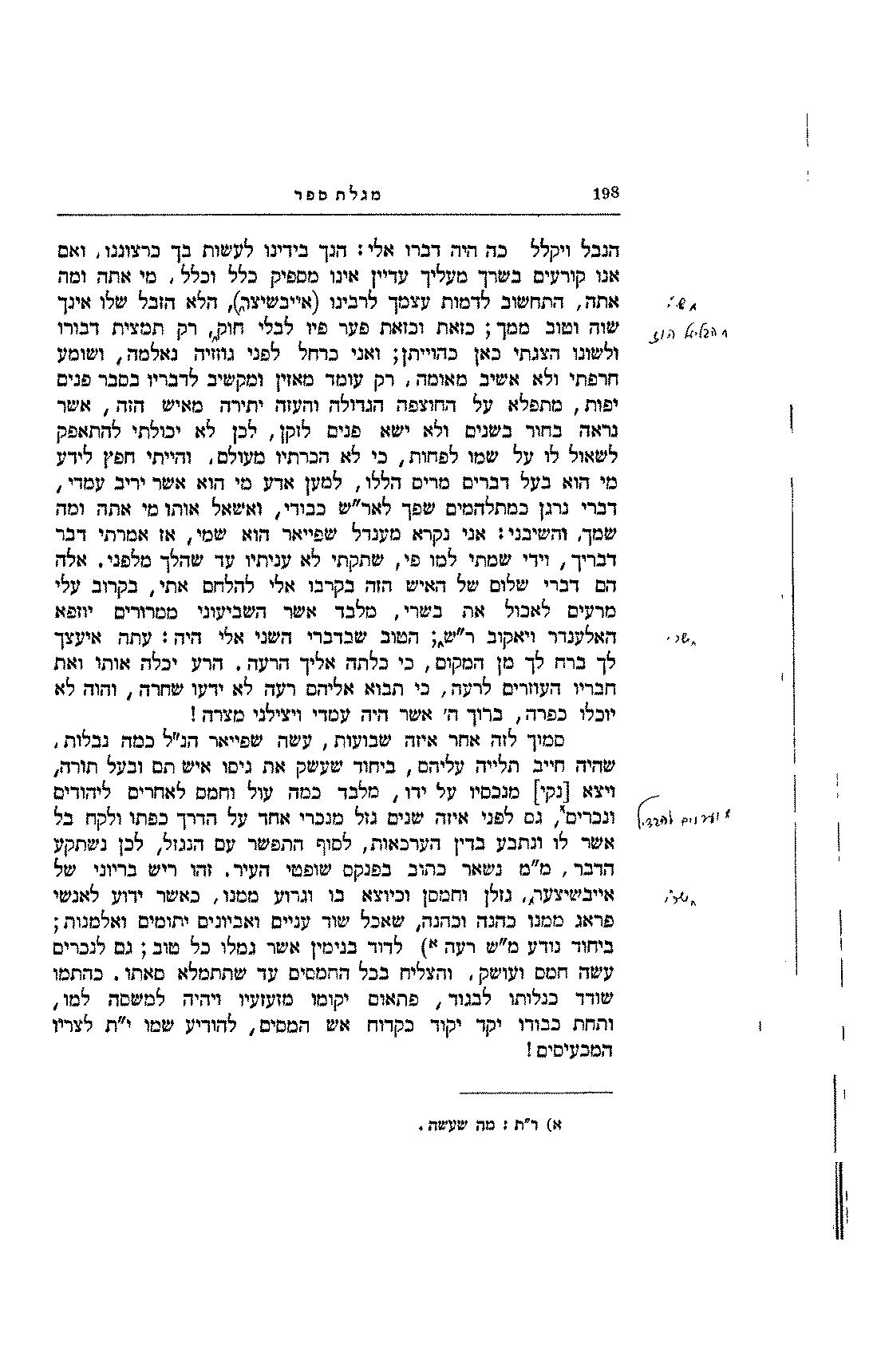
Margin readings in Scholem's copy (5)
| Printed anchor | Type (key sheet) | Mark | Reading | Certainty |
|---|---|---|---|---|
| התחשוב לדמות עצמך לרבינו (אייבשיצר ^), הלא הזבל שלו | V: omission | caret; one abbreviation in right margin | שר"י | fairly sure |
| כזאת וכזאת פער פיו ^ לבלי חוק | V: omission | caret; 2-word note in right margin | הנבל(?) הזה(?) | uncertain |
| השביעוני ממרורים יוזפא האלענדר ויאקוב ר"ש ^; | V: omission | caret; one abbreviation in right margin | שר"י | fairly sure |
| מלבד כמה עול וחמס לאחרים ליהודים ונכרים x, גם לפני | X: substitution | x mark over the word; 2-word note in right margin | ולערלים(?) ו...(?) | uncertain |
| זהו ריש בריוני של אייבשיצער ^, גזלן וחמסן | V: omission | caret; one abbreviation in right margin | שר"י | fairly sure |
Page 199 (scan 221)
Now with all the miracles done in the said event, it caused much loss of money in the gentile courts, until a judgment came out to open the barrel carried off from my house with quires, writings and letters, and to examine it before a commission, through Professor Sticht, in the presence of my opponents. And so it was done in the month of Kislev after the event: the barrel that had been taken was opened and examined before the said [men], and it was found entirely empty of the A. A.; nothing written of it was found in it. Then "the faces of my enemies gathered blackness" (Joel 2:6), for the inquiry and search had been made before them, and they saw a clear thing. They went and cried bitterly before their master Eybeschütz, and their cry was heard as they said to him: Save us, "for the waters are come in unto the soul" (Ps. 69:2), for evil was determined against them, to return their recompense on their own head, since they had bound themselves to pay five things if they did not find their "iniquity bound up" (Hos. 13:12). Then he ⟨S: "the scoundrel"(?)⟩ schemed to put out a slander, a pasquil, also about the book T[orat] ha-K[ena'ot], which bears my name; and I brought it out to light in public — "I have not spoken in secret" (Isa. 45:19) — I gave it out openly and sold it to anyone who wished; I even handed it to the O. P. as a gift [a]. Even so he [dared] ⟨S: "this pig"(?)⟩ to come with such a claim against me before the authorities. "His own blemish" — "whoever disqualifies, disqualifies by his own blemish" (b. Kiddushin 70a); as is said, evident to the eye from the writing, "whose breaking is his calamity", his book Luḥot (Odot) [Edut]: it [testifies] to his bitter lies and falsehoods, denying what is known, both in the story of the event and the incidents accompanying it and the writings he presented, and in the words of Torah he innovated, both in the revealed [law] and in the interpretation of an amulet [by the hidden lore] ⟨S: "which is not a sign of Judaism"(?)⟩.
But the authorities did not turn to this claim, which refuted itself, since he had seen that book a long time and kept silent and said nothing against it; and after he saw his calamity near, he also wanted to make the book T. ha-K. a second part of the A. A. — something no fool could say, and it is contradicted from several sides, [and there is no need to dwell] on them here [b]. But what can be done with a man who has no shame, who has made his face "as an adamant stone" (cf. Zech. 7:12), and exchanges truth for falsehood and "good for bad" (Lev. 27:10)? Yet in this the authorities consented to him: to open the barrel anew and search and investigate a second time, in case they might find in me some iniquity that I had sinned in the matter of composing the A. A. — although this was a great wrong and violence from the very root of the law, to search after me at all; all the more after it had already been done once with full force in the presence of my enemies, and the said professor had given [a statement] written and signed by his hand under oath that he had found nothing concerning the said book. There too they followed the judgment of the judges of Altona, who "turned aside after gain" (1 Sam. 8:3) ⟨S: "as is written …", cut off⟩, and he paid him a lavish fee to stand at his right hand; and that same b. '. [c] demanded his share from our side by word of mouth, and they would not give him anything. Therefore a crooked judgment came out, and they wrote to
Kahana's notes
- [a] The abbreviation [stands for] Ober-Präsident.
- [b] See the book Edut be-Ya'akov (fol. 18b), where he counts all the sides from which this is contradicted; see there.
- [c] The abbreviation [stands for] ba'al etzah (counsellor); and so Ya'avetz said before (p. 183), "counsellor of Altona".
והנה עם כל הנסים שנעשו במאורע הנ"ל, גרם היזק ממון הרבה בעש"ג, עד שיצא פס"ד לפתוח החבית השלולה מביתי עם קונטרסים וכתבים ואגרות, ולבדקה בפני קומיסיאן ע"י פרופעסר שטיכט ובמעמד מתנגדי; וכן נעשה בחודש כסלו שאחר המאורע, נפתחה החבית הלקוחה ונבדקה בפני הנ"ל, ונמצאת ריקנית מסע"ע לגמרי, לא נמצא בה שום דבר רשום ממנו; אז פני שונאי קבצו פארור, כי בפניהם נעשית החקירה והחפוש, וראו דבר ברור, הלכו וצעקו מר לפני רבם אייבשיצר, ונשמע צעקתם באמרם אליו: הושיעה כי באו מים עד נפש, כי כלתה אליהם הרעה להשיב גמולם בראשם, כאשר התחייבו נפשם לשלם חמשה דברים אם לא ימצאו דבר עונם צרור; אז התחבל להוציא לעז פאסקוויל, גם על הספר תה"ק אשר שמי עליו, והוצאתיו לאור בפומבי, לא בסתר דברתי ובפהרסיא נתתיו ומכרתיו לכל החפץ, גם מסרתיו לא"פ במתנה א, אעפ"כ [העיז] הוא לבוא בטענה כזו עלי לפני השררה, מום שבו וכל הפוסל במומו פוסל, כמש"נ לעין בכתב שברו איד ספרו לחות (אודות) ]עדות[ הוא על שקריו וכזביו המרים, להכחיש הידוע, הן בספור המעשה והמקרה המתלוים והכתבים שהציג, והן בד"ת שחדש בנגלה והן בפתרון קמיע [ע"פ הנסתר]; והנה גם השררה לא פנו אל טענה זו המוכחשת מעצמה, לפי שזמן רב ראה אותו ספר ושתק ולא אמר דבר כנגדו; ואחר שראה קרוב אידו, גם רצה לעשות הס' תה"ק חלק שני מסע"ע, מה שלא יוכל לומר שום כסיל, והוא סתור מכמה צדדים, [ואין להאריך] בהם כאן ב; רק מה לעשות באיש שאין לו בושה, שם פניו שמיר, האמת בשקר וטוב ברע ימיר; אך בזאת נאותה לו השררה, לפתוח החבית מחדש ולחפש ולחקור שנית, אולי ימצאו לי עון אשר חטאתי בענין חבור סע"ע; אף על פי שזה היה עול וחמס גדול מעיקרא דדינא לחפש אחרי כלל, כל שכן אחר שכבר נעשה פ"א בכל תוקף במעמד שונאי, ופרופעסר הנ"ל נתן כתוב וחתום מידו בשבועה, שלא מצא כלום מענין ס' הנ"ל; גם שם נטו אחר פסק דין של שופטי אלטונא שנטו אחר הבצע והפריז לו שכר שיעמוד לימינו, ואותו ב"ע ג תבע חלקו בפיו מצד שלנו, ולא רצו לתת לו מאומה, על כן יצא משפט מעוקל וכתבו אל
- [א] ר"ת: אובער פריזידענט.
- [ב] עיין בס' עדות ביעקב (דף י"ח ע"ב) שם חשב כל הצדדים שיש סתורה בזה ע"ש.
- [ג] ר"ת: בעל עצה וכן אמר יעב"ץ מקודם (צד 183) מעצה דאלטונא.
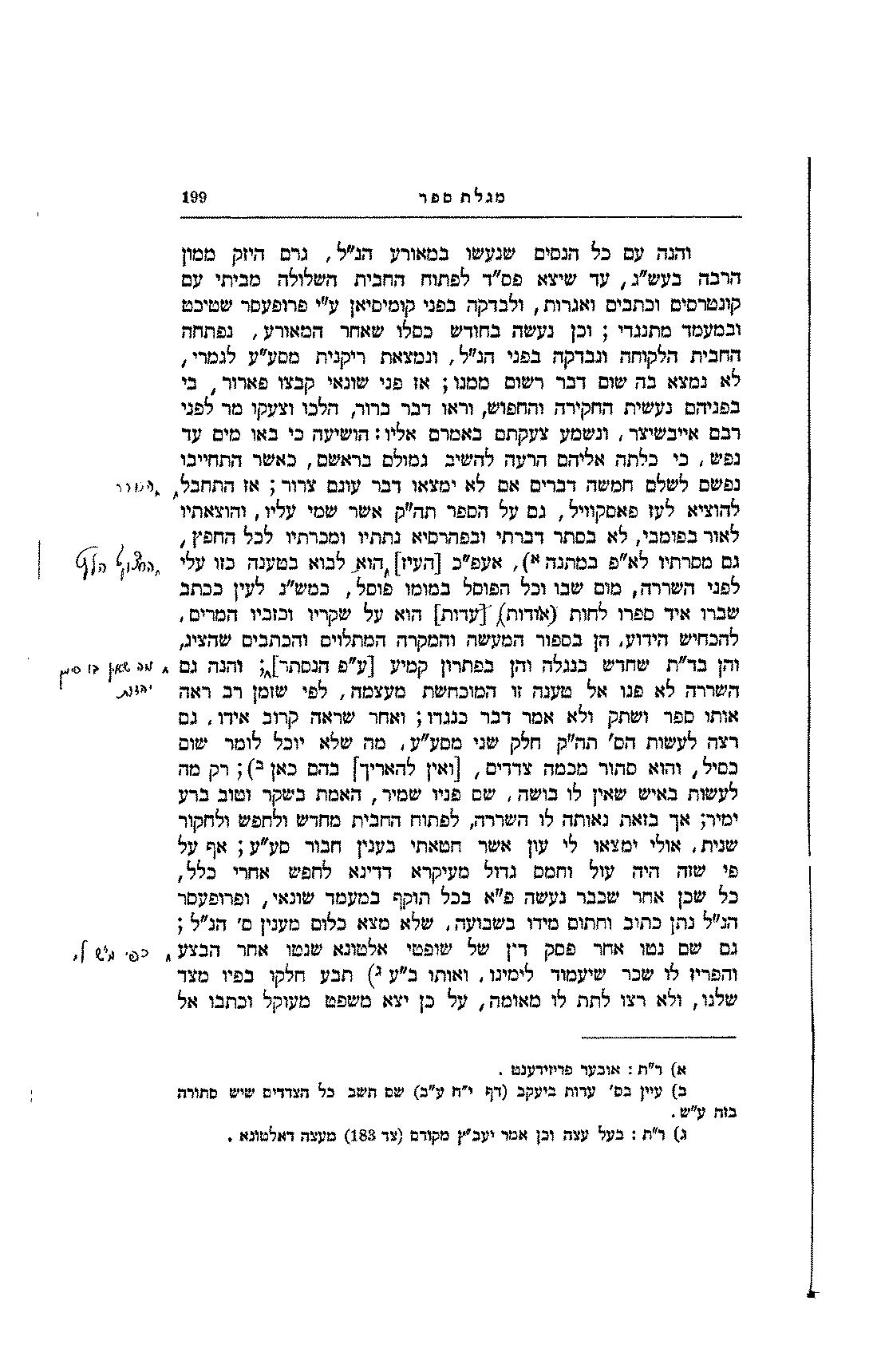
Margin readings in Scholem's copy (4)
| Printed anchor | Type (key sheet) | Mark | Reading | Certainty |
|---|---|---|---|---|
| אז התחבל ^ להוציא לעז פאסקוויל | V: omission | caret; one word in left margin | הנבל(?) | uncertain |
| אעפ"כ [העיז] ^ הוא לבוא בטענה כזו עלי | V: omission | caret; 2-word note in left margin | החזיר(?) הלזה | uncertain |
| והן בפתרון קמיע [ע"פ הנסתר] ^; והנה גם | V: omission | caret; 2-line note in left margin | מה שאין זו סימן / יהדות(?) | fairly sure |
| שופטי אלטונא שנטו אחר הבצע ^ והפריז לו שכר | V: omission | caret; short note in left margin, cut off | כפי מ"ש ל... (cut off) | partial |
Page 200 (scan 222)
the court of G. Sh. [a]. [This was] also to his advantage ⟨S: a one-word note, "with help"(?)⟩; M. K. H. also obtained letters of recommendation and intercession from the counsellors of His Majesty, may his glory be exalted, to the judges in G. Sh., that they should stand at the right hand of his righteousness ⟨S: a four-line note, partly read: "thousands(?) that were … and friends(?) … as is the way(?) of these(?) … of the said men"⟩; and as he made a name for himself, by this his wish came out and his desire was fulfilled in this business in G. Sh. too, as I wrote above concerning the rabbinate of Hamburg. The gentile court of G. Sh. upheld the judgment decreed here, that it could not be otherwise than to go back and search the writings in the barrel. When we saw that so much money had gone to waste — for in the costs of this appeal too they squandered about five hundred Sh.K. for nothing, and about four hundred Reichstaler were lost, and still there was no end to the matter, and who knows how much more expense it would cause before it came to a final judgment; and even so it was still doubtful whether they would do right and just judgment, for it seemed they wanted to acquit him at all events, in any way they could — therefore the men who bore the burden and the expense wearied of bearing it any longer. They no longer sued for my insult, the violence and the oppression done to me, and left the matter in silence. The other side too was content that the matter should remain so, for it surely cost them twice as dear, and they also knew they would not win by straight judgment, only through bribes, as is their custom, and it was still doubtful whether they could hold out in the end; so it seemed good to them to leave it so, and they did not pursue the matter further. Therefore what was robbed from me lies in its place, until the Lord "look down and see from heaven" (Lam. 3:50), to return to me the plunder they robbed and spoiled from me, and to do me good in return for my insult.
In the winter of 5519 [1758/59] I sold, thank God without loss, five houses that I had bought four years before beside my house, after four years had passed from the day the said robbery and violence was done in my house. At that time Mazu'a Julius(?) went into a great bankruptcy (after he had already been ill for a whole year with q"a, God save us — "the fatness of his flesh waxed lean", Isa. 17:4); he went off "to abhorrence" (Isa. 66:24) from Altona to Fredericia, a place of refuge for those fleeing from creditors. Before the Ninth of Av 5519 [1759] the scoundrel fled from here with a great and enormous sum of money, which he had extorted from Jews and gentiles ⟨S: "and from the uncircumcised …"(?)⟩. In that same week, on the day before his flight, he took by robbery a certain sum from Jews in Hamburg who deal in exchange, and he deceived them by showing them forged papers for much merchandise that he was to receive by sea, called consignments; and on the strength of this they trusted him with several thousands. He also made forged signatures on a bill of debt to a gentile ⟨S: "to an uncircumcised man"⟩ in Altona; he fled with nearly fifty thousand Sh.K. courant in ready money, besides what he owed [b] to merchants for grain. "So let all Thine enemies perish, O Lord" (Judg. 5:31).
Afterwards the scoundrel Mendel Speyer sent me a letter asking forgiveness, with great urging. Yet ⟨S: a typed sheet is bound in after this page, see scan 223⟩ the temporal successes of Eybeschütz grew very, very great.
Kahana's notes
- [a] The abbreviation [stands for] "of Glückstadt"; see what he related before (p. 184).
- [b] The abbreviation [stands for]: מה שחיב, "what he owed".
המשפט דג"ש א. ג"כ לטובתו, גם מק"ה השיג כתבי המליצה והשתדלות מיועצי המיר"ה אל השופטים בג"ש, שיעמדו לימין צדקו, וכאשר הוציא לו שם הוא עצמו, בזה יצא לו חפצו ויצא מבוקשו בעסק זה גם בג"ש, כמ"ש בענין רבנות דהמבורג כנ"ל. וקיימו העש"ג דג"ש הפס"ד שנגזר בכאן דלא סגי בלא"ה, אלא לחזור ולחפש בכתבים שבחבית. וכשראינו כך שהלך כל כך מעות לטמיון, כי גם בהוצאות אפלאציאן הלז פזרו כחמש מאות שו"ק לבטלה, ונפסדו כארבע מאות ר"ט, ועדיין אין סוף לדבר, ומי יודע כמה יגרום עוד הוצאות, עד שיבוא לגמר דין, ועם זה עוד הדבר ספק אם יעשו משפט צדק וישר, כי נראה שרוצים לזכותו עכ"פ בכל אופן שיוכלו, על כן נלאו האנשים הנושאים במשא והוצאה לסבול עוד, לא תבעו עוד עלבוני וחמסי ועשקי, והניחו הענין בשתיקה, גם הצד האחר נוח להם שישאר הדבר כך, כי עמד להם ביוקר בכפלים ודאי, וגם הם יודעים שלא יזכו בדין ישר, רק ע"י שחדים כמנהגם, ועדיין הדבר ספק אם יוכלו עמוד בסוף, לכן טוב בעיניהם להניחו כך, לא בקשו עוד הדבר; על כן גזלתי במקומה מונחת, עד ישקיף וירא ה' משמים, להשיב לי הגזלה אשר גזלוני ושללוני ולהיטיב לי תחת עלבוני. בחורף תקי"ט מכרתי ה' בתים, שקניתי לפני ד' שנים אצל ביתי בלי היזק ת"ל, אחר עבור ארבע שנים מיום שנעשה השוד והחמס הנ"ל בביתי, בו בפרק היה מוזע יוליום לפלטה גדולה (אחר שכבר חלה כשנה תמימה בק"א ר"ל משמן בשרו רז ה, הלך לדראון מאלטונא לפרידריציע מקום מקלט הבורחים מפני נושים. לפני ט"ב תקי"ט ברח מכאן הנבל עם סך ממון רב ועצום, שעשק ליהודים ונכרים; באותה שבוע ביום שלפני בריחתו, לקח בגזל סך מסוים מיהודים בהמבורג העוסקים בחלופין, והונה אותם בהראותו להם כתבים מזויפים מסחורות הרבה שיש לו לקבל דרך ים קורין קונסימענטן, ועל סמך זה האמינו לו כמה אלפים, גם עשה חתימות מזויפות בח"כ לנכרי אחד באלטונא, נס עם קרוב לחמשים אלף שו"ק קוראנד מעות מזומנים, מלבד מש"ח ב, לסוחרים בעד תבואות כן יאבדו כל אויביך ה'. אח"כ שלח לי הנבל מענדל שפייאר, אגרת בבקשת מחילה בהפצרה גדולה, אכן גדלו הצלחות אייבשיצער הזמניות מאד מאד:
- [א] ר"ת: דגליקשטאט, עיין מה שהגיד מקודם (צד 184).
- [ב] ר"ת: מה שחיב.
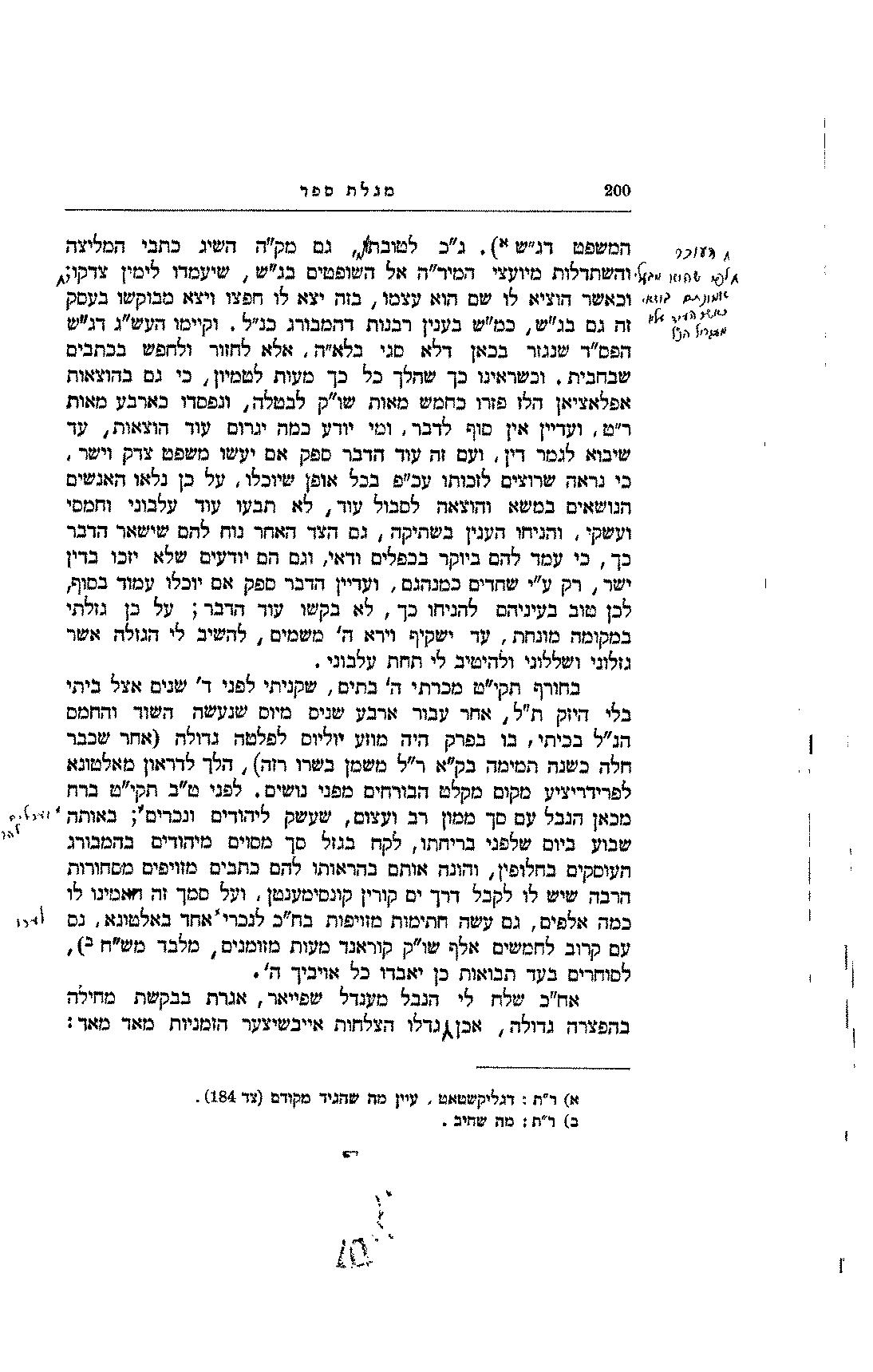
Margin readings in Scholem's copy (5)
| Printed anchor | Type (key sheet) | Mark | Reading | Certainty |
|---|---|---|---|---|
| ג"כ לטובתו ^, גם מק"ה השיג | V: omission | caret; one word in right margin | בעזרה(?) | uncertain |
| אל השופטים בג"ש, שיעמדו לימין צדקו ^, וכאשר | V: omission | caret; 4-line note in right margin | אלפי(?) שהוון(?) ... / ואוהבים(?) ... / כאשר הדרך(?) אלו(?) / מאנשים(?) הנז' | partial |
| שעשק ליהודים ונכרים x; באותה שבוע | X: substitution | x mark over the word; 2-word note in left margin | ולערלים / ... | partial |
| גם עשה חתימות מזויפות בח"כ לנכרי x אחד באלטונא | X: substitution | x mark over the word; one word in left margin | לערל | fairly sure |
| בהפצרה גדולה, אכן ^ גדלו הצלחות אייבשיצער | V: omission | caret (drawn like λ); refers to the typed sheet bound in after the page (scan 223) | (see scan 223) | sure |
Typed insert for p. 200 (scan 223)
A typed sheet bound into Scholem's copy after p. 200, headed "(for p. 200, below)". A handwritten caret-like sign stands beside its first line; it matches the caret after "Yet" (אכן) in the last line of p. 200. It gives the manuscript's longer form of that sentence. The faint mirrored writing in its right margin is show-through of the notes on p. 200, not a note. The back of the sheet (scan 224) is blank.
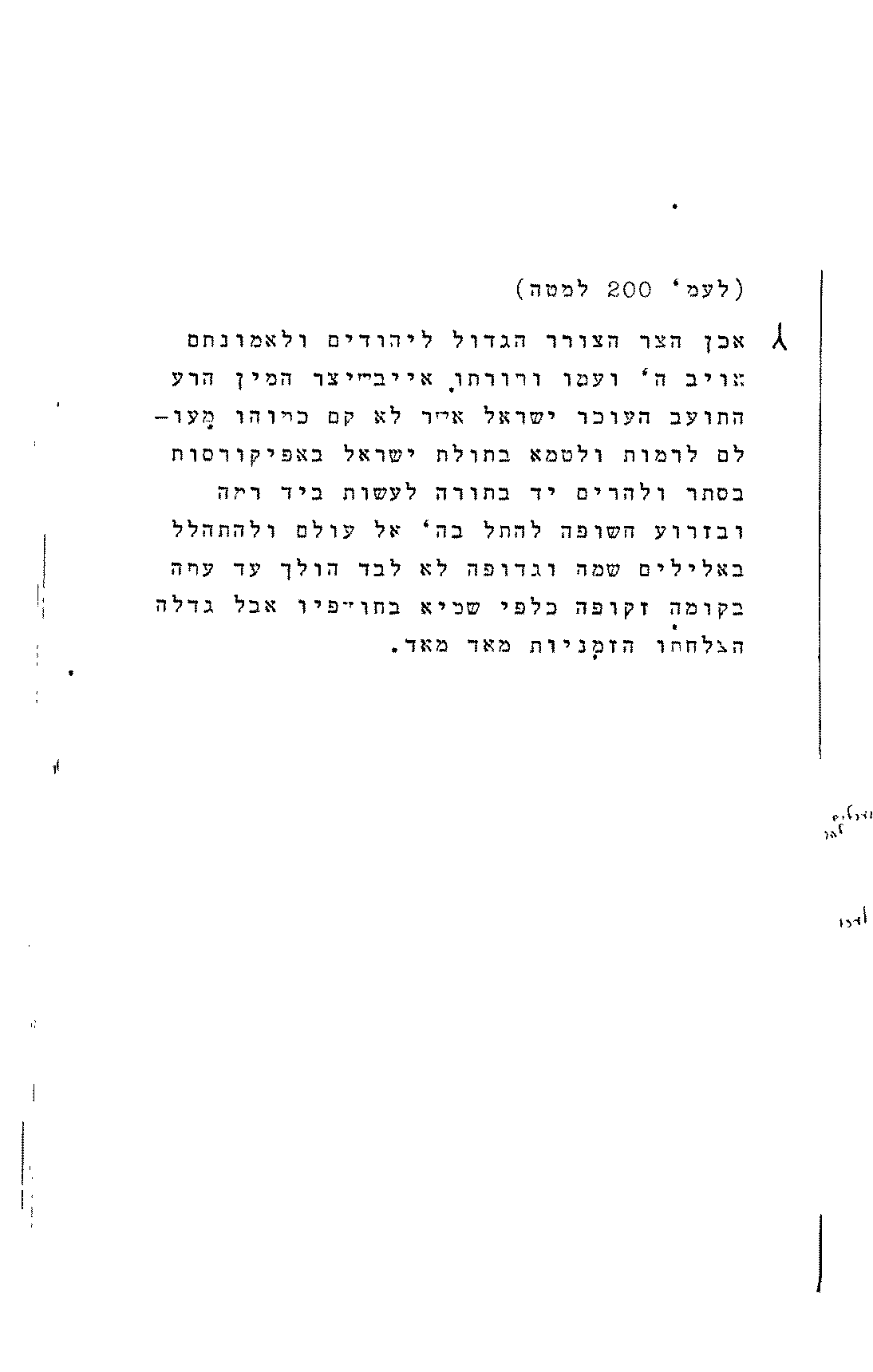
(For p. 200, below.) Yet the great oppressor and enemy of the Jews and of their faith, the enemy of the Lord, His people and His Torah(?), Eybeschütz, the evil heretic, the abominable one, the troubler of Israel, the like of whom never arose to deceive and to defile the virgin of Israel with heresy in secret, and to raise a hand against the Torah, to act "with a high hand" (Num. 15:30) and with a bared(?) arm, to mock the Lord, the everlasting God, and to boast in idols, a name and a reproach — not only does he walk to this day with an upright stature, "against Heaven" in his insolence(?), but his temporal success grew very, very great.
(לעמ' 200 למטה) אכן הצר הצורר הגדול ליהודים ולאמונתם אויב ה' ועמו ותורתו(?), אייבשיצר המין הרע התועב העוכר ישראל א"ר לא קם כמוהו מעולם לרמות ולטמא בתולת ישראל באפיקורסות בסתר ולהרים יד בתורה לעשות ביד רמה ובזרוע השופה(?) להתל בה' אל עולם ולהתהלל באלילים שמה וגדופה לא לבד הולך עד עתה בקומה זקופה כלפי שמיא בחו"פיו(?) אבל גדלה הצלחתו הזמניות מאד מאד.
Page 201 (scan 225)
This year, in this summer, he married off his said daughter ⟨S: "the wanton"(?)⟩ by a second letter to the rabbi of Lothringen, after the despair of her ever having a husband; she was married to a young man tender in years, with great wealth [a], and he ran onto the road, a traveller in his old age; only he had already [gone] ahead and come back here. He also married off his grandson, the son of his eldest son Natsh, to the daughter of Elijah Yarok(?), with great honour; and he held the wedding deliberately on the day before the fast of the 17th of Tammuz ⟨S: a four-line note, partly read: "which is one day … of the Sabbath(?) … the rejoicing of the relatives … was …"⟩, and all seven days of the feast stretched into the days "between the straits" with great rejoicing. And on the 24th of Tammuz ⟨S: a four-line note, partly read: "his son-in-law R. G.(?) with … daughter(?) … may he live(?)"⟩ Yeḥiel Wolf made a great feast for him and for his sons and his relatives by marriage, and they drank themselves very drunk. At that same time his son, the lad Wolf, came back with him from the journey, and brought with him exceeding wealth, with precious objects, silver and gold and "the treasure of kings" (Eccl. 2:8) in abundance, as was made known "with a great voice, and it went on no more" (Deut. 5:19), of the great wealth he brought in his hand. He also bought at once a landed estate in Altona, houses with a large garden; and "when Av came in", this [man] increased rejoicing (cf. b. Ta'anit 26b): he uprooted many fine fruit trees, whose like in goodness and number was not in Altona — he uprooted them, rooted them out and destroyed them, in order to make in their place a planting of joy and delight, of barren trees and royal arbours, in the days of Av. He also cut ⟨S: "reed"(?)⟩ carved figures of alabaster stone to set in them; and so the lad fixed his dwelling then ⟨S: "as … "(?), partly read⟩: on the Sabbath of Ḥazon he dedicated this new house of his, and the father ⟨S: "the … mentioned above"(?)⟩ was with him at the feast of the dedication of the house on the said Saturday night, where they drank and got drunk on wine in abundance, they reeled and raved.
And more than all this it was heard and seen that he established a house of study, and made as its head ⟨S: "for ruffians, men of … m[ay the name of the wicked] rot"⟩ Moses David ⟨S: "m[ay the name of the wicked] rot"⟩, the master of a demon [b] — that is, he will teach there, so to speak, "destruction" (ḥabbalah) with pupils, young men who go and gather there every day to engage in destruction, with this master of a demon, whom Eybeschütz ⟨S: "this … "(?)⟩ and his sons clothed in silk and scarlet (cf. 2 Sam. 1:24), and they feed him with delicacies ⟨S: "the …"(?), partly read⟩ and give him to drink of new wine and must. And those who fear the Lord grieve and are appalled at the great desecration of the Name; they are sated with wormwood and gall ⟨S: "the mad(?) sect, m[ay the name of the wicked] r[ot]"⟩ — the men of this sect justify themselves and say that by their righteousness and the uprightness of their heart they have gotten themselves this wealth; and behold, in their eyes the simpletons are good, upright and innocent, while we who seek the Lord and the honour of His Torah, the believers who tremble at His word and are appalled at the desecration of the Name, are, because of our many sins, counted in their eyes unclean and sinners, madmen, fools and simpletons. Woe to the generation in whose days such has come to pass! Over this "let all the sick be sick at heart", that the order is overturned, the upper below, and like ... in the highest heavens: he has truly raised his height to the heavens, "set his nest among the stars" (Obad. 1:4), and "above the stars" exalted his throne (Isa. 14:13). ⟨S: a note at the foot of the page: "Here a blank space of about four lines was left in the manuscript."⟩
Kahana's notes
- [a] See the book Hit'avkut (fols. 21 and 26b), and see Beit Yehonatan ha-Sofer (fol. 17b).
- [b] See the book Hit'avkut (fols. 21 and 27).
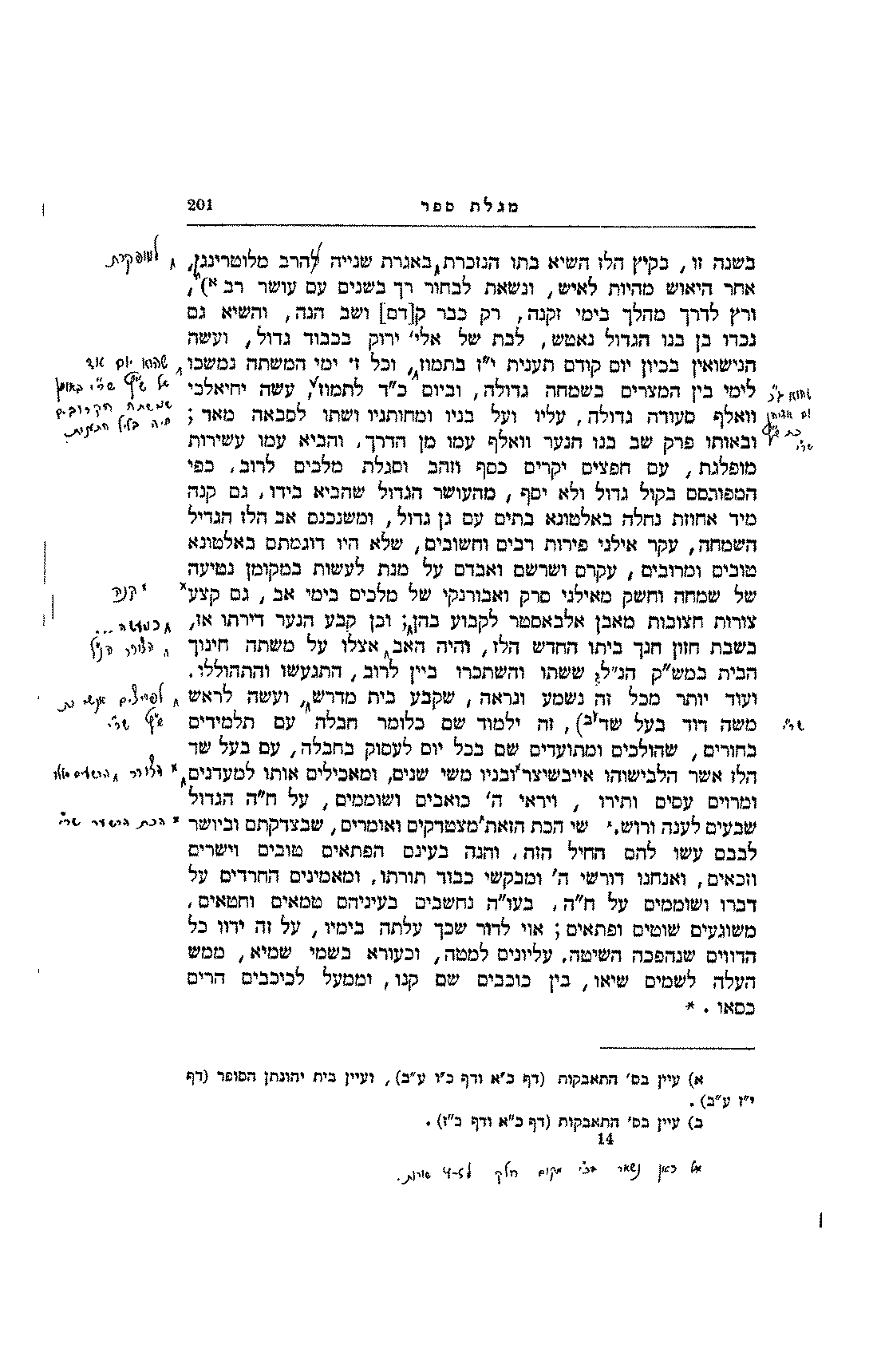
בשנה זו, בקיץ הלז השיא בתו הנזכרת, באגרת שנייה להרב מלוטרינגן, אחר היאוש מהיות לאיש, ונשאת לבחור רך בשנים עם עושר רב א, ורץ לדרך מהלך בימי זקנה, רק כבר ק[דם] ושב הנה, והשיא גם נכדו בן בנו הגדול נאטש, לבת של אלי' ירוק בכבוד גדול, ועשה הנישואין בכיון יום קודם תענית י"ז בתמוז, וכל ז' ימי המשתה נמשכו לימי בין המצרים בשמחה גדולה, וביום כ"ד לתמוז, עשה יחיאלכי וואלף סעודה גדולה, עליו ועל בניו ומחותניו ושתו לסבאה מאד; ובאותו פרק שב בנו הנער וואלף עמו מן הדרך, והביא עמו עשירות מופלגת, עם חפצים יקרים כסף וזהב וסגלת מלכים לרוב, כפי המפורסם בקול גדול ולא יסף, מהעושר הגדול שהביא בידו, גם קנה מיד אחוזת נחלה באלטונא בתים עם גן גדול, ומשנכנס אב הלז הגדיל השמחה, עקר אילני פירות רבים וחשובים, שלא היו דוגמתם באלטונא טובים ומרובים, עקרם ושרשם ואבדם על מנת לעשות במקומן נטיעה של שמחה וחשק מאילני סרק ואבורנקי של מלכים בימי אב, גם קצע צורות חצובות מאבן אלבאסטר לקבוע בהן; וכן קבע הנער דירתו אז, בשבת חזון חנך ביתו החדש הלז, והיה האב אצלו על משתה חינוך הבית במש"ק הנ"ל, ששתו והשתכרו ביין לרוב, התגעשו והתהוללו. ועוד יותר מכל זה נשמע ונראה, שקבע בית מדרש, ועשה לראש משה דוד בעל שד ב, זה ילמוד שם כלומר חבלה עם תלמידים בחורים, שהולכים ומתועדים שם בכל יום לעסוק בחבלה, עם בעל שד הלז אשר הלבישוהו אייבשיצר ובניו משי שנים, ומאכילים אותו למעדנים, ומרוים עסים ותירו, ויראי ה' כואבים ושוממים, על ח"ה הגדול שבעים לענה ורוש. אנשי הכת הזאת מצטדקים ואומרים, שבצדקתם וביושר לבבם עשו להם החיל הזה, והנה בעינם הפתאים טובים וישרים וזכאים, ואנחנו דורשי ה' ומבקשי כבוד תורתו, ומאמינים החרדים על דברו ושוממים על ח"ה, בעו"ה נחשבים בעיניהם טמאים וחטאים, משוגעים שוטים ופתאים; אוי לדור שכך עלתה בימיו, על זה ידוו כל הדווים שנהפכה השיטה, עליונים למטה, וכעורא בשמי שמיא, ממש העלה לשמים שיאו, בין כוכבים שם קנו, וממעל לכוכבים הרים כסאו.
- [א] עיין בס' התאבקות (דף כ"א ודף כ"ו ע"ב), ועיין בית יהונתן הסופר (דף י"ז ע"ב).
- [ב] עיין בס' התאבקות (דף כ"א ודף כ"ז).
Margin readings in Scholem's copy (16)
| Printed anchor | Type (key sheet) | Mark | Reading | Certainty |
|---|---|---|---|---|
| בקיץ הלז השיא בתו הנזכרת ^ באגרת שנייה | V: omission | caret; one word in left margin (beside the end of the line) | המופקרת(?) (written למופקרת?) | uncertain |
| באגרת שנייה להרב מלוטרינגן ^, אחר היאוש | V: omission | caret; no separate note seen | - | - |
| באגרת שנייה להרב מלוטרינגן | — | stroke through the ל of להרב (deletion?) | - | - |
| הנישואין בכיון יום קודם תענית י"ז בתמוז ^, וכל ז' ימי המשתה | V: omission | caret; 4-line note in left margin | שהוא יום אחד / של ש"ק(?) שבו(?) באותן(?) / שמחת הקרובים(?) / היה בזה(?) ... | partial |
| וביום כ"ד לתמוז ^ עשה יחיאלכי וואלף | V: omission | caret; 4-line note in right (inner) margin | חתנו ר"ג(?) / עם ... / בת(?) ... / שי'(?) | partial |
| בימי אב, גם קצע x צורות חצובות | X: substitution | x mark after the word; one word in left margin | קנה(?) | uncertain |
| מאבן אלבאסטר לקבוע בהן ^; | V: omission | caret; no separate note seen | - | - |
| וכן קבע הנער דירתו אז ^, בשבת חזון | V: omission | caret; one-word note in left margin, partly read | כשתו...(?) | partial |
| והיה האב ^ אצלו על משתה חינוך הבית | V: omission | caret; 2-word note in left margin | הנ...(?) הנ"ל | partial |
| שקבע בית מדרש ^, ועשה לראש | V: omission | caret; no separate note seen | - | - |
| ועשה לראש ^ משה דוד בעל שד | V: omission | caret; 2-line note in left margin | לפריצים(?) אנשי ... / ... שר"י(?) | partial |
| משה דוד בעל שד [ב], זה ילמוד (no mark seen) | — | no mark seen; abbreviation in right (inner) margin beside the line | ש"י(?) | uncertain |
| אשר הלבישוהו אייבשיצר x ובניו משי שנים | X: substitution | x mark after the word; one word in left margin | הלזה(?) | uncertain |
| ומאכילים אותו למעדנים ^ ומרווים | V: omission | caret; 2-word note in left margin | הנו...(?) ... | partial |
| שבעים לענה ורוש. x שי הכת הזאת | X: substitution | x mark; 3-word note in left margin | הכת המשוגעת(?) שר"י | uncertain |
| וממעל לכוכבים הרים כסאו. * | — | asterisk after the last word; note at the foot of the page in Scholem's hand | * כאן נשאר בכ"י מקום חלק לכ-4 שורות. | sure |
Page 202 (scan 226)
Last year I brought my book Shimmush to press, and when it was almost finished "a spirit of perverseness" (Isa. 19:14) entered the workman M. B., and he would not finish it [a]; and he caused me great grief, for I had laid out new expense on it, for the Lord's sake and to establish His Torah, so that the truth should not be lacking and heresy should not prevail. Its end had almost come, near to completion; it was held back and still lies incomplete, until the Lord is pleased with my work. "The Lord will accomplish for me" (Ps. 138:8); may He strengthen my hand; "forsake not the work of my hands" (Ps. 138:8).
At the beginning of Marḥeshvan 5520 [1759] a letter came to me from R. A. of Amsterdam ⟨S: a word, not read (it looks like Latin script)⟩, may the Name lengthen his years [b], asking me to instruct him [whether it is permitted to annul and uproot the sect of Sh. Tz. [c]], and to make an effort to answer in particular about the blood libel that the sect of Sh. Tz., may the name of the wicked rot, maintained and upheld out of bitterness, to take revenge on Israel for having persecuted them; for therefore they were alarmed and made a great tumult in Poland, and a decree was renewed. May the Lord deliver His people from all trouble! ⟨S: a note at the foot of the page: "Here a blank space of about nine(?) lines was left in the manuscript."⟩
At the beginning of the year 5520 [1759/60] Jacob Rothschild, who plundered my house and who made my house a pledge(?) in this way, was arrested; he was in prison some weeks, and had to pay a thousand Reichstaler and came out of prison. In Tevet of this year the fool Samson Morenu(?) in Amsterdam, who had risen against me as an adversary and lain in wait for my life, went into a great and enormous bankruptcy. He has done very great wickedness for some time in the evil business of Eybeschütz ⟨S: "this heretic, m[ay the name of the wicked] r[ot]"⟩, and the Lord returned his recompense on his own head.
At that same time letters reached me about the said lad, "shaken out", son of the "old and foolish" (Eccl. 4:13), who walks in the folly of his father — "the talk of a child in the market [is his father's]" (b. Sukkah 56b) etc. They wrote to me from Glogau and from abroad of his ugly and corrupt deeds, especially in the lands of Moravia [and Hungary] [d], he tested(?) and sowed his opinions there.
Kahana's notes
- [a] This book began to be printed in the year 5518 [1758] and continued until the year 5522 [1762]; see his book Mitpaḥat Sefarim (p. 117), and now the reason for this delay is known to us. See also the book Toledot Ya'avetz (p. 61, § 248). The workman M. B. is the lad Moses Bonn, mentioned in Megillat Sefer before (p. 180).
- [b] הי"ל, abbreviation: "may the Name lengthen his years".
- [c] See his book Shimmush (fol. 15); and so he related before in this book Megillat Sefer (p. 189): R. A. Katz sent him the claims of the sect of Sh. Tz. in Poland, and the said rabbi asked him to answer their words.
- [d] And thus he says in his book Mitpaḥat Sefarim (p. 115, Lemberg printing), in these words: "His son, the lad, seed of evil-doers, still leads astray the land of Moravia and Hungary."
בשנה שעברה הבאתי לדפוס ספרי „שמוש“, וכמעט שנגמר נכנס רוח עועים בהפועל מ"ב ולא אבה לגמרו א וגרם לי צער גדול, כי עשיתי ע"ז הוצאה חדשה, למען ה' ולהקים תורתו, שלא תהא האמת נעדרת, לבל תהי האפיקורסות גוברת; וכמעט בא אל קצו סמוך לגמרו עצורו ועדיין מונח חסר, עד ירצה ה' פעלי, ה' יגמור בעדי יחזק ידי, מעשי ידי אל תרף. בתחלת מרחשון תק"כ בא אלי מכתב מהר"א מאמשטרדם הי"ל ב, מבקש שאבינהו [אם מותר לבטל ולשרש כת ש"צ ג], ולהתאמץ להשיב ביחוד על אודות עלילת דם, שהחזיקו וקיימו מרורים כת ש"צ שר"י, להנקם מישראל על מה שרדפו אותן, כי על כן חרדו ועשו רעש גדול בפולין, ונתחדשה גזרה. ה' יציל עמו מכל צרה ! בתחלת שנת תק"כ נתפס יאקב רויטשילד השודד ביתי, ואשר עשה ביתי אפותיקי עד"ז, ועמד בבית הסוהר כמה שבועות, והוצרך לשלם אלף ר"ט ויצא מבית הסוהר. בטבת שנה זו היה לפליטה גדולה ועצומה הטפש שמשון מורנא באמשטרדם, אשר קם עלי לשטן וארב על החיות. זה כמה עשה רשעה גדולה מאד בעסק ביש של אייבשיצר, והשיב ה' גמולו בראשו. בו בפרק הגיעוני מכתבים על אודות הנער המנוער בן זקן וכסיל הנ"ל, ההולך בשטות אביו שותא דינוקא בשוקא כו', וכתבו אלי מגלוגא וממ"א ממעשיו המכוערים והמקולקלים, ביחוד במדינות מעררין [ואונגרין] ד בחן וזרע דעותיו שם.
- [א] הספר הזה החל להדפיס בשנת תקי"ח, ונמשך עד שנת תקכ"ב, עיין בספרו מטפחת ספרים (צד קי"ז) וכעת נודע לנו סבת העכוב הזה, ועיין בספר תולדות יעב"ץ (צד ס"א סי' רמ"ח), והפועל מ"ב הוא הנער משה בון הנזכר במגלת ספר מקודם (צד 180).
- [ב] הי"ל, ר"ת: השם יאריך לשנותיו:
- [ג] עיין ספרו „שמוש" (דף ט"ו), וכן הגיד מקודם בספר הזה "מגלת ספר" (צד 189) מהר"א כ"ץ שלח לו הטענות של כת ש"צ בפולין, ובקש ממנו הרב הנ"ל שישיב על דבריהם.
- [ד] וכה יאמר בספרו „מטפחת ספרים" (צר קט"ו דפוס לבוב) וז"ל: עדיין מתעים ארץ מעררין ואונגרין בנו הנער זרע מרעים.
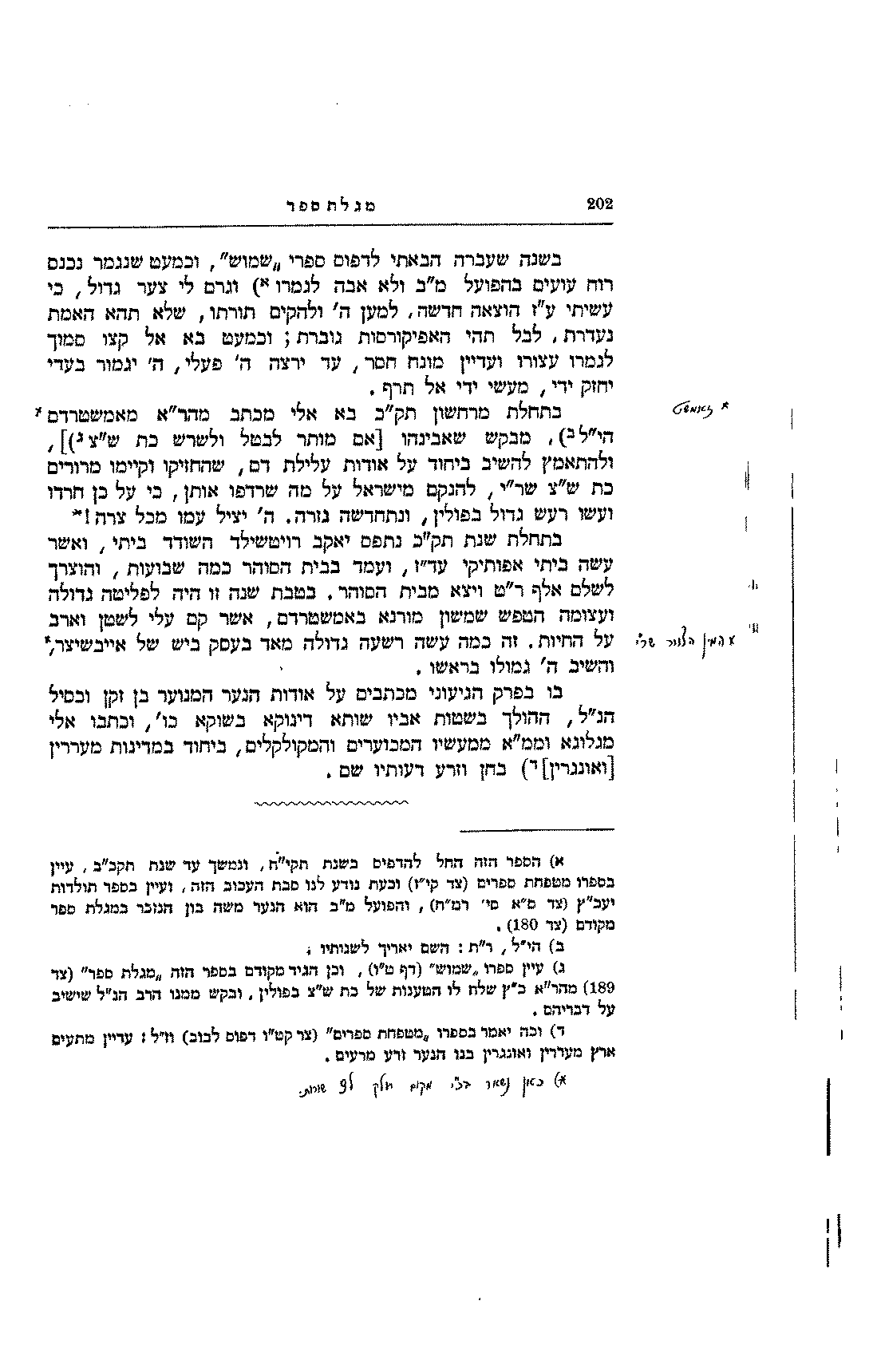
Margin readings in Scholem's copy (3)
| Printed anchor | Type (key sheet) | Mark | Reading | Certainty |
|---|---|---|---|---|
| בא אלי מכתב מהר"א מאמשטרדם x הי"ל | X: substitution | x mark after the word; one word in right margin, apparently in Latin script | not read | not read |
| ה' יציל עמו מכל צרה! * | — | asterisk after the sentence; note at the foot of the page in Scholem's hand | *) כאן נשאר בכ"י מקום חלק לכ-9(?) שורות. | fairly sure |
| זה כמה עשה רשעה גדולה מאד בעסק ביש של אייבשיצר x, | X: substitution | x mark after the name; 3-word note in right margin | המין הלזה שר"י | fairly sure |
Page 203 (scan 227)
Here Emden begins a list of his writings, printed and in manuscript; it continues on the next page.
With God's help I will record the names of the works that the Blessed Name has granted me, in writing and in print. May He, blessed be He, grant me to bring them out to the light of truth, as is in my spirit with me: to magnify the honour of the Torah and make it glorious, and above all to establish the words of the Torah, and to build pillars and supports for the Torah and the faith.
First: with God's help I brought out to the light of print the book Leḥem Shamayim on two orders [of the Mishnah], with the tract Binyan Beit ha-Beḥirah; the second part, on the last orders, still lies in writing. With the help of Heaven I also composed a [second] edition, which I called Mishneh Leḥem, and also Leḥem Nikkudim. Second: I printed the book Iggeret Bikkoret. Third: the book She'ilat Ya'avetz, with the tract Asarah ha-Leḥem, in answers to questions I was asked about the book Leḥem Shamayim, part 1, which is in print. Fourth: the Sefer Tefillah, in two parts called Ammudei Shamayim and Sha'arei Shamayim. Fifth: the book Migdal Oz and Birkhot Shamayim, with Beit Middot. Sixth: the second part of the book Beit Middot; I finished ten "buildings", and in the middle I was driven off by the war of [the dragon]. May the Blessed Name grant me in His kindness to complete it. Seventh: Etz Avot; and three tracts of sermons: first, Tziv Pitgam, the eulogy of my father and teacher the gaon, of blessed memory; second, Shemesh Tzedakah, the sermon at my wedding with the daughter of my brother(?), in a good hour; third, Sha'agat Aryeh, to eulogise my brother-in-law the rabbi of Amsterdam, may he rest in peace; besides a lament on the expulsion from Prague.
And these are the books that I printed in the war of the dragon: first, Torat ha-Kena'ot; second, Akitzat Akrav; third, Tzitzat Novel, with my glosses and answers; fourth, Seder Olam, with what accompanies it and my commentary on it, called Seder Olam Rabbah ve-Zuta, with a tract against ⟨S: "the apostates"⟩ the sect of Sh. Tz., may the name of the wicked rot, in Podolia; fifth, Shelah"a, against the work of Eybeschütz ⟨S: "the heretic, m[ay the name of the wicked] r[ot]"⟩ [a]; sixth, the book Shimmush, comprising three works. And may the Blessed Name in His great kindness show me [how] to record [them] properly [b] ⟨S: "Or Yekarot"(?)⟩.
And these are the names of the books that I composed with God's help, which are still in manuscript: first, Leḥem Shamayim, part 2, with Mishneh Leḥem and Leḥem Nikkudim, as above; second, Mor u-Ketzi'ah on the Tur and Shulḥan Arukh, Oraḥ Ḥayyim, and decided law in rulings and laws that belong to my Sefer Tefillah and were not included in it in detail; third, She'ilat Ya'avetz, part 2; fourth, Kolan shel Soferim; fifth, Ha- Keshurim le-Ya'akov, sermons; sixth, Gal'ed, on the Targum; seventh, Em la-Binah ve-Em la-Masoret, on the Bible; eighth, Mishkenot Ya'akov, glosses on the Midrash Yalkut; ninth, Ezer Or ⟨S: "Ezer Ot"(?)⟩ on the Tishbi ⟨S: "Rashba (?)"⟩, and other books of grammar that I glossed with the help of Heaven [c]; tenth, Likkutei Orot, on the way of the Kabbalah and the secrets of the Torah; eleventh, Mitpaḥat Sefarim, in several parts; twelfth, Mitpaḥat Soferim
Kahana's notes
- [a] שלה"א, abbreviation: Shevirat Luḥot ha-Aven ("The Breaking of the Tablets of Iniquity").
- [b] At the end of the tract Evel Yaḥid the grammarian R. Solomon Dubno wrote that he saw a sheet that Ya'avetz printed, on which were listed thirty-four books that he was privileged to print in his lifetime.
- [c] See Toledot Ya'avetz by Wagenaar (p. 43, § 13).
בעזה"י ארשום שמות החבורים שחנני הי"ת בכתב ובדפוס. הוא י"ת יחנני להוציא אותם לאור אמת, כאשר ברוחי אתי להגדיל כבוד התורה ולהאדירה, וביחוד להקים את דברי התורה, ולבנות עמודים וחזוקים לתורה ולאמונה. ראשית: הוצאתי לאור הדפוס בעזה"י ספר „לחם שמים" על שני סדרים, עם קונטרס בנין „בית הבחירה", ועדיין מונחים בכתב ח"ב הסדרים האחרונים, גם חברתי בס"ד מהדורא קראתי „משנה לחם", גם „לחם נקודים". שנית: הדפסתי ספר "אגרת בקורת". שלישית: ספר „שאילת יעב"ץ" עם קונטרס „עשרה הלחם" בתשובות על שאלות שנשאל מעמדי בספר „לחם שמים" ח"א שבדפוס. רביעית: „ספר תפלה" מב' חלקים הנקראים „עמודי שמים" ו„שערי שמים". חמישית: ספר „מגדל עוז וברכות שמים" עם „בית מדות". ששית: ח"ב מספר "בית מדות", עשרה בוגין כליתי ובאמצע נטרדתי במלחמת [התנין]. הי"ת יזכני בחסדו להשלימו. שביעית: „עץ אבות", ושלשה קונטרסים דרשות: א', "יציב פתגם" הספדו של אמ"ה ז"ל; ב', "שמש צדקה" דרוש חתונתי עם בת אחי למז"ט, ג', „שאגת אריה", להספיד גיסי הרב מאמשטרדם ע"ה; מלבד קינה על אודות גרוש מפראג. ואלה הספרים שהדפסתי במלחמת התנין: א', "תורת הקנאות". ב', "עקיצת עקרב". ג', „ציצת נובל" עם הגהותי ותשובותי. ד', "סדר עולם", והנלוה ופירושי עליו, ונקראת ס"ע רכה וזוטא, עם קונטרס נגד מכת ש"צ שר"י בפאדאליע. ה', "שלה"א" נגד חבור אייבשיצר א. ו', ספר „שמוש" כולל ג' חבורים, והי"ת ברוב חסדיו יראני, לרשום כהוגן ב. ואלה שמות הספרים שחברתי בעזה"י, אשר הם בכתובים עדיין: א', "לח"ש" ח"ב עם „משנה לחם ול"נ" כנ"ל. ב', „מו"ק" על טא"ח שלחן ערוך והלכה פסוקה בדינים והלכות השייכים לס' תפלה שלי ולא נכללו בו בפרט. ג', "שאילת יעב"ץ" ח"ב. ד', „קולן של סופרים". ה', „הקשורים ליעקב" דרשות. ו', "גלעד" על התרגום. ז', „אם לבינה ואם למסורת" על תנ"ך. ח', „משכנות יעקב" הגהות על מדרש ילקוט. ט', "עזר אור" על התשבי, ושאר ס' דקדוק שהגהתי בס"ד ג. י', "לקוטי אורות" ע"ד הקבלה וסתרי תורה. י"א, "מטפחת ספרים" כמה חלקים; י"ב, „מטפחת סופרים"
- [א] שלה"א, ר"ת: שבירת לוחות האון.
- [ב] בסוף הקונטרס אבל יחיד כתב המדקדק ר' שלמה דובנא, כי ראה על נייר אחד אשר הדפיס יעב"ץ, ועליו רשומים ל"ד ספרים שזכה להדפיס בחייו.
- [ג] עיין תולדות יעב"ץ לוואגנה (צד מ"ג סי' י"ג).
Margin readings in Scholem's copy (5)
| Printed anchor | Type (key sheet) | Mark | Reading | Certainty |
|---|---|---|---|---|
| עם קונטרס נגד [word written in] כת ש"צ שר"י בפאדאליע | V: omission | word written in by hand at the end of the line after נגד (no caret seen; a small sign before כת) | המשומדים | fairly sure |
| ה', "שלה"א" נגד חבור אייבשיצר x [א] | X: substitution | x mark after the name; 2-word note in margin | המין שר"י | fairly sure |
| לרשום כהוגן [ב] ^. | V: omission | caret; 2-word note in margin | אור יקרות(?) | uncertain |
| ט', "עזר אור" x על התשבי | X: substitution | x mark after the title; one word in margin | אות(?) | uncertain |
| על התשבי x, ושאר ס' דקדוק | X: substitution | x mark after the word; one word in margin, with Scholem's own query | רשב"א (?) | uncertain |
Page 204 (scan 228)
additions to the book Yuḥasin and Siftei Yeshenim; thirteenth, for the issue of my loins ⟨S: "Luaḥ"⟩, On Prayer and the Blessings [a]; fourteenth, Zikkaron ba-Sefer; fifteenth, Bedek ha-Bayit ve-ha-Migdal; sixteenth, the third part of Beit Middot, a great manuscript [b]; seventeenth, this Megillat Sefer [c].
And these are the names of the works on the business of the Lord's quarrel that still lie in manuscript: first, Milḥemet Tannin and Iggeret Purim; second, Edut be-Ya'akov; third, Beit Yehonatan ha-Sofer; fourth, Petaḥ Einayim; fifth, Teshuvat ha-Minim; sixth, the book Shimmush, comprising three books: Shot la-Sus, Meteg la-Ḥamor, Shevet le-Gev Kesilim; seventh, Hilkheta li-Meshiḥa; eighth, Akrav Beit ha-Budah; ninth, Iggeret Shum, and several letters that I wrote on this evil business; tenth, Yekev Ze'ev, about the fool, the son of the "old and foolish" [king]; eleventh, Resen Mat'eh; twelfth, Tza'akat Damim and Ḥosen Kafun.
At the end of [5]520 [d] the young men were roused to testify about the deeds of Eybeschütz and his son, and then the plague began a second time among women in childbirth. At the beginning of the following year, the year [5]521 [1760/61], the said fool, Eybeschütz's son, went off "to abhorrence", never to return; and a few days later the servant too went, whom he had left as steward over his house and courtyard: they went off as fugitives and did not come back, and left behind a great stink of debts that they had made with Jews and gentiles. People lost about ten thousand Sh.K., who had spent their money, their strength and their substance on the lad's building; they seized his house and courtyard and sold them with all that was in them, as is explained in Yekev Ze'ev ve-Seḥok ha-Kesil. And the money still lies [blocked], because the lad also made many debts there in Moravia and in Vienna, and was caught there in disgrace in Holleschau; and after him Natsh made a forged bond, dated earlier, as if he owed a certain man in Prague such a sum; therefore they came to court here to attach the money for his debt. This year at Passover the lad's house and garden [e] were sold for little money. On that very day the m. p. of A. ⟨S: a three-line note, partly read: "m. k. p. of A. [… / called … from this(?) / …]"⟩ R. Y. P., the first signatory of the fifty-one signatories who sought to hand me over to the government [f], went into a great bankruptcy. At that same time Samson Morenu(?) came here from Amsterdam to hasten an escape, and he also thought to collect his debts from Yozpa Hirsch ⟨S: "Yarok"(?), cut off⟩
Kahana's notes
- [a] And so he says at the end of the introduction to the book Luaḥ Eresh, in these words: "Where there is no man, at any rate I will mention and make known to my sons, may they live."
- [b] He mentioned this book before (p. 174).
- [c] ח"ג, abbreviation: the third part of his book Beit Middot.
- [d] The year is [5]520 [1760].
- [e] See the book Hit'avkut (fol. 19b), in these words: "As soon as he came he bought a courtyard, a house, a landed estate and a garden full of fruit trees."
- [f] See Edut be-Ya'akov (fol. 64b) and Edut be-Ya'akov (fol. 28b). מר"פ מא' רי"פ, abbreviation: one of the chief parnassim of Altona, R. Yosef Popers.
נוספות על ספר יוחסין ושפתי ישנים. י"ג, ליוצאי חלצי „על התפלה והברכות" א. י"ד, „זכרון בספר". ט"ו, „בדק הבית והמגדל". ט"ז, ח"ג מבית מדות כתב גדול ב. י"ז, "מגלת ספר" הלז ג. ואלה שמות החבורים בעסק הריב לה' המונחים עדיין בכתב: א', "מלחמת תנין ואגרת פורים". ב', "עדות ביעקב". ג', "בית יהונתן הסופר". ד', „פתח עינים". ה', „תשובות המינים". ו', ספר „שמוש" כולל ג' ספרים: "שוט לסוס", "מתג לחמור", "שבט לגו כסיל". ז', „הלכתא למשיחא". ח', „עקרב בית הבודה". ט', „אגרת שום", וכמה אגרות שכתבתי ע"ז העסק ביש. י', "יקב זאב" על אודות בן כסיל בן זקן וכסיל. י"א, "רסן מתעה". י"ב, „צעקת דמים וחסן כפון". שילהי תיק"י ד נתעוררו הבחורים להעיד על מעשי אייבשיצר ובנו, ואז התחילה המכה שנית בנשים יולדות, ובתחלת שנה שאחריה שנת קכ"א הלך בן כסיל אייבשיצר הנ"ל לדראון ולא ישוב, ולימים מועטים הלך ג"כ המשרת, שהניח פקיד על ביתו וחצרו, הלכו לפליטה ולא שבו עוד, והניחו סרחון גדול של חובות שעשו אצל יהודים ונכרים. ב"א הפסידו כעשרת אלפים שו"ק, שכלו ממונם, כוחם ואונם בבנינו של הנער, וגבו ביתו וחצרו ומכרום עם כל הנמצא בהם, כמבואר ב"יקב זאב ושחוק הכסיל", ועדיין המעות מונחים, מפני שהנער עשה שם במעררין ובווינא ג"כ חובות הרבה, ונתפס שם בקלון בהעלישויא, ואחריו נאטש עשה שט"ח מזוייף מקודם, כאלו חייב לאדם אחד בפראג סך כזה, על כן באו במשפט כאן לעקל המעות בחובו. בשנה זו בפסח נמכר הבית והגן ה של הנער בדמים מועטים. בו ביום היה לפליטה גדולה מר"פ מא' רי"פ החתום הראשון מן נ"א החותמים שבקשו למסרני למלכות ו. באותו פרק בא לכאן שמשון מורנא מאמשטרדם להחיש מפלט, וסבר ג"כ לגבות חובותיו מיוזפא הירש
- [א] וכה יאמר בהצעה לספר "לוח ארש" בסוף בזה"ל: במקום שאין איש עכ"פ אזכיר ואודיע לבני וי"ח, עכ"ל.
- [ב] הספר הזה הזכיר מקודם (צד 174).
- [ג] ח"ג, ר"ת: חלק שלישי מספרו „בית מדות".
- [ד] פרט השנה הוא תק"כ.
- [ה] עיין בס' התאבקות (דף י"ט ע"ב) וז"ל מיד בבואו קנה חומת בית אחוזת שדה וגן מלא אילני פרי.
- [ו] עיין עדות ביעקב (דף ס"ד ע"ב) ועדות ביעקב (דף כ"ח ע"ב), מר"פ מא' רי"פ, ר״ת: מראשי פרנסים מאלטונא ר' יוסף פופרש.
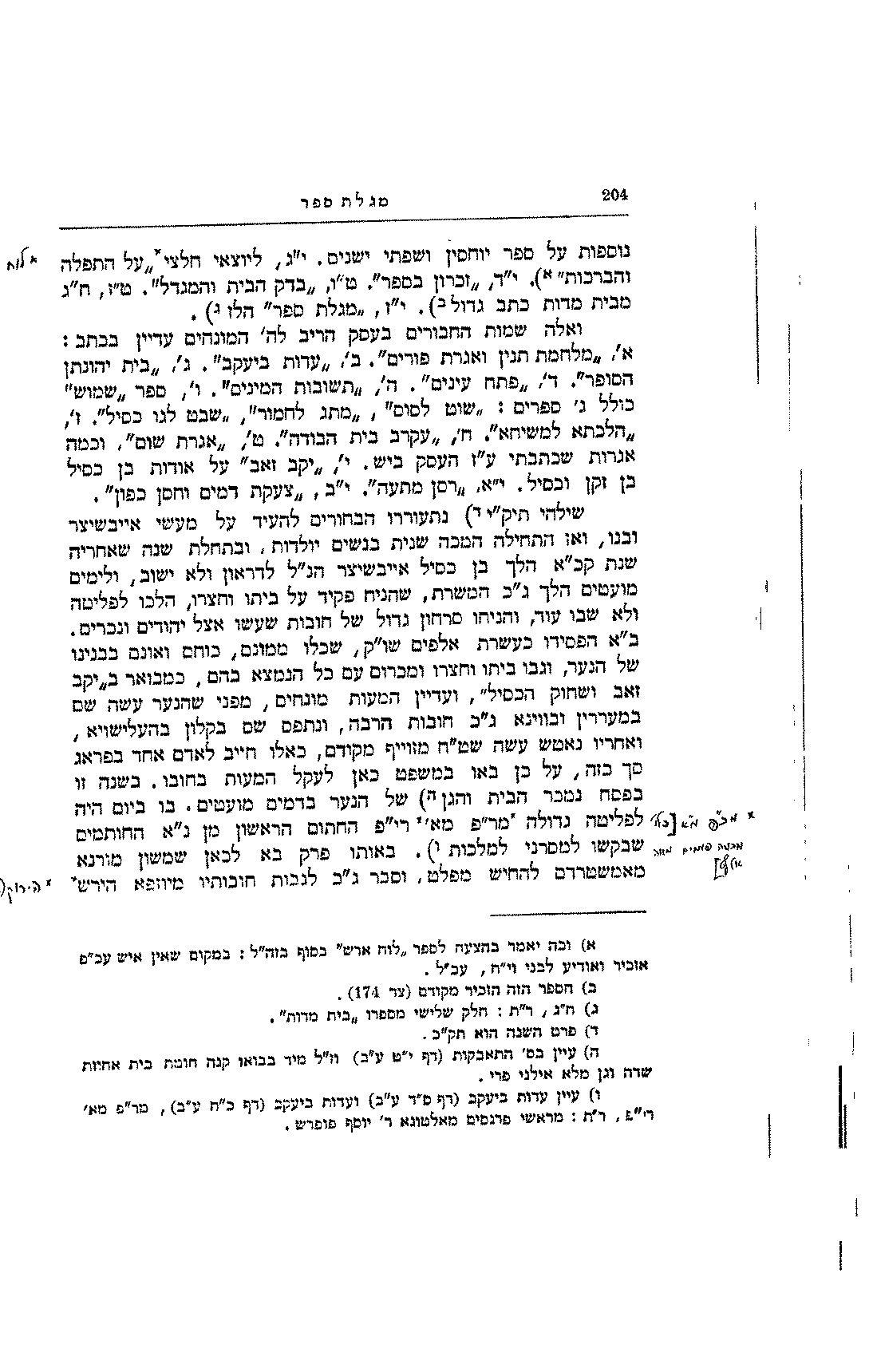
Margin readings in Scholem's copy (3)
| Printed anchor | Type (key sheet) | Mark | Reading | Certainty |
|---|---|---|---|---|
| י"ג, ליוצאי חלצי x "על התפלה והברכות" [א] | X: substitution | x mark after the word; one word in the inner (left) margin, also visible at the edge of scan 229 | לוח | fairly sure |
| היה לפליטה גדולה מר"פ מא' x רי"פ החתום הראשון | X: substitution | x mark; 3-line note in left margin, partly in brackets | מכ"פ מ"א [כ... / מכונה פ...(?) מזה(?) / ...] | partial |
| וסבר ג"כ לגבות חובותיו מיוזפא הירש x | X: substitution | x mark after the name; one word in margin, cut off | הירק... (cut off) | partial |
Page 205 (scan 229)
and he went out empty-handed and returned to Amsterdam, and as soon as he returned he died there; may his death be his atonement. And R. Y. P. asked me to let him come to my synagogue, for out of shame he could not come to the great synagogue; I granted his request, and he kept coming to my synagogue until after the festival. In the said year, on the ... of Tammuz, the ailment of the "golden vein" was aroused in me, drawing blood like a spring; they wanted me not to fast on that day, but I did not incline my ear to the physician who said there was danger in it. I said: let come on me what may, I cannot eat on the festival of Sh. Tz. ⟨S: "on the festival of Sh. Tz., m[ay the name of the wicked] r[ot]"⟩, for surely this has come upon me as a trial. I took courage and completed the fast with God's help; and the flow of blood continued with great violence for three weeks, until after the Ninth of Av, and I no longer had strength to stand on my feet, and needed a staff when I went hither and thither. Even so I also completed the fast of the Ninth of Av, and hardly any breath of the spirit of life was left in me; but the Blessed Name gave strength to the weary to stand this too. Afterwards the Lord restored me to my strength [a]. May His great name be blessed for ever!
At this time Moses Kobes ⟨S: "Kibes"(?)⟩ gave, written and signed by his hand in Bremen, a release concerning the lawsuit over the A. A., and that the barrels with what was in them, which he had robbed from me six years before, should be returned to me. When the letter reached me I sued Jacob R. Sh. [b]; he fell into his sick-bed and was "free among the dead" (Ps. 88:6). His widow was sued, and she too wanted to give me a release; but Eybeschütz ⟨S: "the abominable fool"⟩ stood up and went himself to the gentile court, and said that he would not allow the barrel to be returned to me, for his honour too had been smitten by me. He set up advocates for himself, and they held it up for more than half a year. But it did not help him, for the judgment came out that if he wished to bring his pleas against me, he must provide a sufficient and secure surety for costs and damages. He went and asked his friends to stand surety for him, and no one listened to him. When he saw that it was not in his power, and that he had lost money for nothing, and also was ill, then he made his peace(?) ⟨S: the letters "או" written above the word⟩ ⟨S: "he fell in that very sign"(?)⟩, and judgment was given that what had been plundered from my house should be returned to me. This happened on the "great festival" ⟨S: an alef added to "festival" and to "great", making them Aramaic⟩ of Sh. Tz. ⟨S: "m[ay the name of the wicked] r[ot]"⟩, the 17th of Tammuz 5520 [1760] ⟨S: a bracketed query, "[?]"⟩, in the week of the portion "Therefore say: Behold, I give unto him My covenant of peace" (Num. 25:12); and he returned my barrel to me in the following week, also on a festival of Sh. Tz. ⟨S: "m[ay the name of the wicked] r[ot]"⟩, with nothing at all missing from it. So may the Lord show us His kindnesses and grant us complete consolation, speedily in our days, amen!
In the year 5523 [1762/63] I learned that my daughter Esther, may she rest in peace, had died. May His name be praised for ever ⟨S: a word, not read⟩, blessed ⟨S: "revealed"(?)⟩. This year I brought out to the light of print the book Shimmush. After this the Blessed Name granted me [to reach] the days of understanding, "from which judgments are aroused". At once at the beginning, after the festival of Weeks, at the time of my birthday, the ailment of the golden vein was aroused in me in abundance, and I paid it no heed at all; and I drove away my sleep at night in writing answers to those who asked me about words of Torah. I wearied my nature without
Kahana's notes
- [a] The abbreviation [stands for] "the Lord, to my strength".
- [b] The abbreviation [stands for] Rothschild.
ויצא בפ"נ ושב לאמשטרדם, ומיד בשובו נפטר שם, תהא מיתתו כפרתו. ורי"פ בקש מאתי שאניחהו לילך לבהכ"נ שלי, שמפני הבושה לא יכול לבוא לבהכ"נ הגדולה, ונמצאתי לבקשתו והתמיד הליכתו לבהכ"נ שלי עד אחר החג. בשנה הנ"ל או"י תמוז נתעורר בי מיחוש גיד הזהב שהיה מושך דם כמעין, והיו רוצים שלא אצום בו ביום, ולא נטיתי אזני לרופא שאמר שיש סכנה בדבר; אמרתי יעבור עלי מה, לא אוכל לאכול בחג של ש"ץ, כי ודאי לנסיון בא זה עלי, ונתחזקתי והשלמתי התענית בעזה"י, ושפע הדם התמיד בקצף גדול, משך שלשה שבועות עד אחר ט"ב, וכבר לא היה בי כח לעמוד על רגלי, והוצרכתי למשענת בלכתי אנה ואנה, עכ"ז גמרתי גם תענית ט"ב, וכמעט לא נשארה בי נשמת רוח חיים, והי"ת נתן ליעף כח לעמוד גם בזו; אחר החזירני ה"ל א. יהי שמו הגדול מבורך לעד! בזמן הזה נתן משה קובעס כתוב וחתום מידו בברעמן פטורין על עסק המשפט אודות סע"ע ושיוחזר לי החביות עם מה שבתוכה, שגזל אותי לפני שש שנים, וכבוא הכתב אלי תבעתי ליעקב ר"ש ב, ונפל למשכב ונעשה חפשי, ונתבעה אלמנתו ורצתה לפטרני ג"כ, ועמד אייבשיצער והלך בעצמו לערכאות, ואמר שהוא אינו מניח להחזיר לי החבית, כי גם כבודו לקה ע"י, והעמיד לו מליצים ועכבו יותר מחצי שנה; אבל לא הועיל לו כי יצא דבר המשפט, שאם רוצה להגיש עצומותיו לנגדי, צדיך שיעמיד ערב מספיק ובטוח על הוצאות והזיקות, והלך ובקש אצל מאהביו שיכנסו בערבון בעדו, ואין שומע לו; וכראותו כי אין לאל ידו, והפסיד מעות בחנם, גם היה בחולי, אז נשלם, ונפסק הדין שיוחזר לי הנשלל מביתי. זה אירע בחג גדול של ש"ץ י"ז תמוז תק"כ, בפרשה: לכן אמור הנני נותן לו את בריתי שלום, והחזיר לי החבית שלי בשבוע שלאחריה ג"כ בחג של ש"ץ, בלי נפקד ממנה כל מאומה. ככה יראנו ה' חסדיו ויזכנו לנחמה שלמה בב"א! שנת תקב"ג נודע לי שבתי אסתר ע"ה נפטרה לעולמה. ישת"ל מבורך. בשנה זו הוצאתי לאור הדפוס ס' „שמוש", אחר זה זיכני הי"ת לימי בינה דמנהון דינין מתערין. מיד בהתחלה אחר חג העצרת בפרק מולדי, התעורר בי הזלת גיד הזהב בשפע, ולא חששתי לו מאומה, והדדתי שנתי בלילה בכתיבת תשובה לשואלי ד"ת, הוגעתי טבעי בלי
- [א] ר״ת: השם לאיתני.
- [ב] ר"ת: רויטשילד.
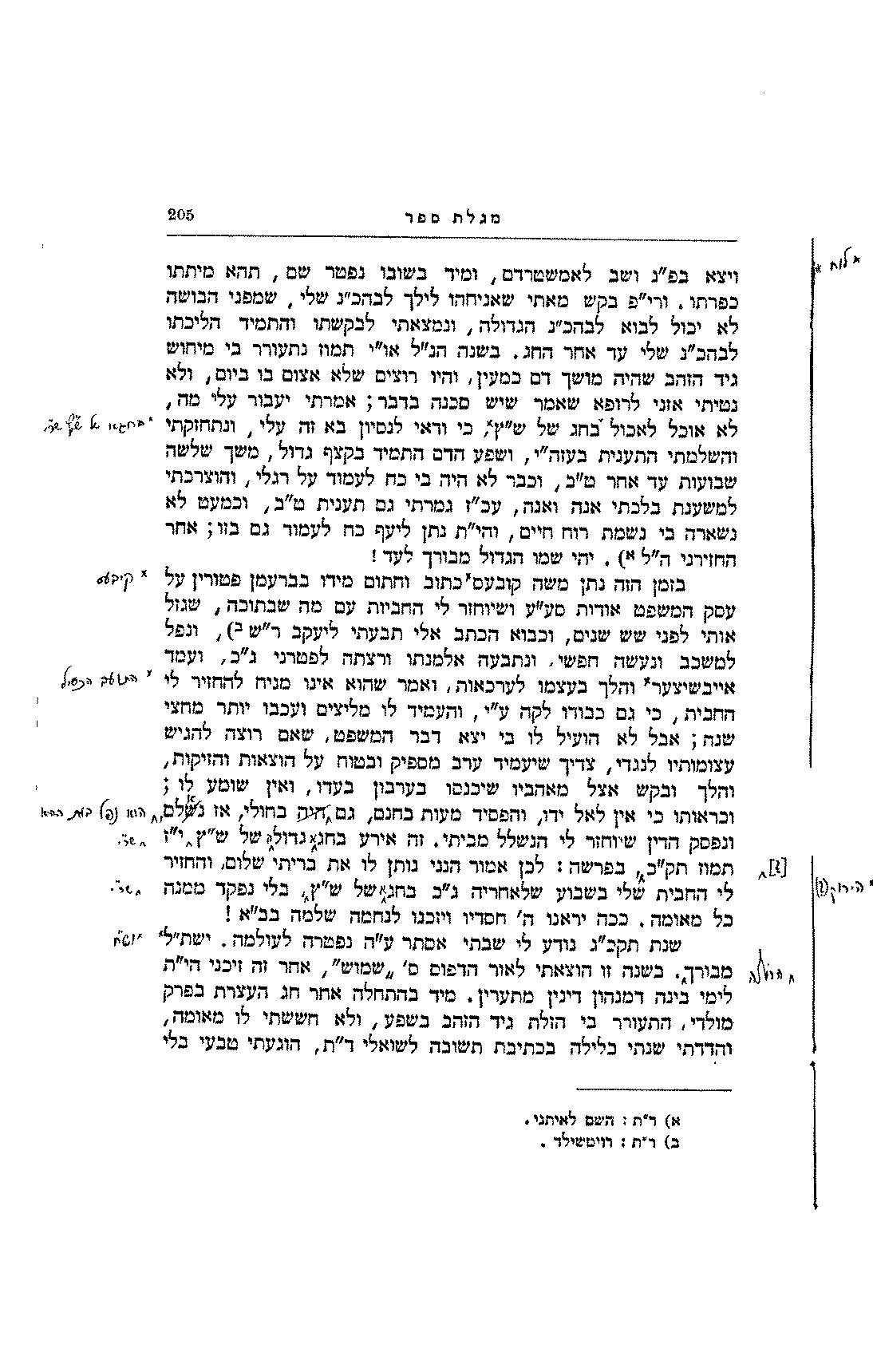
Margin readings in Scholem's copy (12)
| Printed anchor | Type (key sheet) | Mark | Reading | Certainty |
|---|---|---|---|---|
| לא אוכל לאכול בחג של ש"ץ x, כי ודאי | X: substitution | x mark after the word; 4-word note in left margin | בחגא של ש"ץ שר"י | fairly sure |
| נתן משה קובעס x כתוב וחתום מידו | X: substitution | x mark after the name; one word in left margin | קיבעס(?) | uncertain |
| ועמד אייבשיצר x והלך בעצמו לערכאות | X: substitution | x mark after the name; 2-word note in left margin | התועב הכסיל | fairly sure |
| גם ^ היה בחולי | V: omission | caret, and a stroke through היה | - | - |
| אז נשלם (letters written above the word) | — | letters written above the ש of נשלם | או | fairly sure |
| אז נשלם ^, ונפסק הדין | V: omission | caret; 4-word note in left margin | הוא נפל באות ההיא | fairly sure |
| זה אירע בחג גדול של ש"ץ | — | letter א added after בחג and after גדול (בחגא גדולא) | א / א | fairly sure |
| בחג גדול של ש"ץ ^ י"ז תמוז | V: omission | caret; one abbreviation in left margin | שר"י | fairly sure |
| י"ז תמוז תק"כ ^ בפרשה | V: omission | caret; bracketed query in right margin | [?] | fairly sure |
| בשבוע שלאחריה ג"כ בחג של ש"ץ ^, בלי נפקד | V: omission | caret; one abbreviation in left margin | שר"י | fairly sure |
| ישת"ל x מבורך | X: substitution | x mark after the abbreviation; one word in left margin | not read | not read |
| ישת"ל מבורך ^. בשנה זו | V: omission | caret; one word in right margin | מגולה(?) | uncertain |
Page 206 (scan 230)
any worry. But because of it I was in danger the next day, for it caused me a turning of the head, and I could not stand on my feet; for some hours I was forced to lie in bed, and a stir was made on my account, for I needed some medicine. For several days I was in great suffering, for I could not sleep at night because of the pain, until the Lord had pity on me: "he that is bent down shall speedily be loosed" (Isa. 51:14), and He did not let me go down to the pit. I heard the beating of the pulse very loudly, and it seemed to me as if someone were splitting wood in my neighbourhood; and it was only the beating of the pulse, knocking in my brain so hard that my ears thought a man was striking and hewing with an axe near me. I looked this way and that, and there was no one, until I understood that the striking and knocking were in my brain. So it was with me until the Lord had mercy on me. After I returned to health, my daughter, the girl fair of form and goodly to look upon and of good sense, who found favour in the eyes of all who saw her, fell ill with smallpox; her illness grew very heavy, and she too went to her world after she had completed four full [weeks], having been ill several times and each time returned to health, until her end came through the disease of pustules; and she caused me great wailing. "I remembered Thy judgments of old, O Lord, and have comforted myself" (Ps. 119:52)!
Near the end of this year, before the New Year 5524 [1763], very great and enormous bankruptcies took place in the Three Communities; there was truly not a man left of the money-changers and the great moneyed men who did not go into a great bankruptcy, except a very few. Most of those who fled, as good as all of them, were of the band of my enemies; only two or three "berries", young men just beginning, who were on my side, were also burnt by this coal. The state of trade in bills and credit was destroyed; the exchange fell to its foundation for about half a year, and to this day it has not returned to its former strength. Afterwards Hirsch Levi, parnas of the community of Altona, who had also formerly been one of the heads of my opponents, went bankrupt. After the festival Eybeschütz ⟨S: "the abominable"⟩ completed his work K[reti] u-P[leti] [a], and made presents of it on every side and corner, here and everywhere, and they say he made several thousands from it, although it was a laughing-stock and a mockery, and even the boys and young men wrote objections to it. At that time Eybeschütz ⟨S: "the abominable"⟩ fell gravely ill; they said he was given up for about three days, and he made a great commotion among his band. But I said to our people: Pray for him, that he may not depart from the world so, in honour, without repentance, God forbid, which would anger "those who dwell in the dust" (Isa. 26:19); and they would also make an abomination of him. Therefore entreat for him that he may repent and have a remedy, and if not [b], that he may not come to a Jewish grave. And so he returned to his life, which is no life; and he still prolongs his wickedness, and the hour still laughs for him the laughter of the fool. And he did wrong
שום דאגה, אבל הייתי מחמת זה בסכנה למחרת כי גרם לי ביום סבוב מהראש, ולא יכולתי קום על רגלי; איזה שעות הוכרחתי לשכב במטה, ונעשה רעש בעבורי כי הוצרכתי לתרופה קצת; אבל כמה ימים הייתי ביסורין עצומים, כי לא יכולתי לישן בלילה מחמת היסורים, עד שחמל ה' עלי מהר צועה להפתח, ולא נתנני לרדת שחת; ושמעתי מאד תנועת הדפק, והיה נדמה לי כאלו בוקע עצים בשכונתי, ולא היה רק תנועת הדפק, והקשתו במוחי בחזקה כל כך עד שהייתי חושב לאזני שיש איש מכה וחוטב בגרזן סמוך אלי, ואביט כה וכה ואין, עד שהבינותי שההכאה וההקשה הן במוחי; כך הי"ל עד שרחם ה' עלי. אחר שובי לבריאותי נפלה בחולי בלאטרן, בתי הילדה היפת תואר וטובת מראה וטובת שכל, שנשאה חן בעיני כל רואיה, וכבד חליה מאד והלכה גם היא לעולמה, אחר שהשלימה ארבעה [שבועות] שלמות, אחר שחלתה כמה פעמים, וכל פעם חזרה לבריאותה עד שהגיע קצה ע"י חולי אבעבועות, וגרמה לי יללה גדולה. זכרתי משפטי ה' מעולם ואתנחם! קרוב לסוף שנה זו קודם ר"ה תקכ"ד, נעשו בריחות גדולות ועצומות עד מאד בג"ק, ממש לא נשאר איש מהחלפנים ובעלי כיסים העצומים, שלא היו לפלטה גדולה, מלבד מתי מעט, ורוב הבורחים ככולם היו מכת שונאים שלי, רק שנים שלשה גרגרים אנשים בחורים מתחילים, אשר היו מצד שלי נכוו ג"כ בגחלת זו, ונהרס מצב מו"מ של ח"כ ונאמנות; הבערש נפל עד היסוד כחצי שנה, עד היום לא חזר לאיתנו כבראשונה; אח"כ הלך לפליטה הירש הלי פרנס ק"א, שהיה גם הוא א' מראשי מתנגדים שלי מלפנים. אחר החג השלים אייבשיצער חבורו כרו"פ א, ועשה ממנו דורונות בכל צד ופנה בכאן ובכ"מ, ואומרים שהרויח בו כמה אלפים, אע"פ שהיה לשחוק וללעג ועשו עליו השגות אפילו הנערים והבחורים. בו בפרק נפל אייבשיצער בחולי כבד, אמרו שהיה אחר יאוש כשלשה ימים, ועשה מהומה גדולה אצל כת שלו, אכן אני אמרתי לאנשים שלנו, התפללו בעדו שלא יפטר כך מן העולם בכבוד בלי תשובה חלילה, שירגיז שוכני עפר גם יעשו ממנו תועבה, לכן העתירו בעדו שיעשה תשובה ויהא לו תיקון, וא"ל א שלא יבוא לקבר ישראל, ובכן שב לחייו שאינו חיים, ועדיין הוא מאריך ברעתו ועוד השעה משחקת לו שחוק הכסיל. ועשה עול
- [א] ר"ת: כרתי ופלתי, נדפס באלטונא תקכ"ג.
- [ב] ר"ת: ואם לאו, והכונה ואם לא ישוב. ועיין בספרו התאבקות (דף נ"ט ע"ב).
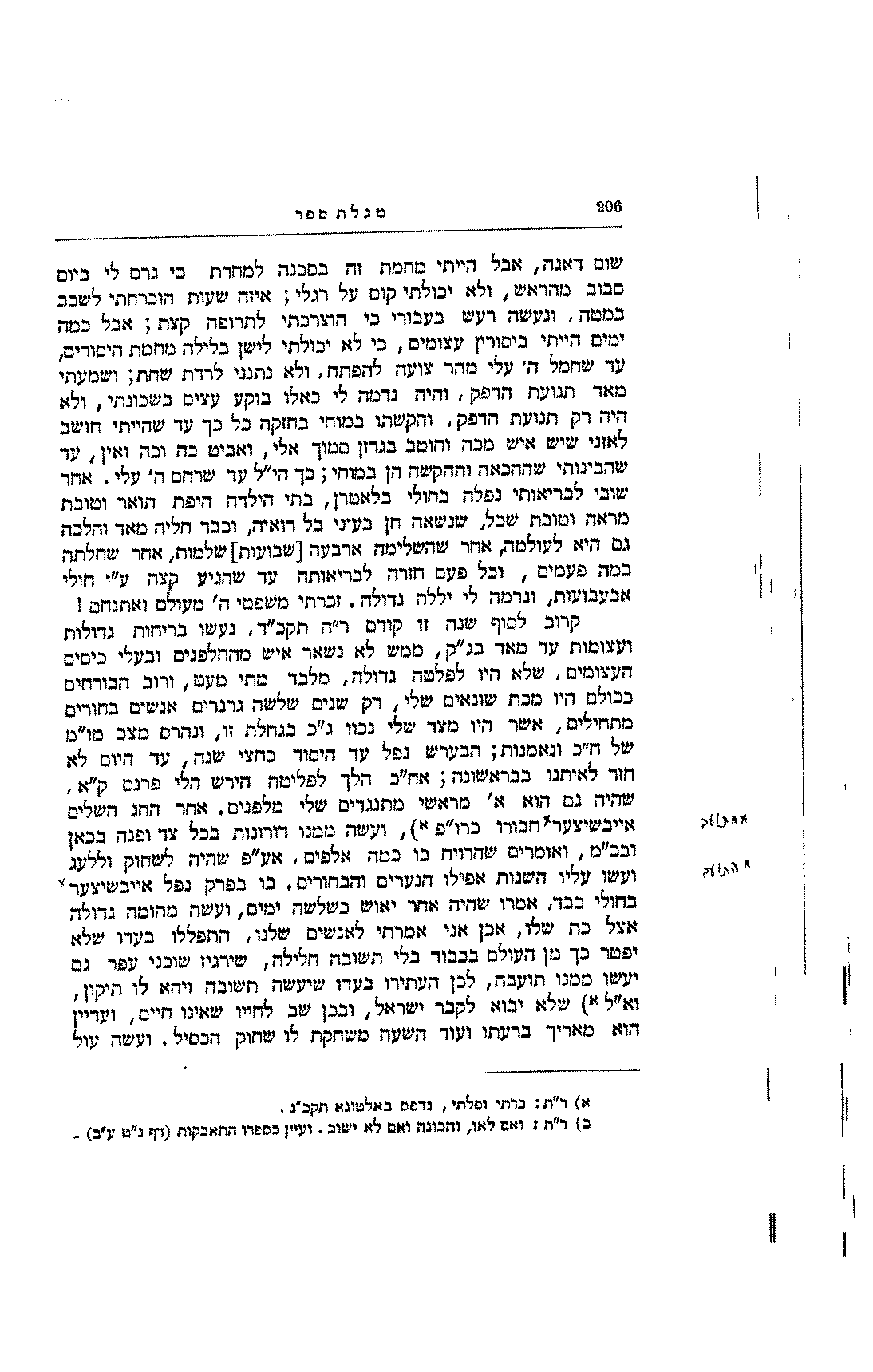
Margin readings in Scholem's copy (2)
| Printed anchor | Type (key sheet) | Mark | Reading | Certainty |
|---|---|---|---|---|
| אחר החג השלים אייבשיצר x חבורו כרו"פ [א] | X: substitution | x mark after the name; one word in right margin | התועב | fairly sure |
| בו בפרק נפל אייבשיצר x בחולי כבד | X: substitution | x mark after the name; one word in right margin | התועב | fairly sure |
Page 207 (scan 231)
and violence to many people, who cry out about his violence in matters of lawsuits, which he conducts as he pleases against the agreement of the court and the community; and they are not answered: he does as he pleases, and "there is none to stay his hand" (Dan. 4:32). At the end of this summer, with God's help, I completed the first part of the book M[or u-]K[etzi'ah] on Oraḥ Ḥayyim.
At that time emissaries came here from Chotin for the support of the proselytes of Russia, who had joined them these four years, as mentioned at the end of the book Shimmush: at that time about forty men began to come, and from then on they went on increasing from week to week, and were added to by fifties and hundreds, going round and about by a long crooked way until they come to Chotin; and the place is too narrow and small to hold them. So they were compelled to send their emissaries to collect the donations of the communities in the land of Germany. When they came here they turned aside to me — at once they came to my house — and would not go to Eybeschütz ⟨S: "the abominable"⟩, because they knew and recognised all the deeds he had done, and the conspiracy he had conspired against the Lord with the accursed sect of Sh. Tz. ⟨S: "m[ay the name of the wicked] r[ot]"⟩ in Podolia, for they are near to the great desecration done there. They also told that his many writings, the work of the hands of Eybeschütz ⟨S: a four-line note: "the many writings of heresy, the work of the hands of this abominable heretic"⟩, were found there, and many of them were burnt there in the holy community of Chotin; and some also remained in the hands of this one and that one who had served him ⟨S: a word, partly read: "by mistake"(?)⟩. There are also some of his relatives there who had his writings ⟨S: "writings of heresy"⟩ in their hands and spread them there. Because of these things these men would not look upon his likeness ⟨S: "wicked men"(?)⟩; they are whole and faithful in their mission, and they said: We are emissaries of a commandment, not emissaries of a transgression. And although evil men pressed them hard to persuade them to go to him, and many frightened them that if they did so they would have great benefit in the business of their mission, and if not they would lose, the emissaries paid no heed to these words, and all his friends could not turn them from their resolve. And they made a great sanctification of the Name [a], such as had not been made in all the years of the Lord's quarrel. For this reason they were not given even one penny from the chest of the community of Altona; but the community of Hamburg did well this time: they did not turn to the community of Altona, and did not hold back from this great commandment, and gave from the community's purse twenty specie ducats for the needs of the proselytes ⟨S: "and they received two ducats"(?)⟩. Besides this I appointed for them two respected householders in the community of Altona and two in the community of Hamburg to go round the doors of the generous for the provision of the proselytes, so that the sum collected in all, together with the above, came to about eighty ducats, handed over to me. I paid for the keep of the emissaries, who were compelled to stay here from before the festival of Unleavened Bread 5524 [1764] until after the festival of Weeks, and about fifty ducats were left in their hands, to send to those in charge of the proselytes in Chotin.
At that time my son-in-law R. M. came here and stayed in my house all the days of this Nisan; then he travelled to Berlin, and after some days he came back here, and I sent by him a certain sum
Kahana's notes
- [a] The abbreviation [stands for] kiddush ha-Shem (sanctification of the Name).
וחמס לכמה ב"א, הצועקים חמס מפניו בעניני משפטים שעושה כרצונו, נגד הסכמת הב"ד והקהל ואינים נענים, עושה כרצונו ולית דימחא בידיה. בשלהי קייטא דנא השלמתי בעזה"י ח"א מספר „מו"ק" א"ח. בו בפרק באו הנה משולחים מחאטין, לצורך פרנסת הגרים של רוסיא, שנלוו אליהם זה ארבע שנים כנזכר בסוף ספר "שמוש", שאז התחילו לבוא כארבעים איש, ומן אז והלאה הולכים ומתרבים מדי שבוע בשבוע, ונוספים לחמשים חמשים ולמאות, סובבים ומקיפים בדרך עקלתון ארוך עד שבאים לחאטין, והמקום צר קטן מהכיל אותם, והוכרחו לשלוח שלוחיהם לקבץ נדבת הקהלות בארץ אשכנז, וכבואם הנה סרו אלי, מיד באו לביתי, ולא אבו ללכת אל אייבשיצער בידעם והכירם כל מעשיו אשר עשה, וקשרו אשר קשר על ה' עם הארורים כת ש"ץ בפאדאליע, כי קרובים המה אל החלל הגדול הנעשה שם. גם ספרו שנמצאו שם כתביו הרבים, מעשה ידי אייבשיצער והרבה מהם שרפו שם בק"ק חאטין, ונשארו ג"כ ביד מי ומי ששמשו אותו. גם יש מקרוביו שם שהיו בידיהם כתביו והפיצום שמה; בגלל הדברים האלה לא רצו האנשים האלה להסתכל בדמותו, שלמים הם ונאמנים בשליחותם, ואמרו אנן שלוחי מצוה ולא שלוחי עבירה, ואע"פ שהרבו עליהם רעים לרצותם שילכו אליו, ורבים מיראים אותם שאם כה יעשו, יהא להם תועלת גדולה בעסק שליחותם ואם לאו יפסידו, לא השגיחו השלוחים בדברים הללו, ולא יכלו כל אוהביו להחזירם מדעתם, ועשו ק"ה א גדול שלא נעשה כמוהו בכל שנות הריב לה'. בשביל כך לא נתנו להם מקופת קהל אלטונא אף פרוטה אחת, אך קהלת המבורג עשו הפעם בטוב לא פנו אל ק"א, ולא מנעו עצמן ממצוה רבה זו. ונתנו מכים הקהל עשרים דוקאטען שפעציא לצורך הגרים. מלבד זה העמדתי להם שני ב"ב נכבדים בק"א ושנים בקה"ב, שיסבבו על פתחי נדיבים לצורך הספקת הגרים, באופן שעלה סך המקובץ בכלל עם הנ"ל יחד כשמונים דוקאטין נמסר בידי, ושלמתי בעד פרנסת השלוחים שהוכרחו להתעכב פה, מן קודם חג המצות תקכ"ד עד אחר חג השבועות, ונשארו בידם כחמשים דוקאטין, לשלחם ליד הממונים על הגרים בחאטין. בו בפרק בא הנה חתני ר"מ ועמד בביתי כל ימי ניסן הלז, אחר נסע לברלין ואחר איזה ימים שב לכאן, ושלחתי על ידו סך מסוים
- [א] ר"ת: קידוש השם.
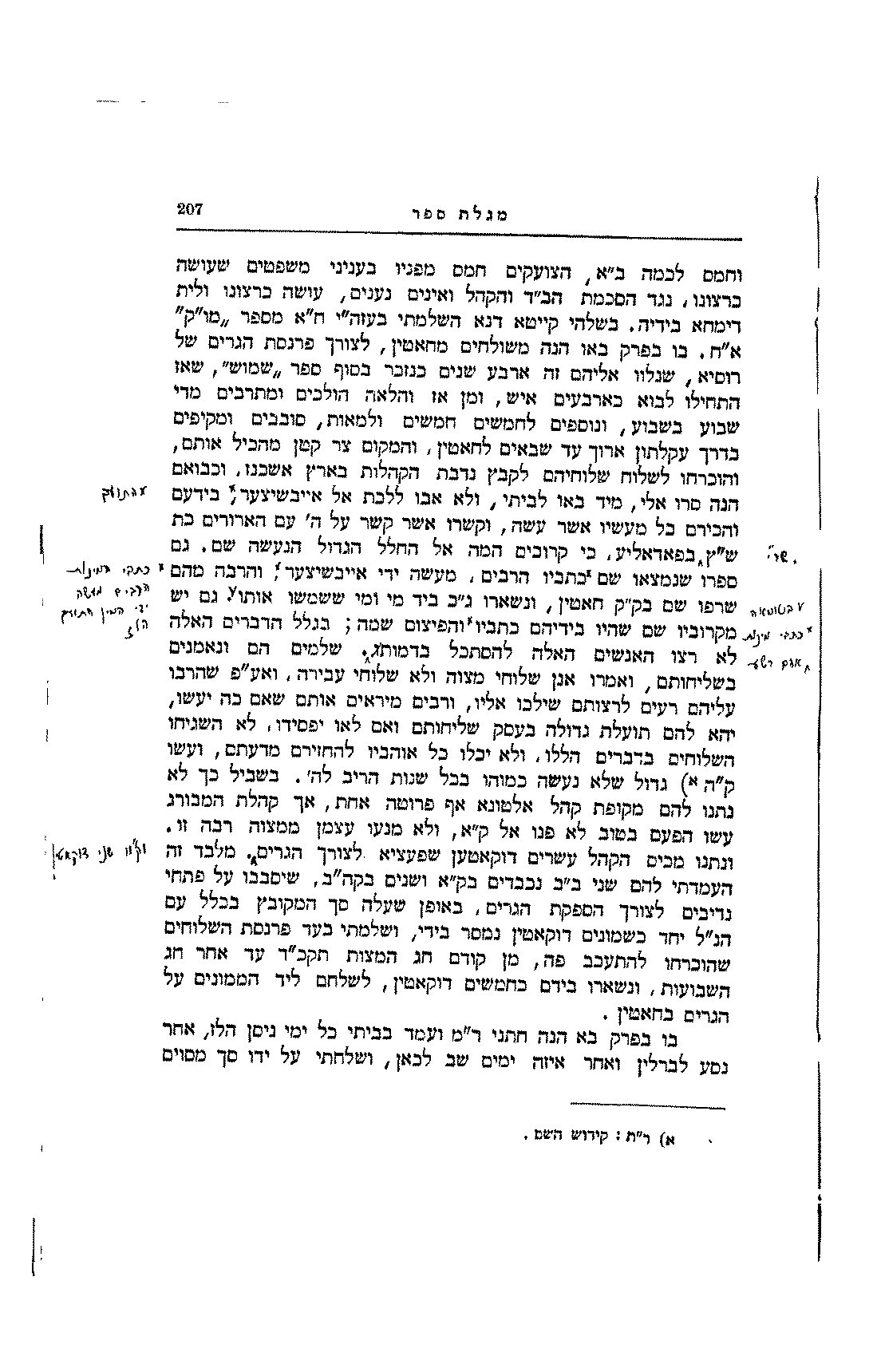
Margin readings in Scholem's copy (7)
| Printed anchor | Type (key sheet) | Mark | Reading | Certainty |
|---|---|---|---|---|
| ולא אבו ללכת אל אייבשיצער x בידעם | X: substitution | x mark after the name; one word in left margin | התועב | fairly sure |
| עם הארורים כת ש"ץ ^ בפאדאליע | V: omission | caret; one abbreviation in right margin | שר"י | fairly sure |
| גם ספרו שנמצאו שם כתביו הרבים, מעשה ידי אייבשיצער x, והרבה מהם | X: substitution | x mark after the name (covering the words before it); 4-line note in left margin | כתבי המינות / הרבים מעשה / ידי המין התועב / הלז | fairly sure |
| ונשארו ג"כ ביד מי ומי ששמשו אותו ^ גם יש | V: omission | caret (drawn as v); one word in right margin | בטעות(?) ... | partial |
| שהיו בידיהם כתביו x והפיצום שמה | X: substitution | x mark after the word; 2-word note in right margin | כתבי מינות | fairly sure |
| לא רצו האנשים האלה להסתכל בדמותו ^, שלמים הם | V: omission | caret; 2-word note in right margin | אנשי רשע(?) | uncertain |
| עשרים דוקאטען שפעציא לצורך הגרים ^, מלבד זה | V: omission | caret; 3-word note at the right edge (gutter) | וקבלו שני דוקאטן(?) | uncertain |
Page 208 (scan 232)
of my works, to the value of two hundred Reichstaler, at the price at which I usually sell them. While this one was going, that one came: my son-in-law R. A. with his wife, my daughter Neḥamah, may she live, thinking that she would return "to her father's house, as in her youth" (Lev. 22:13) [a], for he hated her and wanted to divorce her with a bill of divorce. These two daughters, who had been betrothed at the same time with great acclaim, seemed in my eyes like the tablets that were broken. This happened at the end of the said year of "judgments", and I entered the year of "life" by the kindness of the Lord [b]. May it be His will that I renew my youth like the eagle (Ps. 103:5), and that He grant me in His great mercy and kindness years of long and blessed life for His service, His fear and His Torah, in place of the years of trouble and evil that passed over me without my finding rest and repose. For hardly a moment have I tasted the taste of a life of contentment in the world, neither in body nor in soul nor outside the body, neither in my toil and labour nor in "my strength and the first of my vigour" (Gen. 49:3). I did not see even one joy of the eighteen marriages; only "my soul is full of troubles" (Ps. 88:4), "I am weary with my groaning" (Ps. 6:7) "and I find no rest" (Jer. 45:3). "Mine eyes fail while I wait for my God" (Ps. 69:4): when will He comfort me for my agitation and my grief ⟨S: a four-line note, partly read: "… the great … who already … the abominable heretic, the evil one, m[ay the name of the wicked] r[ot]"⟩? In the Lord my heart trusts: He who has shown me troubles and evils will again comfort me, "and bring me up again from the depths of the earth" (Ps. 71:20), to dwell in honour in our land. May He grant me to bear fruit in a good old age and to serve Him in truth, in gladness of heart, on the holy soil, to see the good of His chosen ones who act out of love. May it be His will!
On the third of the month of Av of this year Eybeschütz ⟨S: "the abominable heretic, the old sinner"⟩ again fell suddenly into the illness of the mute [c], and there was a great commotion in his house for some days; and at the end of Elul ⟨S: a seven-line note, partly read: "the abominable one croaked … perished in vessels of wrath(?) … his croaking … "; it also gives insertions marked 3 and 4, below⟩ Eybeschütz died. And Sh.Ḥ.L.Ḥ.(?) this matter will be written at length on a separate paper. "They that come after shall be astonished at his day" (Job 18:20). His filth has not ceased to this day. They set up a tombstone over his grave ⟨S: a numbered note in the left margin, not read⟩; they also made ⟨S: "a monument(?)"⟩ of him a likeness of his form ⟨S: a numbered note in the left margin, partly read⟩, "painted with vermilion" (Jer. 22:14); and the fools and idiots who cleave to him ⟨S: a numbered note in the left margin, partly read: "… a memorial(?) …"⟩ hug and kiss it ⟨S: "… (3) …, vomiting(?)", partly read⟩. One man put the paper on which the cursed image was ⟨S: "(4) the abominable"⟩ inside a Pentateuch, at the place of the Ten Commandments.
A scholar from Lithuania went mad on his account, when his pupil brought him an amulet that his father had found in a box he bought from the estate ⟨S: "this heretic"⟩ of Eybeschütz ⟨S: "m[ay the name of the wicked] r[ot]"⟩; and it was found written in it that he adjured in the name of Shabbetai(?) [d] Tzvi and in the name of Jonathan son of Shindel. Through this that teacher went out of his mind; he was still young in years, and had also occupied himself with external sciences, and had gone deeper in knowledge than was fitting for him, so that his brain had already been weakened before this and he could not bear it ⟨S: a two-line note, partly read: "and he cursed and reviled the … without pause"⟩. He also did a mad deed, so that they put him into the asylum in Altona; but they did not watch him properly, and did not
Kahana's notes
- [a] The abbreviation [stands for] "to her father's house".
- [b] The year of "judgments" means the year [5]524 [1764]; and then he entered the year of "life", for he was sixty-eight, which in gematria is ḥayyim ("life").
- [c] The illness of the mute: Schlag (stroke) in German. See Edut be-Ya'akov (fol. 11b).
- [d] See the book T[orat] ha-K[ena'ot] (p. 102), Lemberg printing.
מחבורי בערך ב"מ ר"ט, כפי המקח שאני נוהג למכרם. עוד זה הלך וזה בא חתני ר"א עם זוגתו בתי נחמה תי', בחשבו שתשוב לב"א כנעוריה א, כי שנא אותה ורצה לפוטרה בג"פ ונדמו בעיני שתי הבנות הללו שנשתדכו בבת אחת בקול גדול, כחרם לוחות שנשתברה. זה היה מעשה בתום שנת "דינין" הנ"ל, ונכנסתי לשנת „חיים" בחסד ה' ב, יהר"ם שאחדש כנשר נעורי, ויזכני ברוב רחמיו וחסדיו, לשנות חיים ארוכים וברוכים לעבודתו ליראתו ולתורתו, תחת שנות הצרות והרעות אשר עברו עלי, בלי מצוא מנוח ונופש. אף כמעט רגע לא טעמתי טעם חיי קורת רוח בעולם, לא בגוף ולא בנפש ולא מחוץ לגוף, לא בעמלי ויגיעי, לא בכחי וראשית אוני, לא ראיתי אפילו שמחה אחת של י"ח הנשואים, רק שבעה ברעות נפשי יגעתי באנחתי ומנוחה לא מצאתי; כלו עיני מיחל לאלהי מתי ינחמני מרגזי ומעצבוני; בה' בטח לבי, אשר הראני צרות ורעות ישוב ינחמני, ומתהומות הארץ ישוב יעלני, לשכון כבוד בארצנו, יזכני לנוב בשיבה טובה ולעבוד אותו באמת, בשמחת לבב על אדמת הקודש, לראות בטובת בחיריו העושים מאהבה. כ"י! בשלשה לירח אב שנה זו, חזר אייבשיצער ונפל בחולי שתוק פתאום ג, והיתה מהומה גדולה בביתו איזה ימים ובסוף אלול מת אייבשיצער ושחל"ח, יכתב ענין זה בנייר בפ"ע באורך. על יומו נשמו אחרונים. ע"ע לא פסקה זוהמתו. הציגו על קברו מצבה, גם עשו ממנו דמות צורתו משוח בששר, והכסילים האוילים הנצמדים אליו מחבקים ומנשקים אותה. איש אחד הניח הנייר שבו הצורה הארורה, בתוך חומש על מקום עשרת הדברות. למדן אחד מבני ליטא נשתגע על אודותיו, באשר הביא לו תלמידו קמיע, מה שמצא אביו בתוך תיבה שקנה מעזבון אייבשיצר ונמצא כתוב בה שמשביע בשם שבאם ד צבי, ובשם יונתן בן שינדל; עד"ז יצא מדעתו המלמד ההוא, שהיה עדיין רך בשנים ועסק גם בחכמות חיצוניות, והעמיק בידיעות יותר מהראוי לו, עד שהוחלש מוחו כבר קודם זה ולא יכול לסבול, גם עשה מעשה שגעון, עד שהכניסוהו בבית החפשית באלטונא, אבל לא נזהרו בו כראוי ולא
- [א] ר"ת: לבית אביה.
- [ב] שנת "דינין" הכונה שנת תקכ"ד, ואז נכנס לשנת "חיים" כי היה בן ס"ת בגימ' חיים.
- [ג] חולי שתוק, שלאך בלשון אשכנז, עיין עדות ביעקב (דף י"א ע"ב).
- [ד] עיין בס' תה"ק (צד ק"כ) דפוס לבוב.
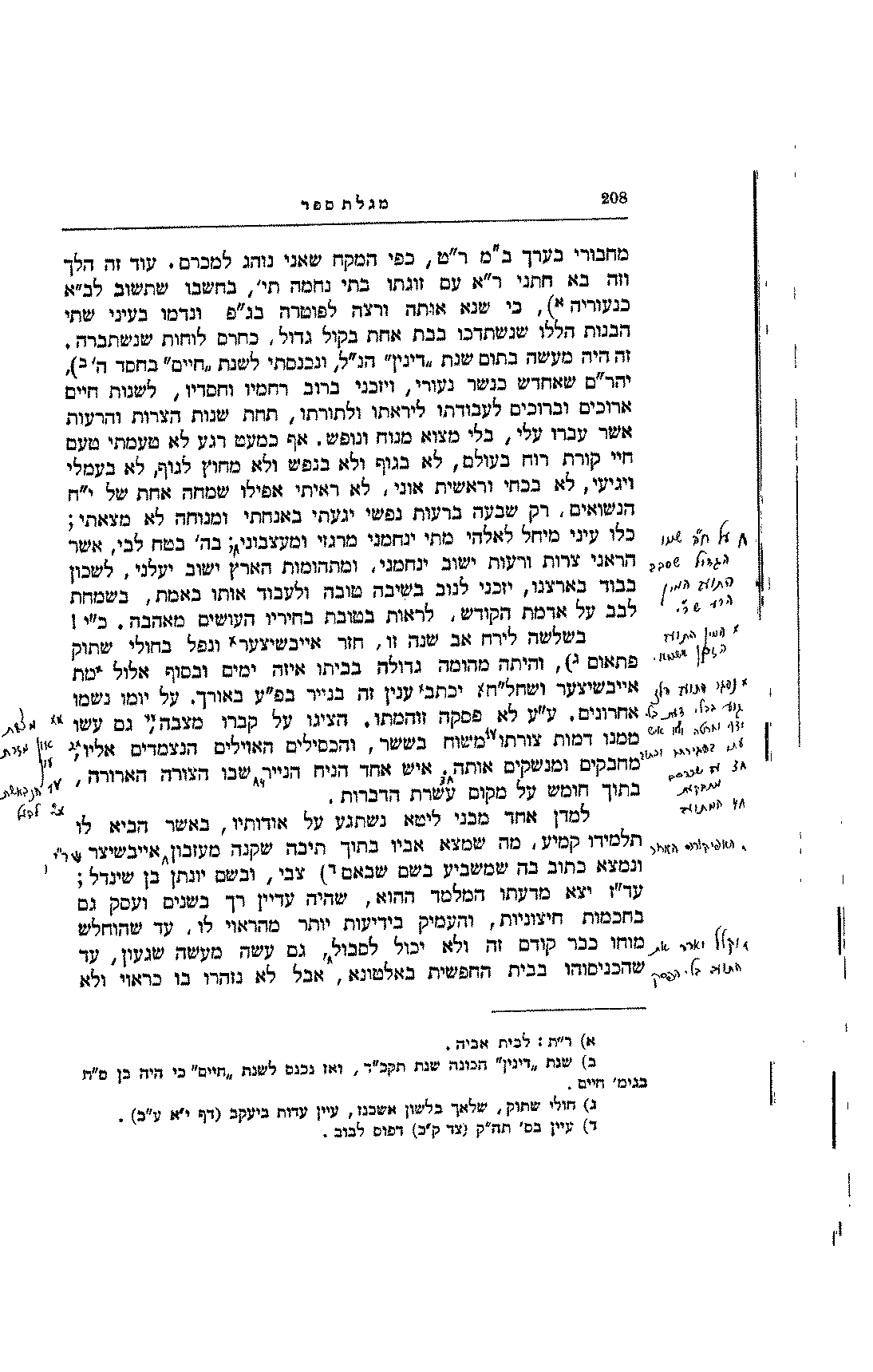
Margin readings in Scholem's copy (12)
| Printed anchor | Type (key sheet) | Mark | Reading | Certainty |
|---|---|---|---|---|
| מתי ינחמני מרגזי ומעצבוני ^; בה' בטח לבי | V: omission | caret; 4-line note in right margin | על חד(?) שנו(?) / הגדול שכבר(?) / התועב המין / הרע שר"י | partial |
| חזר אייבשיצער x ונפל בחולי שתוק פתאום | X: substitution | x mark after the name; 2-line note in right margin | המין התועב / הזקן אשמאי | fairly sure |
| ובסוף אלול x מת אייבשיצער | X: substitution | x mark before מת; 7-line note in right margin, the last lines numbered 3 and 4 (see the rows for ^3 and ^4) | נפגר התועב הלז / גוע בכלי(?) ... / ... / ... לפגירתו(?) ... / [3 and 4: see below] | partial |
| הציגו על קברו מצבה x1 גם עשו | X: substitution | x mark numbered 1; note in left margin | not read | not read |
| גם עשו xx ממנו דמות צורתו | X: substitution | double x mark; one word in left margin | מצבת(?) | uncertain |
| ממנו דמות צורתו ^1 משוח בששר | V: omission | caret numbered 1; note in left margin | ... התנבאות(?) ... | partial |
| והכסילים האוילים הנצמדים אליו x2 מחבקים | X: substitution | x mark numbered 2; 3-line note in left margin | ... / מזכרת(?) / ... | partial |
| מחבקים ומנשקים אותה ^3, איש אחד | V: omission | caret numbered 3; note in right margin (part of the long note) | ... שכבים(?) / מתקיא(?) | partial |
| איש אחד הניח הנייר שבו הצורה ^4 הארורה | V: omission | caret numbered 4; one word in right margin (end of the long note) | המתועב | fairly sure |
| שקנה מעזבון ^ אייבשיצר | V: omission | caret; 2-word note in right margin | והאפיקורוס הזה(?) | uncertain |
| מעזבון אייבשיצר ^ ונמצא כתוב בה | V: omission | caret; abbreviation written beside the name | שר"י | fairly sure |
| ולא יכול לסבול ^, גם עשה מעשה שגעון | V: omission | caret; 2-line note in right margin | ויקלל וארר את(?) / התורה(?) בלי הפסק | partial |
Page 209 (scan 233)
set a guard over him. Once he went out and dug up the grave of Eybeschütz ⟨S: "the abominable"⟩, and had almost reached his coffin, had they not seen him and found him busy digging the grave; they stopped him by force, brought him back to the prison and put him in chains. Afterwards they took the chains off him and left him to himself, for they thought his mind had settled, since he was always saying holy words. Several times he said that he wanted to immerse himself; and when he saw himself without a guard, he went out and ran to a place of water and immersed himself in it. But he sank in it, and wanted to save himself by catching hold of something ⟨S: a short word beside the line, perhaps "אל"(?)⟩, as a gentile who saw him from afar testified; but he could not, for he was weak, and he drowned at once. They brought him to a Jewish grave with honour; they gave him a great funeral close to the coming in of the holy Sabbath. The year [5]529 ⟨S: "the year [5]525"⟩.
In Shevat the Three Communities assembled about the appointment of a new rabbi, and many wanted to bring me back to the inheritance of my fathers. When they stood to vote, to draw up a list of those worthy of this mantle, a quarrel arose among them about me, and the majority was almost on my side; and so it would surely have been, had they done this thing openly: no other man would have been appointed rabbi of the Three Communities this time. But three of my enemies ⟨S: "sinners of Israel"(?)⟩ acted cunningly — namely the chief ruffian Yeḥielke Wolf, Jacob Schlesinger and Hertz Stör — and they broke up that meeting. Afterwards they schemed to carry out their plot: to persuade those assembled to meet again afresh on this matter, and to collect the opinions in secret, hidden altogether; that is, by making different kinds of balls, so that one would indicate yes and the other no. They made two boxes of the balls, so that each of the electors would take one, to express his opinion, taking whichever ball he wished in secret, without anyone seeing from which he took it, and put them in the ballot box; afterwards they would count the balls and see which had the majority. They all agreed to this. Meanwhile the said opponents went and enticed and incited some of them, until one or two came over to their side — perhaps with "pieces of silver" (Ps. 68:31) they were won over to go back and betray me — and they no longer worried, since in any case it would not be known who it was that had gone back on his former opinion and refused me. So they did, and they succeeded in what they wanted, to remove me from the number of the worthy. Now they thought they had already succeeded also in choosing Joseph "who honours the Sabbath" Steinhardt, head of the court of Fürth, and they regarded him as if it were already done. But [they erred]: for afterwards, when they appointed electors to receive the new rabbi, although it seemed to all that the majority was on their side, yet it was from the Lord that some of them sought to learn which way my opinion inclined; and so I had to give my opinion and agreement for the rabbi of Brody, for several reasons, until we succeeded and this man was chosen rabbi of the Three Communities through me, with the help of Heaven.
In the month of Nisan my son, the rabbi our teacher R. Meshullam Zalman, may his light shine, was received as rabbi and head of the court of the holy community of
שמו עליו משמר. פ"א יצא לחוץ וחפר קברו של אייבשיצער, כמעט קט הגיע לארונו, לולי שראוהו ומצאוהו עוסק בחפירות הקבר, ומנעוהו בכח והחזירוהו לבית האסורים וכבלוהו, אחר נטלו הכבלים ממנו ועזבוהו לנפשו, כי חשבוהו שנתיישבה דעתו, שהיה אומר תמיד דברי קדושה, ואמר כ"פ שרוצה לטבול עצמו, ויהי כי ראה עצמו בלי שמירה, יצא ורץ עד מקום המים וטבל בהם, אבל שקע בהם ורצה להציל עצמו לאחוז באיזה דבר, כאשר העיד נכרי שראהו מרחוק, אבל לא יכול כי היה חלש ונטבע מיד, והביאוהו לקבר ישראל בכבוד. לויה גדולה עשו לו סמוך לכניסת שבת קדש. שנת תקכ"ט. בשבט התועדו ג"ק על אודות מינוי רב חדש, והיו רבים חפצים להשיבני לנחלת אבותי, וכשעמדו למנין לעשות רשימה מהראוים לאצטלא זו, נעשית מריבה ביניהם על אודותי, וכמעט היה הרוב על צדי, וכך היה בודאי אם היו עושים דבר זה בגלוי, לא היה אדם אחר עולה להתמנות רב בג"ק בפעם הזאת; אכן התחכמו שלשה מאויבי, הלא הם ריש בריוני יחילכי וואלף, יעקב שלעזינגר, הירץ שטאר, ובטלו הוועד ההוא; אח"כ התחבלו להפיק מזמתם לדבר על לב הנועדים לשוב להתועד מחדש על עסק זה, ולקבץ דעות בהסתר והעלם מכל וכל, דהיינו ע"י שיעשו מיני עגולים שונים, באופן שהאחד יורה על הן והשני על לאו, ועשו שתי קופות מהעיגולים, כדי שיקח כל אחד מהנבררים לחות דעתו, באופן שיקח אחד מהעיגולים שירצה בהסתר, בלי שיראה אדם מאיזה הוא לוקח ומניחם בקלפי, אח"כ ימנו העיגולים ויראו מאיזה הרוב, ונתרצו יחד בזה, ובתוך כך הלכו המתנגדים הנ"ל, ופתו והסיתו קצתם עד שסרו למשמעתם אחד או שנים; אולי ברצי כסף נתרצו להם לחזור בהם ולבגוד בי, ולא דאגו מעתה כי עכ"פ לא יודע מי הוא אשר חזר בו מדעתו הקודמת ומאן בי, ועשו כן והצליח בידם מה שרצו לסלקני מן מנין הראוים. מעתה חשבו שכבר עלה בידיהם ג"כ, לבחור ביוסף מוקיר שבתא שטיינ' אב"ד מפירדא, וחשבוהו כאלו הוא כבר אחר מעשה, אבל [טעו] כי אחר זה כשעשו בוררים לקבל הרב החדש, ואע"פ שהיה נדמה לכל שהרוב היה לצדם, אכן מה' היתה שקצתם בקשו לעמוד על דעתי להיכן נוטה, וע"כ הוצרכתי לתת דעתי והסכמתי להרב מבראד מכמה טעמים, עד שעלתה בידנו ונבחר זה האיש לרב דג"ק על ידי בס"ד. בחדש ניסן נתקבל בני הרב כמ"ו משלם זלמן נר"ו, לרב ואב"ד דק"ק
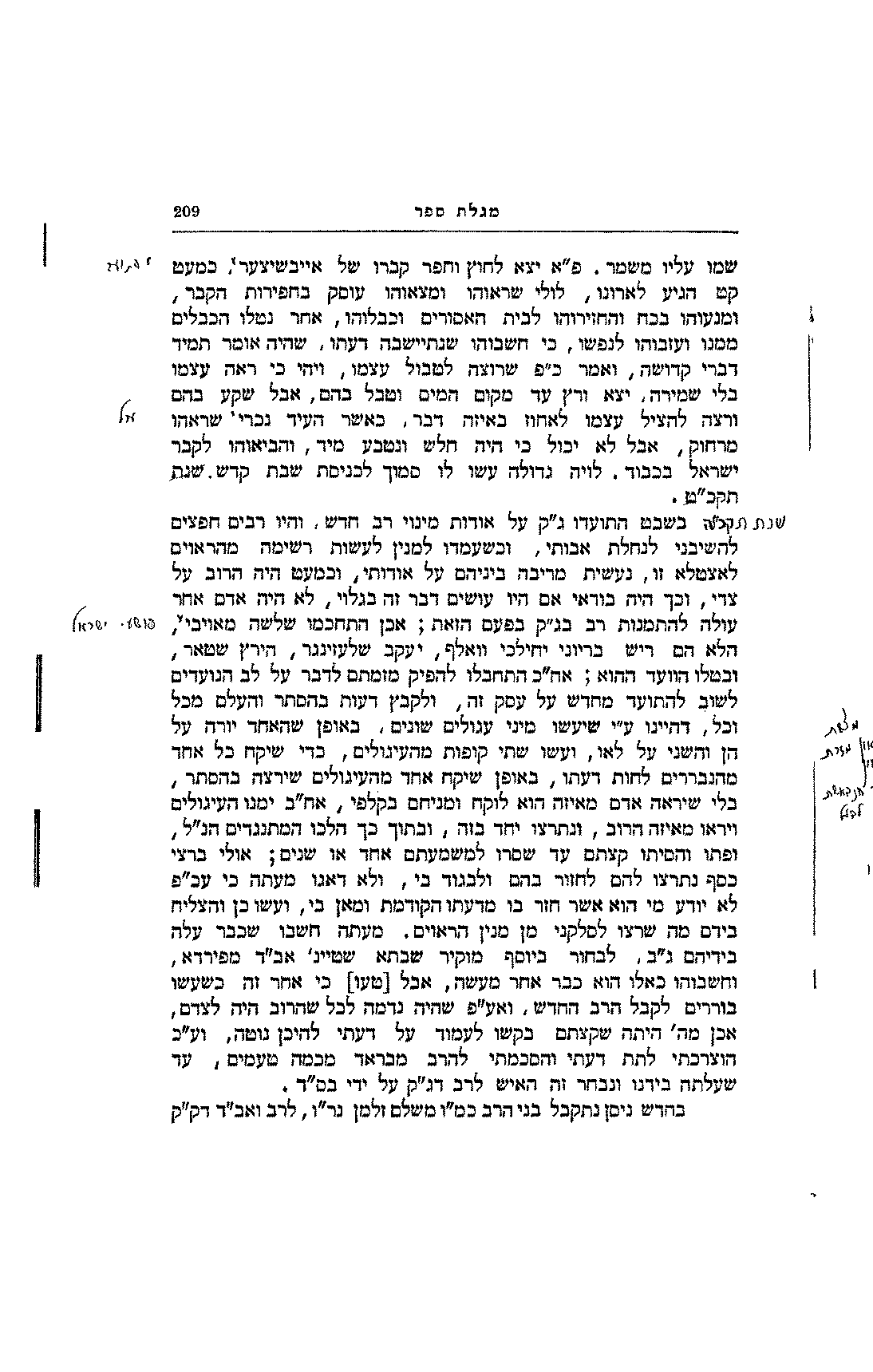
Margin readings in Scholem's copy (4)
| Printed anchor | Type (key sheet) | Mark | Reading | Certainty |
|---|---|---|---|---|
| וחפר קברו של אייבשיצער x, כמעט קט הגיע | X: substitution | x mark after the name; one word in margin | התועב | fairly sure |
| ורצה להציל עצמו לאחוז באיזה דבר (no mark seen) | — | no mark seen; one word in margin beside the line | אל(?) | uncertain |
| לכניסת שבת קדש. שנת תקכ"ט. | — | the printed date is underlined/struck, and a date is written in the margin before the next paragraph | שנת תקכ"ה | fairly sure |
| אכן התחכמו שלשה מאויבי x, הלא הם | X: substitution | x mark after the word; 2-word note in margin | פושעי(?) ישראל(?) | uncertain |
Page 210 (scan 234)
the Hamburg [synagogue] in London [a] — also through my effort and work, with God's help, for some time; and it had already been given up, for he had several opponents on the side of the holy congregation of Duke's Place, who had separated from them and taken for themselves as head of the court R. T[evele] Schiff of Frankfurt am Main. But "this was from the Lord; it is marvellous in our eyes" (Ps. 118:23), that all the cunning and plotting of the opposing side to cancel his appointment were of no avail. Even after he had already been accepted properly and in due form, some individuals of the said side conspired against him and wrote him a letter of rebellion and refusal, with a warning not to come to them, for they would refuse him. This was done through the go-between, "the disgrace of the generation", a pupil of A. A. ⟨S: "the abominable, m[ay the name of the wicked] r[ot]"⟩, who is there; he exerted himself in this and also sent such a gathered and tangled letter by the post, thinking to frighten and alarm me, so that I would keep my son from going there. But the other side, who wanted him, encouraged and urged me on this, not to heed the deceitful doings of the opponents; and so I did, and warned my son not to turn to the words of the ugly letter. And he did and prospered, thank God: he came here, and spent this festival of Weeks with them, and all the notables of the Three Communities did him honour, and he found favour in the eyes of all who saw him. He travelled from here and reached the place of his desire and the seat of his honour in the middle of Tammuz, and was received with great honour, and they rejoiced in him "as with the joy in harvest" (Isa. 9:2). "The people that walked in darkness have seen a great light" (Isa. 9:1), and they praised him greatly. Letters reached me from there that even the enemies had turned into friends, and they are glad and rejoice in him "as the bridegroom rejoices over the bride" (Isa. 62:5). May it be the will of the Master of mercy that he prosper and rise higher and higher, to bring merit to himself and to others with him, and that He grant him sons, and gladden me with my descendants, may they live, in general and in particular. May it be His will. Amen!
At that same time I set up in the town of Gens(?) [b] the scholar R. Joshua Lipschitz, who had been persecuted on account of my ruling which I had asked him about words of Torah; and with God's help I brought him to a place of rest with honour.
In this summer a letter reached me from the rabbi of P. about Nathan Arhaltzer(?), the pupil of ⟨S: "the abominable"⟩ Eybeschütz, the teacher ⟨S: a word, not read⟩ in Stampfen(?), who set up "an Asherah" ⟨S: "a statue"(?)⟩ to Eybeschütz; and he asked me for a confirmed deposition of testimony from the wicked young men, and I did not succeed in it. And the new rabbi, our teacher R. Isaac, who had been head of the court in Brody, came here.
On the seventh of Tishri of the year 5526 [1765] the Lord stirred up my spirit to be zealous with His zeal, after the idolatry, after his abomination ⟨S: "Sh. Tz., m[ay the name of the wicked] r[ot]"⟩, since Eybeschütz had left evil roots ⟨S: "m[ay the name of the wicked] rot"⟩ to teachers ⟨S: "to teachers of heresy"⟩ in Israel. And so I arose and took heart, blessed be the Name, in my synagogue, on the fast day ⟨S: a note, partly read: "…"(?)⟩
Kahana's notes
- [a] He means that he became rabbi and head of the court in the Hamburg synagogue in the city of London; see the book Kelilat Yofi (p. 94).
- [b] In my opinion one should read: "in the town of Gens"; in the manuscript it says בע"ר גענז.
המבורג שבלונדון א, ג"כ ע"י השתדלותי ופעולתי בעזה"י זמן מה, וכבר היה אחר היאוש, כי הי"ל כמה מתנגדים מצד בה"ק דוקספלעס, שנפרדו מהם וקבלו לעצמם אב"ד ר"ט שיף מפפד"מ, אבל מאת ה' היתה זאת היא נפלאת בעינינו, שלא הועילה כל התחכמות והתנכלות הצד המתנגד לבטל מנוייו; גם אחר שכבר נתקבל בהכשר כהוגן, קשרו עליו קשר וכתבו לו איזה יחידים מן הצד הנ"ל, אגרת מרד ומיאון בהתראה שלא יבוא אליהם כי יסרבו בו, ונעשה ע"י הסרסור לז"ע תלמידו של א"א, שישנו שם, שהתעצם בזה גם שלח אגרת אוגרת ומסוכסכת כזו על הפאשט, כסבור ליראני ולבהלני, כדי שאעכב ע"י בני שלא ילך שמה; אך הצד אחר רצו בו המה הרהיבוני וזרזוני על ככה, שלא אשגיח במעשה תעתועים של המתנגדים וכן עשיתי, והזהרתי את בני שלא יפנה לדברי האגרת המכוערת, ועשה והצליח ת"ל; בא עד הנה, ושבת אצלם בחג השבועות הלז, וכל הנכבדים דג"ק עשו לו כבוד, ומצא חן בעיני כל רואיו, ונסע מזה והגיע למקום חפצו וכסא כבודו בחצי תמוז, ונתקבל בכבוד גדול ושמחו בו כשמחת בקציר. העם ההולכים בחשך ראו אור גדול, והפליגו ממנו מאד; והגיעוני משם אגרות שגם האויבים נהפכו לאוהבים, וששים ושמחים בו כמשוש חתן על כלה. יהי רצון מלפני בעל הרחמים, שיצלח ויעלה מעלה מעלה לזכות עצמו ואחרים עמו, ויזכהו בבנים וישמחני בי"ח בכלל ובפרט כי"ר. אמן! ובו בפרק העמדתי בעיר גענז ב, התורני ר' יהושע ליפשיץ שהיה נרדף ע"י הוראתי ששאלתיו בד"ת, והבאתיו בעזה"י למקום מנוחה בכבוד. בקיץ הלז הגיעני מכתב מהרב דפב', על אודות נתן ארהאלצער תלמידו של אייבשיצר, המורה בישטמפן שהקים אשרה לאייבשיצר, ובקש ממני גב"ע מהבחורים הרשעים מקויימת ולא עלתה בידי. והגיע הנה הרב החדש כמו"ה יצחק שהיה לפני זה אב"ד בבראד. בשבעה לתשרי שנת תקכ"ו העיר ה' את רוחי לקנא קנאתו, אחר ע"ז אחר שקץ שלו, מאחר שהניח אייבשיצר, שרשים רעים למורים בישראל; ובכן קמתי ונתעודדתי ב"ה בבה"כ שלי, ביום צום
- [א] כונתו שהיה לרב ואב"ד בבית הכנסת המבורגער אשר בעיר לונדן, עיין בס' כלילת יופי (צד צ"ד).
- [ב] לדעתי צ"ל: בעיר גענז ובכ"י נאמר בע"ר גענז.
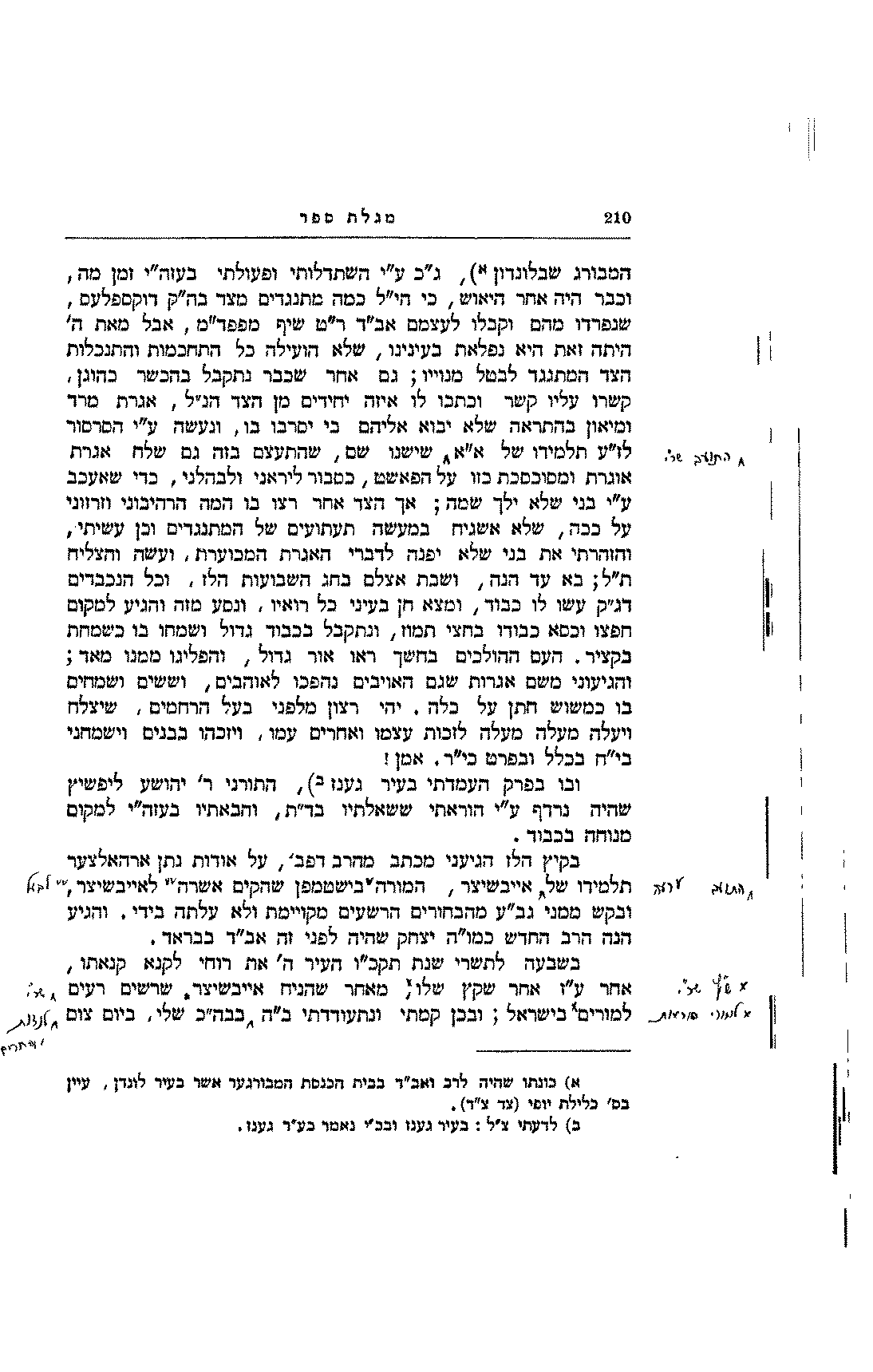
Margin readings in Scholem's copy (8)
| Printed anchor | Type (key sheet) | Mark | Reading | Certainty |
|---|---|---|---|---|
| תלמידו של א"א ^ שישנו שם | V: omission | caret; 2-word note in right margin | התועב שר"י | fairly sure |
| נתן ארהאלצער תלמידו של ^ אייבשיצר | V: omission | caret; one word in right margin | התועב | fairly sure |
| המורה v בישטמפן | V: omission | v mark; one word in right margin | not read | not read |
| שהקים אשרה vv לאייבשיצר | V: omission | double v mark; one word in left margin | לפסל(?) | uncertain |
| אחר ע"ז אחר שקץ שלו x מאחר שהניח | X: substitution | x mark after the word; 2 abbreviations in right margin | ש"ץ שר"י | fairly sure |
| אייבשיצר, שרשים רעים ^ למורים | V: omission | caret; abbreviation in left margin | שר"י(?) | uncertain |
| שרשים רעים למורים x בישראל | X: substitution | x mark after the word; 2-word note in right margin | למורי מינות | fairly sure |
| ונתעודדתי ב"ה בבה"כ שלי, ביום צום ^ | V: omission | caret; note of one or two lines in left margin, partly read | לנגלות(?) / והתרים(?) (second line seen at the edge of scan 235) | partial |
Page 211 (scan 235)
to expel from our community ⟨S: a note at the edge, not read⟩ the lad ⟨S: "the young"(?)⟩ Wolf Eybeschütz and his brother, and Leib Rechtschitz, Nathan Arhaltz(?), Meir Prossnitz, Moses Podhajce ⟨S: a note, partly read: "… in public(?)"⟩ [a]; and no man moved his tongue. Even though afterwards, when the matter was heard and became known, the men ⟨S: a three-line note, partly read: "… blind and foolish … they …"⟩ who love Eybeschütz were angry, yet they were struck dumb and against their will laid their hand on their mouth; but they thought it would make no impression in the world, since no man stood firm with me — not even the new head of the court who was set up through me, though I had thought him also zealous and avenging the Lord's vengeance on the Midianites who vex us with their wiles (cf. Num. 25:18), for he had indeed signed the ban against ⟨S: "the abominable"⟩ Eybeschütz, and that is what stood him in good stead to bring him to the seat of the rabbinate of the Three Communities. After he fell from his honour in Brody they persecuted him there greatly, until he begged his relative by marriage, the rabbi of Hanover, to bring him to the land of Germany, even to the smallest of small rabbinates. The rabbi of Hanover did so with all his strength, also to appease me and to humble himself with "pieces of silver" (Ps. 68:31): he undertook on his behalf that my relative by marriage, the rabbi of Brody, if he were accepted by the Three Communities, would give me fifty ducats year by year, besides other promises to add and not to diminish; and I granted his request. But the main thing was that he should be faithful to the Lord and should help in this great commandment ⟨S: a two-line note, partly read: "and … the abomination(?)"⟩. But when he was examined, he was found to be a chamber pot of excrement: not only did he do nothing, for he feared to open his mouth and say anything bad about him ⟨S: "the abominable"⟩, out of worry lest he lose some gift and present from the men ⟨S: "the sect of …"(?)⟩ who cleave to Eybeschütz to this day — and not only this, but he gave a hand to setting up a new Asherah [b], and gave the title morenu to the grandson of Eybeschütz ⟨S: "the abominable"⟩. Although I protested to him with a great threat, he paid no heed to me, for the man loves gain, and he feared he would not find favour in the eyes of those bound ⟨S: "to the unclean pride of Eybeschütz, m[ay the name of the wicked] r[ot]"(?)⟩ to Eybeschütz. He also would not give me anything of what my relative, the said rabbi, had undertaken on his behalf; but in the end, because of the many entreaties of my relative the rabbi of Hanover, he came to terms with me: I received twelve and a half ducats from the rabbi of Hanover, and fifty from the rabbi R. A., head of the court of the Three Communities. He also gave me a bond for another fifty ducats, to be paid before Passover 5527 [1767], the coming one, for good; and so I returned to him the said deeds of obligation. He also began to cast doubt, saying: Who knows whether Eybeschütz was so ugly? He even said that the signature he gave against Eybeschütz came out of his hand through the scheming of the rabbi of Amsterdam, in return for some promise he made him in a business entangled with Proops over money that he had sunk in the printing of the Talmud — that is what caused it: "a soft tongue breaks the bone" (Prov. 25:15); for he did not answer from his heart (cf. Lam. 3:33). In short, against his will and not to his good, he remained "a donkey-driver and a camel-driver" (cf. b. Eruvin 52b) between the two sides: when he was with the side of the enemies of Eybeschütz, he too spoke evil, so as not to [fall in their eyes]; but before the opponents he feared
Kahana's notes
- [a] See the book Hit'avkut, in the part Gat Derukhah (fol. 72b).
- [b] And see the book Hit'avkut, in the part Gat Derukhah (fol. 73b).
לגרש מקהלנו את הנער וואלף אייבשיצר ואחיו, וליב רעכטשיץ, נתן ארהאלץ, מאיר פרוסטיץ, משה פודהייצר א, ולא חרץ איש לשונו. אף אם אח"כ בהשמע הדבר ונתפרסם, חרה לאנשים אוהבי אייבשיצר, מ"מ נאלמו, על כרחם שמו יד על פה, אך חשבו שלא יעשה רושם בעולם, באשר אין איש מתחזק עמדי; גם לא האב"ד החדש אשר הוקם על פי, כי חשבתיו ג"כ מקנא ונוקם נקמת ה' במדינים הצוערים אותנו בנכליהם, כי אמנם בא עה"ח נגד אייבשיצר, והיא שעמדה לו להביאו על כסא הרבנות דג"ק. אחר שירד מכבודו בבראד רדפוהו שם מאד, עד שהתחנן למחו' הרב דהנובר להביאו לארץ אשכנז אפילו לרבנות קטן שבקטנים, והרב דהנובר עשה בכל מאמצי כחו, גם לפייסני ולהתרפס ברצי כסף, להתחייב בעדו לתת לי הרב מבראד מחו', אם יתקבל לג"ק, חמשים אדומים דבר שנה בשנה, מלבד שאר הבטחות להוסיף ולא לגרוע, ונמצאתי לו. אך העיקר היה, למען יהא נאמן לה' ויהא מסייע לדבר מצוה רבה זו; אך כשנבדק נמצא גרף ש"ר, לא די שלא עשה מאומה, כי ירא לפתוח פה ולדבר מאומה רע עליו; מדאגתו פן יפסיד איזה מתנה ודורן, אצל האנשים הדבקים באייבשיצר עד עתה, ולא די זה בלבד אלא שנתן יד להקים אשרה חדשה ב, ונתן מעלת מורנו לנכד אייבשיצר, אע"פ שמחיתי בידו באיום גדול לא השגיח בי, כי האיש אוהב בצע, ויירא פן לא ימצא חן בעיני הנקשרים לאייבשיצר; אף לא רצה לתת לי מאומה ממה שנתחייב בעדו מחו' הרב הנ"ל, אך לבסוף מחמת רוב הפצרות מחו' הרב דהנובר התפשר עמדי, קבלתי י"ב וחצי אדומים מהרב דהנובר, וחמשים מן הרב ר"א אב"ד דג"ק. גם נתן לי שט"ח על נו"ן אדומים אחרים, לשלם קודם פסח תקכ"ז הבע"ל, בכן החזרתי לו כתבי השעבוד הנ"ל. גם התחיל לעצור ספק לומר, מי יודע אם היה אייבשיצר מכוער כל כך; אף הוא אמר שהחתימה שנתן מידו נגד אייבשיצר יצאה מת"י ע"פ תחבולת הרב מאמשטרדם בעד איזה הבטחה שעשה לו, בעסק שהיה מסובך עם פרופס במעות שתקע בהדפסת הש"ס היא שגרמה, לשון רכה תשבר גרם כי לא ענה מלבו. בקיצור על כרחו שלא בטובתו נשאר חמר גמל בין שני הצדדים: כשנמצא עם הצד אויבי אייבשיצר, דיבר גם הוא רעה למען לא [יפול בעיניהם], אך בפני המתנגדים ירא
- [א] עיין בס' התאבקות בחלק גת דרוכה (דף ע"ב ע"ב).
- [ב] ועיין בס' התאבקות בחלק גת דרוכה (דף ע"ג ע"ב).
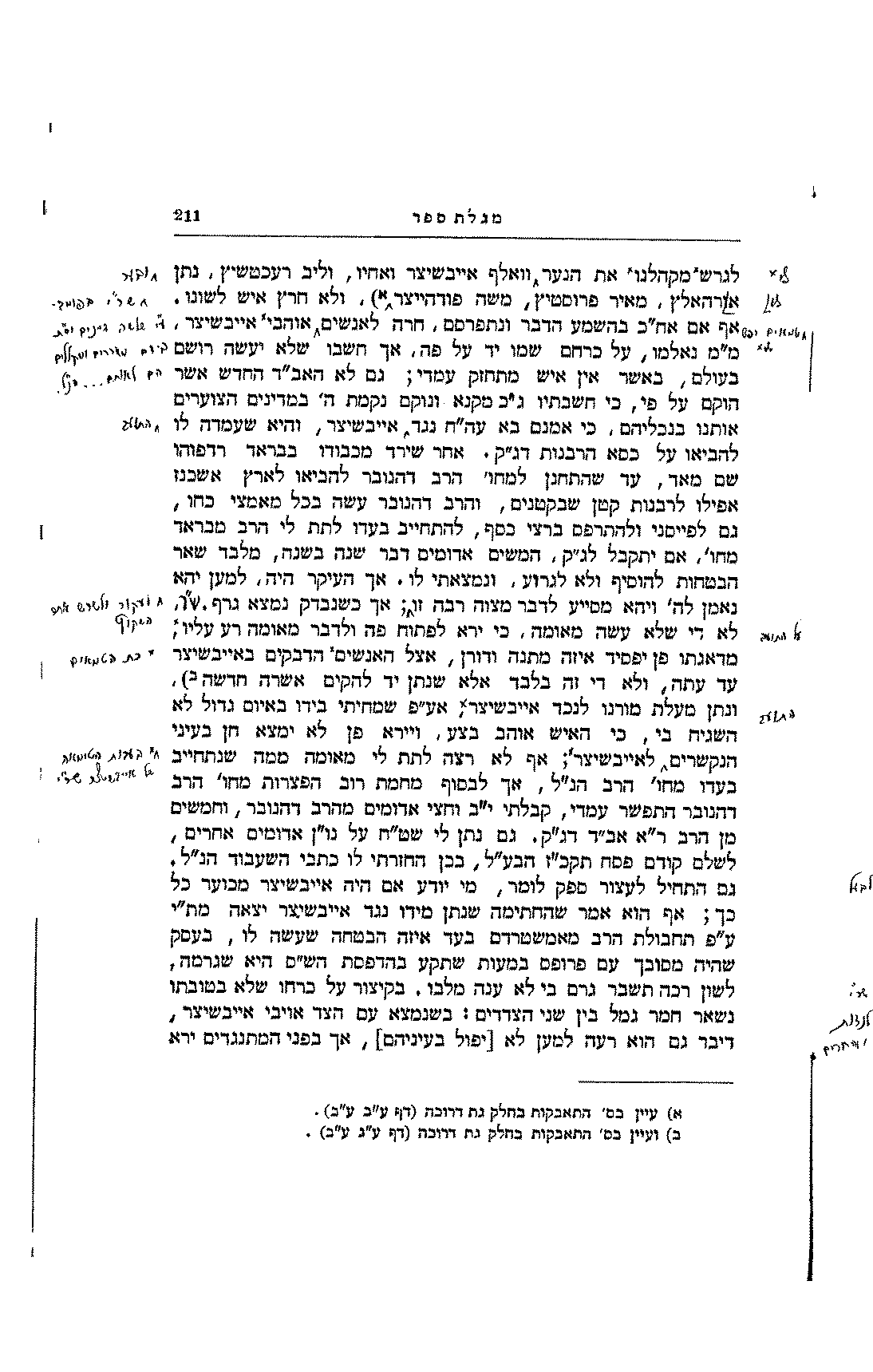
Margin readings in Scholem's copy (10)
| Printed anchor | Type (key sheet) | Mark | Reading | Certainty |
|---|---|---|---|---|
| לגרש x מקהלנו את הנער | X: substitution | x mark; a short note at the edge of the left margin | not read | not read |
| את הנער ^ וואלף אייבשיצר ואחיו | V: omission | caret; one word in left margin | הקטן(?) | uncertain |
| משה פודהייצר ^ [א], ולא חרץ איש לשונו | V: omission | caret; short note in left margin | ש"ר(?) ... בפומבי(?) | partial |
| חרה לאנשים ^ אוהבי x אייבשיצר | V: omission | caret (and an x after אוהבי); 3-line note in left margin | שלא בעינים(?) ... / ... עוורים ושוטים(?) / הם ... | partial |
| כי אמנם בא עה"ח נגד ^ אייבשיצר | V: omission | caret; one word in left margin | התועב | fairly sure |
| ויהא מסייע לדבר מצוה רבה זו ^; אך כשנבדק | V: omission | caret; 2-line note in left margin | והוקר(?) ולשום אותו(?) / השקוץ(?) | partial |
| לדבר מאומה רע עליו ^, מדאגתו | V: omission | caret; one word in right margin | התועב | fairly sure |
| אצל האנשים x הדבקים באייבשיצר | X: substitution | x mark after the word; 2-word note in left margin | כת ה...(?) | partial |
| ונתן מעלת מורנו לנכד אייבשיצר x | X: substitution | x mark after the name; one word in right margin | התועב | fairly sure |
| בעיני הנקשרים ^ לאייבשיצר | V: omission | caret; 2-line note in left margin | הגאות(?) הטמאה / של אייבשיצר שר"י | partial |
Page 212 (scan 236)
to say anything bad, as above. So I could not achieve anything with him, and I remained alone, with no one stirring [to stand with me] and no one supporting me. Yet "the God of my father has been with me" (Gen. 31:5); I will not fear the throng of the workers of iniquity and those who devise evil in their heart. "In the shadow of His hand He hid me" (Isa. 49:2), and in the wings of His compassion He concealed me.
Indeed the said proclamation in my synagogue made an impression. At once, within fourteen days, Israel Schwerin was burnt by the coal of the proclamation ⟨S: "the ban"(?)⟩ [a] — he who supported the said dog Prossnitz to be teacher there, "a teacher of outcry". I had warned all the past summer, writing to Schwerin that they should remove the forbidden thing from [the congregation], lest it be a snare to them, and that it would not prosper; but they would not listen to me [b]. And on the day of H. R. ⟨S: a word, partly read: "H…"(?)⟩ [c] he was scalded with boiling water that the housemaid poured over him, and his skin was scorched; he was in great danger and in ugly sufferings for several weeks, and in the end a physician arranged for him to be bled, and the wound came up in sores. Yet with this too he went on and did not set his heart to the word of the Lord; he still holds fast to his wickedness ⟨S: "to his insolence"(?)⟩, to help the wicked and support transgressors, so that the transgressor Prossnitz ⟨S: "m[ay the name of the wicked] r[ot]"⟩ may be for him a stubborn and rebellious [son].
In this winter, at the end of Kislev, I was appointed arbiter for the woman Kila, to settle her case and her claim against her husband's heirs. I sat several times with the rabbi, head of the court, and the judge R. L. P.; the matter is long and is written down by me in a separate quire. At that time the ailment of the golden vein again attacked me, for I caught a chill after a great heat that I had at the said sitting of the judges; and as I was drawing blood like a spring while sitting in the synagogue ⟨S: a word, partly read⟩, when I went out I fell to the ground from great weakness. There was great alarm in my house and in the community; and the Lord had pity on me and my spirit returned to me. But for several weeks the boiling of the bowels did not subside, and the blood was like a rushing stream; my strength was also greatly weakened, and I was not within the line of health for about two months. Afterwards I returned to my former strength, thank God who lives. In Him my heart trusts and I am helped; may He, blessed be He, keep me alive for His service and His fear!
On the New Moon of Adar a letter reached me by the post from Rechnitz, where Leib Stadtschitz(?), a dog [and] ... (אסו"ר), is teacher of the forbidden and permitted. The upright of the community there informed me that they had heard, known and seen a copy of the proclamation ⟨S: "the ban"(?)⟩ made in my synagogue against the said men ⟨S: a three-line note, partly read: "the unclean … the band of Belial … who were …"⟩; and they were afraid and trembled, and wanted to expel their said rabbi because of the proclamation [d]. But sons of Belial who support him rose up and made light of the proclamation ⟨S: "the ban"(?)⟩,
Kahana's notes
- [a] See the book Hit'avkut, in the part Gat Derukhah (fol. 73), where it says thus: "within fourteen [days] after, etc., he was burnt", etc.
- [b] See the book Hit'avkut, in the part Gat Derukhah (fol. 73).
- [c] And this is an abbreviation: Hosha'na Rabbah; see the said book, the said folio.
- [d] For this whole matter in detail see his book Hit'avkut, in the part Gat Derukhah (fol. 75). From this it appears that the year in which Ya'avetz finished writing his work Megillat Sefer was the year [5]526 [1765/66].
לדבר מאומה רע כנ"ל; לכן לא יכולתי לפעול עמו דבר, ונשארתי לבדי, אין מתעורר [לעמוד עמדי] ולא מחזיק בידי; אכן אלהי אבי היה עמדי, לא אירא מרגשת פועלי און וחורשי רע בלבבם, בצל ידו החביאני ובכנפי חמלתו הסתירני. אמנם הכרוז הנ"ל בבהכ"נ שלי עשה רושם. מיד תוך ד"י ימים נכוה בגחלת הכרוז א ישראל שווערין, מחזיק בכלב פרוסטיץ הנ"ל להיות שם מורה צעקה, והתריתי כל הקיץ שעבר, כתבתי לשווערין שיסירו האיסור מן [העדה] פן יהא להם למוקש והיא לא תצלח, ולא אבו שמוע אלי ב. ויהי ביום ה"ר ג נכווה ברותחין ששפכה עליו משרתת הבית ונבושה עורו, והיה בסכנה גדולה וביסורים מכוערים כמה שבועות, ולבסוף נסדר לו מרופא להקיז דם והעלתה המכה צמחים; וגם בזאת הלך ולא שם לבו לדבר ה', ועודנו מחזיק ברעתו לעזור לרשע ולסייע עוברי עבירה, להיות לו סורר ומורה הפושע פרוסטיצר. בחורף הלז שילהי כסלו נמניתי אני לבורר של אשה קילא לגמור דינה ותביעתה מיורשי בעלה, וישבתי פעמים עם הרב אב"ד והדיין רל"פ, והדברים ארוכים כתובים אצלי בקונטרס בפ"ע. בו בפרק חזר והתעולל בי מיחוש גיד הזהוב, כי נתקררתי אחר חמום גדול שהי"ל בישיבת הדיינין הנ"ל, ובהיותי מושך דם כמעין ביושבי בהכ"נ, ובצאתי נפלתי לארץ מרוב חולשה, והיתה בהלה גדולה בביתי ובקהלה, וה' חמל עלי ושב רוחי אלי; אך כמה שבועות לא שקטה רתיחת המעים, והיה הדם כנחל שוטף גם הוחלשו כחותי מאד, לא הייתי בקו הבריאות כמו שני חדשים; אחר חזרתי לאיתני הראשון ת"ל חיי. בו בטוח לבי ונעזרתי, הוא ית' יחייני לעבודתו ויראתו! בר"ח אדר הגיעני מכתב על הפאשט מרעכניץ, מקום אשר ליב שטאטשטיץ אסו"ר שם למורה איסור והיתר, מודיעים אותי הכשרים שבקהל שם, ששמעו ידעו וראו העתק הכרוז שנעשה בבהכ"נ שלי, על האנשים הנ"ל, ופחדו ורהו והיו רוצים לגרש הרב שלהם הנ"ל בגלל הכרוז ד, אך קמו בני בליעל המחזיקים בידו וההבילו הכרוז,
- [א] עיין בס' התאבקות בחלק גת דרוכה (דף ע"ג) ושם נאמר כך: תוך ד"י אחר וכו' ונכוה בו.
- [ב] עיין בס' התאבקות בחלק גת דרוכה (דף ע"ג).
- [ג] והוא ר"ת: הושענא רבה, עיין בס' הנזכר דף הנזכר.
- [ד] וכל הענין הזה בפרטות עיין בספרו התאבקות בחלק גת דרוכה (דף ע"ה), ופרט השנה שכלה יעב"ץ לכתוב את חבורו מגלת ספר נראה מזה שהיה בשנת תקכ"ו,
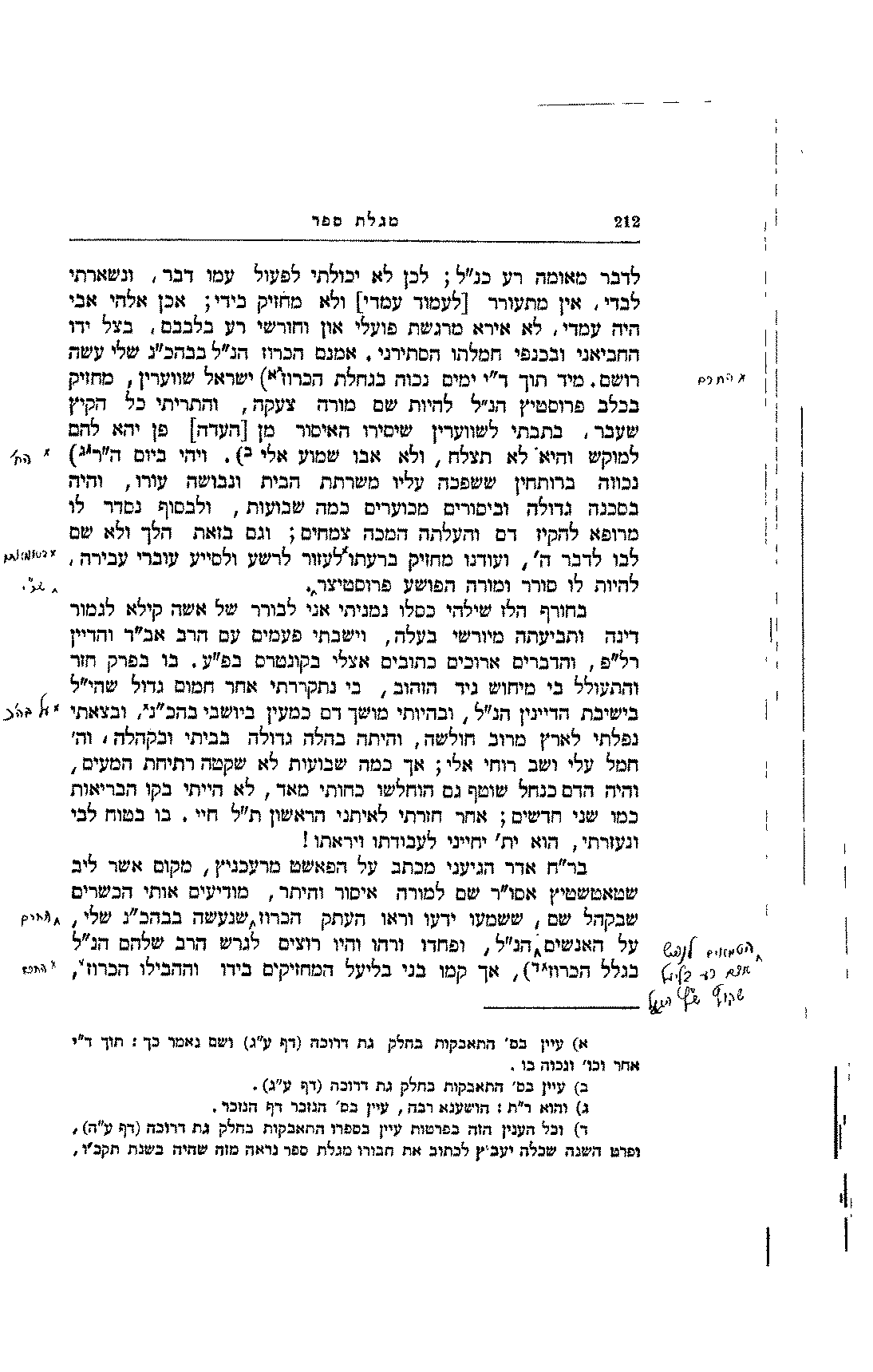
Margin readings in Scholem's copy (8)
| Printed anchor | Type (key sheet) | Mark | Reading | Certainty |
|---|---|---|---|---|
| נכוה בגחלת הכרוז x [א] ישראל שווערין | X: substitution | x mark after the word; one word in right margin | החרם(?) | uncertain |
| ויהי ביום ה"ר x [ג] נכווה ברותחין | X: substitution | x mark after the abbreviation; short note in left margin | הה...(?) | partial |
| ועודנו מחזיק ברעתו x לעזור לרשע | X: substitution | x mark after the word; one word in left margin | בעזותו(?) | uncertain |
| סורר ומורה הפושע פרוסטיצר ^. | V: omission | caret; abbreviation in left margin | שר"י | fairly sure |
| ובהיותי מושך דם כמעין ביושבי בהכ"נ x, ובצאתי | X: substitution | x mark after the word; short note in left margin | א... בגלל(?) | partial |
| ששמעו ידעו וראו העתק הכרוז ^ שנעשה בבהכ"נ שלי | V: omission | caret; one word in left margin | החרם(?) | uncertain |
| על האנשים ^ הנ"ל, ופחדו ורהו | V: omission | caret; 3-line note in right margin | הטמאים(?) לנפש(?) / אשר כת בליעל(?) / שהיו ... | partial |
| המחזיקים בידו וההבילו הכרוז x, | X: substitution | x mark after the word; one word in left margin | החרם(?) | uncertain |
Page 213 (scan 237)
therefore they agreed to write to the community here, to know whether it had been done with their consent; and they received a letter of reply from here, that they knew nothing of this proclamation ⟨S: "ban"⟩; they even went further and decreed that they annul the prohibition ⟨S: "ban"(?)⟩ with all their might. And I answered them in a long letter, according to the good hand of the Lord upon me, to establish the truth and to make a fence for the Torah. May the Lord be zealous for His people [a].
Here Emden's own text ends; a wavy rule follows in the print. What comes after it, to the end of p. 216, is Kahana's continuation, compiled from Emden's books (see note [a]).
Some time later the gaon Ya'avetz learned of this matter in detail, and he wrote to Rechnitz on the 3rd of Adar of the year 5526 [1766] as follows: "The letter that you wrote to the community here surely came into the hand of one of his admirers, and he hid it and showed it to no one else; no upright man's eye fell upon it. We asked and inquired well, and no one knows anything of whether such a letter reached the people of the community here. Therefore without doubt that reckless and empty fellow who received the letter answered you in the name of this whole community, by forgery and deceit, as if it had been done with their knowledge — and perhaps he even signed all their names under it; and all is vanity and a complete lie, invented out of his own heart. Therefore know for certain that the letter you received from Hamburg is "a driven lie" [b]." The words of Ya'avetz made an impression on the community, and they removed their rabbi, whom for some years they had pursued in the holy community of P. B. and in Prague, without prevailing against him [c]. In this year, on the 14th of Iyyar, the gaon Ya'avetz wrote a letter to his relative and pupil, our teacher R. Jacob Katz, about the matter of the sect of Sh. Tz., which had then arisen anew in Teplitz [d]. And in the year 5527, on the 26th of Tishri [1766], the gaon Ya'avetz received a letter from the sage R. M. D. of the city of Berlin, as follows: "Blessed be the Lord, who has not left us without a redeemer, and has raised up for us our master, teacher and rabbi, to keep his charge, and he has risked his life to avenge the vengeance of His Torah. Who is like him in an orphaned generation, fencing the fence and standing in the breach? Who will rise up for us against evil-doers who speak rebellion against the Lord and defy the armies of the God of Israel,
Kahana's notes
- [d, continued from p. 212] Perhaps he wrote more and it has been lost to us; but through his book Gat Derukhah we are able to complete his biography and the events of the last days of his life.
- [a] Up to here Ya'avetz wrote himself; from here on I have added from his books and from various books. David Kahana.
- [b] See the book Hit'avkut, in the part Gat Derukhah (fol. 76b).
- [c] Ibid. (fol. 77).
- [d] Ibid. (fol. 77).
על כן הסכימו לכתוב לקהל דכאן, לידע אם נעשה בהסכמתם, וקבלו אגרת תשובה מפה שלא ידעו מזה הכרוז, אף הוסיפו לגזור עליהם לבטל האיסור בכל עוז, ואנכי השיבותי להם בכתב ארוך כיד ה' הטובה עמי, להעמיד האמת ולעשות סייג לתורה, ה' יקנא לעמו א. אחר ימים אחדים נודע להגאון יעב"ץ הענין הזה בפרטות, וכתב לרעכניטץ בג' אדר שנת תקכ"ו לאמר: האגרת שלכם שכתבתם אל הקהל פה בודאי בא ליד אחד מן מעריציו והצניעה, לא הראה אותה לזולתו, לא שלטה בו עין אדם כשר, שאלנו וחקרנו היטב, ואין איש יודע מאומה אם הגיעה אגרת כזאת לאנשי קהל פה, על כן בלי ספק הפוחז וריק ההוא שקבל האגרת, הוא השיב לכם בשם הקהל הזה כולו בזיוף במרמה, כאלו נעשה בידיעתם ואפשר חתם תחתיה גם שמות כולם, והכל הבל ושקר גמור בדוי מלבו, לכן תדעו נאמנה כי אגרת שקבלתם מהמבורג הוא שקר נדף ב. דברי יעב"ץ עשו רושם אצל הקהלה, והעבירו את הרב שלהם, שזה כמה שנים רדפו אחריו בק"ק פ"ב ופראג ולא יכלו לו ג. בשנה הזאת י"ד אייר כתב הגאון יעב"ץ אגרת למחו' ותלמידו מו"ה יעקב כ"ץ, על דבר הענין מכת ש"צ שנתחדש אז בטיפליץ ד. ובשנת תקכ"ז כ"ו תשרי קבל הג' יעב"ץ מכתב מאת החכם רמ"ד מעיר ברלין לאמר: ברוך ה' אשר לא השבית לנו גואל והקים לנו את אדמו"ר לשמור משמרתו, וחרף נפשו לנקום נקמת תורתו. מי כמוהו בדור יתום גודר גדר ועומד בפרצה, מי יקום לנו עם מרעים הדוברים סרה על ה', ומחרפים מערכות אלהי ישראל,
- ואולי כתב עוד ונאבד מאתנו, אך ע"י ספרו גת דרוכה, יש לאל ידנו להשלים את תולדתו, וקורות ימי הייו האחרונים.
- [א] עד כאן כתב יעב"ץ בעצמו, מכאן ואילך הוספתי אני מפי ספריו וספרים שונים. דוד כהנא.
- [ב] עיין בס' התאבקות בחלק גת דרוכה (דף ע"ו ע"ב).
- [ג] שם (דף ע"ז).
- [ד] שם (דף ע"ז).
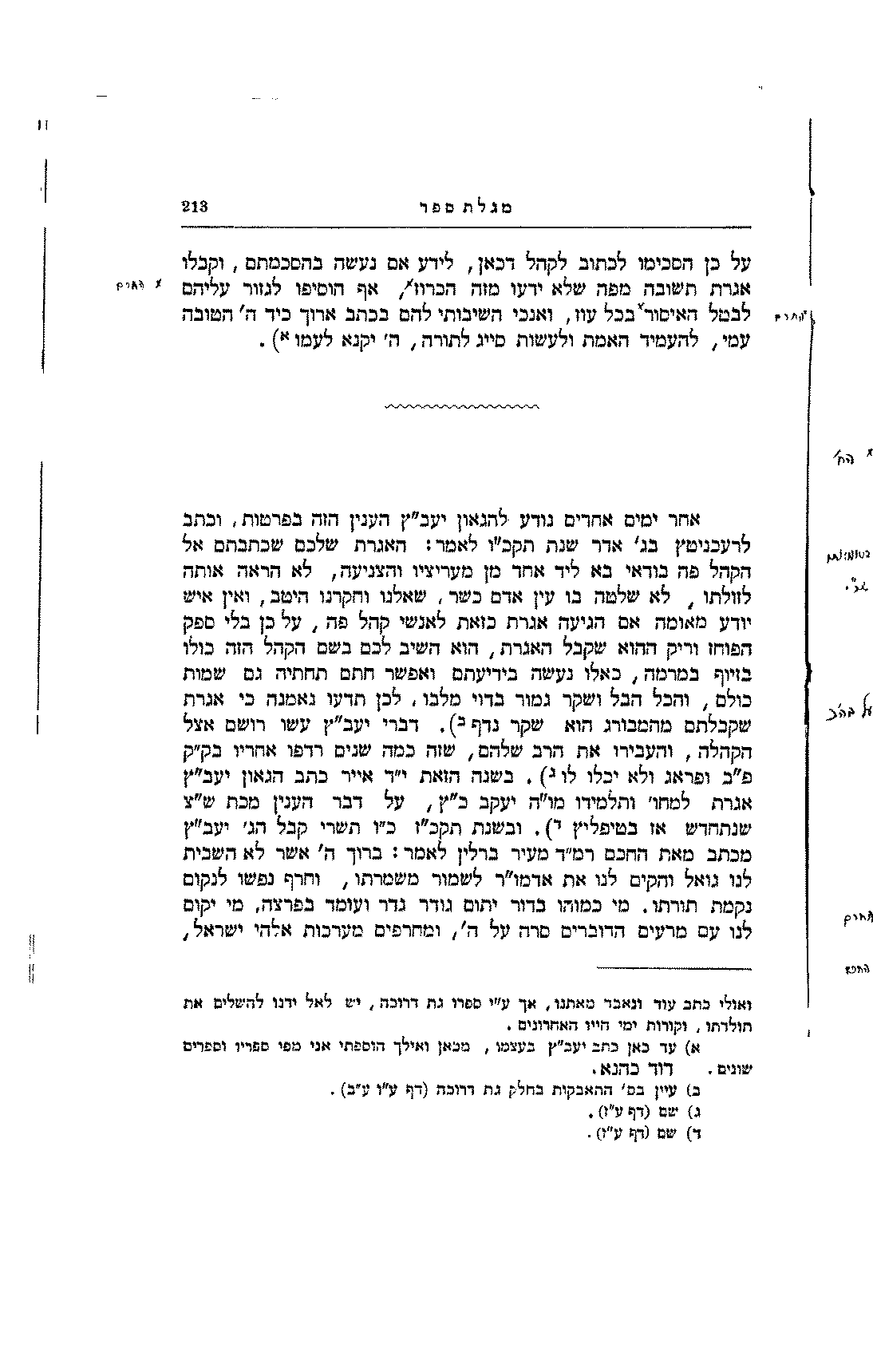
Margin readings in Scholem's copy (2)
| Printed anchor | Type (key sheet) | Mark | Reading | Certainty |
|---|---|---|---|---|
| וקבלו אגרת תשובה מפה שלא ידעו מזה הכרוז x, אף הוסיפו | X: substitution | x mark after the word; one word in left margin | החרם | fairly sure |
| לגזור עליהם לבטל האיסור x בכל עוז | X: substitution | x mark after the word; one word in the inner margin | החרם(?) | uncertain |
Page 214 (scan 238)
who will stand up for us against the workers of iniquity (cf. Ps. 94:16), who lead the heart of the men of Israel astray to deny the homilies and traditions of our sages of blessed memory, by whose mouth we live — had not the Lord stirred up the spirit of my teacher, whose heart is like the heart of a lion? He laughs at the voice of the fools and is not dismayed by their multitude; "He is in one [mind], and who can turn Him?" (Job 23:13) — and who can turn back his strong hand, the uplifted hand of the Mighty One of Jacob, to break the teeth of the wicked and to pull down the great teeth of the young lions (cf. Ps. 58:7), whether with straight and clear arguments, built on the foundations of the Torah and reason, or by pursuing them in the sea of the Kabbalah, in secrets and allusions, gematrias, notarikon and initials, until no place is left for them to flee there and hide with their enchantments; and if they go down "to the bars of the pit" (Job 17:16), "there too his hand will lead them and his right hand will hold them" (cf. Ps. 139:10) [a].
In the year 5528 [1768] the gaon Ya'avetz received a letter from Petersburg saying that the sect of Sh. Tz., seeing that their hope among the Christians in Poland had failed, had gone to the land of Muscovy with letters of recommendation and petitions in their hands, to bring their head, Jacob Frank, out of prison [b]. At that time Ya'avetz saw fit to bring out in print the book Mitpaḥat Sefarim, whose subject is to show the strange things found in the holy Zohar, the Ra'aya Meheimna and the Tikkunim, which had been hidden in his heart for many years, because the hour required it [c]. In this year 5528 [1768] he also brought out in print his book Tzitzim u-Feraḥim, which is the secrets of the letters, allusions and gematrias in the way of the Kabbalah and the hidden lore, to show that "his hands are sufficient for him" (Deut. 33:7) in this too; and then the printing of his book Mor u-Ketzi'ah, parts 1 and 2, was also finished. In the year 5529 [1769] he printed the book Ha-Pedut ve-ha-Purkan of our master Saadiah Gaon, and at its end he added "A Terrible Deed in Podolia", seven pages about the sect of Sh. Tz. [d]. In the year 5532 [1772] there was an exchange of letters between him and the sage R. M. D. on the matter of delaying the burial of the dead [e]. In the year 5534 [1773], on the 9th of Marḥeshvan, the sage R. M. D. asked him a question about the saying of Maimonides, of blessed memory: "Whoever accepts the seven commandments and is careful to do them is one of the pious of the nations of the world", etc.; and he, Ya'avetz, answered him according to the good hand of the Lord upon him [f].
In those days a strong longing awoke in the heart of the gaon Ya'avetz to go to the Land of Israel and settle in the land of his fathers, in the city of the graves of his grandfather, of blessed memory [g]; and he then spoke about
Kahana's notes
- [a] In the said book (fol. 88).
- [b] Ibid. (fol. 81b). This letter was written on the day after the festival of Passover, in the year 5528 [1768].
- [c] See his introduction to his book Mitpaḥat Sefarim.
- [d] See the book Toledot Ya'avetz (p. 44).
- [e] See the journal Ha-Me'assef for the year 5545 [1785].
- [f] See the book Toledot Ya'avetz (p. 6), at the end of the book.
- [g] See the book Hit'avkut, the part Gat Derukhah (fols. 85 and 86); and so he says at the end of his book
מי יתיצב לנו עם פועלי און, המדיחים את לב איש ישראל לכפור בדרשות וקבלות חז"ל אשר מפיהם אנו חיים, לולי העיר ה' את רוח מורי, אשר לבו כלב אריה, ישחק לקול הכסילים מהמונם לא יחת, הוא באחד ומי ישיב ידו החזקה, יד אביר יעקב הנשאה, לשבר שני רשעים ולנתוץ מלתעות כפירים, אם בסברות ישרות וברורות, בנויות על אדני התורה והשכל; ואם לשוט אחריהם בים הקבלה, בסודות ורמזים גימטריאות ונוטריקון ור"ת, עד אשר לא ישאר להם מקום לנוס שמה להסתר בלטיהם; ואם בדי שאול ירדו, גם שם ידו תנחם ותאחזם ימינו א. בשנת תקכ"ח קבל הג' יעב"ץ מכתב מפיטורשבורג לאמר, כי כת ש"צ בראותם כי נכזבה תוחלתם בפולין אצל הנוצרים, הלכו להם למדינת מסקויא וכתבי מליצה ובקשות בידם, להוציא מן המסגר את הראש שלהם יעקב פראנק ב; ובעת ההיא ראה יעב"ץ להוציא בדפוס את ס' „מטפחת ספרים", וענינו להראות הדברים הזרים שנמצאים בסה"ז ר"ם ותקונין, אשר היו צפונים בלבו זה שנים רבות, יען השעה היתה צריכה לכך ג: ובשנה הזאת תקכ"ח הוציא ג"כ בדפוס ספרו "ציצים ופרחים", והוא סודות האותיות ורמזים וגמטריות ע"ד הקבלה והנסתר, להראות כי ידיו רב לו גם בזה; וכן נגמר אז בדפוס ספרו „מור וקציעה" ח"א וח"ב. בשנת תקכ"ט הדפיס ספר "הפדות והפורקן" לרבינו סעדיה גאון, ובסופו הוסיף מעשה נורא בפאדאליא, שבעה עמודים אודות כת ש"צ ד. בשנת תקל"ב היה בינו ובין הח' רמ"ד חליפות מכתבים בדבר הלנת המתים ה. בשנת תקל"ד ט' מרחשון שאל מאתו הח' רמ"ד שאלה בענין המאמר להרמב"ם ז"ל: כל המקבל שבע מצות ונזהר לעשותן ה"ז מחסידי או"ה וכו', והוא יעב"ץ השיב לו כיד ה' הטובה עליו ו. ובימים ההם התעורר בלב הג' יעב"ץ תשוקה עזה ללכת לא"י, ולהתיישב בארץ אבותיו ובעיר קבורות אבי זקנו ז"ל ז ודבר אז על
- [א] בס' הנזכר (דף פ"ח).
- [ב] שם (דף פ"א ע"ב) המכתב הזה נכתב ביום אסרו חג של פסח שנת תקכ"ח.
- [ג] עיין בהקדמתו לספרו מטפחת ספרים.
- [ד] עיין בס' תולדות יעב"ץ (צד מ"ד).
- [ה] עיין במ"ע המאסף לשנת תקמ"ה.
- [ו] עיין בס' תולדות יעב"ץ (צד ו') בסוף הספר.
- [ז] עיין בס' התאבקות חלק גת דרוכה (דף פ"ה ופ"ו), וכן יאמר בסוף ספרו
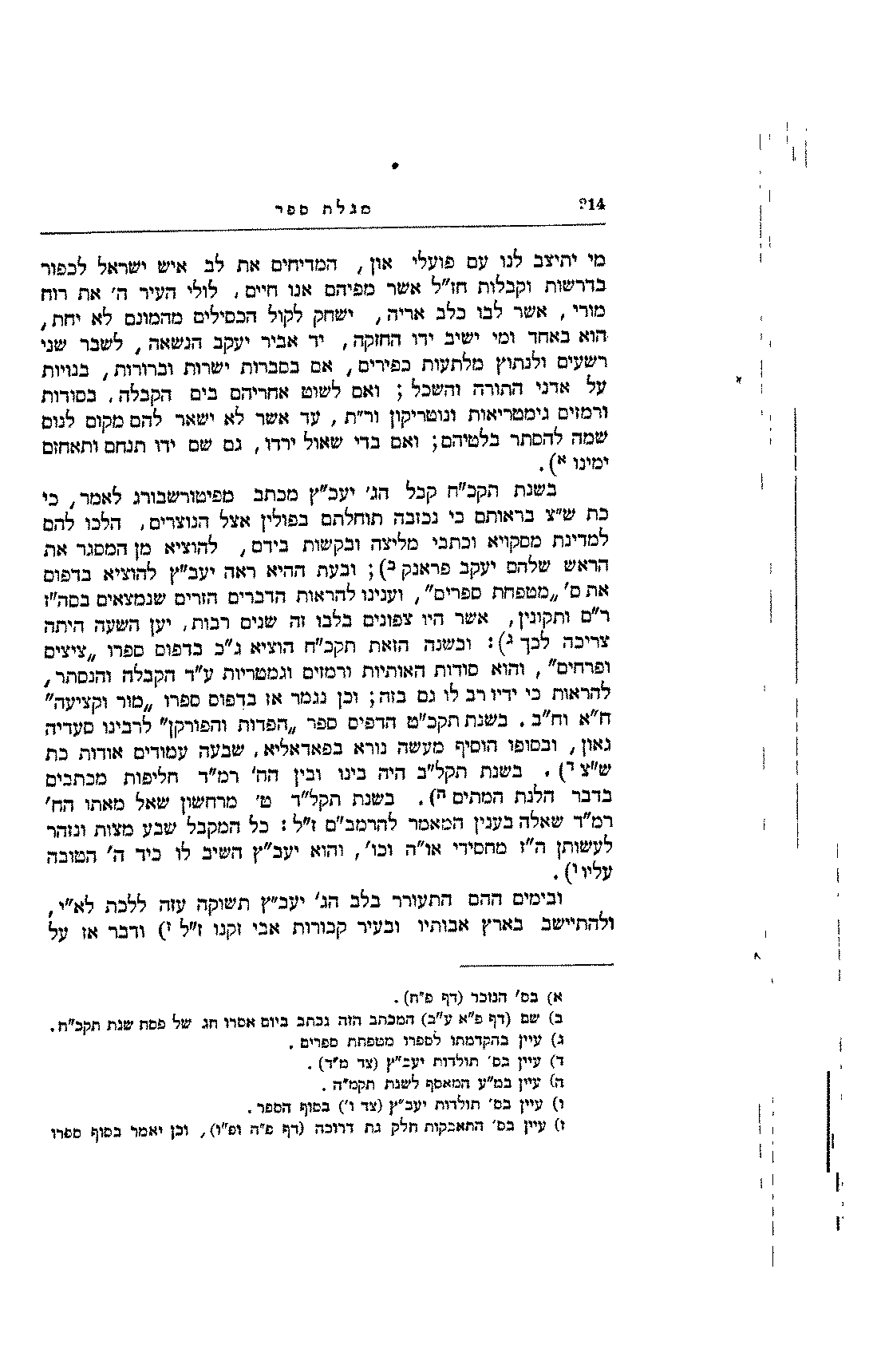
Page 215 (scan 239)
the heart of the parnassim and leaders of Altona to buy his house, to be a landed possession for them, for their great synagogue was too small to hold all this numerous community; and they almost agreed with one voice to take it for the community, but one accuser spoiled the matter. Even so it was agreed among them to give him five hundred Reichstaler in support; and when their messenger came to tell him this, he would not accept the money from them at that time. And since no Jewish buyer turned up for his house, his journey was delayed from day to day; and meanwhile the Lord called Jacob to heaven. On Friday, the eve of the holy Sabbath, the 30th of Nisan, which is the first day of the New Moon of Iyyar, of the year 5536 [1776], the righteous man expired and was gathered to his people in the city of Altona, eighty years old — he had reached "strength" (Ps. 90:10) — and almost all the days of his life he did not depart from the tent of Torah. Four days before his death he sent to the grammarian, the gaon R. Solomon Dubno, the omissions that had been left out of the orders of the services he had arranged in his prayer book, to print them once more [a]. On that very day on which the gaon Ya'avetz died, near the Sabbath, his dust returned to the earth and his spirit to God (cf. Eccl. 12:7), and all the people of the town mourned him with a very heavy mourning. And this is the tombstone set up on his grave [b], and on it are written these words:
Tombstone
The master of the Jews, the best of the sages. Howl and lament! Is it not heard in the camp of the Hebrews that a burning fire has burnt in it? Ornament and glory were cast from her head at the death of a wise man, mighty, "turning back the battle at the gate" (Isa. 28:6). Holy and pure from the womb, from the dawn [of his days]; he made nights like days in the Torah of the Lord, "ordered and sure" (2 Sam. 23:5). By his holy works, "their polishing of sapphire" (Lam. 4:7), he spread to the corners [of the earth] his light, in the hidden and in the revealed, clear law. The fear of the Lord, the reproof of instruction, and all the hidden things of wisdom, he brought out by them to the light. A great prince has fallen in Israel. Do you not know that the Lord has taken the master from over our head (cf. 2 Kgs. 2:3), and the covering of precious stone has been removed (cf. Ezek. 28:13)? Many are his Torah and his wisdom, written and still hidden in his house of study; may light shine upon him.
Translator's note. The inscription is an acrostic: the first letters of its lines, set apart in the print, spell יעקב ישר… and continue on the next page to form "Jacob Israel" (see note [a] there).
Kahana's notes
- [g, continued from p. 214] Mitpaḥat Sefarim (p. 119): "and may He bring us to the holy soil"; and see Edut be-Ya'akov (fol. 29), and also what the gaon Ya'avetz said before in this book of his, Megillat Sefer (p. 208).
- [a] See the book Evel Yaḥid.
- [b] This tombstone inscription was printed in the book Toledot Ya'avetz (p. 33), and more fully in the book Iggeret Peraḥim by Wittkower (p. 289).
לב הפו"מ מאלטונא, לקנות את ביתו להיות להם לאחוזת נחלה, כי בהכ"נ שלהם הגדולה קטנה מהכיל את כל הקהל הרב הזה, וכמעט הסכימו בפה אחד ללקחו אל הקהל, אך מקטרג אחד קלקל הדבר; עכ"ז הוסכם ביניהם לתת לו חמש מאות ר"ט לסיוע, וכשבא שלוחם להגיד לו זאת, לא רצה לקבל המעות כעת מידם. ואחר שלא נזדמן לו קונה יהודי על ביתו, על כן נתעכב מסעו מיום אל יום, ובין כה וכה קרא ה' את יעקב אל השמים, וביום ו' עש"ק למ"ד ניסן, הוא יום א' דר"ח אייר שנת תקל"ו, גוע ונאסף הצדיק אל עמו בעיר אלטונא, בן שמונים שנה וזכה לגבורות, וכמעט כל ימי חייו לא מש מאהל של תורה, וארבעה ימים לפני מותו, שלח להמדקדק הג' ר' שלמה דובנא השמטות שנשמטו בסדרי העבודות שיסד בסדורו, להדפיסם עוד הפעם א; ובעצם היום הזה שמת הגאון יעב"ץ, קרוב לש"ק שב עפרו אל האדמה ורוחו אל האלהים, ויספדו לו כל אנשי העיר אבל כבד מאד. וזאת מצבת האבן אשר הוקמה על קברו ב, ועליה כתובים הדברים האלה: מצבת קבורת רבהון דיהודאי, טוביינא דחכימאי. י לל וקנה הלא נשמע במחנה העברים כי בערה בה אש תבערה. ע די ותפארת מראשתה השלכו במות גבר חכם בעוז משיב מלחמה שערה. ק דוש וטהור מרחם משחר שם לילות כימים בתורת ה' ערוכה ושמורה. ב חבוריו הקדושים ספיר גזרתם הפיץ כנפות אורו בנסתר ובנגלה הלכה ברורה. י ראת ה' ותוכחת מוסר וכל תעלומות חכמה בהם הוציא לאורה. ש ר גדול נפל בישראל הלא תדעו כי לקח אדון מעל ראשנו והוסר מסכת אבן יקרה. ר ובי תורתו וחכמתו כתובים וגנוזים עדיין בבית מדרשו תופע עליו נהרה.
- מטפחת ספרים (צד קי"ט) ועל אדמת הקודש יביאנו, ועיין עדות ביעקב (דף כ"ט), וכן מה שאמר הגאון יעב"ץ מקודם בספרו זה מגלת ספר (צד 208).
- [א] עיין בס' אבל יחיד.
- [ב] המצבה הזאת נדפסה בס' תולדות יעב"ץ (צד ל"ג) וביתר שאת בספר אגרת פרחים לוויטטקאווער (צד רפ"ט).
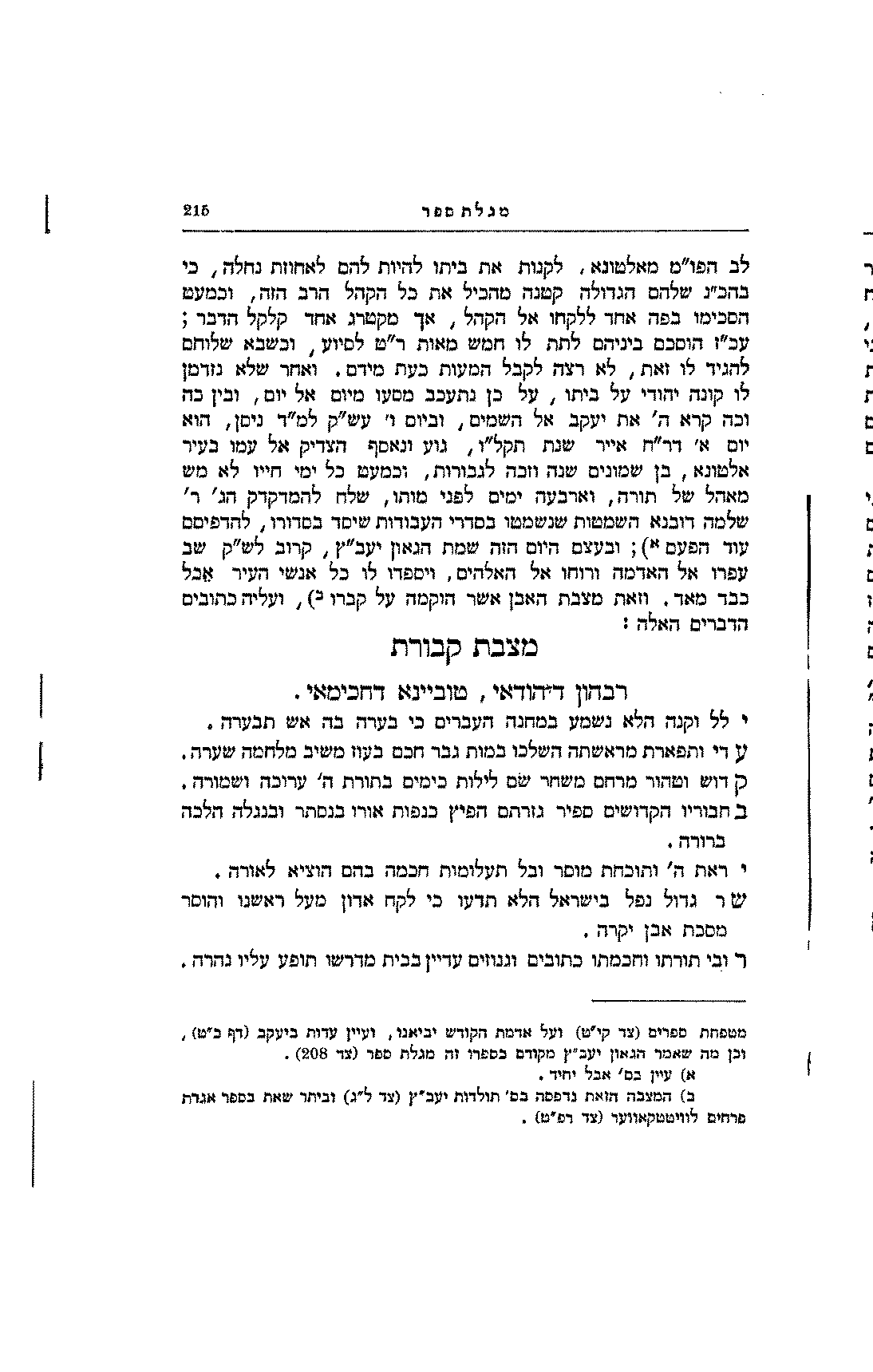
Page 216 (scan 240)
Mightiest of the shepherds and most eminent of the Sanhedrin: on the day he was taken the sun went down, and the pure candlestick was put out. For him it is fitting to weep and to make lament, for he was a wall for us in the day of wrath and fury, "trouble as of her that brings forth her first child" (Jer. 4:31). He is the great and famous gaon, expert in all the chambers of the Torah, in the revealed and in the hidden and in all the sciences — "no secret was too hard for him" (cf. Dan. 4:6) — the honoured our teacher the rabbi R. "Jacob Israel", called "Ya'avetz", the memory of the righteous and holy be for a blessing for the life of the world to come, head of the court of the holy community of Emden, may God protect it; son of that righteous man, the great gaon, the famous pious man, the all-embracing sage, our master and teacher the rabbi R. "Tzvi", called "Ḥakham Tzvi", the memory of the righteous and holy be for a blessing, head of the court of the Three Communities A[ltona], H[amburg] and W[andsbek], may God protect them. His soul went out in holiness on the sixth day, the eve of the holy Sabbath, the first day of the New Moon of Iyyar 5536 [1776] by the short count, and his body was buried on the same day, near the coming in of the holy Sabbath. May his soul be bound in the bond of life, under the wings of the Shekhinah, shining "as the brightness of the firmament" (Dan. 12:3) [a].
And in all the towns, near and far, wherever the news of the death of the gaon Ya'avetz arrived, there was weeping and great mourning for the Jews, for a righteous man and a man of faith was lost from the earth. The great grammarian R. Solomon Dubno went out to lament in a dirge, printed at once in the city of Berlin under the name Evel Yaḥid ("Mourning for an only one") [b]; for the gaon Ya'avetz, of blessed memory, was unique in his generation, and with all his soul he went out to be zealous with the zeal of the Lord of hosts; he hated flattering lips, and gave flattering titles to no man (cf. Job 32:21). "May his name be continued for ever" (Ps. 72:17).
An ornamental rule ends the text.
Kahana's notes
- [a] The initials of the lines of the tombstone are: "Jacob Israel" (יעקב ישראל).
- [b] And R. Solomon Dubno made in the book Evel Yaḥid a chronogram of the year of the death of the gaon Ya'avetz in the words ואי"ך אתנח"ם ("and how shall I be comforted"), which come to [5]536 [1776].
א ביר הרועים ומופלא שבסנהדרין יום הלקחו בא השמש וכבתה מנורה הטהורה. ל ו יאות למבכי ולמעבד הספדא על כי חומה היה לנו ביום זעם ועברה צרה כמבכירה. ה"ה הגאון הגדול המפורסם בקי בכל חדרי תורה בנגלה ובנסתר ובכל החכמות כל רז לא אנס ליה, כבוד מורנו הרב מוהר"ר „יעקב ישראל" נקרא „יעב"ץ" זצלה"ה, אב"ד דק"ק עמדן יע"א, בן לאותו צדיק הגאון הגדול החסיד המפורסם חכם הכולל אדמ"ו הרב מוהר"ר „צבי" נקרא „חכם צבי" זצללה"ה אב"ד דג"ק אה"ו יע"א; נשמתו יצאה בקדושה ביום וי"ו עש"ק א' דר"ח אייר תקל"ו לפ"ק וגופו נקבר בו ביום סמוך לכניסת ש"ק. נ'צ'ב'ה תחת כנפי השכינה כזוהר הרקיע מזהירה א. וכל הערים הקרובות והרחוקות, מקום אשר שמע מות הגאון יעב"ץ הגיע, היה בכי ואבל גדול ליהודים, כי אבד איש צדיק ואיש אמונים מן הארץ; והמדקדק הגדול ר' שלמה דובנא, יצא לקונן בשיר קינה, הנדפס מיד בעיר ברלין בשם אבל יחיד ב, כי הגאון יעב"ץ ז"ל היה יחיד בדורו, ובכל נפשו יצא לקנא קנאת ה' צבאות, ושפתי חנף שנא, ואל אדם לא יכנה, לזכר עולם ינון שמו.
- [א] וראשי החרוזים מן המצבה הם: "יעקב ישראל".
- [ב] ור"ש דובנא עשה בס' אבל יחיד פרט על שנת מות הגאון יעב"ץ בהמלות, ואי"ך אתנח"ם, שעולה תקל"ו.