Chapter 5 Life in Altona, continued
Jacob Emden, Megillat Sefer · Hebrew (Kahana, Warsaw 1896/97) with an English draft translation · work in progress
Page 151 (scan 171)
and fair, and I called her by her mother's name. In that birth my first wife Rachel died on me, the daughter of the great men mentioned above, of priestly lineage, after a week; three doctors attended her at great expense. She was a woman of valour and strong-willed, and I can say of her what R. Judah said to R. Isaac: "Is a son of a hard woman hard? ..." [a], but she was also "more bitter than death" (Eccl. 7:26) many times. She would sometimes pick a quarrel because I had invited a guest, a man of note and learning, to eat with me. Once, too, when I hired a teacher to live in my house to teach my sons and daughters and to write, she was so angry that I was forced to put the man out of the house before his term was up, and to rent lodging for him until that man went mad — although in those days my livelihood was at hand without worry. Yet she used to do just this in the days of my poverty and my homeless wandering: while she was in Brod she kept a teacher for my first son alone, which was far beyond my means, and I agreed to her doing so; not only did I not put her to shame, I said on the contrary that this was good and pleasant. This was my way all my days; and even so she now stayed my hand and made me act against my judgement for the sake of peace in the house. Many such bitter needless quarrels happened with her; above all she was quarrelsome beyond measure with the maidservants, so that she was never at peace with them. When I bought the house I live in, too, she raised a great deal of strife and anger. Though I was almost weary of my life, "my sins turned these things to me" (cf. Jer. 5:25); for apart from this she was a worthy and sensible woman, also doing kindness with her own person and caring for the poor and the afflicted, and bringing up her sons to Torah in the times I stayed away from home, and running her house well, with care and cleanliness, her manservant and maidservant. She dealt in lending some years in Altona in a small way and succeeded: not only did I lose nothing, but there was blessing in it, as said above. Her one fault was anger, because she raged over nothing.
For our many sins, on the day of her death, the New Moon of Tammuz [5]499 [1739], she brought about my first vexation and quarrel with the parnassim and leaders of the holy community of Altona. For at the burial of the daughter mentioned, who died some years before her, they asked nothing of me beyond the custom at the burial of the townspeople, for they reckoned me as one of the townspeople, as I also bore the yoke of paying the tax they had laid on meat. But now they asked me for a pledge for her burial, and grief was added to my great pain and my sorrow over the death of the wife of my youth. I was forced to give them a pledge, so as not to delay her burial, and so that she might have peace in her last abode. After some time they returned the pledge to me and did not ask to take anything; and so they did and behaved afterwards with the wife
Kahana's notes
- [a] See the Gemara, Yevamot (fol. 63b).
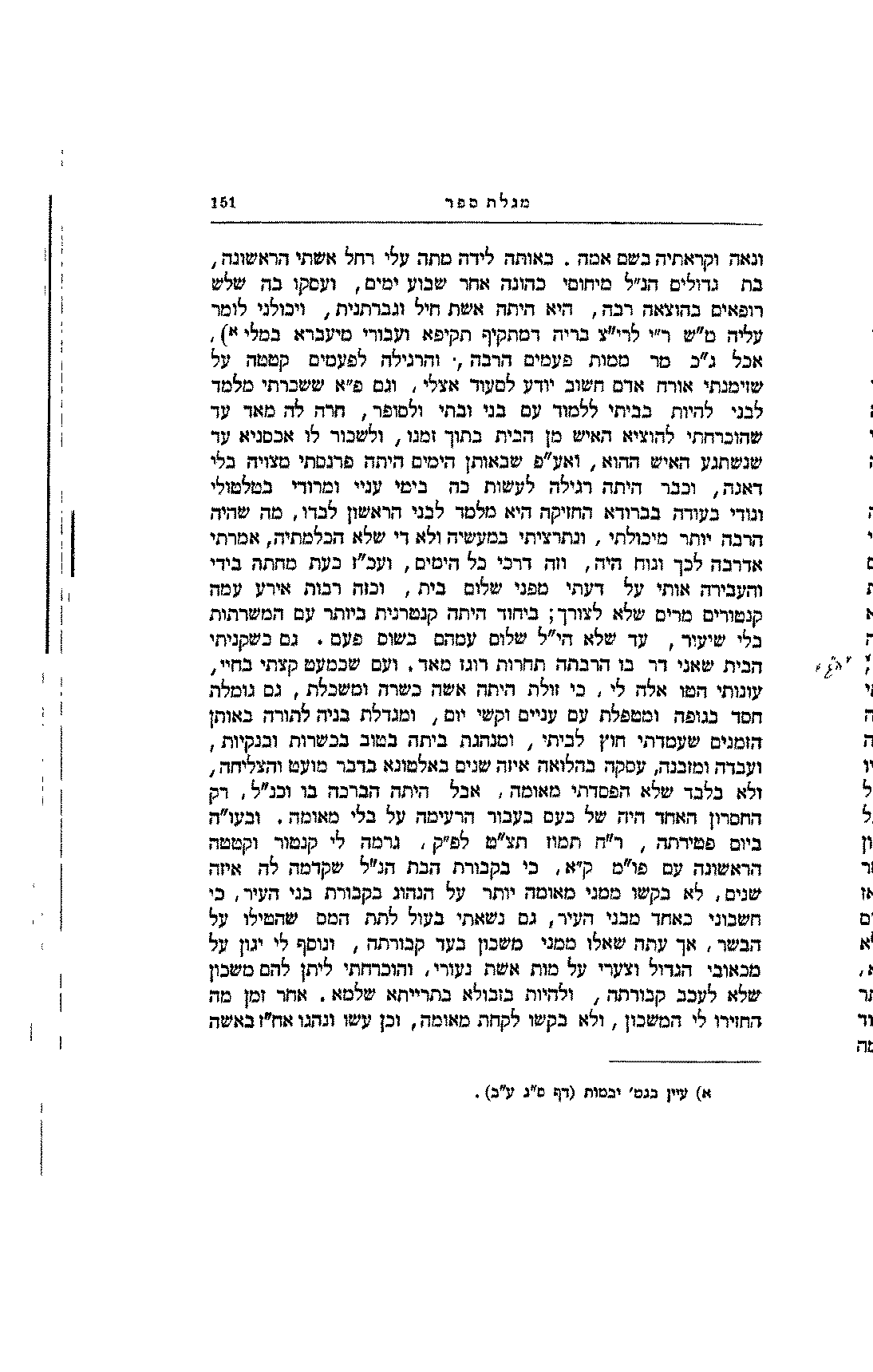
ונאה וקראתיה בשם אמה. באותה לידה מתה עלי רחל אשתי הראשונה, בת גדולים הנ"ל מיחוסי כהונה אחר שבוע ימים, ועסקו בה שלש רופאים בהוצאה רבה, היא היתה אשת חיל וגברתנית, ויכולני לומר עליה מ"ש ר"י לרי"צ בריה דמתקיף תקיפא ועבורי מיעברא במלי א, אבל ג"כ מר ממות פעמים הרבה, והרגילה לפעמים קטטה על שזימנתי אורח אדם חשוב יודע לסעוד אצלי, וגם פ"א ששכרתי מלמד לבני להיות בביתי ללמוד עם בני ובתי ולסופר, חרה לה מאד עד שהוכרחתי להוציא האיש מן הבית בתוך זמנו, ולשכור לו אכסניא עד שנשתגע האיש ההוא, ואע"פ שבאותן הימים היתה פרנסתי מצויה בלי דאגה, וכבר היתה רגילה לעשות כה בימי עניי ומרודי בטלטולי ונודי בעודה בברודא החזיקה היא מלמד לבני הראשון לבדו, מה שהיה הרבה יותר מיכולתי, ונתרציתי במעשיה ולא די שלא הכלמתיה, אמרתי אדרבה לכך ונוח היה, וזה דרכי כל הימים, ועכ"ז כעת מחתה בידי והעבירה אותי על דעתי מפני שלום בית, וכזה רבות אירע עמה קנטורים מרים שלא לצורך; ביחוד היתה קנטרנית ביותר עם המשרתות בלי שיעור, עד שלא הי"ל שלום עמהם בשום פעם. גם כשקניתי הבית שאני דר בו הרבתה תחרות רוגז מאד. ועם שכמעט קצתי בחיי, עונותי הטו אלה לי, כי זולת היתה אשה כשרה ומשכלת, גם גומלת חסד בגופה ומטפלת עם עניים וקשי יום, ומגדלת בניה לתורה באותן הזמנים שעמדתי חוץ לביתי, ומנהגת ביתה בטוב בכשרות ובנקיות, ועבדה ומזבנה, עסקה בהלואה איזה שנים באלטונא בדבר מועט והצליחה, ולא בלבד שלא הפסדתי מאומה, אבל היתה הברכה בו וכנ"ל, רק החסרון האחד היה של כעס בעבור הרעימה על בלי מאומה. ובעו"ה ביום פטירתה, ר"ח תמוז תצ"ט לפ"ק, גרמה לי קנטור וקטטה הראשונה עם פו"מ ק"א, כי בקבורת הבת הנ"ל שקדמה לה איזה שנים, לא בקשו ממני מאומה יותר על הנהוג בקבורת בני העיר, כי חשבוני כאחד מבני העיר, גם נשאתי בעול לתת המס שהטילו על הבשר, אך עתה שאלו ממני משכון בעד קבורתה, ונוסף לי יגון על מכאובי הגדול וצערי על מות אשת נעורי, והוכרחתי ליתן להם משכון שלא לעכב קבורתה, ולהיות בזבולא בתרייתא שלמא. אחר זמן מה החזירו לי המשכון, ולא בקשו לקחת מאומה, וכן עשו ונהגו אח"ז באשה
- [א] עיין בגמ' יבמות (דף ס"ג ע"ב).
Page 152 (scan 172)
and children who died on me, for our many sins. May the Blessed Name remove His burning anger [a] from me and from His people; "He will swallow up death for ever," etc. (Isa. 25:8).
After this event I went to the community's chamber on the day of their sitting and asked them how they meant to deal with me: whether to count me as a guest or as a householder of the community, as in truth I have the established right of my fathers, of blessed memory; and even so, if you ask me for entry money, tell me and I will give it. Then R. Yokel Hozen (?) rose from his seat and asked me insolently what I had in mind: did I think to push him one day from his place of honour? Who asked this of me, and who allowed me to come here to settle? But his fellows rebuked him and silenced him. I answered him: When I came here you were not yet mentioned among the leaders of the community. (For he was new, lately come at that time, after the death of his uncle Joel Schwab; then he filled his place and walked in his way and his folly, to hate me without cause, for some years, a while before ⟨S: "the hangman"⟩ Eybeschütz came; and because of this R. Y. was removed from appointment to office, as I wrote above, thank God; then he turned into a friend to me.) And those parnassim and leaders who were in office at the time I came here had allowed me this. With this I took leave of them in peace. And they returned the pledge to me free, and treated me as a householder of their community from then until now [b].
Some years before the death of my wife, peace be upon her, I sent away from me my son, dear as the apple of my eye, Meshullam Zalman, may his light shine. As I had sent away my first son from Emden, so I was forced to do with this very delightful son, when he was eleven years old and had already begun to study the Tur with the Beit Yosef for some time; he was very clever for his years, and handsome and fair to look upon. Only because I saw no good end before him in this "land of great drought" (Hos. 13:5), to make a fitting match for him that would support [him] in Torah, therefore against my will and in my anger I agreed to it: to send him first to Glogau and afterwards to Poland. It was in my eyes like tearing the nail from the flesh, and it cost me dear, for I always kept a scholar for him in the house, and when he was in another country I also spent much on him for what he needed. For the dowry I gave a lavish hundred gold pieces, and I handed over the dowry I had undertaken for him to the leader R. D. L. D., when he travelled to the fair of F. B. (?) ⟨S: a short sign, perhaps "פו"(?)⟩. When he returned he told me that this deposit, which I had handed to him for this purpose, had been lost, and said he wanted to pay me, and gave me twenty gold pieces at once. After some years had passed, and I pressed him to pay the rest as he had promised, since he had been negligent in guarding the deposit by his own admission, he would not give me more than another twenty gold pieces, and on condition
Kahana's notes
- [a] The abbreviation means "His burning anger".
- [b] The abbreviation means "until now".
וילדים שנפטרו לי בעו"ה. הי"ת יסיר ח"א א ממני ומעמו, בלע המות לנצח וגו'. אחר המאורע הלז הלכתי לחדר הקהל ביום מושבם, ושאלתים האיך דעתם ורצונם להתנהג עמדי, אם לחשוב אותי כאורח, או כבעל הבית מאנשי הקהלה, כאשר באמת יש לי חזקת אבותי ז"ל, ועכ"ז אם מבקשים אתם ממני מעות הקדימה הגידו לי ואתנה; אז קם ר' יוקל הוזן ממקום מושבו ושאל אותי בהעזה, מה בדעתי האם אני חושב לדחות אותו פעם ממקום כבודו, וכי מי בקש זאת מידי, או מי הרשה אותי לבוא הנה לקבוע דירה בכאן, אמנם חביריו גערו בו והשתיקוהו, אך עניתיו כשבאתי לכאן עדיין לא היית נזכר בין מנהיגי הקהל (כי חדש מקרוב בא בעת ההיא אחר פטירת דודו יואל שוא, אז מלא מקומו והלך בשיטתו ובשטותו לשנוא אותי בחנם, כמה שנים איזה זמן טרם עד בא אייבשיצר, ובסבת זה הועבר ר"י ממינוי פרנסות וכמש"ל ב"ה, אז חזר לי לאוה ב ואותן פו"מ שהיו בזמן ההוא שבאתי לכאן, המה הרשוני על זאת, ובזה נפטרתי מהם לשלום. אבל החזירו לי המשכון בחנם, ונהגו עמי כבעה"ב מקהלם מאז ע"ע ב. איזה שנים לפני פטירת אשתי ע"ה, שלחתי מעל פני בני החביב כאישון עיני משלם זלמן נ"י, כאשר שלחתי בני הראשון מעמדן, ככה הוכרחתי לעשות עם זה הבן הנחמד מאד, בהיותו בן י"א שנה וכבר התחיל ללמוד זמן מה טור עם ב"י, והיה משכיל מאד לפי שניו, ויפה תואר עם יפה מראה, רק מחמת שלא ראיתי תכלית טוב לפניו בארץ תלאובות הלזו, לעשות עמו שידוך הגון להחזיק בתורה, על כן על אפי ועל חמתי הסכמתי לכך. לשלחו מתחלה לגלוגא אח"כ לפולין, והיה בעיני כפרישת צפורן מן הבשר, ועמד לי ביוקר כי תמיד הייתי מחזיק לו למדן בבית, ובהיותו בארץ אחרת הוצאתי עליו ג"כ הרבה מה שהיה צריך, ולנדוניא הפרזתי מאה אדומים, ומסרתי הנדן שהתחייבתי לו, להק' ר"ד ל"ד בנסעו על יריד פ"ב, ובשובו אמר לי שנאבד לו הפקדון ההוא, שמסרתי בידו לצורך זה, ואמר שרוצה לשלם לי ונתן לי עשרים אדומים מיד; אחר שעברו איזה שנים והייתי דוחק עליו שישלם המותר כהבטחתו, לפי שפשע בשמירת הפקדון כפי הודאות עצמו, אבל לא רצה לתת לי יותר רק עוד עשרים אדומים, ועל מנת
- [א] ר"ת: חרון אפו.
- [ב] ר"ת: עד עתה.
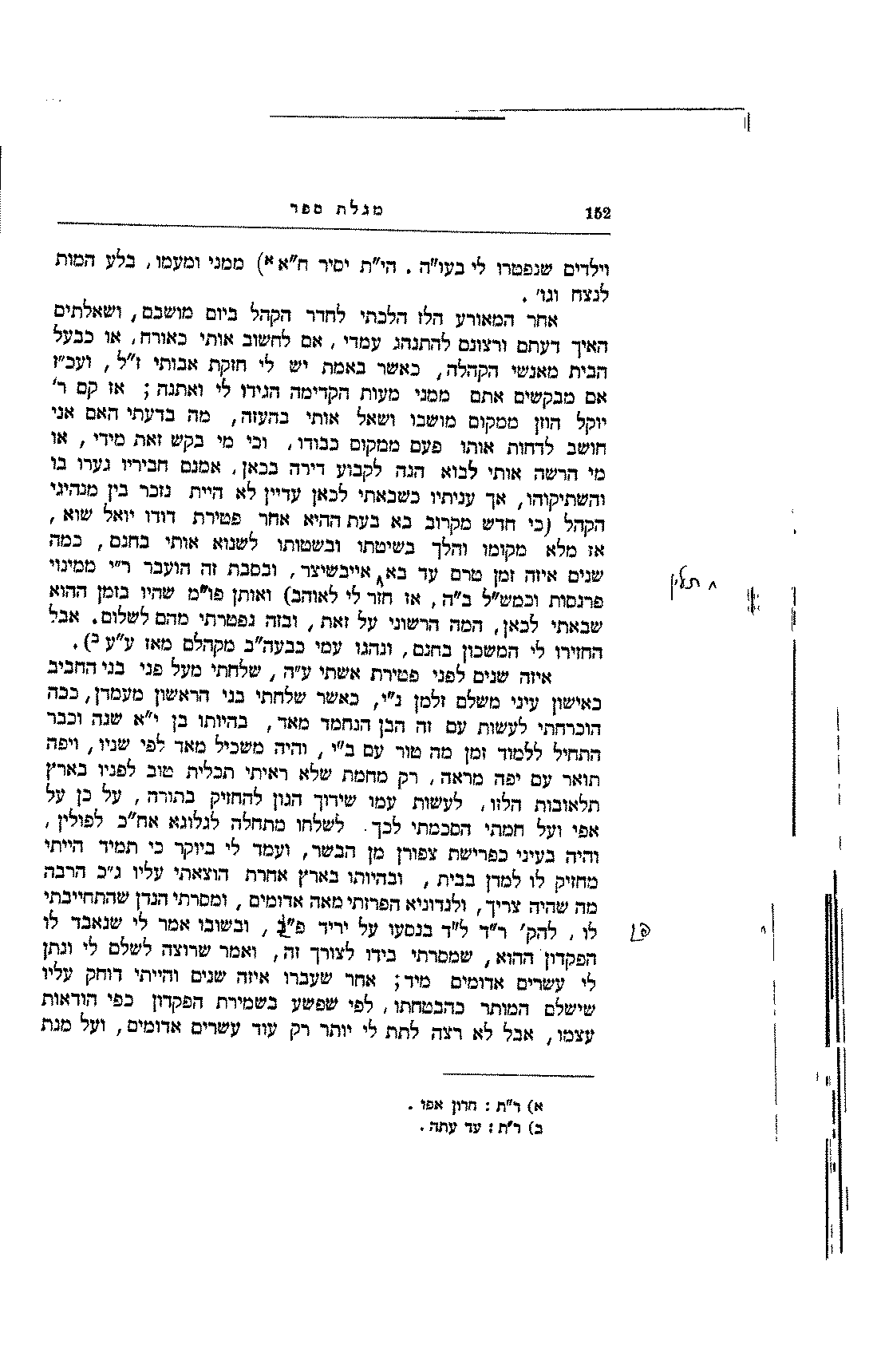
Margin readings in Scholem's copy (2)
| Printed anchor | Type (key sheet) | Mark | Reading | Certainty |
|---|---|---|---|---|
| כמה שנים איזה זמן טרם עד בא ^ אייבשיצר | V: omission | caret below the line; one word in the outer margin (cut off in the NLI image, visible in the HebrewBooks scan) | תלין | fairly sure |
| להק' ר"ד ל"ד בנסעו על יריד פ"ב (the ב retouched in ink) | — | ink retouch on the letter ב, and a short sign in the outer margin beside the line | פו(?) | uncertain |
Page 153 (scan 173)
that I give him a release. I had to do his will so as not to lose more, for he was a hard litigant, and I did not want to bring on him and on me "the disgrace of the court" (b. Bava Metzia 69a). So I received forty gold pieces from him, and I was forced to make up the said sum for my son, a hundred good gold pieces of full weight in cash. He made a fitting match in Brody: he took the daughter of a scholar and God-fearing man; but until now he has not been granted sons. May the Lord grant me to see fitting sons from him too! My eldest son, thank God, was granted offspring, but no male offspring survived to him, only daughters; two of them he has married off, thank God, to fitting men. So may the Blessed Name in His mercy grant him fitting male children too!
In the year [5]498 [1738] I bought a fine dwelling house, and it too brought me envy and enmity. At first the man who lived in it stirred up a quarrel with me. Although I consulted him first and told him that if he wished to buy it I would not touch it — though I did not need to do so, for it belonged to a gentile and was sold publicly by auction — even so I did this beyond the letter of the law, and asked before several people whether he did not want it. A certain gentile had already bid a known sum for it, and they wanted to leave it with him. After that man assured me that it was too dear for him, and went and left it to the gentile, then I too made a bid on it and raised the price a little, and they told me: It is yours. After the purchase had been concluded with full force, the man turned round to make accusations against me, that I had taken his house, as though I had transgressed the law of the Torah, God forbid. But I had witnesses, and even the man's own sons testified against him and contradicted him; so he could not take it out of my hand.
I had great expenses on this house, for it was like a ruin when I bought it. I rescued it from the hand of a gentile in whose hand it had been for some years; a God-fearing Sephardi Jew had built it and fixed the Name in its walls, and by a miracle it had not been erased; but had it come into the hand of another gentile, it would certainly not have escaped erasure, God forbid. So I saw this too as a merit for me, especially as I set up in it a place for prayer too (although it is made on condition), and a room for my study. I spent several thousands on it, as if I had built it anew, and I made in it a ritual bath of rainwater (?); three times I had to repair it until it was "a plastered cistern" (m. Avot 2:8) holding its water. I also built a fine sukkah, with God's help, and a privy on the upper floor, and besides this many repairs inside and out. Eighteen years before this year [5]517 [1757] the holy society wanted to buy it and give me seven thousand Schock for it, and I wanted precisely a thousand gold pieces in gold; so the matter came to nothing. After this I spent much more on it in fine repairs and in strengthening its breaches, when I returned from Amsterdam, as I wrote above. My first wife lived in it three quarters of a year, and left me a nursing daughter, and I had to hire a wet-nurse for her. That daughter was healthy and good, and after some months she too died, for our many sins.
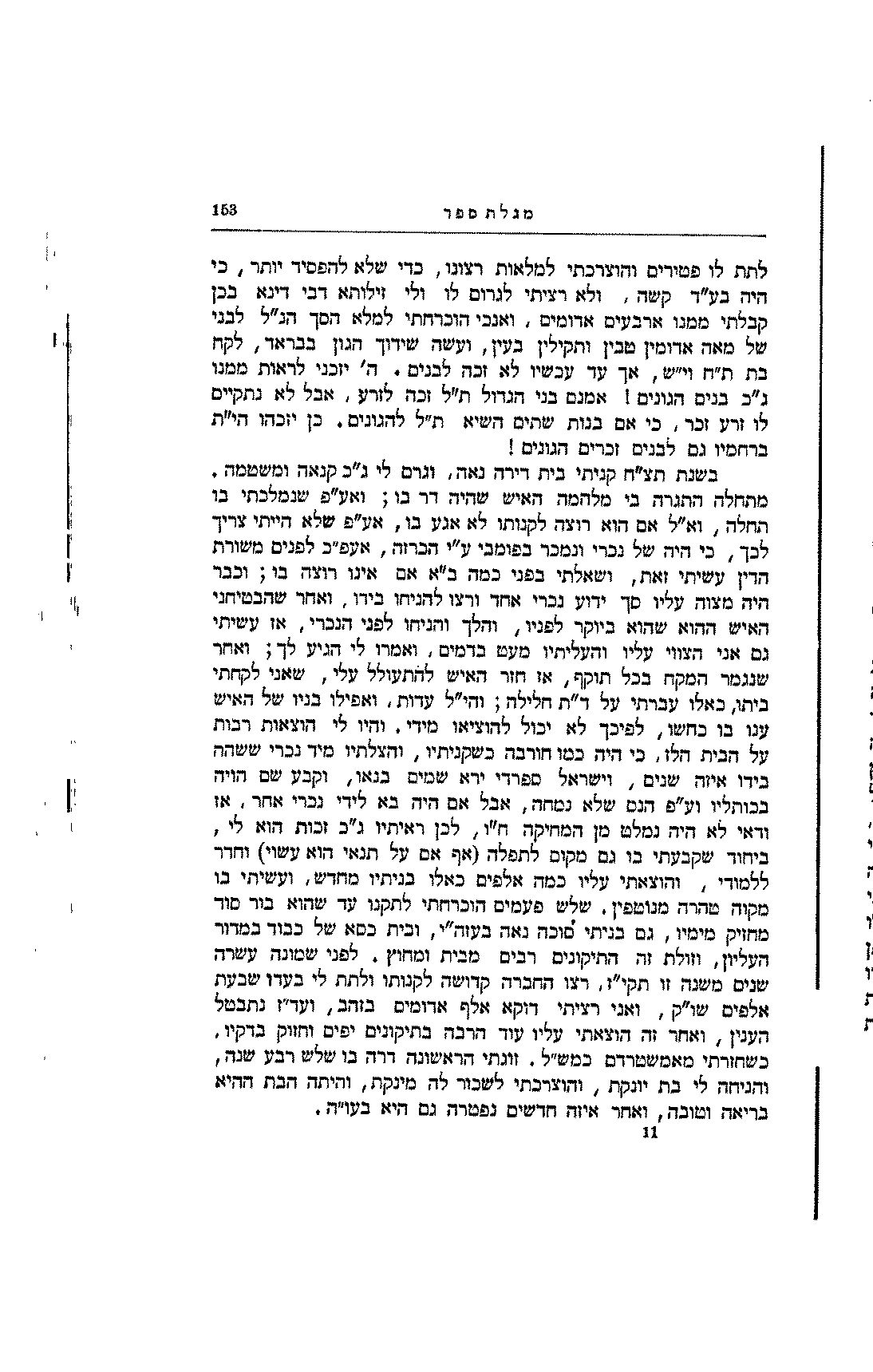
לתת לו פטירים והוצרכתי למלאות רצונו, כדי שלא להפסיד יותר, כי היה בע"ד קשה, ולא רציתי לגרום לו ולי זילותא דבי דינא, בכן קבלתי ממנו ארבעים אדומים, ואנכי הוכרחתי למלא הסך הנ"ל לבני של מאה אדומין טבין ותקילין בעין, ועשה שידוך הגון בבראד, לקח בת ת"ח וי"ש, אך עד עכשיו לא זכה לבנים. ה' יזכני לראות ממנו ג"כ בנים הגונים! אמנם בני הגדול ת"ל זכה לזרע, אבל לא נתקיים לו זרע זכר, כי אם בנות שתים השיא ת"ל להגונים. כן יזכהו הי"ת ברחמיו גם לבנים זכרים הגונים! בשנת תצ"ח קניתי בית דירה נאה, וגרם לי ג"כ קנאה ומשטמה. מתחלה התגרה בי מלחמה האיש שהיה דר בו; ואע"פ שנמלכתי בו תחלה, וא"ל אם הוא רוצה לקנותו לא אגע בו, אע"פ שלא הייתי צריך לכך, כי היה של נכרי ונמכר בפומבי ע"י הכרזה, אעפ"כ לפנים משורת הדין עשיתי זאת, ושאלתי בפני כמה ב"א אם אינו רוצה בו; וכבר היה מצוה עליו סך ידוע נכרי אחד ורצו להניחו בידו, ואחר שהבטיחני האיש ההוא שהוא ביוקר לפניו, והלך והניחו לפני הנכרי, אז עשיתי גם אני הצווי עליו והעליתיו מעט בדמים, ואמרו לי הגיע לך; ואחר שנגמר המקח בכל תוקף, אז חזר האיש להתעולל עלי, שאני לקחתי ביתו, כאלו עברתי על ד"ת חלילה; והי"ל עדות, ואפילו בניו של האיש ענו בו כחשו, לפיכך לא יכול להוציאו מידי. והיו לי הוצאות רבות על הבית הלז, כי היה כמו חורבה כשקניתיו, והצלתיו מיד נכרי ששהה בידו איזה שנים, וישראל ספרדי ירא שמים בנאו, וקבע שם הויה בכותליו וע"פ הנס שלא נמחה, אבל אם היה בא לידי נכרי אחר, אז ודאי לא היה נמלט מן המחיקה ח"ו, לכן ראיתיו ג"כ זכות הוא לי, ביחוד שקבעתי בו גם מקום לתפלה (אף אם על תנאי הוא עשוי) וחדר ללמודי, והוצאתי עליו כמה אלפים כאלו בניתיו מחדש, ועשיתי בו מקוה טהרה מנוטפין. שלש פעמים הוכרחתי לתקנו עד שהוא בור סוד מחזיק מימיו, גם בניתי סוכה נאה בעזה"י, ובית כסא של כבוד במדור העליון, וזולת זה התיקונים רבים מבית ומחוץ. לפני שמונה עשרה שנים משנה זו תקי"ז, רצו החברה קדושה לקנותו ולתת לי בעדו שבעת אלפים שו"ק, ואני רציתי דוקא אלף אדומים בזהב, ועד"ז נתבטל הענין, ואחר זה הוצאתי עליו עוד הרבה בתיקונים יפים וחזוק בדקיו, כשחזרתי מאמשטרדם כמש"ל. זוגתי הראשונה דרה בו שלש רבע שנה, והניחה לי בת יונקת, והוצרכתי לשכור לה מינקת, והיתה הבת ההיא בריאה וטובה, ואחר איזה חדשים נפטרה גם היא בעו"ה.
Page 154 (scan 174)
In those days when I was free, without a wife, I brought out into the light of print the book Iggeret Bikoret, which had been written and lying [by me] since the year [5]496 [1736], when I composed it; and in the year [5]499 [1739] I began to bring it to press. And immediately after I became a widower, many matchmakers spoke to me of honoured women on every side; but I did not set my eye on money. Now I will tell here wonderful things that are hard to believe; but "my witness is in heaven" (Job 16:19) that I do not change anything, only tell the matter as it happened, and show clearly that the words of the Sages, of blessed memory, are true, who said that it is decreed from heaven: this woman for this man; "and there is no counsel nor understanding against the Lord" [a]. And this is how it happened. In the two matches after the first, many people, "both low and high" (Ps. 49:3), set their eyes on making a match with me, and I could have received several thousands as dowry. From Prague they proposed to me a widow with ten thousand gulden, and I did not set my eye on money, to take a woman from a far land whom I did not know. My second wife too, who was widowed that year and had more than three thousand gulden, was eager for me at once, on condition of binding herself to such a sum for me in cash. (The rabbi R. H., head of the court in Mannheim, wanted at that time to give me his daughter and to give me lavishly two thousand Reichstaler in London, and promised me besides the rabbinate of Glogau; and I did not incline my ear.) She had a very good name for good deeds and piety, and was of high birth and of strong character, of the noble families of the land of Ashkenaz; many ran after her and wanted to cling to her, and could not attain her, and I had no desire for her. At that time she did not enter my ears, for she was a widow who had been barren to her [husband], and almost forbidden and alien to me, for a reason that the Sages mention (cf. b. Yevamot 64b). Nor did I believe the words of the matchmaker, who praised her greatly.
Then it happened that my brother, our teacher Ephraim, may his light shine, came from Lwów to Glogau, where my brother-in-law the rabbi, our teacher R. H. L., of blessed memory, was head of the court at that time [b]; and my brother mentioned was then for the first time come to the border of the land of Ashkenaz. When the news of my wife's death, peace be upon her, came to Glogau, they at once took counsel and agreed together that I should take the daughter of my brother mentioned (who is now my wife), and they let me know their mind and their counsel by post, and praised the girl to me greatly, as in truth she merited a good name. So I wished at once that they should bring the matter quickly to an end, for it was hard for me to remain without a wife, with young children. But my brother went away and returned home to Lwów, and no more mention was made of this matter — I do not know whether from forgetfulness or because he went back on his first intention. So the matter was held up, and with me too the matter was "yes and no". Especially since many warned me against taking a woman of the daughters of the men of Poland, for the nature of those of these countries is not alike and does not agree with
Kahana's notes
- [a] See below (p. 163).
- [b] He is his brother-in-law Aryeh Leib, who was afterwards rabbi in Amsterdam.
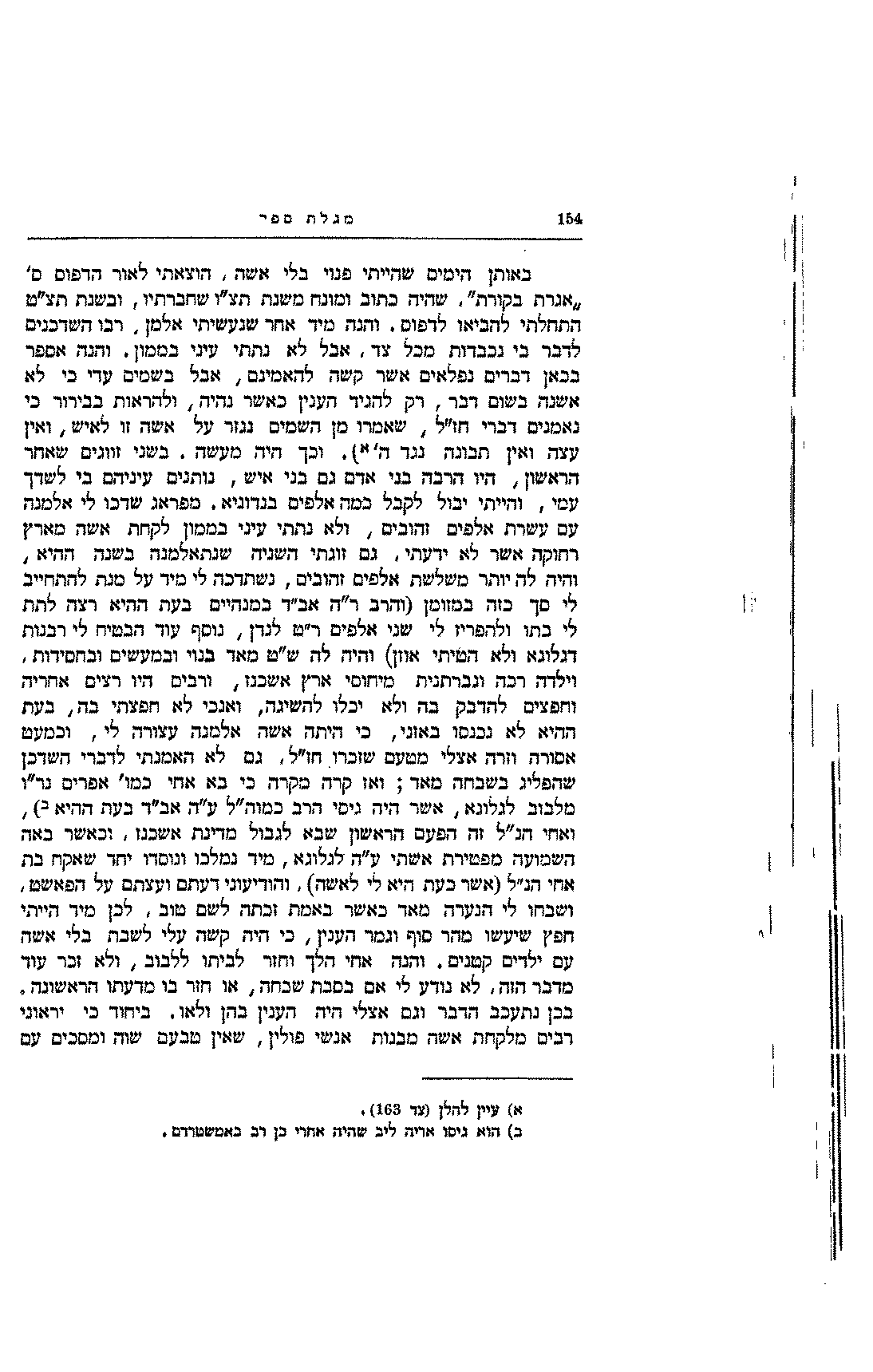
באותן הימים שהייתי פנוי בלי אשה, הוצאתי לאור הדפוס ס' „אגרת בקורת", שהיה כתוב ומונח משנת תצ"ו שחברתיו, ובשנת תצ"ט התחלתי להביאו לדפוס. והנה מיד אחר שנעשיתי אלמן, רבו השדכנים לדבר בי נכבדות מכל צד, אבל לא נתתי עיני בממון. והנה אספר בכאן דברים נפלאים אשר קשה להאמינם, אבל בשמים עדי כי לא אשנה בשום דבר, רק להגיד הענין כאשר נהיה, ולהראות בבירור כי נאמנים דברי חז"ל, שאמרו מן השמים נגזר על אשה זו לאיש, ואין עצה ואין תבונה נגד ה' א. וכך היה מעשה. בשני זווגים שאחר הראשון, היו הרבה בני אדם גם בני איש, נותנים עיניהם בי לשדך עמי, והייתי יכול לקבל כמה אלפים בנדוניא. מפראג שדכו לי אלמנה עם עשרת אלפים זהובים, ולא נתתי עיני בממון לקחת אשה מארץ רחוקה אשר לא ידעתי, גם זוגתי השניה שנתאלמנה בשנה ההיא, והיה לה יותר משלשת אלפים זהובים, נשתדכה לי מיד על מנת להתחייב לי סך כזה במזומן (והרב ר"ה אב"ד במנהיים בעת ההיא רצה לתת לי בתו ולהפריז לי שני אלפים ר"ט לנדן, נוסף עוד הבטיח לי רבנות דגלוגא ולא הטיתי אוזן) והיה לה ש"ט מאד בנוי ובמעשים ובחסידות, וילדה רכה וגברתנית מיחוסי ארץ אשכנז, ורבים היו רצים אחריה וחפצים להדבק בה ולא יכלו להשיגה, ואנכי לא חפצתי בה, בעת ההיא לא נכנסו באזני, כי היתה אשה אלמנה עצורה לי, וכמעט אסורה וזרה אצלי מטעם שזכרו חז"ל, גם לא האמנתי לדברי השדכן שהפליג בשבחה מאד; ואז קרה מקרה כי בא אחי כמו' אפרים נר"ו מלבוב לגלוגא, אשר היה גיסי הרב כמוה"ל ע"ה אב"ד בעת ההיא ב, ואחי הנ"ל זה הפעם הראשון שבא לגבול מדינת אשכנז, וכאשר באה השמועה מפטירת אשתי ע"ה לגלוגא, מיד נמלכו ונוסדו יחד שאקח בת אחי הנ"ל (אשר כעת היא לי לאשה), והודיעוני דעתם ועצתם על הפאשט, ושבחו לי הנערה מאד כאשר באמת זכתה לשם טוב, לכן מיד הייתי חפץ שיעשו מהר סוף וגמר הענין, כי היה קשה עלי לשבת בלי אשה עם ילדים קטנים. והנה אחי הלך וחזר לביתו ללבוב, ולא זכר עוד מדבר הזה, לא נודע לי אם בסבת שכחה, או חזר בו מדעתו הראשונה. בכן נתעכב הדבר וגם אצלי היה הענין בהן ולאו. ביחוד כי יראוני רבים מלקחת אשה מבנות אנשי פולין, שאין טבעם שוה ומסכים עם
- [א] עיין להלן (צד 163).
- [ב] הוא גיסו אריה ליב שהיה אחרי כן רב באמשטרדם.
Page 155 (scan 175)
the nature of the people of these countries. Meanwhile the Lord brought before me, and there came here, an old man from Halberstadt, a scholar, named R. A. Aptrod (?), one of those who sit in the house of study in the said community, and a judge of the province of Hesse, whom I had known for several years, since the time he passed this way from that country. When he came to these countries he made himself known to me, and I knew him by name as a worthy and God-fearing teacher; and he had never been in this place until now, when he lodged in the house of the parnas and leader R. Y. Hozen. I did not know what his business here was, and I did not hear that he accomplished anything in any matter; for as he came so he went, and he took nothing away in his hand. Only he came to me to visit me as a friend and an old acquaintance, and we spoke together on matters of Torah and worldly matters [a], until [he came] to Sarah, the daughter of the leader R. H. K. H., who was still unmarried at that time, and he began to exaggerate her praise twice over beyond what the matchmaker had said to me earlier, as above, with every fitting quality of a woman in great measure; and above all, being a God-fearing woman, "she shall be praised" (Prov. 31:30). And to strengthen his words, so that I should not think he was exaggerating in the hyperbolic manner of matchmakers, he went to the place of the holy ark in my house, where the Torah scroll lay, raised his hands while holding the sacred object, and swore that his words were so without any exaggeration; on the contrary, he had said too little in praise of her qualities, of what there truly was in her, in all fitting words. In this way this man took my heart and bound me "with cords of a man" (Hos. 11:4); he drew me after him "with bands of love", and I agreed to his request to try for her, and cast behind my back all that other matchmakers had spoken, and said: The thing has come from the Lord; she is the woman whom the Lord has appointed for me (Gen. 24:44). And I turned no more to any other way. So much did a desire for a good wife fill me, that I paid no heed at all to the money they would bring in to me; for although at first, the first time they proposed this match, they promised me three thousand gulden in good coin, as said above — and so she truly had at first — in the end, because of the good name, I agreed to half this sum, since her capital too had shrunk in the days she sat without a husband, for she spent much, and also gave credit and loans from her money, which was lost and used up, so that afterwards she could give only half. And even this she did not give me in full, and I did not insist, and was content in everything, for "love upsets the order" (Gen. Rabbah 55:8); and I said: it is enough for me with a worthy, God-fearing, pure woman ⟨S: a five-line note, its edge cut off, partly read: "and so (it was seen …) in a dream at the time of [prayer?], that I came to my mother (?) (may her soul rest in Eden), … (and Dinah)"⟩. When I inquired after the name of the woman proposed to me, and he told me her name was Sarah, then ⟨S: a note at the foot of the page: "I said: here is the interpretation of the dream; from heaven they showed me my match. So"⟩ I concluded the match, with God's help. With all this my brother's daughter too was waiting for me [b].
And so I married my second wife on the New Moon of Nisan [5]500 [1740], and she brought me fifteen
Kahana's notes
- [a] The abbreviation means "in words of Torah and worldly matters".
- [b] See below (p. 163).
טבע בני מדינות הללו. ובתוך כך הקרה ה' לפני ובא לכאן זקן אחד מהלברשטאט ת"ח, שמו היה ר"א אפטרוד מיושבי בה"מ בק' הנ"ל, ודיין דמדינת העסין, אשר הכרתיו מכמה שנים מאז בעברי דרך מדינה הנ"ל. בבואו למדינת הללו נתוודע אלי, וידעתיו בשם למדן הגון וירא שמים, ומימיו לא היה במקום הזה עד עתה שנתאכסן בבית פו"מ ר"י הוזן, ולא ידעתי מה היה עסקו כאן, ולא שמעתי שפועל מאומה באיזה דבר, אחר כי כאשר בא כן הלך ומאומה לא הוליך בידו, רק שבא אלי לבקרני כמו אוהב ומכיר ישן, ודברנו יחד בד"ת וד"א א, עד [שהגיע] לשרה הבת של הק' ר"ה ק"ה, שעדיין היתה פנויה כעת, והתחיל להפליג בשבחה כפלי כפלים מאשר דבר וספר לי השדכן הראשון כנ"ל, בכל מעלות המדות הנאותות לאשה במדה מרובה, ועל כולם היותה אשה יראת ה' היא תתהלל; ולחזק דבריו, כדי שלא אחשוב היותו מפליג בלשון גוזמא כדרך השדכנים, הלך אל מקום אה"ק שלי שס"ת מונח בו, והגביה ידיו בנקיטת החפץ, וקפץ ונשבע שכדבריו כן הוא בלי שום הגדלה, אדרבה יותר קצר בשבח מעלותיה, ממה שיש בה באמת בכל מילי מיטב. בזה האופן לקח האיש הלז לבי, וקשרני בחבלי אדם משכני אחריו בעבותות אהבה, נמצאתי לבקשתו להשתדך אליה, והשלכתי אחרי גוי כל מה שדברו שדכנים אחרים, ואמרתי מה' יצא הדבר, היא האשה אשר הוכיח ה' לי, ולא פניתי עוד לדרך אחרת; וכל כך מלא אותי חשק לאשה טובה, שלא השגחתי כלל בממון שתכנים לי, כי עם היות שמתחלה בפעם הראשון שדברו לי שידוך זה, הבטיחוני לקבל שלשת אלפים זהובים חב"ב כנ"ל, וכך היה לה באמת בתחלה, ולבסוף מפני שמה הטוב נתרציתי בחצי זה הסך, באשר ג"כ נתמעט קרנה בימים שישבה בלי בעל, כי פזרה הרבה, גם האמינה והלותה מממונה, מה שנפסד וכלה, עד שלא יכלה אח"כ לתת רק החצי, וגם זה לא נתנה לי בשלימות ולא הקפדתי, והייתי מרוצה בכל, כי אהבה מקלקלת השורה, ואמרתי די לי באשה כשרה יראת ה' טהורה, וכשחקרתי אחר שם האשה המשודכת לי, ואמר לי שרה שמה, אז גמרתי השידוך בעזה"י, ועם כל זה גם בת אחי היתה משתמרת לי ב. והנה נשאתי אשתי השנייה בר"ח ניסן ת"ק, והכניסה לי ט"ו
- [א] ר"ת: בדברי תורה ודרך ארץ.
- [ב] עיין להלן (צד 163).
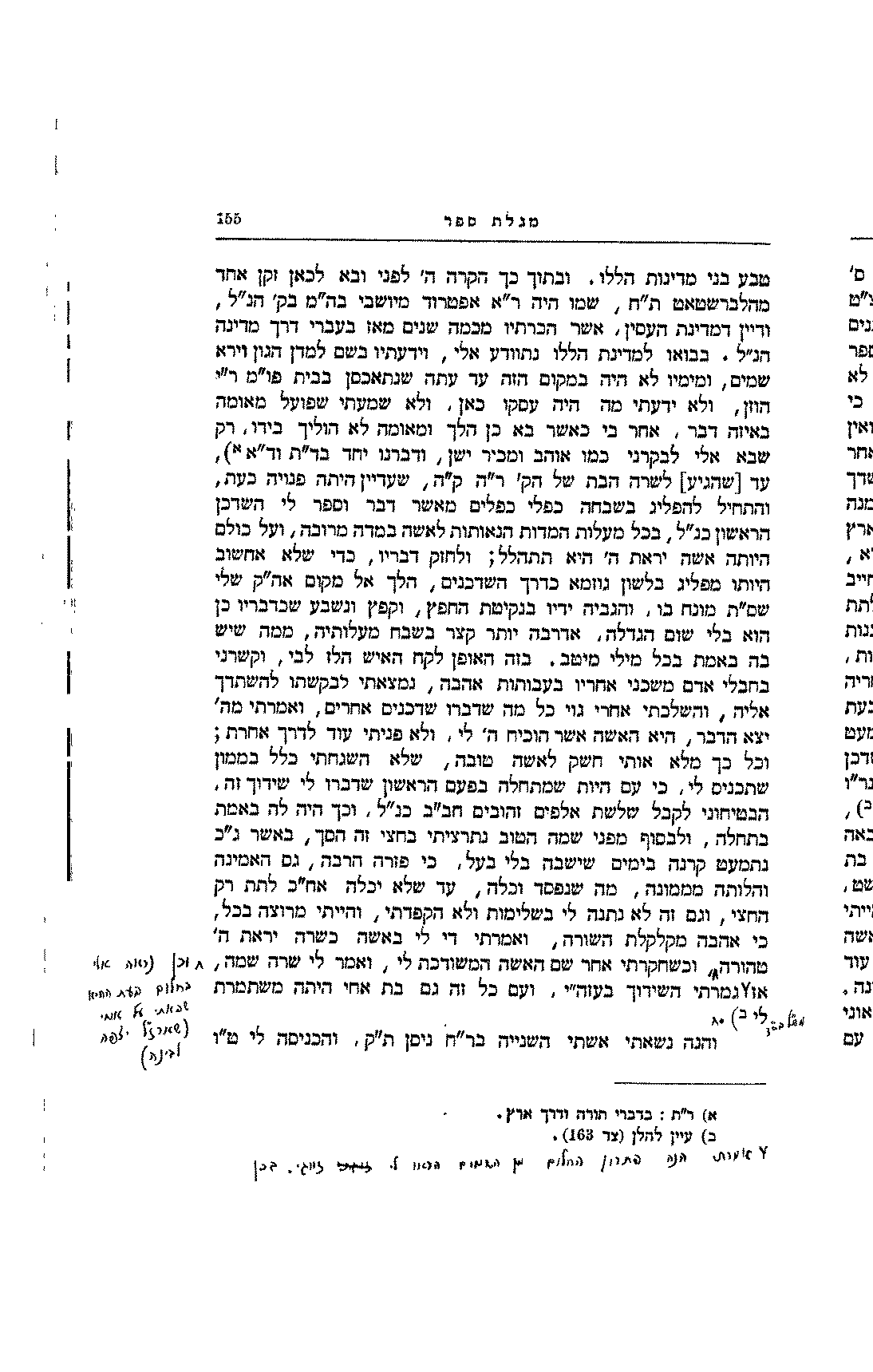
Margin readings in Scholem's copy (2)
| Printed anchor | Type (key sheet) | Mark | Reading | Certainty |
|---|---|---|---|---|
| ואמרתי די לי באשה כשרה יראת ה' טהורה ^, | V: omission | caret after the word; 5-line note in left (outer) margin, its left edge cut off in the NLI image | וכן (נראה(?) א...) / בחלום בעת הת[פלה](?) ... / שבאתי אל אומי(?) ... / (שאר"ל(?)) יצפה ... / (ודינה) | partial |
| אז x גמרתי השידוך בעזה"י | X: substitution | x mark after the word; one-line note at the foot of the page, beside Kahana's notes | אמרתי הנה פתרון החלום מן השמים הראו לי [word struck out] זווגי. בכן | fairly sure |
Page 156 (scan 176)
hundred Reichstaler in Altona money (?), as the conditions required; but not all in cash, for she brought with her goods worth money, which she valued as she pleased, and I was not exact and did not insist at the time of the settlement; for in truth I did not set my eye on money (that is not honest). For this reason I had in the end agreed to half the sum she had wanted to give me at first; so I gave up this too, although it fell short even of the last sum — a recorded matter — according to what the valued items she brought in came to. But this thing caused me some strife and quarrel in the end. For when the final deed of conditions was written, I did not want to give way on this: namely to let the additional third be written also on the valuation. For it is not just that I should be struck twice over for my piety and my generosity in not insisting on the dowry. Even if she could not bring in even half, or if all her property had been lost in the meantime, far be it from me to shame her for it; but why should I take on an excess debt that I do not owe at all? On the contrary, in valuing [goods] the law is to reduce by a fifth, as an explicit Mishnah says (m. Ketubot 6:3); and where the Sages said to reduce, one does not add a further third on top. On this understanding I did not vow. And because they dealt with me craftily, knowing I would not shame her, should I for that reason also take a loss from my own pocket? That never entered my mind. But the sinful brokers, her family, stirred up wars against me over this, even if the woman perhaps did not insist; and through this they cast some enmity between us, for I said: "You have set your eye," etc., God forbid; for they insisted with me on my obligation, though one does not know whether it will ever come to collection, while I did not insist on what it is usual to insist on. So I would in no way take on myself more than eighteen hundred Reichstaler, as I estimated that it came to with the additional third on what she brought in cash.
Even so she lacked nothing; whatever her eyes asked I did not withhold from her, and I loaded on myself a burden far beyond my means, and did not refuse her; for I said: so she was used to with her first husband, who was rich ⟨S: a two-line note, its edge cut off: "[a wife] rises with him and does not go down"⟩; and I bore far too much, for I said: perhaps in return for this the Blessed Name will bestow on me of His goodness, to fill my lack and my needs. At first I saw some good sign: the Norden leaders, when I made the match, helped me with some sum, and R. L. of London too sent me [something] at the time I married R. Y. Lieberman's (?) [daughter]; and from then on their kindness stopped altogether. But I had great and many expenses; I also made a great and costly wedding feast for the whole community and for her family, who are many; so all this was not enough for me. Even when I had profit on one side in some matter, I had a loss against it, this much and that much. And all the world thought I was very rich anyway, and all the more after I married such a woman, who had a name too for wealth and "the treasure of kings" (Eccl. 2:8); they thought she had given me far more than she was obliged to in the dowry. So "many were my friends" (cf. Prov. 14:20) for their own benefit, and all the swindlers brought me pledges
מאות ר"ט מ"צ כפי חיוב התנאים, אך לא הכל במזומנים כי הביאה בידיה שוה כסף, שעשתה שומא כחפצה ולא דקדקתי ולא הקפדתי בעת הסילוק, באשר באמת לא נתתי עיני בממון (שאינו של יושר), כי על כן נתרציתי באחרונה בחצי הסך שרצתה לתת לי בראשונה, לכן ויתרתי גם על זאת, אע"פ שנפחת גם מהסך האחרון, דבר רשום לפי מה שהעלו הדברים הנשומים שהכניסה; אך זה הדבר גרם לי לבסוף תחרות וקטטה קצת; כי אמנם בכתיבת שטר תנאים אחרונים, לא רציתי לוותר על זה, דהיינו להניח לכתוב תוספות שליש גם על השום, שאינו בדין שאלקה פי שנים בשביל חסידותי וותרנותי שלא להקפיד על הנדוניא; שאפילו לא היה ביכלתה להכניס אפילו החצי, או היו כל נכסיה נפסדים בתוך כך, חלילה לי אם הייתי מכלימה בשביל כך, אך מדוע היה לי לקבל חוב יתר שאיני חייב בו כלל, אדרבה בשום הדין לפחות חומש כמ"ש משנה שלימה, ובמקום שאמרו חז"ל לגרוע אין להוסיף עוד תוס' שליש מלבר, אדעתה דהכי לא נדרתי, וכי מפני שנהגו עמי בערמה כי ידעו שלא אביישנה, בשביל זה אקבל ג"כ הפסד מכיסי, זה לא עלה על דעתי. אך הסרסורים החטאים בני משפחתה התעוררו עלי מלחמות בשביל כך, אף אם האשה אולי לא הקפידה, ועד"ז הטיל קצת איבה בינינו, כי אמרתי נתת עינך כו' ח"ו, כי מקפידים עמי בהתחייבותי אע"פ שאין יודע אם יבוא לידי גיבוי, ואני לא הקפדתי במה שדרך להקפיד, על כן לא רציתי בשום אופן לקבל עלי יותר מח"י מאות ר"ט, כמו ששערתי שעולה ברווח לתוספות שליש על מה שהכניסה במזומן. והנה עכ"ז לא יגרע ממנה דבר, כל אשר שאלו עיניה לא אצלתי ממנה, והעמסתי עלי משא הרבה יותר מיכולתי, ולא מנעתי ממנה, כי אמרתי כך היתה רגילה אצל אישה הראשון שהיה עשיר, וסבלתי הרבה יותר מדאי, כי אמרתי אולי תחת זה ישפיע לי הי"ת מטובו למלא חסרוני וצרכי, וקצת ראיתי סימן יפה בהתחלה; גם הק' נורדשי כשעשיתי השידוך עזרו לי באיזה סך, גם ר"ל מלונדון שלח לי באותו פרק שנשאת ר"י ליטרן, ומן אז והלאה פסקה טובתם לגמרי, אך הי"ל הוצאות גדולות ומרובות, גם עשיתי סעודת חתונה גדולה ויקרה לכל פני הקהלה ולבני משפחתה שהם רבים, לכן הכל לא הספיק לי. גם אם היה לי ריוח מצד אחד באיזה דבר, הי"ל הפסד כנגדו כזה וכזה, וכל העולם סוברים שאני עשיר גדול בלא"ה, וכ"ש אחר שכנסתי אשה כזאת, שיצא לה שם ג"כ בעושר וסגולת מלכים, חשבו שנתנה לי כהנה וכהנה יותר ממה שנתחייבה בנדונייא; לכן היו אוהבי רבים לצורך הנאת עצמם, וכל הרמאים הביאו לי משכנות
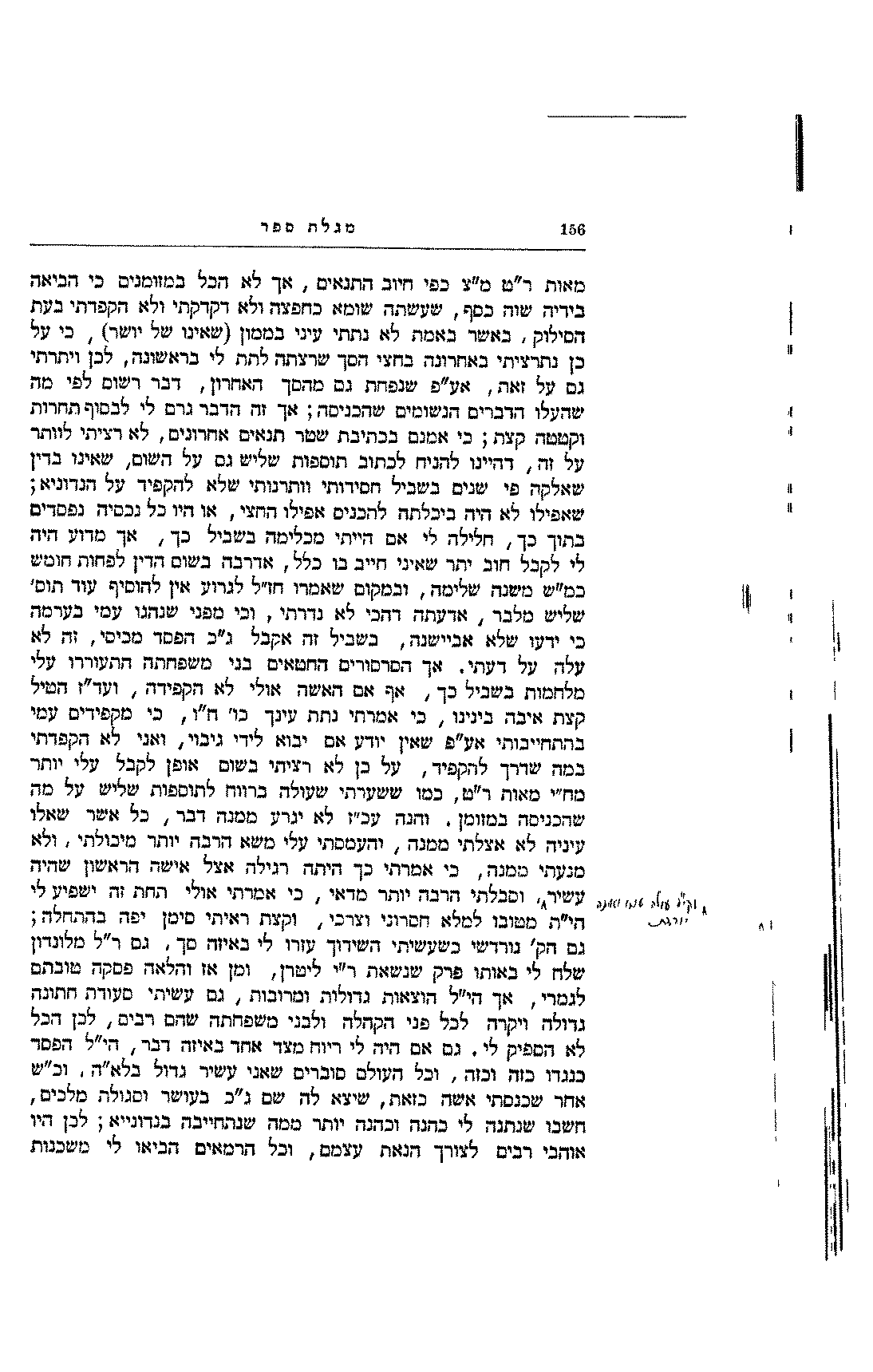
Margin readings in Scholem's copy (1)
| Printed anchor | Type (key sheet) | Mark | Reading | Certainty |
|---|---|---|---|---|
| כך היתה רגילה אצל אישה הראשון שהיה עשיר ^, | V: omission | caret after the word; 2-line note in right margin, its right edge cut off | [ש]ל עולה עמו ואינה / [י]ורדת | fairly sure |
Page 157 (scan 177)
on the strength of [being] neighbours' ⟨S: a note, cut off, not read⟩, to lend on them at interest. Many lied, for they brought their own things, which could not be sold at the price they had received from me as a loan. For I relied on my wife, that she understood, since she had grown up among merchants. I reasoned a fortiori from my first wife, who had never seen or known merchandise and yet dealt in lending wisely: how much more [she], who was a merchant's daughter, a merchant's wife and a merchant's daughter-in-law — it was plain to me that she would know and understand the ways of traders better. So my heart was confident at first, and I said in my heart: Now at last I can be diligent in my study, and I will have no business but the study of books of the Lord's Torah, which is my delight. But in truth my thoughts were very far off; for afterwards I understood that I had lost more than I had gained. Through this quarrels and disputes, law upon law, were stirred up against me also by the owners of the pledges: instead of [owning up that] they had cheated me, they sought to get still more out of me, and caused me "the disgrace of the court"; and scoffers "set the town aflame" (Prov. 29:8), as though I had robbed them. "The strength of the bearers fails" (Neh. 4:4) to tell a part of the violence and toil that befell me here in these matters which the swindlers brought on me.
And not only this, but even R. Y. Ḥ. and his court did a great wrong and disgrace: they imposed an oath on me where I was not obliged to swear at all, as is explained in the pamphlet I wrote on this matter by itself. I also wrote R. Y. Ḥ. a crushing responsum and rebuked him to his face, and he was struck dumb and could answer nothing. And one insolent man, Aaron Fürst, summoned me on the day of my wedding, [demanding] that I give him a broker's fee for what I had lent to a gentile with whom I had dealt, without my knowing anything of this impudent man. And one pawned with me, for four hundred Schock, pawn tickets for pledges that he had pawned with a gentile who has the licence from His Majesty for lending at interest, which they call the Lombard. It lends only half the value of the pledges, or even less than half; so people pawn those tickets from the Lombard with others, to borrow on what the pledges are worth beyond that. In these loan tickets precious things were recorded, coming to a large sum of several thousands, and so he pawned them with me for the said sum, for my security was the surplus value of the supposed pledges. At first I showed those tickets to experts to know whether they were good, and they told me they were certainly good, straight and reliable. I relied on the word of the people who knew, and lent on them.
A great miracle was done for me, for besides the loss of money I could have fallen into a very great danger. For when days and years had come round, and neither principal nor accrued interest was paid, and the debtor put me off, I wanted to redeem the pledges from the owner of the Lombard, and I thought I would save my money by this, for their price was high according to the estimate, by what was written in the tickets, which I held to be genuine. So it was a simple matter in my mind to send to redeem the pledges; and had I done so, the gentile ⟨S: "the uncircumcised"⟩ would have
בחזקות של שכנים להלוות עליהם ברבית, והיו רבים משקרים כי הביאו משלהם, דברים שלא היו יכולים למכור באותן הדמים שקבלו ממני בהלואה, כי אני סמכתי על זוגתי שהיא מבינה, באשר נתגדלה אצל סוחרים, ודנתי קל"ו מאשתי הראשונה שלא ראתה ולא הכירה סחורה מעולם ועשתה בענינה הלואה בהשכל, עאכ"ו ]הוא[ שהיתה בת סוחר ואשת סוחר וכלתו מן סוחר, היה פשוט אצלי שתכיר ותבין ביותר דרך התגרים. כך היה לבי בטוח מתחלה, ואמרתי בלבי: אך עתה הפעם אוכל לשקוד על תלמודי, ולא יהא לי עסק כי אם בעיון הספרים בתורת ה' שבה חפצי; אבל באמת רחיק רחוק היו מחשבותי, כי אח"כ הבנתי שיותר ממה שהרוחתי הפסדתי, ועד"ז נתעוררו עלי מריבות ומדנים דיני דינים גם מבעלי המשכנות; תחת אשר רמוני, בקשו עוד להוציא ממני, וגרמו לי זילותא דבי דינא, ואנשי לצון יפיחו קריה כאלו אני גזלתי אותם, וכשל כח הסבל לספר מקצת החמס והעמל אשר קרני פה בדברים הללו שסבבו לי הרמאים. ולא זו בלבד אלא אפילו רי"ח וב"ד עשו אונאה גדולה וזילותא, שפסקו לי שבועה במקום שלא הייתי חייב לישבע כלל, כמבואר בקונטרס שכתבתי על זה הענין בפני עצמו, וכתבתי גם לרי"ח תשובה נצחת והוכחתיו על פניו, ונאלם ולא ידע להשיב מאומה. ואחד עז פנים ארון פערשט תבע אותי ביום חתונתי, שאתן לו שכר סרסרות ממה שהלויתי לנכרי אחד שעסקתי עמו, בלי שידעתי מזה החצוף מאומה. ואחד השכין אצלי בעד ארבע מאות שו"ק, כתבי ראיה על משכנות, שהשכין אצל נכרי אשר לו החירות מן המיר"ה על הלואה ברבית שקורין לומברד, שהוא אינו מלוה רק בחצי השוויו של המשכנות, וגם פחות מהחצי, ולכן ממשכנים אותם כתבי ראיה מן הלומברד אצל אחרים, ללות על מה ששוים המשכנות ביותר, והיו בכתבי הלואות הללו רשומים דברים יקרים עולים לסך רב כמה אלפים, ולכן השכינם אצלי בעד הסך הנ"ל שהיה בטחוני על מותר דמי שווי המשכנות המדומים. והנה מתחלה הראתי הכתבים ההם לבקיאים לדעת אם טובים הם, ואמרו לי שבודאי הם טובים ישרים ונאמנים. על דברי המכירים סמכתי והלויתי עליהם. ונס גדול נעשה לי כי נוסף על היזק מעות, הייתי יכול ליפול בסכנה גדולה ביותר; כי כאשר הקיפו הימים ושנים, ולא נפרע קרן ורבית שעלה והבע"ד דחה אותי, רציתי לפדות המשכנות מבעל הלומברד, וסבור הייתי להציל מעותי ע"י כך, כי מחירם הרבה כפי האומד, לפי מה שנכתב בכתבי הראיה שהוחזקו אצלי אמתיים; לכן דבר פשוט היה בדעתי לשלוח לפדות המשכנות, ואם הייתי עושה כן היה הנכרי
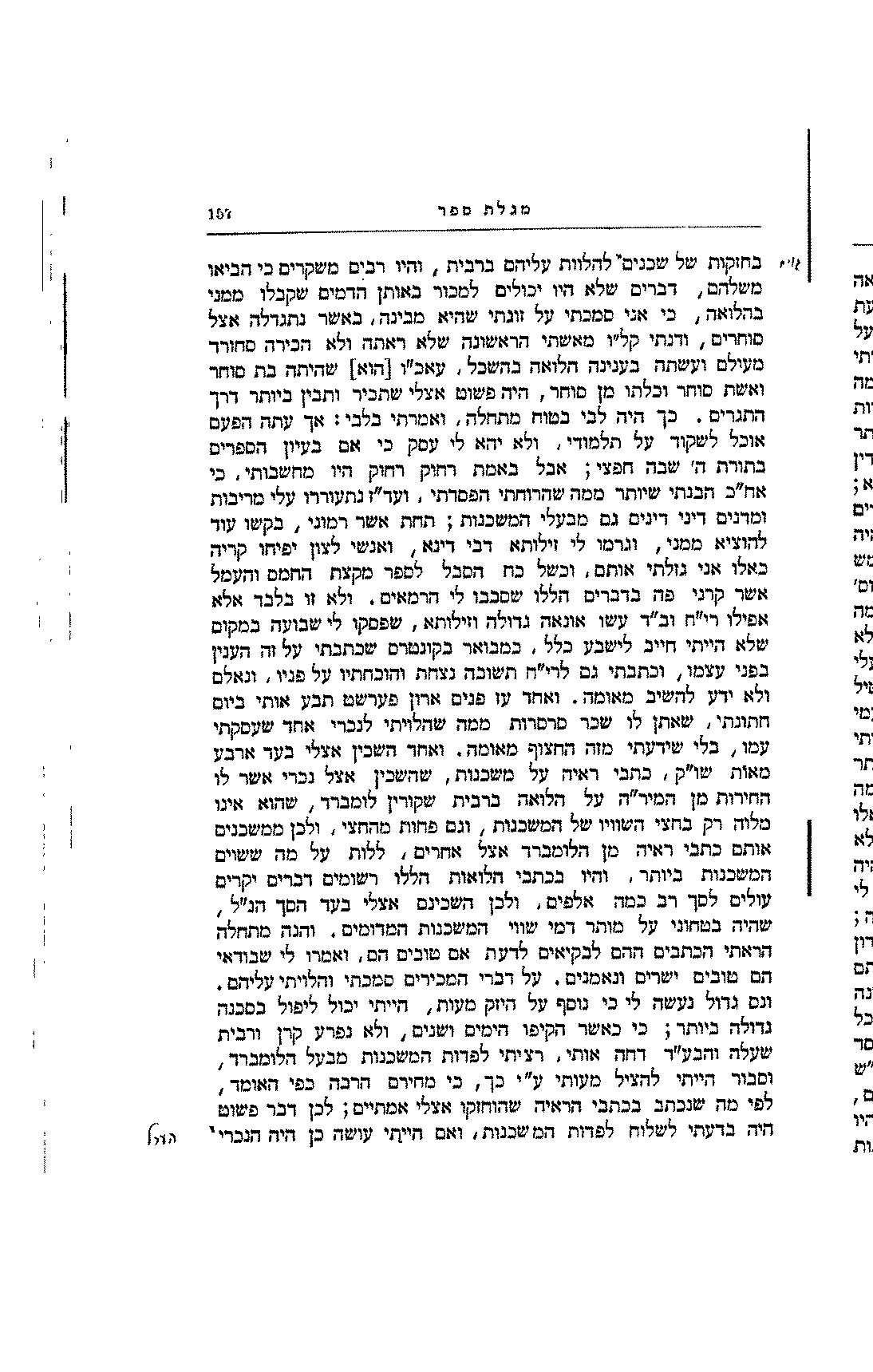
Margin readings in Scholem's copy (2)
| Printed anchor | Type (key sheet) | Mark | Reading | Certainty |
|---|---|---|---|---|
| בחזקות של שכנים x להלוות עליהם | X: substitution | x mark after the word; the margin note is cut off in both scans | not read | not read |
| ואם הייתי עושה כן היה הנכרי x | X: substitution | x mark after the word; one word in left (outer) margin | הערל | sure |
Page 158 (scan 178)
accused me of having forged those writings, and who knows whether all I had would have been enough to save even my body from the punishment of the gentile courts, God forbid. But when the swindler learned that I meant to do this, he came to me and revealed his deceit, that he had forged those writings; so he warned me strongly not to do so, not to claim the pledges, for he had no pledge at all in the Lombard, and all the tickets he had pawned with me were forged; and there would be a great liability if I went and claimed from the Lombard what it had never known of. And so it certainly was; for he too had entered into danger, but my liability was greater than his, for the gentile courts set their eyes on men of means, on one from whom they know they can get money, not on one "shaken out and emptied" (Neh. 5:13). So I certainly had to bless and give thanks for this evil, of the kind of the good (cf. m. Berakhot 9:5), that the said sum was lost. Blessed be He who saved me from coming into the hand of the gentile courts ⟨S: a note, cut off, not read⟩! And this is only a small thing compared with the other losses, which came to several thousands, into which the forgers and swindlers led me — who have eyes only for their gain — to lend to gentiles whom I did not know; and much was lost to me in this way. "The land could not bear them" (Gen. 13:6), and a special book would be needed if I were to tell it. Only a few grains will I mention; but the one is very hard and bitter for me, and I learned what the gentile courts are like — may the Lord save us from them! The story was this.
One of the swindlers pawned with me Lombard tickets of the city of Hamburg, and for half a year he rose early to my door day by day. I rebuked him and said to him: Leave me alone, I have no desire to lend to gentiles, for I have already lost much by them. Even so, "like the troubled sea" (Isa. 57:20), he did not rest or keep quiet, coming back to coax me, though I had already sent him away with a rebuke. He got many friends to press me to agree to lend on them, together with a bill of exchange from the gentile, who was a craftsman in sugar boiling; and he prevailed on me to send one of my trusted friends, on whom I relied, and I paid his fee, and he saw the craftsman and his equipment. In this way he overcame me with his many words, to obtain for me a certain profit, and I redeemed the pledges, which lay in a chest. After this that gentile from Hamburg came to the gentile courts and sued the Jewish broker, saying that he had taken the Lombard ticket from him by craft and deceit, and had not received money from me on it. So the courts sent for me, and their decision was that the Jew was obliged to pay the gentile his loss, and the pledge would remain in my possession as security for my debt; for they knew that I was clean and free of any claim, that there was no guilt on me, for I had done this in the innocence of my heart, and by law I should not lose from my pocket. They only ruled that I was not permitted to return the pledge to the Jewish broker when he paid me the money I had given him on it; and it was written in the court register, and I had to pay a Schock as a writing fee. Now I will tell what happened on the following day — it would not be believed if it were told. On that very day, in the week in which Passover fell, when my household were busy cleaning
מעליל עלי, שאני זייפתי אותן הכתבים, ומי יודע אם היה מספיק כל אשר לי, להציל גם גופי מעונש ערכאות ח"ו; אך כאשר נודע להרמאי שדעתי לעשות כן, בא אלי וגלה רמאותו שהוא זייף אותן הכתבים, ולכן הזהירני מאד שלא לעשות כן לתבוע המשכנות, כי אין לו שום משכון בלומברד, וכל כתבי הראיה שהשכין אצלי מזוייפים הם, ויש אחריות גדולה אם אלך ואתבע מן הלומברד, מה שלא ידע בו מעולם; וכן היה בודאי כי גם הוא נכנס בסכנה, אבל אחריותי היתה גדולה משלו, כי העש"ג נותנים עיניהם בבעלי כיסים, במי שיודעים שיכולים להוציא ממנו ממון, לא בנעור וריק; לפיכך בודאי הייתי צריך לברך ולהודות על הרעה הזאת מעין הטובה כי נפסד הסך הנ"ל. וברוך שהצילני מבוא ביד העש"ג! וזה הוא רק דבר קטן בערך שאר הזיקות שעלו לכמה אלפים, מה שהכניסוני הזייפנים הרמאים, שאין עיניהם כי אם אל בצעם, להלוות לנכרים אשר לא ידעתי, ונפסד לי הרבה בדרך זה, לא תוכל האר"ש שאתם, ויצטרכו לספר מיוחד אם אספרה כמו. רק איזה גרגרים אזכיר, אמנם האחד הוא קשה ומר מאד ממני, ואדע מה טיבן של עש"ג, ה' יצילנו מהם! וכך היה מעשה: אחד מהרמאים השכין אצלי כתבי לומברד של המקום המבורג, וחצי שנה השכים לפתחי יום יום, וגערתי בו ואמרתי לו: הניחני, אין לי חפץ בהלואת נכרים, שכבר הפסדתי בהם הרבה; עכ"ז, כים נגרש לא נח ולא שקט, לשוב ולפיים אף שכבר הוצאתיו בנזיפה, הרבה עלי רעים להתרצות להלוות עליהם, בצירוף ח"כ מהנכרי שהיה אומן בבשול סוקר, והכריעני לשלוח אחד מאוהבי נאמני, שהייתי סומך עליו ונתתי שכרו, והוא ראה האומן וכליו. באופן זה יכול לי ברוב דבריו, להמציא לי רוח מסוים, ופדיתי המשכנות שהיו מונחים בארגז. אחר זה בא אותו נכרי מהמבורג על העש"ג, ותבע את היהודי הסרסור, באמרו, שלקח ממנו הכתב ראיה של לומברד בערמה ורמאות, ולא קבל ממני מעות עליו; בכן שלחו הערכאות אחרי, ויצא מהם דבר שהיהודי מחוייב לשלם לנכרי הפסדו, והמשכון יהא בחזקתי לבטחון על חובי, כי ידעו שאני נקי ופטור משום תביעה, שאין עלי אשם, כי בתום לבבי עשיתי זאת, ובדין שלא אפסיד מכיסי, רק חייבו אותי שלא אהיה רשאי להחזיר המשכון ליהודי הסרסור, כשישלם לי מעותי שנתתי לו עליו, ונכתב בפנקס הערכאי והוצרכתי לשלם שו"ק שכר כתיבה. עתה אשמיע מה שאירע ביום של אחריו, לא יאומן כי יסופר: בעצם היום בשבוע שחל בה פסח, היה שבני ביתי טרודים בנקוי
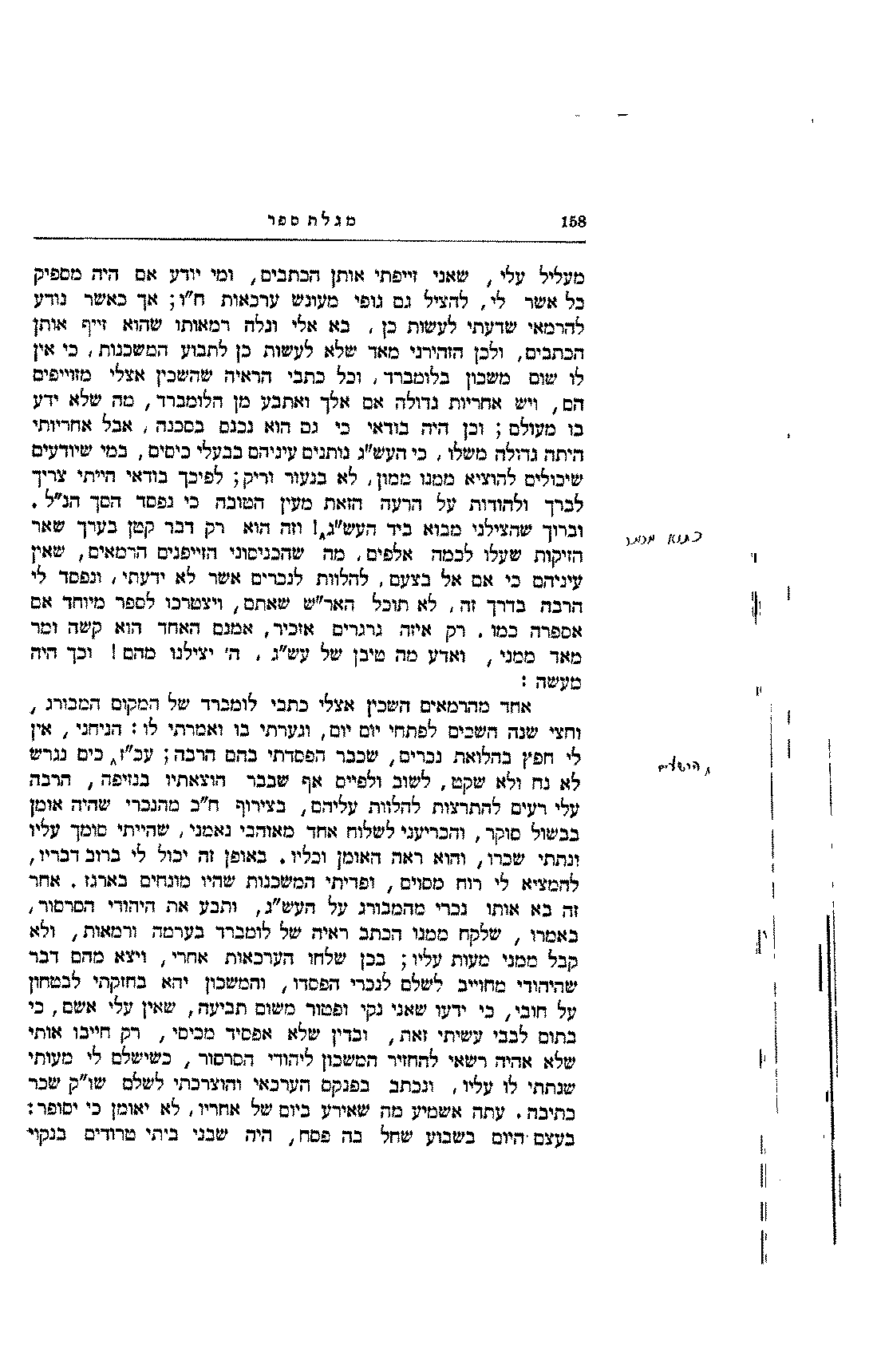
Margin readings in Scholem's copy (1)
| Printed anchor | Type (key sheet) | Mark | Reading | Certainty |
|---|---|---|---|---|
| וברוך שהצילני מבוא ביד העש"ג x! | X: substitution | x mark after the word; a short note in right (outer) margin, cut off at the edge of the NLI image (only a letter like ש is visible) | not read | not read |
Page 159 (scan 179)
the house, my wife, peace be upon her, was with a maidservant at the back of the house and in the yard, and I was sitting upstairs in my rooms in safety, and there was no one downstairs in the house except a gentile who was hired to plaster the lower rooms of the house by the street. The gentile who owned the pledge mentioned came with his wife and took his chest (which stood in the hallway of the house downstairs, near the door on the street side; for the chest was a load for several men, and we did not worry about it at all), with the help of other gentiles — neighbours, too, helped to do evil — and there was no one there of the people of the house; no one saw and no one knew of it except the gentile hired to plaster the house. He alone saw and knew all that was done, and he did not protest, but waited until they had taken the chest and gone out and away. Then he went to the back of the house and told my wife, peace be upon her, being afraid for himself lest they suspect him of stealing the chest; so he did this to clear himself, and said: Here upstairs (?) there are people — I do not know what they are — taking the chest that stands by the door. Then my wife with my household raised an outcry and ran up, and saw: the chest had been taken, and carried "on eagles' wings" (Ex. 19:4) with all its weight; it was already in the middle of the second street before they caught up with it. Many Jews came to help her, and the gentile fought with all of them, striking and wounding everyone who came near to hold back the chest and rescue it from his hand. One he struck and almost blinded his eye; I paid him at once two Reichstaler for his pain and his wound. My wife too, peace be upon her, received blows with a stick, and she was pregnant. Blessed be the Lord that no lives were harmed through this, though it was near and easy, God save us, but for wonderful providence. Blessed be He who guards and rescues!
In the end a guard of soldiers was brought, and they took the gentile with his wife ⟨S: a short note, not read⟩ and the chest into custody. We went to the judge, who was then President Schomburg in Altona, and cried out violence; for he knew what had been done before him the day before, that I was responsible for the chest, to keep it in my possession until the gentile paid me his debt, principal and interest; and now they had come from another place to a place under His Majesty to take the chest from my house by force, like a thief, without my knowledge. Had we not found out after it was taken, he could also have sued me to return his pledge against my money, and could have valued it at a high price as he pleased. And here he had robbed me in the streets, and had almost killed people too. The judge promised to give a sharp judgement on this robber, that he should pay five things (cf. m. Bava Kamma 8:1), and threw him into prison with his wife. Meanwhile the days of the festival of Passover began. I thought it was sure that he would not come out of prison until he had first paid the five things. After the festival I went to seek judgement against this robber, and heard that he had already been released from prison, for the judge had taken a fine from him for himself, as he saw fit, and let him go free. "I cry out but there is none to hear" (cf. Job 19:7), "where is justice?" (Mal. 2:17). The line of justice was struck (?) in several ways, so that we are not safe in our houses even from men
הבית, וזוגתי ע"ה עם משרת היו באחורי הבית ובחצר, ואנכי יושב למעלה בחדרי בטח, ואין איש למטה בבית, זולת נכרי אחד שהיה שכור לסוד חדרי הבית התחתונים שאצל הרחוב; בא הנכרי בעל המשכון הנ"ל עם אשתו שלו, ולקח הארגז שלו (שהיתה מונחת בפרוזדור הבית למטה סמוך לפתח שבצד הרחוב, כי היתה הארגז כבדה משא כמה אנשים ולא דאגנו עליה כלל) בעזרת נכרים אחרים, גם שכנים עזרו לרעה, ואין איש שם מאנשי הבית, אין רואה ואין יודע מזה רק הנכרי השכיר לסוד הבית, הוא לבדו ראה וידע את כל הנעשה, ולא מיחה והמתין עד שלקחו הארגז ויצאו והלכו להם; אז הלך לאחורי הבית והודיע הדבר לזוגתי ע"ה, מפחדו על עצמו שלא יחשדוהו שהוא גנב הארגז, על כן עשה זאת כמנקה עצמו, ואמר: הנה למעלה אנשים, לא ידעתי מה טיבם, לוקחים הארגז העומדת אצל הפתח; אז עשתה זוגתי עם בני ביתי רעש ורצו למעלה, ראו והנה הארגז נלקחה, ונשאת כנפי נשרים עם כובדה, כבר היתה באמצע רחוב שני בטרם השיגוה; והנה רבים מיהודים באים לעזרתה, והנכרי נלחם עם כולם הכה ופצוע כל מי שנגש לעכב הארגז למלטה מידו, לאחד הכה וכמעט סימא את עינו, שלמתי לו מיד שני ר"ט בעד צערו ופצעו, גם זוגתי ע"ה קבלה הכאות במקל והיתה הרה. ברוך ה' שלא נזוקו נפשות בסבה זו, עם כי קרוב וקל היה ר"ל אם לא בהשגחה נפלאה. ברוך השומר ומציל! סוף דבר, הובא משמר בעלי מלחמות, ולקחו הנכרי עם אשתו שלו והארגז במשמר. והלכנו אל השופט, שהיה אז פריזדענט שומבורג באלטונא, וצעקנו חמס, כי הוא היודע את הנעשה בפניו יום אתמול, שאני חייב באחריות הארגז לשמרה ברשותי, עד שישלם לי הנכרי חובו קרן ורבית, ועכשיו באו ממקום אחר למקום שתחת המיר"ה, לקחת מביתי הארגז בחזקה כגונב בלתי ידיעתי, ואלמלא שנודע לנו אחר שנלקחה, היה יכול לתבוע אותי ג"כ שאחזיר לו משכונו נגד מעותי, והיה יכול לשום אותה בדמים יקרים כחפצו, והנה הוא עשק אותי בחוצות, היות גם כמעט הרג נפשות, והבטיח השופט לעשות משפט חרוץ בשודד הלז, שישלם חמשה דברים, והשליכו בתפיסה עם האשה שלו. בתוך כך נכנסו ימי חג הפסח, סבור הייתי שהוא בטוח ולא יצא מבית האסורים, עד שישלם חמשה דברים תחלה. אחר המועד הלכתי לתבוע דין משודד הלז, ושמעתי שכבר נפטר ממאסרו, כי לקח ממנו השופט דמי קנס לעצמו, כאשר ישר בעיניו והניחו ללכת לעצמו חפשי, ושומע אין לי גם כי אזעק ואשוע איה המשפט; ולקתה שורת הדין בכמה אופנים, שלא נהיה בטוחים בבתינו אפילו מפני אנשים
Margin readings in Scholem's copy (1)
| Printed anchor | Type (key sheet) | Mark | Reading | Certainty |
|---|---|---|---|---|
| ולקחו הנכרי עם אשתו x שלו | X: substitution | x mark after the word; a short note in the left (outer) margin seen in a small view of the NLI image (perhaps אי"ה), not found again at higher zoom | not read | not read |
Page 160 (scan 180)
strangers from another city, even though we do not dwell securely among the people of this city, for they too helped in that deed; and "it is better to dwell in the wilderness" (Prov. 21:19) than to live in the town of this king, in a place where there is no judgment on robbers, who go out even on matters of life and death. "The tents of robbers prosper" (Job 12:6), and the upright dwellers of the city lie down trembling and afraid. For all that, the judge stopped his ear to our cry; and what was done was done, there was no undoing it. Only the chest was returned to me, and it was sold afterwards, and that with difficulty, before I came into my own.
A gentile in Hamburg owed me about six hundred Reichstaler (through the arranging of Jewish brokers); in this I had put the dowry money that my second wife had brought me, and on her advice I lent it to him. I had permission from the authorities in Hamburg to distrain him and take his household goods, and my agent was A. G., whom I sent on this matter. But he spoiled and perverted his mission; for he came back to me and advised me to give him time and to wait for him longer. Meanwhile another creditor came and took all that he found in his house and left nothing, and the whole debt was lost. When I met the gentile debtor afterwards and rebuked him — why do you do this to me? — he said to me: "You have ruined yourself! Do you think you have a faithful agent? He took a bribe from me; therefore I got free of him." Such and such went to waste of my wife's dowry with gentiles; and to one [Jew] I lent about a hundred Reichstaler in Altona, and when he could not pay I had him put in prison, and I had to give him board money of five marks a week. This went on nearly half a year, until I grew weary of it and had to ask the court to let him go free from the prison.
Also from London came a Jew, a swindler and forger, who made himself out to be rich, and took from me on credit two rings that my wife, may she rest in peace, had brought me at a valuation of a hundred Reichstaler ⟨S: a word, not read⟩, and fled with them. So too much of the money I had received from my father-in-law, of blessed memory, went to waste in loans to gentiles and to Jews, besides what they stole from me. Once a thief stole from my house, from under my hand, a gold watch, for which they had wanted to give me eighty Reichstaler and I had not wanted to take it; and I do this and that, and it is gone (cf. 1 Kgs. 20:40). Such and such I was robbed a great deal. One night someone took from my house all the tin vessels of the kitchen, which came to a certain sum; and once they took all the laundry that hung behind my house; so too they stripped me of several household vessels of copper and silver; and "I was only oppressed and crushed all the days" (Deut. 28:33). So they oppressed me greatly in several ways, which cannot all be set out in writing.
In the year 5500 [1740] my son Tzvi Hirsch, may he rest in peace, [of my first wife], died. He was about seven and studied Talmud with Rashi and Tosafot; and as it seemed, his teacher caused his death, for he took him with him, to go in his company on an outing to the city of Hamburg [*] in the winter days. [My second wife bore me] twins, and one died at the age of
Emden's gloss (marked *, printed in a side column on pp. 160–161)
And it was fine when they went out of my house; and while they were on the way, suddenly it became
זרים מעיר אחרת, עאכ"ו שלא נשכון בטח מאנשי עיר הזאת, שגם המה סייעו באותו מעשה; וטוב לשבת במדבר מלדור בקרית מלך הזאת, במקום שאין דין מגזלנים, אשר יצאו גם על עסקי נפשות. ישליו אוהלים לשודדים, ודרי העיר הישרים יהיו שוכבים חרדים ופוחדים. עם כל זה השופט אטם אזנו מזעקתנו, ומה שעשה עשה אין להשיב, רק הארגז הושבה לי, ונמכרה אח"כ ובדוחק עד שבאתי אל שלי. לנכרי אחד בהמבורג שהיה חייב לי כשש מאות ר"ט (ע"פ השאת סרסורי יהודים, ובזה בחנתי מעות נדוניא שהכניסה לי זוגתי שנייה, וע"פ עצתה הלויתי ל ו היתה לי רשות מהשררה בהמבורג, לחבול אותו ולקחת כלי ביתו, והיה שלוחי א"ג ששלחתי בעסק זה, אבל הוא קלקל ועוות שליחותו; כי חזר אלי ויעץ אותי להניחו ולהמתין לו עוד, בתוך כך בא ב"ח אחר, ולקח כל מה שמצא בביתו לא הניח מאומה, ונפסד כל החוב; וכשנתראיתי אח"כ עם הנכרי הב"ח והוכחתיו מדוע עושה לי ככה, א"ל: את דאפסדת אנפשך! אתה חושב שיש לך שליח נאמן, והוא לקח ממני שוחד, על כן נפטרתי מאתו. כזה וכזה הלך לטמיון מנדונית זוגתי ע"ה אצל ב"ח נכרים, ולאחד הלויתי ג"כ כמאה ר"ט באלטונא, וכשלא הי"ל מה לשלם הכנסתיו בתפיסה, והוצרכתי לתת לו דמי מזונות חמשה שו"ק לשבוע, ועמד כך קרוב לחצי שנה עד נלאיתי נשוא, והוצרכתי לבקש מן המשפט שיעזבוהו ללכת חפשי מבית הסוהר. גם מלונדן בא יהודי רמאי וזייפן הראה עצמו מתעשר, ולקח ממני בהקפה שתי טבעות, שהכניסה לי שום זוגתי ע"ה בעד מאה ר"ט, וברח מזה. וכן הרבה מהמעות שקבלתי מח"ל הלך לאבוד, בהלואות לנכרים וליהודים, מלבד מה שגנבו ממני. פ"א גנב לי מביתי תחת ידי כלי שעות זהב, שרצו לתת לי בעדו שמונים ר"ט ולא רציתי ליקח, ואני עושה הנה והנה ואיננו. כהנה וכהנה נעשקתי הרבה. בלילה אחד נלקח מביתי כל כלי בדיל מבית המבשלים שלי, שהיה עולה לסך מסוים, ופ"א לקחו כל כלי כביסה שהיו תולים באחורי ביתי, וכן נצלו אותי מכמה כלי בית נחושת וכסף, והייתי אך עשוק ורצוץ כל הימים. כמו כן עשקו הרבה בכמה אופנים שא"א לבאר הכל בכתב. בשנת ת"ק נפטר לי מזוגתי [הראשונה] בני צבי הירש ע"ה. כבן שבע למד גפ"ת, וכפי המדומה סבב לו מיתתו המלמד, שלקחו עמו לילך בחברתו לטייל לעיר המבורג *) בימי החורף. [אשתי השניה ילדה לי] תאומות, ונפטרה אחת כבת [הגהה *] והיה יפה כשיצאו מביתי, ובהיותם בדרך פתאום היות נעשה
Margin readings in Scholem's copy (1)
| Printed anchor | Type (key sheet) | Mark | Reading | Certainty |
|---|---|---|---|---|
| שהכניסה לי שום זוגתי ע"ה בעד מאה ר"ט ^, וברח מזה | V: omission | caret; one word in right margin | not read | not read |
Page 161 (scan 181)
six, and the second, Neḥamah, may she live long and well. After that a daughter was born, and lived some months, and suddenly died; after that a son was born to me and lived likewise some months, and suddenly died. After that her son by her first husband also died, in my house. And a year later, at her fourth childbirth, she too died, on the eve of the New Moon of Adar 5503 [1743].
At that time all my household fell ill; I too fell ill like one of them, with a heavy illness, until I reached the gates of death. As it seemed, they had already despaired of me: those who watched over me, with the doctor, all thought that my hope was lost, God forbid. This was on the night after the Sabbath of the Song, 15 Shevat of the said year. On that Sabbath it had already become known to many that I had fallen on my bed with a hard illness, and there was a commotion in the Three Communities in general, for I still had no enemies, God forbid, but all the people, more or less, loved me. Then their love for me was seen, for they made a mi she-berakh for me [b], and vowed charity on that Sabbath in all the synagogues of the Three Communities. That night I strengthened myself in bed after I had taken a remedy to make me sweat, and a great sweat fell upon me; and from much sweating I fainted, and little by little my spirit flew away, and only a little movement was left in me. Those who stood over me were greatly alarmed, and thought it was the going out of the soul, God forbid. But I was, thank God, in my mind, and by feeling and by sight I took notice of them, and did not know what [was happening]; only weakness I felt. Then they called the doctor, and he despaired of me, for he did not feel movement in the pulse; and from despair he did not hesitate to give me a spoonful of wine. I drank, and my spirit came back to me, thank God; and after some hours, in the morning, "the bowed one was quickly loosed" (Isa. 51:14), and the Lord did not give me over to die to the pit; "the spirit of Jacob revived" (Gen. 45:27) as at first, and I became a wonder in the eyes of those who heard and saw: in their eyes it was like the resurrection of the dead [c]. Blessed is He who revives the dead
Emden's gloss (continued)
rainy weather, wind and snow and great cold, and the child was badly chilled; and though he did not fall ill at once, he kept wasting away [a], and when he was asked he wept, and it was not known what hurt him; it seems he was struck then in the inner organs, until he fell into a heavy illness, God save us. A vein opened in him, so that blood ran from his nose for some days, and all the remedies made for him did not help; though it stopped a little, it came back after an hour, until his soul went out in purity at the end of the Sabbath of the portion Mishpatim, for our many sins; and I eulogised him on a theme from that portion. At that time I printed the booklet Yatziv Pitgam and made in it a memorial for him. After this my son Meshullam Zalman, may he live, married a wife, and I sent as dowry about a hundred ducats through R. David, may he rest in peace, and the deposit was lost in his hands; I had to send a second hundred ducats in cash. Between these times I was busy with printing the book She'ilat Ya'avetz, which I had already begun in the year [5]499 [1739].
Kahana's notes
- [a] The language of the Gemara, Ḥullin (57b).
- [b] That is: mi she-berakh.
- [c] That is: like the resurrection of the dead.
שש, והשניה נחמה תי' לאי"ט, אחר ילדה בת ונתקיימה איזה חדשים ופתאום מתה, אח"כ ילדה לי בן וחי כמו כן איזה חדשים ופתאום מת, אח"כ נפטר ג"כ גם בנה מבעלה הראשון מת בביתי, ואחר שנה היא רביעית לנישואין מתה גם היא, בר"ח אדר תק"ג. בעת ההיא חלו כל בני ביתי, גם אנכי חליתי כאחד מהם חולי כבד עד שהגעתי לשערי מות. כפי הנראה כבר נתייאשו ממני; השומרים אותי עם הרופא, כולם חשבו שאבדה תקותי ח"ו, והיה זה במוצאי שבת שירה ט"ו שבט שנה הנ"ל, ובשבת ההיא כבר נשמע לרבים שנפלתי למשכב בחולי קשה, והיה רעש בג"ק בכלל כי עדיין לא הי"ל שונאים, אך כל העם מקצה אהבוני; אז נראה חבתם אלי, כי היו עושים מ"ש בשבילי ב, ונודרים לצדקה באותו שבת בכל בתי כנסיות שבג"ק, ובלילה ההיא החזקתי עצמי במטה אחר שקבלתי תרופה להזיע, וכן נפלה עלי זיעה גדולה, ומרוב הזיעה נחלשתי וכמעט פרחה רוחי, ונשארה בי מעט תנועה, וכן נבהלו מאד העומדים עלי, חשבוה ליציאת נשמה ר"ל; אמנם אנכי הייתי ת"ל בשכלי, ובהרגשה ובחוש הראיה נסתכלתי בהם ולא ידעתי מה, רק חולשה הרגשתי; והנה קראו לרופא ונתייאש ממני, כי לא הרגיש תנועה בדפק ומפני היאוש לא חשש לתת לי כף מלא יין; שתיתי ושבה אלי רוחי בעזה"י, ואחר איזה שעות בבקר מהר צועה להפתח, ולא נתנני הי"ת למות לשחת, ותחי רוח יעקב כבראשונה, ואהי לנס, בעיני השומעים והרואים, היתה בעיניהם כת"ה ג. ברוך מחיה מתים [הגהה, המשך] סגריר רוח ושלג וקור עצום ונתקרר הילד מאד, ואע"פ שלא חלה מיד, אכן תמיד מתנוונה א והולך, וכשנשאל היה בוכה ולא נודע מהו שכואב לו; כנראה לקה מאז באברים הפנימים עד שנפל בחולי כבד ר"ל, נפתח לו וריד שנזל הדם מחוטמו איזה ימים, ובכל התרופות שנעשו לו לא הועיל, אף שפסק מעט מ"מ חזר אחר שעה, עד שיצאה נשמתו בטהרה מש"ק פ' משפטים בעונות שרבו, והספדתי עליו מעין אותו הפרשה . ובאותו פרק הדפסתי קונטרס יציב פתגם ועשיתי לו בו מזכרת. אחר זה נשא בני משלם זלמן שי' אשה, ושלחתי לנדוניא בערך מאה אדומים ע"י ר' דוד ע"ה ונאבד הפקדון בידו, הוצרכתי לשלוח שנית מאה אדומים במזומנים. בין הפרקים הנ"ל הייתי עסוק בהדפסת ס' שי"ע שכבר התחלתי בו בשנת תצ"ט.
- [א] לשון הגמרא חולין (דף נ"ז ע"ב).
- [ב] ר"ת: מי שברך.
- [ג] ר"ת: כתחית המתים.
Page 162 (scan 182)
and heals the sick! I took upon myself to make a festival on this night every year, and so I did for some years: on every night after the Sabbath of the Song, together with 15 Shevat, I used to make a meal for the poor and to call together a quorum of ten, to give thanks to the Name, "for He has dealt bountifully with me" (Ps. 13:6) — until I was driven out in the war of ⟨S: "the oppressor, may his name be blotted out"⟩ Eybeschütz, which "put far from me lover and friend" (Ps. 88:19). The money too "is gone from my vessels" (1 Sam. 9:7); "all joy is darkened" (Isa. 24:11); perforce this festival was set aside for the time, until the Lord sees my affliction, and I merit to see comfort; "I will pay my vows to the Lord in the presence of all His people" (Ps. 116:14); "that my glory may sing praise to You and not be silent; O Lord my God, I will give thanks to You for ever" (Ps. 30:13).
After the Blessed Name had revived me and healed me in His great mercy, and I had risen from my sickbed, my wife fell to bed too. The illness had already passed, and she had begun to return to her strength, and everyone thought her out of danger; and so it certainly was, for those who watched over her had already withdrawn from her sickbed. But they brought on and caused her death, by giving her a drink of chocolate to strengthen her; and I did not know of it, for I was still weak like one after a heavy illness, and lay in a room upstairs, on the second floor of my house, and she lay below in the lower room, and nothing that was done with her was made known to me. Only they told me that she too had recovered from the illness and was returning to health; and so it was without doubt. So too the doctor left her in good health and no longer busied himself with healing her, for he said she no longer needed it. And behold, suddenly she relapsed and began [again], and at once she was dying, God save us. When we called the doctor, he stood trembling and astonished, and asked what had happened, for he had left her these days really healthy. Afterwards the matter of the said drink that she had taken became known, which was not yet fitting for her, for it is contrary to a sick woman recovering from her illness only a few days before; and it seemed without doubt that this caused her the relapse and her sudden death, God save us.
At that time there was the fair of Frankfurt on the Oder, and the news of my second wife's death reached there. To that fair my brother R. Ephraim [a] happened to come, and this was the second time that he came to the country, after his first journey in the year 5500 [1740] to Glogau, as said above, after my first wife's death. And now, in the year 5503 [1743], the second time, for a reason: for his daughter, who is now my third wife, was already betrothed to the rabbi R. Y., head of the court of Hanau, may he rest in peace, and my brother had been obliged to leave the dowry money that he had promised him in the agreement deposited there in Frankfurt with a trustworthy man. Even so the match did not come to completion. From Heaven they held it up a long time, so that my brother's money, as said, lay idle, and the match was cancelled; and the said rabbi also died, God save us. Therefore my brother came to Frankfurt
Kahana's notes
- [a] That is the gaon our teacher R. Ephraim Ashkenazi, who was the second son of his father Ḥakham Tzvi, of blessed memory. R. Ephraim died in the year 5532 [1772] in the city of Lwów; see the book Kelilat Yofi (p. 100).
ורופא חולים! וקבלתי לעשות יו"ט בלילה זה מדי שנה בשנה, וכן עשיתי איזה שנים בכל מ"ש שירה עם ט"ו בשבט, הייתי נוהג לעשות סעודה לעניים, ולקרוא מנין עשרה להודות לשי"ת כי גמל עלי, עד שנטרדתי במלחמת אייבשיצר, שהרחיקה ממני אוהב ורע, גם הכסף אזל מכלי, ערבה כל שמחה, ע"כ בהכרח בטל י"ט זה לפי שעה, עד שיראה ה' בעניי, ויזכני לראות בנחמה, נדרי לה' אשלם נגדה נא לכל עמו, יזמרך כבוד ולא ידום ה' אלהי לעולם אודך! אחר שהחייני והחלימני הי"ת ברוב חסדיו וקמתי מערש דוי, נפלה זוגתי למשכב גם היא, כבר עברה החולי והתחילה לחזור לאיתנה, ונחשבה אצל הכל חוץ לסכנה, וכן היה בודאי, כי כבר הסתלקו ממנה השומרים אותה בחלייה; אך המה קרבו וסבבו מיתתה, ע"י שנתנו לה משקה השיקלאדי לחזק כחה, ואנכי לא ידעתי מזה, כי עדיין הייתי חלוש כמו אחר חולי כבד, ושוכב בחדר למעלה במדור שני שבביתי, והיא שוכבת למטה בחדר התחתון, ולא נודע לי מכל הנעשה שם עמה, אך הודיעוני שנמלטה גם היא מהחולי וחוזרת לבריאותה, וכך היה בלי ספק וכן הניחה הרופא בחזקת בריאה, ולא עסקו עוד ברפואתה, כי אמר שאינו מהצורך עוד; והנה פתאום חזרה ותחלה ומיד היתה גוססת ר"ל, וכשקראנו לרופא עמד מרעיד ומשתומם, וחקר מה אירע, כי הלא הנחתיה זה ימים בריאה ממש; אח"כ נודע הדבר מהמשקה הנ"ל שלקחה, שעדיין לא היה ראוי לה, כי הוא מתנגד לחולה שנתרפא מחליו לפני איזה ימים, והיה נראה בלי ספק שזה גרם לה חזרת החולי ומיתה פתאומית ר"ל. באותו פרק היה יריד פ"פ דאדר והשמועה הגיעה עד שם מפטירת אשתי השנייה, ובאותו יריד נזדמן לשם אחי מהר"א נר"ו א והוא הפעם השנית שבא למדינת אשכנז אחר מסעו הראשון בשנת ת"ק לגלוגא כנ"ל, אחר פטירת אשתי הראשונה, ועתה בשנת תק"ג פעם שניה בסבה, כי בתו שהיא אשתי שלישית כעת, כבר משודכת להרב ר"י אב"ד מהענא ע"ה, והוכרח אחי להניח מעות הנדוניא שהפריז לו בתנאים מופקדים שם בפ"פ ביד איש בטוח, מ"מ לא בא השידוך לגמר. מן השמים עכבוהו זמן רב, שהיו מעותיו של אחי כנ"ל מונחים בטלים ונתבטל השידוך, וגם נפטר הרב הנ"ל וחלי"ש, לכן בא אחי עד פ"פ
- [א] הוא הגאון מו"ה אפרים אשכנזי שהיה בן שני לאביו חכם צבי ז"ל, ונפטר ר' אפרים בשנת תקל"ב בעיר לבוב, עיין בס' כלילת יופי (צד ק').
Margin readings in Scholem's copy (1)
| Printed anchor | Type (key sheet) | Mark | Reading | Certainty |
|---|---|---|---|---|
| שנטרדתי במלחמת ^ אייבשיצר | V: omission | caret; short note in right margin | הצורר ימ"ש ... | fairly sure |
Page 163 (scan 183)
to take his money and to take it out in merchandise and to return to his home in Lwów. He was already like one who has "put his hand to the wagon" to go back, with the men of his community, the merchants returning from the fair, in his company; and behold, on the way the news came of my second wife's death. Then the men of my brother's company came and told him, and said to him: now you have nothing to do but to travel to Altona with the men of the fair from there, to see your brother the rabbi of Emden, who has been widowed a second time; and your elder daughter, a virgin, is still unmarried — as it seems, Heaven held her back and kept her for him. Therefore make haste and set your way "to seek for her a resting place, that it may be well with her" (Ruth 3:1), for this is surely from the Lord, and now the time of favour and the right moment have come. And so my brother did; he hurried to come here. He "turned his face" — I had not thought (Gen. 48:11) — the Holy One, blessed be He, helped him and brought him here, as if he had been standing behind the door. "But the counsel of the Lord, that shall stand" (Prov. 19:21); "for He spoke, and it was" (Ps. 33:9) — this is a wife from my father's house; "He commanded, and it stood" — these are the children, may the Lord be upon them, may they live! — to build me from her a lasting house.
When I saw that "the thing had come from the Lord" (Gen. 24:50), we agreed both of us with one mind, and wrote the betrothal agreement on the seventh of the said Nisan, his day of the prince of the tribe of the sons of Ephraim (cf. Num. 7:48), for good luck and good fortune; and he promised me two hundred ducats as dowry. He also undertook to clothe her with clothes befitting the custom of this country, and he kept his promise in the matter of the dowry, and only lessened the tithe of 20 ducats. But the matter of the clothing he did not keep, and she brought me almost naked of the clothes and vessels a wife needs; and I had to give her of the clothes of my second wife, may she rest in peace. I left nothing to my daughter as a remembrance of her mother, may she rest in peace, though it was bad in my eyes that the little girl, "the only one of her mother" (Song 6:9), would have nothing of all her mother's clothes and vessels; but against my will I left this in the hand of my brother's daughter, my third wife, so as not to stir up a quarrel. I married her in the middle of Kislev of the year 5504 [1743]; and in the greatness of my joy in her [for I saw] in the eye of understanding that she was a woman of good sense, sharp and fearing the Lord in purity, learned and from the house of my father, of blessed memory, and of distinguished lineage also on her mother's side — I therefore printed a booklet that I preached on the day of this wedding, and called it Shemesh Tzedakah ("Sun of Righteousness"), for there I set out the righteous acts of the Lord, who healed me from my stumbling, and made shine for me the sun of my righteousness [a].
At the time of my marriage to my brother's daughter I saw and tested again the nature and character of R. Y. Ḥ., that he is a lover of gain, "may his belly be filled" (Job 20:23), for his eye was never satisfied; for he was not ashamed to take from me also at this time a fee for setting up the wedding canopy, though he did not know whether my brother had given me anything, and it was not hidden from him that I made the match for the sake of Heaven; and he showed no regard for the Torah, nor for our being sons and grandsons of the old rabbis, the founders of the community,
Kahana's notes
- [a] His third wife was called Batya Tzviyah; see Toledot Ya'avetz (p. 8, note 116).
לקחת מעותיו ולהוציאם בסחורה ולשוב לביתו ללבוב; וכבר היה כמו בחד כרעא אעגלה לחזור לאחור, עם אנשי קהלתו הסוחרים השבים מן היריד בדרך ביאתו עמהם, והנה השמועה באה לשם שנפטרה גם זוגתי השניה; אז באו אנשי חברתו של אחי שי', והודיעוהו ואמרו לו מעתה אין לך אלא ליסע לאלטונא עם אנשי יריד משם, לראות את פני אחיך הרב מעמדן שנתאלמן שנית, ועדיין בתך הגדולה פנויה בתולה, כנראה מן השמים עכבוה ושמרוה לו, לכן מהר חוש ושים לדרך פעמיך, לבקש לבתך מנוח אשר ייטב לה, כי מאת ה' היתה גם מאז, ועתה הגיע עת רצון ושעת הכושר, וכן עשה אחי; מיהר לבוא הנה, ראה פניו לא פללתי, הסיעו הקב"ה והביאו לכאן כאילו אחורי תרעא הוה קאי, ועצת ה' היא תקום, כי הוא אמר ויהי, זו אשה מבית אבי, צוה ויעמוד, אלו הבנים, ה' עליהם יחיו! לבנות לי ממנה בנין עדי עד. וכראותי כי מה' יצא הדבר, הסכמנו שנינו לדעת אחת וכתבנו התנאים בשביעי לניסן הנ"ל, יומו של נשיא לבני אפרים לס"ט ולמז"ט, והפריז לי שני מאות אדומים בנדוניא, גם התחייב א"ע להלבישה מלבושי כבוד כמנהג מדינה זו, ושמר הבטחתו בענין הנדן, ורק פיחת המעשר כ' אדומים, אך דבר הלבשה לא קיים, והכניסה לי כמעט ערומה מבגדים וכלים הנצרכים לאשה, והוכרחתי לתת לה מלבושי זוגתי השנייה ע"ה, לא השארתי לבתי מאומה לזכרון מאמה ע"ה, אע"פ שהיה רע בעיני שלא יהא לילדה, אחת היא לאמה, כלום מכל בגדי אמה וכליה; אכן בעל כרחי הנחתי זה ביד בת אחי, זוגתי השלישית, שלא להרגיל קטטה, וכנסתיה בחציו של כסליו שנת תק"ד. ומרוב שמחתי בה [כי ראיתי] בעין השכל, כי מה' אשה משכלת פקחית ויראת ה' טהורה, מלומדת ומבית אבי ז"ל, ומיוחסת גם מצד אמה, על כן הדפסתי קונטרס שדרשתי ביום חתונתי הלז, קראתיו „שמש צדקה", שם אתנה צדקות ה' שרפאני מצלעתי והזריח שמש צדקתי א. בעת נישואי בת אחי הלזו, ראיתי ובחנתי עוד טבעו ומזגו של רי"ח היותו אוהב בצע, יהי למלא בטנו לא שבעה עינו, כי לא בוש לקחת ממני גם בפעם הזאת מכם על העמדת החופה, עם שלא ידע אם נתן לי אחי מאומה, ולא נעלם ממנו שעשיתי שידוך לשם שמים, ולא נשא פנים לתורה היותנו בני ונכדי הרבנים הזקנים מיסדי הקהלה
- [א] ואשתו השלישית היתה נקראת בתיה צביה, עיין תולדות יעב"ץ (צד ח' הערה קט"ז).
Page 164 (scan 184)
of blessed memory. Nor did he remember what I had fought for his sake in the book Iggeret Bikkoret, although it was not fitting for that; and I had a large expense, fixed in the printing, and I had no profit from that printing — even a tenth of the capital I have not received for it to this day. And he had already had much enjoyment of money from me, he and his sons too; and in particular he had already taken a large sum from me at two marriages, like a fixed tax that has no limit, and I gave generously without any hesitation, for he thought that I had attained wealth, beyond the name that had gone out about me, according to "there is one who makes himself rich" etc. (Prov. 13:7); therefore I did not think about him. Only this time, since he already knew that I had lost a great deal of money through the swindlers in his community, and saw that I was marrying my brother's daughter, who is not reckoned entirely rich, I thought that for the honour of the family he would overcome his lust, and would ask nothing this time, even though it is a small matter. Had he cared for my honour, which is the honour of the Torah, I would in any case have given him according to his fee, and perhaps more. And so I said to the beadle who claimed the betrothal fee, that he should leave me alone and not do this to me, for it would not be counted to him as honour before my brother, when he knew that I was so slight in his eyes; and such is not the custom in the land of Poland with a man like me. Therefore I asked him to honour me in this, and to regard himself as having waived it, and so to gain honour and glory from Heaven. Yet for all that he would not set up the canopy until I had discharged my debt beforehand, and I was forced to do his will [a]. Then I understood well his base character in matters of money: even a small thing that is not worth it, he cannot restrain himself; "the exactress has not ceased" (Isa. 14:4).
When I married this daughter of my brother, for good luck, I came out almost clean of my property, for no money was left to me in cash, only some scattered in loans on pledges and some merchandise. My brother, may he live, gave me two hundred ducats as dowry, and I said I would try something new with them for good luck; I sent them to the hand of R. L. in London, to buy me with them haberdashery goods. At first he would not send anything, putting me off with vain excuses, and held the money for nothing; at last he agreed. I sent the money to his hand on Purim, and on the eve of the Day of Atonement I received through a captain six copper boxes of snuff. I stood trembling and made a great commotion, for he had written that I would receive silver watches, which were the main merchandise I had ordered him to buy and send me; and I thought the captain had stolen and hidden them, or exchanged mine for another's. But in the end it was proved that the captain had not betrayed his trust, and this stumbling was under the hand of R. L., for he had forgotten the watches with him; afterwards he sent them to me in the days of Ḥanukkah. And with God's help
Kahana's notes
- [a] See above (p. 140).
ז"ל, גם לא זכר את אשר נלחמתי בעבורו בס' "אגרת בקורת" אע"פ שלא היה ראוי לכך, ועשיתי הוצאה מרובה ונקבעת בדפוס, ולא נהניתי מהדפסה זו מאומה, אפילו עשירית הקרן לא קבלתי בעדו עד עתה; וכבר הי"ל הנאות רבות בממון ממני הוא ובניו ג"כ, וביחוד כבר לקח ממני סך רב בנישואין שניים, כמוכס שאין לו קצבה, ונתתי בעין יפה בלי שום פקפוק, כי היה סבור שהגעתי לעשירות, נוסף על עשירות כפי השם שיצא לי, ע"ד יש מתעשר וגו', על כן לא הרהרתי אחריו; רק בפעם הזאת שכבר ידע שלקיתי הרבה בממון ע"י הרמאים שבקהלתו, וראה שאני נושא אשה בת אחי, שאינו בחזקת עשיר לגמרי, ומפני כבוד המשפחה הייתי חושב שיגבר שכלו על תאותו, ולא יבקש מאומה בפעם הזאת אף כי מצער הוא, ואלו היה חושש לכבודי שהוא כבוד תורה, אזי מ"מ הייתי נותן לו כפי המכס שלו ואפשר יותר, וכך אמרתי לשמש התובע מעות קידושין בעבור שיניחני ואל יעשה לי ככה, כי לא לכבוד יחשב לי לפני אחי, כשיודע לו שאני כל כך נקלה בעיניו, ולא כן המנהג בארץ פולין עם איש אשר כמוני, לכן בקשתיו שיכבדני בזה ויראה עצמו כמוותר על זאת, וישיג בזה כבוד ותפארת מן השמים, ועכ"ז לא רצה להעמיד החופה, עד אצא ידי חובתי מקודם והוכרחתי לעשות רצונו א, אז הבנתי היטב תכונתו הגרועה מאד בעניני ממון הקל, אפילו דבר מועט שאינו כדאי לא יכול להתאפק, לא שבתה מדהבה. כשנשאתי בת אחי זאת למ"ט, כמעט יצאתי נקי מנכסי, כי לא נשארו לי מעות בעין, רק איזה פרורים בהלואה על משכנות ואיזה סחורה, ואחי שי' נתן לי שני מאות אדומים לנדן, ואמרתי לנסות בהם מו"מ חדש, ושלחתים ליד ר"ל ללונדון שיקנה לי בהם סחורה של גלאנטרי, ובתחלה לא רצה לשלוח מאומה בדחיה של הבל, ועכב המעות לחנם, ולסוף נתרצה לי בכך; והנה שלחתי המעות לידו ביום פורים, ובערב יום כפורים, קבלתי ע"י ספן אחד שש דאסין נחושת של שנופטבאק, ועמדתי מרעיד ועשיתי רעש גדול, כי הוא כתב שאקבל כלי שעות של כסף, שזה עיקר הסחורה שסדרתי לקנות ולשלוח אלי, וחשבתי שהספן גנב והעלים, או החליף את שלי בשל אחר, אבל סופו הוכיח שהספן לא מעל בשליחותו, והמכשלה הזאת תחת ידו של ר"ל שהוא שכח האורלאזיש אצלו, אח"ז שלחם אלי בימי חנוכה, ובעז"ה
- [א] עיין מקודם (צד 140).
Page 165 (scan 185)
I had satisfaction in this merchandise. Had he been diligent for my good, to send me always according to my desires and wishes in merchandise, as I arranged with him each time, and had he [wanted] to be quick in the matter, to carry out the sending at its time and season without delay, hindrance and negligence, I could easily have earned enough for my livelihood and some over, with God's help. But all my business with him went with difficulty and with much delay. Several times, too, he sent into my hands merchandise that I had not asked for or requested, namely gold watches of old workmanship, which have no quick sale at all; so several times they lay idle "like a stone that no one turns over", and came to a certain sum — whereas I asked only for new ones, which are quick to sell. This caused me to be unable to meet my obligations, in time after time, against my will, and in the end it went backwards altogether.
This I saw in this man, who at first was very good to me, as I told above, for he drew near to me of himself before it had come into my heart, and took pains to let me benefit from his money; but to do the commandment of kindness wholly — in a thing that has no loss to the purse, only a little trouble and a little credit and trust, for a certain sum that counts for nothing to a man of his standing — he was not truly fit for it. What he did for me in this he did in spite of himself, only that he did not want to turn me away in those times when I was more esteemed by him. Therefore no business from there succeeded in my hands, although at first I saw a good sign in it; and in all that he sent according to what I had arranged, it was good for him, and what he did not do according to my mind was lost. But had he done me a kindness, quickly and as I asked him in the matter of the merchandise I made known to him, I could easily have earned much through him, and he would not have needed to forgive me anything, as he did in the end only in order to [lighten] the yoke of my bother from himself. "Righteous is the Lord!" (Lam. 1:18). Surely my own deeds deprived me.
Also at the beginning of this third marriage of mine I set my heart to engage in the work of the Lord through printing. I tried to obtain a privilege for it from the king, may his majesty be exalted, and it was accomplished through the leader R. M. Emden, may he rest in peace, of ... (?), who was a man quick to carry out his mission in all that I charged him, at the expense of his own pocket: he did all this at once, with great expense and speed, and did not ask me to repay him anything of what he had laid out for me. So he did twice; for when the king died too, and his son the king stood in his place, we had to renew the privilege for the printing and its confirmation, and that too came to a certain sum, the expense of the confirmation, which he paid from his own. And not this alone; but let that man be remembered for good, for he was always ready at my request. In the business of trade too, when I asked him to try me also with some merchandise that comes from there, he at once bought for me with his money, from the Company there, tea and pepper for several thousand Reichstaler, and sent them into my hands without any impatience about his money; and he did it handsomely and willingly
היה לי רוח נאות בסחורה זו; ואם היה שוקד על טובתי, לשלוח לי תמיד כחפצי ורצוני הסחורה, כאשר סדרתי לו בכל פעם ופעם, ואם היה [רוצה] להיות זריז בדבר, לקיים המשלוח בעתו וזמנו בלי אחור ועכוב והתרשלות, הייתי יכול בקל להרויח די פרנסתי ולהותיר בעזה"י, אך כל עסקי עמו הלך בקושי ובשהייה מרובה. גם כמה פעמים שלח לידי סחורה שלא בקשתי ולא שאלתי, דהיינו אורלאזיש של זהב ממלאכה ישנה, ושאין חריפא זבינא כלל; לכן כמה פעמים נשארו מונחים כאבן שא"ל הופכים, ועלו לסך מסוים, ואנכי לא שאלתי רק חדשים דוקא שהם חריפים למכור, וזה שגרם כי לא יכולתי לצאת ידי חובתי נגדו כפעם בפעם כחשקי, ובסוף נסוג אחור לגמרי. את זה חזיתי באיש הלז אשר היה טוב לי מאד בתחלה כאשר ספרתי למעלה, כי התקרב אלי מעצמו בטרם עלה על לבי, והתאמץ לההנות אותי במעותיו; אך לעשות מצות ג"ח בשלמות, בדבר שאין בו חסרון כיס, רק טורח קטן וקצת הקפה ונאמנות, בסך בלתי נחשב לאיש כערכו, לא היה מסוגל בעצם, ומה שהיה עושה לי בזה היה על אפו ועל חמתו, רק שלא היה רוצה להשיב פני בעתים ההם שהייתי חשוב אצלו ביותר; על כן לא הצליח בידי עסק מו"מ משם, אע"פ שמתחלה ראיתי בו סימן יפה, ובכל מה ששלח כפי שסדרתי לו היה טוב, ומה שעשה שלא מדעתי נפסד, אבל אלמלא היה עושה בעין טובה בזריזות, וכפי שאלתי מאתו בענין הסחורות שהודעתי לו, אזי בקלות הייתי יכול להרויח על ידו הרבה, ולא היה צריך לוותר לי מאומה, כאשר עשה בסוף רק למען [הקל] עול טרחי מעליו. צדיק הוא ה'! ודאי מעשי קפחו. גם בתחלת זווגי השלישי הלז, נתתי אל לבי לעסוק במלאכת ה' ע"י מעשה הדפוס, והשתדלתי להשיג חירות מן המיר"ה על ככה, ועלה בידי ע"י הק' ר"מ עמדין ע"ה מק"ה, שהיה איש מהיר לעשות שליחותו בכל אשר צויתיו עם הוצאה מכיסו, כאשר פעל את זאת מיד בהוצאה מרובה ובמהירות, ולא בקש להחזיר לו מאומה ממה שהוציא בעבורי, וכן עשה שתי פעמים; כי גם במות המלך, ועמד תחתיו בנו המיר"ה, שהוצרכנו לחדש החירות על ההדפסה ולקיימה, ועלה ג"כ לסך מסוים הוצאת הקיום משלו. ולא זו בלבד, ברם זכור אותו האיש לטובה, כי היה נמצא תיכף לבקשתי, גם בעסק מו"מ ששאלתי ממנו, ג"כ לנסות אותי באיזה סחורה הבאה משם, ומיד קנה בשבילי ממעותיו, אצל הקאמפני שם טע ופלפלין בעד כמה אלפים ר"ט, ושלחם לידי בלי שום בקשת רוח ממעותיו, ועשה בעין יפה וברצון
Page 166 (scan 186)
good. But my sins caused that this business too did not succeed in my hands. Though it did not help much, it helped a little: for I sold the pepper quickly, and I also had a profit of about a hundred marks; and he also left me the money as a loan for some years at his good will. When I asked him [for it], because I needed to pay off what I owed on my house, a sum of a thousand Reichstaler, and a gentile creditor was pressing me, the generous leader R. M., may he rest in peace, agreed willingly to leave the money in my hands as I wished, and it was counted to me a great kindness. For in truth I thereby removed from me the burden of the sum of forty Reichstaler a year, which I had had to pay in interest every year, a fixed law, not one day to pass; through this kindness my house stood free of the burden of the loan for several years. And I repaid this generous man his money bit by bit, without his losing anything with me, and I did not feel the repayments at all; and this was a complete kindness.
But in the tea merchandise that was in my hands I had sorrow and much heartbreak from the said generous man. For after it had been in my hands some months and I had hoped to profit by it, I worried that I could not hold out with it; but it lay idle in my house, with no one seeking or asking, and in my eyes it was "merchandise thrown on its face", and I feared a loss. Therefore I entreated and begged the leader very much, if it pleased him, to authorise another man, who knows and understands this merchandise, to take the merchandise into his charge, since I am not expert in trade, and in all my affairs I must act through others. So his relative Jonathan A. B. arranged to receive from him the cases of tea deposited with me. And behold, in that week the market went up and the price of tea rose, and I wanted to keep it in my hands still, and to sell it for my own benefit and profit, since it had already been handed over and sent into my hands for my benefit, and not to give my labour to others. But this Jonathan pressed me hard through a messenger of the court, and I was not at ease to accept the disgrace of the court, although I was sure of R. M. Emden that he would not force me, for he did not do this [except] at my request; he did not compel me to leave the fruit of my labour [to a man] ⟨S: "to another"⟩ who had not toiled for it. So, to quiet the complaint of the said one, may he rest in peace, I handed the merchandise into his hand on condition that he give me only ten Reichstaler of the profit, and he earned what he earned [a].
Nor was this alone bad for me, but through it my business with the said R. M. Emden came to an end too, after he saw that I am not expert in trade; and I no longer had the face to ask him for merchandise on commission again. All this sorrow my "faithfulness" caused me: for I was very anxious lest his capital be diminished, God forbid, if the market went down — as it had already begun to go down a little — or that the merchandise would lie some time and I would hold up the money of the said leader in my hands without
Kahana's notes
- [a] Abbreviation of: "what he earned".
טוב; אבל עונותי גרמו שגם זה העסק לא עלה בידי. אך אם לא הועיל הרבה הועיל מעט, כי הפלפלין מכרתי מהר והי"ל ג"כ רוח כמאה שו"ק, והניח לי ג"כ המעות בהלואה איזה שנים ברצונו הטוב, כאשר שאלתי מעמו שהוצרכתי לכך לפרוע מה שהייתי חייב על ביתי סך אלף ר"ט, והיה עלי ב"ח נכרי דוחק, ונאות לי הקצין הנדיב ר"מ ע"ה בנפש חפצה, להניח המעות בידי כחפצי, והיה נחשב לי טובה גדולה, כי באמת מתוך כך פרקתי מעלי עול כבד סך ארבעים ר"ט לשנה, שהייתי צריך לשלם רבית מדי שנה בשנה, חוק ולא יעבור יום אחד בהמתנה; ע"י הטובה הלז עמד ביתי חפשי מהכבדת הלואה כמה שנים, ואנכי פרעתי להנדיב הלז מעותיו אחת לאחת בלי שהפסיד אצלי מאומה, ואנכי לא הרגשתי כלל בתשלומין, וזאת היתה טובה שלמה, ובסחורות הטע שהיתה בידי ג"כ מנדיב הנ"ל, הי"ל צער ושברון לב הרבה, כי אחר שהיה בידי איזה חדשים וצפיתי להרויח בו, דאנתי שלא אוכל לעמוד בו, אך היה מונח בביתי בחנם באין מבקש ושואל, והיה בעיני זבינא דרמו על אפיה ויראתי מהפסד, על כן התחננתי ובקשתי מאת הקצין, אם ייטב בעיניו להרשות לאיש אחר, היודע ומכיר בסחורה זו, שיקח הסחורה לרשותו מאחר שאני בלתי בקי בעסק מו"מ, וכל עניני צריך אני לעשות ע"י אחרים, בכן סדר לקרובו יונתן א"ב, שיקבל ממנו הקושטין טע המופקדים אצלי. והנה באותו שבוע עלה המקח ונתייקר השער של הטע, ורציתי לעכבו עוד בידי, ולמכרו לטובתי ולהנאתי, כאשר ע"ד זו נמסר ונשלח לידי לתועלתי, ולא לתת יגיעי לאחרים, אבל יונתן הלז נגש אותי מאד בשליח ב"ד, ולא הייתי נוח לקבל זילותא דב"ד, אע"פ שהייתי בטוח בר"מ עמדין, שלא היה כופה אותי, כי לא עשה זאת [אלא] על פי בקשתי, לא הכריחני לעזוב פרי יגיעי [לאיש] אשר לא עמל בו, על כן להשקיט התלונה של ע"ה הנ"ל, מסרתי הסחורה בידו ע"מ שיתן לי רק עשרה ר"ט מן הרוח, והוא מרויח מש"ה א. אך לא זה הרע לי, רק שע"י כך נפסק ג"כ ענין העסק שלי עם ר"מ עמדין הנ"ל, אחר שראה שאינני בקי בעסקי מו"מ; גם אנכי לא הי"ל פתחון פה עוד, לבקש ממנו סחורה בקומיסיאן עוד שנית. וכל זה הצער גרמה לי נאמנותי, שהייתי דואג מאד שלא יורע ח"ו כחו, אם חלילה ירד השער, כאשר התחיל כבר לירד קצת, או שתהיה הסחורה מונחת זמן מה, ואעכב מעותיו של הק' הנ"ל בידי בלי
- [א] ר״ת : מה שהרויח.
Margin readings in Scholem's copy (1)
| Printed anchor | Type (key sheet) | Mark | Reading | Certainty |
|---|---|---|---|---|
| לא הכריחני לעזוב פרי יגיעי [לאיש] x אשר לא עמל בו | X: substitution | x mark; one word in right margin | לאחר | fairly sure |
Page 167 (scan 187)
benefit to him and to me. Therefore I hurried to ask such a thing of him, although he had no worry ⟨S: a four-line note: "at all about his money and the merchandise that he handed into my hand. Remember it to him, my God, for good, for in any case he did well with me"⟩, as said.
Now I will return to the matter of the work of printing. If I said I would put into a book all that befell me because of it, "the bed would be too short to stretch oneself" (Isa. 28:20); for it would need a book of its own, and even so I would not reach a third or a quarter. Who could tell all the weariness that befell me in this business! I began with what I printed in my house through workmen, all of it my own, the book She'ilat Ya'avetz; I have already made known what happened to me with it. Afterwards, in the year after my third marriage, as said, I went to great expense to have new square letters made for me in Amsterdam, with vowel points and accents, which came to a large account, besides the expenses I had already had for tools and new Rashi letters, which together came to a large sum. And now I began the work of the Siddur, in the year [5]505 [1745], and I left other works, written and lying with me, and set my heart to take upon myself the yoke of the burden of this holy work, for it is great; especially as in this work I had not yet written anything of the service for the work of the Lord, and nothing had been written before at that time but the work Luaḥ Eresh, and that I left aside, so as not to provoke war with a man who is not of my craft; I made for it only markers and a record of references [a] in the work of the Siddur, which I called Ammudei Shamayim.
In it I included laws and customs that must be known for the whole year; also the order of the services that were practised in the time of the Temple, and all the events that befell our fathers, and the prophecies — on which day the prophets prophesied. All that is found in the Written and the Oral Torah that depends on time, I set in its place and on its day, for all the months of the year, and even hours for all the days of the week, fit for practice on the day itself, and the custom by night, on weekday and on holy day. I set everything apart by itself (cf. Gen. 21:29); I did not mix the matter of one day with another, for all the days of the year. All the prayers and the blessings, and the texts of the early supplications, I explained with God's help, and I explained them according to the four senses (PaRDeS), and customs, as far as I could bear. As a first undertaking it was a great, long and broad work, very heavy in quantity and quality, for I took upon myself even bringing the words of all the blessings in number, and to make for them "buds and blossoms" (cf. Ex. 25:33) in beautiful allusions. So too I set out in this work many plain senses, pleasant, sweet and lucid, both in difficult verses of Scripture, beyond the plain way, and in astonishing and strange sayings of the sages, of blessed memory, which became near and acceptable to the upright mind, with God's help.
Kahana's notes
- [a] Abbreviation of: references (mar'eh mekomot). The book Luaḥ Eresh was written against the grammarian R. Solomon Zalman Hena, author of Tzohar ha-Tevah.
תועלת לו ולי, לכן מהרתי לבקש כזאת מלפניו, עם שהוא לא הי"ל דאגה כנ"ל. עתה אחזור לענין מלאכת הדפוס. ואם אמרתי אעלה על ספר כל אשר מצאוני בגללו, יקצר המצע מהשתרע, כי יצטרך לספר בפ"ע, ועכ"ז לשליש או לרביע לא אגיע. מי יוכל לספר את כל התלאה אשר מצאוני בעסק זה. תחלת מה שהדפסתי בביתי ע"י פועלים וכלו שלי, ס' „שאילת יעבץ", כבר הודעתי מה שקרני בו; אח"ז בשנה שאחר נישואין השלישי כנ"ל עשיתי הוצאה גדולה לעשות לי אותיות חדשות מרובעות באמשטרדם עם נקודות וטעמים, שהיה עולה ההוצאה לחשבון גדול, מלבד ההוצאות שכבר הי"ל על כלים ואותיות רש"י חדשים שנצטרפו לסך מרובה, ועתה התחלתי במלאכת הסדור שנת ברג"ש לפ"ק, והנחתי חבורים אחרים הכתובים ומונחים אצלי, ונתתי לבי אל זאת לקבל עלי עול טורח מלאכה הקדושה זו כי רב הוא, בפרטות שלא כתבתי בזה החבור עדיין מאומה די העבודה למלאכה מלאכת ה', ולא היה כתוב לפני לעת כזאת רק חבור "לוח ארש", ואותו הנחתי מן הצד, שלא להתגרות מלחמה עם אדם שאינו מבעלי אומנתי ועשיתי לו רק סימניות ורושם מ"מ בלבד א בחבור הסדור שקראתיו "עמודי שמים", וכללתי בו דינים ומנהגים הצריכים לידע לכל השנה כולה, גם משפט העבודות שהיו נוהגים בזמן הבית, וכל הקורות שארעו את אבותינו, והנבואות באיזה יום מן הימים שנתנבאו בהם הנביאים; כל הנמצא בתורה שבכתב ושבע"פ התלוי בזמן, הצגתי במקומו וביומו לכל חדשי השנה, ואפילו שעות לכל ימי השבוע, הראוים למעשה בדבר יום ביומו, והנוהג בלילה ביום חול וביום קודש; את הכל הצבתי לבדנה, לא ערבתי ענין יום בזולתו לכל ימי השנה, וכל התפלות והברכות ונוסחי תחנות קדמונים פרשתי בעזה"י, ובארתי ע"ד פרד"ס ומנהגים כפי אשר יכולתי שאת, וכפעם ראשון היתה המלאכה הגדולה הארוכה והרחבה כבדה מאד בכמות ואיכות, כי קבלתי עלי אפילו הבאת התיבות במספר לכל הברכות, ולעשות להם ציצים ופרחים ברמזים יפים, כמו כן הצגתי בחבור הלז הרבה פשטים נעימים מתוקים וצחים, הן במקראות חמורים, מלבד דרך הפשוט, וכן במאמרי חז"ל התמוהים וזרים נעשו קרובים ומקובלים לשכל הישר בעזה"י.
- [א] ר"ת: מראה מקומות, והספר "לוח ארש" כתב נגד המדקדק ר' שלמה זלמן הענא בעל "צהר התיבה".
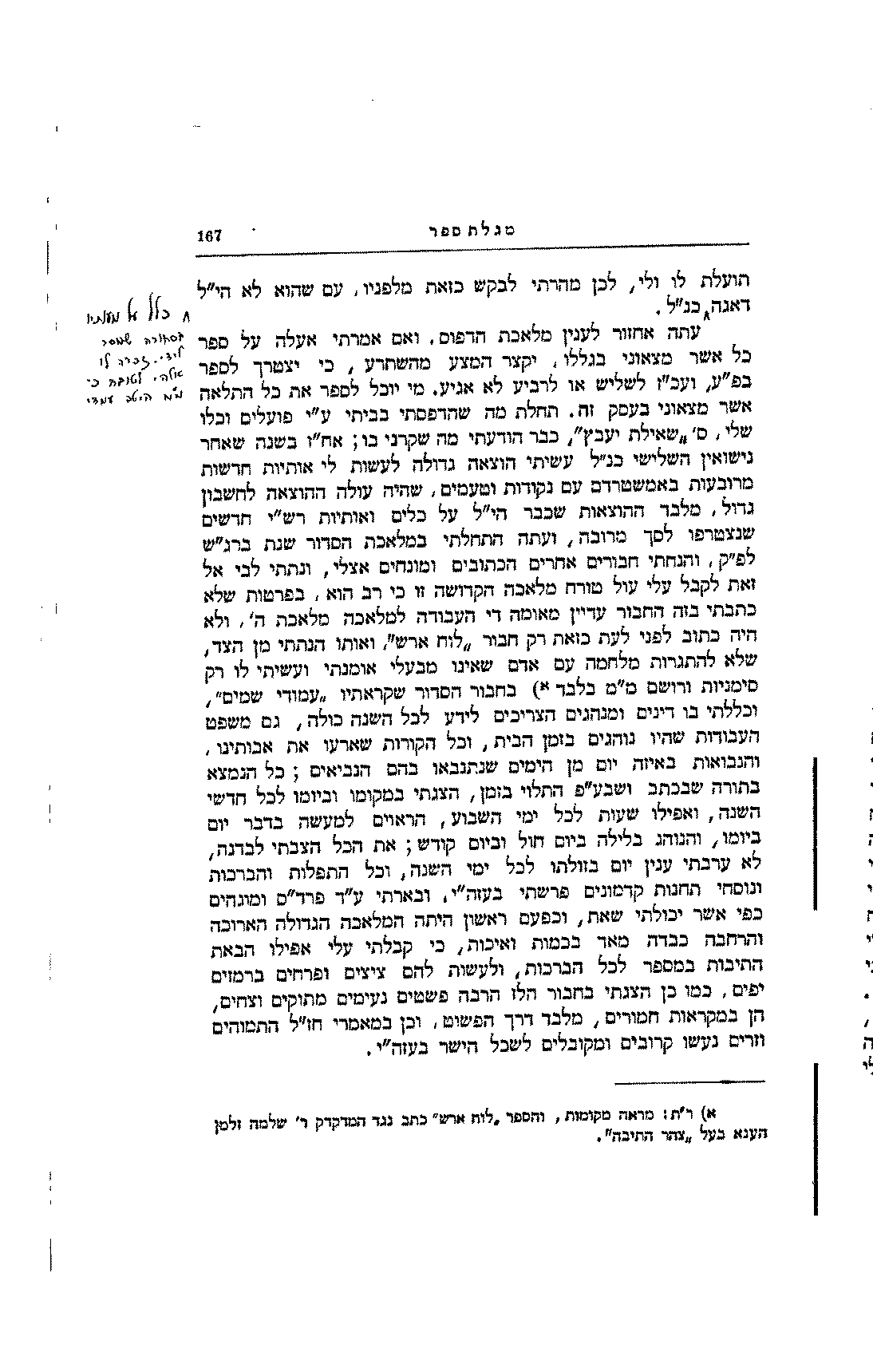
Margin readings in Scholem's copy (1)
| Printed anchor | Type (key sheet) | Mark | Reading | Certainty |
|---|---|---|---|---|
| עם שהוא לא הי"ל דאגה ^ כנ"ל | V: omission | caret; 5-line note in left margin | כלל על מעותיו / לסחורה שמסר / לידי. זכרה לו / אלהי לטובה כי / מ"מ היטב עמדי | fairly sure |