Chapter 2 Emden's own life, from his youth
Jacob Emden, Megillat Sefer · Hebrew (Kahana, Warsaw 1896/97) with an English draft translation · work in progress
Pages in this chapter
Chapter 2 Emden's own life, from his youth · from p. 54
p. 55 · p. 56 · p. 57 · p. 58 · insert · p. 59 · p. 60 · p. 61 · p. 62 · p. 63 · p. 64 · p. 65 · p. 66 · p. 67 · p. 68 · p. 69 · p. 70 · insert · p. 71 · p. 72 · p. 73 · p. 74 · p. 75 · p. 76 · p. 77 · p. 78 · p. 79 · p. 80 · p. 81 · p. 82 · p. 83 · p. 84 · p. 85 · p. 86 · p. 87 · p. 88 · p. 89 · p. 90 · p. 91 · p. 92 · p. 93 · p. 94 · p. 95 · p. 96 · p. 97 · p. 98 · p. 99
Page 55 (scan 67)
"He has chastened me sore, but He has not given me over to death" (Ps. 118:18); He did not forsake me to be destroyed, God forbid, "as a father the son in whom he delights" (Prov. 3:12); "He set my feet upon a rock" (Ps. 40:3). "When I said, My foot slips, Your mercy, O Lord, held me up" (Ps. 94:18); "the right hand of the Lord is exalted" (Ps. 118:16) — it supported and upheld me. So I said: I will declare Your name, O Lord, to my brothers and to my descendants, so as not to forget His kindnesses — "forget not, my soul, all His benefits" (Ps. 103:2) — and "among the many I will praise Him, for He stands at the right hand of the needy, to save him from those who judge his soul" (Ps. 109:30–31). The greatness of the wonders that He did for me, the poorest of my clan (Judg. 6:15), I will make known to the last generation. "Come and hear, all you who fear God, what He has done for my soul" (Ps. 66:16), "my life is continually in my hand" (Ps. 119:109); "my mouth shall praise You with joyful lips" (Ps. 63:6), and with my pen I will pour out His great kindness and make thanksgiving heard aloud, "that the generation to come might know, the children yet to be born, who shall arise and tell their children" (Ps. 78:6), and give thanks to the Lord, for He is good, for His kindness endures for ever; "for He has delivered the soul of the needy from the hand of evildoers" (Jer. 20:13).
And this is the second reason: to strengthen weak hands, the crushed in spirit and the broken in heart, the insulted and the persecuted who have no violence in their hands — as I am today. "Upon our necks we are persecuted" (Lam. 5:5) by those who hate me without cause and repay evil for good; "they are my adversaries because I follow the good" (Ps. 38:21). "Many shall see and fear, and shall trust in the Lord" (Ps. 40:4); "that they might set their hope in God, and not forget the works of God" (Ps. 78:7); and their hearts shall not fail before the multitude of tyrants and the hatred of the archers.
And the third: that the sun of my righteousness may shine, and no cloud rest on it, "from the wicked who despoil me, my deadly enemies who compass me about" (Ps. 17:9), who spread an evil report about me to make me odious to the inhabitants of the land (Gen. 34:30), to destroy me — a reproach in their hands — with their lies and their recklessness, which spread in every direction through all the land, to their shame. Surely many of their libels will remain in the world for some time. So necessity forced me to set out my affairs plainly before God and man, that my righteousness may go forth as the light (Ps. 37:6); "He will deliver the innocent" (Job 22:30); and the truth is a witness for me. Let it be to me "a covering of the eyes" (Gen. 20:16), and for my sons and descendants, may the Blessed One keep them.
I begin the story of my life, to make known the righteous acts of the Lord: that "those who wait for Him shall not be ashamed" (Isa. 49:23), and none who take refuge in Him will be confounded for ever. "A very present help in trouble" (Ps. 46:2), as I have seen with my own eyes many times. "I said in my haste, I am cut off" (Ps. 31:23) from the land of the living; and I said, "Surely the darkness shall cover me" (Ps. 139:11), "the deep surrounded me" (Jon. 2:6), "and the night shall be light about me"; "when I said, My foot slips, Your mercy, O Lord, held me up"; "though I sit in darkness, the Lord is a light to me" (Mic. 7:8); "His anger is turned away and He comforts me" (Isa. 12:1); "He has put a new song in my mouth, praise to our God" (Ps. 40:4). May the Lord put His word in my mouth and be with my lips and my pen, and may His praise be made known to the generations to come.
* * *
I have told above that while my mother was carrying me, my father fell ill with melancholy because of the loss of his money. His illness was very severe, until they almost despaired of his recovery, had not the mercy of Heaven prevailed over him and restored him to his strength. Some days before the time
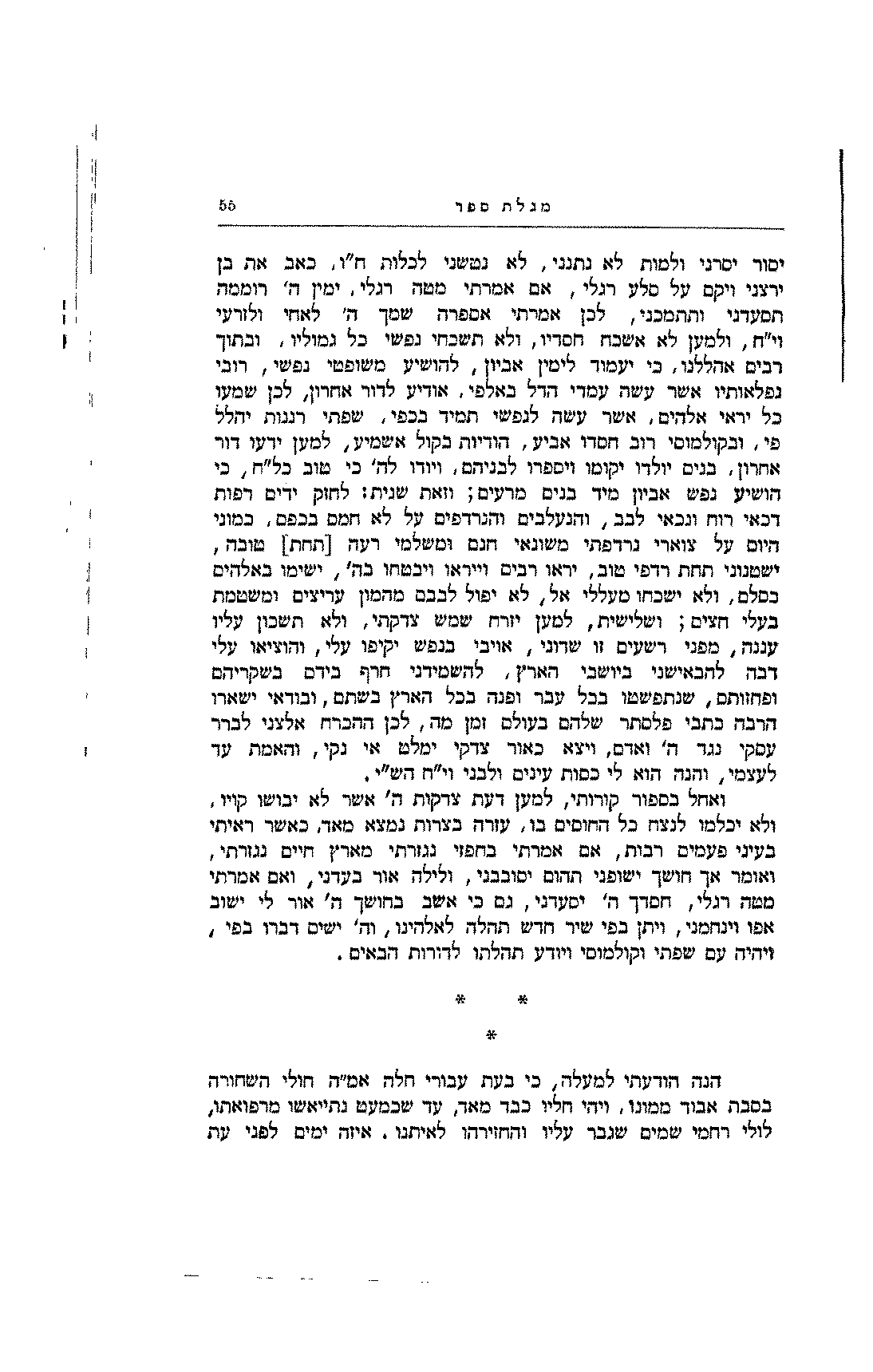
יסור יסרני ולמות לא נתנני, לא נטשני לכלות ח"ו, כאב את בן ירצני ויקם על סלע רגלי, אם אמרתי מטה רגלי, ימין ה' רוממה תסעדני ותתמכני, לכן אמרתי אספרה שמך ה' לאחי ולזרעי וי"ח, ולמען לא אשבח חסדיו, ולא תשכחי נפשי כל גמוליו, ובתוך רבים אהללנו, כי יעמוד לימין אביון, להושיע משופטי נפשי, רובי נפלאותיו אשר עשה עמדי הדל באלפי, אודיע לדור אחרון, לכן שמעו כל יראי אלהים, אשר עשה לנפשי תמיד בכפי, שפתי רננות יהלל פי, ובקולמוסי רוב חסדו אביע, הודיות בקול אשמיע, למען ידעו דור אחרון, בנים יולדו יקומו ויספרו לבניהם, ויודו לה' כי טוב כל"ח, כי הושיע נפש אביון מיד בנים מרעים; וזאת שנית: לחזק ידים רפות דכאי רוח ונכאי לבב, והנעלבים והנרדפים על לא חמס בכפם, כמוני היום על צוארי נרדפתי משונאי חנם ומשלמי רעה ]תחת[ טובה, ישטנוני תחת רדפי טוב, יראו רבים וייראו ויבטחו בה', ישימו באלהים כסלם, ולא ישכחו מעללי אל, לא יפול לבבם מהמון עריצים ומשטמת בעלי חצים; ושלישית, למען יזרח שמש צדקתי, ולא תשכון עליו עננה, מפני רשעים זו שדוני, אויבי בנפש יקיפו עלי, והוציאו עלי דבה להבאישני ביושבי הארץ, להשמידני חרף בידם בשקריהם ופחזותם, שנתפשטו בכל עבר ופנה בכל הארץ בשתם, ובודאי ישארו הרבה כתבי פלסתר שלהם בעולם זמן מה, לכן ההכרח אלצני לברר עסקי נגד ה' ואדם, ויצא כאור צדקי ימלט אי נקי, והאמת עד לעצמי, והנה הוא לי כסות עינים ולבני וי"ח הש"י. ואחל בספור קורותי, למען דעת צדקות ה' אשר לא יבושו קויו, ולא יכלמו לנצח כל החוסים בו, עזרה בצרות נמצא מאד, כאשר ראיתי בעיני פעמים רבות, אם אמרתי בחפזי נגזרתי מארץ חיים נגזרתי, ואומר אך חושך ישופני תהום יסובבני, ולילה אור בעדני, ואם אמרתי מטה רגלי, חסדך ה' יסעדני, גם כי אשב בחושך ה' אור לי ישוב אפו וינחמני, ויתן בפי שיר חדש תהלה לאלהינו, וה' ישים דברו בפי, ויהיה עם שפתי וקולמוסי ויודע תהלתו לדורות הבאים. הנה הודעתי למעלה, כי בעת עבורי חלה אמ"ה חולי השחורה בסבת אבוד ממונו, ויהי חליו כבד מאד, עד שכמעט נתייאשו מרפואתו, לולי רחמי שמים שגבר עליו והחזירהו לאיתנו. איזה ימים לפני עת
Page 56 (scan 68)
of my birth he came home from the bath of Ems, where he had taken the cure of that spring between Passover and Shavuot. He came to Altona after his wife, my mother the rebbetzin, of blessed memory, had given birth to me, on the fifteenth of Sivan 5457 [1697] [a]. He circumcised me himself — after the despair, when the commandment had already been given to another mohel — and brought me into the covenant with a great double joy: that he had returned to his health as before, and that he had been given a son after despairing of one, for until then he had only daughters; and so he fulfilled the commandment of circumcision with rejoicing.
I was the fourth child and the first son, tender and an only one to my father and my mother, after my mother had borne three daughters. My parents trembled and quaked over me greatly, and I was brought up on their knees as a darling child, in great pleasure, tenderness and longing. With all this my father hurried to put me into school when I turned three, so that in my fifth year I had already finished learning the tractate Berakhot ⟨S: perhaps "plunder"⟩. I was so diligent at the book that my companions of my own age ran after me and had not yet learned to read the prayers at that time. But afterwards he held back from putting my brothers, born after me, into the teacher's house while they were such tender children, for he said that it had weakened me.
If I set out to tell all that passed over me in the years of my childhood, the story would be very long, besides what is hidden and forgotten from me. I will mention only a few grains: three terrible things that happened to me in the days of my tender childhood. First, a sore broke out on my face, in the flesh only, and the sore spread from one side to the other, so that I was in great danger, almost beyond hope; and the Lord "sent His word and healed" me (Ps. 107:20), without leaving any mark of injury on my face, and no scar at all. Second, a leprous boil rose on my member and closed the opening of the urine for some time, so that it caused my parents worry, grief and much sighing over me. Third, a heavy boil covered my whole leg, like the boil of Job, with ugly sufferings.
From all these the Lord saved me — besides other evil and lasting illnesses that come to all children, such as smallpox and measles, and the cutting of teeth. Above all I was very prone to swelling of the tonsils, to catarrh and cough, and to burning of the urine, and sometimes to small blisters and red spots. And besides the blows "with which I was wounded in the house of my friends" (Zech. 13:6) — the teachers into whose hands I was given to learn, who were for the most part cruel and beat me without pity — and besides other pains and ailments that passed over me from my earliest years: "many a time have they afflicted me from my youth, yet they have not prevailed against me" (Ps. 129:2) ⟨S: two words, perhaps "to destroy …"⟩ — from the falling out of teeth and the growing of others in their place, from the pressing of the fingernails and the like, they are too many to number.
Kahana's notes
- [a] See Wagenaar, Toledot Ya'avetz (p. 49, note 1).
לידתי אז שב לביתו מעמסיר באד, שם עסק ברפואות הבאר ההוא בין דיבחא לעצרתא, ובא לאלטונא אחר שהמליטה אשתו הורתי הרבנית ז"ל אותי, בחמשה עשר לסיון שנת תנ"ז לפ"ק א, ומל אותי אחר היאוש שכבר נתנה המצוה למוהל אחד, והכניסני לברית בשמחה גדולה כפולה, שחזר לבריאתו כבתחלה וזכה לבן, אחר שנתייאש ממנו, כי העת ההיא לא הי"ל כי אם בנות, ולקיים גם מצות המילה בגילה. והייתי רביעי לבטן ובן ראשון, רך ויחיד לאבי ולאמי, אחר שהולידה אמי שלש בנות, והיו חרדים אבותי ורועדים עלי מאד, ונתגדלתי על ברכיהם כבן שעשועים, בעונג ורכות גדול וגעגועים. עם כל זה מהר אבי ז"ל להכניסני בבית הספר אחר מלאו לי שלש שנים, באופן שבשנה החמישית למולדי, כבר השלמתי ללמוד מס' ברכה. כל כך שקדתי על הספר, עד שחבירי בני גילי רצו אחרי ולא הגיעו לידיעת קריאת התפלה בעת ההיא, אבל אח"כ מנע עצמו מלהכניס אחי שנולדו לו אחרי לבית המלמד בעודם ילדים רכים כל כך, כי אמר שהחליש אותי ע"י כך אם אמרתי אספרה כמו, כל מה שעבר עלי בשנות הילדות יארך הספור מאד, מלבד מה שנעלם ושנשכח ממני, רק אזכיר איזה גרגרים שלשה דברים נוראים, שקרו לי בימי רכות ילדותי. האחד שנפלה מכה בפני בבשר לחוד, ושלטה המכה מעבר אל עבר, באופן שהייתי בסכנה גדולה כמעט אחר יאוש, וה' שלח דברו וירפאני בלי השאר ממנה שום רושם חבלה בפני, ולא צלקת כלל; השנית, עלה צרעת שחין על אמתי, וסגר נקב השתן זמן מה, באופן שגרם לאבותי דאגה יגון ואנחה רבה בעבורי; ושלישית, שחין כבד כסה כל רגלי מעין שחין איוב, עם יסורין מכוערין, מכל אלה הצילני ה', מלבד שאר חלאים רעים ונאמנים, המצויים בכל הילדים, כאבעבועות, פאקן, מאסלן, גדול שנים, וביחוד הייתי עלול מאד מנפוח שקדים, ונזילות ושיעול ושרפת שתן, ולפעמים גם בועות קטנות וטלואים אדומים. ומלבד המכות אשר הוכיתי בית מאהבי המלמדים, אשר נמסרתי בידיהם ללמוד, והיו ע"פ הרוב אכזרים, הכוני בלי חמלה, ומלבד שאר כאבים ומיחושים, שעברו עלי מימי חרפי, רבות צררוני מנעורי גם לא יכלו לי, הן מנפילת שנים וצמיחת אחרים תחתיהם, וכן בלחיצת צפרני ידים וכדומה עצמו מספר.
- [א] עיין בספר תולדות יעב"ץ מאת אברהם וואגנה (צד מ"ט הערה א').
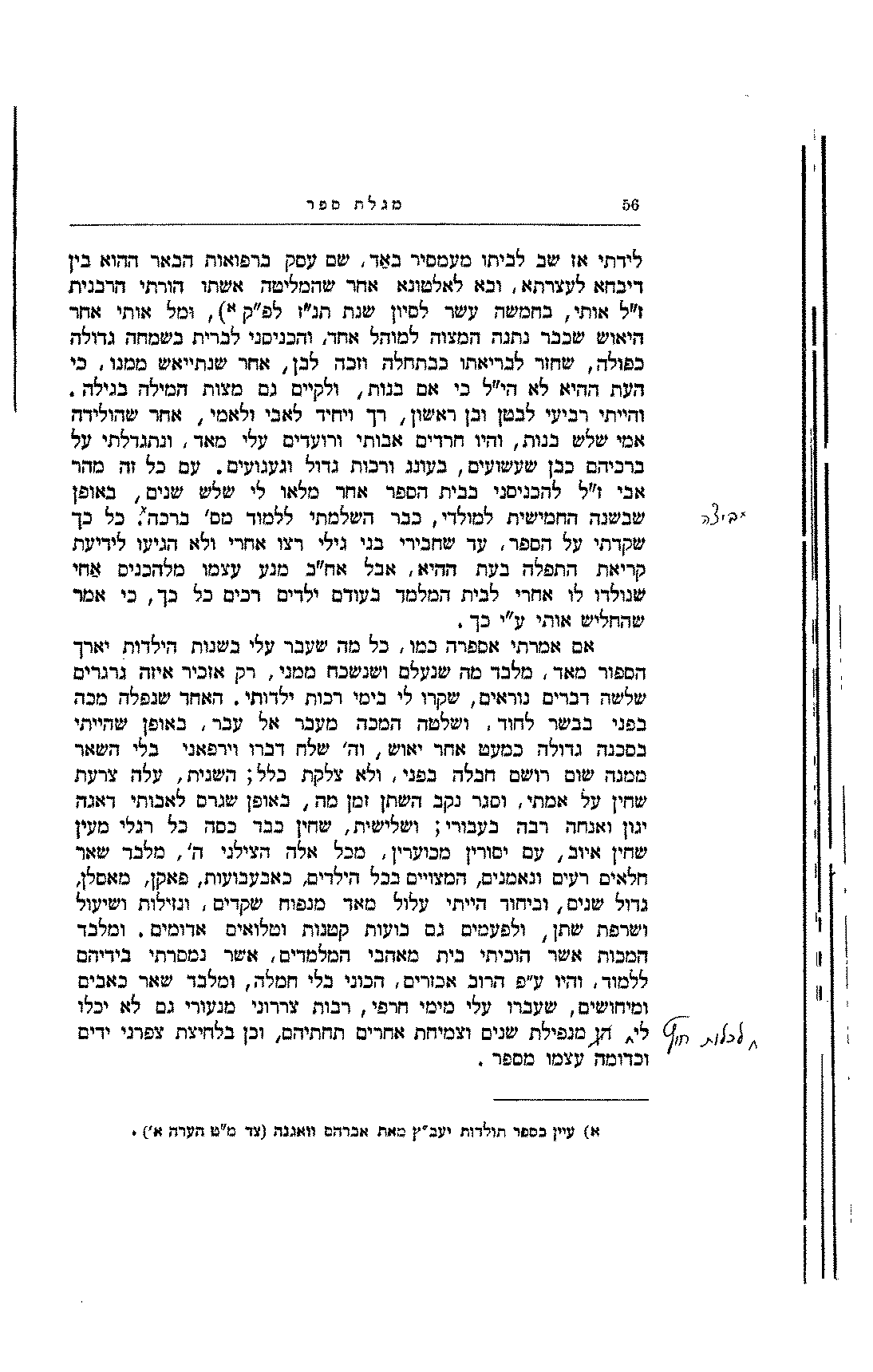
Margin readings in Scholem's copy (2)
| Printed anchor | Type (key sheet) | Mark | Reading | Certainty |
|---|---|---|---|---|
| כבר השלמתי ללמוד מס' ברכה x | X: substitution | x mark; one word in right margin | ביזה(?) | uncertain |
| רבות צררוני מנעורי גם לא יכלו לי ^, הן מנפילת שנים | V: omission | caret; 2-word note (Kraken read it as a line) | לכלות חוץ | fairly sure |
Page 57 (scan 69)
When I came a little to understanding, I felt my father's suffering, his afflictions and the insults mentioned above, when they rose against him to cut off his living and bring him down from his honour. After this my father fell into a severe and dangerous illness (pleurisy) from an excess of bile, brought on by the controversy in Altona, and the doctors had already given up on him. I and my sisters, may they live, fasted for a week, and I was still a boy of twelve [a].
[When my father was received] as rabbi of the Ashkenazi community of Amsterdam, my exile and my wandering began. My father's household set out at the end of the winter of 5470 [1710]. It was the time of the thaw, after very heavy snows in that fierce and mighty winter, and we were in great danger on the road: the wagon in which all the women and children sat almost broke and fell into the waters that overflowed it, and "the waters came even to the soul" (Jon. 2:6). Our cry went up on high; "had it not been the Lord who was on our side, then the waters had overwhelmed us, the stream had gone over our soul" (Ps. 124:2–4). We came alive and in peace to another land, the country of Holland, which we had not known before: new air, the customs of a new world. Many changes passed over us until we grew used to the nature of the country, for the food and drink did not suit us according to our habit.
And above all, the quiet did not last; "this is the rest, give rest to the weary" (Isa. 28:12) — that they did not allow. For at once the quarrels and persecutions began of the two factions of the strong men ⟨S: corrected to "of the cantors"⟩, told above, each of which wanted to swallow the other alive. My father was pressed between them. Since he could not reconcile them, and it was impossible to find both in the right, and since he protected the weak side so that it should not be trampled, the opposing side declared war on him; "they embittered him, and shot at him, the archers"; they thought to bring his honour down to the ground, as said. And the Lord helped him and was a shield for him, and at that time the congregation of the Sephardim supported him.
With all this it was "a time of trouble for Jacob" and confusion, from my father's suffering; besides which this controversy caused much neglect of Torah. At that time I became bar mitzvah: "the twilight that I longed for He has turned into trembling for me" (Isa. 21:4) [b] — "distress and darkness, the gloom of anguish" (Isa. 8:22), a time of worry, grief and sighing. The times did not let me be diligent at the book and acquire perfection, for great lack of a companion, a leader and a guide to deal with me in blessing. And there was no remedy for my lack of quiet, until the sins of that place brought it about, and there came there the hypocritical serpent
Kahana's notes
- [a] Here the order is somewhat disturbed in the manuscript, and I saw fit to correct it, so that the continuation of the story should come in its proper place.
- [b] He means that immediately after his bar mitzvah, when he was fourteen, many troubles came upon him quickly.
ואחר שבאתי קצת לכלל דעת, הרגשתי בצערו של אבא, יסוריו ועלבונו הנ"ל, שקמו עליו לקפח פרנסתו ולהורידו מכבודו. אחר זאת נפל אמ"ה ז"ל בחולי כבד ומסום (פלערוס) מתגבורת הירוקה, שנתעלל בסבת המחלוקת באלטונא, וכבר נתייאשו הרופאים ממנו, והתעניתי אני ואחיותי ב"ה בשבוע אחד, ואני עודני נער בן י"ב שנה א. ]וכאשר נתקבל אבי[ לרב בק"ק אשכנזים דאמשטרדם, והתחיל הגלות והטלטול שלי בכלל. בית אבא נסעו בסוף ימי החורף שנת ת"ע, והיתה עת הפשרת שלגים, שנפלו לרוב מאד בחורף העז והעצום ההוא, והיינו באחריות גדול על הדרך, כמעט חשבה העגלה שישבנו עליה כל הנשים וילדים להשבר, ולפול במים שגברו עליה, ובאו מים עד נפש. עלתה שאגתנו למרום, לולי ה' שהושיע לנו, אזי המים ישטפונו, נחלה עבר על ראשנו. באנו לחיים ולשלום אל ארץ אחרת, מדינת הולאנד, אשר לא ידענו תמול שלשום, אויר חדש, מנהגי עולם חדש. וכמה תמורות עברו עלינו, עד שהורגלנו בטבע המדינה, עם היות המאכלים ומשקים לא היו נאותים לנו כפי הרגלנו. ועל כולם לא ארכה השלוה, לא זאת המנוחה הניחו לעיף, כי מיד התחילו הקטטות והרדיפות של שני כתות החזקים המסופר למעלה, שכל אחת רצתה לבלוע חברתה חיים. אמ"ה לחץ ביניהם, כי באשר לא יכול להשוותם, ולא היה אפשר להצדיקם גם שתיהן, ובהגינו על צד החלוש שלא יהיה למרמס, קדשו עליו מלחמה וימררהו ורובו בעלי חצים הצד המתנגד, חשבו להוריד לארץ כבודו כנ"ל, וה' עזרו והיה מגן בעדו, ובעת ההיא עדת הספרדים החזיקו בידו. בכל זאת היתה עת צרה ליעקב ומבוכה מצערו של אבא; נוסף לזה שהרבה תורה בטלה המחלוקת הזאת. ואני בעת ההיא נעשיתי בר מצוה, את נשף חשקי אור לי"ד שם לי לחרדה ב, מעוף צוקה וחשכה עת דאגה ויגון ואנחה, ולא היה הזמן גורם לשקוד על הספר, ולקנות שלמות מחסרון רב וחבר, מנהיג ומנהל לעשות אתי ברכה. ולהעדר שלותי לא עלתה ארוכה, עד שגרמו עונות המקום ההוא, ובא לשם הנחש הצבוע
- [א] פה נתקלקל הסדר מעט בכ"י, ואנכי ראיתי לתקן שיבוא המשך הספור אל נכון.
- [ב] כוונתו כי מיד אחר בר מצוה כאשר היה בן י"ד שנים באו עליו חיש צרות רבות.
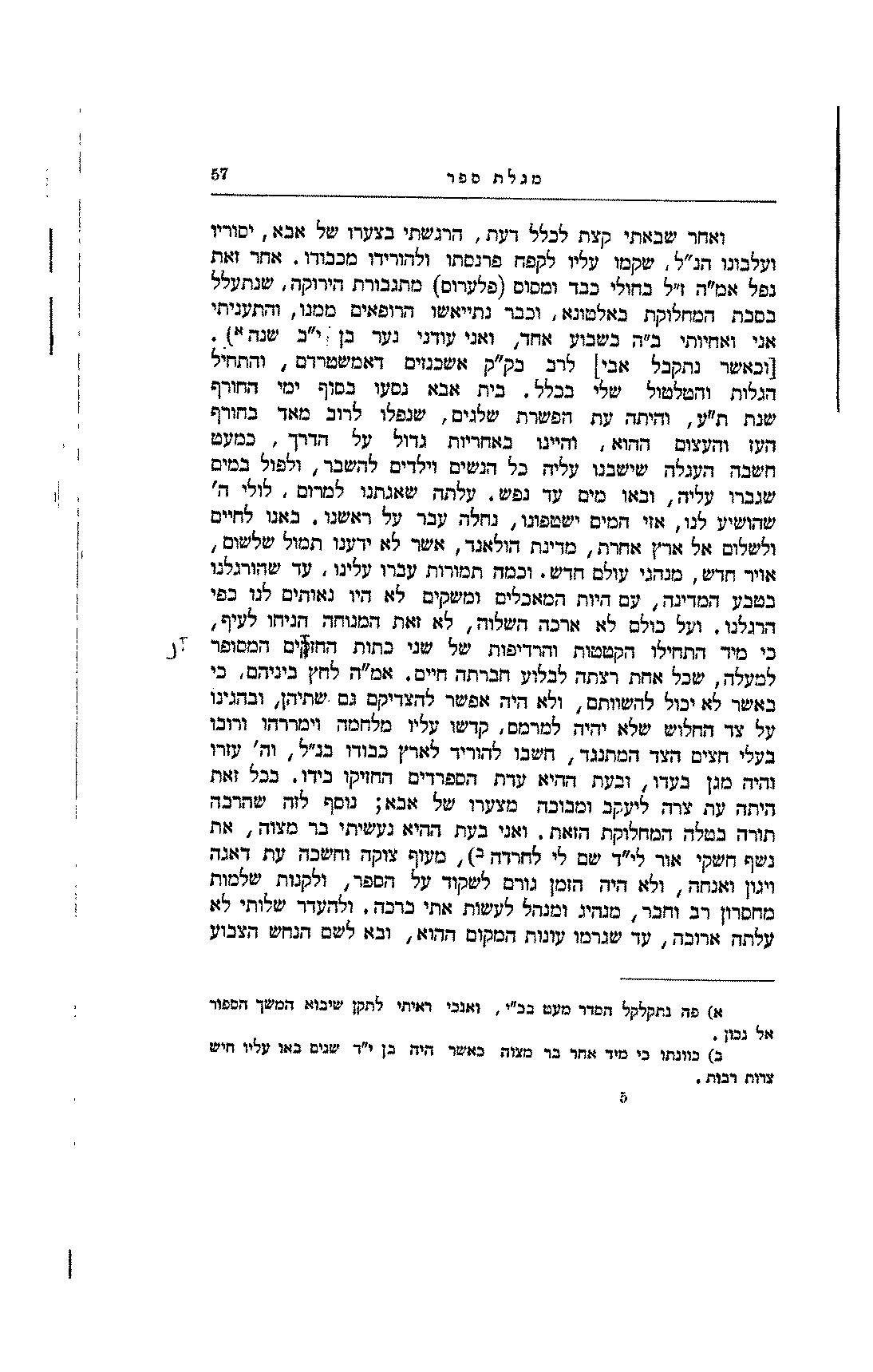
Margin readings in Scholem's copy (1)
| Printed anchor | Type (key sheet) | Mark | Reading | Certainty |
|---|---|---|---|---|
| הקטטות והרדיפות של שני כתות החזקים x | X: substitution | x mark over the word; one or two letters in right margin | ן (correcting החזקים to החזנים, "the cantors") | fairly sure |
Page 58 (scan 70)
the abominable Ḥayon, who threw the whole world into confusion. The righteous man, my father, was driven into a heavy war, to stand against the presumptuous and powerful Sephardim, who broke their old covenant of love with him and turned into enemies, meddling in a quarrel that was not theirs, to cover the shame of their protector and the sin that hung on the head of R. S. A. [a] ⟨S: "may the name of the wicked rot"⟩, as said. So my father was forced to move his home from there, as told, and he bent his shoulder to wander again on the wings of exile, to hasten an escape for himself and his household.
In the middle of the winter of 5474 [1714] he travelled to London for some weeks, and sent us, his household, by ship across the sea to Emden. We lived there as strangers until after Passover, though the people of that small town did us every honour and every kindness they could. The learned leader R. L. Emden, of blessed memory, wanted to give me his daughter as a wife: a learned and intelligent maiden — truly there was none like her in all the land of Germany. He wanted to settle a large dowry on me, for he was very rich and a man of Torah; and his daughter too longed to join herself to Torah and to lineage. But for a reason known in the family my father would not agree and call the match good.
It was a great trial for me too, for I was already of understanding, and knew how to weigh things in the scales of right judgement. It was not hidden from me that it was a very fitting match, the like of which was not to be found in the land in every respect — in capital and wealth, and as a daughter of a good family — so that it looked to me like a very straight road, by which I could easily reach the goal of perfection. I knew well that my father could give me nothing, all the more since he could barely provide for himself and his household, moving about without knowing where he was going; and the leader and his household loved me very much and truly pressed me to carry out their plan and gain their wish in me. Even so, far be it from me, I did not want to grieve my father, though my own mind leaned towards not giving up so fitting a thing. That blemish in the family was not a reason to reject it either, for it was not disqualifying in itself, God forbid; all the great leaders of Germany had already married into that family, which excelled in kindness and greatness; and such a match does not happen every day. Even so I did not reveal even what was in my heart. I submitted and accepted my father's decision with love, and concluded that she was not from the Lord to be my wife, for I was destined for a greater match than this in respect of family. But "trouble and anguish have found me" (Ps. 119:143), as I will write with God's help. And that important woman mentioned above, who had longed for me and did not succeed, was still ready to do me good a long time afterwards, when the Blessed One brought me to sit on the rabbinical seat of Emden.
Kahana's notes
- [a] The abbreviation means R. Solomon Ayllon, the rabbi of the Sephardim.
התועב חיון, שבלבל את כל העולם, ונטרד הצדיק אמ"ה ז"ל במלחמה כבדה, לעמוד נגד התקיפים הספרדים הזדים, אשר הפרו ברית אהבתם עמו הקדומה ונהפכו לאויבים, בהתערבתם על ריב לא להם, כדי לחפות על קלון מגינם, ועון התלוי בראש רש"א כנ"ל א, באופן שהיה מוכרח אמ"ה ז"ל, להעתיק דירתו משם כמסופר, ונטה שכמו לנוע עוד על כנפי הנדוד, להחיש מפלט לו ולביתו. באמצע חורף תע"ד נסע הוא ז"ל ללונדון, על איזה שבועות, ואותנו ב"ב שלח בספינה דרך ים כה לעמדן. ישבנו שם כגרים עד אחר הפסח, עם שבני העיר הקטנה הלז עשו לנו כל הכבוד וכל נחת רוח שיכלו. והק' התורני ר"ל עמדין ע"ה רצה לתת לי בתו לאשה בתולה מלומדת משכלת, ממש לא היתה דוגמתה בכל ארץ אשכנז, ובקש להפריז לי סך גדול לנדן, כי היה עשיר מופלג מאד ובעל תורה, וכן בתו היתה חושקת להתדבק בתורה וביחוס; אך מטעם ידוע במשפחה נמנע אמ"ה להתרצות אליו ולומר לדבק טוב, והיה נסיון גדול גם מצדי, כי כבר הייתי בר דעת, ויודע לשקול הדברים במאזני בחינה נכונה, ולא נעלם ממני שהיה שידוך הגון מאד, לא נמצא כמוהו בארץ בכל אופן הן מצד הקרן והעשירות ובת טובים, באופן שהיה נראה לכל דרך ישר מאד לפני, ובענין שהייתי יכול לבוא לתכלית השלימות בנקל, וידעתי היטב שאמ"ה לא היה ביכולתו לתת לי מאומה, מה גם שדיו להפקיע את עצמו וב"ב, מתנועע ולא היה יודע להיכן נוסע, והק' הנ"ל וב"ב היו מחבבים אותי מאד, וממש מפצירים בי להפיק זממם ולהגיע לחפצם בי, עכ"ז חלילה לא בקשתי לצער את אבא, עם שהיתה דעתי נוטה לכך, שלא להניח דבר הגון הזה; גם אותו הפגם של משפחה לא היה כדאי להרחיקו, כי לא היה פסול בעצם ח"ו, וכבר דבקו כל גדולי קציני אשכנז במשפחה ההיא, שגברה ידה במעלת החסד והגדולה, ולא בכל יומא מתרחש שידוך כזה, אעפ"כ לא גליתי אפילו מה שבלבי, ונכנעתי לקבל מאהבה הסכמת אמ"ה ז"ל, והחלטתי שאינו מה' להיות בת זוגי, כי לגדולה מזו הייתי מתוקן בענין זווגי מצד משפחה, אך יום צר ומצוק מצאוני כנ"ל בס"ד. וגם אותה אשה החשובה הנ"ל, אשר חשקה נפשה בי, ולא עלתה בידה, מ"מ היתה מוכנה להיטב אלי אחר זמן רב, בהזדמן הי"ת אותי לישב על כסא הרבנות דעמדן.
- [א] ר"ת: ר' שלמה אילין הרב של הספרדים.
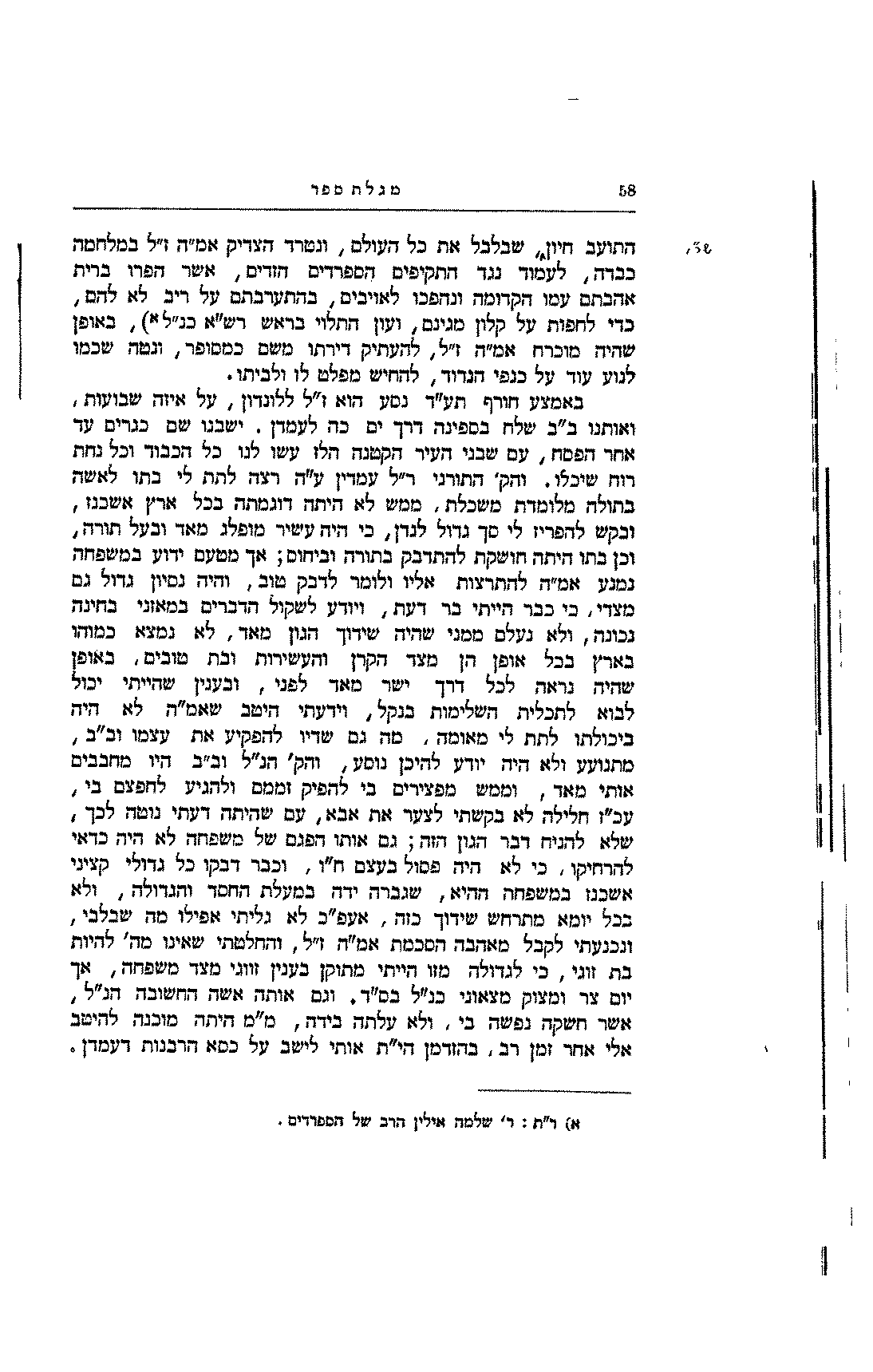
Margin readings in Scholem's copy (1)
| Printed anchor | Type (key sheet) | Mark | Reading | Certainty |
|---|---|---|---|---|
| ועון התלוי בראש רש"א כנ"ל א) x | X: substitution | x mark; short note | שר"י | fairly sure |
Handwritten sheet for p. 59 (scan 72)
A handwritten leaf bound into Scholem's copy and headed "for p. 59". The hand looks like that of the key sheet in the copy, which names Ḥayyim Wirszubski as the collator; whose hand it is, is not certain. It begins with a caret, matching the caret after "We came to Breslau at the end of the said summer". It seems to give the manuscript's account of the match at this point. Kahana does not print it here (he has a similar account on p. 39). Read from the scan; words not read are marked […].
There too there was talk of honourable matches with this and that leader of Vienna(?). But the Lord brought before me […], for the gaon R. Naftali Katz, of blessed memory, was then living in the city of Breslau(?), and there was a great affection(?) and a strong love known between him and my father, of blessed memory; and they agreed between them to bind themselves together, that I would take as wife his granddaughter, the daughter of his son R. M[ordecai], head of the court of the holy community of Brod; and he vowed to give me a thousand Reichstaler as a dowry, and maintenance for three years.
לעמ' 59. ^ שם ג"כ היה מדובר בי נכבדות להשתדך עם מי ומי מקציני ווינא(?) אך הקרה ה' לפני [...] [...] כי הגאון מוהר"ן כ"ץ ז"ל היה שרוי אז בעיר ברעסלוי(?) וחבה(?) יתירה ואהבה עזה נודעת לו עם אמ"ה ז"ל והסכימו ביניהם להתקשר יחד שאקח לאשה נכדו בת בנו מהר"מ אב"ד דק"ק ברודא ונדר לתת לי אלף ר"ט נדוניא ומזונות ג' שנים.
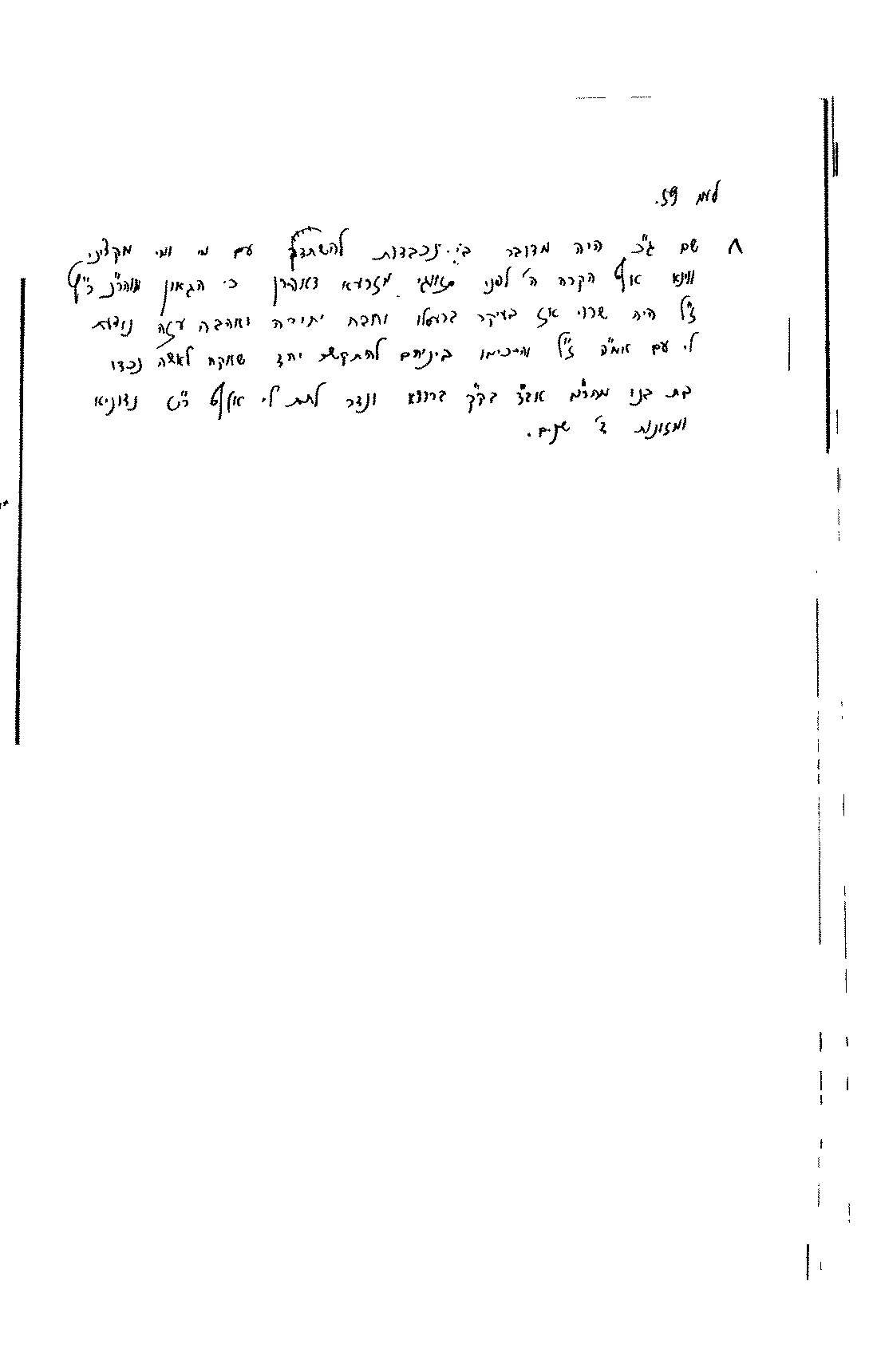
Margin readings in Scholem's copy (1)
| Printed anchor | Type (key sheet) | Mark | Reading | Certainty |
|---|---|---|---|---|
| (handwritten sheet "for p. 59", in Scholem's hand) | V: omission | whole sheet; caret at its start, matching the caret after "באנו לברעסלוי שילהי קיץ הנ"ל א)" on p. 59 | see data/text/s072.he.txt (6 lines, most words read) | partial (most words fairly sure) |
Page 59 (scan 73)
She worked for this with all her soul, and showed great kindness to me and to my wife, of blessed memory; and she had a great affection for all my household, like brotherhood and close kinship, as I will write.
From Emden my father set out with his large household. We were five sons and five daughters to my father and mother, of blessed memory; we were all born to them in Altona, and of the children born to my father in Amsterdam, who did not survive, only one little daughter was left; and this daughter too died on the way. Only my sister Rachel was then with her father-in-law in Eisenstadt; her elder sister, with her husband and children, was with us at that time; my mother the rebbetzin, of blessed memory, was pregnant; and there were with us a manservant and a maidservant, as necessary. So we needed to load ⟨S: "two"⟩ large wagons, full; and men of war were about on the roads. We stayed some days in my uncle's house ⟨S: "and after several adventures we came to Berlin; and it was then a time of war between kingdoms"⟩.
There the Lord put it into my heart to answer the objections of R. A. ⟨S: corrected to "R. M."⟩ to my father's responsum, for my father had no time to study them on his journey. In those days I set myself to look into the matter, to search it out and understand it, and there I wrote a certain part of this responsum, the first that I composed, with God's help, out of my studies. I did not tell my father or show it to him until he was in Breslau. Then he saw what I had written and answered on his behalf, and my words were very right in his eyes; he kissed me on my head and recited to me the verse, "He kisses the lips", and so on.
After a stay of some weeks in Berlin we set out for Breslau. On this road we were in great danger because of the soldiers of the army of the land of Prussia, who were then passing along that road; although it was a time of peace, the roads were considered dangerous, and sometimes we had to stop and wait in the middle of the road. Some of them met us, and with great difficulty we got away from them in peace, and it was a miracle. We came to Breslau at the end of the said summer [a] ⟨S: a caret, pointing to the handwritten sheet that follows⟩.
From Breslau we set out for Poland at the beginning of the winter of 5475 [1714]. My father married off my sister Neḥamah, and, for our many sins, her marriage did not prosper, for her husband was killed; he was the grandson of the leader R. H. Witschitz. We rolled about in great distress, sometimes in the town of Apta, sometimes in various villages nearby, for that community had become a burning, food for the fire. We had not yet found rest when a courier came from Hamburg to tell my father that he had been chosen by the leader R. A. to sit on his case with his brother-in-law E. P., as said. Then my father set out on his road and took me with him, and we travelled in the middle of the winter on so long and hard a road. Then the ailment of shortness of breath and pressure afflicted me ⟨S: a word, not read⟩, and I caused my father great sorrow on top of his own pain and sorrow. Several remedies were made for me on the way, in Berlin and in other places, and they did not help at all; and it seems
Kahana's notes
- [a] See above (p. 39).
היא השתדלה על זה בכל נפשה, וגמלה אתי חסד הרבה ועם אשתי ע"ה, וכל ב"ב היתה לה חבה יתרה כאחוה וקורבה עצמית כמש"ל. מעמדן נסע אמ"ה ז"ל בטפולו גדול, כי היינו חמשה בנים וחמש בנות לאבי ולאמי ז"ל; כולנו נולדנו להם באלטונא, ובת אחת קטנה היא לבדה נשארה מהנולדים לאמ"ה ז"ל באמשטרדם שלא נתקיימו, גם הבת הזאת מתה בדרך; רק אחותי רחל היתה אז אצל חמיה בק"ק אייזן שטאט; ואחותה הגדולה עם אישה וילדיה היו ג"כ אצלינו בעת ההיא, ואמי הרבנית ז"ל היתה מעוברת, ועמנו משרת ומשרתת כפי ההכרח, באופן שהיינו צריכין לשאת עגלות גדולות מלאות, ובעלי מלחמות מצויים בדרכים. נתעכבנו בבית דודי ז"ל ימים אחדים. שם נתן ה' אל לבי להשיב ע"ד מהר"א כהשגותיו על תשובת אמ"ה ז"ל, שלא הי"ל לאמ"ה פנאי לעיין בהן בדרך נסיעתו, ואני פניתי לראות ולחקור ולהבין בדבר באותן הימים, ושם כתבתי חלק מסוים מתשובה זו, ראשונה שחברתי בעז"ה מלמודים, לא הגדתי ולא הראיתי לאמ"ה, עד היותו בברעסלוי; אז ראה מה שכתבתי והשבתי בעדו, וישרו דברי מאד בעיניו, ונשקני על ראשי, וקרא אלי המקרא: שפתים ישק וכו'. אחר עיכוב איזה שבועות בברלין, נסענו לבוא לברעסלוי, ובדרך הזה היה לנו אחריות גדול, בסבת חיילות של צבא מלחמה מדינת פרייסן, שעברו אז בדרך ההיא, אע"פ שהיתה חרב של שלוה היו הדרכים בחזקת סכנה, ולפעמים היינו מוכרחים לעמוד ולהתעכב באמצע הדרך, וקצתם פגשו ובקושי גדול נפטרנו מהם בשלום ותהי לנס. באנו לברעסלוי שילהי קיץ הנ"ל א. מברעסלוי נסענו לפולין בתחלת ימי חורף תע"ה. והשיא אמ"ה ז"ל את אחותי נחמה, ולא הצליח זווגה בעו"ה, כי נהרג בעלה, שהיה נכדו של הק' ר"ה וויטשיז. ונתגלגלנו בצער גדול פעם בעיר אפטא, פעם בכפרים שונים הסמוכים, כי היתה הק' הלזו לשרפה מאכולת אש, ועדנו לא הונח לנו עד שבא רץ מהמבורג, להודיע לאמ"ה ז"ל שנבחר מהק' ר"א, לשבת על המשפט שלו עם גיסו א"פ כנ"ל. אז שם אמ"ה לדרך פעמיו ולקח אותי עמו, ונסענו באמצע החורף בדרך רחוקה וקשה כזאת. אז התעולל בי מיחוש של קוצר הנשימה ולחיצה, וגרמתי לאמ"ה ז"ל נוסף על מכאובו וצערו צער גדול, וכמה רפואות נעשו לי בדרך, בברלין ובשאר מקומות ולא הועילו כלום, וכמדומה
- [א] עיין לעיל (צד 39).
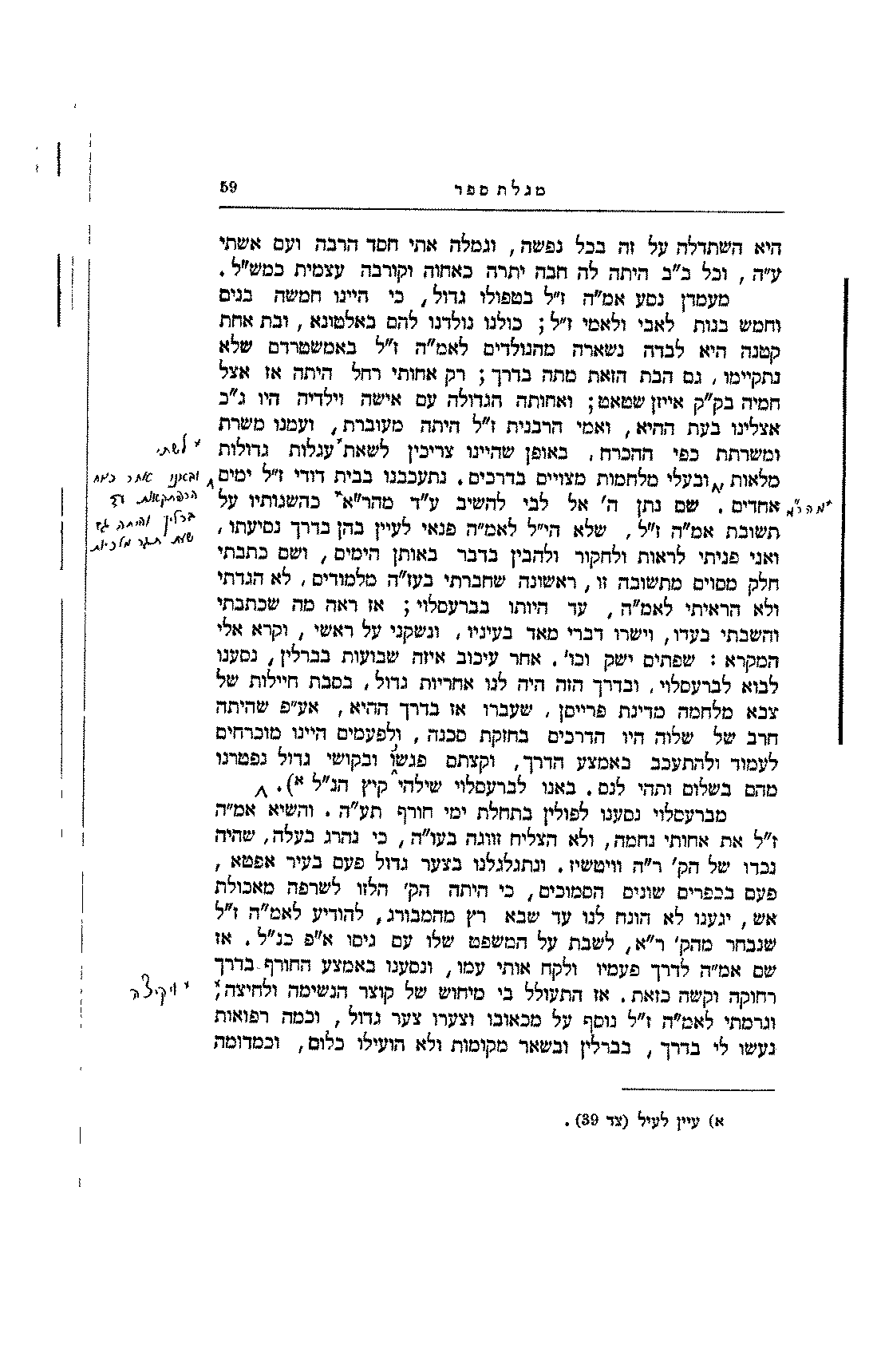
Margin readings in Scholem's copy (5)
| Printed anchor | Type (key sheet) | Mark | Reading | Certainty |
|---|---|---|---|---|
| שהיינו צריכין לשאת x עגלות גדולות | X: substitution | x mark; one word (Kraken read it as a line: לשתי) | לשתי | fairly sure |
| נתעכבנו בבית דודי ז"ל ימים ^ אחדים | V: omission | caret; 4-line note (Kraken: הרפתקאות / ברלין ... / שעת תגר מלכיות) | ובאנו אחר כמה / הרפתקאות עד / ברלין והיה אז / שעת תגר מלכיות | fairly sure |
| להשיב ע"ד מהר"א x כהשגותיו | X: substitution | x mark over the name; short note | מהר"מ (correcting to R. M[ichel], the author of the objections, cf. p. 38) | fairly sure |
| באנו לברעסלוי שילהי קיץ הנ"ל א) ^ | V: omission | caret pointing to the handwritten sheet (scan 72) | (see scan 72) | sure |
| מיחוש של קוצר הנשימה ולחיצה x | X: substitution | x mark; one word | not read | not read |
Page 60 (scan 74)
that the doctors too did not understand the nature of my illness. After many years in which this strange ailment afflicted me, I felt that it came from an excess of blood, which needed to be lightened in me; so it did not let go of me until the "golden vein" opened for me, with God's help, and then it left me a little. Only there [melancholy] grew strong on me, and I was prone to the black humour. I travelled to Hamburg in this distress and stayed there until the rainy season was over; and at the beginning of the summer my father went back with me from Hamburg to Breslau and made my wedding [a] ⟨S: "on the way the customs took from me the little money they had given me …"⟩.
After my wedding, time separated me from my father; I never had the merit to see him again. Parting from him was as hard for me as the parting of the soul from the body ⟨S: a long note, mostly read: "and with all this I did not taste any taste(?), not even the taste of intercourse; joy and gladness were taken from me … on the way to Breslau. I did not taste the taste of joy, for I was … grief and sighing from the black bile"⟩ — above all because I was a boy of seventeen, and tender, and lacked the perfection I longed for; and I had not taken from my father and teacher even as much as a dog laps from the sea, in the hard times that passed over me at the beginning of my growing up, as said, most of which went by in sorrow, grief and sighing, wandering and moving from land to land for a long time. Now my face was set towards a land I had not known before, to live in the country of Moravia, among a people and a language I did not know, and customs of the country I was not used to.
And above all, my heart was troubled within me that I had not been worthy to serve my father as I should. For in my childhood and youth I said in my heart, there is still time; so "I did not listen to the voice of my teachers, nor incline my ear to my instructors" (Prov. 5:13). And when I did want and desire to learn, I found no master, teacher or guide. My father was mostly occupied in the hard war, as said; nor could he keep teachers for his young sons at home by themselves, especially as living in a great city like Amsterdam is hard; and he accepted no gifts and presents, so the money was gone from his vessels. So I, in my early youth, at about fifteen, had to teach my two little brothers — not only did I myself have no teacher or instructor any longer, but it was not in his power to keep for them a special teacher who would be right in his eyes.
When I parted from my father, I travelled with my wife and my father-in-law, of blessed memory, to the land of Moravia. When we arrived, tired and weary from the road, in the first year of the joy of my wedding, the plague spread in the land of Moravia, and came also to the town of Brod, the town in which we lived, just after my father-in-law had come home and had hardly settled in his house. After a few days the plague began among the people. We fled the town and moved out to the villages to find escape, and we were cast out on the face of the field. In the winter days we had to lodge under a tent spread in the forest, in the frost of the night,
Kahana's notes
- [a] See above (p. 42).
שגם הרופאים לא הבינו ענין מחלתי, ולאחר שנים רבות שהתעולל בי המיחוש הזר הלז, הרגשתי שהיה מחמת תגבורת הדם, שהיה צריך להקל ממני ריבויו, ע"כ לא רפתה ידו מעלי עד שנפתח לי גיד הזהוב בעזה"י, אז הניח לי מעט. רק שם גברה עלי ]עצבות[ ועלול משחורה. ונסעתי בצער הזה להמבורג, והייתי שם עד אחר עבור ימות הגשמים, ובתחלת הקיץ חזר אמ"ה ז"ל עמי מהמבורג לברעסלוי, ועשה לי נישואין א. אחר נישואין שלי הפריד הזמן ביני ובין אמ"ה ז"ל, לא זכיתי לראותו עוד, היתה קשה עלי פרידתו כפרידת הנפש מן הגוף, בפרטות כי הייתי נער בן שבע עשרה שנה ורך, וחסרתי שלימות הנכסף, ולא חסרתי מאבי רבי ככלב המלקק מן הים, בצוק העתים הקשים שעברו עלי בעת התחלת גדולי כנ"ל, שרובם הלכו בצער יגון ואנחה, טלטול ותנועה מארץ אל ארץ זמן רב. עתה היו פני מועדות ללכת אל ארץ אשר לא ידעתי מתמול שלשום, לבוא לדור בין מדינת מעררין עם ולשון אשר לא הכרתי, ומנהגי מדינה אשר לא הורגלתי, ועל כולם היה לבי דואג בקרבי, על שלא זכיתי לשמש את אמ"ה ז"ל כראוי, כי בילדותי וקטנותי אמרתי בלבי עדיין יש זמן, על כן לא שמעתי בקול מורי, ולמלמדי לא הטיתי אזני; וגם בעת שהייתי רוצה וחפץ ללמוד לא מצאתי לי רב ומלמד ומנהל, ואמ"ה ז"ל רוב היה טרוד במלחמה קשה כנ"ל, גם לא היה יכול להחזיק מלמדים לבניו הילדים בבית בפ"ע, בפרט ישיבת כרכים קשה כאמשטרדאם, והוא ז"ל לא קבל מתנות ודורונות, כי על כן הכסף אזל מכליו, ולכן אני בימי חרפי כבן חמש עשרה שנה, הייתי מוכרח ללמוד עם שני אחי הקטנים, לא זו בלבד שלא היה לי עוד מלמד ומורה, לפי שלא היה בכחו ז"ל, להחזיק להם מלמד מיוחד אשר ישר בעיניו. ובהפרדי מאת אמ"ה ז"ל, נסעתי עם זוגתי וחמי ז"ל לארץ מעררין. ויהי כבואנו עייפים ויגעים מן הדרך, בשנה ראשונה של שמחת חתונתי, פשט הנגף בארץ מעררין, גם בא אל העיר ברודא, העיר שהיינו שוכנים בתוכה, סמוך מיד לשוב חמי ע"ה לביתו, זה שבתו הבית מעט. אחר ימים אחדים החל הנגף בעם, ברחנו מן העיר ונעתקנו אל הכפרים להחיש מפלט, והיינו נטושים על פני השדה. בימות החורף היינו מוכרחים ללון תחת אוהל פרדם ביער וקרח בלילה
- [א] עיין לעיל (צד 42).
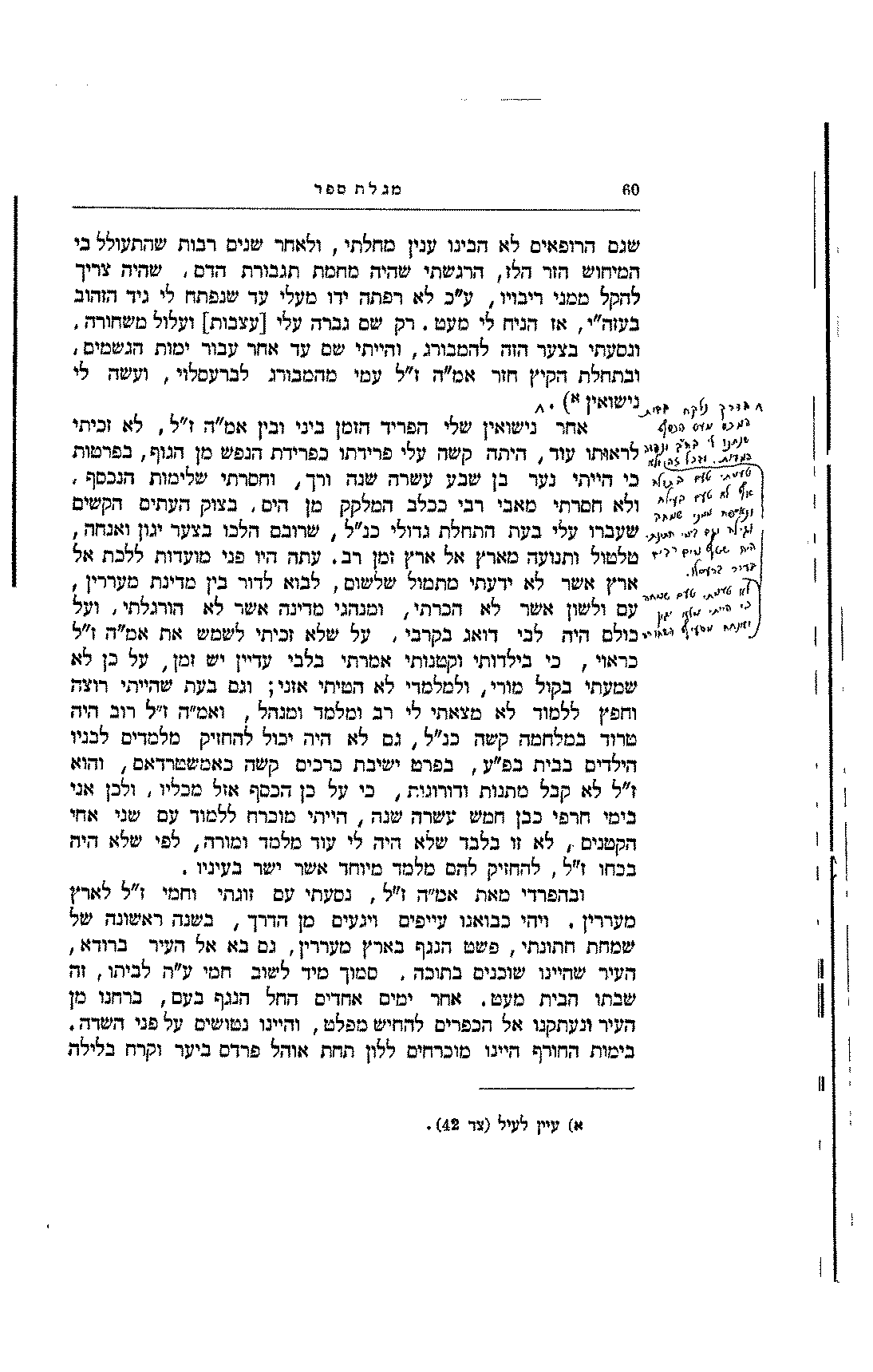
Margin readings in Scholem's copy (2)
| Printed anchor | Type (key sheet) | Mark | Reading | Certainty |
|---|---|---|---|---|
| ועשה לי ^ נישואין א) | V: omission | caret; 3-line note in right margin (Kraken: ... לקח ... ) | בדרך נלקח ממני(?) / המכס מעט הכסף / שנתנו לי בהב"ג ונפזר / כמדות | fairly sure |
| היתה קשה עלי פרידתו ... (lines 9-21) | — | long note in right margin, about 13 lines, beside the passage on parting from his father after the wedding (Kraken fragments: ... הכסף / ... / אף לא טעם בעילה / ... / לא טעמתי טעם שמחה / ... יגון) | ובכל זה לא / טעמתי טעם בעולם(?) / אף לא טעם בעילה / ונאספה ממני שמחה / וגילה עם רעי(?) תענוגי / היה שטף מים רבים(?) / בדרך לברעסלו. / לא טעמתי טעם שמחה / כי הייתי ... יגון / ואנחת מסוף(?) השחור(?) | partial (most words read) |
Page 61 (scan 75)
for several weeks, until by the Lord's mercy the villagers' compassion was stirred and they let us come into the villages to live with them under their roofs, at a high price.
When this trouble had passed, I saw a new world, a new nature and new customs. In my father-in-law's house, too, the living was hard at that time, and I had to make do with the barest necessities, against the tenderness of my nature and the habits I had learned in my father's house. And at once I tasted a taste more bitter than death, for my wife, of blessed memory, was hard and stubborn, though she was gentle in speech and lovely; only my sins did this to me. Besides, "when the barley is finished from the jar, strife comes knocking at the house" [a] in my father-in-law's house; and they "ploughed with my heifer to find out my riddle" (Judg. 14:18) — the place where I had hidden my purse, the little money I had received. I did not agree to give an outlet for the money and throw coins away for nothing; and they made quarrels with me and almost separated me from my wife, so that I had no rest, no quiet and no peace.
Never in my life did I sit one day in tranquillity. When the flower of my youth blossomed, "from the womb of the morning, the dew of my youth" (Ps. 110:3), the days of my boyhood and youth passed in poverty; all the times came in sorrow, trouble and suffering; "from within and without my sighs are many" (Lam. 1:22), and all my joy was darkened (Isa. 24:11). With all this, "the precepts of the Lord are right, rejoicing the heart" (Ps. 19:9), the broken and contrite heart; they were to me the joy of my heart and the restoring of my soul: "unless Your law had been my delight, I should then have perished in my affliction" (Ps. 119:92). Only the main thing was missing: books. I had then only the four Ṭurim, which I had brought with me, given me by my uncle ⟨S: "a gift"⟩, of blessed memory, as a wedding present. In them I studied, as the good hand of the Lord was upon me, according to my understanding; besides them I did not have even a volume of the Gemara as I wished, except on loan and with great difficulty. Though my father-in-law, of blessed memory, had several sets of the Talmud, and his house was full of precious and honoured books, my eye had no access to them, and I had no permission to take any of them to study as I needed.
With all this pressure and want, young men of desire at once set their eyes on me: scholars married and unmarried longed to study with me. I wanted more to learn than to teach; even so I could not make their word and their pressing void and refuse them, God forbid, also because I said: "from my students more than from all" (b. Ta'anit 7a) — they will keep my learning in my hands. So I bent my shoulder and became "a servant under tribute" (Gen. 49:15), serving the service of the Lord with companions who listened to my voice. Young men of the people and important scholars gathered to me, and I studied with them Gemara, Rashi and Tosafot, the Ṭur Oraḥ Ḥayyim with the Beit Yosef, Bible, halakhah and aggadah; my words were sweet to those who heard them, and their company was pleasant and agreeable to me, good fellowship. They even wanted to provide the needs of my household amply, for their fathers were rich merchants, notables of the land
Kahana's notes
- [a] After the saying of the Sages (b. Bava Metzia 59a): "When the barley is finished from the jar, strife comes knocking at the house."
כמה שבועות, עד כי בחמלת ה' עלינו נכמרו רחמי הכפרים, והניחונו לבוא אל הכפרים, לשכון עמהם בצל קורתם בדמים יקרים. וכאשר עברה זאת הצרה, וראיתי עולם חדש טבע חדש ומנהג חדש, ובבית חמי ז"ל היתה ג"כ הפרנסה קשה בעת ההיא, והוצרכתי להסתפק בהכרחי מאד בלבד נגד רכות טבעי והרגלי ולמודי בבית אבא, ומיד טעמתי ג"כ טעם מר ממות, כי אשתי ע"ה היתה מתקף תקיפא, אף אם מעברא במילי וחמידה היתה, רק עוונותי עשו אלה לי; נוסף לזה כד משלם שעורי מכדא בבית חותני ז"ל, והיו חורשים בעגלתי למצוא חידתי, מקום שהצנעתי כיסי, מעט הכסף שקבלתי, לא התרציתי לתת לכסף מוצא למשדי זוזי בכדי, נקיש ואתי תיגרא א, והרגילו עמי קטטה, וכמעט הפרידו ביני ובין זוגתי, באופן שלא נחתי ולא שלותי ולא שקטתי, מעודי לא ישבתי יום אחד בשלוה, בעת פרח ציץ בחרותי מרחם משחר טל ילדותי, ימי נערותי ובחרותי חלפו עם עניות, כל עמת שבאו בצער וצרה ויסורין, מבית ומבחוץ רבה אנחתי, ערבה כל שמחתי, עם כל זה פקודי ה' ישרים משמחי לב נשבר ונדכה, היו לי לשמחת לבבי ולמשיב נפש, לולי תורתיך שעשועי אז אבדתי בעניי. רק העיקר חסר מן הספר, ר"ל שלא היה נמצא בידי אז רק ספרי ד' טורים, שהבאתי עמדי מה שנתן לי דודי ז"ל ודורון לחתונה, בהם עסקתי כיד ה' הטובה עלי כפי השגתי, וזולת לא היה מצוי לי אפילו כרך גמרא לחפצי, כי אם בשאלה ובקושי גדול. אף אם היה לחותני ע"ה כמה ש"ם, וביתו מלא ספרים יקרים ונכבדים, לא שלטה עיני בהם, ולא הי"ל רשות לקחת מהם לעיין בהם כצרכי. ועם כל הדוחק והלחץ הלז, מיד נתנו עיניהם בי בחורי חמד, לומדים נשואים ופנויים חשקו ללמוד אצלי, ואני הייתי יותר חפץ ללמוד מללמד, מ"מ לא יכולתי לשום לאל מלתם והפצרתם למנוע מהם ח"ו, גם כי אמרתי: מתלמידי יותר מכולם, המה יקיימו תלמודי בידי בכן הטיתי שכמי והייתי למס עובד עבודת ה' עם חברים מקשיבים לקולי, ונאספו אלי בחורים מעם ולומדים חשובים, ולמדתי עמם גפ"ת וטא"ח עם ב"י מקרא הלכה ואגדה, והיו דברי ערבים לשומעיהם, והיתה לי חברתם נוחה ונעימה צוותא בסימא, עד שרצו לקבוע לי ספוק צרכי ביתי בריוח, כי היו אבותיהם עשירים סוחרים נכבדי ארץ
- [א] ע"פ מאמר חז"ל (ב"מ דף נ"ט) כד משלם שעורי מכדא נקיש ואתי תגרא בביתא.
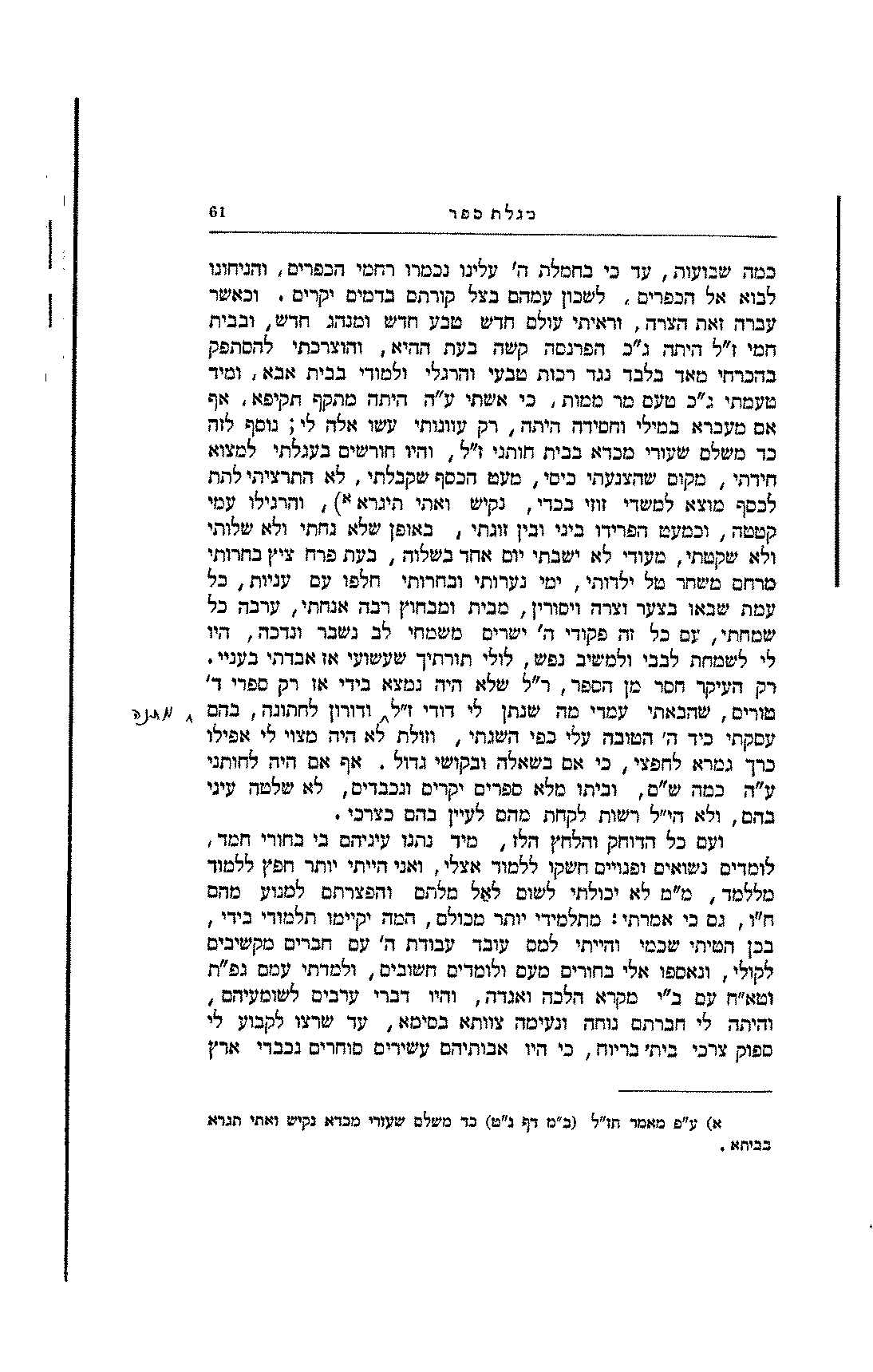
Margin readings in Scholem's copy (1)
| Printed anchor | Type (key sheet) | Mark | Reading | Certainty |
|---|---|---|---|---|
| מה שנתן לי דודי ז"ל ^ ודורון לחתונה | V: omission | caret; one word | מתנה | fairly sure |
Page 62 (scan 76)
of Hungary; and I would not at all. The faithful witness in the sky (Ps. 89:38) knows that I took no money or money's worth of any kind.
But my days of rest and joy did not last. For within three years, "as the years of a hireling" (Isa. 16:14), in which I was a day-labourer ⟨S: a five-line note, partly read: "diligent … as if I were …"⟩ — for I did not let them leave me having heard a lesson from my mouth only once, but they repeated their learning before me, especially the lessons in the rabbinic codes, the Ṭur with the Beit Yosef; they did not leave me until it was fluent in their mouths, what they had heard and received day by day; and sometimes I toiled with them so much that "I am weary of my crying, my throat is dried" (Ps. 69:4), and I had to bind my head with a cloth from the great labour, to explain to them and set their learning in order in their mouths, so that it would be arranged in the heart and kept on the tongue, without mistake and without error in understanding — suddenly "the spoiler came upon my tent, and all my cords are broken" (Jer. 10:20); "my purposes are broken off, the thoughts of my heart" (Job 17:11); "horror has overwhelmed me, trembling has seized me; the twilight I longed for He has turned into trembling for me" (Isa. 21:4), when the news of my father's death reached me. "Terrors are turned upon me" (Job 30:15): the wheel turned upon me and rolled me backwards; "He will toss me like a ball into a large country" (Isa. 22:18), the land of Poland.
I went on a long road on which I had never travelled before. I travelled alone with men of Poland, in hard wandering, much more than a hundred leagues, in many dangers. Once we saw it plainly: as we left the inn, two robbers on horseback joined us and rode beside our wagon as far as the forest, back and forth, looking at us as if plotting against us, until we came upon another wagon, of armed gentile traders, going ahead of us. When the riders saw that wagon going before us they turned back at once, and no evil touched us. Blessed is the Rescuer!
I came, thank God, to the holy community of Lwów at the end of the summer of 5478 [1718], and found my father's household in heavy mourning, and the whole land weeping for its precious loss, which had no replacement, refusing to be comforted, as said [a]. I opened my mouth to lament him anew, and preached at my father's grave before a great gathering; for all the dear and honoured men of the community came to hear my words, and a great multitude with them, in honour of the dead. They heard my words, for they were pleasant, and I won a very good name, for the words were very pleasant to the ears of the hearers. I called the sermon Yatziv Pitgam, after the setting up of the gravestone that I made for my father on his grave on the very day I preached and lamented him. The subject of the sermon was this making of a gravestone, woven into the verses of the weekly portion with much invention, depth and sweetness, and well-settled words
Kahana's notes
- [a] The gaon Ḥakham Tzvi died on the night of Monday, the New Moon of Iyar 5478 [1718], aged 58. See Yatziv Pitgam by Emden (fols. 16b and 26b).
הגר, ולא אביתי כלל, ועד בשחק נאמן כי לא לקחתי כסף ושוה כסף כל מאומה. אבל לא ארכו לי ימי המנוחה והשמחה, כי בעוד שלש שנים כשני שכיר, שהייתי שכיר יום, כי לא הנחתי אותם מלפני לצאת ידי שמועה מפי פ"א בלבד, אבל היו חוזרים על תלמודם לפני, ביחוד בלמודי שיעורי דרבנן הפוסקים טור עם ב"י, לא נפטרו מאתי עד שהיה שגור בפיהם, מה ששמעו וקבלו דבר יום ביומו, ולפעמים הייתי טורח עמהם כל כך, עד שיגעתי בקראי נחר גרוני, והוצרכתי לקשור ראשי בסודר מרוב עבודה כדי להסביר להם ולהסדיר למודם בפיהם, שיהא ערוך בלב ושמור בלשון בלי משגה ובלי טעות בהבנה, פתאום שודד בא אהלי וכל מיתרי נתקו, זמותי עברו מורשי לבבי, פלצות בעתתני רעדה אחזתני, את נשף חשקי שם לי לחרדה, בבוא אלי שמועת פטירת אמ"ה ז"ל, ההפך עלי בלהות נהפך עלי הגלגל, גלגלני לאחור צנפני כדור אל ארץ רחבת ידים, היא מדינת פולין, הלכתי בדרך רחוקה אשר לא עברתי בה מתמול שלשום, עברתי יחידי עם אנשי פולין בטלטול הקשה, הרבה יותר ממאה פרסאות בסכנות רבות. פ"א ראינו בחוש, כי הלכנו מן המלון, נתלוו אלינו שודדים שני רוכבי סוסים, הלכו אצל עגלה שלנו עד היער, הלוך ושוב ומביטים אלינו כנועצים עלינו, עד שפגענו בעגלה אחרת של תגרים נכרים מזויינים שהלכו לפנינו, וכראות הרוכבים הנ"ל את העגלה ההיא נוסעת לפנינו, אז מיד חזרו לאחוריהם, ולא נגע בנו רע. ברוך המציל! ובאתי ת"ל לק' לבוב בשילהי קיץ תע"ח, ומצאתי בית אבי ז"ל מתאבלים אבל כבד גם כל הארץ בוכים על אבדתם היקרה בלי תמורה מאנו הנחם כנ"ל א, ואנכי פתחתי פי להספידו מחדש, ודרשתי על קברו של אמ"ה ז"ל בפני קבוץ גדול שהיה, כי באו לשמוע אמרי כל יקירי נכבדי הקהל, והמון רב עמהם ליקרא דשכבא, ושמעו אמרי כי נעמו, וקניתי שם טוב מאד, כי היו הדברים נעימים מאד לאזני השומעים, וקראתי שם הדרוש „יציב פתגם", על שם העמדת המצבה שעשיתי לאמ"ה ז"ל על קברו בו ביום שדרשתי והספדתי עליו. ומענין זה של עשיית מצבה היה נושא הדרוש, וכלול בתוך פסוקי פרשת השבוע, בהמצאה רבה ועומק ומתיקות, ודברים מיושבים
- [א] הגאון חכם צבי מת בליל יום ב' דר"ת אייר תע"ח, בן נ"ח שנה עיין בס' "יציב פתגם" ליעב"ץ (דף ט"ז ע"ב ודף כ"ו ע"ב).
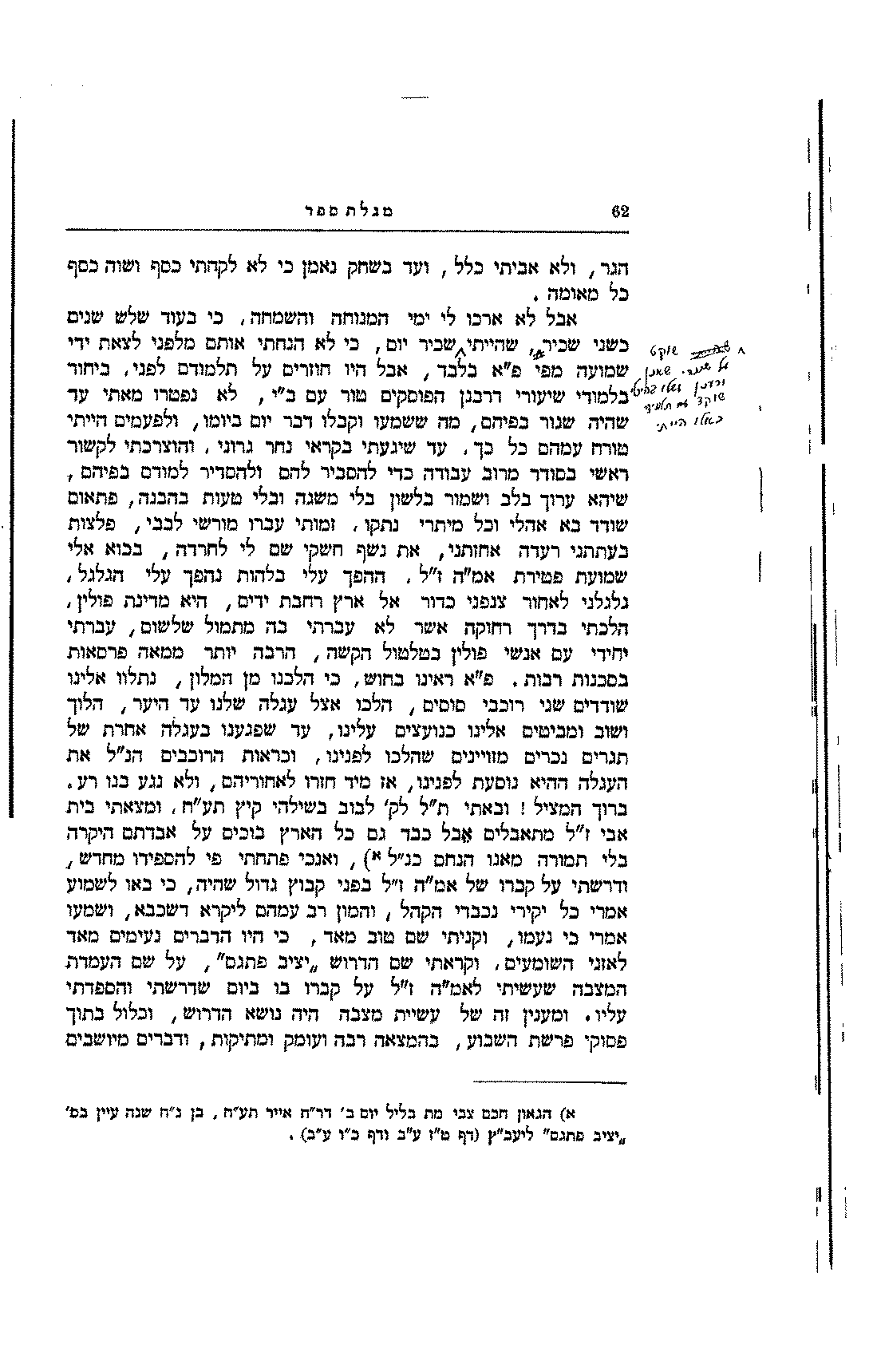
Margin readings in Scholem's copy (1)
| Printed anchor | Type (key sheet) | Mark | Reading | Certainty |
|---|---|---|---|---|
| כי בעוד שלש שנים כשני שכיר, שהייתי ^ שכיר יום | V: omission | caret; 5-line note in right margin | שוקד(?) ... / ... / ... כאלו הייתי (partly read) | partial |
Page 63 (scan 77)
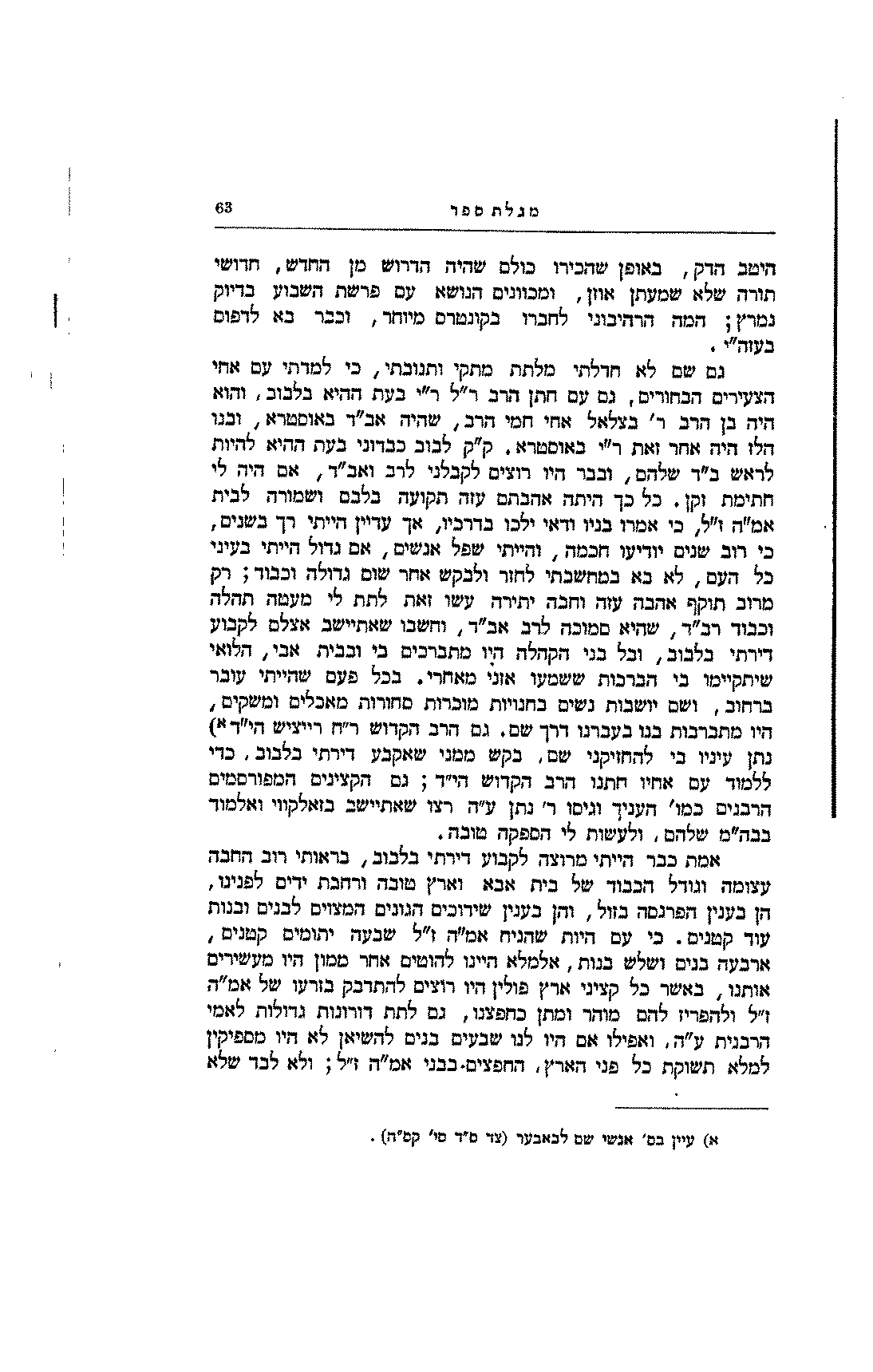
ground very fine, so that everyone recognised that the sermon was new — Torah novellae that no ear had heard — and that its subject matched the weekly portion with great precision. They urged me to set it down as a separate pamphlet, and it has already come out in print, with God's help.
There too I did not cease to give "my sweetness and my good fruit" (Judg. 9:11). I studied with my young brothers, the youths, and also with the bridegroom, the rabbi R. L., head of a yeshivah, who was in Lwów at that time. He was the son of the rabbi R. Bezalel, brother of my father-in-law the rabbi, who was head of the court in Ostróg; and this son of his was afterwards head of the yeshivah in Ostróg.
The holy community of Lwów honoured me at that time by making me head of their court; and they would already have wanted to receive me as rabbi and head of the court, had I had a full beard. So strong was their love, fixed in their hearts and kept for my father's house; for they said, his sons will surely walk in his ways. But I was still young in years — "the multitude of years should teach wisdom" (Job 32:7) — and I was the lowliest of men, though I was great in the eyes of all the people. It did not enter my mind to seek or pursue any greatness or honour. Only out of the strength of their great love and affection did they do this, to give me a mantle of praise and the honour of judge of the court, which is next to rabbi and head of the court; and they thought that I would settle with them and make my home in Lwów. All the members of the community blessed themselves by me and by my father's house — would that the blessings my ears heard behind me were fulfilled in me. Every time I passed through the street where women sat in shops selling goods, food and drink, they blessed themselves by us as we went by.
The holy rabbi R. Ḥ. Reitzes, may God avenge his blood [a], also set his eyes on me to keep me there, and asked me to make my home in Lwów, in order to study with his brother, his son-in-law, the holy rabbi, may God avenge his blood. The famous leaders, the learned R. Henikh and his brother-in-law R. Nathan, of blessed memory, also wanted me to settle in Żółkiew and study in their house of study, and to make good provision for me.
Truly, I was already content to make my home in Lwów, seeing the great affection and the great honour for my father's house, and a good and wide land before us — both in the cheapness of living and in the fitting matches to be found for the sons and daughters, who were still small. For although my father left seven young orphans, four sons and three daughters, had we been eager for money they would have made us rich: all the leaders of the land of Poland wanted to join themselves to my father's descendants and to settle on them dowry and gift as we pleased, and also to give great presents to my mother the rebbetzin. Even if we had had seventy sons to marry off, they would not have been enough to satisfy the longing of the whole land, which desired my father's sons. And not only would we not
Kahana's notes
- [a] See Buber, Anshei Shem (p. 64, § 165).
היטב הדק, באופן שהכירו כולם שהיה הדרוש מן החדש, חדושי תורה שלא שמעתן אוזן, ומכוונים הנושא עם פרשת השבוע בדיוק נמרץ; המה הרהיבוני לחברו בקונטרס מיוחד, וכבר בא לדפוס בעזה"י. גם שם לא חדלתי מלתת מתקי ותנובתי, כי למדתי עם אחי הצעירים הבחורים, גם עם חתן הרב ר"ל ר"י בעת ההיא בלבוב, והוא היה בן הרב ר' בצלאל אחי חמי הרב, שהיה אב"ד באוסטרא, ובנו הלז היה אחר זאת ר"י באוסטרא. ק"ק לבוב כבדוני בעת ההיא להיות לראש ב"ד שלהם, ובבר היו רוצים לקבלני לרב ואב"ד, אם היה לי חתימת זקן. כל כך היתה אהבתם עזה תקועה בלבם ושמורה לבית אמ"ה ז"ל, כי אמרו בניו ודאי ילכו בדרכיו, אך עדיין הייתי רך בשנים, כי רוב שנים יודיעו חכמה, והייתי שפל אנשים, אם גדול הייתי בעיני כל העם, לא בא במחשבתי לחזר ולבקש אחר שום גדולה וכבוד; רק מרוב תוקף אהבה עזה וחבה יתירה עשו זאת לתת לי מעטה תהלה וכבוד רב"ד, שהיא סמוכה לרב אב"ד, וחשבו שאתיישב אצלם לקבוע דירתי בלבוב, ובל בני הקהלה היו מתברכים בי ובבית אבי, הלואי שיתקיימו בי הברכות ששמעו אזני מאחרי. בכל פעם שהייתי עובר ברחוב, ושם יושבות נשים בחנויות מוכרות סחורות מאכלים ומשקים, היו מתברכות בנו בעברנו דרך שם. גם הרב הקדוש ר"ח רייציש הי"ד א נתן עיניו בי להחזיקני שם, בקש ממני שאקבע דירתי בלבוב, כדי ללמוד עם אחיו חתנו הרב הקדוש הי"ד; גם הקצינים המפורסמים הרבנים כמו' העניך וגיסו ר' נתן ע"ה רצו שאתיישב בזאלקווי ואלמוד בבה"מ שלהם, ולעשות לי הספקה טובה. אמת כבר הייתי מרוצה לקבוע דירתי בלבוב, בראותי רוב החבה עצומה וגודל הכבוד של בית אבא וארץ טובה ורחבת ידים לפנינו, הן בענין הפרנסה בזול, והן בענין שידוכים הגונים המצוים לבנים ובנות עוד קטנים. כי עם היות שהניח אמ"ה ז"ל שבעה יתומים קטנים, ארבעה בנים ושלש בנות, אלמלא היינו להוטים אחר ממון היו מעשירים אותנו, באשר כל קציני ארץ פולין היו רוצים להתדבק בזרעו של אמ"ה ז"ל ולהפריז להם מוהר ומתן כחפצנו, גם לתת דורונות גדולות לאמי הרבנית ע"ה, ואפילו אם היו לנו שבעים בנים להשיאן לא היו מספיקין למלא תשוקת כל פני הארץ, החפצים בבני אמ"ה ז"ל; ולא לבד שלא
- [א] עיין בס' אנשי שם לבאבער (צד ס"ד סי' קס"ה).
Page 64 (scan 78)
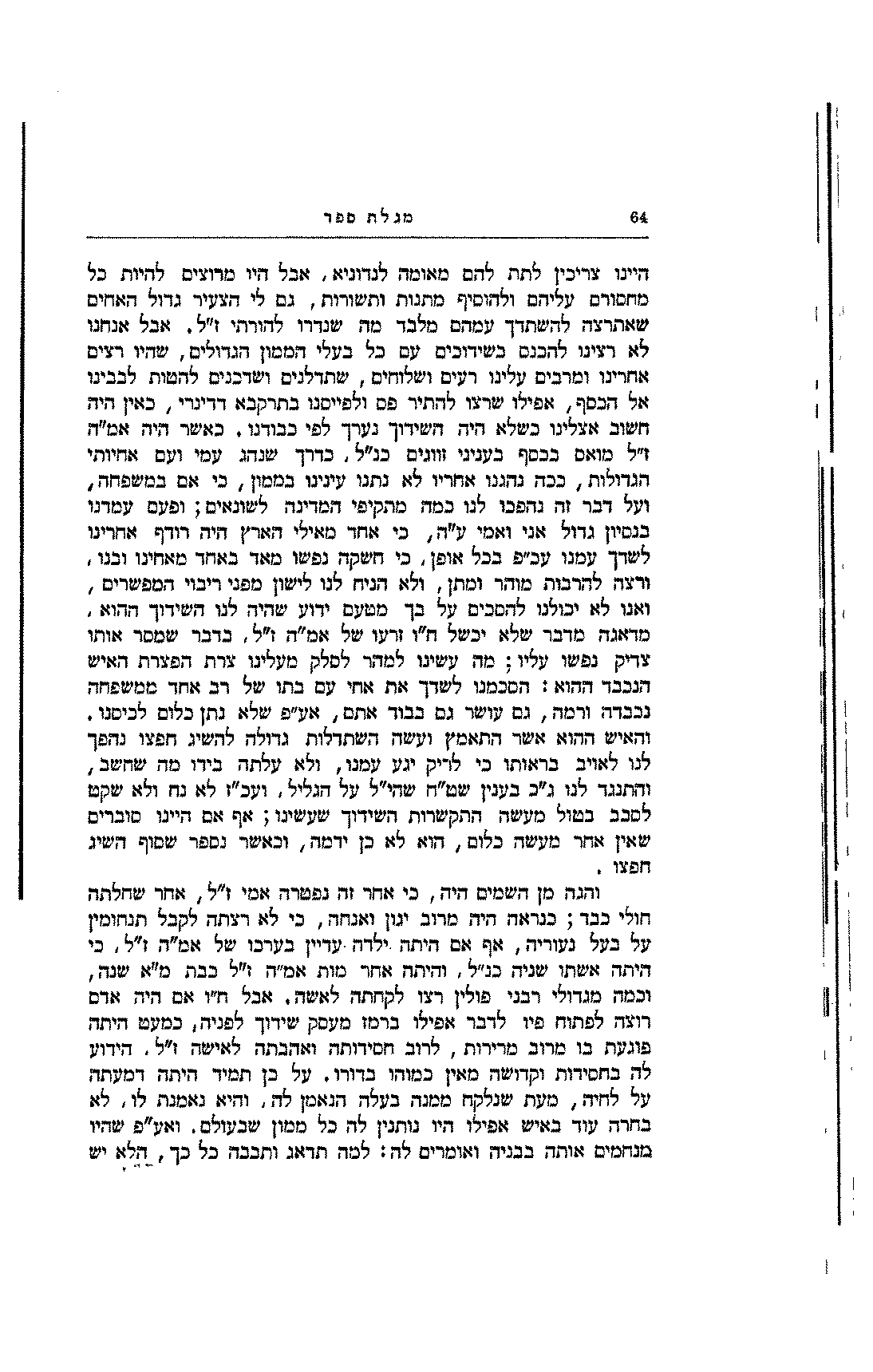
have needed to give them anything as a dowry; they were willing to take all their wants on themselves and to add gifts and presents — to me too, the young one, the eldest of the brothers, if I would agree to make a match with them — besides what they promised my mother, of blessed memory. But we did not want to enter into matches with all the great moneyed men who ran after us and sent us many friends and messengers, intercessors and matchmakers, to turn our hearts to money. Even when they wanted to open their hand wide and win us with a purse of gold coins, it counted for nothing with us when the match was not suited to our honour. As my father had despised money in matters of marriage, as said, in the way he acted with me and with my elder sisters, so we acted after him: we did not set our eyes on money, but on family. Because of this several of the powerful men of the land turned into our enemies.
Once my mother, of blessed memory, and I stood in a great trial. One of the "rams" of the land pursued us to make a match with us at all costs, for his soul greatly longed for one of our brothers for his son's daughter, and he wanted to heap up dowry and gift, and did not let us sleep for the many go-betweens. We could not agree to it, for a reason we knew concerning that match: out of worry that my father's descendants should not stumble, God forbid, in a matter for which that righteous man had given his life. What did we do to rid ourselves quickly of the trouble of that honoured man's pressing? We agreed to match my brother with the daughter of a rabbi of an honoured and high family, with wealth and honour, though he gave nothing to our purse. That man, who had exerted himself and made great efforts to get his wish, turned into our enemy when he saw that he had toiled with us in vain and had not achieved what he planned. He opposed us also in the matter of a bond we held on the district; and even so he did not rest or keep quiet in trying to undo the binding of the match we had made. Though we thought that nothing could be done after the deed, he did not think so; and, as we will tell, in the end he got his wish.
And it was from heaven: after this my mother, of blessed memory, died, after a severe illness — it seems from much grief and sighing, for she would not be comforted for the husband of her youth. She was still young compared with my father, for she was his second wife, as said; after my father's death she was about forty-one, and several of the great rabbis of Poland wanted to take her as a wife. But God forbid that anyone should open his mouth to speak even by a hint of a match before her: she would almost strike him, out of great bitterness, from her great piety and her love for her husband, of blessed memory, whom she knew for a piety and holiness that had no equal in his generation. So her tear was always on her cheek from the time that her husband, faithful to her, was taken from her; and she was faithful to him, and would not choose another man even if they had given her all the money in the world. And though they comforted her with her children and said to her: "Why do you worry and weep so much? Have you not,
היינו צריכין לתת להם מאומה לנדוניא, אבל היו מרוצים להיות כל מחסורם עליהם ולהוסיף מתנות ותשורות, גם לי הצעיר גדול האחים שאתרצה להשתדך עמהם מלבד מה שנדרו להורתי ז"ל. אבל אנחנו לא רצינו להכנס בשידוכים עם כל בעלי הממון הגדולים, שהיו רצים אחרינו ומרבים עלינו רעים ושלוחים, שתדלנים ושדכנים להטות לבבינו אל הכסף, אפילו שרצו להתיר פס ולפייסנו בתרקבא דדינרי, כאין היה חשוב אצלינו כשלא היה השידוך נערך לפי כבודנו. כאשר היה אמ"ה ז"ל מואס בכסף בעניני זווגים כנ"ל, כדרך שנהג עמי ועם אחיותי הגדולות, ככה נהגנו אחריו לא נתנו עינינו בממון, כי אם במשפחה, ועל דבר זה נהפכו לנו כמה מתקיפי המדינה לשונאים; ופעם עמדנו בנסיון גדול אני ואמי ע"ה, כי אחד מאילי הארץ היה רודף אחרינו לשדך עמנו עכ"פ בכל אופן, כי חשקה נפשו מאד באחד מאחינו ובנו, ורצה להרבות מוהר ומתן, ולא הניח לנו לישון מפני ריבוי המפשרים, ואנו לא יכולנו להסכים על כך מטעם ידוע שהיה לנו השידוך ההוא, מדאגה מדבר שלא יכשל ח"ו זרעו של אמ"ה ז"ל, בדבר שמסר אותו צדיק נפשו עליו; מה עשינו למהר לסלק מעלינו צרת הפצרת האיש הנכבד ההוא: הסכמנו לשדך את אחי עם בתו של רב אחד ממשפחה נכבדה ורמה, גם עושר גם כבוד אתם, אע"פ שלא נתן כלום לכיסנו. והאיש ההוא אשר התאמץ ועשה השתדלות גדולה להשיג חפצו נהפך לנו לאויב בראותו כי לריק יגע עמנו, ולא עלתה בידו מה שחשב, והתנגד לנו ג"כ בענין שט"ח שהי"ל על הגליל, ועכ"ז לא נח ולא שקט לסבב בטול מעשה התקשרות השידוך שעשינו; אף אם היינו סוברים שאין אחר מעשה כלום, הוא לא כן ידמה, וכאשר נספר שסוף השיג חפצו. והנה מן השמים היה, כי אחר זה נפטרה אמי ז"ל, אחר שחלתה חולי כבד; כנראה היה מרוב יגון ואנחה, כי לא רצתה לקבל תנחומין על בעל נעוריה, אף אם היתה ילדה עדיין בערכו של אמ"ה ז"ל, כי היתה אשתו שניה כנ"ל, והיתה אחר מות אמ"ה ז"ל כבת מ"א שנה, וכמה מגדולי רבני פולין רצו לקחתה לאשה. אבל ח"ו אם היה אדם רוצה לפתוח פיו לדבר אפילו ברמז מעסק שידוך לפניה, כמעט היתה פוגעת בו מרוב מרירות, לרוב חסידותה ואהבתה לאישה ז"ל. הידוע לה בחסידות וקדושה מאין כמוהו בדורו. על כן תמיד היתה דמעתה על לחיה, מעת שנלקח ממנה בעלה הנאמן לה, והיא נאמנת לו, לא בחרה עוד באיש אפילו היו נותנין לה כל ממון שבעולם. ואע"פ שהיו מנחמים אותה בבניה ואומרים לה: למה תדאג ותבבה כל כך, הלא יש
Page 65 (scan 79)
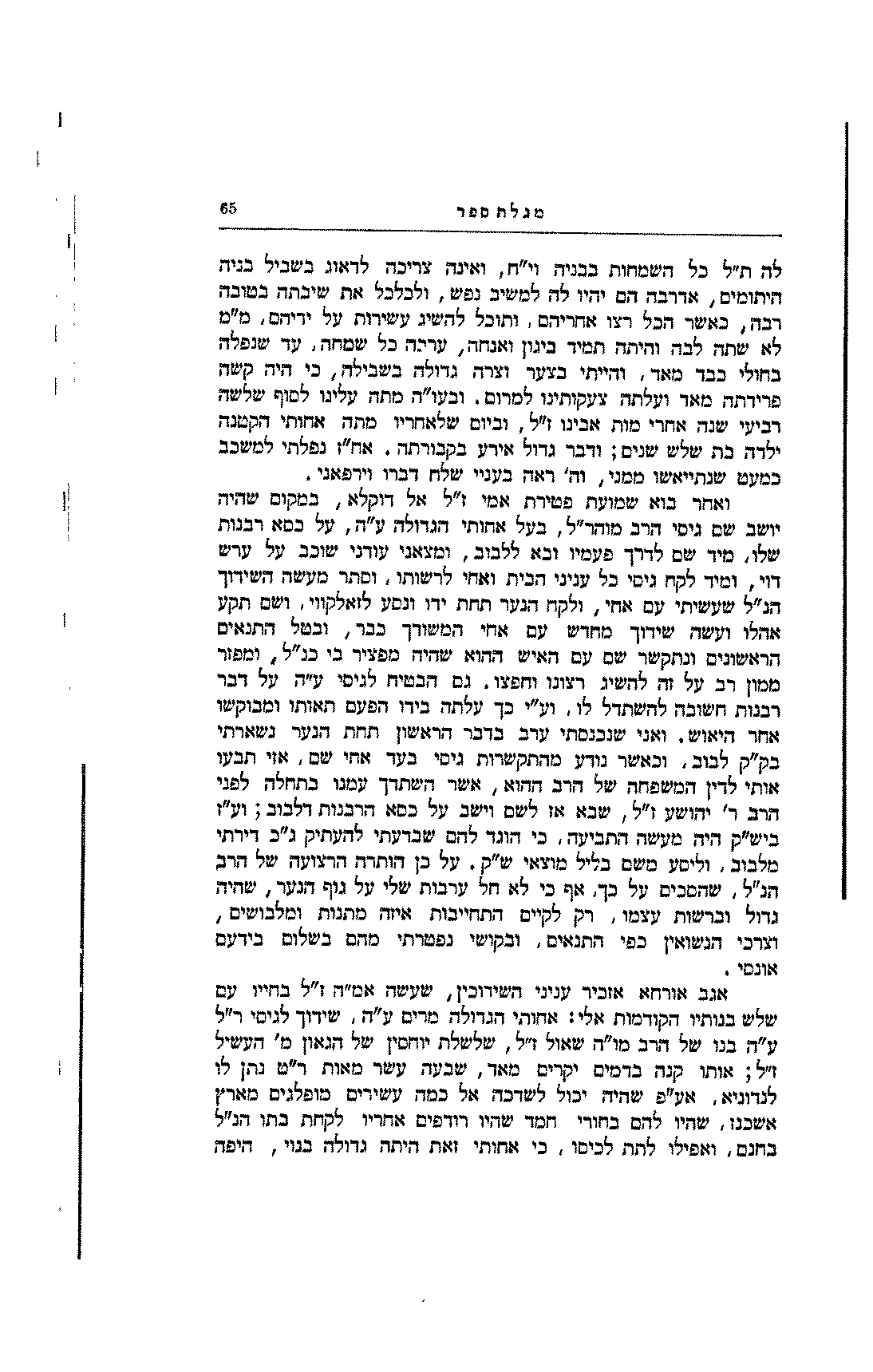
thank God, every joy in your children and descendants? You need not worry for your orphaned children; on the contrary, they will restore your soul and sustain your old age with much good, since everyone runs after them, and you can gain wealth through them" — even so she did not take it to heart. She was always in grief and sighing, and all joy was darkened for her, until she fell into a very severe illness. I was in sorrow and great distress for her, for parting from her was very hard, and our cries went up on high. For our many sins she died, at the end of three quarters of a year after the death of our father, of blessed memory; and on the following day my little sister died, a girl of three; and a great thing happened at her burial. After this I fell ill and took to my bed, and they almost despaired of me; and the Lord saw my affliction, "sent His word and healed" me.
When the news of my mother's death reached Dukla, where my brother-in-law the rabbi R. L., husband of my elder sister, of blessed memory, sat on his rabbinical seat, he at once set out and came to Lwów, and found me still lying on my sickbed. At once my brother-in-law took all the affairs of the house, and my brother, into his own hands. He undid the match I had made for my brother, took the boy with him and travelled to Żółkiew. There he pitched his tent and made a new match for my brother, who was already betrothed: he cancelled the first conditions and bound himself there with that man who had pressed me, as said, and who spent much money on it to get his will and his wish. He also promised my brother-in-law to exert himself to get him an important rabbinate; and through this he got his desire and his wish this time, after he had given up hope.
I had become guarantor for the boy in the first match, and I remained in Lwów. When the new binding made by my brother-in-law for my brother there became known, the family of that rabbi who had first made the match with us sued me before the rabbi R. Joshua, of blessed memory, who had then come there and sat on the rabbinical seat of Lwów. The suit was held on the holy Sabbath, for they had been told that I meant to move from Lwów too, and to travel from there on Saturday night; so the rabbi allowed it. Yet my guarantee did not apply to the person of the boy, who was grown and his own master, but only to fulfilling the obligation of some gifts, clothes and wedding needs according to the conditions. With difficulty I got away from them in peace, since they knew I had been forced.
By the way, I will mention the matches my father made in his lifetime for his three daughters who were older than me. My elder sister Miriam, of blessed memory, he matched with my brother-in-law R. L., of blessed memory, son of the rabbi R. Saul, of blessed memory, of the line of the gaon R. Heschel, of blessed memory. Him he "bought" at a very high price: he gave him seventeen hundred Reichstaler as a dowry, though he could have matched her with several exceedingly rich men of Germany, who had desirable young men and ran after him to take his daughter for nothing, and even to pay into his purse. For this sister of mine was great in beauty, the fairest
לה ת"ל כל השמחות בבניה וי"ח, ואינה צריכה לדאוג בשביל בניה היתומים, אדרבה הם יהיו לה למשיב נפש, ולכלכל את שיבתה בטובה רבה, כאשר הכל רצו אחריהם, ותוכל להשיג עשירות על ידיהם, מ"מ לא שתה לבה והיתה תמיד ביגון ואנחה, ערבה כל שמחה, עד שנפלה בחולי כבד מאד, והייתי בצער וצרה גדולה בשבילה, כי היה קשה פרידתה מאד ועלתה צעקותינו למרום. ובעו"ה מתה עלינו לסוף שלשה רביעי שנה אחרי מות אבינו ז"ל, וביום שלאחריו מתה אחותי הקטנה ילדה בת שלש שנים; ודבר גדול אירע בקבורתה. אח"ז נפלתי למשכב כמעט שנתייאשו ממני, וה' ראה בעניי שלח דברו וירפאני. ואחר בוא שמועת פטירת אמי ז"ל אל דוקלא, במקום שהיה יושב שם גיסי הרב מוהר"ל, בעל אחותי הגדולה ע"ה, על כסא רבנות שלו, מיד שם לדרך פעמיו ובא ללבוב, ומצאני עודני שוכב על ערש דוי, ומיד לקח גיסי כל עניני הבית ואחי לרשותו, וסתר מעשה השידוך הנ"ל שעשיתי עם אחי, ולקח הנער תחת ידו ונסע לזאלקווי, ושם תקע אהלו ועשה שידוך מחדש עם אחי המשודך כבר, ובטל התנאים הראשונים ונתקשר שם עם האיש ההוא שהיה מפציר בי כנ"ל, ומפזר ממון רב על זה להשיג רצונו וחפצו. גם הבטיח לגיסי ע"ה על דבר רבנות חשובה להשתדל לו, וע"י כך עלתה בידו הפעם תאותו ומבוקשו אחר היאוש. ואני שנכנסתי ערב בדבר הראשון תחת הנער נשארתי בק"ק לבוב, וכאשר נודע מהתקשרות גיסי בעד אחי שם, אזי תבעו אותי לדין המשפחה של הרב ההוא, אשר השתדך עמנו בתחלה לפני הרב ר' יהושע ז"ל, שבא אז לשם וישב על כסא הרבנות דלבוב; וע"ז ביש"ק היה מעשה התביעה, כי הוגד להם שבדעתי להעתיק ג"כ דירתי מלבוב, וליסע משם בליל מוצאי ש"ק. על כן הותרה הרצועה של הרב הנ"ל, שהסכים על כך, אף כי לא חל ערבות שלי על גוף הנער, שהיה גדול וברשות עצמו, רק לקיים התחייבות איזה מתנות ומלבושים, וצרכי הנשואין כפי התנאים, ובקושי נפטרתי מהם בשלום בידעם אונסי. אגב אורחא אזכיר עניני השידוכין, שעשה אמ"ה ז"ל בחייו עם שלש בנותיו הקודמות אלי: אחותי הגדולה מרים ע"ה, שידוך לגיסי ר"ל ע"ה בנו של הרב מו"ה שאול ז"ל, שלשלת יוחסין של הגאון מ' העשיל ז"ל; אותו קנה בדמים יקרים מאד, שבעה עשר מאות ר"ט נתן לו לנדוניא, אע"פ שהיה יכול לשדכה אל כמה עשירים מופלגים מארץ אשכנז, שהיו להם בחורי חמד שהיו רודפים אחריו לקחת בתו הנ"ל בחנם, ואפילו לתת לכיסו, כי אחותי זאת היתה גדולה בנוי, היפה
Page 66 (scan 80)
among women and learned; and they offered great wealth. He did not turn to the proud, nor to those who turn aside after silver (cf. Ps. 40:5), and gave his young daughter more than he could afford, in order to join her to a family of lineage — besides great expenses and maintenance for several years — while the groom's father bound himself only to clothes and gifts. While they were on the way to come ⟨S: a word, not read⟩ to the wedding of this youngest of their sons, the rabbi R. Saul died on the road, in the holy community of Glogau [a]. He had already been received as rabbi in Amsterdam too, and wanted to go there after his son's wedding; he did not live to see his son's joy, for his hour was cut off. My brother-in-law came with his mother, his brother and his brother-in-law, and my father made the wedding at his own expense, with great outlay, as said.
The bridegroom, a boy, was left in my father's charge after his mother, brother and brother-in-law left, like a newborn child, and all his care fell on my father: to study with him, and to give him a good companion to fill his hands with reviewing his studies and to guide him on a good way. My father did not rest until he made a great man of him. For several years my brother-in-law sucked at the breasts of the understanding of his father-in-law, my father, and "poured water on his hands" (2 Kgs. 3:11); he was also his scribe, copying his writings and letters; and he studied grammar and other things with him. Even so he did not succeed ⟨S: a word, not read⟩, through serving the rabbi, in becoming a man of pure style and good Hebrew diction; but in reasoning, ruling and leading a community he gained something from him [b], and in any case he did not lack much. At the beginning he was very diligent at his studies, with a broad heart and in great comfort, such as great scholars do not have, not one in a thousand. For he had a very good wife, with lovely qualities, love of moral teaching, fear of Heaven and modesty, very pious, with strong love for her husband together with submission and humility — besides her great beauty and charm — and skilled in women's work and in keeping a clean house. Added to this was the great affection of his father-in-law and mother-in-law, my parents, of blessed memory, who did all his heart's desire; all my father's eyes and thought were on him, to raise him, make him wise and make him prosper in every way he could, and to give him good companions — for he was their first son-in-law, of their beloved daughter, and in him truly was set all his toil and labour. Not only in my father's lifetime but also after his death: for he arranged that my brother and my two sisters, among the orphans, should be supported by him.
After he left Poland I handed over to him the whole estate of my father, of blessed memory — money and money's worth, movables, books and bonds of the province, which came to a certain sum. Several thousand Reichstaler went to waste; much sank in this way. And I, the eldest of the brothers,
Kahana's notes
- [a] He was buried on Thursday, 17 Iyar 5467 [1707]. See Zunz, Ir ha-Tzedek (p. 159).
- [b] Emden here uses the word me'umah for "something", like the German etwas.
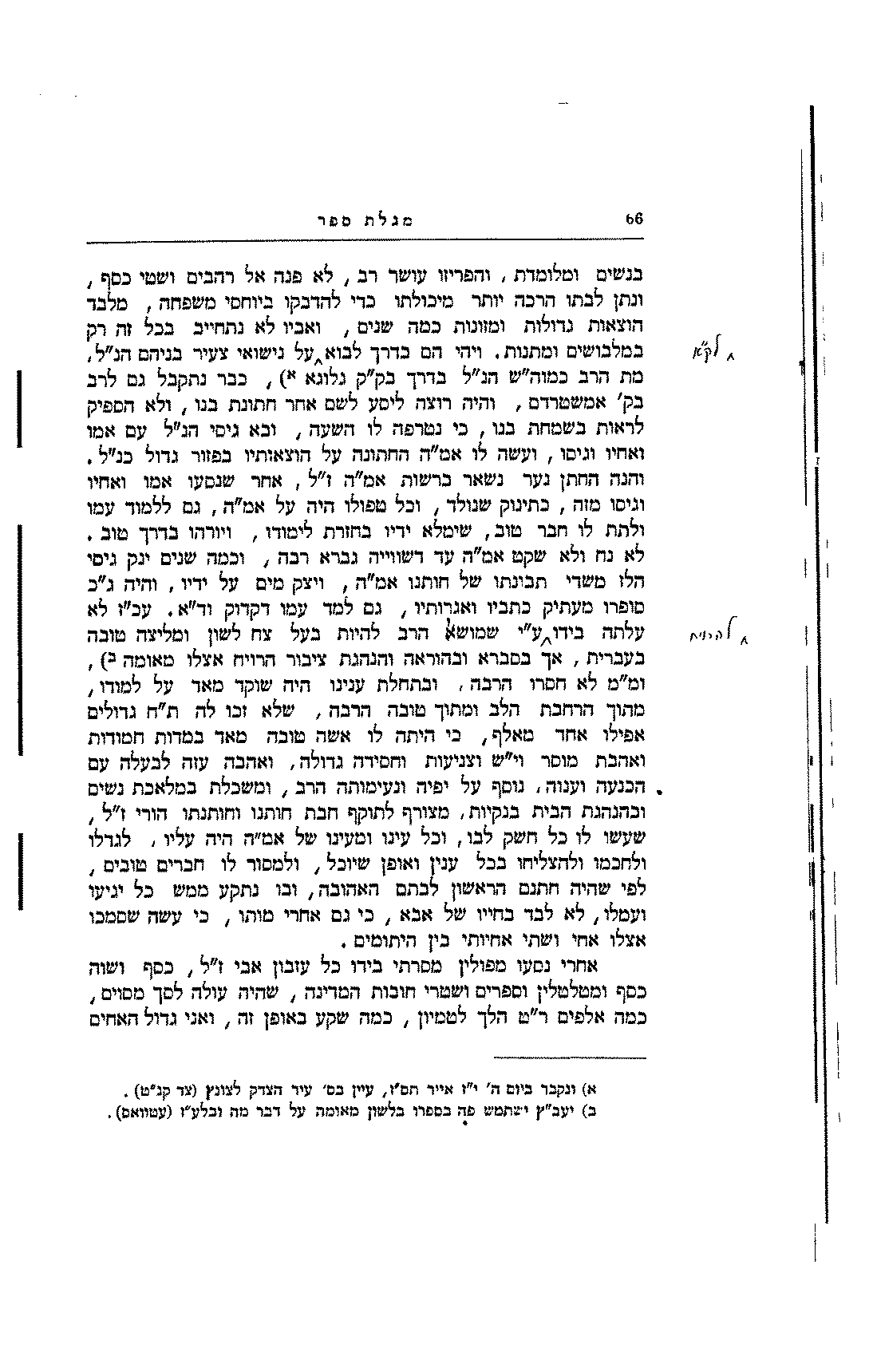
בנשים ומלומדת, והפריזו עושר רב, לא פנה אל רהבים ושטי כסף, ונתן לבתו הרכה יותר מיכולתו כדי להדבקו ביוחסי משפחה, מלבד הוצאות גדולות ומזונות כמה שנים, ואביו לא נתחייב בכל זה רק במלבושים ומתנות. ויהי הם בדרך לבוא על נישואי צעיר בניהם הנ"ל, מת הרב כמוה"ש הנ"ל בדרך בק"ק גלוגא א, כבר נתקבל גם לרב בק' אמשטרדם, והיה רוצה ליסע לשם אחר חתונת בנו, ולא הספיק לראות בשמחת בנו, כי נטרפה לו השעה, ובא גיסי הנ"ל עם אמו ואחיו וגיסו, ועשה לו אמ"ה החתונה על הוצאותיו בפזור גדול כנ"ל. והנה החתן נער נשאר ברשות אמ"ה ז"ל, אחר שנסעו אמו ואחיו וגיסו מזה, כתינוק שנולד, וכל טפולו היה על אמ"ה, גם ללמוד עמו ולתת לו חבר טוב, שימלא ידיו בחזרת לימודו, ויורהו בדרך טוב. לא נח ולא שקט אמ"ה עד דשווייה גברא רבה, וכמה שנים ינק גיסי הלז משדי תבונתו של חותנו אמ"ה, ויצק מים על ידיו, והיה ג"כ סופרו מעתיק כתביו ואגרותיו, גם למד עמו דקדוק וד"א. עכ"ז לא עלתה בידו, ע"י שמושא הרב להיות בעל צח לשון ומליצה טובה בעברית, אך בסברא ובהוראה והנהגת ציבור הרויח אצלו מאומה ב, ומ"מ לא חסרו הרבה, ובתחלת ענינו היה שוקד מאד על למודו, מתוך הרחבת הלב ומתוך טובה הרבה, שלא זכו לה ת"ח גדולים אפילו אחד מאלף, כי היתה לו אשה טובה מאד במדות חמודות ואהבת מוסר וי"ש וצניעות וחסידה גדולה, ואהבה עזה לבעלה עם הכנעה וענוה, נוסף על יפיה ונעימותה הרב, ומשכלת במלאכת נשים ובהנהגת הבית בנקיות, מצורף לתוקף חבת חותנו וחותנתו הורי ז"ל שעשו לו כל חשק לבו, וכל עינו ומעינו של אמ"ה היה עליו, לגדלו ולחכמו ולהצליחו בכל ענין ואופן שיוכל, ולמסור לו חברים טובים, לפי שהיה חתנם הראשון לבתם האהובה, ובו נתקע ממש כל יגיעו ועמלו, לא לבד בחייו של אבא, כי גם אחרי מותו, כי עשה שסמכו אצלו אחי ושתי אחיותי בין היתומים. אחרי נסעו מפולין מסרתי בידו כל עזבון אבי ז"ל, כסף ושוה כסף ומטלטלין וספרים ושטרי חובות המדינה, שהיה עולה לסך מסוים, כמה אלפים ר"ט הלך לטמיון, כמה שקע באופן זה, ואני גדול האחים
- [א] ונקבר ביום ה' י"ז אייר תס"ז, עיין בס' עיר הצדק לצונץ (צד קנ"ט).
- [ב] יעב"ץ ישתמש פה בספרו בלשון מאומה על דבר מה ובלע"ז (עטוואס).
Margin readings in Scholem's copy (2)
| Printed anchor | Type (key sheet) | Mark | Reading | Certainty |
|---|---|---|---|---|
| ויהי הם בדרך לבוא ^ על נישואי | V: omission | caret; short note | לק"ק(?) | uncertain |
| עכ"ז לא עלתה בידו ^ ע"י שמושא הרב | V: omission | caret; one word | להבחין(?) (Kraken: לקו) | uncertain |
Page 67 (scan 81)
took a bond on R. Hendele, of blessed memory, in Altona, which was due to be collected [a], and so he removed me from the whole recorded estate, as said; for he said that it would come to account afterwards, when everything was collected and the movables, money and books were gathered together — they were still scattered in other places, in Breslau and Danzig — and the money of the provincial debt. All this was collected after I moved from Poland. True, he also had expenses for my brothers and sisters for some years, until they were all married, with God's help; but he had no need to give a dowry except to one sister, Mrs. Leah. She was betrothed to the son of the rabbi and leader R. Ḥ. Leizerl, who had a pleasant son, and he too settled some money on him; and he had helped towards the rabbinate of Lwów. My father, of blessed memory, had bound himself in his lifetime to settle a thousand Reichstaler as a dowry, and other things as customary. This was a hard creditor, and he had to be paid in any case; though to this day I do not know how much he gave this sister of mine. But to my four brothers, not only did he not need to give anything; on the contrary, he took much from them — above all from the leader R. Yozpa of Ostróg, with whom I made a match, to marry my little brother to his daughter: my said brother-in-law drew great benefit from him all the time my young brother was in his charge. Likewise from the second relative by marriage, with whom my brother-in-law made the second match, as said, he had great benefits too. And this was what caused him afterwards to be caught up in the business of rabbinates; for he promised to give him real help, to bring him up the steps of high office.
For this reason hatred and rivalry reigned between him and the gaon R. Joshua mentioned above, who had then been received in Lwów through the great efforts of the relatives he had there [b]. In truth R. Joshua was received somewhat by force, and with pieces of silver, through the judges and the heads of the province, not according to the law of the Torah; and there were many people in Lwów whose minds were close to our father's house, who leaned towards my brother-in-law, to receive him as rabbi of Lwów and the province, had not the hand of the strong-armed prevailed, together with the giving of money. So after the rabbi and leader R. Nathan of Żółkiew also bound himself to our father's house and to my brother-in-law — who had obtained for him his heart's desire, my brother R. David — he wished to be [a helper] to him in the matter of the rabbinate of Lwów. Rivalry and strife arose between my brother-in-law and R. Joshua, who pursued each other for many days. That leader, his relative by marriage, also exerted himself to find him a place of honour meanwhile in the community of Tarnopol, where a rabbi, one of my brother-in-law's relatives, sat;
Kahana's notes
- [a] His name was Hendele ha-Kohen; see below (p. 71). Emden also says in his Torat ha-Kena'ot (p. 56): "There died to us the learned parnas and leader R. Hendele, of blessed memory, aged 86, son of the perfect and famous sage R. Moses R. Lipsch, of blessed memory, who was the right-hand pillar of the community of Altona."
- [b] He is the gaon R. Joshua, author of Penei Yehoshua, who was received as head of the court in Lwów in 5477 [1717]. See S. Buber, Anshei Shem (p. 105).
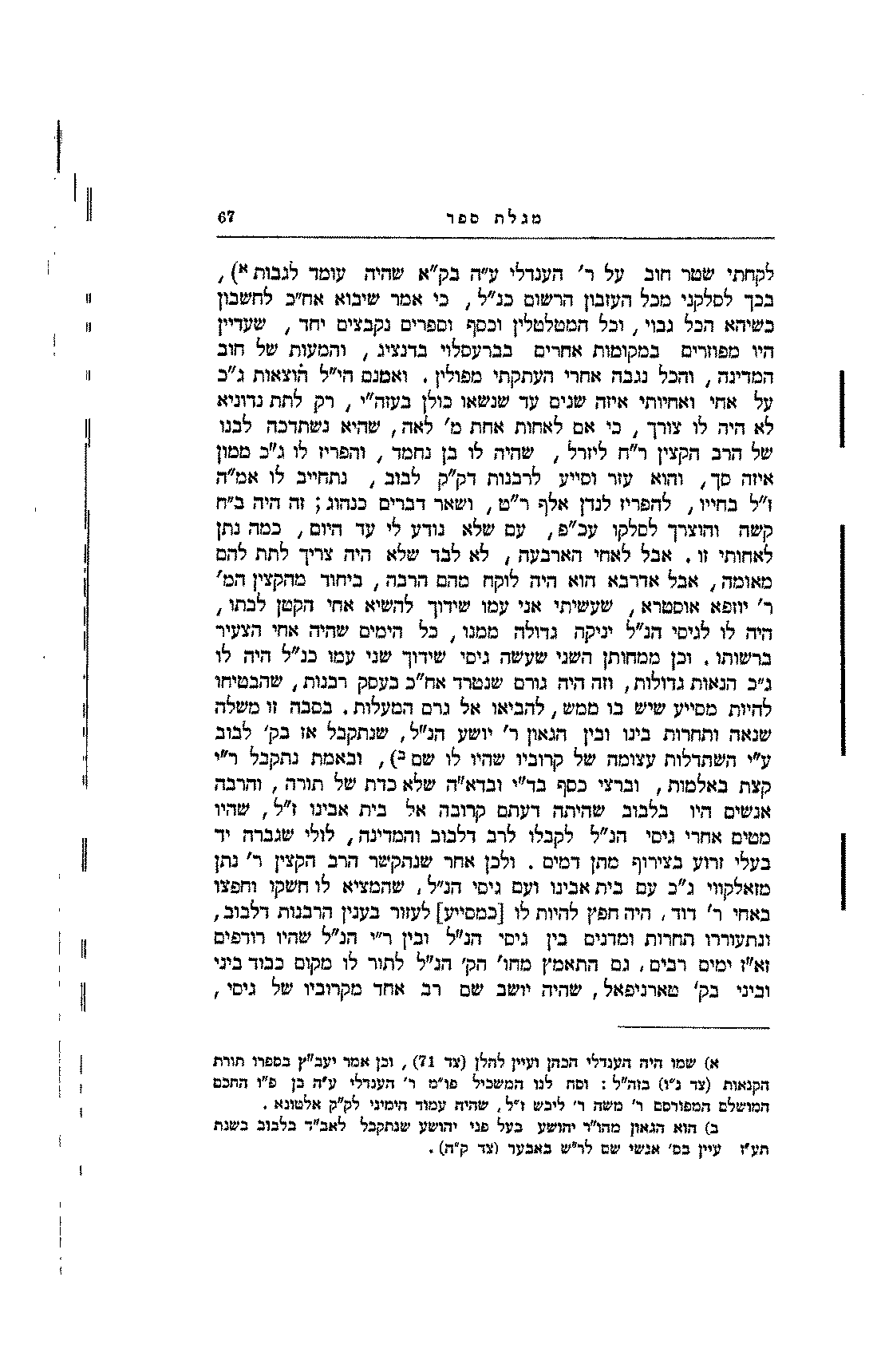
לקחתי שטר חוב על ר' הענדלי ע"ה בק"א שהיה עומד לגבות א, בכך לסלקני מכל העזבון הרשום כנ"ל, כי אמר שיבוא אח"כ לחשבון כשיהא הכל גבוי, וכל המטלטלין וכסף וספרים נקבצים יחד, שעדיין היו מפוזרים במקומות אחרים בברעסלוי בדנציג, והמעות של חוב המדינה, והכל נגבה אחרי העתקתי מפולין. ואמנם הי"ל הוצאות ג"כ על אחי ואחיותי איזה שנים עד שנשאו כולן בעזה"י, רק לתת נדוניא לא היה לו צורך, כי אם לאחות אחת מ' לאה, שהיא נשתדכה לבנו של הרב הקצין ר"ח ליזרל, שהיה לו בן נחמד, והפריז לו ג"כ ממון איזה סך, והוא עזר וסייע לרבנות דק"ק לבוב, נתחייב לו אמ"ה ז"ל בחייו, להפריז לנדן אלף ר"ט, ושאר דברים כנהוג; זה היה ב"ח קשה והוצרך לסלקו עכ"פ, עם שלא נודע לי עד היום, כמה נתן לאחותי זו. אבל לאחי הארבעה, לא לבד שלא היה צריך לתת להם מאומה, אבל אדרבא הוא היה לוקח מהם הרבה, ביחוד מהקצין המ' ר' יוזפא אוסטרא, שעשיתי אני עמו שידוך להשיא אחי הקטן לבתו, היה לו לגיסי הנ"ל יניקה גדולה ממנו, כל הימים שהיה אחי הצעיר ברשותו. וכן ממחותן השני שעשה גיסי שידוך שני עמו כנ"ל היה לו ג"כ הנאות גדולות, וזה היה גורם שנטרד אח"כ בעסק רבנות, שהבטיחו להיות מסייע שיש בו ממש, להביאו אל גרם המעלות. בסבה זו משלה שנאה ותחרות בינו ובין הגאון ר' יושע הנ"ל, שנתקבל אז בק' לבוב ע"י השתדלות עצומה של קרוביו שהיו לו שם ב, ובאמת נתקבל ר"י קצת באלמות, וברצי כסף בד"י ובדא"ה שלא כדת של תורה, והרבה אנשים היו בלבוב שהיתה דעתם קרובה אל בית אבינו ז"ל, שהיו מטים אחרי גיסי הנ"ל לקבלו לרב דלבוב והמדינה, לולי שגברה יד בעלי זרוע בצירוף מתן דמים. ולכן אחר שנתקשר הרב הקצין ר' נתן מזאלקווי ג"כ עם בית אבינו ועם גיסי הנ"ל, שהמציא לו חשקו וחפצו באחי ר' דוד, היה חפץ להיות לו ]כמסייע[ לעזור בענין הרבנות דלבוב, ונתעוררו תחרות ומדנים בין גיסי הנ"ל ובין ר"י הנ"ל שהיו רודפים זא"ז ימים רבים, גם התאמץ מחו' הק' הנ"ל לתור לו מקום כבוד ביני וביני בק' טארניפאל, שהיה יושב שם רב אחד מקרוביו של גיסי,
- [א] שמו היה הענדלי הכהן ועיין להלן (צד 71), וכן אמר יעב"ץ בספרו תורת הקנאות (צד נ"ו) בזה"ל: ומח לנו המשכיל פו"מ ר' הענדלי ע"ה בן פ"ו החכם המושלם המפורסם ר' משה ר' ליבש ז"ל, שהיה עמוד הימיני לק"ק אלטונא.
- [ב] הוא הגאון מהו"ר יהושע בעל פני יהושע שנתקבל לאב"ד בלבוב בשנת תע"ז עיין בס' אנשי שם לר"ש באבער (צד ק"ה).
Page 68 (scan 82)
and that rabbi had to be pushed out before him through the efforts of the relative R. Nathan, whose hand was strong there with the authorities. So the former rabbi was removed and my brother-in-law installed there. I heard that there was a pretext in this matter: they said that the former rabbi was not learned and not fit to sit on the seat of ruling. Be that as it may, this made him many enemies, also in the district, among members of my brother-in-law's own family, who had first been his friends and helpers. Afterwards they opposed him greatly and were among his troublers, for in their view he had taken part in an ugly business, troubling his own flesh for his own benefit. So they did not rest or keep quiet until they put him out of that rabbinate too; as he had done, so it was done to him. And they said: "Is this why we needed him in Poland? At first, that he should walk in the ways of his master, who was like his father, Ḥakham Tzvi, of saintly memory, all of whose deeds were for the sake of Heaven, who loved uprightness and justice to every man, [without] any leaning or motive, and did not seek his own honour and benefit." So many of his former friends turned into enemies, and he did not obtain the rabbinate of Lwów — especially as R. Joshua was already sitting there with great and strong power.
All the days he sat in his first rabbinate, in the holy community of Dukla, a small town, he was diligent at his studies and prospered. Afterwards he was caught up in the pursuit of the honour of rabbinates. He was received in Rzeszów, and did not sit in peace there either; afterwards he was received in Glogau, and the like. In all these places he did not gain much in knowledge of the Torah, except what the office of the rabbinate necessarily brought with it — the leading of a community and practice in ruling and judging — especially as he had in those places important scholars, judges and elders who loved him. In any case he also rolled about in sorrow many times, besides matters of controversy, for he needed great expenses and outlay and did not find enough for his needs in those places.
But in his old age he succeeded [in finding] the place and the honour of his father and master: he was received as rabbi of the Ashkenazi community in Amsterdam without opposition, and stayed there about fifteen years. There he had all the good of this world in fullness and great sufficiency — though he did not escape rivalry several times then either, because of the two old sides that were there, as said. And though they were united in his hand for a while, still several times the old hatred awoke against him, and a new one too; for in his days the city of Amsterdam was divided a second time over new cantors — first over the cantor who was afterwards cantor of Glogau, after him the cantor from Schwersenz. All these were causes of new division of hearts. Even so they could not prevail over him, for he knew how to put away the claims and complaints that his opponents found against him. He also renewed the house of study, as he had seen his master, my father, do, as said, though he could not spread Torah much, for he was weak at the end of his days and chastened with pains. When I wandered far from my home [to Amsterdam], it was after despair; even so he became like a new creature at once when I came to his house, and he was until
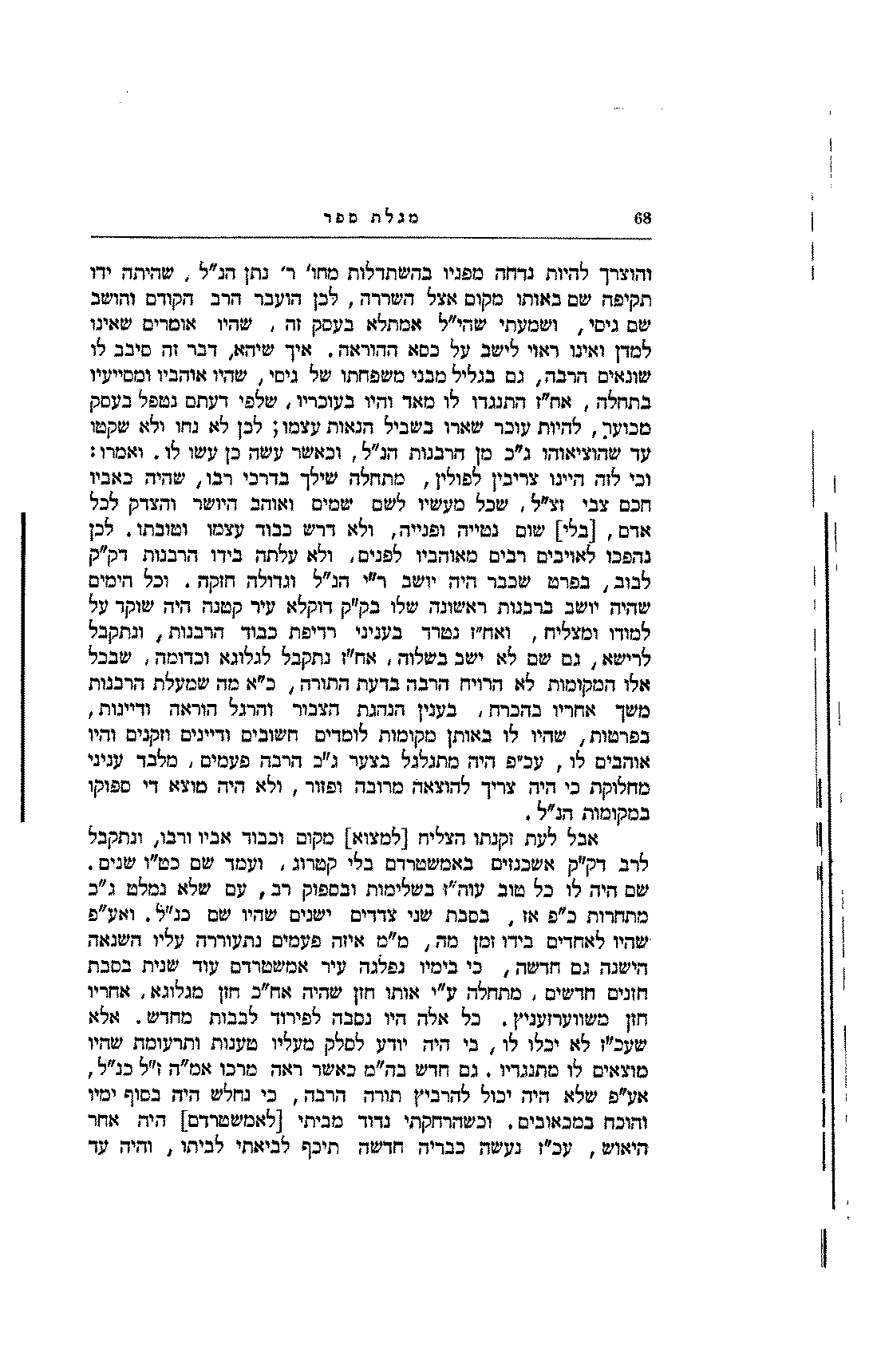
והוצרך להיות נדחה מפניו בהשתדלות מחו' ר' נתן הנ"ל, שהיתה ידו תקיפה שם באותו מקום אצל השררה, לכן הועבר הרב הקודם והושב שם גיסי, ושמעתי שהי"ל אמתלא בעסק זה, שהיו אומרים שאינו למדן ואינו ראוי לישב על כסא ההוראה. איך שיהא, דבר זה סיבב לו שונאים הרבה, גם בגליל מבני משפחתו של גיסי, שהיו אוהביו ומסייעיו בתחלה, אח"ז התנגדו לו מאד והיו בעוכריו, שלפי דעתם נטפל בעסק מכוער, להיות עוכר שארו בשביל הנאות עצמו; לכן לא נחו ולא שקטו עד שהוציאוהו ג"כ מן הרבנות הנ"ל, וכאשר עשה כן עשו לו. ואמרו: וכי לזה היינו צריכין לפולין, מתחלה שילך בדרכי רבו, שהיה כאביו חכם צבי זצ"ל, שכל מעשיו לשם שמים ואוהב היושר והצדק לכל אדם, ]בלי[ שום נטייה ופנייה, ולא דרש כבוד עצמו וטובתו. לכן נהפכו לאויבים רבים מאוהביו לפנים, ולא עלתה בידו הרבנות דק"ק לבוב, בפרט שכבר היה יושב ר"י הנ"ל וגדולה חזקה. וכל הימים שהיה יושב ברבנות ראשונה שלו בק"ק דוקלא עיר קטנה היה שוקד על למודו ומצליח, ואח"ז נטרד בעניני רדיפת כבוד הרבנות, ונתקבל לרישא, גם שם לא ישב בשלוה, אח"ז נתקבל לגלוגא וכדומה, שבכל אלו המקומות לא הרויח הרבה בדעת התורה, כ"א מה שמעלת הרבנות משך אחריו בהכרח, בענין הנהגת הצבור והרגל הוראה ודיינות, בפרטות, שהיו לו באותן מקומות לומדים חשובים ודיינים וזקנים והיו אוהבים לו, עכ"פ היה מתגלגל בצער ג"כ הרבה פעמים, מלבד עניני מחלוקת כי היה צריך להוצאה מרובה ופזור, ולא היה מוצא די ספוקו במקומות הנ"ל. אבל לעת זקנתו הצליח ]למצוא[ מקום וכבוד אביו ורבו, ונתקבל לרב דק"ק אשכנזים באמשטרדם בלי קטרוג, ועמד שם כט"ו שנים. שם היה לו כל טוב עוה"ז בשלימות ובספוק רב, עם שלא נמלט ג"כ מתחרות כ"פ אז, בסבת שני צדדים ישנים שהיו שם כנ"ל. ואע"פ שהיו לאחדים בידו זמן מה, מ"מ איזה פעמים נתעוררה עליו השנאה הישנה גם חדשה, כי בימיו נפלגה עיר אמשטרדם עוד שנית בסבת חזנים חדשים, מתחלה ע"י אותו חזן שהיה אח"כ חזן מגלוגא, אחריו חזן משווערזעניץ. כל אלה היו נסבה לפירוד לבבות מחדש. אלא שעכ"ז לא יכלו לו, כי היה יודע לסלק מעליו טענות ותרעומת שהיו מוצאים לו מתנגדיו. גם חדש בה"מ כאשר ראה מרכו אמ"ה ז"ל כנ"ל, אע"פ שלא היה יכול להרביץ תורה הרבה, כי נחלש היה בסוף ימיו והוכח במכאובים. וכשהרחקתי נדוד מביתי ]לאמשטרדם[ היה אחר היאוש, עכ"ז נעשה כבריה חדשה תיכף לביאתי לביתו, והיה עד
Page 69 (scan 83)
the year [5515 (1755), still alive] [a], about two years after the death of my sister, of blessed memory, his wife the rebbetzin [b]; and he left his abundance to his little ones, his sons and daughters, and bequeathed his seat to his eldest son. His praise must also be told: he was generous with his money, and my sister was as generous as he, doing much kindness to near and far; a book could not hold the story of her good deeds. Not for nothing did they gain what the pillars of the earth did not. In my brother-in-law was fulfilled: "greater is the serving of [Torah] than its study" (b. Berakhot 7b); for he stood and served my father like a servant, and that is what stood by him, and he merited two sons who are scholars and scribes, somewhat like their mother's brothers, all of whom are great scholars, great scribes and pious men — may the Lord be upon them and may they live. With his second daughter he married into the family of the son of the gaon R. Meir, head of the court of Prostějov, who also prospered in rabbinates in the provinces of Lithuania; they have only one son, tender and good, a scholar and scribe. She too stood him in much money. May the Lord lengthen their days and years in pleasantness.
My third sister married the grandson of R. H. Witschitz, but did not prosper at all: after some years her husband was killed on the road, in a forest, by murderers. It seems that he had to pay the debt of his grandfather and his sons, who had caused the killing of two righteous and good men, as said. He left no son or offspring, and my sister, may she live, remained a widow and alone. She would not marry another man, although several great men of the generation wanted to take her as a wife; she chose to remain a widow all her life.
These three sisters older than me my father married off in his lifetime; and me too, his first son, the fourth child, he married, as said. My little sister, Mrs. Leah, he betrothed in his lifetime to the son of the rabbi and leader R. Ḥ. R. Leizers, and he settled on her too a large sum as a dowry; he did not live to marry her off, but she married him after my father's death, and money from the estate sank into it. He did not live long, but she has from him a pleasant son, may God keep him. Afterwards she married the rabbi R. M., son of the gaon [c], head of the court in Amsterdam; from there he went to the Land of Israel. He too did not live long, but she has from him too a worthy son, may God keep him. My youngest sister, Deborah, may she live, married the grandson of the rabbi R. Joel of Ostróg; her husband's father and his son are rabbis in Volhynia. My four brothers, may they live, all married after my father's death, to daughters of leaders — except my brother R. Nathan, who married the daughter of an outstanding rabbi; and to all of them the Lord has graciously given good and worthy children, wise and understanding,
Kahana's notes
- [a] He was received as rabbi in Amsterdam in 5500 [1740] and died on the night of the seventh day of Passover 5515 [1755]; see She'erit Yisrael in Judeo-German (fols. 140b and 146b). The learned Emden left a blank space here in the manuscript, and I have added this detail.
- [b] Her name was Miriam, and she died in the month of Tammuz 5513 [1753]. See Toledot Ya'avetz (p. 51).
- [c] The name of this gaon is left out in the manuscript. Perhaps it is R. Eleazar of Brody, whose name is also left out in the manuscript earlier (see p. 47); he was rabbi in Amsterdam and went from there to the Land of Israel.
96 שנת ]תקט"ו עוד בחיים[ א, כמו שתי שנים אחר פטירת אחותי ע"ה אשתו הרבנית ב, והניח יתרו לעולליו בניו ובנותיו, ולבנו הגדול הוריש כסאו. גם צריך להודיע שבחו, שהיה ותרן בממונו, גם אחותי הנ"ל כמוהו ותרנית, גומלת חסדים הרבה לקרובים ולרחוקים, ולא יכיל ספר ספור מעשיה הטובים, ולא חנם זכו מה שלא זכו מצוקי ארץ. גם נתקיים בגיסי הנ"ל: גדולה שמושה יותר מלמודה, כי היה עומד ומשמש לאמ"ה כעבד, והיא שעמדה לו וזכה גם לשני בנים חכמים וסופרים, דומים קצת לאחי אמם, שכלם חכמים גדולים וסופרים גדולים וחסידים, ה' עליהם יחיו; בבתו השנייה נתחתן לבן הגאון ר' מאיר אב"ד דפרוסטיץ, והצליח גם כן ברבנות במדינות ליטא, ורק להם בן יחיד רך וטוב חכם וסופר, היא עמדה לו ג"כ בממון הרבה, וה' יאריך ימיהם ושנותיהם בנעימים. אחותי השלישית נשאת לנכדו של ר"ה וויטשיז, אבל לא הצליחה כלל, אחר איזה שנים נהרג בעלה בדרך ביער מן רוצחים, ונראה שהוא ע"ה היה צריך לשלם חוב זקנו ובניו, שסבבו הריגת שני אנשים צדיקים וטובים כנ"ל, ולא הניח בן וזרע, ואחותי תי' היא נשארה אלמנה וגלמודה, לא רצתה להנשא עוד לאיש, אע"פ שרצו כמה גדולי הדור לקחתה לאשה, בחרה לישב אלמנה כל ימי חייה. אלה השלשת אחיות הגדולות ממני השיא אמ"ה בחייו, גם אותי בנו הראשון רביעי לבטן עשה לי נישואין כנ"ל, ואחותי קטנה מ' לאה שדך בחייו לבנו של הרב הק' ר"ח ר' ליזרש, והפריז לה ג"כ ממון רב בנדוניא, ולא זכה להשיאה בחייו, אבל נשאת לו לאחר מות אמ"ה ז"ל, ונשקע בו ממון של העזבון הנ"ל, ולא האריך ימים, אבל יש לה ממנו בן נחמד ה"י, ואח"כ נשאת להרב ר"מ בנו של הגאון ג אב"ד באמשטרדם. משם נסע לא"י; גם זה לא האריך ימים, אבל גם ממנו ז"ל בן הגון ה"י. אחותי הצעירה דבורה תי' נשאת לנכד הרב ר' יואל מאוסטרא, גם אביו ובנו בעלה של אחותי הם רבנים בוואלין. אחי הארבעה שי' כולם נשאו נשים אחר מות אמ"ה ז"ל, ונשתדכו לבנות קצינים, חוץ מאחי מו"ה נתן שנשתדך לבת רב מופלג ולכולם חנן ה' ילדים טובים והגונים, חכמים ונבונים
- [א] נתקבל לרב באמשטרדם בשנת ת"ק ומת ליל שביעי של פסח תקט"ו עיין בס' שארית ישראל בלשון יהודית אשכנזית (דף ק"מ ע"ב ודף קמ"ו ע"ב) והח' יעב"ץ השאיר פה מקום חלק בכ"י, ואנכי הוספתי פה הפרט ההוא.
- [ב] שמה מרים ומתה בחודש תמוז שנת תקי"ג עיין תולדות יעב"ץ (צד נ"א).
- [ג] נשמט בכ"י שם הגאון הזה, ואולי הוא ר' אלעזר מבראדי שנשמט בכ"י גם שמו מקודם (עיין צד 74) והוא היה רב באמשטרדם והלך משם לא"י.
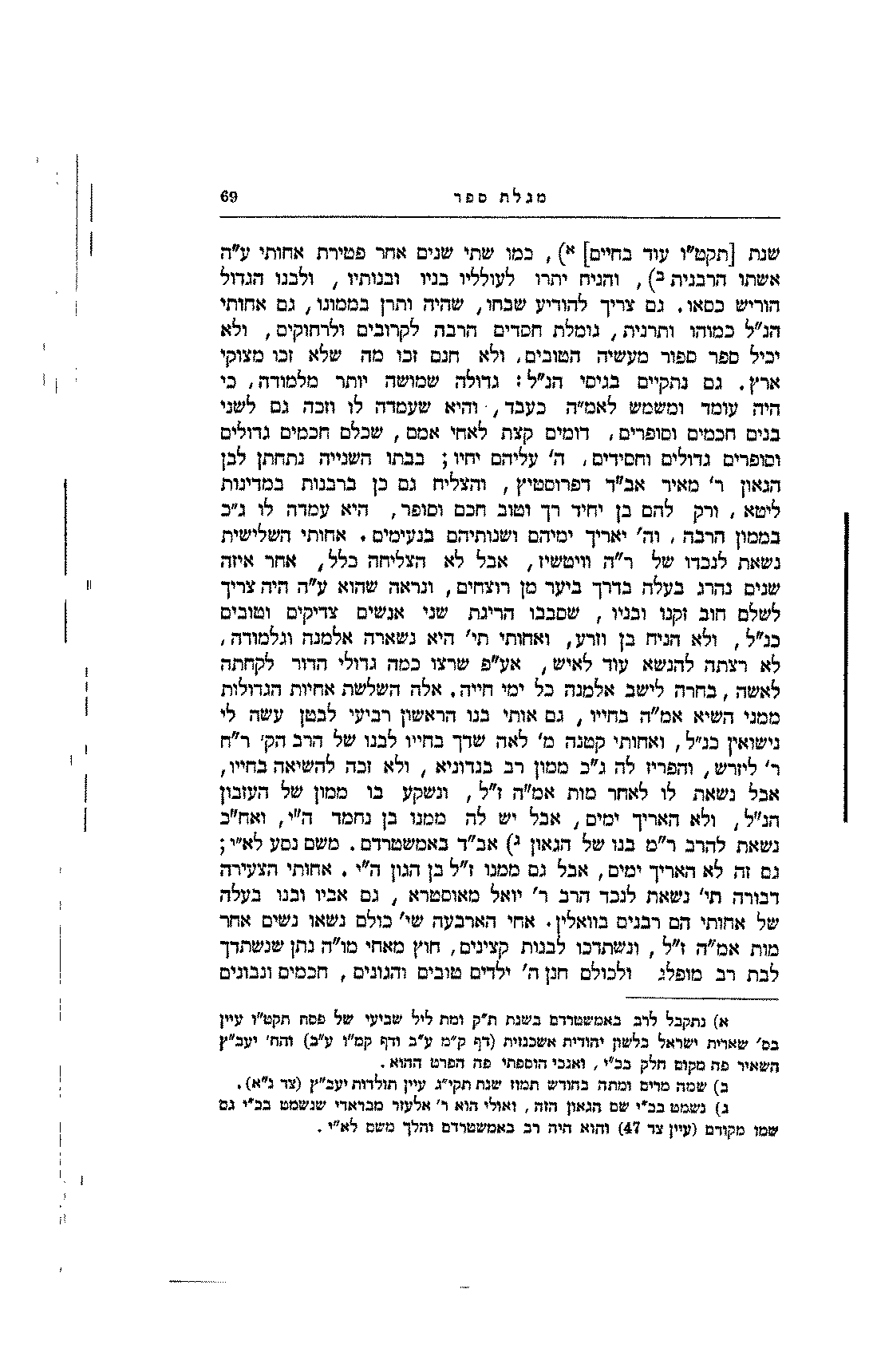
Page 70 (scan 84)
sons and sons-in-law, may God keep them; only, since I am not familiar with them and their names, I will not dwell on them.
I return now to the order of the story of my life, with God's help, to the place where I broke off above between the sections. My soul longed very much to settle in the provinces of Poland with my father's household: "how pleasant for brothers to dwell together" (Ps. 133:1). I stayed in Poland from the end of the summer of 5478 [1718], when I came there, until after Passover 5479 [1719]. In that time I wrote to my wife to come to me in Poland, for the land is good before us; above all, men of Torah find in it everything they want, both an honourable living and matches for sons and daughters — especially for families of lineage: everyone runs after them and gives money to their fathers' house. But I did not succeed, and my fitting request was not granted, as it seems. But "the counsel of the Lord, that shall stand", and the Lord meant it for good, as I will write with God's help. For she was then young in years and could not agree to this, to leave her father and mother and travel to another land; so I was forced to go back to my home — after I had been sated with many evils and troubles.
The days I spent in Lwów in the year of mourning for my father were not like these. Not even sleep was granted us all year; "we had no quiet, and trouble came" (Job 3:26). There I buried [on Monday, 3 Shevat 5479 (1719)] [a] Sarah Rebecca, of blessed memory, my mother and teacher, the pious woman, who was still young in years, about forty and a little more [b] ⟨S: a caret, pointing to the typed sheet that follows⟩. Several times her soul had already flown from her, and through our many cries it came back to her for some days after. All the household also took to their beds; I too fell ill and was like one of them, and more than them I reached the gates of death; and the Lord sent His word and healed me and restored me to my strength, "and my life was given me for a prey" (Jer. 45:5).
I left my father's house after I had made a match for my youngest brother with the daughter of the leader R. Y. of Ostróg. I also left my father's estate — money, vessels, movables, books and debts, which came to a certain sum — all of it remained in the hands of my brother-in-law the rabbi, of blessed memory, as the property of my father's house; for everything was scattered and divided in other places, as said, and I could not stay longer until everything came together to one place, to my father's house. Into my hands were given the copies of my father's book of responsa, printed in his lifetime, of which only very few had been sold. My father's household laid on me, as the eldest of the brothers, the task of taking on the travelling to "divide them in Jacob" (Gen. 49:7), to take them for distribution and spread them in Israel. Along with them they gave me bills of exchange [c]
Kahana's notes
- [a] This is left out in the manuscript; in this manuscript there is an empty space, and the gaon Emden left it so in order to write afterwards correctly the day and the year in which his mother died. See Matzevet Kodesh, part 1, tombstone 122; see there.
- [b] See above (p. 64).
- [c] (See the note on the next page.)
בנים וחתנים ה"י, רק לפי שאיני בקי בהן ובשמותיהן לא אאריך בהן. והריני חוזר לסדר דברי תולדותי בעזה"י, ולמקום שהפסקתי למעלה בין הפרקים. כי מאד חשקה נפשי להתיישב במדינות פולין עם בית אבי מה נעים שבת אחים גם יחד. ונתאחרתי בפולין מסוף קיץ תע"ח שבאתי לשם עד אחר פסח תע"ט. ובזמן הלזה כתבתי לאשתי שתבוא אצלי לפולין, כי טובה הארץ לפנינו, ביחוד בעלי תורה מוצאים בה כל חפצם, הן בענין הפרנסה בכבוד, והן בעסקי שדוכים לבנים ולבנות, בפרט אם הם משפחות מיוחסות, הכל רודפים אחריהם ונותנין מעות לבית אבותיהם. אבל לא עלתה בידי ולא נתנה לי שאלתי ההגונה כפי הנראה, אבל עצת ה' היא תקום, וה' חשבה לטובה כמש"ל בס"ד. כי היא היתה אז ילדה בשנים, ולא יכלה להסכים על זאת, לעזוב אביה ואמה וליסע אל ארץ אחרת, והוכרחתי לשוב לביתי, אחר ששב]עתי[ רעות רבות וצרות, לא זו כאותן ימים שעמדתי בלבוב בשנת אבלו של אמ"ה, גם שינה לא הונח לנו כל השנה, לא שקטנו כלנו ויבא רוגז, שם קברתי ]יום ב' ג' שבט תע"ט[ א שרה רבקה ע"ה, אמי הורתי מורתי החסידה, אשר היתה עדיין רבה בשנים, בערך ארבעים שנה ומקצת יותר ב. ואיזה פעמים כבר פרחה נשמתה ממנה, ומרוב צעקותינו חזרה פעמים באיזה ימים שלאחריו כמעט. גם כל בני בית נפלו למשכב, גם אנכי חליתי והייתי כאחד מהם ויתר עליהם הגעתי שערי מות, וה' שלח דברו וירפאני והחזירני לאיתני, והיתה לי נפשי לשלל. ועזבתי את בית אבי אחר שעשיתי עם אחי הקטן שבבולנו שידוך עם בת הק' ר"י אוסטרא. והנחתי גם עזבונו של אבא כסף וכלים ומטלטלים וספרים וחובות שעלו לסך מסוים, הכל נשאר ביד גיסי הרב הנ"ל ע"ה, ובחזקת בית אבי ז"ל, כי היה הכל מפוזר ומפורד במקומות אחרים כנ"ל, ולא יכלתי להתעכב עוד, עד שיבוא הכל אל מקום אחד לבית אבי. ובידי נמסרו הס' שו"ת חבורו של אמ"ה הנדפס בחייו, ולא נמכרו מהן רק מעט מזער, הטילו בית אבא עלי להיות גדול האחים, שאקבל עלי הטלטול לחלקם ביעקב, להיות לי לחלק ולהפיצם בישראל. ובאגב נתנו בידי שטרות ח"כ
- [א] זאת נשמט בכ"י, ובכ"י הזה יש מקום פנוי וחלק, והג' יעב"ץ עזב פה כך למען יכתוב אחרי כן אל נכון היום והשנה ובאיזה שנה מתה אמו, עיין בס' מצבת קודש ח"א סי' המצבה קב"ב ע"ש.
- [ב] עיין לעיל (צד 64).
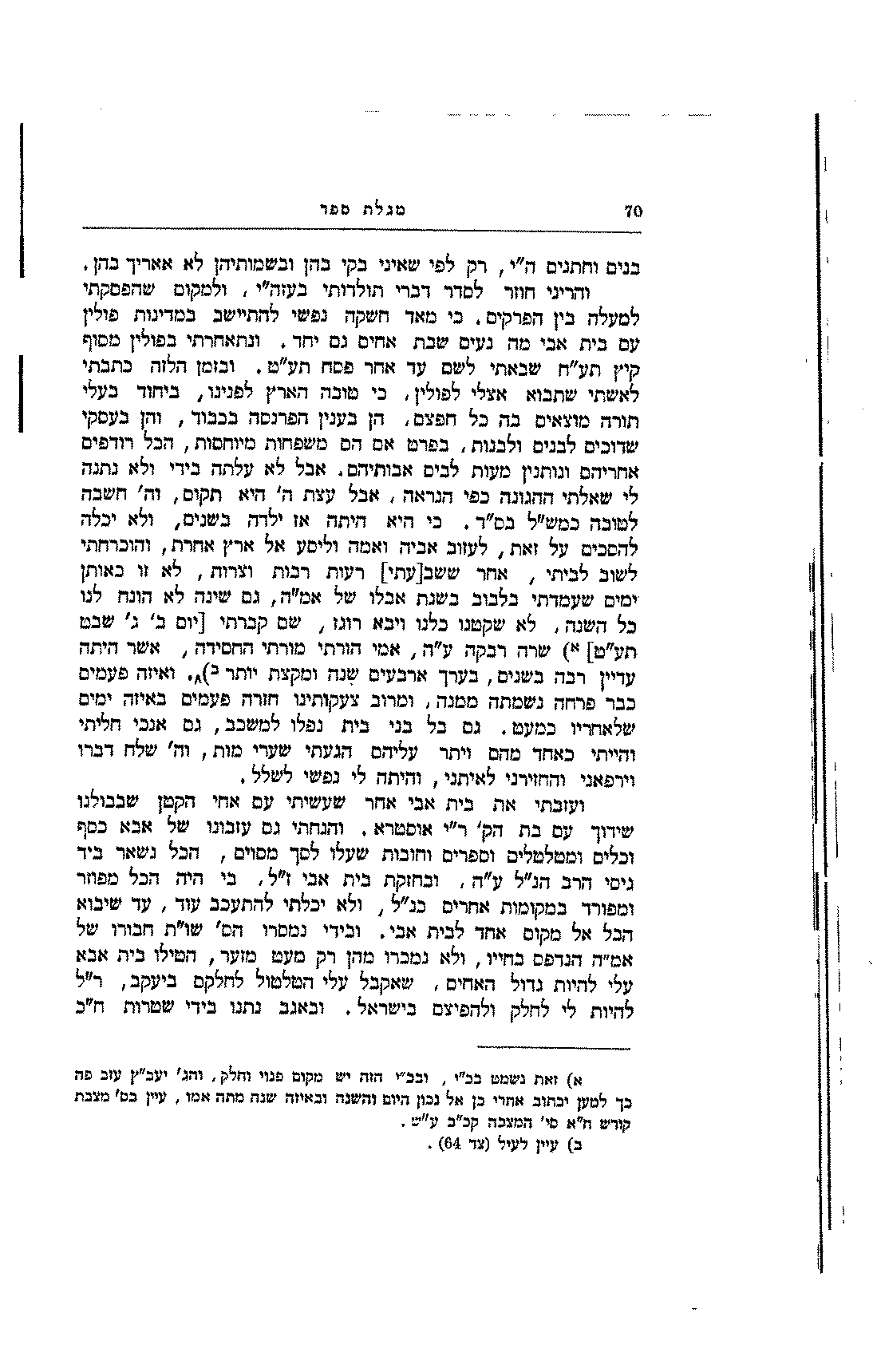
Margin readings in Scholem's copy (1)
| Printed anchor | Type (key sheet) | Mark | Reading | Certainty |
|---|---|---|---|---|
| בערך ארבעים שנה ומקצת יותר ב) ^ | V: omission | caret pointing to the typed sheet "for p. 70" (scan 85) | (see typed insert, scan 85) | sure |
Typed insert for p. 70 (scan 85)
A third typewritten sheet in Scholem's copy, headed "for p. 70". It belongs after "about forty and a little more" on p. 70, where a caret is marked in Scholem's copy, and expands on the death of Emden's mother. Kahana tells the same story more briefly on p. 64. The typescript has some damaged letters; uncertain readings are marked (?).
The great men of the land of Poland desired her. But whoever wanted to try to speak with her of matters of a match, even from afar, by roundabout words that came round of themselves, put himself in danger: she would almost strike anyone who said in her ear a word or half a word of it. From the great bitterness of her soul she wasted away in the tears of her eyes, which ran without ceasing; she refused to be comforted for the husband of her youth. Everyone, near and far, tried with cunning and effort to speak to her heart and to comfort her with her sons and daughters, in whom she saw every honour and the hope of seeing much more. For all that she did not take it to heart, and would not be comforted for the living one(?) in the Garden of Eden […], to whom she was faithful, knowing that he had not left his like; and she was great in piety, in holiness and in extra modesty. So she could not forget, "and the dove found no rest" (Gen. 8:9) in all the comforts they made for her to calm her. It was all in vain and for nothing, until she fell into a very severe illness from the greatness of her grief and sighing.
(לעמ' 70) ^ והיו חפצים בה גדולי ארץ פולין, אך מי שהיה רוצה לבחון לדבר עמה מענייני שידוך אפי' מרחוק בסבובי דברים שסבבו מעצמה והיה מסכן בנפשו, שכמעט היתה פוגעת בו במי שיאמר באזנה דבר או חצי דבר מזה. מרוב מרירות נפשה כלו בדמעות עיניה, נגרה זולגות מאין הפוגות, מאנה [ל]הנחם [ע]ל ב[ע]ל נעוריה. והכל התחכמו והתאמצו, האנשים הקרובים והרחוקים, לדבר על לבה ולנחמה בבניה ובנותיה, [ש]רואה בהם כל הכבוד ותקוה לראות עוד הרבה בהם. בכל זאת לא שתה לבה ולא קבלה תנ[חומין] מ[ע]ל החי בג"ע(?) [...] [...] להי' ולה והיא נאמנת לו בידעה שלא הניח כמותו, והיא היתה גדולה בחסידות בקדו[ש]ה ובצניעות יתרה, על כן לא יכלה לשכוח ולא מצאה היונה מנוח בכל הקורת רוח היו עושין לה להשקיטה. הכל היה בחנם ולבטלה עד שנפלה בחולי כבד מאוד מרוב היגון והאנחה.
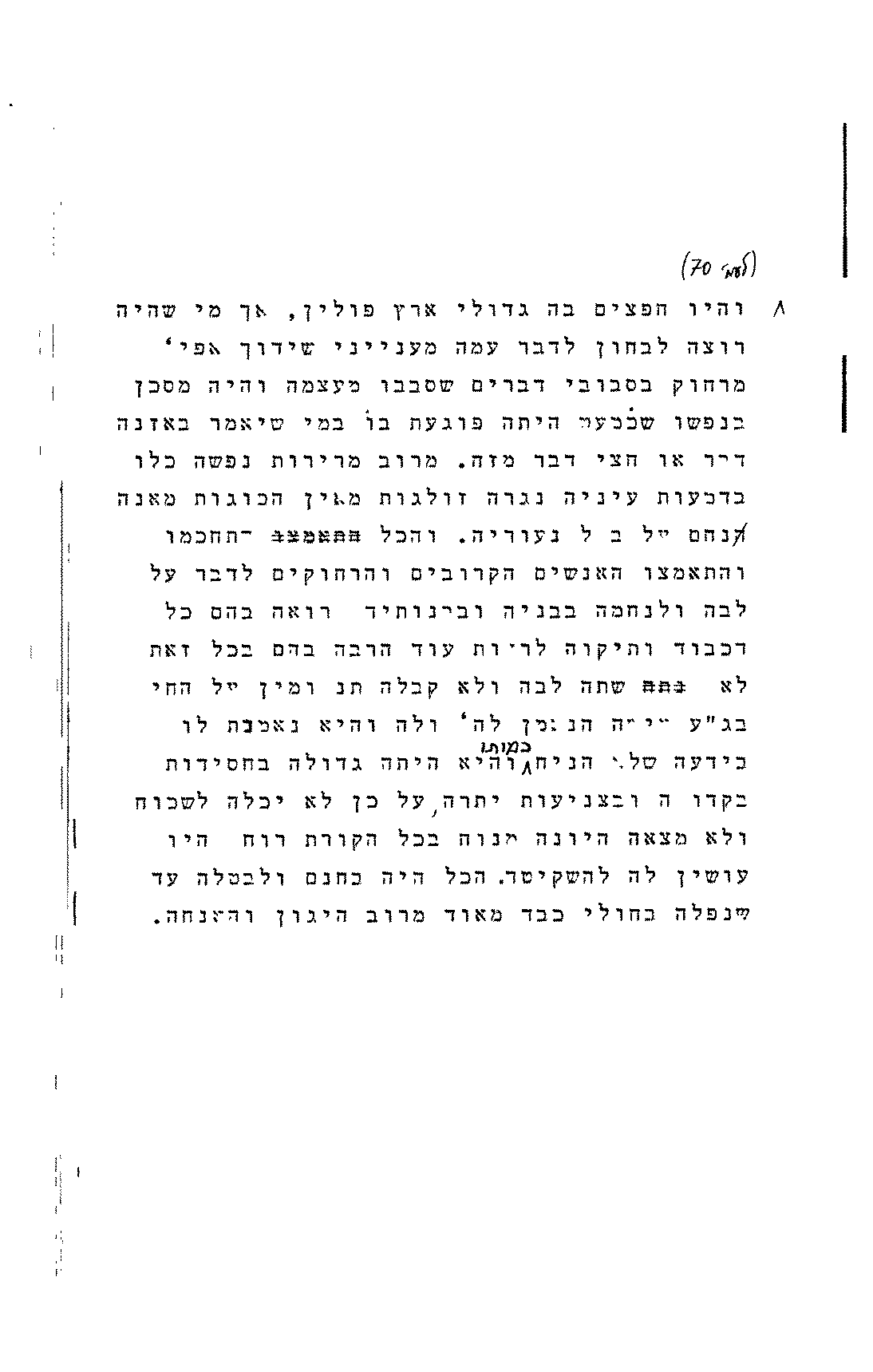
Page 71 (scan 87)
which my father, of blessed memory, held on R. H. K. and his brother and brother-in-law in Hamburg [a], which they thought I would collect. So I went on my way at the beginning of the summer of 5479 [1719], and returned in peace from my father's house to my own home in Brod, and stayed there a few days. Hardly had I settled in my house when I fell again into a hard and heavy illness; the servant I had taken from Poland and brought with me also fell very ill; and the Lord in His kindness healed me and gave me life.
When my spirit came back to me I had to think about a new journey, far, heavy and hard, in order to keep my promise to my father's household: to turn the books into money, and to gather "handfuls of blessing" from collecting the debts mentioned, to help my orphaned brothers and sisters towards fitting marriages — for they despised money that is not honest, a nature they inherited from my father and mother. I also thought that some sum would come to my share, after accounts were settled on both sides; and on that condition I took on myself to pay my father's debt, which was to Mrs. Malkah, of blessed memory, daughter of the gaon R. M., of blessed memory, who died in Altona, and who had deposited her estate with my father until her heirs grew up. So I paid a hundred Reichstaler from my own pocket, on the security of the [books] and debts I had taken into my hands.
So I set out on the road a second time, after first writing to Hamburg. I exchanged letters with the leader R. Ber Kohen, mentioned above, on whom everything depended in all the affairs there, and set out my case to him in writing about the said debt of R. H. K. [b], which at first was sure to come to collection. For the leader [R. H. K.] had grounds to collect a huge sum from the estate of Mordecai Kohen [c] ⟨S: a word, not read⟩, very great money; Mordecai Kohen had already agreed in his lifetime to give him nearly thirty thousand by compromise, and he would not, for much more was due to him. Because Mordecai Kohen was a violent man, R. H. K. could not get it out of him by Jewish law, for he was much more powerful than him in the community and the court, so that R. H. K. could not obtain just judgement in the Jewish court, to make him disgorge what he had swallowed; he was forced to bring him to judgement before His Majesty. I asked the leader R. Ber Kohen by letter by the post to tell me how the matter stood, and he answered that the affair still depended on the king's final judgement, and that when judgement came out, my debt, which was nearly a thousand Reichstaler, was sure to come into my hands.
At that time too, when the news of my father's death came to Germany and the provinces
Kahana's notes
- [a] Reh"kh abbreviates R. Hendele Kohen, mentioned above (p. 67); Ḥ"K abbreviates ḥiluf ketavim, bills of exchange, Wechselbriefe in German. See the memoirs of Glückel of Hameln (p. 80, note 1).
- [b] The abbreviation means R. Hendele Kohen, mentioned above.
- [c] In my opinion this is the man Mordecai Kohen mentioned in the memoirs of Glückel of Hameln; see there (pp. 122 and 145).
שהיו לאמ"ה ע"ה על רה"ך ואחיו וגיסם בהמבורג א, שהיו סבורים שאגבה אותן. בכן הלכתי לדרכי בתחלת קיץ תע"ט, ושבתי בשלום מבית אבי לביתי לברודא, וישבתי שם ימים אחדים. זה שבתי הבית מעט, חזרתי ונפלתי בחולי קשה וכבד, וגם המשרת שלקחתי מפולין והבאתיו עמי, והיה גם הוא נחלה מאד, וה' בחסדו החלימני והחייני, וכאשר שבה רוחי אלי, הוצרכתי לחשוב על נסיעה חדשה רחוקה כבדה וקשה, כדי לקיים הבטחתי לבית אבא, לעשות הספרים כסף, ולאסוף מלא חפני ברכה מגביית חובות הנ"ל, להיות לעזר לאחי ולאחיותי היתומים לצרכי נשואין הגונים, במאסם בממון שאינו של יושר, כטבע שנחלו מאבא ומאמ"א ז"ל. וסבור הייתי ג"כ שיגיע לחלקי ג"כ איזה דבר מסויים, אחר מצוי חשבון משני צדדים, ועל מנת כן קבלתי עלי לסלק חוב אבא, שהיה נ"ח מלכה ע"ה, בת הגאון ר"מ ע"ה שנפטרה בק"א, שהפקידה עזבונה ביד אמ"ה, עד שיגדלו יורשיה, ועל כן פרעתי עוד מכיסי מאה ר"ט, על בטחון זה של ]הספרים[ וחובות שלקחתי בידי. ובכן שמתי פעמי לדרך שנית, אחר שכתבתי תחלה להמבורג, והחלפתי אגרות עם הק' רב"ך הנ"ל. שהוא היה שהכל תלוי בו בכל העסקים ההווים שם, והרציתי דברי אליו בכתב אודות חוב הנ"ל של רה"ע א, שהיה מתחלה בטוח שיבוא לידי גיבוי. כי היה להק' מקום לגבות סך עצום מעזבונו של מרדכי כהן ב, ממון רב ועצום, וכבר התרצה בחייו לתת לו בדרך פשרה קרוב לשלשים אלף ולא אבה, כי היה מגיע לו ממנו הרבה יותר, ומחמת זה שהיה מרדכי כהן גבר אלים, ולא היה רה"ע יכול להוציא ממנו בד"י, כי היה תקיף ממנו הרבה בקהל ובד"י, באופן שלא היה יכול רה"ע להשיג משפטו צדק בד"י, להוציא בלעו מפיו, הוכרח להגישו במשפט המיר"ה, וחקרתי אני את הק' רב"ך ע"י אגרת על הפאשט, שיודיעני האיך הדבר עומד, והשיבני דבר שעדיין העסק תלוי בגמר דין המלך, וכשיצא לאור משפט, אזי החוב שלי שהיה קרוב לאלף ר"ט בטוח לבוא לידי. גם בעת ההיא בבוא שמועת פטירת אמ"ה ז"ל לאשכנז ומדינות
- [א] רה"ך, ר"ת: ר' הענדלי כהן הנזכר לעיל (צד 67); ח"כ, ר"ת: חלוף כתבים, וועקסעלבריעפֿע בלע"ז, עיין בספר זכרונות מרת גליקל האמיל (צד פ' הערה א').
- [ב] ר"ת: ר' הענדלי כהן הנזכר לעיל.
- [ג] ולדעתי הוא האיש מרדכי כהן הנזכר בספר זכרונות מרת גליקל האמיל עיין שם (צד קכ"ב וצד קמ"ה).
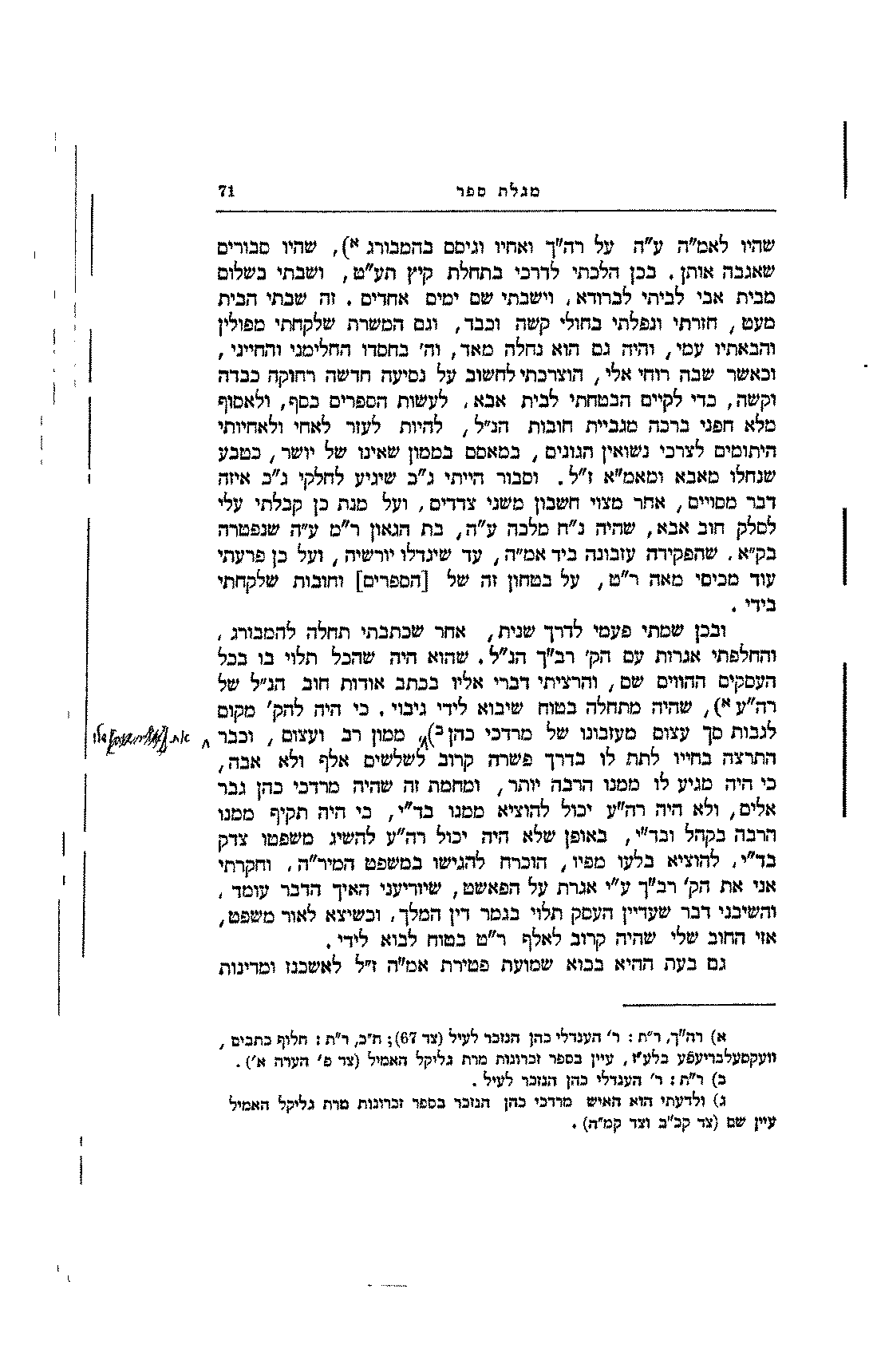
Margin readings in Scholem's copy (1)
| Printed anchor | Type (key sheet) | Mark | Reading | Certainty |
|---|---|---|---|---|
| מעזבונו של מרדכי כהן ג) ^ | V: omission | caret; one or two words in right margin | not read | not read |
Page 72 (scan 88)
nearby, at that time news came from R. Aberle London that he had become rich again with great wealth. Since he had heard of my father's death — that the righteous man's sun had set before its time, and that he had left behind young orphaned children — the said R. Aberle vowed a hundred ducats to my father's orphans, above all because the righteous man's blessing had been fulfilled in him, as said. So he instructed his sons in Hamburg to write and let us know that one of us should come to receive the money. The news reached me from a faithful friend, to whom it had been written, and he encouraged me, saying: "Harness your chariot and go up to the land of Germany, to gather a handful of quiet and to collect everything that is due to be collected — the debts my father left. For God sent you before your father's house to preserve life (Gen. 45:5); so hurry, set out on your way, do not stand still."
I went on the road on which the Lord sent me, in very hard and heavy wandering and at great expense, from my home in Brod to Hamburg, some hundred and fifty leagues by special post, all at the cost of my own purse. I did not enjoy even one meal from anyone's house on the way, except in Frankfurt an der Oder ⟨S: a word, not read⟩ and in Berlin, where I stayed some days and was a guest of relatives; and I lost on what I left there. I also took a boy servant with me.
I came to Hamburg without adversary or mishap, and lodged in the house of the leader R. Ber Kohen, of blessed memory, who received me with honour and a pleasant face. I went to him at once, before I made myself known to anyone, knowing that he was "the nail" on which everything depended, in my affairs in particular, for whose sake I had uprooted myself [from my house] and my home and run on a long road. I also knew that my father had already made peace with him; so I did this, since I had first inquired of him by letter by the post, and I could not pass him by and seek other lodging.
But when I came there, all the money of the estate of Mordecai Kohen had already been eaten up. As his wealth had come not by right, so it went to waste. Though he left at his death ninety thousand Reichstaler in cash, lying in an iron chest that was placed in his house, locked and sealed, and the community appointed men to guard it, his sons, worthless men, did not rest until they bribed the guards, let them steal the chest with all that was in it, and divided it among themselves. That wealth "perished in an evil venture": for in a few days they squandered all that great hoard, ate it up, consumed it, sent it to waste ⟨S: "to the place of filth"⟩. As it came, so it went. They were left stripped of their father's property, and some of them went to evil ways; all his sons and grandsons go begging from door to door — except one son, R. Yozpa Kohen ⟨S: "and two of his sons too are apostates, converted, among the gentiles"⟩, and except one daughter in Hamburg, and two daughters in Prague and Nikolsburg, who married men of standing. Another daughter, who had been married to two scholars and was a rebbetzin in the community of Kremsier, now goes begging from door to door in Hamburg; she is also fed by gentiles who knew her father's house, and had a great living from him; they too give her some benefit.
הסמוכות, בפרק ההוא באה השמועה מר"א לונדון, שחזר ונתעשר עושר רב, ולפי ששמע מפטירת אמ"ה, שבא שמשו של צדיק שלא בעונתו, והניח אחריו ילדים רכים יתומים, לכן נדר ר"א הנ"ל ליתמי אמ"ה מאה אדומים, ביחוד מחמת שנתקיים בו ברכת הצדיק זה כנ"ל. לכן צוה לבניו בהמבורג, שיכתבו את זאת להודיענו שיבוא אחד מאתנו לקבל המעות. והגיעה השמועה אלי מאוהב נאמן, שנכתב אליו על הדבר הזה, והרהיבני בנפשי לאמר: אסור מרכבתך, ועלה אל ארץ אשכנז, לאסוף מלא כף נחת, ולקבץ כל העומד לגבות, מה שהניח אמ"ה ז"ל חובות, כי למחיה שלחך ה' לבית אביך, בכן חושה מהרה שום לדרך פעמיך אל תעמוד. ואלך בדרך אשר שלחני ה', בטלטול קשה וכבד מאד ובפזור רב, מביתי מברודא עד המבורג, כמאה וחמשים פרסאות על פאשט מיוחד, הכל על הוצאות כיסי, ולא נהניתי אפילו סעודה משום בית אדם בדרך, זולת בפפד"ש ובברלין שנתעכבתי איזה ימים, ונתארחתי אצל קרובים, והפסדתי במה שהנחתי שם, גם נער משרת לקחתי עמי. באתי להמבורג בלי שטן ופגע רע, ונתאכסנתי בבית הק' רב"ך ע"ה, שקבל אותי בכבוד ובסבר פנים יפות, והלכתי מיד אליו בטרם הודעי לשום אדם, בידעי שהוא יתד שהכל תלוי בו בעסקים שלי בפרטות, שבשבילם עקרתי ]מביתי[ ומשכני ורהיטנא לאורחא רחיקא; גם ידעתי שכבר נתפייס עמו אמ"ה ז"ל, לכן עשיתי זאת, כאשר מתחלה חקרתי אותו בכתב אגרת על הפאשט, ולא יכולתי לעבור מעליו, ולבקש אכסניא אחרת. אכן בבואי שמה כבר נתאכל כל המעות עזבונו של מרדכי כהן הנ"ל, כאשר בא עשרו שלא במשפט כן הלך לטמיון, עם שהניח בשעת מותו תשעים אלף ר"ט מזומנים, מונחים בארגז ברזל שהונח בביתו סגורה וחתומה, והפקידו הקהל עליהם אנשים לשמרה, לא נחו בניו בני בליעל, עד ששכרו השומרים והניחום לגנוב הארגז עם כל אשר בה, וחלקוה ביניהם, ואבד העושר ההוא בענין רע, בי במעט ימים לא כביר פזרו כל ההמון העצום ההוא, אכלוהו ויכלוהו הוציאוהו לטמיון, כל עומת שבא וגו', ונשארו נקיים מנכסי אביהם, ויצאו מהם לתרבות רעה, וכל בניו ונכדיו מחזרים על הפתחים, חוץ מבן אחד ר' יוזפא כהן, וחוץ מבת אחת מהמבורג, ושתי בנותיו שבפראג ונ"ש, שנשתדכו בהם לאנשים מסוימים, גם בת אחרת שהיתה נשואה לשני ת"ח, והיתה רבנית בק' קרעמזיר, עתה היא מבקשת לחזר על הפתחים בהמבורג, ונזונת גם מן הנכרים, שהיו מכירים לבית אביה, והי"ל מחיה גדולה ממנו, הם מהנים אותה ג"כ,
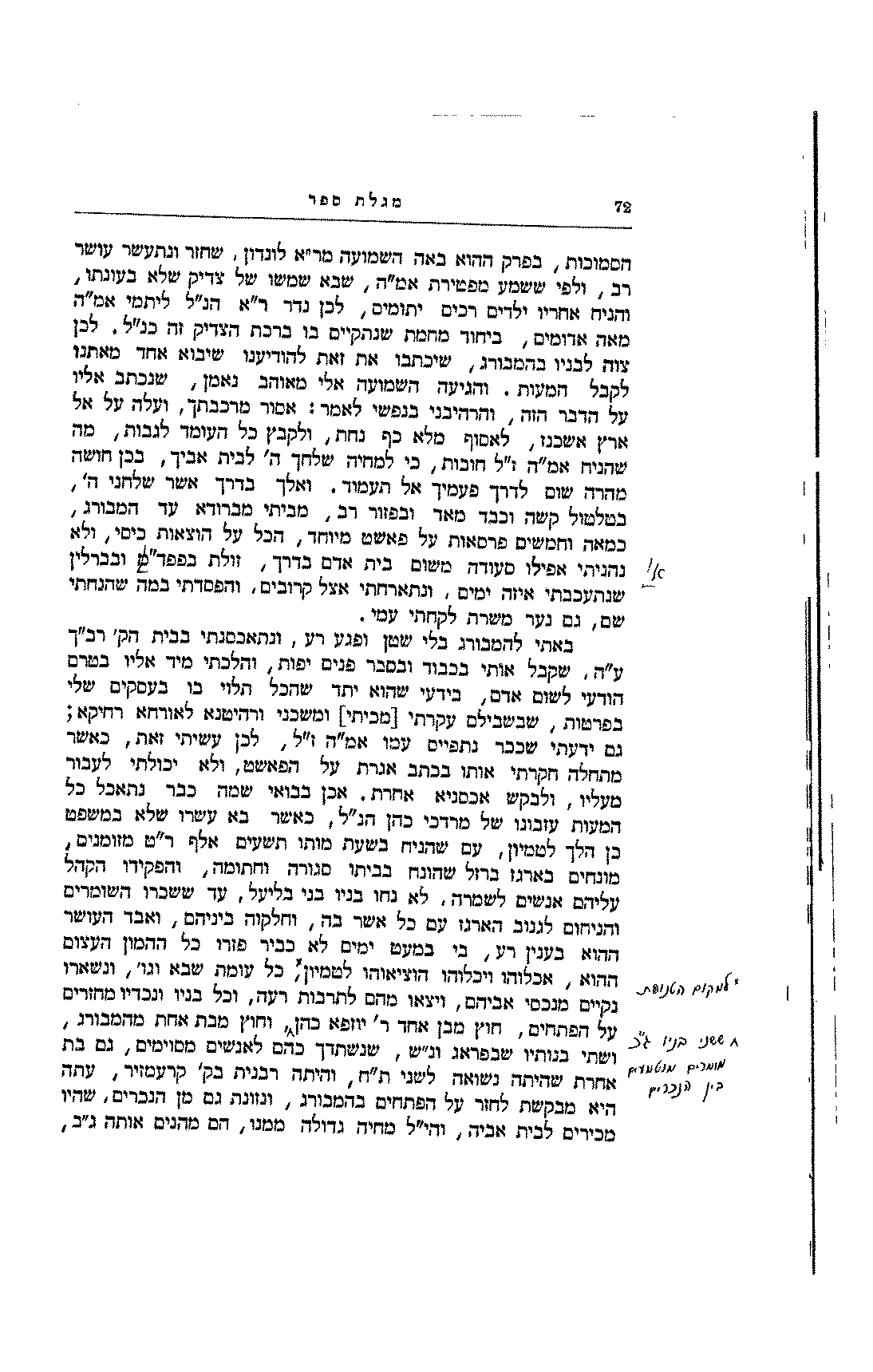
Margin readings in Scholem's copy (3)
| Printed anchor | Type (key sheet) | Mark | Reading | Certainty |
|---|---|---|---|---|
| זולת בפפד"ש ^ ובברלין | V: omission | caret; one word | not read | not read |
| אכלוהו ויכלוהו הוציאוהו לטמיון ^ | V: omission | caret; 2-word note | למקום הטנופת | fairly sure |
| חוץ מבן אחד ר' יוזפא כהן ^ | V: omission | caret; 3-line note | ששני בניו ג"כ / מומרים מושמדים / בין הנכרים | fairly sure |
Page 73 (scan 89)
And she now is the best of his sons and daughters, who bears poverty and wandering with love, as atonement for her sins; and she has worthy sons. But the rest, apart from those mentioned, almost all their sons and daughters went to evil ways ⟨S: "they are either apostates, or converted women, or thieves and abandoned whores"⟩, as most of the sons of the three brothers did: Mordecai, mentioned above, and his brother Nathan, who was nicknamed Natsh, and Green Jacob, who left behind them "a box full of reptiles" (b. Yoma 22b), full to overflowing — except a few good ones among the sons of Green Jacob. And "not for nothing did the starling go to the raven, but because it is of its kind" (b. Bava Kamma 92b): Eybeschütz — for "the rod of wickedness shall not rest" (Ps. 125:3), and so on. Therefore he had to complete that family as a vessel full of shame; and he is equal to all of them, for all of them together do not anger the Omnipresent as much as this man ⟨S: "the heretic"; "may the name of the wicked rot"⟩; and this is not the place to dwell on him [a].
Let us return to the affair of Mordecai Kohen. As he caused the house of the leader R. Hendele Kohen to lack bread through him, so it was done to his own house: almost all his sons and grandsons wander for bread — except a few who have not yet reached this level ⟨S: "and whores, a band of thieves, adulterers, changers of religion and holiness"⟩ — and their father's hope is lost. But the sons of R. Hendele [b], of a good and upright family, though they came to need other people because of that sinner, who destroyed much good, still kept their holiness: they all fear the Lord and bear the sufferings of poverty, harder than death, for the love of their Father in Heaven, and remain honoured by all. May the Lord have mercy on them among all the poor of His people, and may the sun of their success shine.
I return to the story of my affairs. When I reached Hamburg, all the estate of Mordecai Kohen was already lost and gone, and I found nothing to collect of the said debt, which was a thousand Reichstaler. As for the second debt, of eight hundred Reichstaler, in a note by R. M. N. D. with the guarantee of his brother-in-law R. Ber Kohen, of blessed memory: when I claimed it from him himself, he answered me that it was a paid bond. I did not know the history of this debt, though it was clear in the signatures, and they did not deny it; nor did I find it among the paid bonds. Only some of his words entered my ears: that it was an oversight, that they had forgotten to tear up the bond or to write a receipt on it. For one would expect that my father would not have left this debt uncollected all that time, while R. Ber Kohen was in good standing and able to pay, and was his debtor himself, being the guarantor-surety; and that my father had handed it into his hand — only it was torn at its folds from great age ⟨S: a five-line note, partly read: "the pledge of [his] father(?), which was worth more(?), and he gave no deed(?) …"⟩. Against this there are estimative claims and proofs that this debt too is good and true. First, there is a presumption about a ḥaver that he does not let out of his hand anything not in order, and we rely on it even in matters of prohibition, as they said: a ḥaver who died and left a granary full of produce — even if
Kahana's notes
- [a] The abbreviation means "and this is not the place to dwell on it".
- [b] See (p. 71); he is R. Hendele Kohen, mentioned above.
וזאת היא כעת הטובה שבבניו ובנותיו, שסובלת ענייה ומרודה באהבה לכפרת פשעיה, וי"ל בנים הגונים, אבל השאר חוץ מהנ"ל כמעט כולם בניהם ובנותיהם יצאו לתרבות רעה, כאשר הם רוב בני שלשת האחים, מרדכי הנ"ל ואחיו נתן שהיה מכונה נאטש וגרין יעקב, שהניחו אחריהם קופה של שרצים מלאה וגדושה, חוץ מעטים טובים שנמצא בבני גרין יעקב; ולא לחנם הלך זרזיר אייבשיצר אצל עורב מפני שהוא מינו, כי לא ינוח שבט הרשע וגו', ועל כן הוא היה צריך להשלים המשפחה ההיא בכלי מלא בושה, והוא שקול כנגד כולם, שכולם אינם מכעיסין למקום כמו האיש הלז ואכמ"ל ממנו א. נחזור לעניינו של מרדכי כהן. שכמו שגרם לבית הק' ר' הענדלי כהן, שנעשו חסרי לחם על ידו, כן נעשה לביתו, שכמעט שכל בניו ונכדיו נודדים ללחם, חוץ מעטים שלא הניעו עדיין למדרגה זו הנ"ל, ותקות אביהם אבדה; אבל בני רה"ע הנ"ל ב, ממשפחה טובה וישרה הנ"ל, עם שנצרכו לבריות בסבת חוטא הנ"ל שאבד טובה הרבה, מ"מ נשארו בקדושתן, כולן יראי ה', וסובלי יסורי עניות קשה ממות, באהבת אביהם שבשמים ונשארו מכובדים אצל הכל, ה' ירחם עליהם בכלל עניי עמו ויזרח שמש הצלחתם. אשוב לספור ענייני בעסקי הנ"ל. כי בהגיעי להמבורג כבר נאבד וכלה כל עזבונו של מרדכי כהן, ולא מצאתי לגבות מחוב הנ"ל שהיה אלף ר"ט; גם החוב שני של שמונה מאות ר"ט בנקי מרנ"ד וערבותו של גיסו רב"ך ע"ה כשתבעתיו בעצמו הוא ענה אותי ששטר פרוע הוא, ובאשר שזה החוב לא ידעתי מה טיבו, עם שהיה ברור בחתימות של הנ"ל, וגם הם לא הכחישוהו, גם אנכי לא מצאתיו בין שטרות פרועים, רק שנכנסו קצת דבריו של הנ"ל באזני, ששגגה הוא שנשכח לקרוע השט"ח, או למכתב עליו תברא, לפי שהדעת נוטה, שאמ"ה לא היה מניח חוב זה בלי גבייה בכל זה הזמן, עם היות רב"ך במעמד טוב בעל יכולת לשלם, והוא היה בע"ד דידיה, באשר היה ערב קבלן שמסר אמ"ה בידו, רק שקרוע בכפליו מרוב ישנו; נגד זה י"ל טענות אומדיות והוכחות, שהחוב הלז ג"כ טוב ואמתי הוא: ראשונה חזקה על חבר שאינו מוציא מת"י דבר שאינו מתוקן, וסמכינן עלה במידי דאיסורא, כמ"ש חבר שמת והניח מגורה מלאה פירות, אפילו
- [א] ר"ת: ואין כאן מקום להאריך.
- [ב] עיין (צד 71) והוא ר' הענדלי כהן הנזכר.
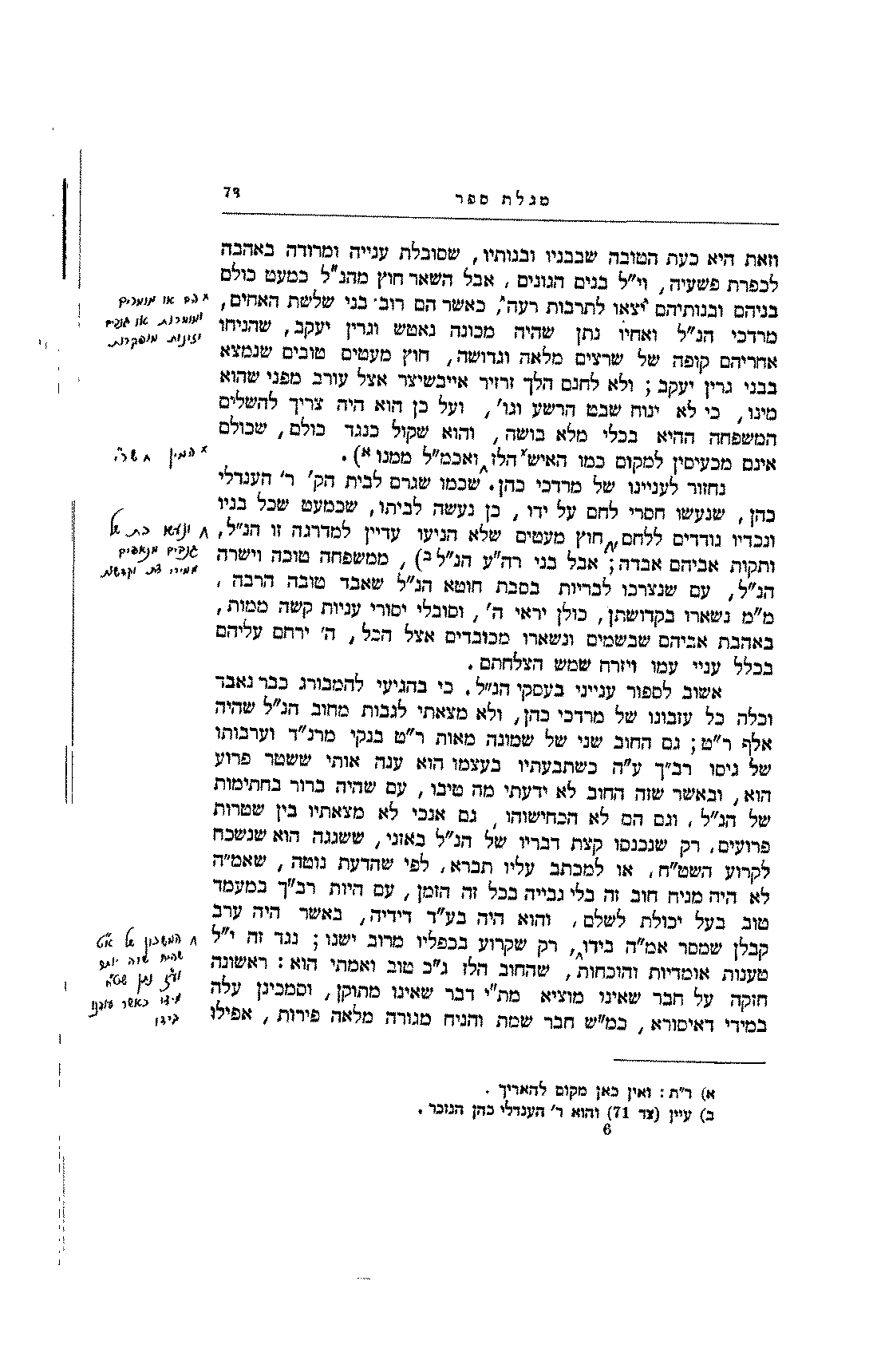
Margin readings in Scholem's copy (4)
| Printed anchor | Type (key sheet) | Mark | Reading | Certainty |
|---|---|---|---|---|
| יצאו לתרבות רעה ^, כאשר הם רוב בני שלשת האחים | V: omission | caret; 3-line note | הם או מומרים / ומומרות או גנבים / וזונות מופקרות | fairly sure |
| כמו האיש ^ הלז | V: omission | caret; short note (on Eybeschütz) | אמן(?) שר"י | fairly sure |
| חוץ מעטים שלא הגיעו עדיין למדרגה זו הנ"ל ^ | V: omission | caret; 3-line note | וזונות כת של / גנבים מנאפים / ממירי דת וקדושה | fairly sure |
| רק שקרוע בכפליו מרוב ישנו ^ | V: omission | caret; 5-line note | המשכון של אב(?) / שהיה שוה יותר(?) / ולא נתן שטר(?) / ... כאשר ... / ... | partial |
Page 74 (scan 90)
they are only a day old, they are presumed to be tithed (b. Pesaḥim 9a); all the more a great pietist, exact in his deeds, like my father, of blessed memory. Nor was there room to say that perhaps death prevented him: for according to R. Ber Kohen this bond was paid while my father was still sitting on the rabbinical seat of Amsterdam, so that there were several years between the payment and my father's death.
Harder still, R. Ber Kohen could not clarify the payment — how and when and through whom it was made — and it was not even recorded in his ledger at all; for otherwise he would have shown it. And more than this: why did he not ask for, or at least seek, a receipt from my father at the time of payment, or at least at the time he was in Hamburg for the said lawsuit, if the bonds were not ready to be torn up and handed into R. Ber Kohen's hand? R. Ber Kohen was an orderly and precise man, so it is surely a great wonder that he should be careless in such a matter, which came to a considerable sum, and not worry at all that he might be sued a second time unlawfully. So I am forced to say that there was surely some condition in the matter that was not fulfilled, or the payment was not properly completed. Even so I could not agree to have R. Ber Kohen confirmed in judgement, since he seemed a very trustworthy man, with a presumption of [honesty], and I feared a stumbling-block — although I could have sworn the oath "my father did not instruct me", and so on, or brought him to an oath; at least he would not have escaped that. I did not want to concern myself with it; I left it as a "bad bond", which we neither collect nor tear up, in case the matter is cleared up later — especially since it is not mine alone: [and the brothers' share], who will forgive it? So I could not release him or tear up the bond. It lies like this, in doubt, until Elijah comes; I did not agree to sue by force in court.
But the second debt, on the said R. Hendele: here I was "within", and it is certain to me that it is a complete debt, without doubt or hesitation, for it was made in my presence, when my father was in Hamburg for the said lawsuit. At that time he refined and cleared his accounts with R. Hendele, and my father lent him more then, beyond what he owed him before, at the time of his loss; and he gave him a new bill of exchange in the year 5475 [1715], at the time he was there, as said — on the strength of collecting it from the payments of Mordecai Kohen, which were about to be made.
Also the said vow of R. Aberle London, who instructed his sons to give my father's heirs a hundred ducats, flew in the air. Although R. Ber Kohen tried to carry it out, and wrote to R. Aberle reminding him to keep his vow, "he brought up a potsherd in his hand". Meanwhile R. Aberle's ledger was broken: for he sent his eldest son to Paris ⟨S: a short note, perhaps "a market of whores"⟩ and hung a purse on his neck — though he meant only to train him in trade, he was already marked to be called a destroyer of property — with merchandise of precious stones [a], a huge sum, and he was
Kahana's notes
- [a] The abbreviation means "precious stones".
הן ב"י הרי הן בחזקת מתוקנין, כ"ש חסיד גדול ומדקדק במעשיו כאמ"ה ז"ל. גם לא היה מקום לומר דילמא מ]ית[ה אנסיה, כי לפ"ד רב"ך נפרע שט"ח זה, בעוד אמ"ה יושב על כסא הרבנות בק"ק אמשטרדם; גמצא שכמה שנים יש בין הפרעון, ובין פטירתו של אבא. והיותר קשה מזה שרב"ך לא היה יכול לברר הפרעון, ואופן הפרעון איך ומתי וע"י מי, ואפילו בפנקס שלו לא נרשם כלל, שאלמלא כן היה מראה. ועוד יתר על זה מדוע לא שאל ולא בקש לפחות שובר מאמ"ה ז"ל בעת הפרעון, או לפחות בזמן שהיה בהמבורג על המשפט הנ"ל, אם לא היו השטרות מוכנים לקרעם ולמסרם ביד רב"ך, ורב"ך זה היה איש מסודר ומבורר, לכן ודאי זו פליאה נשגבה שיקל בענין כזה שעולה לסך מסוים, ולא יחוש לו כלל שיהא נתבע בפעם שנית שלא כדין. על כן על כרחי אני אומר, שהי' שם בודאי איזה תנאי בדבר שלא נתקיים, או לא נגמר הפרעון כראוי, מ"מ לא יכולתי להסכים לאוקמיה לרב"ך בדינא, לפי שהיה נראה אדם נאמן מאד ובחזקת ]כשר[ ויראתי ממכשול, אע"פ שהייתי יכול לישבע שבועת שלא פקדני אבא וכו', או להביאו לידי שבועה, לפחות לא היה נמלט מזה. ולא רציתי לטפל עצמי בכך, והנחתיו כשטרא ריעא דלא מגבינן ביה ולא קרענן ליה, שמא יתברר הדבר עוד, וביחוד שאינו שלי לבדי וחלק האחים[ מי ימחול, לכן לא יכולתי לפטרו ולא לקרוע השטר, והרי הוא מונח כך, ומוטל בספק עד שיבוא אליהו, לא הסכמתי לתבוע בכח בב"ד. אך החוב השני שעל רה"ע הנ"ל, בזה הייתי מבפנים וברי לי שהוא חוב גמור בלי פקפוק והרהור, שהוא נעשה בפני, בהיות אמ"ה ז"ל בהמבורג על המשפט הנ"ל, ובאותו פרק צרף וזקק חשבונותיו עם רה"ע, והוסיף אמ"ה ז"ל להלוותו אז יתר על מה שהיה חייב לו מקודם בעת חסרונו, ונתן לו ח"כ חדש שנת תע"ה, בזמן שהיה שם כנ"ל על סמך שיגבה מהתשלומין של מרדכי כהן, שהיה קרוב לצאת אל הפועל; גם הנדר הנ"ל של ר"א לונדון, שצוה לבניו לתת ליורשי אמ"ה מאה הגריים פרח באויר, עם היות שרב"ך השתדל להוציא הדבר אל הפועל, וכתב לר"א והזכירו לקיים נדרו, העלה חרם בידו, ובתוך כך נתבקר פנקס של ר"א, כי שלח בנו הגדול לפאריז ותלה לו כיס בצווארו, עם שלא כיון רק לחנכו במו"מ, אבל כבר היה מועד להיות נקרא מפסיד נכסי - עם סחורות א"ט א סך עצום ורב, והיה
- [א] ר"ת: אבנים טובות.
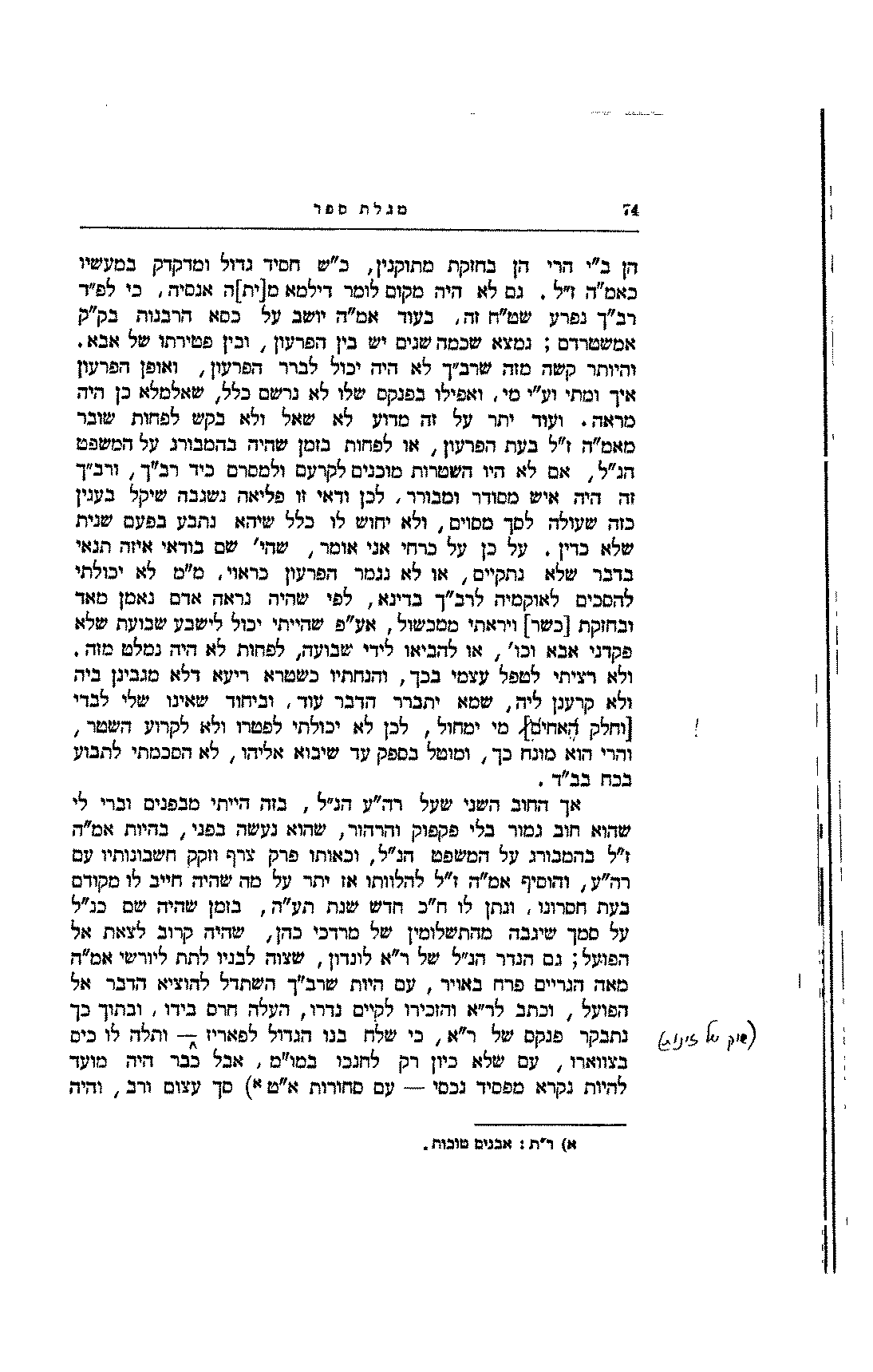
Margin readings in Scholem's copy (1)
| Printed anchor | Type (key sheet) | Mark | Reading | Certainty |
|---|---|---|---|---|
| כי שלח בנו הגדול לפאריז ^ | V: omission | caret; short note in parentheses | (שוק של זונות(?)) | uncertain |
Page 75 (scan 91)
the son was "as the cold of snow in the time of harvest" (Prov. 25:13); he was to those who sent him an envoy of ruin. He went and came back with nothing, and lost all that his father had given into his hand. For the hundred thousand handed to him ⟨S: a three-line note, partly read: "in the house … as a harlot's hire …"⟩ he brought back "the price of a dog": he brought home a little smooth hairless dog in exchange for the said merchandise. And the very great wealth that R. Aberle had earned in the previous years [a] through the righteous man's blessing, as I wrote, he lost entirely "in an evil venture" when he delayed his vow; he went back to his former state and was left stripped of his property. So I came out of this affair too disappointed, as I will write below, without being able to get even enough for the expenses of the road.
Only the parnassim of the Three Communities took from me a certain number of copies of my father's responsa, which I had in my hands along the way, as said. Apart from this I would take nothing from anyone. Even when the leader R. Ber Kohen, of blessed memory, sent me a gift with honour while I was lodging in his house at Purim, I did not accept it and sent the messenger back. Nor did I send copies of the book as gifts to individual honoured leaders, as authors and printers of books do in this time, sending copies as presents so that a fine portion will come back to them. I guarded myself from this all along that long road. Although the land of Germany was then at the height of wealth, and I could have gained riches through my father's books had I acted in that way, I was careful about it as much as I could, not to burden anyone; only to whoever wanted them of his own free will. In this way I sold very little. Even in Hamburg I could have placed many more of the books, had I not been concerned for the honour of the Torah, which ought not to go round to lodgings that are not its own; "and my exaltation is our exaltation" [b] ⟨S: a word, not read⟩ — although in truth many loved me and remembered my fathers as well.
At that time my father's great friend, the leader Joel Schwab, became my enemy without cause, because I had taken my lodging with R. Ber Kohen, who was his great enemy, as said. Although to my face he showed no hatred or enmity, only love and affection, he kept the matter in his heart and bore me a strong grudge and much hatred for several years, as I will write, with God's help. Also, in R. Ber Kohen's house a precious watch [c] of mine was lost or stolen.
From Hamburg I went to Hanover, and took with me some copies of my father's responsa. I lodged with Gumpel Hanover, who with his brother R. A. were in those days still, as it seemed, at the height of standing and honour. I stayed there a few days; they treated me with every honour and cleared a special, honoured room for me. In those days Gumpel's brother,
Kahana's notes
- [a] See earlier (p. 50).
- [b] See b. Kiddushin 42b, "they divided in the increase".
- [c] That is, a clock.
הבן כצנת שלג ביום קציר, היה לשולחיו ציר וחבל, הלך הלך ובא בהבל, ואבד כל מה שנתן אביו בידו, בעד מאה אלף שנמסר בידו, הוציא במחיר כלב, כי הביא בידו כלב קטן חלק בלי שערות תמורת הסחורה הנ"ל, והעשירות המופלג שהרויח ר"א בשנים הקודמות כנ"ל א בברכתו של צדיק כמש"ל את הכל אבד בענין רע כשאיחר נדרו, וחזר למעמדו הקודם ויצא נקי מנכסיו. על כן יצאתי גם מעסק זה בפחי נפש, כמ"ש להלן בלי שידעתי אפילו להשיג די להוצאות הדרך. רק פו"מ דג"ק לקחו ממני איזה סך ספרי שו"ת של אמ"ה, שהיו בידי אגב אורחא כנ"ל, וזולת זה לא רציתי לקבל מאומה מב"א, אפילו ששלח הק' רב"ך ע"ה מתנה בכבוד בהיותי מתאכסן בביתו בפורים, לא קבלתי והחזרתי השליח לאחור, וגם לא שלחתי מן הספרים כיבודים ליחידים קצינים נכבדים, כדרך מחברים ומדפיסים ספרים בזמן הזה, ששולחים מהם מתנות ע"מ להחזיר להם מנה יפה, נשמרתי מזה בכל הדרך הרחוק ההוא, ואף שהיתה ארץ אשכנז בעת ההיא ברום המעלה בענין העושר, והייתי יכול להשיג עשירות ע"י הספרים ]של[ אמ"ה ז"ל, אם הייתי נוהג בהם מנהג הנ"ל, אך נזהרתי מזה בכל היכולת, שלא להכביד על אדם, רק באשר יחפוץ בהם מרצון נפשו, ועד"ז מכרתי מעט מזער, אפילו בהמבורג הייתי יכול להניח עוד הרבה מהספרים, אם לא הייתי חושש לכבודה של תורה, שאינה מהראוי שתחזיר על האכסניא שאינה שלה, ועילויא דידי היינו עלויא ב, עם שבאמת רבים היו אוהבים אותי וזוכרים ג"כ אבותי. ובאותו פרק נעשה לי שונא חנם, האוהב הגדול שהיה לאמ"ה ז"ל, הוא הק' יואל שוא, מפני שלקחתי אכסניא שלי אצל רב"ך, שהיה שונאו העצום כנ"ל, ואע"פ שבאמת בפני לא היה מראה שום שנאה ואיבה רק אהבה וחבה, שמר הדבר בלבו ונטר לי איבה עזה ומשטמה רבה כמה שנים כמש"ל בס"ד. גם בביתו של רב"ך נאבדה לי או נגנבה ממני אורלוגין ג יקרה. מהמבורג נסעתי להנובר, ולקחתי עמי איזה מס' שו"ת אמ"ה ז"ל, ונתאכסנתי אצל גומפל הנובר, שהוא ואחיו ר"א עדיין היו באותן הימים ברום המעלה והכבוד כפי הנראה וישבתי שם ימים אחדים, ונהגו בי כל הכבוד ופנו לי חדר מיוחד מכובד. באותן הימים עשה אחיו של
- [א] עיין מקודם (צד 50).
- [ב] עיין בגמ' קידושין (דף מ"ב ע"ב) פלוג בעילויא.
- [ג] הוא מורה שעות.
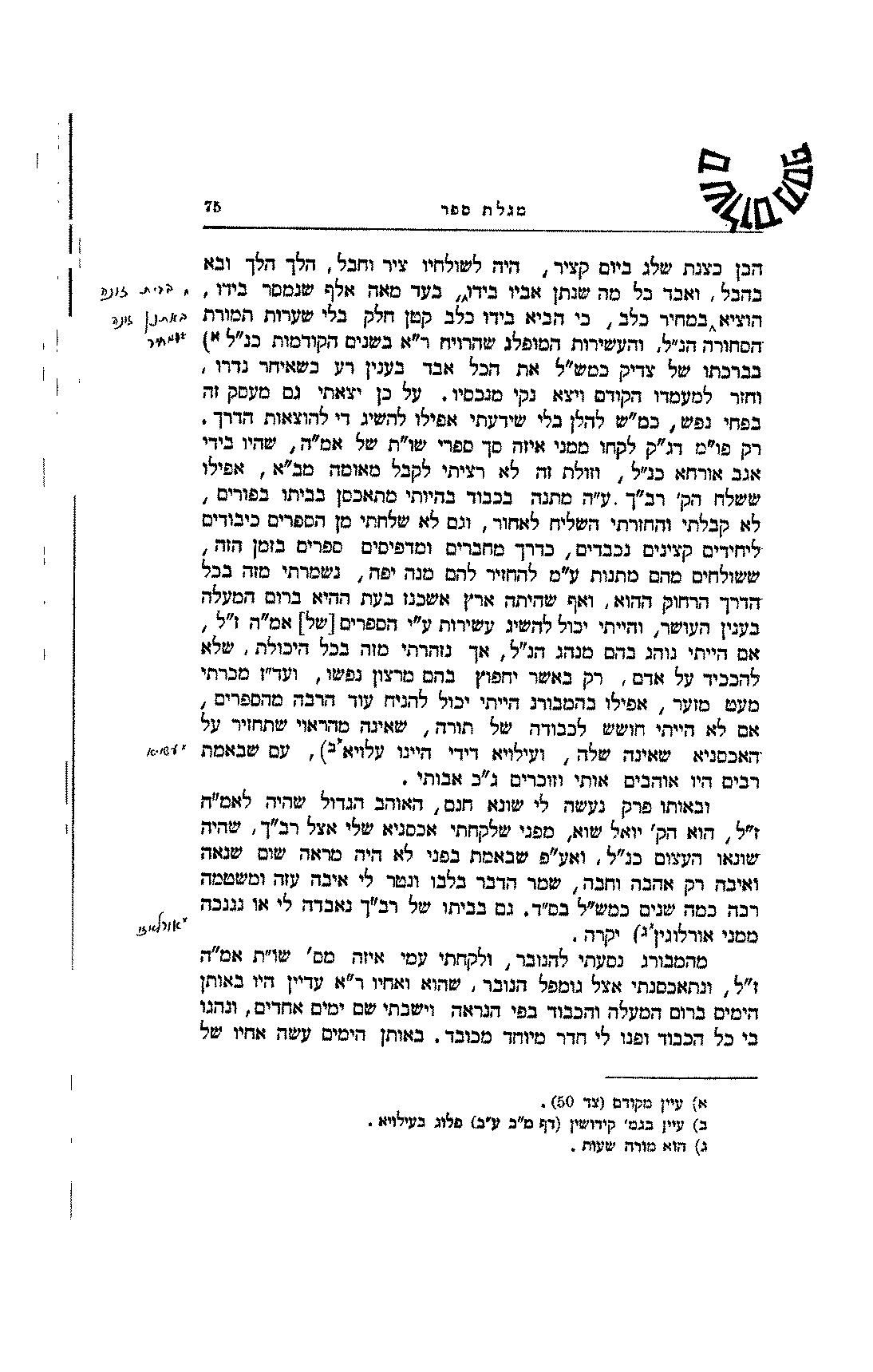
Margin readings in Scholem's copy (3)
| Printed anchor | Type (key sheet) | Mark | Reading | Certainty |
|---|---|---|---|---|
| ואבד כל מה שנתן אביו בידו ^, בעד מאה אלף | V: omission | caret; 3-line note | בבית ... / באתנן זו[נה] / ואחר(?) (cut at the page edge) | partial |
| ועילויא דידי היינו עלויא ב) ^ | V: omission | caret; one word | not read | not read |
| נאבדה לי או נגנבה ממני ^ אורלוגין | V: omission | caret; one word | אורלוגין | fairly sure |
Page 76 (scan 92)
the leader R. A., made a circumcision feast like a royal table; and immediately afterwards, in that same week, these brothers went into a great and enormous bankruptcy. They were left owing to lords ⟨S: perhaps "of the uncircumcised"⟩ and councillors; they lost the great wealth they had inherited from their father and consumed that of others — a huge and terrible sum they lost "in an evil venture", in fulfilling evil desires. They hardly engaged in the settled ways of the world; they left all their business in the hands of their servants, scribes and officials, many of whom grew rich from them, while they went to waste. They had to flee by night. The next day the matter became known, and everything left in their house was sealed with the seal of the king and the courts. Had I not hurried to leave the house before the court officers came to seal everything found after their flight, all I had, and my chest, would have been taken too as their property. I had to hurry to escape for my life and take a place to sleep at a lodging with a gentile ⟨S: "an uncircumcised man"⟩. In truth, before they left they had told the official they left in their house to give me six Reichstaler, and that man wanted to carry out his errand; and I would not accept anything.
From there I went by post to the holy community of Frankfurt am Main, which was then at the very height of its standing, the crown of all the communities of Germany in wealth and honour. But before I got there, while I was still on the road — and when I arrived I found it — it [had then] been burned: most of the Jewish street lay under the ashes [a]. Here too I did nothing, especially as I did not want to make "a spade" of the book in my hands, sending it as a gift to leaders, as is customary, as said. My relative the rabbi R. Y. Katz [b], who was then head of the court there, complained of me over this; he wanted my good, that the toil of my journey should not be in vain. The community of Frankfurt excused themselves that they could not take books from me at such a time, when the street was burned and they [could not] lay a burden on their individuals — though in truth they remained exceedingly rich and would not have sent me away empty: had I sent them the book, they would have given its price with a generous and willing eye, above all for the sake of my father, whose name was great among them and whose book too was very highly regarded by them. The said rabbi would also have exerted himself to do what he could on his side, had I listened to his advice to behave as the authors of books do in their time. But the words did not enter my ears, and I could not bend my mind to accept the rabbi's opinion. He almost quarrelled with me, saying: "How can it be
Kahana's notes
- [a] In 5471 [1711], on 24 Tevet, a fire went out from the house of the rabbi Naftali Kohen and consumed several hundred houses in the Jewish street; nothing was left except one, at the cemetery. See Ammudei ha-Avodah, part 2 (p. 282b).
- [b] He is the rabbi, the gaon R. Jacob Katz, who took the Sabbatian writings from their emissary Moses Meir in 5485 [1725]. See Torat ha-Kena'ot (p. 74), Lemberg printing.
גומפל הק' ר"א סעודת ברית כשלחן מלכים, ומיד אח"ז באותו שבוע היו האחים הללו לפליטה גדולה ועצומה, שנשארו חייבים לשררות ויועצים, אבדו העושר הגדול שירשו מאביהם, וכילו את של אחרים, סך עצום ונורא הפסידו בענין רע, במילוי תאות רעות, כמעט לא עסקו בישובו של עולם, והניחו כל עסקי מו"מ שלהם ביד משרתיהם סופריהם ופקידיהם רבים שנתעשרו מהם, והם הלכו לטמיון, והוצרכו לברוח בלילה, וביום המחרת נודע הדבר, נחתם כל אשר נשאר בביתם בטבעת המלך וערכאות, לולי שמהרתי לצאת מן הבית, בטרם באו עבדי הערכאות לחתום כל הנמצא אחר בריחתם, אזי היה נלקח גם כל אשר לי וארגז שלי בחזקת נכסיהם, והוצרכתי למהר להמלט על נפשי לקחת מקום לינה באושפיזא אצל נכרי, ובאמת צוו קודם הליכתם לפקידם שהניחו בביתם, שיתן לי ששה ר"ט, וכן רצה האיש ההוא לקיים שליחותו, ולא אביתי לקבל מאומה. משם הלכתי על הפאשט לק"ק פפד"מ, שהיתה אז בתכלית רום המעלה, כתר לכל קהלות אשכנז בעושר ובכבוד. אך טרם בואי לשם עודני על הדרך ובהגיעי לשם מצאתי ]מאז[ היתה לשריפה, רוב הרחוב של היהודים היה מונח תחת האפר א. ולא עשיתי גם פה מאומה, ביחוד שלא רציתי לעשות קרדום מהספר שבידי, לשלחו לדורון לקצינים כנהוג וכנ"ל. ועד"ז נתרעם עלי מחו' הרב מוהר"י כ"ץ ז"ל ב, שהיה אב"ד שם בעת ההיא, שהיה רוצה בתקנתי שלא תהא יגיעת נסיעתי לריק. וקהל פ"פ התנצלו שלא יכלו ליקח ממני ספרים לעת כזאת שהרחוב שרופה, ואינם ]יכולים[ להטיל מעמם על יחידיהם, עם שבאמת מ"מ נשארו עשירים מופלגים ולא היו משיבים פני ריקם, אם הייתי שולח הספר אליהם, היו נותנים דמי תמורתו בעין יפה ונדיבה, ביחוד בשביל אבא ז"ל, שהיה שמו גדול אצלם וספרו ג"כ חשוב מאד בעיניהם. והרב הנ"ל היה משתדל ג"כ לעשות מה שבידו מצדו, אם הייתי שומע לעצתו להתנהג כדרך מחברי ס' בזמנם. אמנם לא נכנסו הדברים באזני, ולא יכולתי לכוף דעתי בזה לקבל דעתו של הרב הנ"ל, וכמעט עשה מריבה עמי באמרו אלי: איך יתכן
- [א] בשנת תע"א בכ"ד טבת יצא אש מבית הרב נפתלי כהן ותאכל כמה מאות בתים ברחוב היהודים ולא נותר כי אם אחד בבית הקברות, עיין עמודי העבודה ח"ב (צד רפ"ב).
- [ב] הוא הרב הגאון מו"ה יעקב כ"ץ שלקח הכתבים של ש"צ מאת המשולח שלהם משה מאיר בשנת תפ"ה, עיין בס' תה"ק (צד ע"ד) דפוס לבוב.
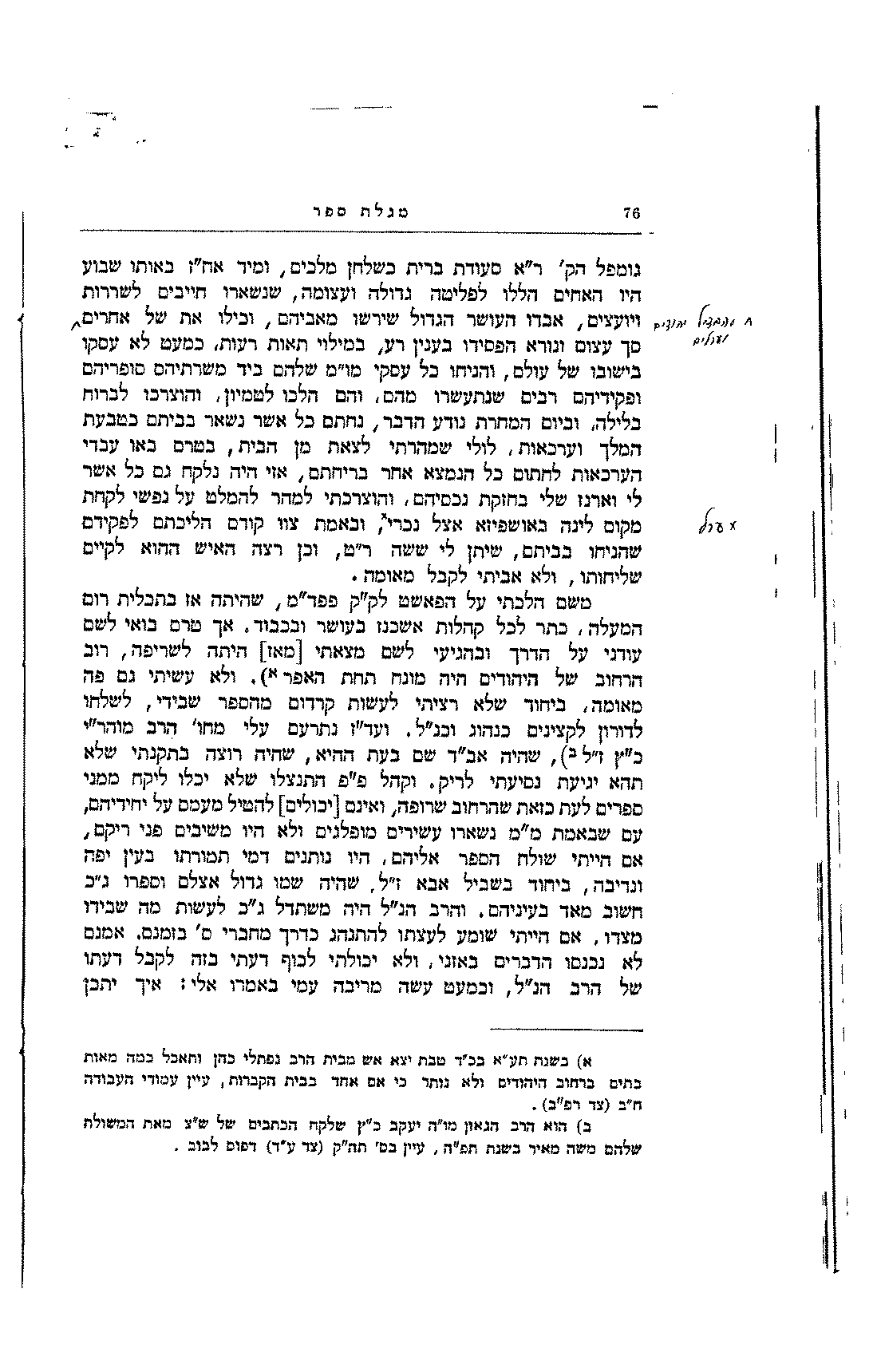
Margin readings in Scholem's copy (2)
| Printed anchor | Type (key sheet) | Mark | Reading | Certainty |
|---|---|---|---|---|
| שנשארו חייבים לשררות ^ ויועצים | V: omission | caret; 2-word note (Kraken: מערלים) | מהערלים(?) ונכרים(?) | uncertain |
| באושפיזא אצל נכרי x | X: substitution | x mark; one word | ערל | fairly sure |
Page 77 (scan 93)
that I should seek or hope that leaders would come to me, or send their messengers to take the book from my hand" (especially as I also kept it at a high price: the price my father had fixed for it I would not change, not even lower it for the rich), "which is not the custom in these times and in these lands?" He brought me proof from several great men who, though they themselves were the authors, were forced to come to this practice, for there is no other way — all the more since I was not the author of the book myself, was still a tender child in years, and my reputation had not gone out in the world, so that it could not be imagined any other way. "If so, it would have been better for you to stay at home and not take on the yoke of a heavy and hard journey on so long a road, and spend so much." And many more things like these he said, to make the matter acceptable to me. But I stood by my first decision; all the winds in the world did not move me a hair's breadth; whatever might happen to me, I could not go back on my mind. Even so, some men of standing among the leaders and the students of Torah sent and took the book from my hand and bought it for full money, about fifteen pieces.
So I set my aim on returning home, for I saw that I was not suited to this. They advised me to turn from there to the holy communities of Mannheim and Metz and their surroundings, which were great in standing and wealth, and promised me that on that road I would gather "handfuls of good"; but their words did not enter my ears. I saw and found that "the way is perverse before me" (Num. 22:32): everywhere I came, people were busy with their own troubles and mourning. So I decided to turn back on my steps with empty hands; I said, "neither them nor their reward" (b. Berakhot 5b).
At the time when my face was already set towards home, news came from London how Mordecai Hamburger [a] had come home from the lands across the sea, East India, where he had stayed about ten years. He had gone there empty-handed, poor and needy, leaving his house empty, with a wife and nine children and her belly between her teeth. His coming made a great stir, a great thing the like of which had never been heard: that a man advanced in years should go from our cold climate and travel by sea nearly a year's journey to that hot climate, stay there so long, and prosper so much that he earned very great wealth, and come home alive with all his great property, full of every good, after he had gone into it lacking. Not one of his sons and children was lost in that time; he even gained in them — he had left nine and found ten sons and daughters, all healthy and whole. He brought with him a treasure of precious stones [b], and above all, among them, one large diamond of great value, the like of which there was not in all the land,
Kahana's notes
- [a] R. Mordecai Hamburger was the brother of R. Hendele, who owed Emden a thousand Reichstaler, and also the brother of R. N. D., who owed him eight hundred Reichstaler; see below.
- [b] The abbreviation means "of precious stones".
שאבק]ש[ או אקוה שיבואו קצינים אלי, או ישלחו שלוחיהם לקחת הספר מידי (בפרטות שהייתי מחזיק אותו ביוקר ג"כ, המקח אשר קצב לו אמ"ה ז"ל לא רציתי לשנות לפחות מן המקח לעשירים), מה שאינו נהוג בעתים הללו ובמדינות אלו. והביא לי ראיה מכמה גדולים, עם שהיו הם המוכרים עצמם, הוכרחו לבוא לידי מדה זו דלא סגי בלא"ה, כ"ש שאני אינני המחבר בה"ס עצמו ועודני ילד רך בשנים ולא יצא טבעי בעולם, שלא יעלה על הדעת באופן אחר, ואם כן היה מוטב לי לעמוד בביתי, ולא לקבל עלי עול נסיעה וטלטול כבד וקשה בדרך רחוקה כזו, ולעשות הוצאה מרובה כל כך, וכהנה רבות עמו להטעים לי הדבר. ואנכי עמדתי בהסכמתי הראשונה, כל הרוחות שבעולם לא הזיזוני זיז כל שהוא, אם יעבור עלי מה לא יכולתי לחזור בי מדעתי. אמנם איזה אנשים של צורה מקצינים ולומדי תורה שלחו ולקחו הס' מידי וקנוהו בכסף מלא לערך ט"ו חתיכות. בכן שמתי מגמתי לשוב לביתי, כי ראיתי שאינני מסוגל לכך. יעצוני שאפנה משם לק"ק מנהיים ומיץ וסביבותיהם, שהיו גדולות במעלה ובעושר, והבטיחוני שאוכל לאסוף בדרך ההוא מלא חפני טיבותא, אבל לא נכנסו דבריהם באזני, וראיתי ובחנתי כי ירט הדרך לנגדי, בכל מקום שהגעתי לשם היו טרודים בחבלם ואבלם, על כן הסכמתי לחזור על עקבי בידים ריקניות, אמרתי לא הן ולא שכרן. באותו זמן שכבר היו פני מועדות לשוב לביתי באה השמועה מלונדון איך מרדכי המבורגר א חזר לביתו ממדינות הים ארץ הודו מזרחית, ששהה שם כעשר שנים, והלך לשם בידים ריקניות עני ואביון, והניח ביתו ריקן עם אשה ותשעה בניה וכריסה בין שניה, כי בואו עשה רעש גדול, וענין גדול שלא נשמע דבר נפלא כמוהו, שילך אדם בא בשנים מאקלים קר שלנו, ויסע דרך ים כה מהלך שנה בקרוב אל אקלים החם ההוא, וישהה שם זמן רב כזה, ויצליח כל כך ירויח עושר גדול מופלג, וישוב חי לביתו עם כל רכושו הרב מלא כל טוב, אחר שנכנס לה חסר, ולא אבד אחד מבניו וילדיו בתוך זמן זה, והרויח גם בהם שהניח תשע, ומצא עשר בנים ובנות והם כולם בריאים ושלמים, והביא בידו אוצר מא"ט ב; וביחוד היה בתוכם אבן יהלום דימנט אחד גדול יקר הערך, שלא היה כמוהו בכל הארץ גם
- [א] ר' מרדכי המבורגר היה אח לרה"ע, שהיה חייב לשלם ליעב"ץ אלף ר"ט, וכן היה אח ג"כ לרנ"ד שהיה חייב לשלם לו שמונה מאות ר"ט, ועיין להלן.
- [ב] ר"ת: מאבנים טובות.
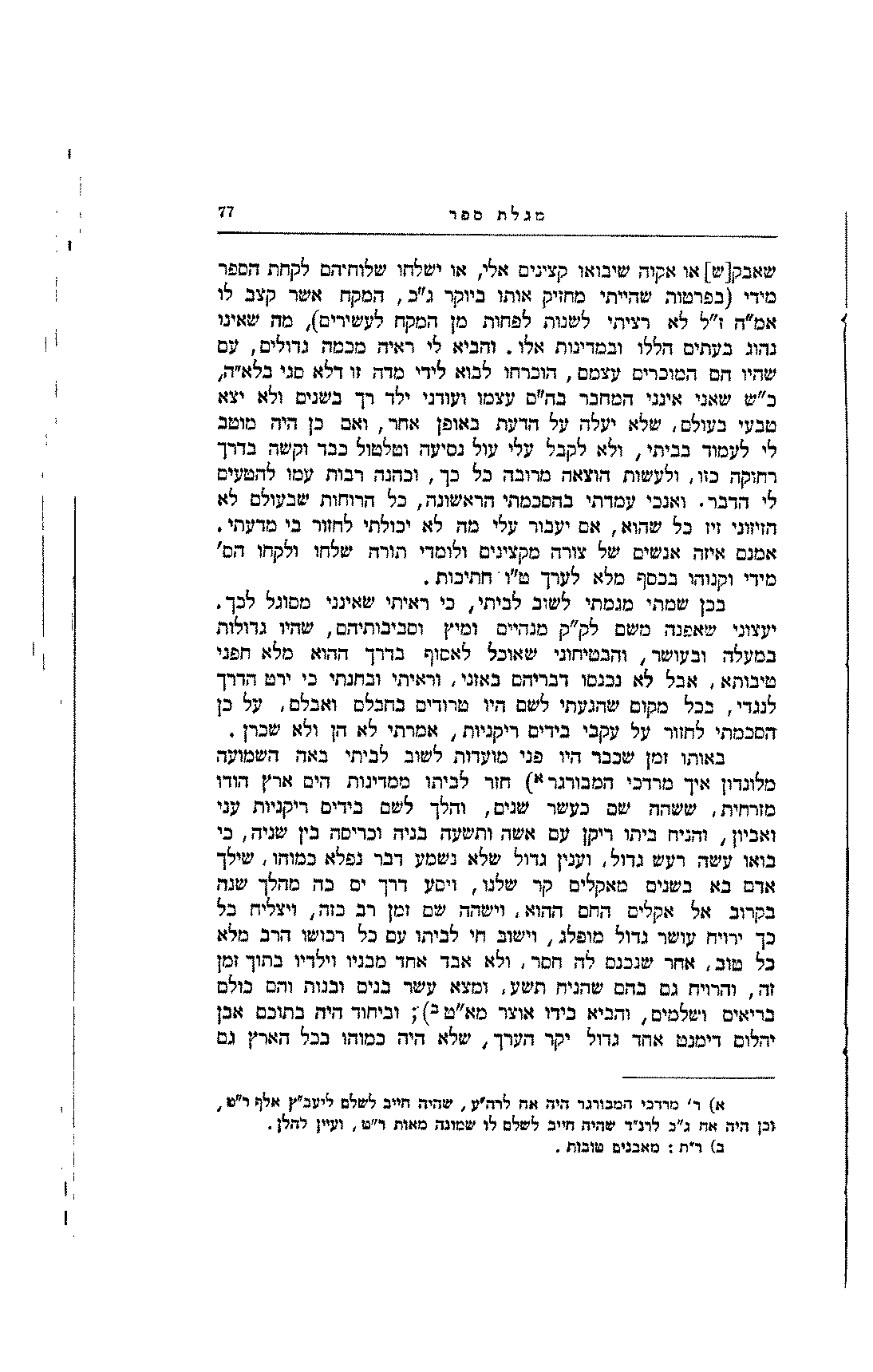
Page 78 (scan 94)
he brought with him precious vessels of gold the like of which had not been seen, especially in that they were green in colour. The great wonder that happened to this man was printed in the news sheets printed in London every day. The news reached Frankfurt am Main while I was there, in a letter to the upright and God-fearing leader R. B. Hamburger, Mordecai's brother-in-law. This R. B. loved me very much, and at once sent a great cup of good tidings full of wine to bring me the news with great joy. He encouraged me not to go home yet, but first to go and travel to London. He assured me that from now on the money of the bills of exchange on R. Hendele and his brother R. N. D. was safe, since R. Mordecai was their brother and had been a partner with his brothers, "one purse for all".
He too had been a faithful friend of my father, like all his father's house; and he owed him a special debt for the good my father had done him, when that evil teacher, R. Ph. B., and his band plotted evil against him over a bill of divorce that this lying teacher had arranged to give secretly by a priest, on condition [a], in which there were several things astonishing to many. R. Mordecai said some light word expressing wonder and astonishment at the giving of that divorce, which was considered strange. For R. Mordecai was the son of great men, as said, and had grown up in an important community, and the thing was hard in his eyes. Through this, that side which was with the teacher, who were his opponents anyway, found an opening to stir up war against him. They meant to kill him and destroy his house and his children for nothing. They went down after his life: they expelled him from the synagogue and his children from the school, and drove him away ⟨S: a three-line note, partly read⟩ from sharing in the Lord's inheritance, and to disqualify his children ⟨S: a four-line note, partly read⟩ — a thing never heard or seen in Israel, to persecute a son of the covenant, a simple and upright man, for truly nothing. For what he said he said in his innocence, with no ill intention at all.
They would almost have swallowed him alive, "had it not been the Lord who was for him". He put it into his heart to make his distress known in Hamburg and to tell my father, of blessed memory, asking him whether he deserved for this a punishment harder than death, as said. By the Lord's kindness to him, my father "filled his hand with the inkhorn" and wrote him a clear answer to his question, clearing R. Mordecai of this matter entirely. His persecutors let go of him; he separated from them and made a synagogue and congregation of his own. A pamphlet was made of this affair, called Ma'aseh Rav, and R. Y. of Holešov put it in print.
I return to the matter. Because of all this there was no doubt in the world that R. Mordecai would remember the old love, and acknowledge the good he had received from my father without any return; that he would not be ungrateful to my father's orphaned children, and would at least pay the said debt, after the great kindness the Blessed One had done him with miracles and wonders, as said. So the words entered my ears, and I took on myself the yoke of a new wandering, heavier than I could bear:
Kahana's notes
- [a] The abbreviation means "on condition".
הביא אתו כלי חמדה מזהב שלא נראו כמוהם, בפרטות שהיה גוון ירוק. ונדפס החידוש הגדול שאירע עם זה האיש, נדפס בדפי החידושים הנדפסים בלונדון מדי יום ביומו. והשמועה באה עד פ"פ דמיין, בעת היותי שמה הגיעה במכתב להק' הישר וי"ש ר"ב המבורגר גיסו של מרדכי, והיה האיש ההוא ר"ב אוהב אותי עד למאד, ושלח מיד כוס של בשורה גדול מלא יין לבשרני בשמחה גדולה, והרהיבני בנפשי עוז שלא אשוב לביתי עדיין, עד שאלך ואסע תחלה ללונדון. והבטיחני שמעתה המעות של הח"כ מרה"ע ואחיו רנ"ד בטוחים, באשר כ' מרדכי אחיהם והיה שותף עם אחיו, כיס אחד לכולם; גם הוא היה אוהב נאמן לאמ"ה ז"ל כמו כל בית אביו, ועליו חובה ביחוד מחמת הטובה שעשה לו, כשחרש עליו רעה המורה רעה שם רפ"ב וסיעתו, אודות גט אחד שסידר המורה שקר הלז לתת בחשאי כהן ע"ת א שהיו בו כמה דברים תמוהים לרבים, ואמר כ' מרדכי איזה דבור קל להפליא ולתמוה מנתינת הגט ההוא, אשר כמו זר נחשב, כי כ' מרדכי בן גדולים כנ"ל ונתגדל כק"ק חשוב, היה הדבר קשה בעיניו, וע"י זה הצד ההוא שעם המורה שהיו מתנגדיו בלא"ה מצאו מקום להתגרות בו מלחמה, אותו דמו להרוג ולהשמיד ביתו ובניו על לא דבר, וירדו עמו לחייו, ויגרשוהו מבית הכנסת וילדיו מבית הספר, והרחיקוהו מהסתפח בנחלת ה' ולפסול את בניו, דבר שלא נשמע ולא נראה בישראל, לעשות רדיפה לבן ברית ואיש פשוט וישר על חנם ממש; כי מה שאמר לפי תומו אמר בלי כוונה רעה כלל, וכמעט חיים בלעוהו לולי ה' שהיה לו, ונתן בלבו להודיע צערו להמבורג ולגלות אוזן אמ"ה ז"ל, לשאול את פיו אם הוא חייב בשביל כך עונש קשה ממות כנ"ל, ובחסד ה' עליו מלא ידו בקסת, וכתב לו תשובת שאלתו בברור, לנקותו לכ' מרדכי מענין זה לגמרי, רפו ממנו רודפיו, והוא נפרד מהם, ועשה לו בה"כ וקהל בפ"ע. ונעשה קונטרס מזה המאורע נקרא „מעשה רב", וקבעו בדפוס ר"י מהעלישויא. חוזרני לענין. כי מחמת כל זה לא היה ספק בעולם שיזכור כ' מרדכי האהבה הישנה, ויכיר הטובה שקבל מאמ"ה ז"ל בלי שום גמול. ולא יהא כפוי טובה לבנים יתומים של אמ"ה ז"ל, ולפחות ישלם החוב הנ"ל, אחרי החסד הגדול שעשה לו השי"ת בנסים ונפלאות כנ"ל, על כן נכנסו הדברים באזני, וקבלתי עלי עול טלטול חדש כבד ממני,
- [א] ר״ת: על תנאי.
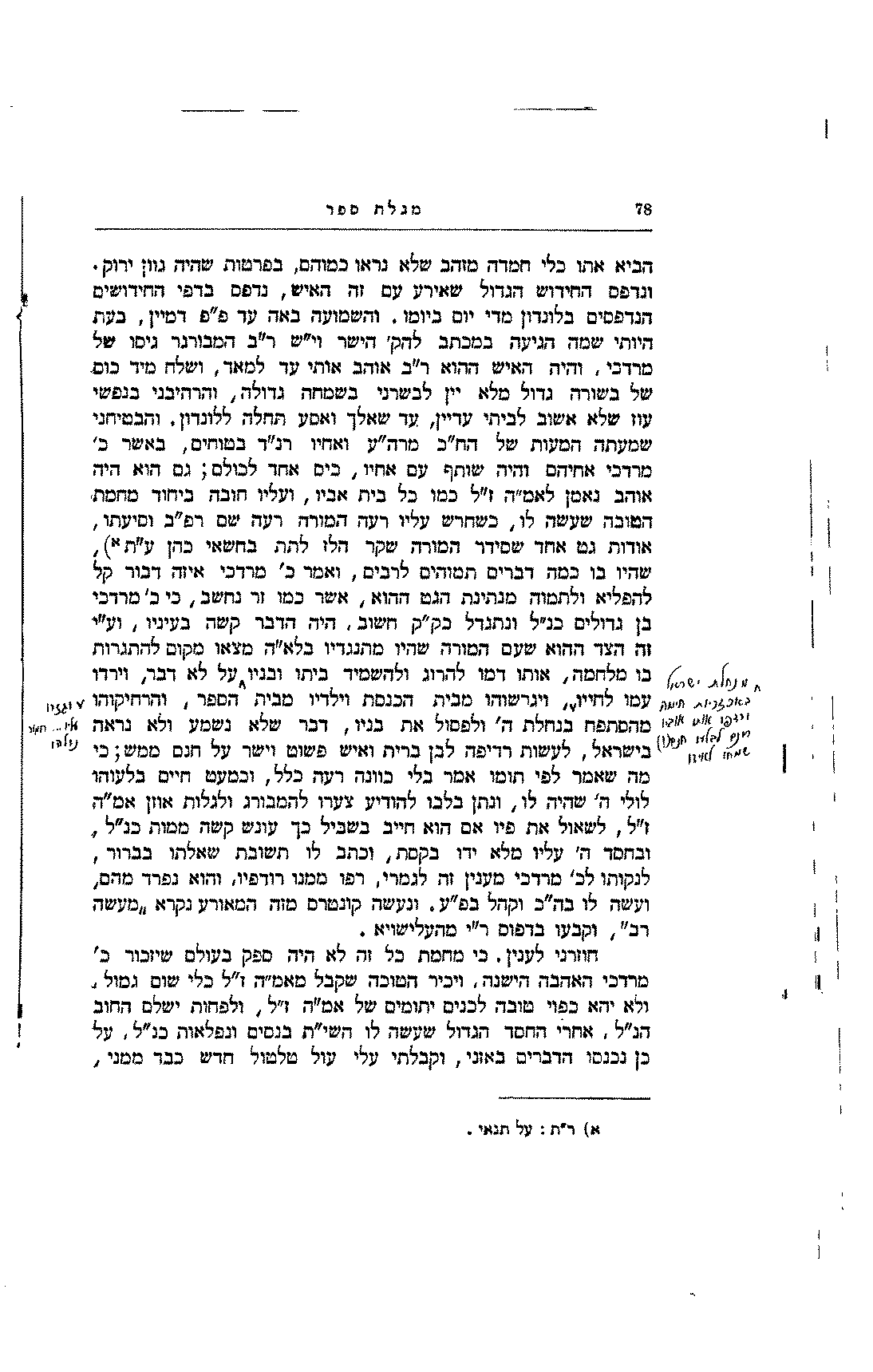
Margin readings in Scholem's copy (2)
| Printed anchor | Type (key sheet) | Mark | Reading | Certainty |
|---|---|---|---|---|
| ולפסול את בניו ^, דבר שלא נשמע | V: omission | caret; 4-line note in right margin | partly read (... ישראל / ... / ... ותשן(?)) | partial |
| והרחיקוהו ^ מהסתפח | V: omission | caret; 3-line note | partly read | partial |
Page 79 (scan 95)
to go by ship across the sea, on which I had never travelled before. I hired a new servant at a high price and set out. I was sick and fell ill on the ship with "a shivering fever" [a]. We were also in danger from the ship itself: a breaker rose against us and a stormy wind opposed us, so that the ship was about to break. With God's help we came into harbour. I was sick and very weak, and could not stand on my feet; I had to hire a covered wagon, and came to the house of R. Mordecai. I was received with honour and good will. His household hurried to call an expert doctor to treat me and restore my health, and set aside a room for me for all my needs and wants, with good care. He, his honoured wife and all his household gave all this; in general they did everything needful for my comfort, with a pleasant face.
When the Blessed One in His great kindness restored me to my strength and my health, I spoke with R. Mordecai and revealed to him why I had come so far — "for need drove me" — and showed him all the said bills of exchange I held on his two brothers. He said to me: "True, I recognise my brothers' handwriting; but I do not pay for them. For if I do such a thing, their other creditors will quickly come to me like the cocks of Bukia (b. Yoma 23a), and I shall have to give them all that I brought with me from India, and come out stripped of my property as before." I said to him: "Is it not a small thing that he would pay me for his brothers? He would do a great double commandment, and I will keep silent and not publish the matter to anyone." But for all my words of conciliation I did not succeed: he was "like the deaf adder that stops its ear" (Ps. 58:5) from hearing of money; and he sent me away disappointed ⟨S: a word, not read⟩.
All my toil and labour was in vain: I had troubled myself to wander as far as my strength allowed, to cross deserts and to spend much money, all for loss. Had the winter days not already come, I would have turned back at once to go home quickly; but Heaven held me back. All the rainy season I had to stay there, against my will and to my anger, prolonging my exile; and I was in sorrow, grief and sighing over the loss of time and money — "and when shall I provide for my own house?" (Gen. 30:30). The days of sorrow were very long for me there. And after I had recovered my health, I once fainted on the night of the holy Sabbath, when I was below, in a lower room; there was a great commotion in the middle of the night, at the hour when everyone was lying asleep, and at once they brought me a remedy that helped, with God's help.
That was my affair with R. Mordecai. He gave me a few guineas as help for the road, and against my will I was forced to accept them, against the expenses of the long road. R. Aberle too, who had vowed to my father's orphans, as said, had already grown poor before I came to London, as I wrote; and I was "bald on this side and bald on that". After Passover I went down in a ship into the heart of the sea and passed through Amsterdam.
Kahana's notes
- [a] See b. Pesaḥim 25b, and its meaning: in the fire of fever.
לילך בספינה דרך ים כה אשר לא עברתי בה מתמול שלשום, ושכרתי לי מחדש משרת בדמים יקרים, ושמתי לדרך פעמי, ונהייתי ונחליתי בספינה באשתא צמירתא א. גם היינו בסכנה מחמת הספינה עצמה, שעמד עלינו נחשול ורוח סערה נגדנו באופן שהאניה חשבה להשבר. בעזה"י באנו אל הנמל ואנכי הייתי חולה חלוש מאוד, לא יכולתי להעמיד רגלי, והוצרכתי לשכור עגלת צב, ובאתי לבית של כ' מרדכי, ונתקבלתי בכבוד וברצון טוב, גם מהרו בני ביתו לקרוא לרופא מומחה, לעסוק ברפואתי והשבת בריאותי, ולייחד לי חדר לכל צרכי ומחסורי והשגחה טובה, את הכל נתנו הוא ואשתו הכבודה וכל ב"ב, בכלל עשו קורת רוחי בכל המצטרך בסבר פ"י. וכאשר החזירני הי"ת בחסדיו הגדולים לאיתני ולבריאותי, דברתי עם כ' מרדכי וגליתי לו על מה באתי עד הלום, כי הנחץ השיאני והראיתיו כל ח"כ הנ"ל שבידי על שני אחיו. ואמר אלי: אמת אני מכיר ח"י אחי, אך אינני משלם בעדם, כי אם אעשה כזאת מהר יבואו אלי שאר ב"ח שלהם כתרנגולים של בית בוקיא, ואצטרך לתת להם כל מה שהבאתי בידי מהודו, ואצא נקי מנכסי כבראשונה. ואני אמרתי אליו, הלא דבר מועט הוא מה שישלם לי בעד אחיו, ויעשה מצוה רבה כפולה, ואני אשתוק ולא אפרסם הדבר לשום אדם. אבל בכל דברי פיוסים לא הועלתי, הוא כפתן חרש כבדה אזנו משמוע דמי"ם, והוציאני בפחי נפש. כל יגיעי ועמלי לריק היה, וטרחתי לענות בדרך כחי ולעבור בציות, ולפזר ממון הרבה הכל לאבוד, ולולי שכבר נכנסו ימי החורף, הייתי חוזר על עקבי מיד לשוב לביתי מהר, אך מן השמים עכבוני; כל ימי הגשמים הוכרחתי להתעכב שם על אפי ועל חמתי, להאריך ענין גלותי, והייתי בצער יגון ואנחה על אבוד זמן וממון, ומתי אעשה לביתי, מאד ארכו לי שם הימים של צער. וגם אחר שחזרתי לבריאותי פעם נפלתי בחולשה בליל שבת קודש בהיותי למטה בבית מדור תחתון, ונעשה רעש גדול בחצי לילה האחרון בשעה שכל ב"א שוכבים ישנים, ומיד הביאו לי תרופה שהועילה בעזה"י. זה היה עניני עם כ' מרדכי, ונתן לי איזה גינעש סיועת הדרך, ועל כרחי הייתי מוכרח לקבלם נגד הוצאות הדרך הרחוקה. גם ר' אברלי שנדר ליתמי אמ"ה ז"ל כנ"ל כבר נתדלדל קודם שבאתי ללונדון כמש"ל, והייתי קרח מכאן וקרח מכאן. אחר הפסח ירדתי באניה בלב ים, ועברתי דרך אמשטרדם.
- [א] עיין גמ' פסחים (דף כ"ה ע"ב) ופירושו באש הקדחת.
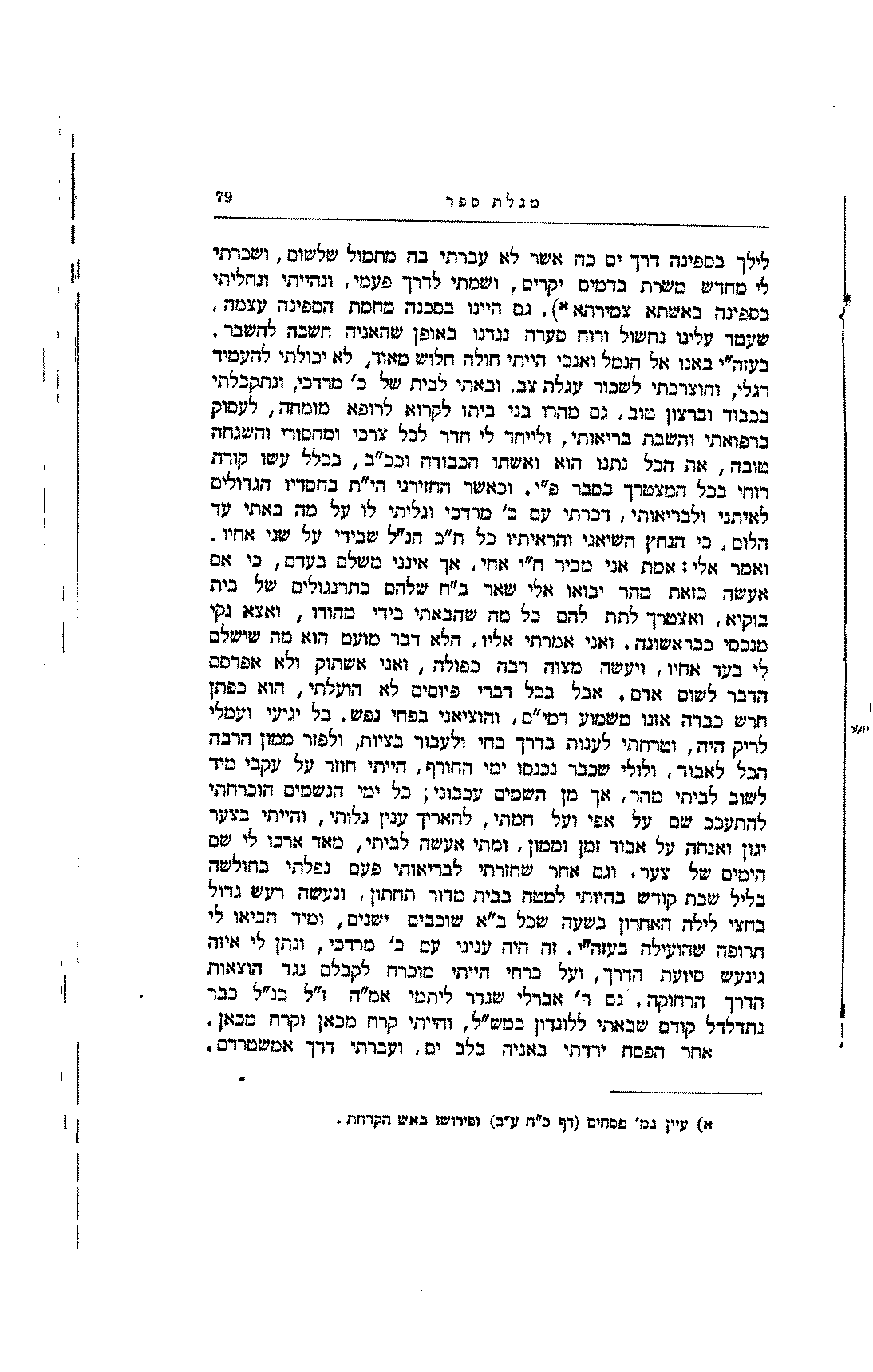
Margin readings in Scholem's copy (1)
| Printed anchor | Type (key sheet) | Mark | Reading | Certainty |
|---|---|---|---|---|
| והוציאני בפחי נפש ^ | V: omission | caret; one word | חור(?) | not read |
Page 80 (scan 96)
On the eve of the holy Sabbath, the very day I came there, good news came to my kinsman R. A. N. [a]: one of his tickets had won in the lottery of Utrecht, with a sum of twenty-eight thousand Dutch gulden [b]. At that time my said kinsman, with his father-in-law's household, was in a low state; and from that day on the star of their fortune began to rise, and their state went up and prospered for good, growing day by day ever higher. The old man, simple, upright, God-fearing and intelligent, R. Zalman Norden, of blessed memory, saw a new world: in his old age he prospered greatly, above all in having the merit of doing many good deeds of commandments and charity, to near and far, with a generous spirit, and of marrying off his sons and daughters. He had eleven sons and daughters, grown up at that time, and had married off only his eldest daughter, whom my said kinsman married with the little dowry he gave him; afterwards he made matches as he desired.
I had to take my lodging in the house of this fortunate man, who treated me like a father; great affection was shown me by him and his sons, and all his household were my servants. Then I fell ill with a second fever, God save us, which afflicted me for several months and held me back from going home quickly as I wished. The beloved people did much for me; above all my said kinsman had great trouble: it fell on him in particular to provide a doctor and medicines for me, and all my needs for some time.
As the illness went on, there came out of me through the anus a worm several cubits long, which had been gnawing at my bowels all the time. I had felt it from about a year before: it seemed to me that something alive was gnawing in my body on the right side, by the loins, near my kidneys, and I did not know what it was. The fever too was for the good: through the constant purging the doctor gave me — his intention being to remove the cause of the fever by cleansing the turbid matter in the blood; the worm never entered his mind, and it seems the worm caused the fever — the very long worm came out with the stool in diarrhoea. I had to draw it out with my hand, for it could not come out all at once; it stayed hanging from my behind and was drawn out like a rope, until it made me tremble and shudder, for I thought, God forbid, that my intestines [c] were coming out and being drawn along. At first it did not occur to me that such a long worm could grow in the belly of a living person. It was a great good, removing such an illness from me; praised be the Helper. So almost the whole summer passed in this way in Amsterdam.
After this I travelled straight home, without any stay or delay,
Kahana's notes
- [a] See (p. 50); he was the servant of Ḥakham Tzvi without taking pay from him; see there.
- [b] The abbreviation means "Dutch".
- [c] The abbreviation means "intestines".
בעש"ק בו ביום שבאתי לשם באה בשורה טובה לש"ב רא"ן א. שעלה גורל הת"ק אחד שלו בלאטרייא של איטרט עם סך כ"ח אלפים זהובים האל' ב. ובאותו זמן היה ש"ב הנ"ל עם בית חמיו במעמד נמוך, ומן אותו יום ואילך התחיל מזל מערכתם לצמוח, ועלה והצליח מעמדם לטובה, יום יום הולך וגדל עד למעלה. והאיש הזקן תם וישר וי"ש ומשכיל ר' זלמן נורדן ע"ה ראה עולם חדש, לעת זקנתו היה מצליח מאד, ביחוד במה שזכה לעשות טובות רבות במצות וצדקות לקרובים ולרחוקים ברוח נדיבה, ולהשיא בניו ובנותיו שהיו לו י"א בנים ובנות גדולות בעת ההיא, ועדיין לא השיא כי אם בתו הגדולה שנשאה ש"ב הנ"ל במעט שנתן לו לנדן, ואח"ז עשה שידוכים כחשקו. והוצרכתי לקחת אכסניא שלי בביתו של זה האיש המאושר הנ"ל, שעשה לי כאב, וחבה יתירה היתה נודעת לי ממנו ובניו, וכל ב"ב היו לי משרתים. אז נפלתי בחולי קדחת שנייה ר"ל, שהיה מתעולל בי איזה חדשים, ויעכבני זה פעמים מלשוב לביתי מהרה כחפצי, ועשו לי הרבה האנשים האהובים, ביחוד ש"ב הנ"ל הי"ל טרחא גדולה, פרטית עליו להחזיק לי רופא ורפואות, וכל מחסורי משך זמן מה; ובהארך ימי החולי יצא ממני דרך בית הרעי תולע ארוך כמה אמות, שהיה נוקר במעי תמיד, וכך הייתי מרגיש מאז כמו שנה לפנים, נדמה לי דבר חי מנקר בגופי מצד ימין נגד המתניים סמוך לכליותי, ולא ידעתי מהו, והיה הקדחת גם הוא לטובה, כי ע"י הרקה תמידית שעשה לי הרופא, וכוונתו להסיר סבת הקדחת למרק החומר העכור שבדם, ולא עלתה על דעתו ענין התולע, וכמדומה התולע ההוא גרם הקדחת, הלך התולע הארוך מאד עם הרעי בשלשול, והוצרכתי להוציאו בידי, כי לא היה יכול לצאת כולו כאחת, ונשאר תלוי באחורי והיה נמשך כחבל עד שגרם לי רעדה וחלחלה, כי חשבתי כאלו ח"ו יצאו ב"מ ג ונמשכים, ולא היה עולה בתחלת המחשבה, שתהיה אפשר לגדל בבטן אדם חי תולע ארוך כזה, והיתה טובה גדולה להסיר ממני מחלה כזו, ישתבח העוזר. וכמעט עבר קיץ בזה האופן באמשטרדם. אחר זה נסעתי דרך ישר ללבת לביתי, בלי שום שהות ועיכוב,
- [א] עיין (צד 50) והוא היה משרתו של החכם צבי מבלי לקבל ממנו פרס, עיין שם.
- [ב] ר"ת: האלענדיש.
- [ג] ר״ת: בני מעים.
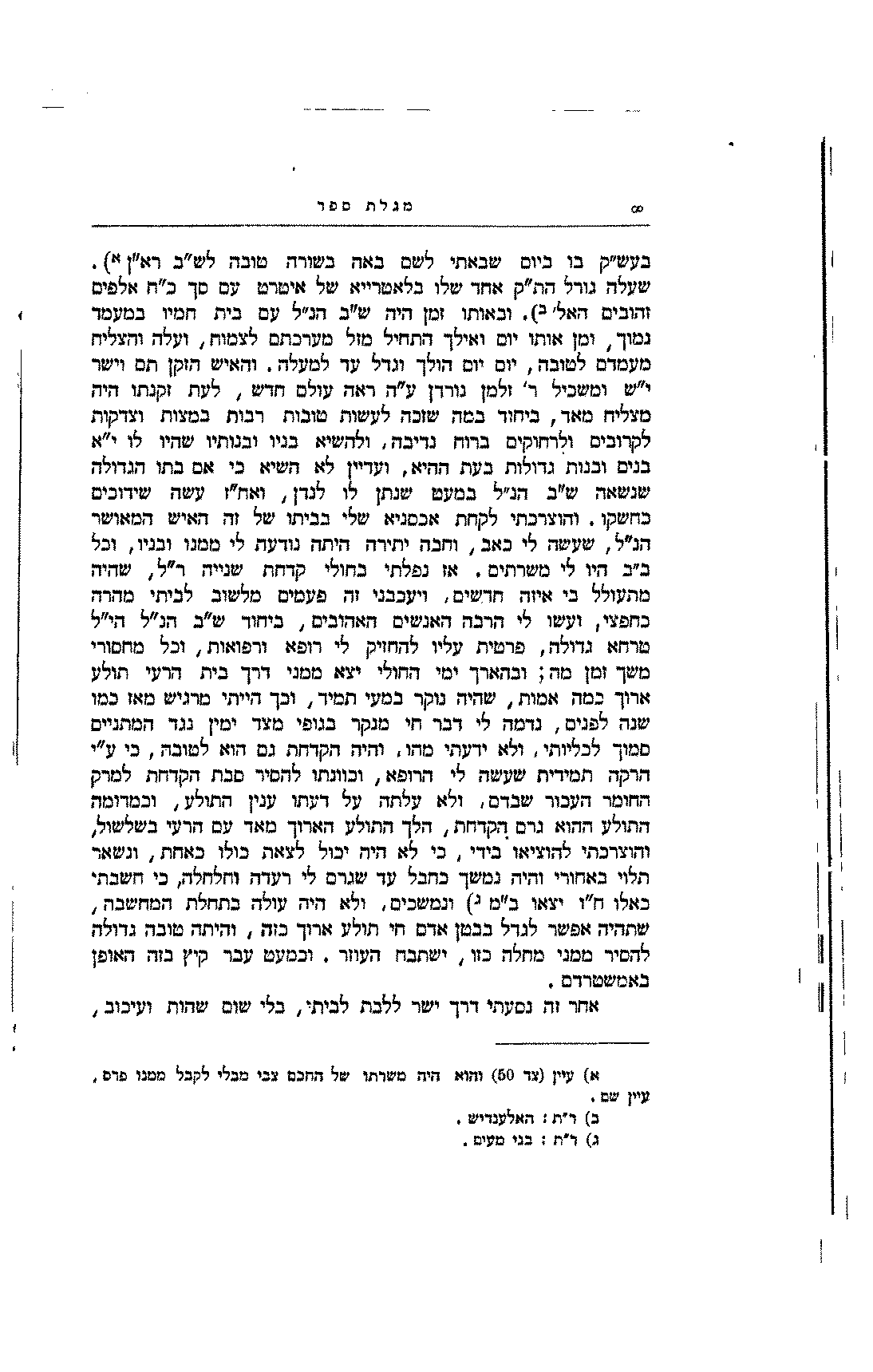
Page 81 (scan 97)
and from many evil mishaps [the Lord] saved me [on this] long [road], which I cannot number; I will mention only a very little of the Lord's kindnesses. From Fürth I went by the Landkutsche that goes to Prague. I forgot to make a condition with the coach about stopping on the Sabbath, and I had to stay on the holy Sabbath on the road at an inn, and hire a special wagon there to travel by night to catch up with the said coach going to Prague. Afterwards I was told that there were robbers on that road and also at the inn. The second driver, whom I hired for myself on Saturday night at a high price, also took me as he liked, by a road on which no Jew passed without a special pass; my soul almost "came into iron" (Ps. 105:18), and trembling seized my flesh. But by the Lord's mercy on me the customs-collector was not at home, only his maidservant ⟨S: "a gentile woman"⟩; her compassion was stirred at the sound of my crying and weeping, and she was appeased.
In Prague too wonders happened to me which I cannot tell as they were; I will touch only a little, "with the tube that drips", of the drops of my experiences, the troubles of my hardships and my rescues by God's kindness to me always. As soon as I entered that city — which is more dangerous than other cities anyway, because of the black-robed priests and their students ⟨S: a note, perhaps "the tonsured …"⟩ — a number of copies of my father's responsa that I had with me were taken from me at the customs. And it was a great danger to bring Talmudic books into a city where royal decrees had already been issued about this.
Eybeschütz was then at the very lowest point with most of the Jews, for in that period, the year before, a scandal had gone out about him, which came to light especially in the holy community of Frankfurt am Main and in several communities, as is well known — although he brazenly denied what was known, seeing that the evil was determined against him. And the rabbis of that generation, who had at first put on zeal against him, also let their hands drop, "for fear of the enemy, terror on every side" (Jer. 6:25), also because of his family and his wife's families, whose hand was strong there — above all because he had influence with the Catholics ⟨S: "the priests"⟩, whom he had joined and whose ways he had learned; so he found favour in their eyes; and through this he had also seized half the office of preacher. So the rabbis withdrew their hands from him, and were satisfied with a false oath he made on the night of Kol Nidrei.
Even so he was much despised in the eyes of the Jews, who already knew all his trickery and deceit; even to his former friends he had become abominable — they loathed him, and even his relatives. My uncle, the honest man, of blessed memory, assured me that even his father-in-law, the rabbi R. Y., wanted to disinherit him [a]; and no one supported him except those companions of his ⟨S: a word, perhaps "the heretics"⟩, like Pappers and the other
Kahana's notes
- [a] His name was R. Isaac Spira, head of the court in Prague; see Kelilat Yofi (fol. 119b). R. Isaac Spira was the son-in-law of R. Mordecai Kohen of Hamburg; see the beginning of his book Beit Yehonatan ha-Sofer. Emden also says in his Hit'avkut (fol. 2): "Even his father-in-law wanted to disinherit him."
ומכמה פגעים רעים הצילני ]ה' בדרך[ הארוכה הזאת, אשר לא ידעתי ספורות, רק קצת מעט מזער אזכיר חסדי ה'. מפירדא הלכתי על לאנדקוטש ההולכת עד פראג, ושכחתי להתנות עם העגלה אודות העכוב בשבת, והוצרכתי להשאר בש"ק על הדרך במלון, ולשכור שם עגלה מיוחדת ליסע בלילה להשיג עגלת צב הנ"ל ההולכת עד פראג. אח"כ הוגד לי שהיו בדרך ההוא גזלנים וגם במלון, גם הוליכני העגלון השני, ששכרתי לעצמי במ"ש הנ"ל בדמים יקרים, כחפצו בדרך לא עבר בה איש יהודי מבלי כתב תיור מיוחד, וכמעט ברזל באה נפשי ואחז בשרי פלצות, אך בחמלת ה' עלי לא היה שם המוכסן בביתו רק המשרתת שלו, ונכמרו רחמיה עלי לקול צעקתי ובכיותי ונתפייסה. בפראג ג"כ נעשו לי פלאות, אשר לא אוכל לספרם כהוייתן, רק מעט מזער אגע בצנור המקלח מנוטפי קורותי וצרות תלאותי והצלותי בחסד אל עלי תמיד. מיד בכניסתי לכרך הלז, המסוכן בלא"ה יותר משאר כרכים, מחמת הכומרים השחורים ותלמידיהם, נלקחו ממני על המכס איזה סך מספרי שו"ת של אמ"ה ז"ל שהיו בידי, ושם סכנה גדולה להביא ספר תלמודיים לעיר שכבר נגזרה גזרות המלכות על זאת. והיה אז אייבשיצר בתכלית השפלות אצל רוב היהודים, כי בו בפרק בשנה שלפניה יצא קול לעז עליו, שנתגלה בק"ק פפד"מ ביחוד ובכמה קהלות כמפורסם. ואע"פ שהעיז פניו להכחיש הידוע, בראותו כי כלתה אליו הרעה. ורבני הדור ההוא אשר לבשו קנאה עליו מתחלה ג"כ נתרשלו ידיהם מפחד אויב מגור מסביב, גם מחמת משפחתו ומשפחות אשתו שהיתה ידם תקיפה שם, ביחוד שהוא תקיף אצל הקטולים, שנתלוה אליהם ולמד מעשיהם, על כן מצא חן בעיניהם, וע"י זה ג"כ נטל הזרוע חצי מעלת הדרשנות, לכן משכו הרבנים ידיהם ממנו, ונתפייסו בשבועת שקר שעשה בליל כל נדרי; מ"מ היה בזוי מאד בעיני היהודים, שכבר ידעו כל תעתועיו ומרמתו, אפילו לאוהביו מלפנים היה נתעב מאסו בו ואפילו קרובים. והבטיח אותי האדם הכשר דודי ע"ה, שאפילו חמיו הרב ר"י היה רוצה להוציאו מנכסיו א, ולא היו מחזיקים בידו, רק אותם חבריו כפאפרש ושאר
- [א] שמו ר' יצחק שפירא האב"ד בפראג, עיין בס' כלילת יופי (דף קי"ט ע"ב) ור' יצחק שפירא היה חתנו של ר' מרדכי כהן מהמבורג, עיין בראש ספרו בית יהונתן הסופר, וכן אמר יעב"ץ בספרו התאבקות (דף ב') בזה"ל: אף חותנו רצה להוציאהו מנכסיו.
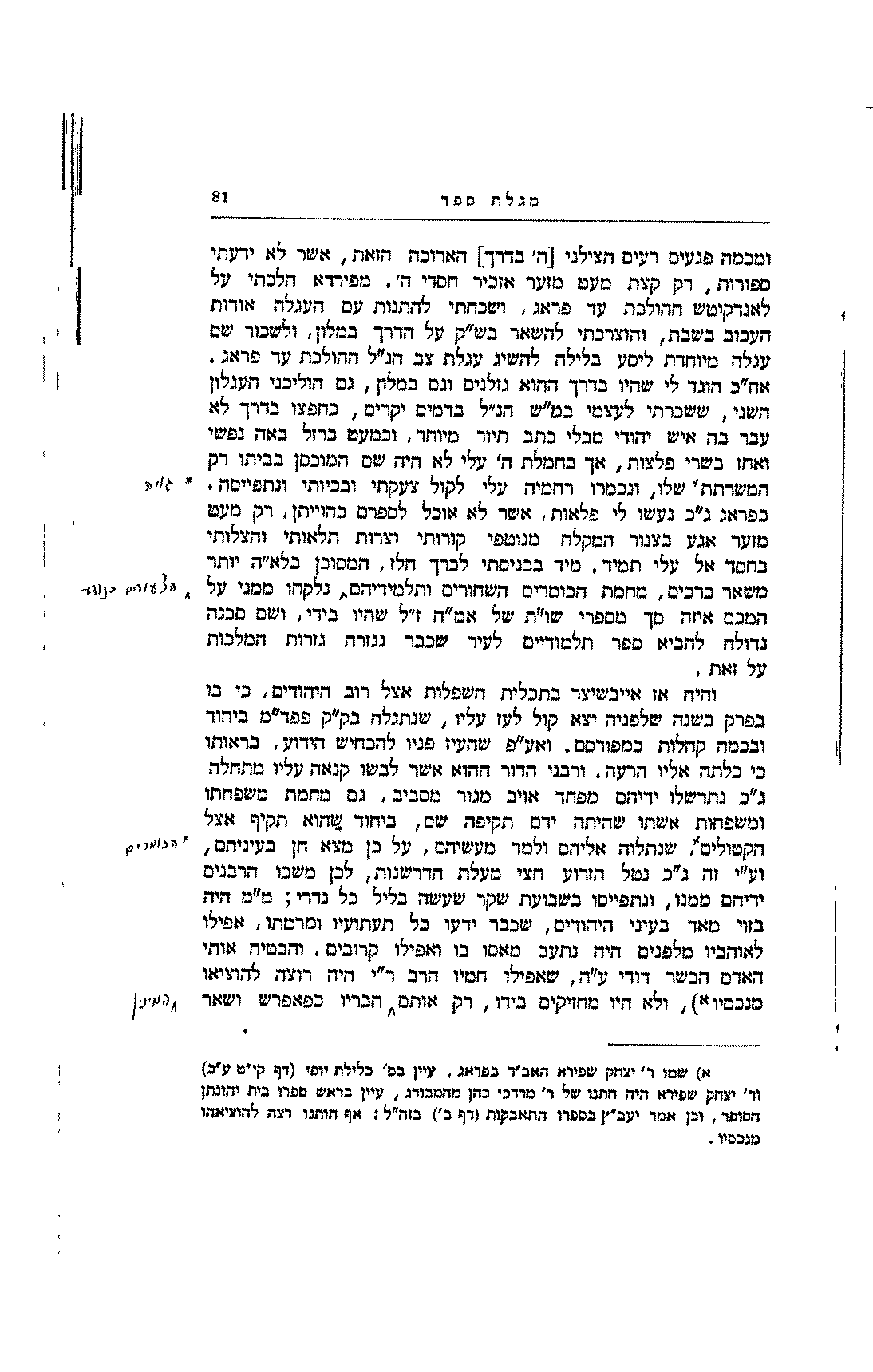
Margin readings in Scholem's copy (4)
| Printed anchor | Type (key sheet) | Mark | Reading | Certainty |
|---|---|---|---|---|
| לא היה שם המוכסן בביתו רק המשרתת x שלו | X: substitution | x mark; one word | גויה | fairly sure |
| מחמת הכומרים השחורים ותלמידיהם ^ | V: omission | caret; 2-word note | הגלחים(?) ... (Kraken: הלעורים כגובא) | uncertain |
| ביחוד שהוא תקיף אצל הקטולים x | X: substitution | x mark; one word | הכומרים | fairly sure |
| רק אותם ^ חבריו כפאפרש | V: omission | caret; one word | המינין(?) | uncertain |
Page 82 (scan 98)
men of the house of study there, as is known. But with the Catholic ⟨S: "uncircumcised"⟩ priests Eybeschütz was important ⟨S: a two-line note, partly read⟩; with them he had a hand and a name; however it was, with the priests he had favour. He was also then busy appearing in the courts of the gentiles, pleading for every man who had a creditor and every man in distress and hard-pressed; and in this way he made his living ⟨S: "there is no doubt that the unclean one also [showed] them a friendly face towards their faith, though at first he made himself out to argue with them and defeat them; and perhaps so it was at first, but in the end an evil spirit clung to him …, and the matter became clear that he too believed in the Christian …"⟩.
They showed him to me through the window of my uncle's house, of blessed memory, where I lodged [a]: how he ran like a deer through the streets and markets. I would not look at his face. He also sent to let me know that if I agreed to do him the honour of coming to his house, he would exert himself on my behalf to rescue the said books taken from me, and get them back for me free, without money. I would not see his face; I preferred to lose the books rather than greet his insolent face.
I was with the head of the court there [b], who made me a great feast and kept me the whole day. He did me great honour and showed me great affection; he showed me strong love before all who sat at table and gathered there, and held my hand all day — "his hand held my right hand", "as a father the son in whom he delights" — in the sight of all. He spoke at length in praise of my father before all the important men there, a house full, and said with a full mouth that my father was unique in his generation; there was none like him.
There a miracle also happened to me, especially in matters of the soul: a miracle like that of Joseph the righteous, and even somewhat more. For I was then a young man, tender in years, in the full strength of my heat. It was a long time since I had left my home, and I was very hungry for a woman. And there a single woman came my way, a young woman, very beautiful, my relative, my uncle's daughter. She was alone with me, and she made bold to show me great affection, to come close to me; she almost kissed me. Also, when I was lying in my bed, she came to cover me well with the bedclothes — as it were out of a relative's affection. In truth, had I listened to the counsel of my inclination, she would not have withheld from me my desire at all. Several times the thing came near, God forbid, to being done, like fire in tow. Many times there was no one in the house with me but her, nor did people usually come, for they were in the shop in the market, busy all day with their living — had the Blessed One not given me great strength, "excellency of dignity and excellency of power" (Gen. 49:3), to overcome my burning inclination, which almost forced me once to do its will, had not the Lord's kindness been great upon me, to stand this trial, very wonderful, beyond all trials. For I was a man in the full strength of my vigour and my desire, and a beautiful and very pleasant woman before me, showing me all manner of affection and closeness many times; she was a relative, single, young
Kahana's notes
- [a] His uncle's name was R. Wolf, a pious man; see Hit'avkut (fol. 60b).
- [b] This rabbi and gaon is R. David Oppenheim, who was rabbi in Prague from 5472 [1712] until his death in 5496 [1736]; see Gal'ed (§ 80) and the notes of R. S. Hock.
אנשי בה"מ שם כנודע. אכן אצל כומרי הקטולים חשוב היה אייבשיצר, אצלם היה לו יד ושם, איך שיהיה אצל הכומרים הי"ל חן. גם היה עוסק אז לעמוד לשרת במשפט הערכאות, טוען בעד כל איש אשר לו נושה, וכל איש מצוק ונקשה, ובזה האופן היה מרויח פרנסתו, והראוהו לי דרך חלון בית דודי ע"ה שהיה אכסניא שלי א, איך היה רץ כצבי ברחובות ובשוקים, ולא רציתי להסתכל בפניו. גם שלח אלי הודיעני, שאם אתרצה לתת לו הכבוד לבוא אליו לביתו, ישתדל בעבורי להציל את הספרים הנ"ל שנלקחו ממני, להחזירם לי חנם אין כסף, ולא אביתי לראות פניו, ונוח היה לי יותר להפסיד הספרים, מלהקביל פניו העזים. אצל הגאב"ד שם הייתי ב, שעשה לי סעודה גדולה ועכבני כל היום, ועשה לי כבוד גדול וחבה יתירה, ואהבה עזה הראה לי בפני כל המסובים והנועדים שם, ומחזיק בידו כל היום, ידו אחזה בימיני, כאב את בנו ירצני לעיני כל הרואים, והפליג לספר בשבחו של אמ"ה ז"ל בפני כל האנשים החשובים שהיו שם בית מלא, ואמר בפה מלא שאמ"ה ז"ל יחיד בדורו, לא נמצא עוד כמוהו. גם נעשה לי נס שם ביחוד בעניני הנפש, נס מעין של יוסף הצדיק ובקצת יתר, כי הייתי אז בחור רך בשנים בכל תוקף חומי, וזמן רב שפרשתי מביתי, והייתי רעב לאשה הרבה, ושם היתה מזדמנת אלי אשה פנויה, ילדה יפת תואר מאד, קרובתי בת דודי מתיחדת עמי, והעיזה פניה להראות לי חבה יתירה להקריב אצלי, במעט נשקה לי, גם בהיותי שוכב במטתי באה לכסותי היטב במצע, כלומר דרך חבת קרובה, ובאמת שאם הייתי שומע לעצת יצרי, לא היתה מונעת ממני חפצי כלל, וכ"פ היה קרוב הדבר ח"ו לצאת לפועל כאש בנעורת, פעמים רבות לא היה שום אדם בבית עמי זולתה, גם לא היו רגילים לבוא, כי היו שרוים בחנות על השוק, כל היום טרודים במחיתם, אם לא היה הי"ת נותן לי כח עצום, יתר שאת ויתר עז, להתגבר על יצרי הנלהב, שכמעט כפה אותי לעשות צרכיו פ"א, לולי חסדי ה' כי רבו עלי, לעמוד בזה הנסיון הנפלא מאד יתר מכל הנסיונות, כי הייתי איש בכל תוקף כחי ויצרי, ואשה יפה ונעימה מאד לנגדי, ומראה לי כל עניני חבה וקריבה פעמים הרבה, וקרובה היתה ופנויה וילדה
- [א] ושם דודו היה ר' וואלף איש חסיד, עיין התאבקות (דף ס' ע"ב).
- [ב] הרב הגאון הזה הוא ר' דוד אופנהיים שהיה רב בפראג משנת תע"ב עד יום מותו תצ"ו, עיין בס' גלעד (סי' פ') והערות ר"ש האק.
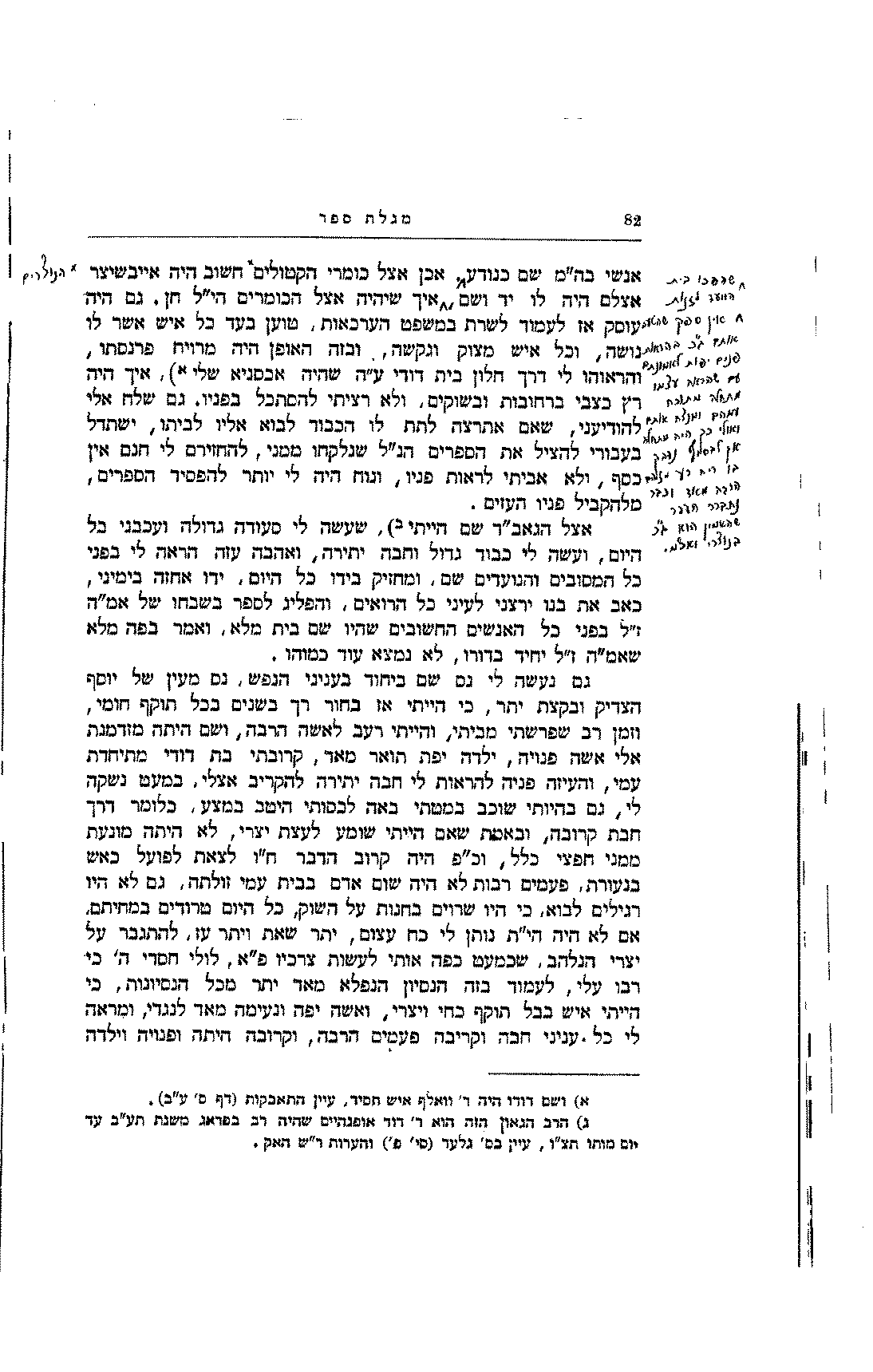
Margin readings in Scholem's copy (3)
| Printed anchor | Type (key sheet) | Mark | Reading | Certainty |
|---|---|---|---|---|
| אכן אצל כומרי הקטולים x חשוב היה אייבשיצר | X: substitution | x mark; one word | הערלים | fairly sure |
| אייבשיצר ^, אצלם היה לו יד ושם | V: omission | caret; 2-line note | שספכו(?) בית / הוועד לצנות(?) | uncertain |
| ובזה האופן היה מרויח פרנסתו ^ | V: omission | caret; about 12-line note in right margin on Eybeschütz in Prague (Kraken fragments: שנים יפות ... / תחת תוכחת / ... / אולי כך היה ...) | אין ספק שהטמא / אותם ג"כ ... / פנים יפות לאמונתם / עם שהראה עצמו / מתחלה מתוכח(?) / עמהם ומנצח אותם / ואולי כך היה מתחלה / אך לבסוף נדבק / בו רוח רע מאליו(?) / הרבה מאד ... / נתברר הדבר / שהאמין הוא ג"כ / בנוצרי ואלמו(?) | fairly sure |
Page 83 (scan 99)
and tender; she had been widowed recently, and perhaps pure, or would have purified herself if I had wanted; and I was sure in every way that she would not reveal my secret, had I wished to fulfil my lust and desire with her. And I conquered my inclination, killed my heat, and resolved to slay it — "and my heart is wounded within me" (Ps. 109:22) — and did not [fulfil my desire]. Blessed is the Lord, who gives strength to the weary, that I was saved from this fire and flame. As a reward for this may I and my descendants be saved for ever from the fire of the evil inclination and the fire of Gehenna; may it be His will, amen. Here are included my requests at several different times and places, from all of which the Lord saved me; and may He save me and my descendants for ever from every evil mishap.
Above all, how great is the power and the trials of the inclination, and how many nets it spreads for a man's feet — only that in no [way] was the thing light and simple, ready and prepared in the eyes of the inclination and safe from being known. Praised be the Helper and Rescuer. In that matter I then learned, and then knew, that even so free choice is [in the hand of] man(?), and the Lord will not abandon him to its hand: "happy is the man whose strength is in Him" (Ps. 84:6); "He keeps the feet of His pious ones" (1 Sam. 2:9).
From Prague I set out, for life and peace, on the coach called Landkutsche, which goes from there to the city of Brünn, the chief city of the land of Moravia. I thought I had got ahead, in the company of Jewish men of Moravia returning home: we had hired from the driver the first and highest place in the coach, according to the custom that whoever hires first wins precedence of seat in the carriage. But when we came to the coach, two gentiles ⟨S: "wicked uncircumcised men"⟩ came too, one an Italian merchant and the other a priest. Though they came late, they pushed us Jews out of our first place with mockery and derision; and the driver could not stand against them even if he had wanted, knowing that it was against law and right. So he had to keep silent, and we suffered various insults from these evil men ⟨S: "sinners"⟩, who did not leave us in peace a moment. We could not perform the commandment of putting on tefillin or pray properly because of them. They always reproached us and called us despicable Jews ⟨S: "dogs"⟩. And every time the road was a little crooked, they shouted at us with rebuke and scorn and contemptuous names: "Get out and get down from the coach and go on foot!", and pushed us out like objects.
And this too was for the good, for the Lord saw our affliction. After they had oppressed us for about ten leagues beyond Prague, we came to a very dangerous road: we had to pass along a very narrow way, with on one side a mountain straight up like a wall and on the other side a slope as deep as the abyss. When we came near the very dangerous place, these men drove us out of the coach and pursued us as was their custom; and we did not refuse, and walked on foot, while they stayed sitting securely in the coach. We were walking only a few steps from the coach — and behold, the coach overturned and fell on its face down the slope beside the road, as said. It was loaded with a heavy burden of chests and boxes, and some of them fell on the Italian merchant ⟨S: perhaps "the uncircumcised"⟩; they almost broke all his bones, and he fell down battered and very ill; he could no longer
רכה, נתאלמנה מקרוב, ואולי טהורה או מטהרת אם הייתי רוצה, והייתי בטוח בכל אופן שלא תגלה סודי, אם הייתי חפץ למלא תאותי וחפצי בה, וכבשתי יצרי, והמתי חומתי, והסכמתי להרגו ולבי חלל ולא ]מלאתי תאותי[, וברוך ה' הנותן ליעף כח, שנצלתי מאש ולהבה זאת. בשכר זאת אנצל אני וצאצאי עד עולם מאשו של יצה"ר ומאשה של גיהנם כי"ר אמן. ובכאן נכלל משאלי הזה בכמה זמנים ומקומות שונים, אשר מכולם הצילני ה', ויצילני לי ולזרעי עד עולם מכל פגע רע. ביחוד כמה גדול כח ונסיונות היצר, וכמה רשתות פורש לרגליו של אדם, ירק בשום ]אופן[ לא היה הדבר קל ופשוט, מזומן נכון בעיני היצר ובטוח מלהתודע, ישתבח העוזר ומציל. בענין הנ"ל אז נודע לי ואז ידעתי, כי עכ"ז הבחירה חפשית ]ביד[ ה', ולא יעזבנו בידו, אשרי אדם עוז לו בו, רגלי חסידיו ישמור. מפראג נסעתי לחיים ולשלום על עגלת צב הנקראת לאנדקוטש, ההולכת משם לכרך ברין, ראשית בארץ מעררין, וחשבתי שהקדמתי עצמי אני, בחברת אנשים יהודים מבני מעררין החוזרים לביתם, ושכרנו מן העגלון המקום הראשון ועליון בעגלה, כמנהג שכל הקודם לשכור זוכה בקדימת מושב הקרון. אך כשבאנו אל העגלה באו גם שני נכרים א' סוחר איטאליאני והב' כומר, ואלה עם שאחרו לבוא דחו אותנו היהודים מן מקום מושבנו הראשון בדרך לעג וקלס, והעגלון לא היהכול לעמוד נגדם, אפילו אם היה רוצה, בידעו שהוא נגד הדין והדת. ע"כ היה מוכרח לשתוק ואנחנו סבלנו עלבונות שונות מהאנשים הרעים הללו, שלא הניחונו בשלום רגע, ולא יכולנו לקיים דבר מצוה להניח תפילין, להתפלל כהוגן מפניהם, ותמיד מונים אותנו וקראונו יהודים נבזים. ובכל פעם שהיה דרך עקלתון מעט היו נותנים עלינו בקולם בגערה נזיפה ובכינוי בזוי: צאו ורדו מן העגלה ולכו ברגלים, ודוחפים אותנו החוצה כחפצים. וגם זו לטובה היתה, כי ראה ה' בעניינו; אחר שהיו מצרים לנו בכמו מהלך עשר פרסאות אחר פראג, נזדמנה לפנינו דרך מסוכנת מאד, כי היינו צריכין לעבור אורח צר מאד, מצדו אחד הר זקוף ככותל, וצדו האחר משופע עמוק כתהום, בהגיענו לשם קרוב למקום המסוכן מאד, דחפו ורדפו אותנו מהעגלה האנשים הללו כמנהגם, ואנו לא סרבנו והלכנו ברגלינו, והם נשארו יושבים בעגלה לבטח, עודנו הולכים רק איזה פסיעות רחוק מהעגלה, והנה העגלה נהפכת נופלת על פניה במדרון שאצל הדרך מזה כנזכר, והיתה טעונה משא כבד בארגזים ותיבות, ונפלו קצתם על הסוחר האיטאליאני הנ"ל, כמעט שברו כל עצמותיו, ונפל שדוד חולה מאד, לא יכול לשוב עוד
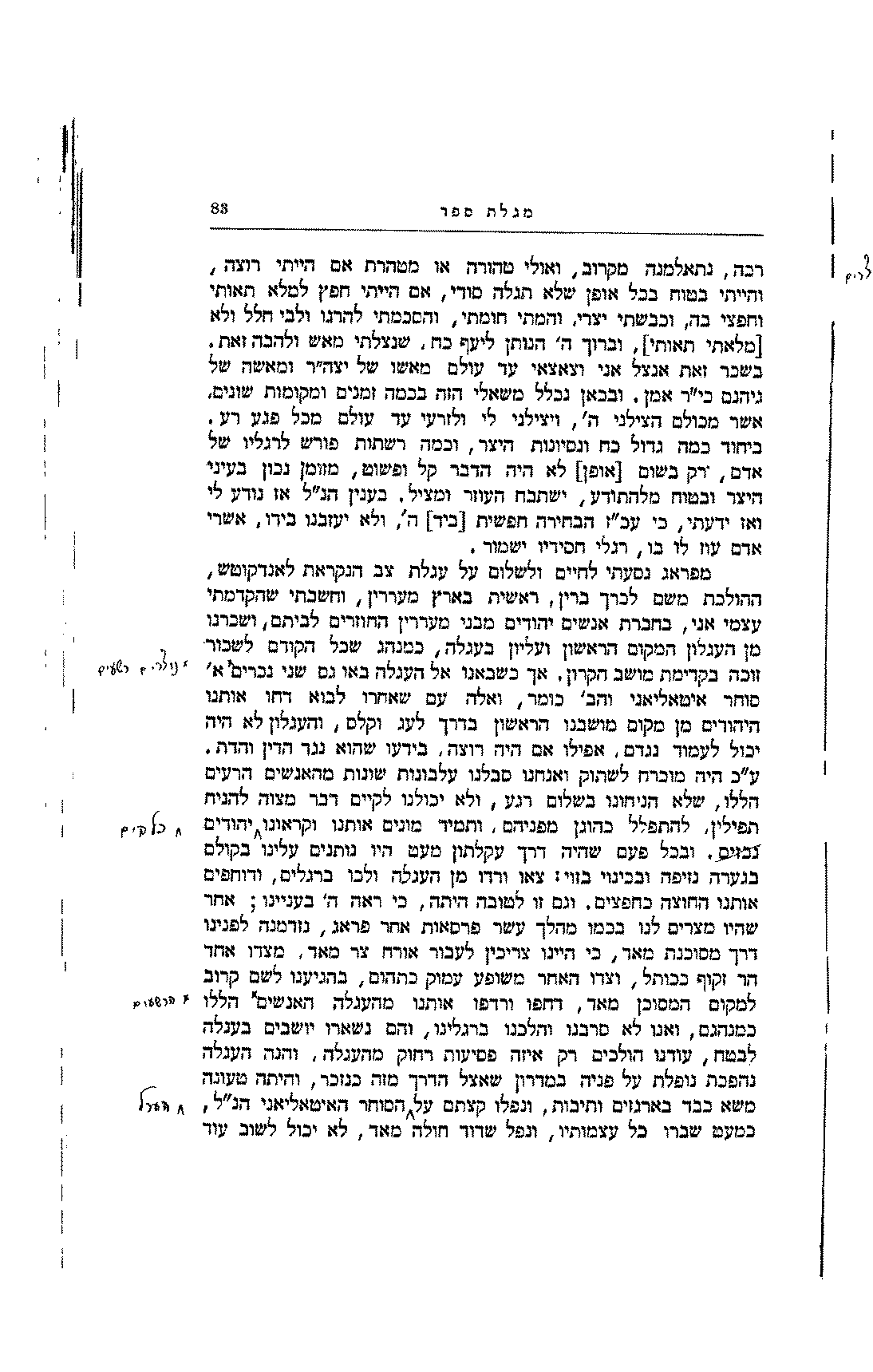
Margin readings in Scholem's copy (4)
| Printed anchor | Type (key sheet) | Mark | Reading | Certainty |
|---|---|---|---|---|
| באו גם שני נכרים x | X: substitution | x mark; 2-word note | ערלים רשעים | fairly sure |
| וקראונו יהודים ^ נבזים | V: omission | caret; one word | כלבים | fairly sure |
| האנשים x הללו | X: substitution | x mark; one word | הפושעים | fairly sure |
| על הסוחר ^ האיטאליאני | V: omission | caret; one word | הערל(?) | uncertain |
Page 84 (scan 100)
get back into the coach, and had to stay there on the road and look for lodging in a nearby village. The priest was not hurt at all; even so the merchant would not let him leave him, saying that he was obliged to keep him comfortable in case he should die. Besides, their hearts almost died within them, knowing that we rejoiced at their fall; "the Lord showed us" (cf. Ps. 118:7) [what happens to] those who hope in Him. In this way our troublers ⟨S: "the wicked"⟩ parted from us, and we got away from them in peace; we saw vengeance on our enemies. We went on our way in the name of the Lord, joyful and glad of heart, sitting by ourselves in a roomy coach, thanking and blessing the Blessed One for the good He had done us in this; and we could keep His commandments without adversary or evil mishap on the road. We reached the city of Brünn, with God's help, whole and glad of heart. There I saw the priest who had parted from me on the road; he nodded his head at me and said that he would never again travel with a Jew in one coach.
When I returned home from Brünn it was the middle of winter, in the days of terrible frost. I travelled with the people of the fair in a carriage without wheels, sitting on its runners, which they call a sledge; it is drawn over the ice and snow at speed, for it slides well. It was crowded for all the people of the vehicle to sit together, for they were many, and I had to put one leg outside the sledge, as many others did. While I sat like this there was a slope and descent in the road, so that the sledge I was sitting in slid, on the side where my leg was between the two sledges ⟨S: a five-line note, partly read: "… another such sledge, coming towards him, and my leg was rubbed"⟩. I thought the joint of my foot had been crushed, for it hurt me very much and I could not stand on my feet; and I came home "like the old man Sava, limping on my thigh". I had to treat it with ointments and sharp plasters ⟨S: a word, perhaps "and remedies"⟩ for some weeks, until my foot returned to its strength as before, with God's help.
After that great and terrible journey I came home empty-handed: the money was gone from my vessels. My eldest son, may he live — now grown, thank God — was then about seven and studying Gemara. My wife the rebbetzin, of blessed memory, hired a teacher for him alone in my house, and his board was on me besides his wage. For my father-in-law the rabbi, of blessed memory, though he kept a teacher in his house, begrudged his grandson, my son, may he live, because he had a better mind and was quicker and sharper than his own sons; so out of jealousy he did not let him study in one group with his sons. A heavy yoke was laid on me. A male child had died to me before I returned, and my wife, of blessed memory, became pregnant at once, and the burden of expense on me grew. I brought nothing back from that long journey except toil and labour, loss of time and money. For everything praised be the Creator and Sustainer, that "my life was given me for a prey" in all the many experiences, troubles "bound up on my shoulder".
But this much I gained: I saw for myself a way of trade in the countries of Holland, by which I could earn something [a], with God's help,
Kahana's notes
- [a] Me'umah, meaning "something"; see earlier (p. 66).
אל העגלה, והיה מוכרח להשאר שם על הדרך, ולבקש לו מלון בכפר הסמוך; אך הכומר לא ניזוק כלל, אבל עכ"ז לא רצה הסוחר להניחו מאצלו, כי אמר שחייב לעשות לו קורת רוחו פן ימות. נוסף לזה כמעט מת לבם בקרבם, בידעם ששמחנו במפלתם, לכל הראנו ה' תקותו בו. בזה האופן נפרדו מאתנו העוכרים אותנו, ונפטרנו מהם בשלום, ראינו נקמה באויבינו, ואנחנו בשם ה' הלכנו לדרכנו בשמחה ובטוב לב, יושבים לבדנו בעגלה רחבת ידים, מודים ומברכים להי"ת על הטובה שעשה לנו בזה, ויכולנו לשמור מצותיו בלי שטן ופגע רע על הדרך, והגענו למקום ברין בעזה"י שלמים וטובי לב. שם מצאתי ראיתי את הכומר שנפרד ממני בדרך, ונענע לי ראשו ואמר שלא יסע עוד עם יהודי בעגלה אחת. ובשובי לביתי מברין היה באמצע החורף וימי הקרח הנורא. נסעתי עם אנשי היריד בקרון בלי אופנים היושב על שוליו שקורין שלידן, ונמשך על הקרח והשלג במהירות שהוא מחליק יפה. והיה דוחק לישב יחדיו לכל אנשי העגלה, כי רבים היו, והוצרכתי להוציא רגלי אחת חוץ לקרון, כמו שעשו רבים זולתי, ובעודני יושב במצב הלז היה איזה שפוע בדרך ומדרון, באופן שהוחלק הקרון שאני יושב בו מצד שרגלי בין שתי הקרונות בתוך, חשבתי שנתרוסס פרק כף הרגל, כי היה כואב לי מאד, ולא הייתי יכול לעמוד על רגלי, וחזרתי אל ביתי דמי לסבאי צולע על ירכי. והוכרחתי לעסוק במשיחות וסיכות חריפות איזה שבועות, עד ששבה רגלי לאיתנה כבראשונה בעזה"י. והנה אחר המסע הגדול והנורא ההוא, באתי בידים ריקניות לביתי, הכסף אזל מכלי. ובני הבכור שי' גדול ת"ל, היה אז כבן שבע, למד גמרא. וזוגתי הרבנית ע"ה שכרה לו מלמד בפ"ע בביתי, ומזונותיו עלי מלבד שכרו. כי חמי הרב ע"ה אף ע"פ שהיה מחזיק מלמד בביתו, היתה עינו צרה בנכדו בני שי', מחמת שהי"ל שכל טוב ומהיר וזריז יותר מבניו. על כן מצד קנאה לא הניחו ללמוד בחברה אחת עם בניו. והוטל עלי עול כבד. וילד אחד זכר נפטר לי קודם שובי, וזוגתי ע"ה נתעברה מיד ונתרבה משא ההוצאה עלי, ולא העליתי בידי מהנסיעה הארוכה הנ"ל כי אם העמל והיגיעה אבוד זמן וממון. על הכל ישתבח היוצר וסועד, שהיתה לי נפשי לשלל בכל קורות הרבות, משוערות צרורות על שכמי. אך את זאת הרוחתי קצת, שראיתי לי איזה דרך מו"מ במדינות הולאנד, שאוכל להרויח מאומה א בעזה"י
- [א] מאומה, הכוונה דבר מה, עיין מקודם (צד 66).
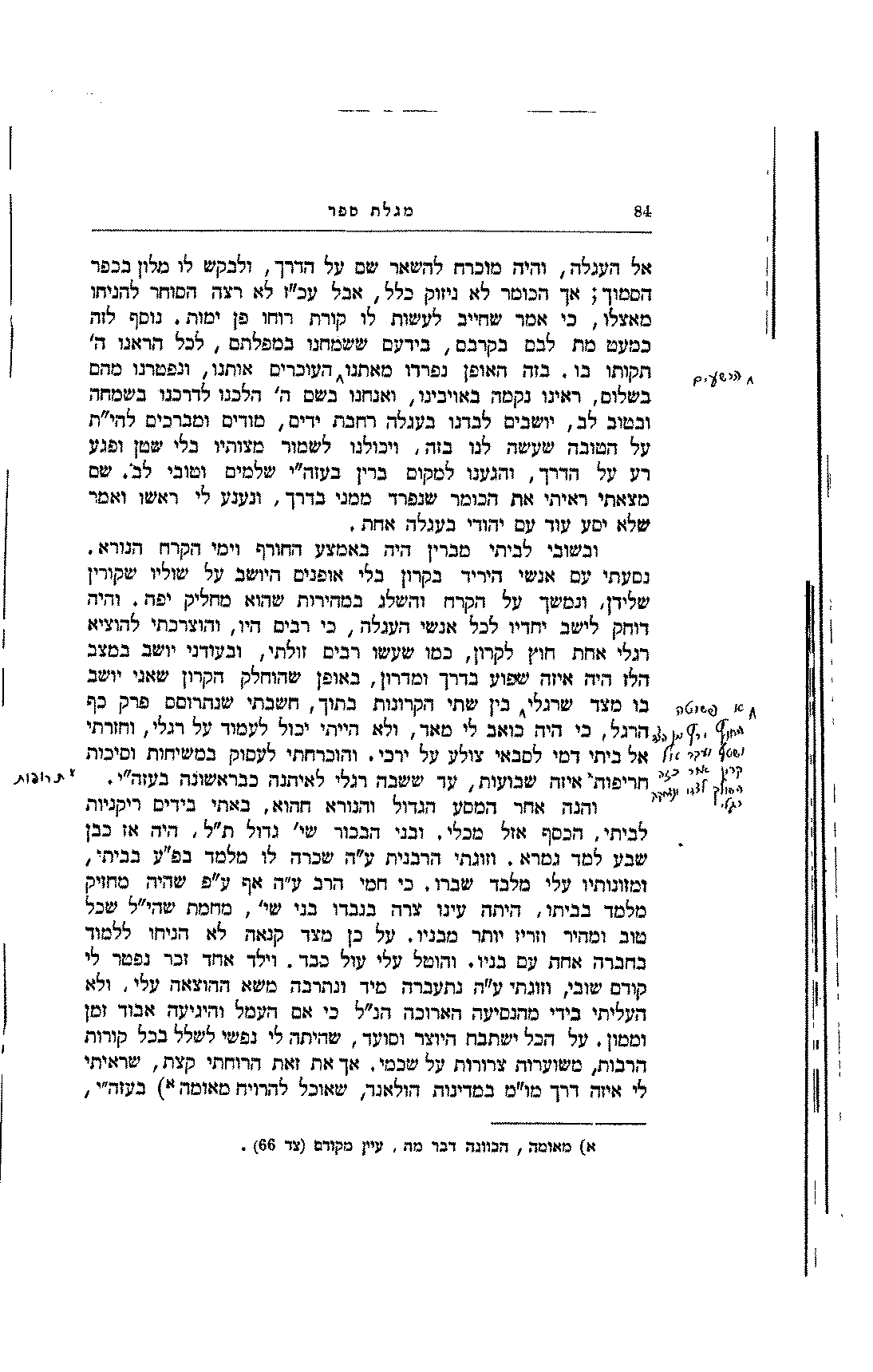
Margin readings in Scholem's copy (3)
| Printed anchor | Type (key sheet) | Mark | Reading | Certainty |
|---|---|---|---|---|
| נפרדו מאתנו ^ העוכרים אותנו | V: omission | caret; one word | הרשעים | fairly sure |
| שהוחלק הקרון שאני יושב בו מצד שרגלי ^ בין שתי הקרונות | V: omission | caret; 5-line note in right margin | ... פשוטה(?) / והחוק(?) ירוק מן ... / ושטף ועקר ... / קרון אחר כזה / ההולך לנגדו ונתחככה / רגלי | partial |
| במשיחות וסיכות חריפות x | X: substitution | x mark; one word | ורפואות(?) | uncertain |
Page 85 (scan 101)
and still be diligent at my studies. I tried sending goats' hair and wild goats' hair and the wool of the sheep of Hungary, which was white and very long and is not found in other countries. I bought such goods from the people of the holy community of Brod, who bring it from the lands of Hungary, and sent it to Amsterdam to an acquaintance there, who was in partnership with me in this. For the price of the money they sent me from there some goods that were good in Moravia and Hungary, which the people of that community [a], who travelled to Hungary, bought from me. I saw some good sign in these goods, and I could have stayed at home without great trouble in business in this way. But not many days passed before the price of these goods went down and fell greatly in Amsterdam, and a considerable amount was left lying there, which could not be sold even at a great loss — besides the money I had sunk with the people of Hungary who buy the hair and the wool there. I had advanced them money on account from time to time: for the money they had received from me they used to bring goods, and when they brought them to me I had to give fresh money for the future; and some of them kept the money by fraud and brought me nothing for my money.
Before I leave the land of Moravia in this story, I will tell, as is due, some of the great things the Blessed One did for me there, what I remember; for much I have forgotten, and it has gone from my mind at this time. First, in the matter of trade: at its beginning I called it "contention" (Gen. 26:20), for jealous people contended with me over it. A man from Germany rose against me from afar as an adversary, to settle in Brod; he bought a right of residence in the community, and he also bought the trade in the said hair from the authorities at a high price, on condition that no one else would be allowed to deal in this trade but he alone. Not only did he come from outside to my place to encroach on my border, but he wanted to stop me by force from dealing in this trade, and thought to inform against me to ruin me. The thing was already close to harming me, and it was not possible for me to stand against him. And behold, suddenly he fell ill with a hard illness, God save us, and died within a short time, soon after his coming and after taking a wife. He was a young man like a cedar, tall, mighty and very strong. May his death be his atonement. And the fear on every side was removed from me. After some time his wife, whom he had left a widow, after she had squandered what he left her, went round the towns and also passed through here, Altona.
Again a miracle happened to me with an apostate. While he was outwardly a Jew he pawned with me pledges of rings with precious stones; afterwards he converted there in Brod,
Kahana's notes
- [a] The abbreviation means "the said community".
ולשקוד על תלמודי, ונסיתי לשלוח שערות עזים ויעלים וצמר רחלים של ארץ הגר, שהיו לבנים וארוכים מאד, ואינן נמצאים בשאר מדינות. סחורה כזו קניתי מאנשי ק"ק ברודא, המביאים אותה ממדינות אונגרין. ושלחתיה לאמשטרדם ליד מכירי שם, שהי"ל שותפות עמי בזה, ובמחיר המעות שלחו לי משם איזה סחורות, הטובות בארץ מעררין ואונגרין, שקנו ממני אנשי קהנ"ל א, הנוסעים לארץ הגר, וראיתי קצת בסחורות הללו סימן יפה, והייתי יכול לישב בביתי בלי טרחה גדולה בעסק מו"מ באופן זה. אך לא ארכו הימים וירד שער הסחורות הללו, ונפל מאד באמשטרדם, ונשארו לי מונחים שם סך מסוים, שלא היו יכולים להמכר אפילו בהפסד מרובה. מלבד מה שתקעתי מעותי אצל אנשי מדינות הגר, הקונים שם השערות והצמר. והקדמתי להם מעות על יד כפעם בפעם, שבעד המעות שקבלו ממני היו רגילים להביא, ובהביאם אלי הייתי צריך לתת מעות מחדש על העתיד, גם קצתם החזיקו המעות בעושק ולא הביאו לי מאומה בעד מעותי. וקודם שאצא בסיפורי זה ממדינת מעררין, אספרה אל חוק מקצת גדולות שעשה עמדי הי"ת שם את אשר אזכור, כי הרבה שכחתי ויצא ממחשבתי בעת הזאת. ראשונה בענין מו"מ בתחלתו קראתי עסק, כי התעסקו עמי קנאים על הדבר הזה. וקם עלי איש אחד מארץ אשכנז ממרחק לשטן להתיישב בברודא, וקנה חזקת הקהלה. גם המו"מ של שערות הנ"ל קנה עמה מן השררה בדמים יקרים, על מנת שלא יהא אדם רשאי להסתחר במו"מ זה אלא הוא לבדו. ולא די שבא מן החוץ למקומי להשיג גבולי, אבל רצה למחות בידי בחזקת היד, שאמנע מלעסוק במו"מ הנ"ל, וחשב למסור אותי להפסידני, וכבר היה קרוב להדבר להזיקני, ולא היה אפשר לי לקום כנגדו, והנה פתאום לפתע נפל למשכב בחולי קשה ר"ל ונפטר בקוצר ימים, סמוך לביאתו ולנשיאתו אשה. והיה בחור כארז בעל קומה גבור ואמיץ כח מאד, תהא מיתתו כפרתו, ונסתלק ממני המגור מסביב. אחר איזה זמן באה אשתו שהניחה אלמנה, אחר שפזרה מה שהניח לה, סבבה בעיירות ועברה גם הנה באלטונא. שוב נעשה לי נס אודות מומר אחד שבהיותו כמו יהודי לעינים השכין אצלי משכנות של טבעות עם א"ט, אח"כ המיר שם בברודא,
- [א] ר"ת: קהל הנ״ל.
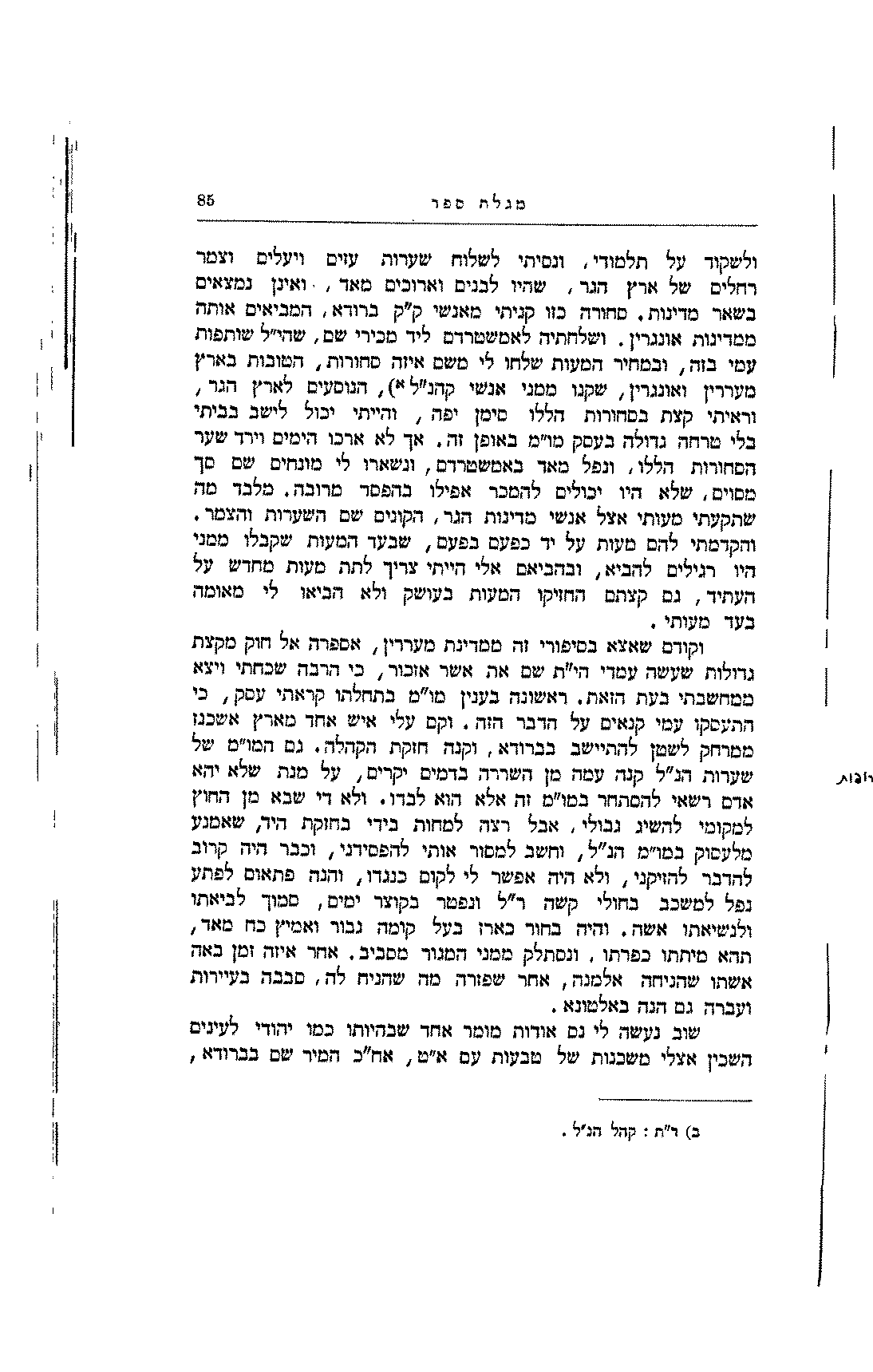
Margin readings in Scholem's copy (1)
| Printed anchor | Type (key sheet) | Mark | Reading | Certainty |
|---|---|---|---|---|
| על מנת שלא יהא אדם רשאי ... (line 21) | — | short note at scan edge (cut off) | - | not read (cut by scan edge) |
Page 86 (scan 102)
and then it became known that he had already been an apostate elsewhere, and had come to Brod in the guise of a rich Jew from the land of Bohemia. From what was heard at that time he was also a thief and a robber; he had acquired property, and his hands were sufficient for him; he fled and came to Brod to make a match and settle there. When his money was used up he converted again and went among the gentiles, and informed against me to the authorities there, as if he had a vast fortune with me. By the Lord's mercy on me I got out of this affair too in peace. Although I was sued in the courts, he could not take anything from me unlawfully; they let me take first what was due to me by my account, by the valuation they made of those pledges, and the rest I was to return to him; and so it was done. I lost nothing from my purse, thank God.
Another hard event passed over me there: I was in great danger of body and money, and the Lord brought me out into a broad place and delivered me from the fowler's snare. The matter was this. Once, after the said trade had collapsed, I received from Amsterdam the balance of my account from the said partnership. The bill of exchange was made out in the name of the provincial rabbi R. B., and he sent me a bill for that sum on his correspondent Gabriel Wimpfen in Breslau, to be paid there. I did not want to hand it to another person; I also thought that perhaps I could earn something with the money, through some goods that come from there. So I travelled with people of Moravia to collect the money of this bill.
When I came to the said Gabriel to claim my money, he said to me: "The money is ready; but I advise you to take instead goods — precious stones and pearls that I have; you can earn much with them in Moravia, and I will do you a favour and sell to you cheaply, for the sake of old love" — for his father had been a parnas in Amsterdam in my father's days — "and for the great affection known to me from him", according to his words and his promise. With this he stole my heart, especially as he seemed rich at the time; so I believed his deceitful words and relied very much on him and on the vision of his words, that he meant my good. For I had no knowledge or understanding at all of his goods, and I took from him at his valuation. By his account I remained owing him seventy-seven gulden beyond the amount of the bill he received from me in exchange for the goods, and I had to give him a bill for seventy-seven gulden, to be paid at a fixed time, for my heart trusted him that he would not deceive me.
But as soon as I left his house with his goods into the street of the city, I found merchants who understood these things, men of standing who truly loved me. I showed them what I had bought for money, as one who asks and takes counsel after the deed, for I was young in years and not experienced in trade at all. These men, who were at peace with me, rebuked me and said to me: "What have you done? Your 'friend' has deceived you: these are not worth half their price for a hundred Reichstaler, if even half; and a string of pearls, which are sold by weight, he sold you by number, so that it comes to a huge sum. So hurry, go back to him, return his goods to him and take your money."
ואז נודע שכבר היה מומר במ"א, ובא לברודא בחזקת יהודי עשיר ממדינת פיהם, ולפי הנשמע בעת ההיא היה ג"כ גנב ושודד, וקנה נכסים וידיו רב לו, וברח ובא עד ברודא לעשות שידוך ולהתיישב שם, וכאשר כלה מעותיו חזר והמיר דתו, והלך בין הנכרים, ומסר אותי אצל השררה שם, כאלו יש לו הון עתק אצלי. ובחמלת ה' עלי נפטרתי גם מזה העסק בשלום, אף כי נתבעתי בערכאות לא יכול להוציא מידי שלא כדין, רק הניחו לי לטול בראש מה שמגיע לפי חשבוני, בשומא ששמו אותן המשכנות, והמותר יחזיר לו וכן נעשה, ולא הפסדתי כלום מכיסי ת"ל עוד מקרה קשה עבר עלי שם, הייתי בסכנת גוף וממון גדול מאד, ויוציאני ה' למרחב ויחלצני מפח יקוש. הענין היה כי פ"א אחר שנתרועע מו"מ הנ"ל, קבלתי אח"כ מאמשטרדם דמי מותר חשבוני משותפות הנ"ל, והח"כ נעשה על שם הרב מדינה ר"ב והוא שלח לי ח"כ מהסך ההוא על קרושפנדענץ שלו גבריאל ווימפפא בברעסלוי שישלם שם, ולא רציתי למסרו לאדם אחר, גם חשבתי אולי אוכל להרויח איזה דבר עם המעות, ע"י איזה סחורה הבאה משם, ונסעתי עם אנשי מעררין לגבות מעות הח"כ הלז, וכשבאתי אצל גבריאל הנ"ל לתבוע מעותי, אמר לי המעות מוכנים כבר, אך איעצך וקח תמורתו סחורה א"ט ומרגליות שבידי, תוכל להרויח בהם הרבה במדינת מעררין, ואני אעשה עמך בטובה למכור לך בזול לסבת אהבה ישנה - כי אביו פו"מ באמשטרדם בימי אמ"ה ז"ל - ולחבה יתירה נודעת לי ממנו, לפי דבריו והבטחתו, ובזה גנב לבבי, כפרט שהיה נראה אז כעשיר, על כן האמנתי לדברי מרמתו, וסמכתי עליו ועל חזון דבריו מאד שלטובתי נתכוון, כי אני לא היתה לי ידיעה והבנה כלל בסחורותיו, ולקחתי ממנו כפי שויתו, ולפי חשבונו נשארתי חייב לו ע"ז זהובים, יותר על סך דמי הח"כ שקבל מאתי תמורת הסחורות, והוצרכתי לתת לו ח"כ על סך ע"ז זהובים, לפרוע לזמן ידוע, כי היה לבי בטוח בו שלא ירמה אותי; אכן מיד כצאתי מביתי עם סחורותיו אל רחוב העיר, ומצאתי אנשים סוחרים מבינים בדברים הללו והם מסוימים ואוהבים באמת, הראיתי להם מה שקניתי בדמים, כשואל ונמלך אחר מעשה, כי הייתי רך בשנים ולא בקי בעניני מו"מ לגמרי, והאנשים האלה שלמים אתי, גערו בי, וא"ל מה זאת עשית? כי רמה אותך איש שלומך, שאין שוין חצי דמיהם בעד מאה ר"ט, לוא היה החצי, וחרוזת של מרגליות הנמכרות במשקל, מכר לי במספר שיהיה עולה לסך רב ועצום, בכן מהר ושוב אליו והשב לו סחורותיך וקח מעותיך.
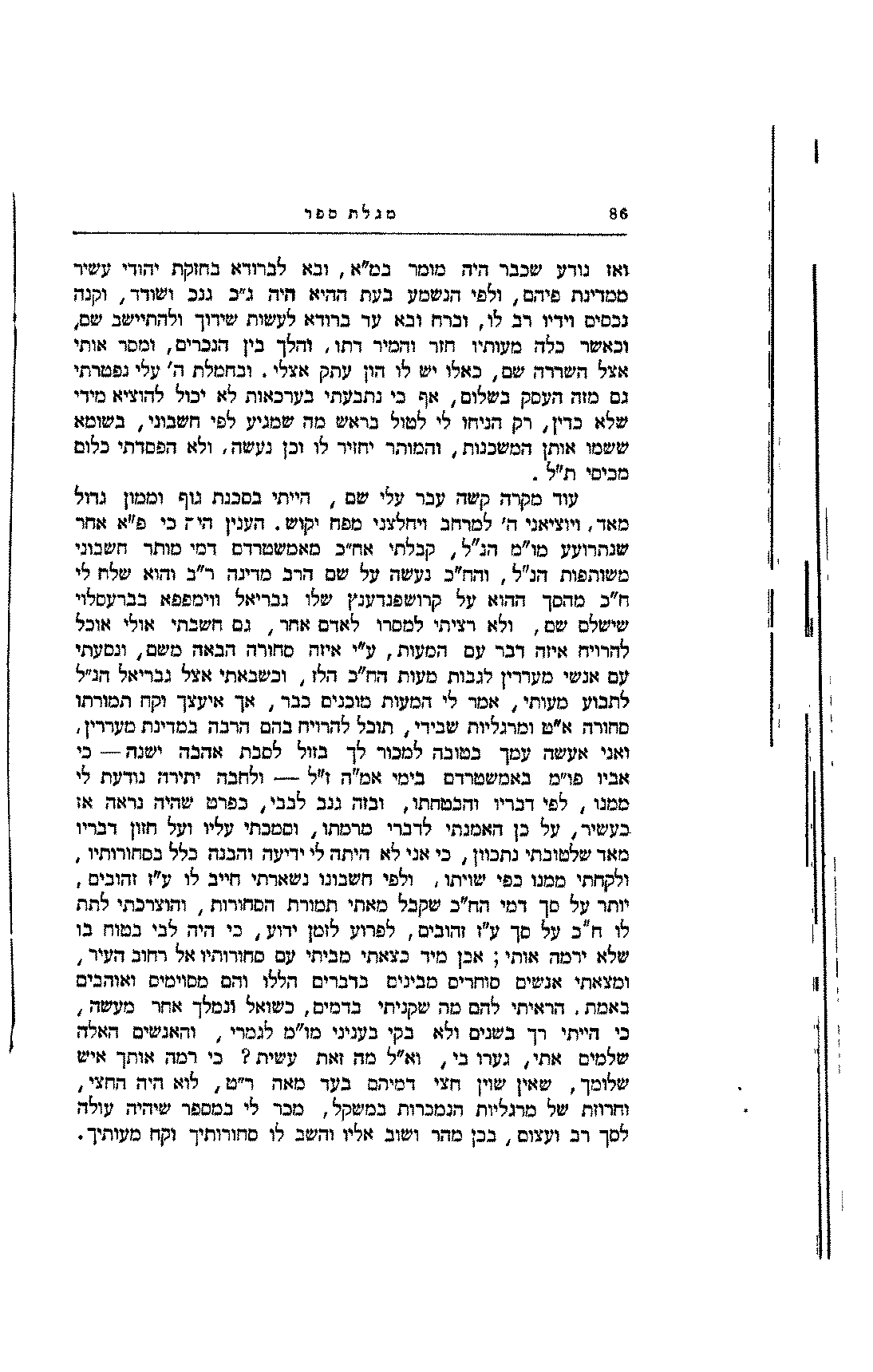
Page 87 (scan 103)
So I did: I turned back on my steps and wanted to return them to him and take my money; for I had understood from his words that the choice was mine to cancel the sale as I wished, since I had relied on his words alone. It seemed a simple thing to me that he would agree to take back his goods and give me my money, for what had I done to him? He lost nothing by it. But I was wrong in my reckoning: when I came to him with these words, "his ear was uncircumcised" to hearing; for he said, what is done cannot be undone. I cried out like a crane: "Did you not promise me that you meant my good? Now I do not want your 'good' against my will!" — "we cried, take back your favours" — and no one paid attention, for his hand was strong there, and who can go to law with one stronger than himself? Then I understood that he was a man of iniquity and deceit; and his end showed that his hand was already failing. When I saw that he was stronger than me, I went my way.
I went home loaded with such goods, for others too had become jealous of him and gave me such goods on credit. His brother too made himself out to be doing me a kindness, to benefit me, and sold me goods on credit, in the name of brotherhood ⟨S: a note, not read⟩, as said. When I reached home it became clearly known to me that "my lovers deceived me" (Lam. 1:19). So the goods I had taken from his brother I sent back at once, and the bill I had given for them was returned to me. But Gabriel's goods, for which my money was in his hands, could not be returned, as said; it was already with him "stolen goods that have been eaten". I had to seek ways and means somewhat strange to me, and "counsels from afar", to dispose of them, for they came to a considerable sum — all I had was sunk in them — besides what I had bound myself to pay him, as said.
I spoke with merchants of Hungary and showed them the goods, and they promised to act for me, to search the land for buyers for such things, which are not "quick to sell". A broker toiled and found a lord in Hungary who wanted to see these things in order to buy them. So he urged me to travel there myself to complete the sale quickly. Out of great need I agreed to set out, over mountain passes doubly dangerous: both because of the high mountains and crooked paths that I had never tried before, and a people I did not know, whose speech I did not recognise and whose language I did not know; and because of the robbers ⟨S: perhaps "the bandits"⟩ there among the mountains, "who are like wild beasts".
From all these I escaped with God's help; but another very dangerous bear attacked me. I avoided the customs on the advice of my broker, who assured me that he knew the roads and would lead me safely by a place where the hand of the customs guards in Hungary would not reach me — for the customs yoke there is great and heavy, especially on precious things like jewels and Galanterie, which they can value as they wish, and one cannot stand against them. So I listened to that man's advice, thinking he was sure of it, and that no sin would befall me in this as I crossed the border. I took with me all the said goods, and I added everything else I had of precious
וכן עשיתי, חזרתי על עקבי ורציתי להחזירם לו ולקחת מעותי, שכך הבנתי מדבריו שהברירה בידי לבטל המקח כרצוני, מאחר שסמכתי על דבריו בלבד, והיה דבר פשוט בעיני, שיתרצה לקבל סחורותיו בחזרה ולתת לי מעותי, כי מה עשיתי לו ולא הפסיד בזה מאומה; אבל טעיתי בחשבוני, כי בבואי אליו בדברים האלה, היתה אזנו ערלה משמוע, כי אמר מה שנעשה אין להשיב, וצוחתי ככרוכיא: הלא הבטחתני שלטובתי נתכוונת, ועתה איני רוצה בטובתך בעל כרחי, צווחנא שקילא טיבותיך כו ולית דמשגח, כי היתה ידו תקיפה שם, ומי יוכל לדון עם מי שתקיף ממנו; אז הבנתי כי הוא איש עול ומרמה, וסופו הוכיח שכבר מטה ידו, וכראותי כי חזק הוא ממני, הלכתי לדרכי. שבתי לביתי טעון בסחורות כאלו, כי גם אחרים נתקנאו בו, והקיפוני בסחורות כאלה. גם אחיו של הנ"ל הראה עצמו כמתחסד עמי להנות אותי, ומכר לי בהקפה מצד אחוה כנ"ל. ובהגיעי לביתי אז נתוודע לי עוד בבירור, שמאהבי המה רמוני. לכן הסחורות שלקחתי מאחיו שלחתי מיד בחזרה והוחזר לי ח"כ שנתתי בעדם, ואך הסחורה של גבריאל שהיו מעותי בידו, לא היה אפשר בחזרה כנ"ל, וכבר היה אצלו גזל הנאכל, והוצרכתי לבקש דרכים ואופנים זרים קצת אצלי, ועצות מרחוק לעשותם, כי היו עולים לסך מסוים, כל אשר לי תקוע בהם, ונוסף עליהם מה שהתחייבתי לו כנ"ל, ודברתי עם סוחרי ארץ אונגרין והראיתי להם הסחורות, והבטיחוני לעשות את שלהם, לתור את הארץ לבקש קונים לחפצים כאלה, שאינם חריפא זבינא. והיה סרסור אחד שיגע ומצא שר אחד בארץ הגר, שחשק לראות דברים הללו לקנות, בכן הרהיבני ליסע בעצמי לשם כדי לגמור המקח מהר. ומפני הצורך הגדול הסכמתי לכך לשום לדרך פעמי, במעברות הרים המסוכנים מאד בכפלים, הן מצד ההרים הרמים, וארחות עקלקלות אשר לא נסיתי מתמול שלשום, ואל עם אשר לא ידעתי, ושפה אחרת לא הכרתי, ולא ידעתי לשונם, והן מצד השודדים, שם בין ההרים כחיותא מתילי. ומכל אלה נמלטתי בעזה"י, אך נתגרה בי דוב אחר מסוכן מאד, כי העברתי את המכס בעצת הסרסור שלי, שהבטיחני שהוא בקי בדרכים, ויוליך אותי בטח במקום שלא תשיג אותי יד שומרי המכס באונגרין, כי רב הוא וכבד עול המכס שם, ביחוד על דברים יקרים כא"ט וגלאנטריע, שיוכל לשום אותן כחפצו, ואי אפשר לעמוד; על כן שמעתי לעצת האיש ההוא, כמדומני שהוא מובטח בכך, שלא יקרני עון בדבר הזה בעברי על הגבול, ולקחתי בידי כל הסחורות הנ"ל, גם צרפתי כל אשר היה בידי עוד מחפצים
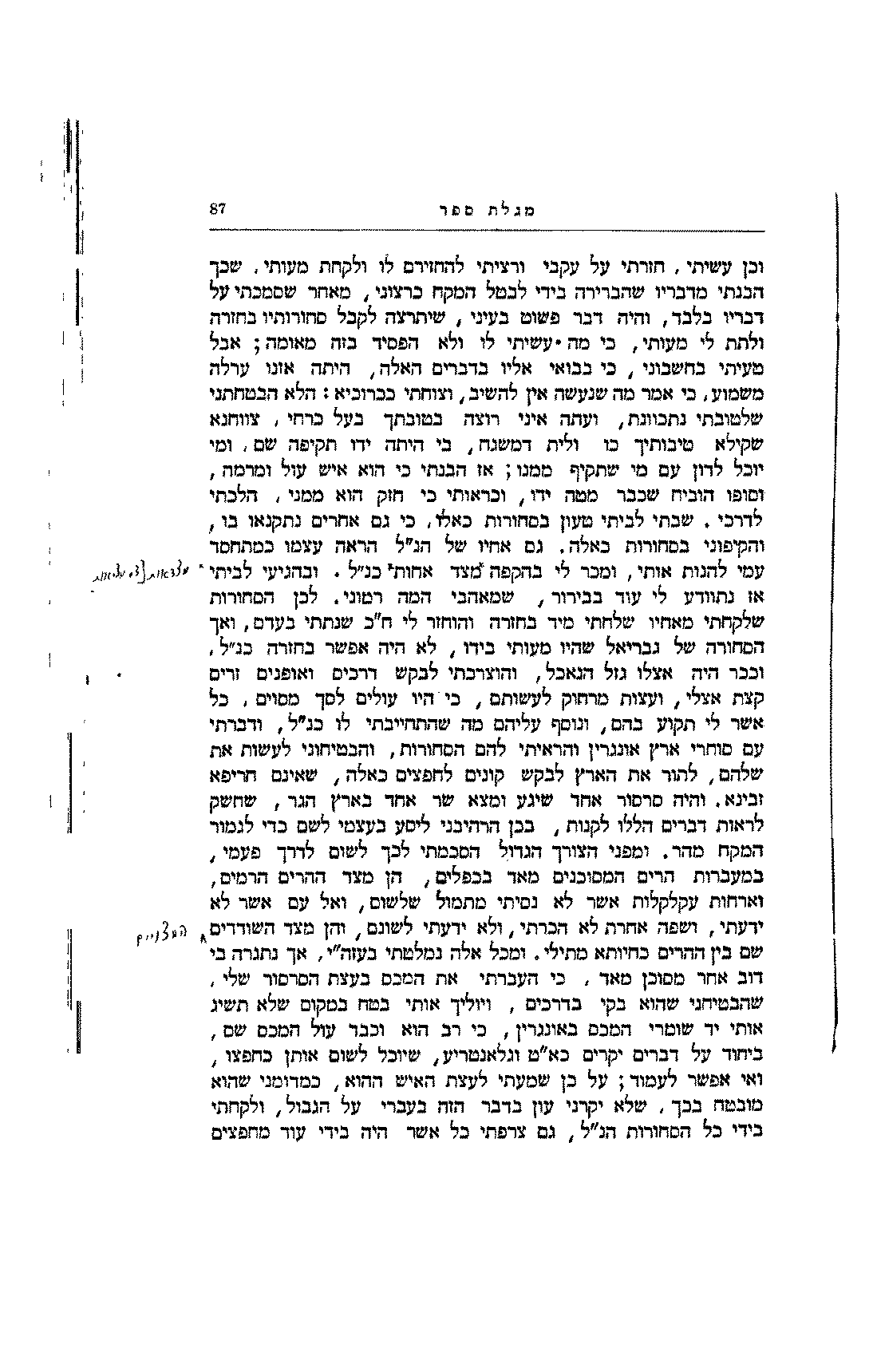
Margin readings in Scholem's copy (2)
| Printed anchor | Type (key sheet) | Mark | Reading | Certainty |
|---|---|---|---|---|
| ומכר לי בהקפה מצד אחוה x כנ"ל | X: substitution | x mark; 2-word note | not read | not read |
| והן מצד השודדים ^ שם בין ההרים | V: omission | caret; one word | הגזלנים(?) | uncertain |
Page 88 (scan 104)
things, and crossed into Hungary as far as the place of that lord who, according to the broker, wanted to buy my goods; and he promised me that I would gather handfuls of blessing for my goods. When I thought I had already reached a safe place, the matter became known to the great customs officer there. He sent his servants after me to seize me; and so they did: they took me and beat me, and brought me and all I had to the customs house. I begged him to forgive me, for I did not know the custom of the country and had never travelled this way; I was innocent of sin, and for a first time he ought to have pity on me. Throwing myself before him, I begged him to settle with me as was fitting, and I would pay. But he set his eyes on the money, and thought to swallow it all, or at least half or a third of the business, as is the law of customs officers.
Then I spoke a little harshly to him and said: "Know that you will not profit by this, for I too have powerful people at the seat of judgement, the city of Pressburg; when the matter comes there, they will stand at my right hand." The customs officer was a German; he wrote down all the words I said to him, and "like the deaf adder he stopped his ear". He said to me: "There is no other way before me but that the matter come to judgement in the said royal city; as the judges there decide, so it will stand." He went there himself with the goods he had taken from me, to bring his claims against me; and I went by this dangerous road, and at great expense came to Pressburg.
I lodged in the house of my relative the rabbi R. Moses, who had been head of the yeshivah in Lwów and was then living in Pressburg, married to the daughter of R. L. Mokhiaḥ. This man Moses did me good in this affair with all his heart. I was in his house from before Passover until after Shavuot, all the days until my judgement came to light, and he honoured me greatly. And it seems that from ⟨S: "Heaven it was"⟩ this affair, by deep counsel, events were rolled in this way, and He drew me with cords of man to come there for another, hidden purpose.
For while I was in the said rabbi's house he revealed to me in secret how an unclean thing had happened. Before I came there, a traveller had passed through, coming from Prague from Eybeschütz's yeshivah, and in his hand libellous writings of this man ⟨S: perhaps "of a heretic"⟩. At that time, through the efforts of the head of the court of Prague with the leaders of Vienna, those returning from Prague and bringing with them ⟨S: "the princes used to invite scholars and preachers of(?) students who were not fit"⟩ writings of their master's novellae were searched; and so it was done with this man in Pressburg, a short time before I came there. The community's beadles suddenly searched the traveller's room, opened his chest and found the manuscript book of A. Sh. [a] ⟨S: a note, partly read: "the treatise(?) famous in the world, called …"⟩, whose opening is: "And I came this day to the fountain" (Gen. 24:42). This book was handed to the said rabbi R. Moses; and when I came there he revealed to me in secret that it had been given to him to examine, and that the things found in it looked strange and astonishing. But he did not know and was not expert
Kahana's notes
- [a] The abbreviation means Eybeschütz.
קרים, ועברתי בארץ הגר עד מקום השר ההוא, אשר לפ"ד הסרסור היה חושק לקנות סחורות שלי, והבטיחני לאסוף מלא חפנים ברכה בעד סחורותי; וכאשר חשבתי שכבר הגעתי למקום בטוח, נתודע הדבר למוכסן הגדול שם, ושלח אחרי משרתיו לתפשני, וכן עשו ולקחוני והכוני, והביאוני וכל מה שבידי אל בית המכס, והתחננתי לפניו, שימחול לי כי לא ידעתי מנהג המדינה, ולא הלכתי בדרך זו מעולם, נקי אני מעון, ופעם ראשון ראוי שיחמול עלי, ובהתנפלי לפניו התחננתי אליו, שיתפשר עמי כפי הראוי ואתן, אבל הוא נתן עיניו בממון, וחשב לבלוע הכל או לפחות חציו או שלישיתו של העסק כדת המוכסנים. אז דברתי אליו קצת קשות, וא"ל תדע כי לא תרויח בזה, כי יש לי ג"כ אנשים תקיפים במקום המשפט עיר פרעשבורג, כשיבוא הדבר לשם המה יעמדו לימיני, והיה המוכסן אשכנזי, ורשם כל הדברים שדברתי אליו, וכפתן חרש יאטם אזנו. וא"ל: אין דרך אחר לפני כי יגיע הדבר למשפט בעיר המלוכה הנ"ל, וכאשר יפסקו הדין השופטים שם כן יקום. והוא הלך בעצמו לשם עם הסחורות שלקח ממני, להגיש עצומותיו נגדי, ואנכי הלכתי בדרך מסוכנת זו, ובהוצאות מרובות באתי לפרעשבורג, ונתארחתי בבית מחו' הרב מ' משה שהיה ר"י בלבוב. ובעת ההיא דר בפ"ב נשוי בתו של ר"ל מוכיח; זה האיש משה היטיב עמי בעסק זה בכל לבבו, שהייתי בביתו מן קודם פסח עד לאחר עצרת, כל הימים עד שיצא משפטי לאור, כבדני כבוד גדול. וכנראה מן העסק הלז בעצה עמוקה לגלגל הדברים באופן זה, ומשכני בחבלי אדם לבוא לשם לתכלית אחר נעלם. כי הנה בהיותי בביתו של הרב הנ"ל גלה אלי בחשאי, איך קרה מקרה בלתי טהור, טרם בואי שמה נזדמן לשם עובר אורח, בא מפראג מישיבה של אייבשיצר, ובידו כתבי פלסתר מהאיש הלזה, ואז בהשתדלות האב"ד מפראג עם קציני ווינא, השבים מפראג ומביאים עמהם כתבי חדושי רבם, לבדוק אחריהם, וכן נעשה עם הנ"ל בפרעשבורג, איזה זמן קצר לפני הגיעי לשם, באו שמשי הקהל חפשו חדרו של האורח הנ"ל פתאום, פתחו ארגזו ומצאו הספר כ"י של א"ש א, פתיחתו: ואבוא היום אל העין, ונמסר הס' הלז בידו של הרב ר' משה הנ"ל, וכבואי שמה גלה אלי בסתר, כי נתן אליו הס' כ"י הלז לבדוק, והדברים הנמצאים בו נראים זרים ותמוהים, אך הוא אינו יודע ובקי
- [א] ר״ת: אייבשיץ.
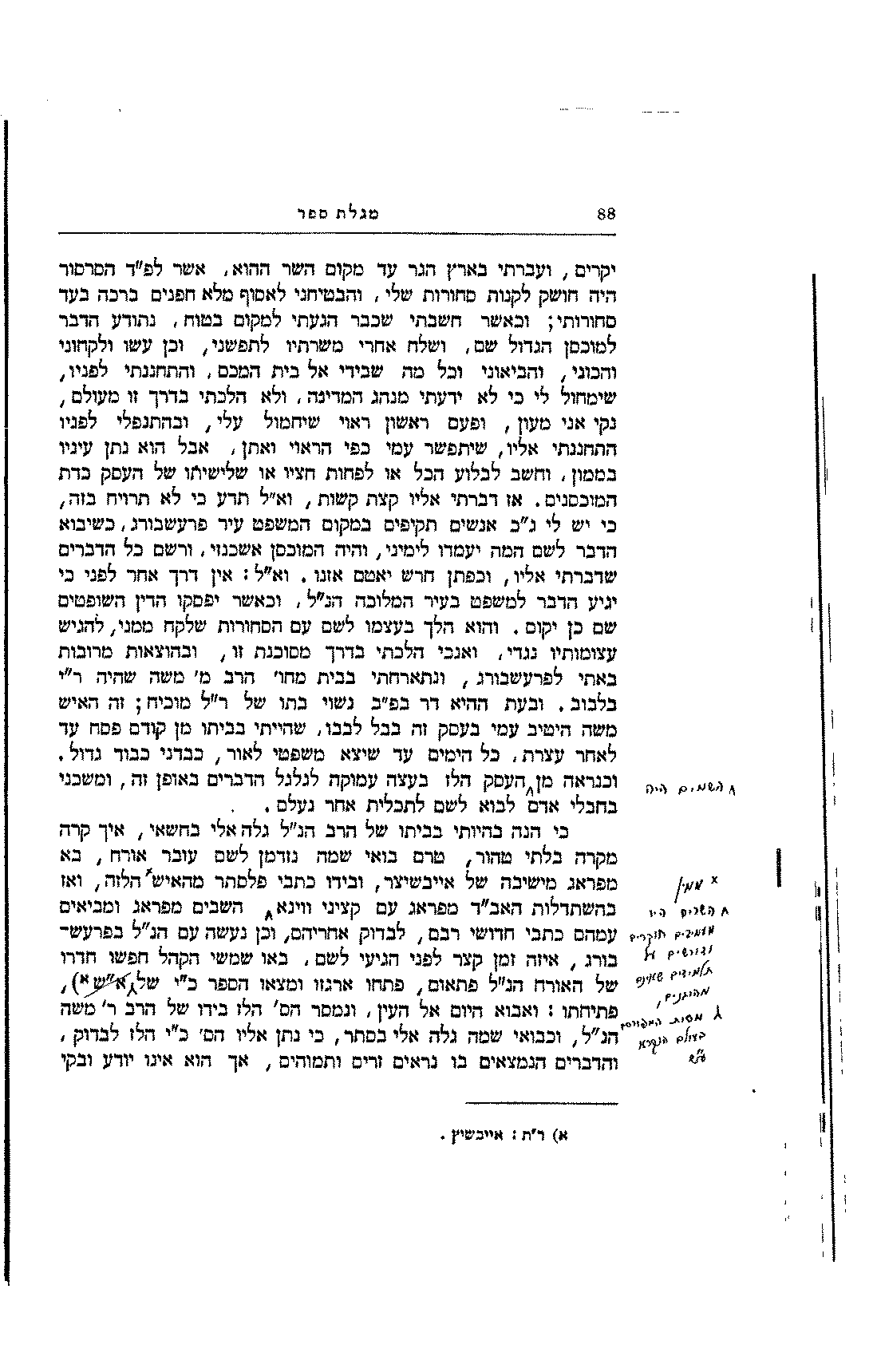
Margin readings in Scholem's copy (4)
| Printed anchor | Type (key sheet) | Mark | Reading | Certainty |
|---|---|---|---|---|
| וכנראה מן ^ העסק הלז | V: omission | caret; 2-word note | השמים היה | fairly sure |
| כתבי פלסתר מהאיש x הלזה | X: substitution | x mark; one word | ממין(?) | uncertain |
| עם קציני ווינא ^, השבים מפראג | V: omission | caret; 5-line note in right margin | השרים היו / מזמינים חוקרים / ודורשים של(?) / תלמידים שאינם / מהוגנים | fairly sure |
| הספר כ"י של א"ש א) ^ | V: omission | caret; 3-line note (the title of the manuscript) | מסות(?) המפורסם / בעולם הנקרא / ... | partial |
Page 89 (scan 105)
in matters of Kabbalah; so [he was not] a judge in this matter. Therefore he entreated me, as one who takes counsel, and asked me what should be done with it according to law: whether to reveal it publicly, or to condemn it to burning or to hiding away. He handed it to me to study and learn its nature, and as I should assess it, so it would stand: "the decision is upon me" — though I was then in my early youth, tender in years, and had not even the beginning of a beard.
I agreed to his request, took the said manuscript [a] from his hand, studied it and "passed between its pieces"; and the hair of my flesh stood up as I read two or three columns of it, from the great blasphemies and revilings and the perversion of the words of the living God in the secrets of Kabbalah ⟨S: "a book of heresy and apostasy"⟩. So I told the said rabbi that there was no doubt that it ⟨S: "he was not known, and not known at his death, as a heretic and apostate in the world"⟩ certainly required burning; and with this I advised him not to publicise the matter, for I judged that no benefit would come of it, but rather harm, as I have already written in Torat ha-Kena'ot [b].
From then on I knew with complete certainty that this man Eybeschütz was a bear lying in wait ⟨S: "may the name of the wicked rot"⟩ for Judaism, an aḥer — "Aḥer, Yehonatan Eybeschütz" — in secret. The thing entered my heart like the venom of a serpent, though I hid the matters within me, for I had no strength, because of my youth. Also, he had not signed his name on the book, and I knew he would deny the known and say that it was not his work, since his name was not expressly called on it in the body of the manuscript; and his students who brought it in their hands to spread it quietly hide the author's name in public and reveal it only to the men of their secret. It was not possible to set anything right at that time, so I kept silent and kept the matter; and it was abominable to me to hear the mention of Eybeschütz ⟨S: "the heretic"⟩.
Now, at this time, when the Blessed One has occupied me in the war of the commandment, to wrestle with him, I set my mind to the said incident, and understood that ⟨S: "there the Levite …, the troubler of Israel"⟩ "this was from the Lord" for this purpose: the Blessed One brought me to Pressburg only for this — that I was brought here to be shown the abominations of this man ⟨S: "the apostate"⟩. That was the main thing. I will tell you further what happened afterwards to the said rabbi; but first I will tell the end of the matter of avoiding the said customs, which was also with great kindness.
The Blessed One provided me there with an honoured man named R. Daniel, of blessed memory. He was an intercessor in such matters himself, and did many good things for our people ⟨S: "my nation"⟩, the children of Israel, to save their property, for he had a hand and a name in the courts there. So he did good to me and took up this commandment with all his heart, and spent a long time on this affair — especially as those were the days of the court sessions, and he could not eat until several hours
Kahana's notes
- [a] Emden tells the same in Torat ha-Kena'ot (p. 86), and further on there, in his letter to the gaon R. David Oppenheim (p. 88) of 7 Kislev 5486 [1725], he says: "When the Lord brought me by some cause to the holy community of Pressburg before last Passover", etc.
- [b] There (pp. 88, 91), and in Hit'avkut (fol. 1), Lemberg printing.
בעניני קבלה, על כן ]לא אדון הוא בדבר הזה, ולכן חלה פני כנמלך בי, שאלני כדת מה לעשות בו, אם יגלהו בפרסום או ידון אותו בשרפה או בגניזה, ומסרו בידי לעיין בו לידע מה טיבו; והיה באשר אעריך אותו כן יקום, כי עלי דידי קסמיך בהא, עם היותי אז בימי חרפי רך בשנים, לא הי"ל אפילו התחלת צמיחת זקן. נעתרתי לבקשתו ולקחתי מידו הס' כ"י הנ"ל א, ועיינתי בו ועברתי בין בתריו, ותסמר שערת בשרי בקראי בו שתים שלש דלתות, מרוב החירופים וגידופים והפוך דא"ח בסתרי קבלה. על כן אמרתי להרב הנ"ל, שאין ספק שהוא טעון שריפה בודאי, ועם זה יעצתיו שלא לפרסם הדבר, כי שערתי שלא יצא תועלת, כי אם קרוב להפסד, וכמ"ש כבר בס' "תורת הקנאות" ב. ומן אז והלאה ידעתי בבירור גמור, שזה האיש אייבשיצר, דוב אורב הוא להיהדות, אר"י (אחר יונתן אייבשיץ) במסתרים, ונכנס הדבר בלבי כארסו של עכנאי, אע"פ שצפנתי הדברים בקרבי, כי לא עצרתי כח לפי ילדותי, גם לא החתים שמו על הספר, וידעתי שיכחיש הידוע ויאמר שאינו מעשה ידיו, כי על כן לא נקרא שמו עליו בפירוש בגוף הכ"י : גם תלמידיו המביאים אותו בידיהם להפיצו בלאט מעלימים שם המחבר בפרהסיא, ואינן מגלין אלא לאנשי סודם. ולא היה אפשר לתקן שום דבר בעת ההוא, לכן החרשתי ושמרתי את הדבר, והיה נתעב אצלי לשמוע זכר אייבשיצר. ועכשיו בעת הזאת שהטרידני הי"ת במלחמת מצוה, להתאבק עמו, אז נתתי אל לבי המקרה הנ"ל, והבנתי כי מאת ה' היתה זאת בשביל כך, ולא הביאני הי"ת לפרעשבורג כי אם דווקא על אודות זה, למען הראותי תועבות האיש הלז הובאתי הנה, זה היה העיקר. עוד אשמיעך מה שקרה אחר זה להרב הנ"ל, רק תחלה אספר סוף הענין של העברת מכס הנ"ל, שהיה ג"כ בחסד גדול. והנה המציא לי הי"ת שם אדם נכבד שמו היה ר' דניאל ע"ה, הוא היה שתדלן עצמי בענינים האלה, ופעל כמה טובות לעמנו בני ישראל להציל את שלהם, כי היה לו יד ושם בערכאות שם; וכן עשה בטובה עמי והתעסק במצוה זו בכל לבבו, וזמן רב כלה בעסק זה, בפרטות שהיו שם ימי המשפט, לא היה יכול לסעוד עד כמה שעות
- [א] וכן יספר יעב"ץ כזאת בס' תורת הקנאות (צד פ"ו), וכן שם להלן במכתבו להגאון ר' דוד אופנהיים (צד פ"ח) מן ז' כסליו שנת תפ"ו, יאמר: בהזדמן ה' אותי ע"פ סבה בק"ק פ"ב קודם פסח העבר, וכו' .
- [ב] שם (צד פ"ח, צ"א) ובס' התאבקות (דף א') דפוס לבוב.
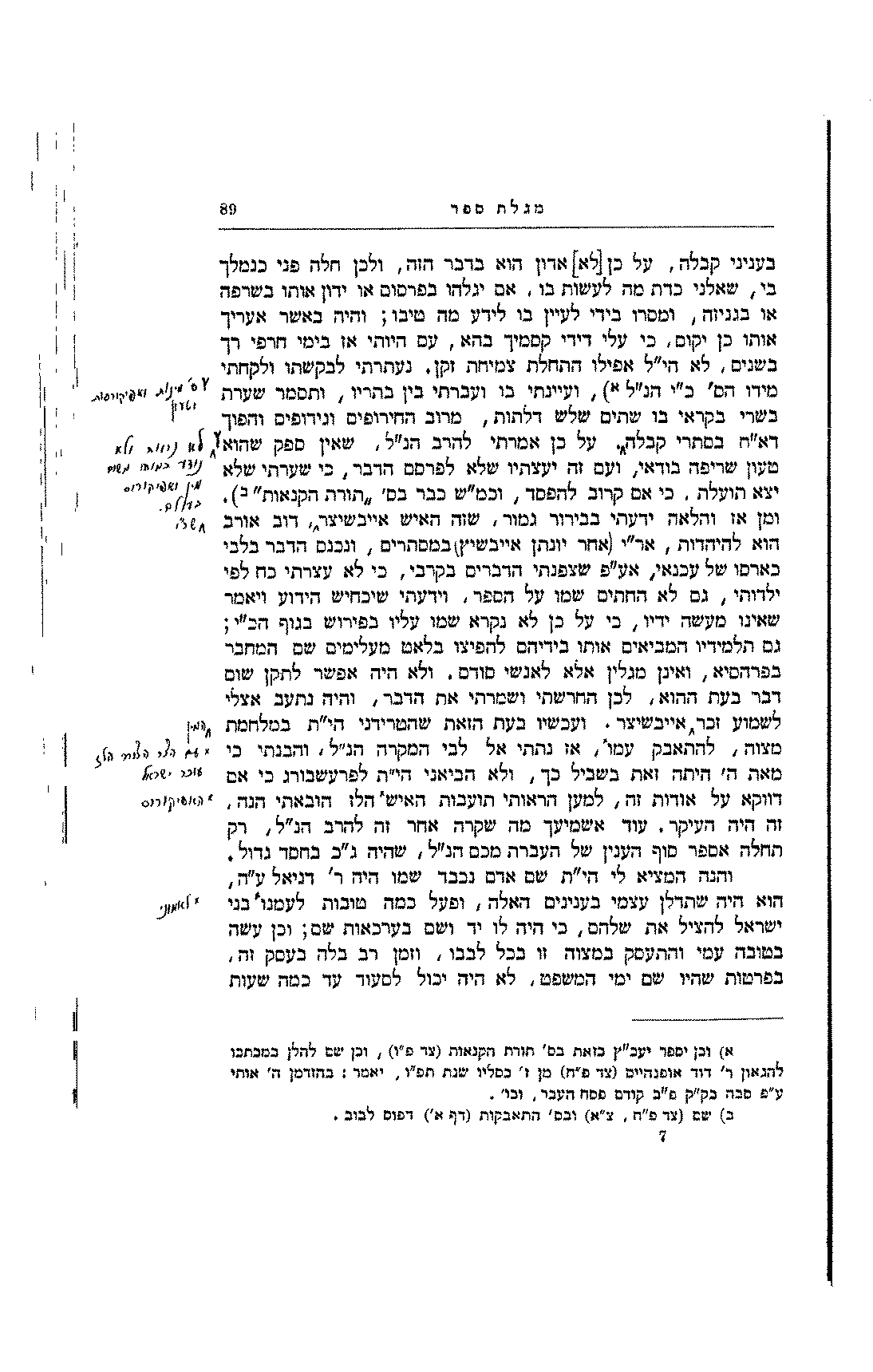
Margin readings in Scholem's copy (7)
| Printed anchor | Type (key sheet) | Mark | Reading | Certainty |
|---|---|---|---|---|
| מרוב החירופים וגידופים והפוך דא"ח ^ בסתרי קבלה | V: omission | caret; 2-word note | ס' מינות ואפיקורסות / וטעון(?) | fairly sure |
| שאין ספק שהוא x טעון שריפה בודאי | X: substitution | x mark; 5-line note | לא נודע ולא / נודע במותו משום(?) / מין ואפיקורוס / בעולם | fairly sure |
| דוב אורב x הוא להיהדות | X: substitution | x mark; one word | שר"י | fairly sure |
| זכר אייבשיצר ^ | V: omission | caret; one word | המין | fairly sure |
| והבנתי כי ^ מאת ה' היתה זאת | V: omission | caret; 2-line note | שם הלוי ה... / עוכר ישראל | partial |
| תועבות האיש x הלז | X: substitution | x mark; one word | האפיקורוס | fairly sure |
| טובות לעמנו x בני ישראל | X: substitution | x mark; one word | לאומי | fairly sure |
Page 90 (scan 106)
after midday; he was as one who fasts every day, for he had to go to the court and knock on their doors — both with requests, pleas and intercession with each of the lords, at whose doors he came early, and by giving bribes in advance and asking advice. Some of them were found for him and granted his request through conciliation and bribes, and some were not men of bribes. He also left all his own affairs and did not rest or keep quiet until he brought my case to light. He took me to the lords whom I had to bribe: there was only one on whom the matter depended, and I myself gave him six ducats; and for this he taught me and put in my mouth the words I should say in the court when I stood against the customs officer to answer his words. So I did. The said important man did not move from my side, to support me in preparing the answer of my tongue and to help me so that my arguments should not be blocked. I answered the customs officer boldly — though he too was an official — before the lords sitting on the seats of judgement, and spoke harshly to him for having wronged me. So my case came out to the light, and I won judgement: everything the customs officer had taken from me was returned to me; nothing was missing, thank God, without any gain of money, except what I wrote of to the said man. The customs officer went out ⟨S: a word, perhaps "trapped"⟩ mourning and with his head covered, and lost much from his own purse in the expenses of the road; and his mounted servants who had caught me and taken me and my money all toiled in vain.
The said honest man, the intercessor R. Daniel, of blessed memory, took no benefit from me for all his great trouble over a long time. Truly I have not found his like, to engage in such intercession with all his heart, losing much time for nothing. May his righteousness stand for ever for him, his sons and his household; I will never forget the deeds he did for me, though he was a stranger and had never known me, only through the recommendation of the said rabbi, who also did me the kindness of hospitality. Other people too, who had influence with the judges, did not refrain from interceding for me; also a lady leader, who had a hand with the lords, exerted herself in this. But the said upright man gave his soul to the matter, as said.
Even so I had great expense on the road, for it was long, and in the delay and the return, which came to a considerable sum. Nor did I know what to do with the goods, for I had been much cheated in them, as said, and nothing was left in my hands with which to go home. I had already agreed to exchange them for other goods, lower and poorer than them, in the mistaken thought that perhaps they would be "quick to sell", although I would be forced to lose much of the capital, for my goods were "merchandise that lies on the hands of its owner". But in truth, had I completed the trade by exchange, as the adviser advised me in his opinion — and I was not experienced in trade — then surely this second business would have been much worse than the first. What did the Holy One, blessed be He, do? While I was busy with this, valuing the things I would receive in exchange for my goods from one of the traders of Lud(?), and we were busy together examining the two kinds of goods to put a price on them, as we had already agreed,
אחר חצות היום, והיה כמו מתענה בכל שבת, שהיה צריך לילך למקום הערכאות, ולדפוק על פתחיהם, הן בבקשות ותחנונים והמליצות אצל כל אחד מהשררות שהיה משכים לפתחם, הן בהקדמת נתינת שוחד ושאלת עצות, שקצתם נמצאו לו ונעתרו לבקשתו ע"י פיום ושוחד, ובקצתן שלא היו בעלי שוחד. והניח גם כל עסקיו ולא נח ולא שקט עד שהוציא לאור משפטי, והוליכני אל השררות אשר הוצרכתי לשחדו, היה אחד בלבד שבו היה הדבר תלוי, ונתתי לו בעצמי ששה דוקאטין, ובשכר זה למדני ושם בפי הדברים שאדבר בבית המשפט, כשאעמוד נגד המוכסין לענות על דבריו, וכן עשיתי; והאדם חשוב הנ"ל לא זז מצדי, לתמוך בידי להכין מענה לשוני, ולסעדי שלא יסתתמו טענותי. ועניתי עזות להמוכס, עם היותו ג"כ שררה, בפני השררות היושבים כסאות למשפט, ודברתי עמו קשות על שהעביר עלי הדרך, בכן יצא משפטי לאורה, וזכיתי בדין להחזיר לי את שלי, כל מה שנטל ממני המוכסן לא נעדר דבר ת"ל, בלי שום בצע כסף, רק מ"ש להנ"ל, והמוכס יצא אבל וחפוי ראש, והפסיד מכיסו הרבה בהוצאות הדרך, ומשרתיו הרוכבים שהשיגוני ולקחו אותי וממוני כולם יגעו לריק. והאיש כשר הנ"ל השתדלן ר' דניאל זכור לטוב לא נהנה ממני שום דבר בעד כל טרחתו הגדולה זמן רב. באמת לא מצאתי כמוהו שיעסוק בהשתדלות כזו בכל לבבו באבוד זמן הרבה לחנם, צדקתו תעמוד לעד לו ולבניו וב"ב, לא אשכח לנצח מעשיו אשר גמל עמי, עם היותו נכרי ולא הכיר אותי מעולם, רק ע"פ המלצת הרב הנ"ל, שגמל עמי טובה באכסנאי ג"כ. וכן בני אדם אחרים שהי"ל הצד אצל בעלי המשפט לא נמנעו מלהמליץ בעדי, גם אשה קצינה אחת השתדלה בזה שהי"ל יד אצל השררות, אך האדם הישר הנ"ל מסר נפשו על הדבר כנ"ל. עכ"ז הי"ל הוצאה רבה בהליכת הדרך כי רב הוא, ובעיכוב וחזרה שעלה לסך מסוים. גם לא ידעתי מה לעשות עם הסחורות כי נתאניתי בהם הרבה כנ"ל, ולא נשאר בידי מאומה במה לחזור לביתי. וכבר הייתי מסכים להחליפם על סחורות אחרים, יותר שפלים ופחותים מהן, במחשבה מוטעת אולי יהיו חריפא זבינא, אע"פ שאהיה מוכרח להפסיד הרבה מהקרן, כי סחורות שלי היו זבינא דרמי באפי; אבל באמת אם הייתי גומר המו"מ בחליפין, כאשר יעצוני היועץ לפ"ד, ואנכי לא הייתי בקי במו"מ, אז ודאי היה המו"מ השני הלז גרוע הרבה יותר מהראשון; מה עשה הקב"ה? והנה בהיותי עוסק בכך, להעריך החפצים שאקבל תמורת סחורות שלי מאחד מתגרי לוד, והיינו טרודים יחד לעיין בשני מיני סחורות לשום אותן בדמים, באשר כבר הסכמנו,
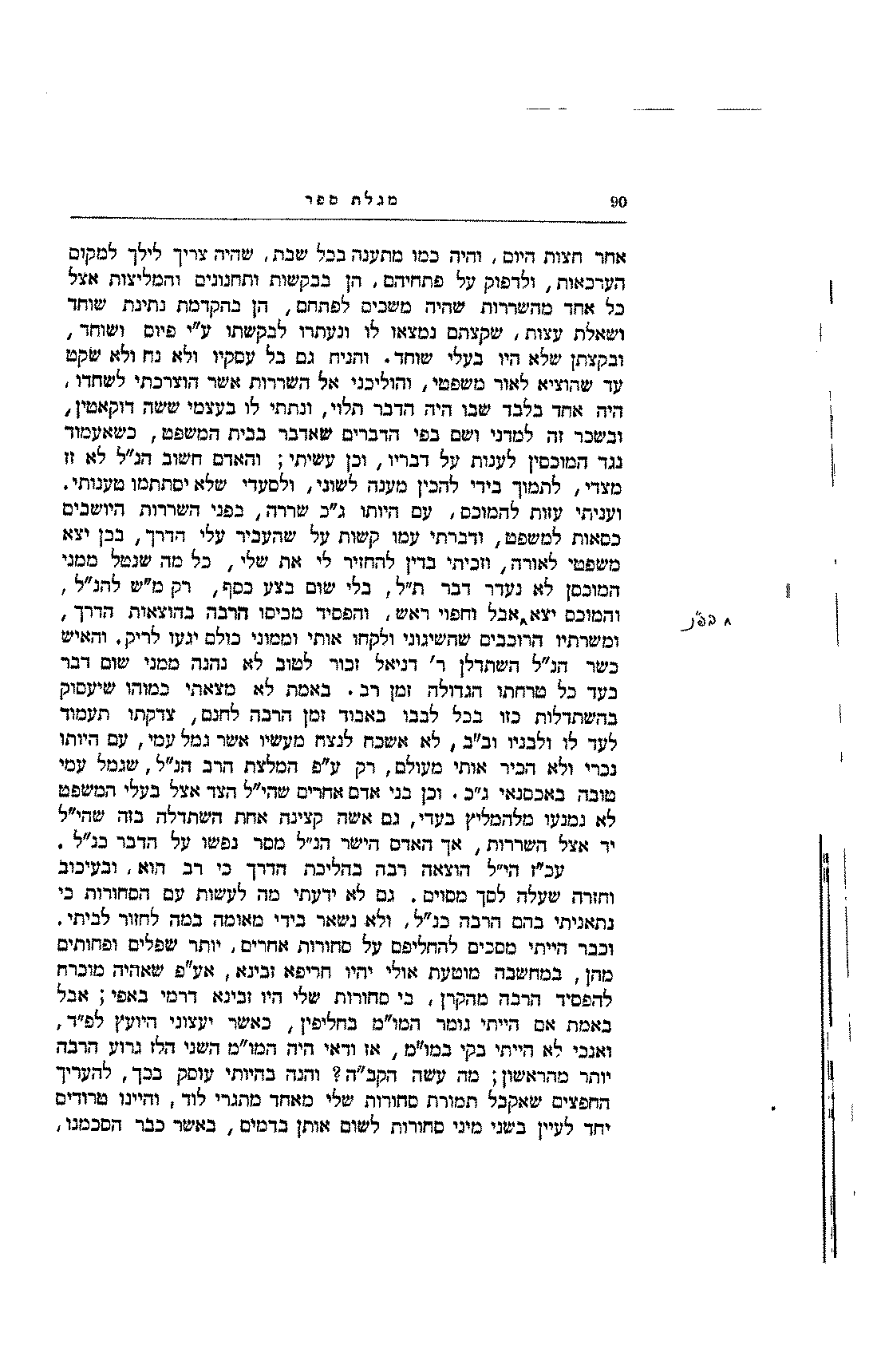
Margin readings in Scholem's copy (1)
| Printed anchor | Type (key sheet) | Mark | Reading | Certainty |
|---|---|---|---|---|
| והמוכס יצא ^ אבל וחפוי ראש | V: omission | caret; one word | בפח(?) | uncertain |
Page 91 (scan 107)
and only the details of the valuation and the account were lacking — while I was in this state I stood by the window of the room in the upper storey, looking out at the street to see the passers-by, without any purpose, only for the breeze of the day, for it was summer. I saw a man running fast and looking at the house where I was lodging. When he saw me "peering through the lattice", he called to me: did I still have the goods? For he had seen them with me some days before, and had said that he knew a buyer for them, only I should wait for him some days, for he had to go back to his place and ask his lord whether he still needed them. Because the time had passed beyond the date he had set, and also our acquaintances had told me that he was not reliable, I had made no more account of him, "after I had waited till I was ashamed", and I had agreed to exchange good for bad, as said.
But the Blessed One saw my affliction. At that very moment, when the trade was almost completed, I looked out of the window, as said, without any thought of this; even when I saw him he looked at me, and I did not recognise him until he called aloud and spoke to me, and reminded me that he was the man who had been with me eight days before, had seen my goods and promised to find buyers for them. And so he succeeded, and the Lord provided for him as he had said, to buy from me for a certain sum in ready money. At once the said exchange was cancelled, and I sold to him at a price double what the exchanging trader had valued them; so that I brought home with me "a handful of quietness", after all the great sorrow and the loss of time and money, and this thing restored my soul a little. Blessed is He who does good to the guilty!
Even so I carried back with me many more of the goods, which were not fit to be sold there or in Moravia, and I had to send them with a great [merchant] to Holland too, and there they were sold with great difficulty. Blessed is the Helper!
And even so I was not entirely rid of the said bad business that happened to me in Hungary. For the Jewish broker, who had been the cause of all the said evil, on whose words and promises I had crossed that land by the said dangerous road, made a new confusion for me after I escaped from Hungary. His pretext was a false charge: the lord of his place had wanted to buy some of the goods I had, and I could not come to terms with him, and I left him in peace and, as it seemed, in friendship. After some time, while I was sitting securely at home, this broker brought me to judgement before the Jewish court in Brod and held on to what was mine — I had entrusted him with a certain sum — and would not pay me; for he claimed that he had suffered loss because of me with his lord, who demanded that he provide him at all costs with those goods on which he had set his eyes when I was there. What he could not dare do while I was in his power — to demand that I give him against my will — now he made a false charge, to take much from him for nothing. He came at me indirectly, and I had to settle with him and pay what I did not owe. These are the edges of the ways of kindness and mercy that the Blessed One did for me, according to His mercy and the abundance of His kindness,
והיו מחוסרין רק דקדוק רשומא והחשבון; בעודי במעמד הזה נצב אצל חלון החדר בעליה, והייתי מביט אל הרחוב לראות עוברים ושבים בלי שום השגחה, רק לרוח היום כי עת קיץ היה, וראיתי איש רץ מהר ומסתכל אל הבית שאני מתארח בו, ובראותו אותי מציץ מן החרכים, קרא אלי האם יש עוד הסחורות בידי, כי הוא ראה אותם לפני איזה ימים אצלי, ואמר שיודע להם קונה, רק שאמתין עליו איזה ימים, שצריך לחזור למקומו ולחקור אצל שררה שלו, אם עדיין נצרך להם, ולפי שעבר הזמן יותר מן המועד אשר יעדו, גם אמרו לי מכירינו דלאו בר סמכא הוא, לכן לא עשיתי עוד חשבון ממנו, אחר שהוחלתי עד בוש, ונתרציתי להחליף יפה ברע כנ"ז; אך השי"ת ראה בעניי, ובאותו רגע שכמעט נגמר המו"מ, השגחתי מן החלון כאמור בלי שום מחשבה על זה, אפילו כשראיתיו גם הביט אלי, ולא הכרתיו עוד עד שקרא בקול ודבר עמדי, והזכירני כי הוא האיש שהיה אצלי לפני שמונה ימים, וראה סחורה שלי והבטיח למצוא לה קונים, וכן עלה בידו והזמין לו ה' כאשר אמר, לקנות ממני בעד איזה סך במעות מזומנים, ומיד נתבטל עסק החליפין הנ"ל, ומכרתי לזה בדמים יקרים כפלים ממה שהעריכם התגר המחליף, באופן שהבאתי עמי מלא כף נחת לביתי, אחר כל הצער הגדול ואבוד זמן וממון, והיה לי הדבר הזה משיב נפש קצת. יתברך הגומל לחייבים טובות! מ"מ נשאתי בידי עוד הרבה מהסחורות, שלא היו ראוים למכור שם ולא במעררין, והוצרכתי לשלוח ]סוחר[ אחד גדול גם להולאנד, ושם נמכרו בדוחק גדול. ברוך העוזר! ואף גם זאת לא פלטי מכל וכל מעסק ביש הנ"ל שקרה לי באונגרין. כי היהודי הסרסור הנ"ל שהיה סבה לכל הרעה הנ"ל, שעל פי דבריו והבטחותיו עברתי בארץ ההיא בדרך מסוכנת הנ"ל, עשה לי בלבול חדש אחר שנמלטתי מארץ הגר. ותשובתו היתה דרך עלילה, כי השררה שבמקומו רצה לקנות ממני איזה מהסחורות שבידי, ולא יכולתי להשוות עמו, ונפטרתי ממנו בשלום ובחבה לפי הנראה, ואחר עבור זמן מה ואני יושב בביתי לבטח, הגישני האיש הסרסור זה, אל המשפט בב"ד של ישראל בברודא, והחזיק בשלי, שהאמנתיו איזה סך רשום, ולא רצה לפרוע לי, כי טען שהיה לו היזק בעבורי אצל השררה שלו, שתבע ממנו להמציא לו עכ"פ הסחורה ההיא, שנתן עיניו בה בהיותי שמה, מה שלא היה יכול להעיז בהיותי ברשותו, לבקש ממני לתת לו בע"כ, עכשיו הוא מעליל עליו לטול ממנו הרבה בחנם. ובא עלי בעקיפין והוצרכתי להתפשר עמו, ולשלם מה שלא הייתי חייב. הן אלה קצות דרכי החסד והרחמים, שעשה לי השי"ת כרחמיו וכרוב חסדיו
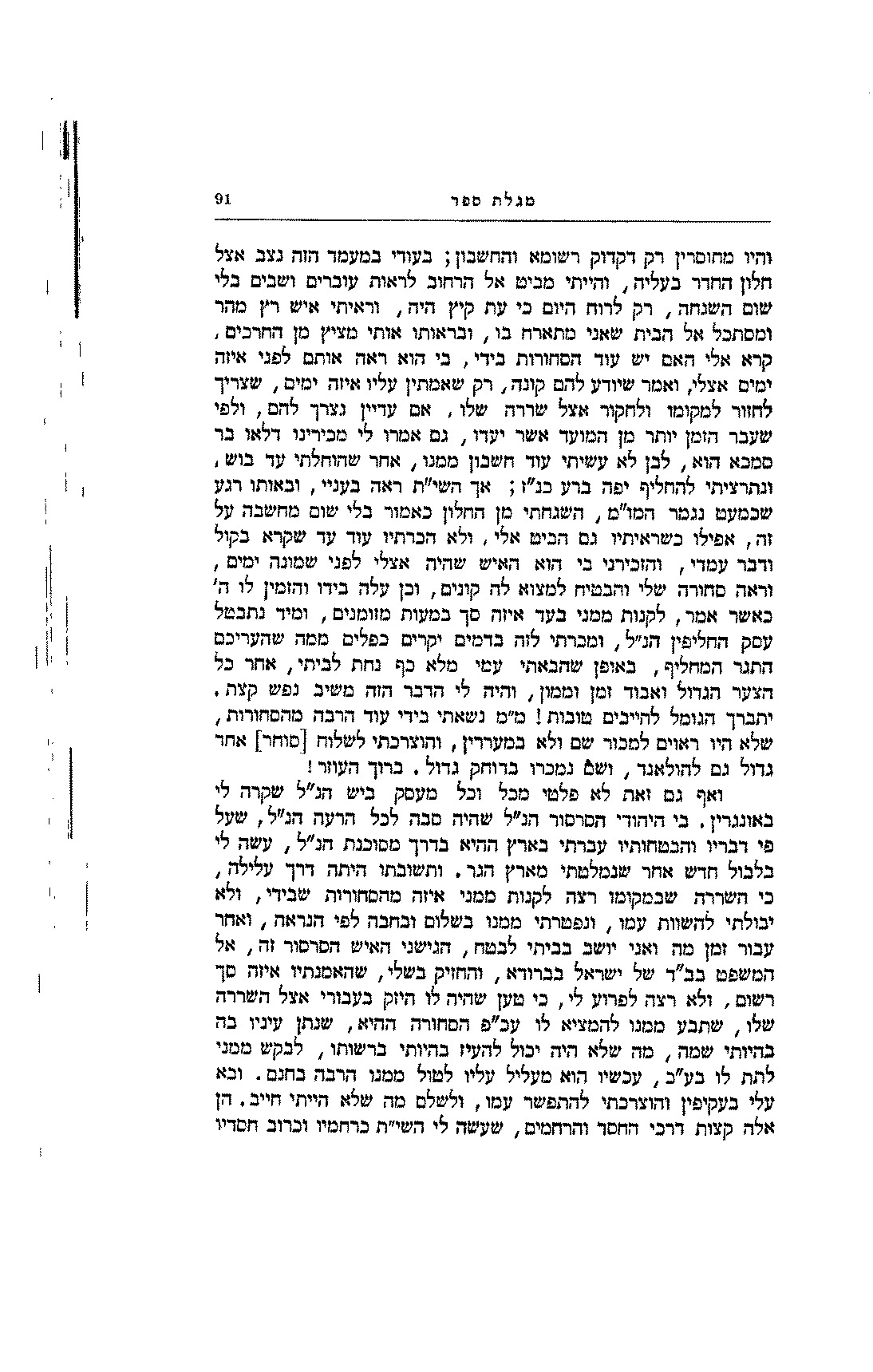
Page 92 (scan 108)
in the land of Moravia. I have much more to tell, but most of it has gone from my mind, and I cannot direct my thoughts at this time to tell them all in order as they were; the book would also become very long. So I will be content with "the little that holds the much", as an example. From many evil and lasting illnesses the Blessed One saved me there, and also from many jealous people, Jews and gentiles ⟨S: "and the uncircumcised, to distinguish [between them]"⟩; from all of them He rescued me. Although in truth I was very well liked — not only in the holy community of Brod were most of the members of the community loving me as their own soul and blessing themselves by me, because of my conduct and my deeds that brought me near, thank God, as said — still there was no lack of jealous people and "lovers of bribes" (Isa. 1:23). I was cheated ten times over too: one man sold me a chain of copper at the price of gold, and I did not know it until I came here to Altona; here the forgery became known. For in truth I had shown it before I bought it to several experts, and they all tested it on the touchstone and said that it was pure gold, for it was plated with a little gold.
In all that country too my name was great, like the name of the great. The head of the court, the provincial rabbi R. G., of blessed memory [a], set his eyes on me to seat me at the head of one of the communities; and I did not bend my shoulder to bear the yoke of a rabbinate. In the end, at that time new decrees of His Majesty the emperor were issued there in the lands of Bohemia and Moravia; his hand lay heavy on our brothers, the children of Israel, in the matter of the marriages of sons and daughters, besides many other hard and evil decrees; so that I saw the affliction of my people very wretched in that country. I said in my heart: it is forbidden to live there. I decided to uproot my home from there and return to the land of my birth, without relying on any position of livelihood, only on my trust in my Maker that He would not forsake me.
And I cast behind my back a great thing. Some leaders of Vienna, without my knowledge, offered of their own accord to fix for me an ample livelihood, about twelve Reichstaler a week, every week, and bound themselves for several years, so that I could sit at home studying Torah without pressure and without worry. I would not have needed even half that allowance, for I was still young in years and my household small; and in that country living is cheap, so I could have easily saved more than half of the said sum, to put away for a time of need. They did this of their own initiative alone, without having seen me or known me face to face; only by report was my name great in Vienna too. The rabbi R. ⟨S: a name, perhaps "Leizer"⟩ Deichs, of blessed memory, told me that when he was in Vienna he heard from the mouth of the famous rabbi and magnate R. Samson Wertheimer [b] that he had once heard of me, and that he would say: "I will not rest until
Kahana's notes
- [a] He is the rabbi R. Gabriel Eskeles son of R. Judah Leib, who died in 5478 [1718]; see the text of his tombstone in Kevutzat Ḥakhamim (p. 118), and Edut be-Ya'akov (fol. 3b), and the memoirs of Glückel of Hameln (p. 321).
- [b] He is the rabbi and magnate R. Samson Wertheimer, who died on 17 Av 5484 [1724]; see about him the book Simson Wertheimer by Prof. D. Kaufmann.
בארץ מעררין. אלה הי"ל לספר הרבה, אלא שרובם יצאו ממחשבתי ולא אוכל לכוון דעתי בעת הזאת ולספרם כולן כסדרן כהוייתן, גם יארך הספר מאד, ע"כ אסתפק במועט המחזיק את המרובה לדוגמא. ומכמה חלאים רעים ונאמנים הצילני השי"ת שם, וכן מכמה קנאים יהודים ונכרים, מכולם מלטני. אע"פ שבאמת חביב הייתי מאד, ולא לבד בק"ק ברודא היה רוב בני הקהל אוהבים אותי כנפשם ומתברכים בי כפי מנהגי ומעשי קרבוני ת"ל כנז'. מ"מ לא חסרו ג"כ מקנאים ורודפי שלמונים, ונתאניתי ג"כ עשרת מונים, ואחד מכר לי שלשלת נחושת במחיר הזהב, ולא נודע לי עד שבאתי הנה לק"ק אלטונא; בכאן נודע הזיוף לפי שבאמת הראיתיה מקודם שקניתיה לכמה מבינים, וכולם בחנו אותה על אבן המבחן, ואמרו שהוא זהב טהור, שהיתה מצופה בזהב קצת. גם בכל המדינה שם היה גדול שמי כשם הגדולים, והגאב"ד רב מדינה מוהר"ג ז"ל א נתן עיניו בי להושיבני בראש באחת הקהלות, ולא נטיתי שכמי לסבול עול רבנות. סוף הדברים בפרק ההוא נתחדשו שם גזרות הקיר"ה במדינת פיהם ומעררין, כבדה ידו על אחינו ב"י בענין שדוכי הבנים והבנות, זולת שאר גזרות קשות רבות ורעות, באופן שראיתי עני עמי מרודה מאד באותה מדינה; אמרתי אל לבי אסור לדור שמה, והסכמתי בדעתי לעקור דירתי משם, ולשוב אל ארץ מולדתי, בלי סמיכה ממעמד פרנסה, כי אם בטחוני על קוני אל יעזבני, והשלכתי אחרי גוי דבר גדול: איזה קציני ווינא התנדבו אלי, מבלי ידיעתי, לקבוע לי מעמד פרנסה בריוח, כעשרה כי"ב ר"ט לשבוע מדי שבוע בשבוע, ונתחייבו על כמה שנים, כדי שאוכל לישב בבית ללמוד תורה, שלא מדוחק ובלי דאגה, ולא הייתי צריך אפילו למחצית מעמד ההוא, כי עדיין הייתי רך בשנים וביתי מצער, וגם במדינה ההיא שהפרנסה בזול, והייתי יכול להרויח בשופי יותר מחצי הסך הנ"ל, להצניעו לעת הצורך, ועשו זה מהתעוררותם בלבד מבלי שראו אותי ולא הכירוני פא"פ, רק מפי השמועה היה גדול שמי גם בווינא. וא"ל הרב כמו' דייכש ז"ל שבהיותו בווינא שמע מפי הרב הגביר המפורסם ר"ש ווירטהיים ב, שא"ל פ"א ששמע ממני, ושהיה אומר: לא אנוח עד
- [א] הוא הרב ר' גבריאל עשקלס בר' יהודה ליב, ונפטר בשנת תע"ח עיין נוסח מצבתו בס' קבוצת חכמים (צד קי"ח), ועיין בס' עדות ביעקב (דף "ג ע"ב), ועיין בס' זכרונות מרת גליקל האמיל (צד שכ"א).
- [ב] הוא הרב והגביר ר' שמשון ווערטהיים נפטר בי"ז אב שנת פד"ת, עיין אודותיו בספר: שמשון ווערטהיימער שחבר הפראפֿ' ר"ד קויפמאנן נ"י.
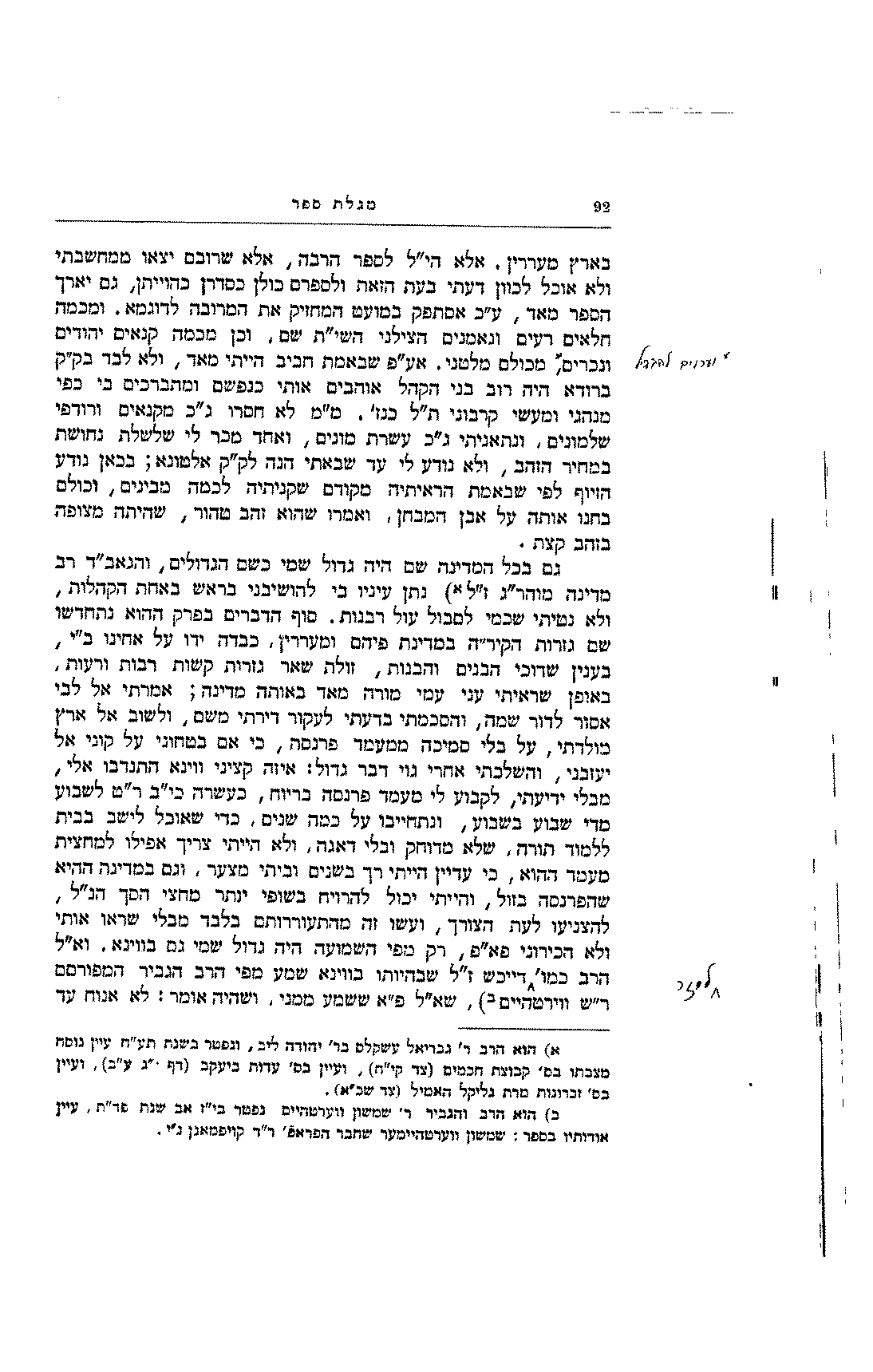
Margin readings in Scholem's copy (2)
| Printed anchor | Type (key sheet) | Mark | Reading | Certainty |
|---|---|---|---|---|
| וכן מכמה קנאים יהודים ונכרים x | X: substitution | x mark; 2-word note (Kraken: וארוים להבדיל) | וערלים להבדיל | fairly sure |
| הרב כמו' ^ דייכש | V: omission | caret; one word | ליזר(?) | uncertain |
Page 93 (scan 109)
I see him made rich." A few days later R. Samson, of blessed memory, died. Also the leader R. M. Pizrang(?) once wanted to take me into his house, and promised that I would earn at least a thousand Reichstaler a year; and I did not want to sit at other people's tables. Also, when I was in Pressburg because of the said affair, important people who loved me pressed me to travel with them to Vienna — it is not far, only a little more than a day's journey — and I could easily make up what I had lost in Pressburg, for I had many and powerful friends in Vienna who had always wanted me. I made their word as nothing, for it was very strange to me to benefit from flesh and blood as a gift. And even though I longed to see the city of Vienna, and moreover the opportunity to go there without expense and with great honour, I refrained from this too, for fear of the Catholic priests who carry the idol through the streets of Vienna, as is known, so that whoever meets them puts his life in danger. So I never saw the city of Vienna at all.
With all this I had many friends there who made me a livelihood, as said, without my having courted or flattered any of them, in writing or by mouth. They actually did it: suddenly they sent me a sum in broken gold, and I accepted it once, at that time, which was a time of distress for me; and I saw that it was from the Lord to bring me my bread [a] [at that time through them. But several times] I cast away such and such. For in my own place, Brod, many wanted to fix a livelihood for me, so that I would dwell with honour among them. The provincial rabbi R. G. also desired my honour; he praised me and revealed his mind several times that he wanted to do me good with eagerness; also in a letter to me he showed me great affection. None of this counted with me.
I also left behind of my own a considerable sum in Moravia in debts, which I had in the hands of several people on bonds, especially what I had given in the trade in hair, as said. A certain sum was also sunk for me in the trade in hair that I had sent to Amsterdam on my own account to the hand of my kinsman R. A. N.; it lay there for some time "like a stone that no one turns over". So I set out first by myself and passed the long road as far as Amsterdam, and did not benefit from any leader even a meal. Even when I was in Dresden and the leader R. Jonah of Dresden pressed me to dine with him, I made his word as nothing; all who saw and heard were amazed at the humility he showed me, and that he could not persuade me, and they said they had never seen a guest refuse so great and powerful a leader. I will not dwell on the many terrible hardships that found me on that hard road, for they are past counting.
I also passed through Hanover. At that time the head of the court of Prague was there, for the wedding that his son, the rabbi of Holešov, made for his daughter, who married the son of the leader
Kahana's notes
- [a] Here a few words are missing in the manuscript, and I have completed them from the context.
שאראה להעשיר אותו, ולימים מועטים נפטר כמוהר"ש ע"ה, וגם הק' ר"מ פיזרנג שרצה פ"א לקחת אותי לביתו, ונדר לי להרויח עכ"פ אלף ר"ט לשנה, ולא חפצתי להסב על שולחן אחרים. גם בהיותי בפרעשבורג ע"פ המאורע הנ"ל הפצירו בי אנשים חשובים אוהבים, שאסע עמהם לווינא, כי לא רחוקה רק כמהלך יום קצת, ואוכל למלא חסרוני בקל מה שהפסדתי בפ"ב, כי יש לי אוהבים רבים ועצומים בווינא, שחפצים בי מימיהם, ושמתי לאל מלתם, כי היה זר לי מאד ליהנות מב"ו בתורת נדבה, ואפילו שהייתי חושק לראות המקום ווינא, ובשגם הסמיכות לבוא שמה בלי הוצאה ובכבוד גדול, נמנעתי מזה גם כן לפחדי מפ"ר של הכומרים הקתולים מוליכי הפסל ברחובות ווינא כנודע, שמסתכן בנפשו הפוגע בהם, לכן לא ראיתי המקום ווינא כלל. ועם כל זה היו לי אוהבים רבים שם שעשו לי מצב פרנסה כנ"ל, מבלי שפייסתי ולא רצותי לאחד מהם לא בכתב ולא בע"פ, ועשו בפועל, פתאום שלחו אלי סך מסוים דהבא פריכה, וקבלתי פ"א בעת ההיא שהיתה שעה דחוקה לי. וראיתי כי מה' הוא להביא לחמי א ]כעת על ידם, אך כמה פעמים[ השלכתי מידי כזה וכזה, שגם במקומי בברודא היו רבים רוצים לקבוע לי פרנסה, לשכון כבוד בתוכם. גם הרב מדינה ר"ג היה חפץ ביקרי, והשתבח בי וגלה דעתו כ"פ שרוצה לעשות עמי בטובה בחשק, גם במכתב אלי הראה לי חבה יתירה, לא היה כל זה נחשב אצלי, והנחתי גם משלי סך רשום בארץ מעררין בחובות, שהי"ל ביד כמה אנשים על שט"ח, בפרטות מה שנתתי על עסק מו"מ השערות כנ"ל; גם נשתקע לי סך מסוים במו"מ של שערות ששלחתי לאמשטרדם בעד חשבוני ליד ש"ב רא"ן, נשארו מונחים זמן מה כאבן שא"ל הופכים. לכן שמתי לדרך פעמי תחלה אני לבדי, ועברתי הדרך הארוכה עד אמשטרדם, ולא נהניתי משום קצין אפילו ארוחה, אף כי הייתי בדרעזין והפציר בי הק' ר' יונה דרעזין לסעוד אצלו, שמתי לאל מלתו, ונפלאו כל הרואים ושומעים ההכנעה שעשה לי, ולא יכול לפתותני, ואמרו שלא ראו כזה מעולם שיסרב אורח לאיש קצין ותקיף כמוהו. ולא אאריך בתלאות רבות ונוראות, המוצאות אותי בדרך הקשה ההיא, כי רבו מספר. גם עברתי דרך הנובר, והיה שם בעת ההיא הגאב"ד מפראג, על נשואין שעשה בנו הרב מהעלישויא לבתו, שנשאת לבנו של הק'
- [א] כאן חסרו דברים אחדים בכ"י, ואנכי השלמתי ע"פ הענין.
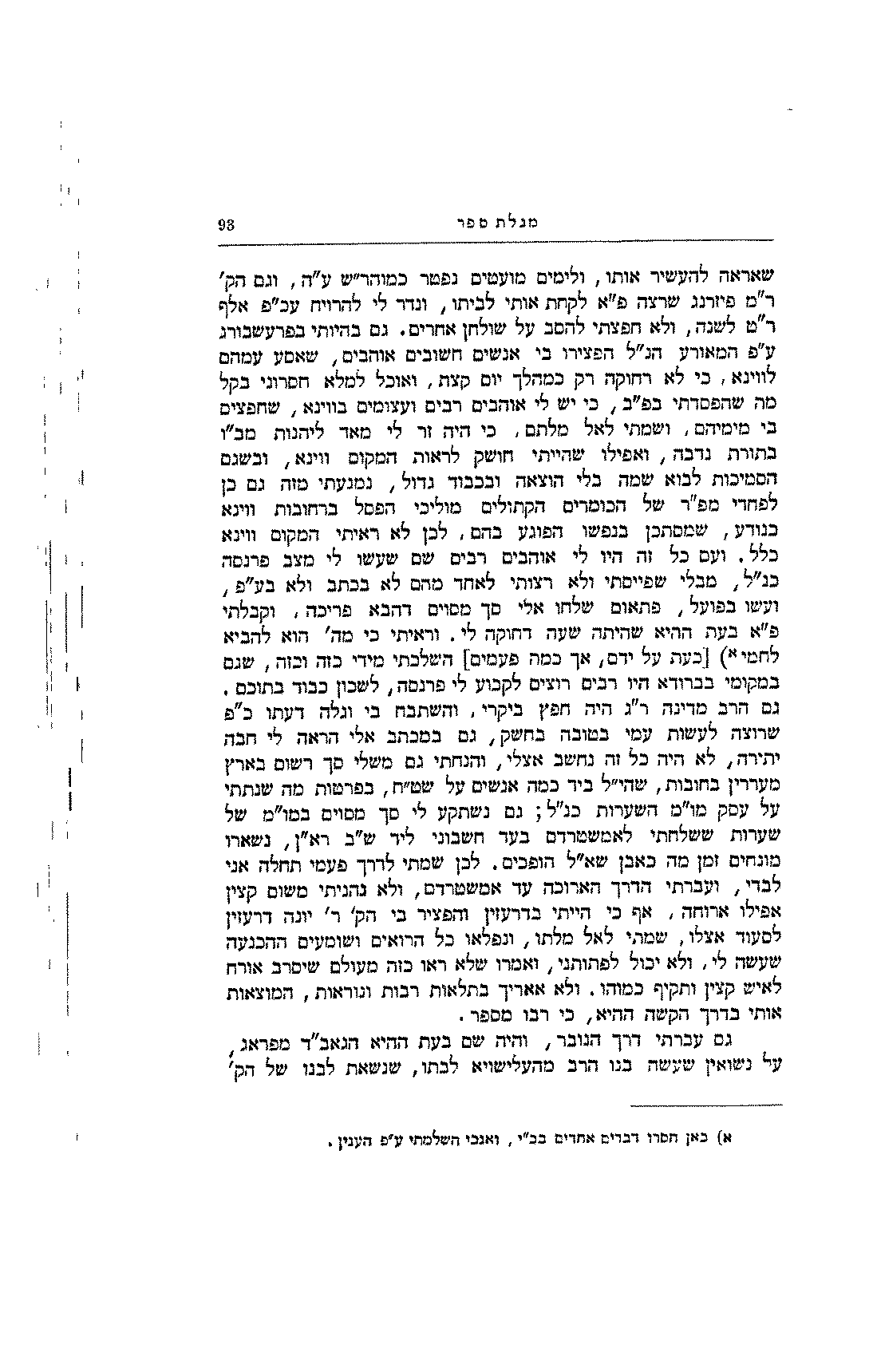
Page 94 (scan 110)
R. A. A., who was the rabbi of Hildesheim. He wanted to honour me with an important present, "handfuls of good", gold coins, and I did not want to take it. He also spoke in my praise and wanted to keep me to study with his son's said son-in-law. But I went on my way, weary and with weak hands, to Amsterdam, and lodged in the house of my said kinsman.
He and all his father-in-law's household had already risen to great standing since the time I had been in Amsterdam once before and lodged with them, as said. But at that time, when I came back a second time to live with them one winter — to see meanwhile what to do for my household and with the said goods that remained lying there — the Holy One, blessed be He, in His mercy on them, created for them something new through which they became very rich: a newly opened spring. The matter is a mine of stones ⟨S: a word, not read⟩ that was discovered in the land of Brazil, the West Indies — "a mine for silver and a place for gold" (Job 28:1). Diamonds were found there in great abundance, without anyone besides them knowing of it; for until then there had been none in England and Holland except from the East Indies alone, since the days of old.
For several years the matter remained secret. The traders, sailors who came from Portugal, brought those new precious stones to England in secret and quietly, to try them; for they were afraid to publicise the matter of this new mine of diamonds they had found, lest the merchants in precious stones would not buy them from them as real diamonds, since they came from a place where it had never been known that such stones grew — and besides, they were not as large or as good as those of the East Indies, from which they had been brought since ancient times. So the men of Portugal who found the mine did this wisely: they kept the matter a hidden secret, and handed a certain quantity quietly to the said sailors.
When these came to London, they revealed their secret to the two sons of the old man R. Z. N., of blessed memory, the brothers R. L. and Reuben, who were already dealing in the gold brought there by Portuguese ships, whom they knew, since they used to buy broken gold from them. From that too they had begun to grow rich. These sailors held the brothers to be trustworthy and discreet in the land; so they trusted them to reveal to them this secret of theirs about the new diamonds, without making it known to anyone else at all. The said merchants took from them the new precious stones that the Portuguese sailors they knew had brought in their hands; they tried, and succeeded, and the Blessed One sent them great blessing through it.
The blessing was found in great abundance in the hands of these brothers from two sides. On one side, because the Portuguese traders sold cheaply, since the stones had come to them as a find and in huge abundance, and they worried that they would find no buyers at all, in case they were thought forgeries or very poor; so they agreed at once to the price the said brothers fixed for them — the more so as they were held trustworthy, and so that their secret should not be published and become a snare, as said. On the other side, buyers and much money were available at that time; for in those days there were many great and very rich moneyed men in those countries, who had gained great wealth from trade in shares, and did not know what to do with the money
רא"א, והוא הרב מהילדסהיים, ורצה לכבדני בדורון חשוב מלא חפני טיבותא זהובים, ולא חפצתי לקחת; גם ספר בשבחי והיה חושק להחזיק אותי ללמוד עם חתן בנו הנ"ל, אבל אני הלכתי לדרכי יגע ורפה ידים לאמשטרדם, ונתארחתי בבית ש"ב הנ"ל, וכבר עלה במעלה גדולה הוא וכל בית חמיו, מן העת שהייתי באמשטרדם פ"א ובאכסניא שלהם כנ"ל, אך באותו פרק שחזרתי שנית לשכון אצלם ימי חורף אחד, לראות בתוך כך מה לעשות לביתי, ועם הסחורות הנ"ל שנשארו לי מונחים שם, חדש להם הקב"ה בחמלתו עליהם דבר להתעשר בו מאד, מקור נפתח מחדש. הענין הוא מחצב של אבן, שנתגלה בארץ בראזיל הודו מערבא, לכסף מוצא ומקום לזהב, אבן דימנט נמצא שם בשפע גדול, בלי שידע מזה אדם אחר זולתם, אחר שלא היו בענגלאנד והולאנד, כי אם מהודו מדינחא בלבד מימות עולם; כמה שנים נשאר הדבר בסוד, והספנים התגרים הבאים מארץ פורטוגאל, הביאו האבנים טובות החדשים ההם לענגלאנד בסוד ובחשאי לנסות בהם, כי היו יראים לפרסם ענין מחצב חדש הלז של דימאנטין שמצאו, פן לא יקנום מהם הסוחרים בא"ט בחזקת דימנטין גמורים ממש, מאחר שבאים ממקום שלא נודע דבר מעולם, שיגדלו שם א"ט כאלה, בשגם לא היו גדולים כל כך ולא טובים, כמו אותן של הודו מזרחית שמשם היו מובאים מימי קדם; לכן עשו זאת בחכמה אנשי פורטוגאל המוצאים המחצב, והחזיקו הענין בסוד כמוס, ומסרו מהם סך מה בחשאי ביד הספנים הנ"ל. ובבואם ללונדון גילו סודם לשני בני הישיש רז"ן ע"ה האחים ר"ל וראובן, שהיו עוסקים כבר בסחורות הזהב המובא לשם ע"י ספני פורטוגאל שהיו מכירין אותן, לפי שהיו רגילים לקנות מהם דהבא פריכא. וגם משם התחילו להתעשר, והיו אותן ספנים מחזיקים לאחים לנאמנים וצנועים בארץ על כן בטחו בהם לגלות אליהם מסתרם הלז של דימנטין חדשים, בלי שהתודעו לאדם אחר כלל. ולקחו מהם הסוחרים הנ"ל הא"ט חדשים, שהביאו בידיהם ספני פורטוגאל מכיריהם, ונסו ועלתה בידם, ושלח להם הי"ת ברכה מרובה עי"כ. והיתה הברכה מצויה בזה בשפע גדול ביד האחים הללו משני צדדים, אם משום שתגרי פורטוגאל מכרו בזול, מפני שבאו לידם במציאה ובשפע עצום, ודאגו שלא ימצאו קונים לגמרי, שמא יחשבו לזיופים או גרועים מאד, ועל כן מיד נאותו למקח שקצבו להם האנשים האחים הנ"ל, מה גם בהיות נאמנים נחשבו, וגם למען לא יפורסם סודם, פן יהיה למוקש כנ"ל; ומצד אחר היו הקונים ומעות הרבה מצוים בעת ההיא, כי באותו הזמן היו בעלי כיסים רבים וגדולים מופלגים באותן מדינות, שהשיגו עושר רב מו"מ של אקציעם, ולא היו יודעים מה לעשות עם המעות שיהיו
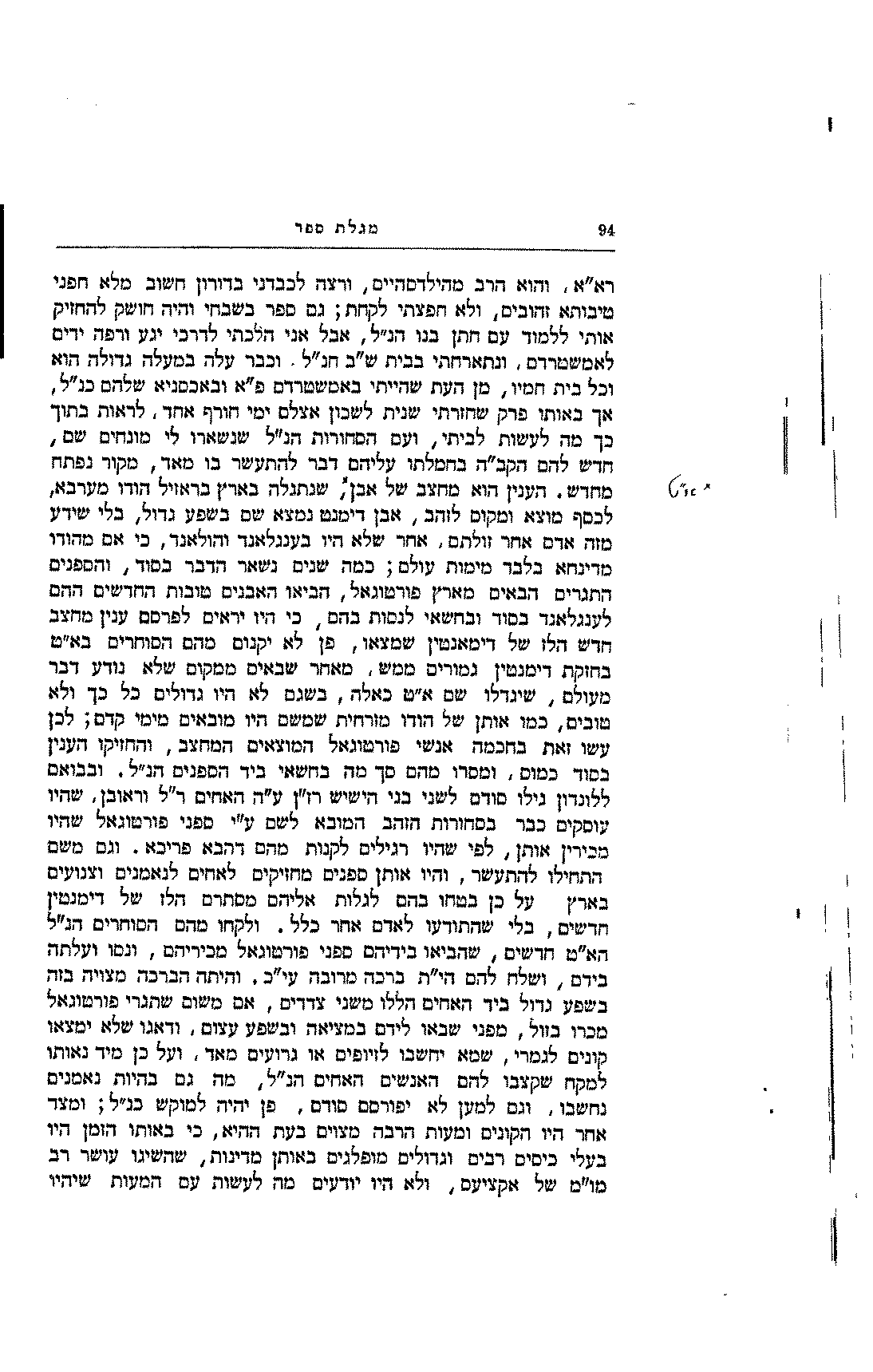
Margin readings in Scholem's copy (1)
| Printed anchor | Type (key sheet) | Mark | Reading | Certainty |
|---|---|---|---|---|
| הענין הוא מחצב של אבן x | X: substitution | x mark; one word | טוב(?) (Kraken: ... ) | uncertain |
Page 95 (scan 111)
to keep it safe; they were afraid of losing it in the said trade, which rises and falls greatly. So they put their money into the trade in precious stones, and silver counted for nothing in their eyes; they bought precious stones in great quantity, at whatever price the traders asked.
From this these men became very, very rich, without an evil eye ruling over them, for no one else knew. They sold their goods as "quick-selling" precious stones coming from the East Indies, and no one noticed their secret, for the Portuguese sailors hid the matter themselves, as said. The said brothers also bound themselves to them afterwards, and undertook to take their goods at a price fair to them, on condition that the matter would not become known to anyone else; and they kept their faith for several years, for money was quick in their eyes, and they were satisfied with the price they fixed. So the men of the house of R. Z. N., of blessed memory, grew great and rich, and no one [knew]. Although they were then recognised as great rich men, no one estimated even a half, or a third or a quarter, of the wealth the house of R. Z. N. attained. They grew and prospered and bore fruit upwards.
In the course of time, after several years, the world noticed how these men kept growing beyond the usual and beyond nature, and also gave charity and did kindness in great abundance, a thing astonishing to many. So other merchants who envied them did not rest or keep quiet; they inquired much into the matter, searched and found their secret — "they searched out his hidden places" (Obad. 1:6) — and also obtained some of this new merchandise. One by one the trade spread through this and became known, until now the hand of all the merchants rules over it, and the price has also risen. Even so they kept precedence with those who brought that merchandise at first, and kept at it for many years, and earned thousands and tens of thousands, precious wealth beyond reckoning; and all the other merchants truly did not reach their ankles. They gathered "a handful of quietness"; their table was full of fatness, satisfied with favour and the blessing of the Lord. All this came about while I was in their house, the first time and the second.
But my own trade fell down until it left no remnant, any sum I could live on. The hair goods that lay in their attic a long time were partly eaten by the moth, and the rest was sold at a great loss. And the Lord put it into the heart of these good men to do me good: for some years they supported me of their own accord; they volunteered and fixed on themselves a certain sum a year for my livelihood, and at first they added and did more than their fixed gift.
If I set out to put into a book the new sufferings and the hard events that found me in those days when I stayed in Amsterdam a second time, because of the strength of the melancholy, God save us, the reader would be astonished and would not believe it possible; it could not be imagined that a stout-hearted man among the mighty could bear them, let alone a weak man of tender nature like me, "stricken, smitten of God and afflicted" (Isa. 53:4) as it was. The cause was the great loss I had in the said goods, which touched my heart; so my pain grew great,
קיימים בטוחים, והיו מתיראים להפסידם במו"מ הנ"ל, שעולה ויורד מאד, על כן היו מניחים מעותיהם בסחורת א"ט, ולא היה הכסף נחשב בעיניהם מאומה, וקנו הרבה א"ט לרוב בכל ממון שיפסקו התגרים. משם נתעשרו אנשים הללו מאד מאד, בלי ששלטה בהם עין, כי לא ידע אדם אחר, והיו מוכרים סחורתם כזבינא חריפא של א"ט הבאים מהודו מזרחית, ולא היה אדם מרגיש בסודם, כי ספני פורטוגאל היו מסתירים הענין מעצמן כנ"ל, גם האנשים אחים הנ"ל התקשרו עמהם אחר זאת, והתחייבו לקבל סחורתם במקח השוה להם, ובתנאי שלא יודע הדבר לאיש אחר, ושמרו אמונתם כמה שנים, כי היה כסף חריף בעיניהם, ונתפייסו בדמים שקצבו. על כן גדלו והעשירו האנשים בית רז"ן ע"ה ואיש לא ]ידע[, עם שהיו ניכרים אז לעשירים גדולים, אך לא שער אדם החצי ולא שליש ורביע העושר שהשיגו בית רז"ן, גדלו והצליח ועשו פרי עד למעלה; ובהמשך הזמן אחרי כמה שנים הרגישו העולם איך האנשים האלה הולכים הלוך וגדול, שלא כמנהג וחוץ לטבע, גם היו עושים צדקות וג"ח בשפע גדול, דבר תמיה לרבים. לכן לא נחו ולא שקטו סוחרים אחרים המתקנאים בהם, חקרו מאד על הענין חפשו ומצאו סודם, חפשו סתרם נבעו מצפונם, והשיגו ג"כ מסחורה חדשה זו; אחת לאחת ע"י כך נתפשט המו"מ, ונתפרסם עד שעכשיו יד כל הסוחרים שולטת בו, ונתיקר השער ג"כ. מ"מ הי"ל קדימה אצל המביאים אותה סחורה בראשונה, והתמידו בה שנים רבות, והרויחו לאלפים ולרבבות הון יקר לאין חקר, וכל הסוחרים האחרים כן ממש לא הגיעו לקרסולם, המה אספו כף מלא נחת, שולחנם מלא דשן ושבע רצון וברכת ה', כל זה נתחדש בעת היותי בביתם בראשונה ובשנייה. אך מו"מ שלי נפל ירד, עד בלתי השאיר לו שריד, סך שאוכל להתפרנס בו, וסחורות השערות שהיו מונחים בעלייתם זמן רב, קצתם אכלה עש והנשאר נמכר בהיזק גדול. וה' נתן בלב האנשים הטובים הנ"ל לעשות עמי בטובה, איזה שנים תמכו בידי מעצמן, התנדבו וקצבו עליהם דבר מסוים לשנה לצורך פרנסתי, ובתחלה הוסיפו ועשו יותר מקצבתם ונדבתם. אם אמרתי להעלות על ספר מהיסורין החדשים, והמקרים הקשים שמצאוני באותן הימים, שעמדתי באמשטרדם שנית, מחמת תגבורת השחורה ר"ל, ישתומם הקורא ולא יאמין אפשרותיו, לא יצויר שיוכל לסבלם אדם אמיץ לבו בגבורים, אף כי אדם חלוש רך הטבע כמוני כאין, נגוע ומוכה אלקים ומעונה בלא זאת. והסבה מחמת ההפסד הגדול שהיה לי בסחורה הנ"ל, שנגע אל לבי; על כן גדל כאבי,
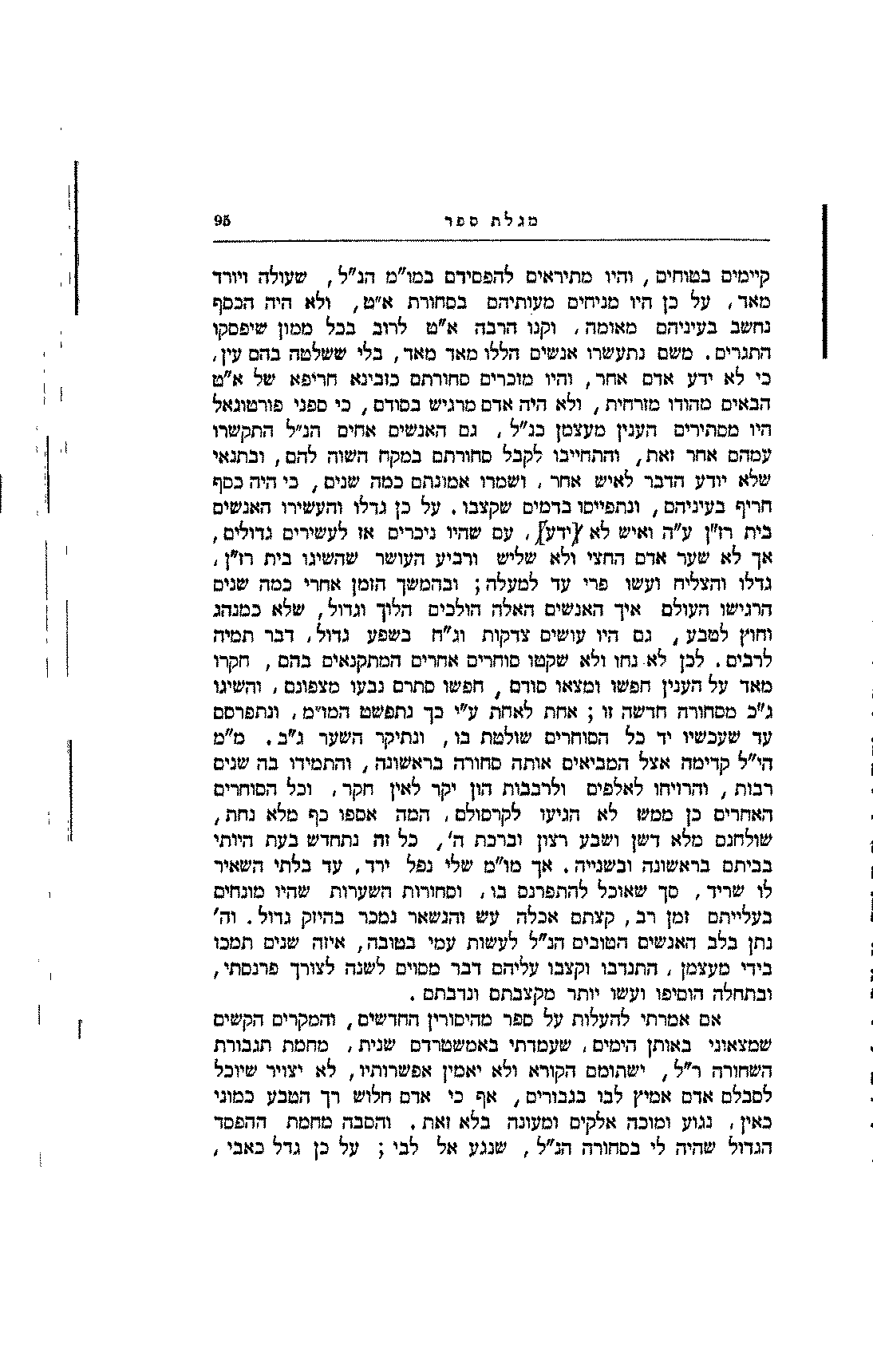
Page 96 (scan 112)
and I could not gladden my heart by drinking wine or brandy. All the comfort I sought, to find rest in it, was drinking boiled tea water, to which I had already grown used on my first journey, from what I had read in the book of a Dutch doctor who praises it greatly. From then on I accustomed myself to it; it was all my drink for my thirst, and from then on I was like a Nazirite from wine and beer altogether, except one cup of wine during a meal. I found this regimen beneficial for the health of my body for several years. But this time I went too far in drinking boiled tea water, for in it I wanted all my diversion — to rest from my sorrow and my agitation, to turn away the thoughts of my spirit and find repose. And it turned against me into a stumbling-block and harm: all my blood was turned to water, and a spring of urine opened, flowing like a fountain. I could not stand a moment without passing water, and it caused me hard, bitter and cruel sufferings in the head of the member; several times "there was but a step between me" and death; sometimes I fainted, and my spirit almost flew away, had it not been for the great mercy of Heaven.
If I set out to tell all that came [upon me] then in Amsterdam ⟨S: a note, perhaps "passed over me"⟩, the thoughts would be dismayed, eyes would wonder at what they saw and ears would be bowed down from hearing, the heart would be dismayed and the spirit filled with trembling. I will only make known briefly a whisper of it; I will shorten the telling of the Lord's kindnesses to me: though I was stricken all day in all the many and evil troubles, He did not let my foot be moved. Praised be His name for ever; generation to generation shall make it known! It was brought about by the Lord that the time I stayed in Amsterdam on that occasion grew long — about half a summer and a whole winter — while I waited to find a good buyer for the hair goods, which lay there "like a stone that no one turns over". Over this grief overcame me day and night; "my heart took no rest in the night" over the loss of my precious time in a strange land, "like a wayfarer that turns aside to tarry for a night" (Jer. 14:8), some six hundred leagues from my home and my young children, for whom my bowels yearned. My soul refused to be comforted, and the melancholy overcame me; "my tears have been my bread day and night" (Ps. 42:4), saying: when shall I provide for my own house — I, who pass like a shadow — and a fixed dwelling, to lodge in the shadow of the Almighty, where I had always hoped that the spirit of my understanding would be upon me?
"I make mention of my faults" (Gen. 41:9), to put into a book what multiplied my sorrow and my grief and almost destroyed me — had it not been for the great kindnesses of the Lord, "I should then have perished in my affliction" — with strange sufferings, the like of which I had never heard until now. And what brought this on me was a book of medicine in the vernacular, written by a Dutch doctor, Bontekoe.
For on my first long wandering and exile, in the days when I stayed in the house of the leader R. Ber Kohen until the autumn had passed, I longed to know and recognise the German vernacular script in their typeface, which my father had not taught me. Even their handwriting I had not received from a teacher, and I had to learn it by myself; but I did not know the books of the gentiles ⟨S: a word, not read⟩ and their writing at all. And my heart always leaned to know and to explore also the matters of the world, the nations and their faiths, their characters, their opinions, their histories and their sciences, which are not known from
ולא יכולתי לשמח לבבי בשתיית יין וי"ש, אך כל הקורת רוח שבקשתי למצוא בו מנוחה היה שתית מי בישול טהע, שכבר הורגלתי בו מקודם מנסיעה ראשונה, ע"פ מה שקראתי בס' רופא הולנדי שמפליג בשבחו. מאז הורגלתי עצמי בו, היא היה כל שתייתי לצמאי, ומן הוא והלאה הייתי כנזיר מיין ושכר לגמרי, זולת כוס אחד של יין בתוך סעודה. ומצאתי בהנהגה זו תועלת לבריאת גופי כמה שנים. אך הפעם הזאת הפלגתי לשתות מי בישול טהע יותר מדאי, כי בו חפצתי כל טיולי להניח לי מעצבי ומרגזי, ולהעביר רעיון רוחי ולמצוא מרגוע, ונהפך לי לרועץ ולרוע, כי נהפך כל דמי למים, ונפתח מקור מי רגלים מושך כמעין, לא יכולתי עמוד רגע בלי הטלת מים וגרם לי יסורים קשים ומרים אכזרים בראש הגויה, וכמה פעמים היה כפשע ביני וגו', פעמים נתעלפתי כמעט פרח רוחי, לולי רחמי שמים הגדולים. אם אמרתי אספרה כמו כל אשר עלו ]עלי[ אז באמשטרדם יבהלו הרעיונים, עינים יתמהו מראות ואזנים יהיו נעוים משמוע, ולבב ישתע ורוח ימלא רתת וירתע, רק דרך קצרה אודיע שמץ מנהו, אקצר לספר חסדי ה' אתי, גם בהיותי כל היום נגוע, בכל הצרות הרבות והרעות, לא נתן למוט רגלי. ישתבח שמו נצח דור לדור יודיע! מאת ה' היתה נסבה, כי ארך לי הזמן שעמדתי באותו פעם באמשטרדם כחצי קיץ וחורף שלם, שהייתי מצפה למצוא קונה טוב לסחורות השערות, שהיו מונחים לי שם כאבן שא"ל הופכים, ועל דבר זה גבר עלי יגון יומם ולילה לא שכב לבי, על אבוד זמני היקר בארץ נכריה, כאורח נטה ללון רחוק כשש מאות פרסאות מביתי ומבני הרכים, אשר יהמו מעי עליהם, מאנה הנחם נפשי וגברה עלי השחורה, היתה לי דמעתי לחם יומם ולילה, באמור מתי אעשה לביתי העובר כצל, ולדירת קבע להתלונן בצל שדי, אשר צפיתי מעודי רוח בינתי עלי יאצל. ואת חטאי אני מזכיר להעלות על ספר את אשר הרבה עצבוני ויגוני, כמעט כלוני, לולי חסדי ה' הגדולים, אז אבדתי בעניי ביסורים המשונים, אשר לא שמעתי דוגמתו עד כה. וזה סבב לי ספר רפואה של לשון לעז, שחבר רופא הולנדר בונטעקהל. לאשר בטלטול וגלות הראשון הארוך, בימים אשר ישבתי בבית הק' רב"ך עד עבור הסתיו, הייתי חושק לידע ולהכיר כתב לעז אשכנזי בגופן שלהם, שלא למדני אמ"ה ז"ל, ואפילו כתיבת שלהן לא קבלתי מרב, והוצרכתי ללמוד מעצמי, אבל ספרי נכרים וכתיבתן לא ידעתי כל עיקר, ולבי היה נוטה תמיד לדעת לחקור ג"כ עניני העולם והאומות והאמונות ומדותיהם ודעותיהם וקורותיהם וחכמותיהם, שלא יודעו ענינם מתוך
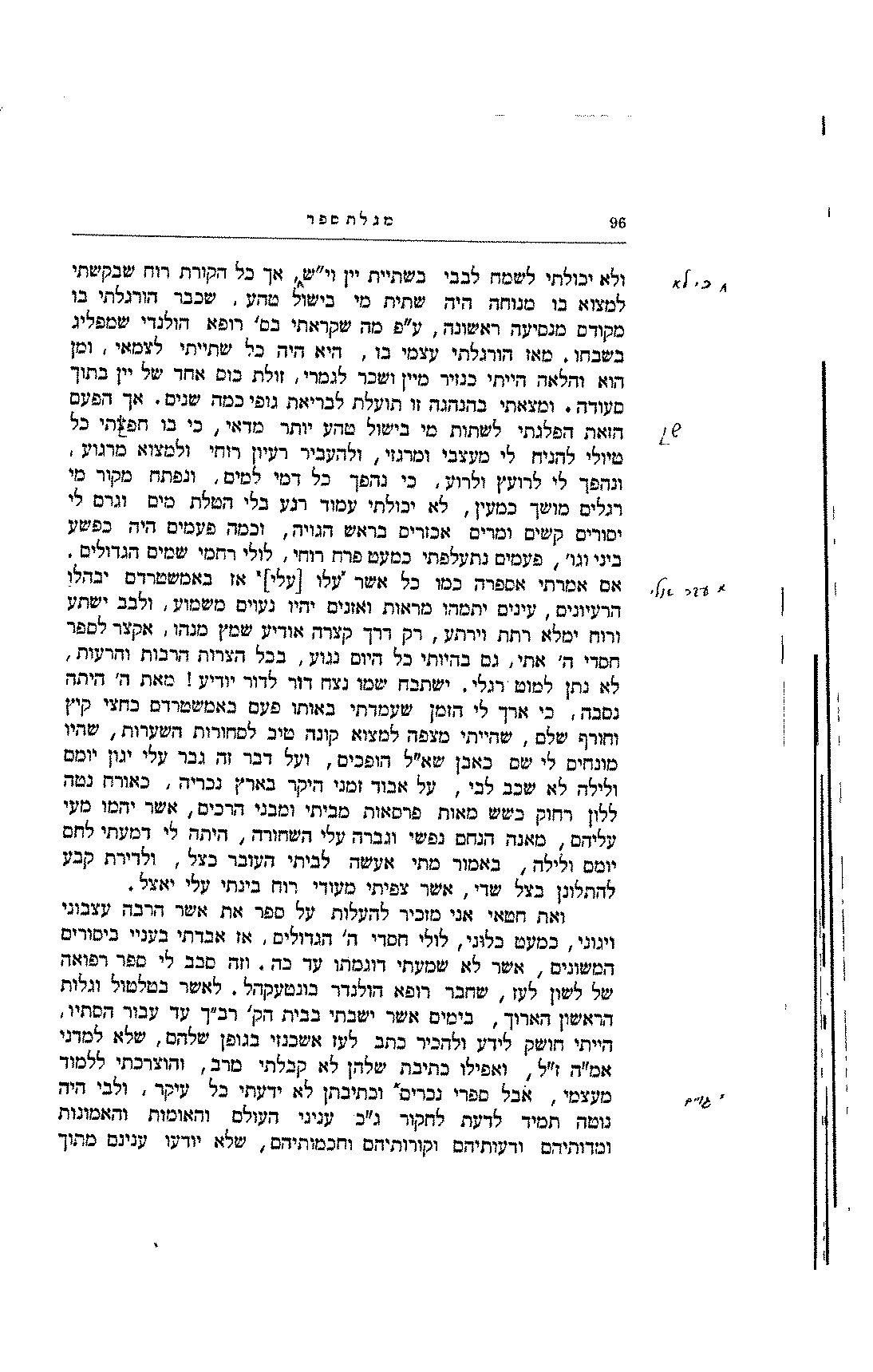
Margin readings in Scholem's copy (4)
| Printed anchor | Type (key sheet) | Mark | Reading | Certainty |
|---|---|---|---|---|
| ולא יכולתי לשמח לבבי ^ בשתיית יין | V: omission | caret; 2-word note | כי לא(?) ... | uncertain |
| ונהפך לי לרועץ ולרוע ^ | V: omission | caret; one word | not read | not read |
| כמו כל אשר עלו [עלי] ^ | V: omission | caret; 2-word note | עבר עלי(?) | uncertain |
| ספרי נכרים x | X: substitution | x mark; one word | הגוים(?) | uncertain |
Page 97 (scan 113)
our holy books — and also "to know what to answer" (Avot 2:14), to be mixed with people, to know the customs of each country, the nature of lands and the nature of their inhabitants, to lay bare their secrets and to stand on the test. All these my soul longed to know from their own books. I found no way or means to reach this, for I did not allow myself to hire a teacher to read books in the vernacular, for I feared great neglect [of Torah]; it was also loathsome in my eyes to spend money on it, and I was ashamed to do so before people.
Now I knew a boy, one of the servants, who was learning to write and read in the vernacular. I took him secretly and asked him to show me the shape of the letters of the printed alphabet of the vernacular, which he had begun to learn with a gentile teacher-scribe. He still barely knew the shapes of the letters, separately, without knowing how to read them joined in words, or understanding the words. The boy showed me only once or twice, saying "this is A, this is Be, this is Tse", and so on, nothing more. With the help of God, who "graciously gives man knowledge", I grasped at once the recognition of the letters by their forms. Afterwards I toiled by myself alone at joining the words, and connected them and understood their meaning without the help of any teacher or instructor at all; and within a short time I gained this knowledge, to read well in German vernacular books, as if I had had a teacher for it for several years.
But I succeeded only in reading their printed books, and likewise Latin script; the vernacular handwriting, made with flowing strokes, I still do not recognise, for lack of having learned it at all. Even in printed Latin script some forms and marks, or changes of shape in the letters, remained that I do not know to this day; for this thing was "stolen" to me in haste and in passing — even the boy who showed me was not complete in it — and afterwards I was ashamed to ask anyone what I lacked in knowing them.
With all this I quickly read all their printed books by myself, until I gained enough proficiency to read even Dutch and the gazettes, and to understand much of Latin too. I read many of their books in all the different branches of knowledge in Europe [a]: to stand on all the opinions of the people of the world in faiths, religions and customs, and to lay bare their thoughts about us and our holy faith. My soul also longed and pined to know and understand the settlement of the globe of the earth, as explained in [their] books, from the motion of the heavenly body — though it is explained in our books, it is in a very short way. I also wanted to know and understand natural things: the nature of minerals, the properties of plants and herbs, and above all the science of medicine; the governments of countries and kings and wars, their chronicles, other stories and the histories of the generations, and the new discoveries of the describers of lands,
Kahana's notes
- [a] Europe.
ספרינו הקדושים, וגם כדי לידע מה להשיב, להיות מעורב עם הבריות, לדעת נימוסי מדינה ומדינה, וטבע הארצות וטבע יושביהם, לחשוף סודותיהם ולעמוד על הבחינה; הן כל אלה חשקה נפשי לדעת מתוך ספריהם העצמיים, ולא מצאתי דרך ואופן להגיע אל זה, כי לא הרשיתי עצמי לשכור לי מלמד קריאת ספרי לעז, כי יראתי מבטול גדול, גם נתעב בעיני להוציא ממון על כך, גם הייתי בוש לעשות כן מפני בני אדם. והנה ידעתי נער אחד מן המשרתים לומד כתיבה וקריאה בלשון לעז, לקחתיו בחשאי ובקשתי ממנו שיראה לי צורת האותיות של א"ב של לעז בדפוס, שהוא התחיל ללמוד אצל מלמד סופר נכרי, ועדיין בדוחק היה יודע תמונות האותיות בלבד נפרדות, מבלי ידיעת קריאתן בתיבות מחוברות והבנה במלותיה, והראה לי הנער רק פעם או פעמים, לומר זה א, זה בה, זה צע כו', לא דבר יותר, ובעזה"י החונן לאדם דעת תפסתי מיד הכרת האותיות בדמיונם, אח"כ טרחתי בעצמי אני לבדי בחבור התיבות, ונקשרתי והבנתי ענין בלי עזר שום מלמד ומורה כלל וכלל, ותוך זמן קצר השגתי ידיעה זו לקרוא היטב בס' לעז אשכנזי, כאלו הי"ל מלמד על זאת כמה שנים; אך לא עלה בידי כי אם קריאת ספרי דפוס שלהן וכן הכתיבה לטינית, אבל הכתיבה לועזית הנעשית במשיכא ורהיטא עדיין איני מכירה מחסרון למודה לגמרי, ואפילו בכתיבה לטינית של דפוס נשארו איזה צורות ורשמים או שינוי תמונה באותיות, שאין אני יודעם עד היום, כי אלי דבר (זה) יגונב בחטיפה ולפום שטפא, שאפילו הנער המראה לי לא היה מושלם, ואח"ז בושתי מלשאול אדם מה שחסר לי בידיעתם. עם כל זה מהרתי לקרוא בכל ספרי דפוס שלהם מיד מעצמי, עד שהשגתי בקיאות לקרות אפילו לשון הולנדי וגאזעטין, ולהבין גם הרבה מלשון לטין, וקראתי הרבה מספריהם בכל הידיעות השונות באייראפ"י א לעמוד על כל דעות אנשי העולם, באמונות בדתות ומנהגים, ולחשוף מחשבותיהם עלינו ועל אמונתנו הקדושה. גם נכספה כלתה נפשי לדעת ולהבין ישוב כדור הארצי, כמבואר בספר]יהם[ מתנועת גרם השמימי, עם היותו מבואר בספרינו, הוא דרך קצר מאד; גם חפצתי לדעת ולהשכיל בדברים הטבעיים, וטבע המחצבים וסגולות צמחים ועשבים, וחכמת הרפואות ביחוד, והנהגות המדינות והמלכים והמלחמות וספורי ד"ה שלהם, ומעשיות זולתיות וקורות הדורות, וחדושי כותבי הארצות
- [א] אייראפה.
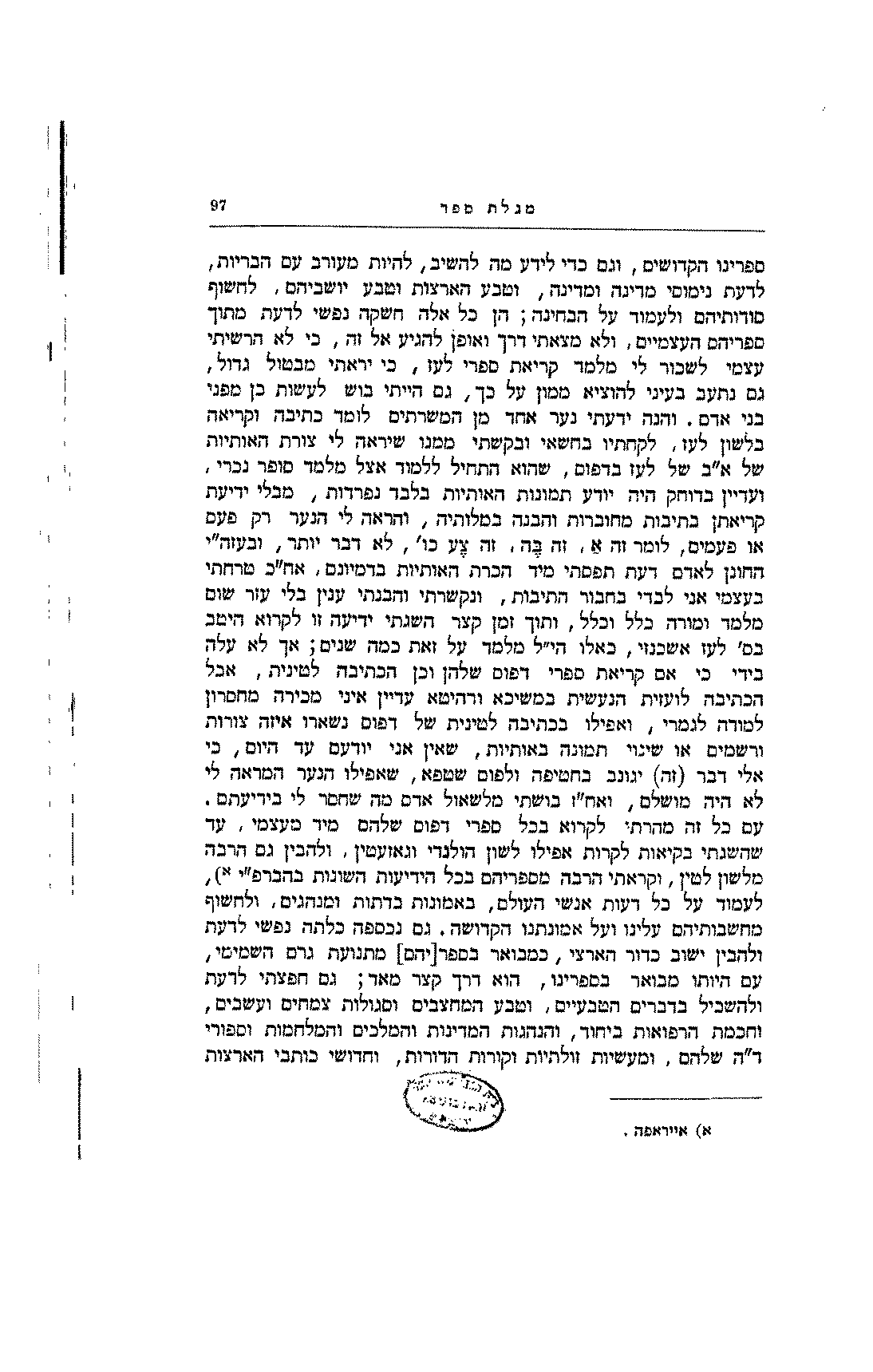
Page 98 (scan 114)
seas, rivers and deserts and those who map their positions; artistic work and crafts, devices, tricks and cunning; and tales of vanity in invented fictions. All these my eye has seen in their books. I am expert in them and in their deeds, and all their thoughts, their falsifications and their good things — I know it all and it is open before me, so as not to be naked of the wisdom of the people of the world.
But I take care not to read them or study them except in a place where it is forbidden to think of words of Torah — nowhere else at all ⟨S: "and since it was natural to him to stay long in the synagogue, as the custom spread, so that they did not go twice to the synagogue, to lose and waste [time] altogether"⟩. Indeed, several times "out of the strong came forth sweetness" (Judg. 14:14), and the honey I found in them I scraped into my hands, to use it for the work of the holy service, in several closed and sealed matters; and above all I succeeded through this in knowing what to answer, and also in not being thought a fool in their eyes. Especially in the work ⟨S: a note, not read⟩ of the science of medicine and the preservation of health, which is "the life of all creatures", I searched their books in a time of leisure, as said; and I studied natural science, which I needed of necessity for the preservation of the human species.
Now I have come to the point I began with. For behold, once the said book of medicine came into my hands, and I saw that it praised greatly the virtue of tea and spoke much in its praise, commanding and urging one to get used to drinking its boiled water, and promising that it is a general balm and a cure for illnesses in general. This entered my heart, and I tried and tested it for some years, from the year 5484 [1724], when I came home the first time, until the year 5489 [1729], when I was driven into a second exile to the land of Germany. All that time I used to drink tea water morning and evening to satiety; it was my main drink, and I found it very healthy for my body. I hardly drank any other drink besides it: it was my drink at breakfast, and with it I quenched my thirst after the midday meal, at the beginning of digestion. From then on I kept myself away from the drink of barley beer ⟨S: a word, not read⟩ altogether; it never came to my mouth again, except in some strange and remote way. Wine I did not drink even when I was in Moravia, where wine is cheap and plentiful; I was not used to it except on festivals and at the joy of a feast of a commandment; apart from that it was loathsome to me. But in drinking tea water I found comfort and rest for my soul, and it gladdened my heart as if I were drinking spiced wine, all those years I stayed at home. And on the way of my travels in the [world], the first and second exile, this drink was good and useful to me.
But after, for my sins, I fell into the sickness of grief mentioned above in Amsterdam, I thought to gain relief from my trouble by drinking much of this drink, to gladden my heart and rest from my grief and sorrow, as was my custom from time to time when my spirit was troubled. For I had not tried intoxicating drink, and it harmed me; so I drank neither wine nor beer, and all my search for broadening the heart was in drinking tea water too much, for I imagined I would be helped by it to escape the grief that afflicted me. And this time, as I went over the limit, especially as I drank a great deal of it, through this my blood was turned to water
ימים ונהרות ומדברות ורושמי מצבם, ומלאכת מחשבת ואומניות ותחבולות ורמאות וערמות, וספורי הבלים בהמצאות בדויות, את כל אלה ראתה עיני בספריהם, בקי אני בהם ובמעשיהם, וכל מחשבותיהם זיופיהם וטובותיהם, את הכל ידעתי וגלוי לפני, שלא להיות ערום מחכמת אנשי עולם. אבל נזהר אני שלא לקרותן ולעיין בהם, אלא במקום שאסור להרהר בד"ת לא זולת בלל, אכן כמה פעמים הוצאתי מתוק מעז, ודבש שמצאתי בהם רדיתי אל כפי, להשתמש בו למלאכת עבודת הקודש, בכמה ענינים סתומים וחתומים, ועל כולם עלתה בידי ע"י כך לידע להשיב, וגם שלא להחשב סכל בעיניהם; ביחוד במלאכת חכמת הרפואה ושמירות הבריאות שהיא חיי דברייתא חקרתי בספריהם בעת פנאי כנ"ל, ועיינתי בחכמת הטבע הוצרכתי בהכרח לקיום מין האנושי. ועתה הגעתי אל המבוקש שהתחלתי בו, כי הנה נזדמן לידי פ"א ספר רפואה הנ"ל, וראיתי מפליג בטוב סגולת הטהע ומרבה לספר בשבחו, ומצוה ומזרז להרגיל שתית מי בישולו, ומבטיח היותו צרי כולל ומרפא לחליים בכלל. דבר זה נכנס בלבי ונסיתיו ובחנתיו איזו שנים, משנת תפ"ד שחזרתי לביתי בפעם ראשון עד שנת תפ"ט שנטרדתי בגלות שנית לארץ אשכנז; בכל משך זמן זה הייתי נוהג לשתות מי טהע בבקר ובערב לרויה, הוא היה עיקר משקה שלי, ומצאתיו בריא לגופי מאד, כמעט לא שתיתי שום משקה אחר זולתו, הוא היה שתייתי בטעימת שחרית, ובו הייתי מרוה צמאוני אחר סעודת צהרים בהתחלת העיכול, ומן אז הזרתי עצמי ממשקה שכר שעורים לגמרי, לא בא עוד לפי, אם לא בדרך זר ורחוק; ויין לא שתיתי גם בהיותי בארץ מעררין, שהיין שם בזול ומצוי לא הייתי רגיל בו, כי אם ביו"ט ובשמחת סעודת מצוה, זולת זה היה נתעב אלי, אך בשתיית מי הטהע מצאתי קורת רוח מנוח לנפשי, והיה משמח לבבי כאלו הייתי שותה יין הרקח, כל אלה השנים שעמדתי בביתי; ובדרך מהלכי ]בעולם[ גלות ראשונה ושנייה היה טוב ומועיל לי משקה הלז, אכן אחר שבעונותי נפלתי במדוה היגון הנ"ל באמשטרדם, וחשבתי להרויח לי מצרתי ע"י רבוי שתית המשקה הלז, לשמח לבי להניח לי מיגוני ועצבי כמנהגי פעם בפעם, כשרוחי נפעם כי דבר המשכר לא נסיתי והיה מזיק לי, לכך יין ושכר לא שתיתי, רק כל עסק הרחבת הלב חפשתי בשתיית מי טהע יותר מדאי, כי דמיתי להעזר בו להמלט מהיגון המתעולל בי. והוא היה בעוברי בפעם הזאת, בפרט שהפלגתי לשתות ממנו הרבה, עי"ז נהפך דמי למים
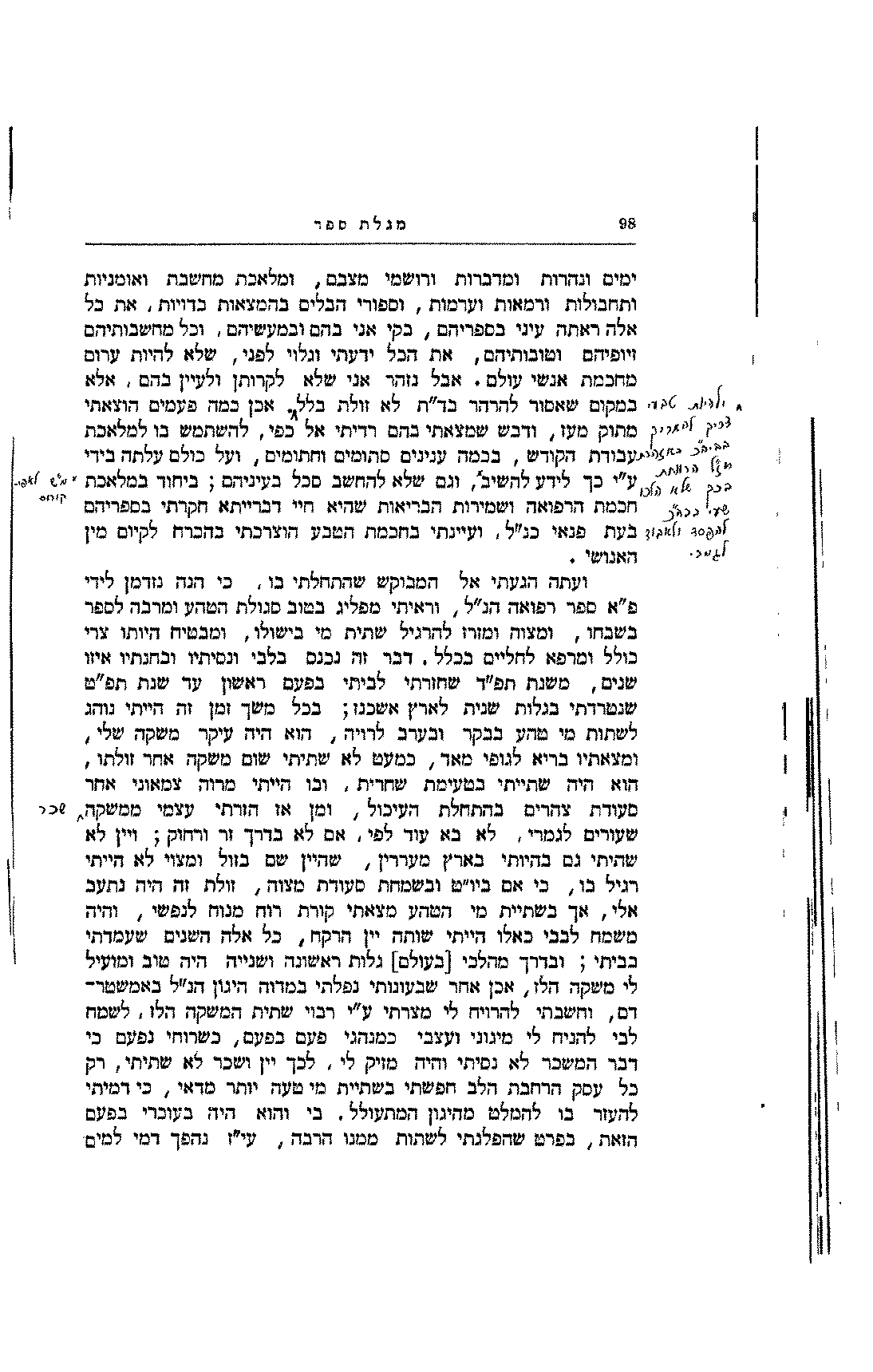
Margin readings in Scholem's copy (3)
| Printed anchor | Type (key sheet) | Mark | Reading | Certainty |
|---|---|---|---|---|
| במקום שאסור להרהר בד"ת לא זולת בלל ^ | V: omission | caret; 5-line note in right margin (Kraken: ... הרווחת / ... שלא ...) | ולהיות טבעי / דבוק להאריך / בבוהכ"נ כאשר(?) / מנ"ל הרווחת / בכך שלא הלכו / שני בבה"כ / להפסיד ולאבד / לגמרי | fairly sure |
| ביחוד במלאכת ^ חכמת הרפואה | V: omission | caret; 2-word note | not read | not read |
| ממשקה ^ שכר שעורים | V: omission | caret; one word | של(?) | uncertain |
Page 99 (scan 115)
and my heart melted; and since I could not hold myself back from passing water even a moment, my distress was doubled and my sufferings grew very, very great. For about half a year I rolled myself in this great and wonderful sorrow, with no one understanding the root of the illness, and with hard and bitter sufferings whose like was unknown to me, although I had read much in books. Besides this there was a burning in my bowels and in my innards, until several times my soul was struggling ⟨S: a word, not read⟩ to go out. For a long time I did not taste the taste of sleep: "in the evening I said, would that it were morning" (Deut. 28:67). Several times they had to profane the Sabbath for me and wake sleepers in the middle of the night for my sake, to make me hot water to drink, and to make a treatment ⟨S: "an enema"⟩ to open the bowels. I took many remedies, and was relieved only very little.
But the sickness of the urine, which pressed to come out at every time and moment, did not leave me after this. For more than twenty years I was prone to it, although I had already given up and abandoned drinking tea altogether and chosen the drink coffee instead (for beer I could no longer get used to), and only three or four small cups at a time; that could no longer be borne. In any case my said sufferings rested and quieted a little; even so they did something ⟨S: a word, not read⟩ bad to my nature, but it was gradually diminishing when I returned to sit quietly at home with my household. More than this, the "golden vein" did a good work, with God's help, when it opened for me after several years, as I will write with God's help. But I could not send away ⟨S: a word, not read⟩ the bad condition of my nature in the urine and be rid of it altogether, to return to my former strength, until I went into a third exile to Amsterdam, in the year 5511 [1751]. In this last exile this sickness left me by the mercy of Heaven — there, in the very thing in which I had been stricken ⟨S: a note, partly read⟩, that is, in water. For the sickness came to me through drinking much hot water, and the Blessed One sent my cure then through drinking cold water — although from this too other cruel sufferings came to me. In the year 5513 [1753] I came home whole in body, thank God, like a new creature; I knew no more of excess urine at all, and it left me entirely, with God's help, after it had afflicted me for about twenty-four years, until I was weary of my life because of it, and had already despaired of it and thought it would accompany me to the grave. Thank God, I was saved from it, after other strange sufferings had come upon me, besides the sorrow of wandering and the hard exile, as I will write with God's help. Indeed, in me was fulfilled the matter of "hot illness" (cf. b. Shabbat 66b). The Healer of the sick, the Helper and Saviour of the poor — in Him I trust; He will redeem me from all my troubles and comfort me with the consolation of returning to Zion redeemed. May it be His will, amen.
After this I travelled from Amsterdam, meaning to come without delay to Altona, to return there and make my home in the city of my birth and the dwelling place of my fathers. I passed through Emden, and the people of the holy community set their eyes on me to be their leader, conducting the rabbinate — which had never entered my mind at all, as said above, for I chose lowliness and hated the rabbinate. I was going on my way, and I lodged in the house of the leader R. Jonathan
ונמס לבבי, וגם שלא יכולתי לעכב עצמי מהטלת מ"ר אפילו רגע, אז נכפלה רעתי וגברו יסורי מאד מאד. כחצי שנה גלגלתי עצמי בצער הגדול הנפלא הזאת, באין מבין שורש המחלה, וביסורים קשים ומרים שלא נודעו לי דוגמתם, אע"פ שקראתי הרבה בספרים. גם נוסף על זאת היה מוקד במעי ובקרבי, עד שכמה פעמים היה נפשי מבצבצת לצאת, ולא טעמתי טעם שינה זמן רב, בערב הייתי אומר מי יתן בקר, כמה פעמים הוצרכו לחלל שבת עלי, ולעורר ישנים באמצע הלילה בשבילי, לעשות לי מים חמים לשתיה, ולעשות תקון לפתוח בני מעים, ועסקתי ברפואות הרבה ומעט מזער הונח לי; אך מדוה השתן שהיה הדוחק לצאת בכל עת ורגע לא עזבני אחרי זאת, יותר מעשרים שנה הייתי עלול בו, אע"פ שכבר הנחתי ועזבתי שתיית הטהע לגמרי, ובחרתי במשקה קאפע תמורתו (כי שכר לא היה אפשר לי להרגיל בו עו ד ורק שלש או ארבע כוסות קטנות במדה לפ"א, זאת לא היה אפשר לסבול עוד, ועכ"פ נחו שקטו יסורי הנ"ל קצת, עכ"ז עשו ענין רע בטבעי, אך היה פוחת והולך, כשחזרתי להיות יושב שקט בביתי אצל בני ביתי, ויותר עשה פעולה טובה בעזה"י גיד הזהוב כשנפתח לי אחר כמה שנים כמש"ל בס"ד, אבל לא יכולתי לשלח הענין רוע הטבע בשתן ולפטרו מכל וכל, לשוב לאיתני הראשון, עד שהלכתי בגלות שלישית לאמשטרדם, שנת תקי"א. בזה הגלות האחרון נסתלק ממני זה המדוה ברחמי שמים, שם באותו מקום שלקיתי בו דהיינו במים, כי המדוה בא לי ע"י רבוי שתיית מים חמים, ושלח הי"ת רפואתי אז ע"י שתיית מים קרים, אלא שגם מזה גרמו לי יסורים אחרים אכזרים. בשנת תקי"ג שבתי לביתי שלם בגופי ת"ל בבריה חדשה, לא ידעתי עוד מריבוי שתן כלל, ועזבני בעזה"י לגמרי, אחר שנתעולל כעשרים וארבע שנה, עד שקצתי בחיי מחמתו, וכבר נתייאשתי מזה חשבתי שילווני לקבר; ת"ל נושעתי ממנו אחרי שנתחדשו לי יסורים אחרים משונים, ונוסף על צער הטלטול וגלות הקשה כמש"ל בס"ד, אכן נתקיים בי הענין חולי חמים, רופא חולים ועוזר ומושיע דלים בו אבטח, יפדה אותי מכל צרותי, וינחמני בנחמה לשוב לציון גאולים, כיר"א. אחר זאת נסעתי מאמשטרדם, על דעתי לבוא בלי אחור לאלטונא, לשוב שמה לקבוע דירתי בעיר מולדתי ומקום מגורי אבותי. ועברתי דרך עמדן ונתנו עיניהם בי אנשי הק"ק להיות להם לקצין נוהג רבנות, מה שלא עלה על דעתי לגמרי כנז"ל, שבחרתי בשפלות ושנאתי את הרבנות, לדרכי הייתי מהלך ונתארחתי בבית הק' ר' יונתן
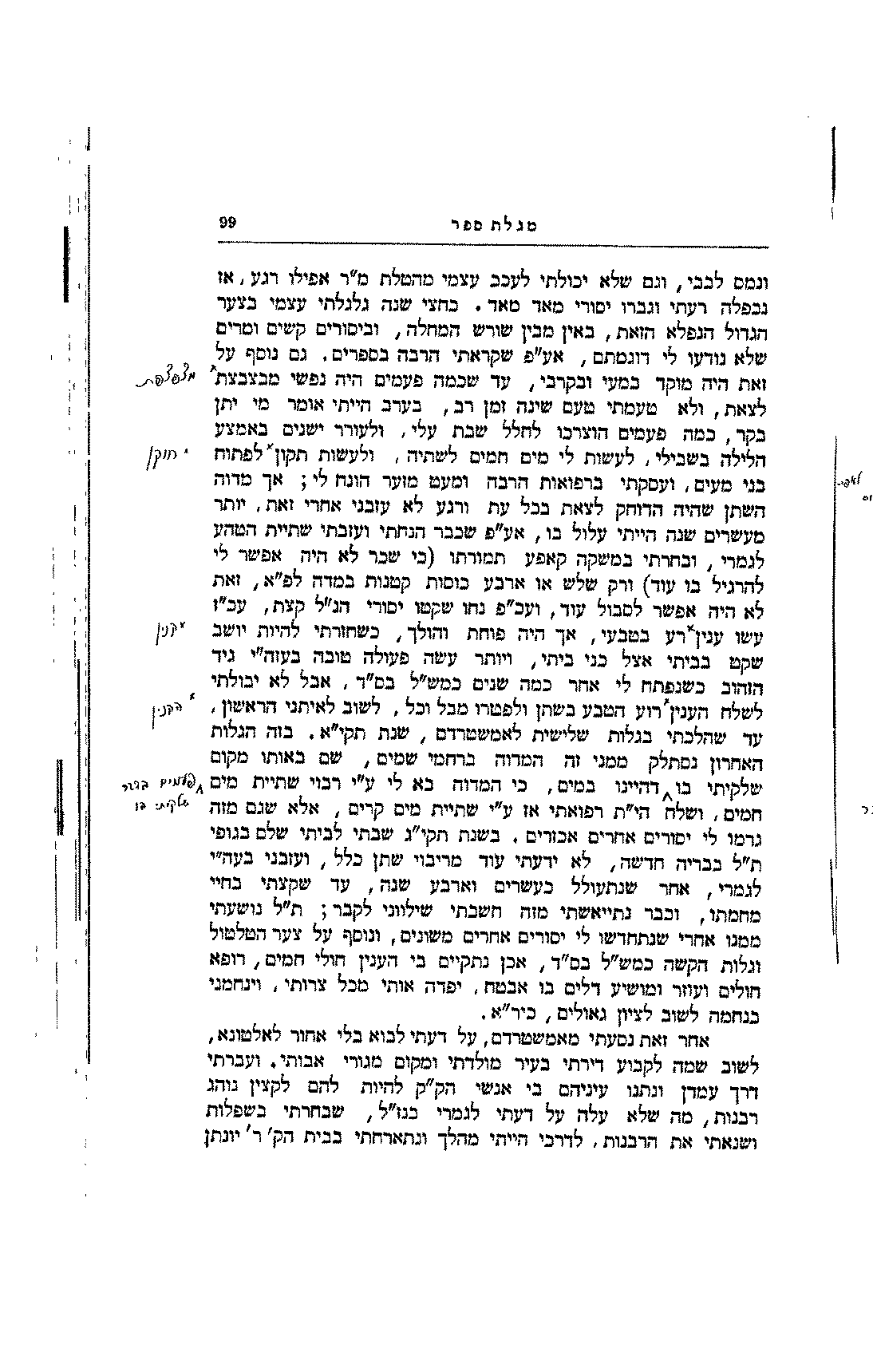
Margin readings in Scholem's copy (5)
| Printed anchor | Type (key sheet) | Mark | Reading | Certainty |
|---|---|---|---|---|
| עד שכמה פעמים היה נפשי מבצבצת ^ | V: omission | caret; one word | מלפרוח(?) | uncertain |
| ולעשות תקון ^ לפתוח בני מעים | V: omission | caret; one word | חוקן | fairly sure |
| עשו ענין ^ רע בטבעי | V: omission | caret; one word | קנין(?) | uncertain |
| לשלח הענין ^ רוע הטבע | V: omission | caret; one word | הקנין(?) | uncertain |
| שם באותו מקום שלקיתי בו ^ דהיינו במים | V: omission | caret; 2-word note (Kraken read: שלקיתי בו) | באמשטרדם(?) / שלקיתי בו | uncertain |