Chapter 1 Emden's ancestors and the life of his father, Ḥakham Tzvi
Jacob Emden, Megillat Sefer · Hebrew (Kahana, Warsaw 1896/97) with an English draft translation · work in progress
Pages in this chapter
Chapter 1 Emden's ancestors and the life of his father, Ḥakham Tzvi · from p. 3
p. 3 · p. 4 · p. 5 · p. 6 · p. 7 · p. 8 · insert · p. 9 · p. 10 · p. 11 · p. 12 · p. 13 · p. 14 · p. 15 · p. 16 · p. 17 · p. 18 · p. 19 · p. 20 · p. 21 · p. 22 · p. 23 · p. 24 · p. 25 · p. 26 · p. 27 · p. 28 · p. 29 · p. 30 · p. 31 · p. 32 · p. 33 · p. 34 · p. 35 · p. 36 · p. 37 · p. 38 · p. 39 · p. 40 · insert · p. 41 · p. 42 · p. 43 · p. 44 · p. 45 · p. 46 · p. 47 · p. 48 · p. 49 · p. 50 · p. 51 · p. 52 · p. 53 · p. 54
Page 3 (scan 11)
My father! May the Keeper of truth guard you forever, in the light of the Lord. "Gather together and hear, O Jacob" (Gen. 49:2), and may God hear you — the God of your gods, the God of your fathers.
I will tell of the decree (Ps. 2:7) and ascribe righteousness to my Maker (Job 36:3), and I will say: "Many things have You done, O Lord my God, with me; were I to declare and speak of them, they are too many to be numbered" (Ps. 40:6) — and to engrave them in a book: "where is he who weighs, where is the scribe?" (Isa. 33:18) [a] — though I have not seen good [b], and one cannot bend judgement or press the hour. "O Lord, You are my God; I will exalt You, I will praise Your name, for You have done wonders, counsels from afar" (Isa. 25:1) [c]. The Lord has appeared to me through His deeds and the acts that He showed me against my adversaries. "Oh that my words were now written, oh that they were inscribed in a book, … that they were engraved in the rock for ever" (Job 19:23–24), in the writing of the house of Israel, so that "children yet to be born may arise and tell them to their children" (Ps. 78:6) at the last day. "Then will our mouth be filled with laughter and our tongue with song" (Ps. 126:2), for wickedness and iniquity will be no more.
I will begin with my grandfather, my father's father, of blessed memory, whose name I bear: the gaon R. Jacob son of R. Benjamin — may his merit shield me — an Ashkenazi of the stock of Z"K [d]. So they used to sign their family name, for they were zera kodesh, "holy seed": tested and refined men in the days of the persecutions and forced conversions, who remained faithful to the Lord for many generations, of the greatest of the early Ashkenazi pietists.
My grandfather's father, mentioned above [e], was one of the distinguished scholars of Vilna in those days, before the decree of Chmiel, and he was a disciple of the gaon R. Jacob, head of the court in Lublin, father of the gaon R. Heschel of blessed memory. He served him in the yeshiva, and R. Jacob gave him his daughter as a wife [f].
My father's grandfather [on his mother's side] was the gaon, the pious priest, author of the responsa Sha'ar Efraim, of blessed memory, head of the court in the community of Vilna the crowned city, then in its tranquillity. He had a genealogy reaching back to Aaron the priest, and he was son-in-law to one of the
Kahana's notes
- [a] Emden says the same in his Hit'avkut (fol. 70b, line 2), Lemberg printing.
- [b] So he says in his prayer; see his Edut be-Ya'akov (fol. 65b).
- [c] Ibid., in the same prayer.
- [d] Z"Y stands for zekhuto alai yagen ("may his merit shield me"); Z"K stands for zera kodesh, "holy seed".
- [e] By "my grandfather's father mentioned above" he means his grandfather's father, R. Benjamin, named just before.
- [f] R. Benjamin was a disciple of the gaon R. Jacob, head of the court in Lublin, and R. Jacob gave his daughter to Benjamin as a wife. See Fuenn, Kiryah Ne'emanah (p. 88), and Zunz, Ir ha-Tzedek (p. 113 and note 55).
אבי! ישמרכם השומר אמת לעולם, באור ה' הקבצו ושמעו אל יעקב וישמע אליכם אלהים, אלהי אלהיכם ואלהי אבותיכם. אספרה אל חוק ולפועלי אתן צדק, ואומרה רבות עשית אתה ה' אלהי עמדי, אגידה ואדברה עצמו מספר, ולחקקם בספר איה שוקל ואיה סופר א, אף כי לא ראיתי בטובה ב, וא"א לכוף את הדין והשעה לדחוק. ה' אלהי ארוממך, אודה שמך כי עשית פלא עצות מרחוק ג. ה' נראה לי ממעשיו ועלילותיו אשר הראני נגד צוררי, מי יתן בספר ויכתבון מלי, לעד בצור יחצבון בכתב בית ישראל, בנים יולדו יקומו ויספרו לבניהם ליום אחרון. אז ימלא שחוק פינו ולשונינו רנה, כי אפס רשע ועולה. ואתחיל מאבי זקני אבי אבא זצ"ל אשר אני נקרא בשמו, ה"ה הגאון מו"ה יעקב במוה"ר בנימין זע"י אשכנזי מגזע ז"ק ד, כך היו נוהגין לחתום שם משפחתם, כי היו זרע קדש בני בחונים וצרופים בימי הגזרות ושמדות והמה נשארים נאמנים לה' מכמה דורות מגדולי חסידי אשכנז הקדמונים, ואבי זקני הנ"ל היה אחד מחכמי ווילנא המסוימים באותן הימים לפני גזרת חמיל ה, והיה תלמידו של הגאון מו"ה יעקב אב"ד בלובלין, אביו של הגאון מוה"ר העשיל זצ"ל. אצלו שמש בישיבה ונתן לו בתו לאשה ו. אבא רבה הוא הגאון החסיד שבכהונה בעל ס' שו"ת שער אפרים ז"ל, ראש ב"ד בק' ווילנא המעטירה אז בהיותה בשלותה, והיה לו כתב יחוסו עד אהרן הכהן, וחתן לאחד
- [א] ע"ד זה אמר יעב"ץ בספרו התאבקות (דף ע' ע"ב, שורה ב') דפוס לבוב,
- [ב] כן אמר בתפלתו, עיין בספרו עדות ביעקב (דף ס"ה ע"ב).
- [ג] שם בתפלתו הנזכרת.
- [ד] זע"י ר"ת: זכותו עלי יגן, ז"ק ר"ת: זרע קדש.
- [ה] כונתו באמרו: ואבי זקני הנ"ל, על אביו הר"ר בנימין הנזכר מקודם.
- [ו] ר' בנימין היה תלמיד הגאון מו"ה יעקב אב"ד בלובלין, והוא נתן את בתו לבנימין לאשה. עיין בס' קריה נאמנה לפין (צד פ"ח) ועיין עוד בס' עיר הצדק לצונץ (צד קי"ג והערה נ"ה).
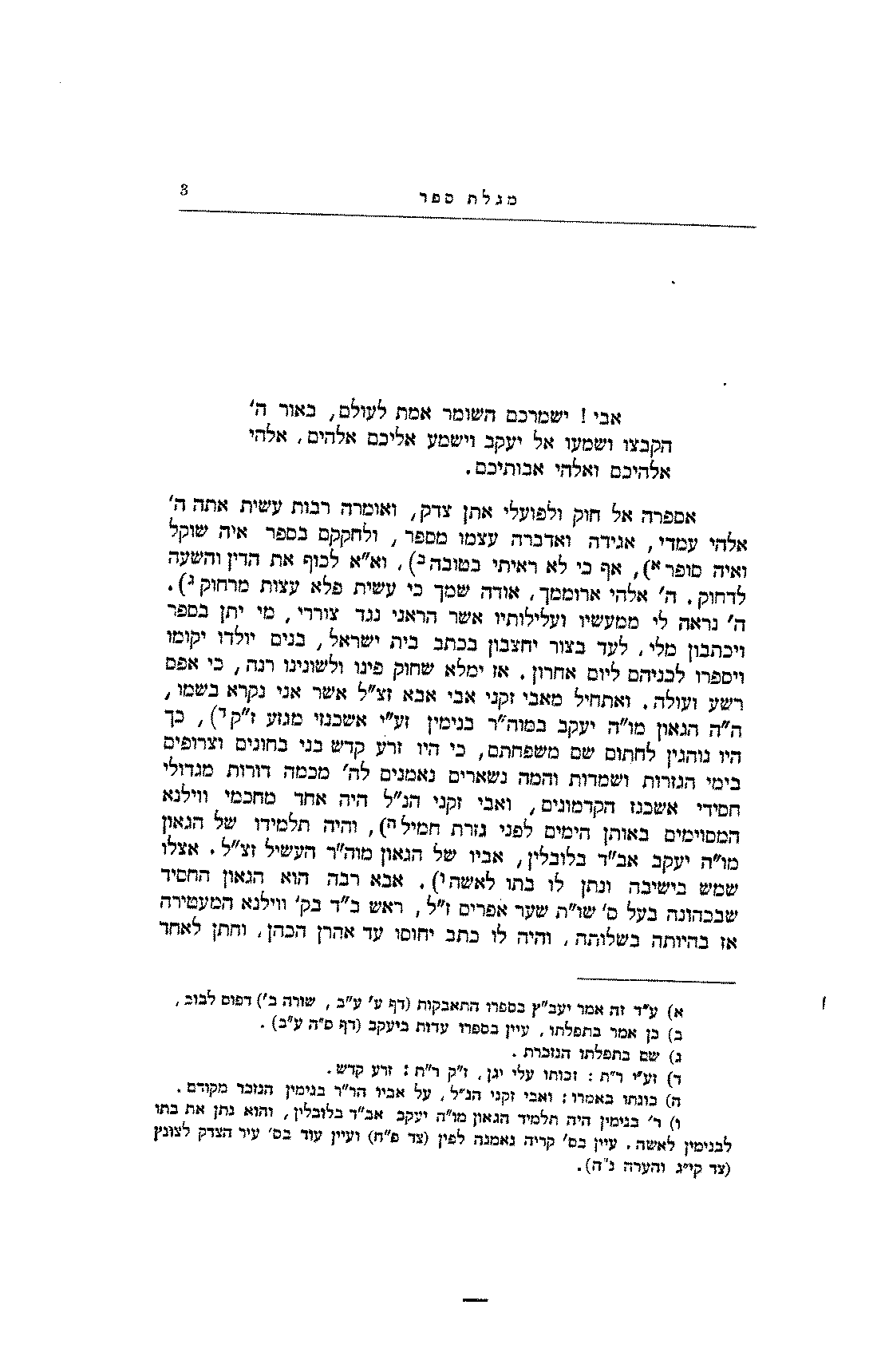
Page 4 (scan 12)
grandsons of the gaon R. Elijah Ba'al Shem the Elder, of blessed memory, who was head of the court in the holy community of Chełm in those days [a]. See the responsa of my father and master the gaon, of blessed memory (§ 93): he created a man. He told a story about him: the creature was without speech and served him like a slave. When the rabbi saw that the work of his hands was growing ever stronger and very large through the Name written on a paper that he had stuck to its forehead, R. Elijah Ba'al Shem feared that it would do harm and destroy. He quickly overpowered it and tore off the sheet on which the Name was written, pulled it from its forehead, and it fell down a lump of earth, as it had been. But it injured its master: it scratched his face as he took the writing and tore the Name off it [b].
My lord, my great-grandfather, the gaon author of Sha'ar Efraim, the great pious man mentioned above, sat fasting all his days except on Sabbath and festivals; besides that, several times a year he fasted from Sabbath to Sabbath, and other fasts on consecutive days. For all that, his face shone like the sun, as if he drank like a drunkard every day; and his mouth did not cease from study day and night. Whoever wants to know more of his deeds, his teaching of Torah, the depth of his learning, his rulings and his history — and how he redeemed the life of his only son — let him read the introduction to Sha'ar Efraim, written by his son, the distinguished rabbi R. Judah Leib, of blessed memory, who brought his father's book to print. My great-grandfather, the pious gaon, died in his seat of honour, the holy community of Ofen, which is called Buda, and which was then great and wealthy. He died aged sixty-two [c], before the emperor conquered it [d]. His son Judah Leib pitched the tent of Torah in Jerusalem — may it be built and established speedily in our days — and died there with a good name. He left a son, a great scholar, the rabbi R. Yedidiah, of blessed memory, who married the daughter of the rabbi R. [Abraham] Yitzḥaki, of blessed memory, the master of the Land of Israel in his day [e].
My great-grandfather, the gaon of Sha'ar Efraim, had one daughter, named Neḥamah, of blessed memory. She was the mother of my father and teacher the gaon, and the wife of my grandfather R. Jacob mentioned above; her father gave her to him in marriage, for he was perfect in Torah and in the fear of Heaven. The gaon R. David Oppenheim and one other man, both of whom knew him and were his close disciples, told me
Kahana's notes
- [a] See Dembitzer, Kelilat Yofi (fol. 78b).
- [b] See b. Sanhedrin 65b, "Rava created a man", etc., and Shem ha-Gedolim, Ma'arekhet Gedolim (fol. 9b, § 163). Similarly the commentary on Sefer Yetzirah attributed to Saadia Gaon (p. 84, Warsaw printing) says: "I heard that Ibn Ezra created a creature in the presence of Rabbenu Tam, and said: See what the Holy One, blessed be He, has given in the holy letters; and he said: Turn back — and it returned to its former state." The golem story is very old and is found also among the ancient peoples; see Pierer's Lexikon, s.v. Automat. The manuscript reads "for he removed it (sar) from his face"; I have emended to serat, "it scratched".
- [c] See the introduction to Sha'ar Efraim. He died on 13 Sivan 5438 [1678].
- [d] In 5446 [1686] the Austrian army took the fortress of Ofen from the Turks. See the introduction of Ḥakham Tzvi to his responsa, and Ginzei Nistarot (vol. 3, p. 17).
- [e] See Shem ha-Gedolim, Ma'arekhet Gedolim (fol. 5, § 60, and fol. 52, § 16).
מן בני בניו של הגאון ר' אליהו בעל שם הזקן ז"ל, שהיה אב"ד בק"ק חעלם בימים ההם א. עיין בס' תשובותיו של אבא מרי הגאון ז"ל (סי' צ"ג) דברא גברא, וספר ממנו מעשה כי הנוצר ההוא היה בלי דבור, והיה משמשו כעבד, וכראות הרב שיצור כפיו הולך וחזק וגדול מאד, ע"י השם הכתוב בנייר שדבקו במצחו, באופן שהיה מתירא ר"א בעל שם שלא יזיק וישחית, נתחזק עליו מהרה וקרע מעליו הגליון שהיה כתוב עליו השם ונתקו ממצחו, ונפל גוש עפר כשהיה, אבל הזיק לרבו כי סרט אותו בפניו, כשלקח הכתב ונתק השם מעליו ב. וא"א זקני הגאון בעל שער אפרים ז"ל, החסיד הגדול הנ"ל, היה כל ימיו יושב בתענית חוץ משבת ויום טוב, לבד מכמה פעמים בשנה שהיה מתענה משבת לשבת, ושארי תעניות רצופים, ובכל זאת היו פניו מאירות כחמה כאלו כל יום שותה שכור, ולא פסיק פומי' מגרסא יום ולילה. והרוצה עוד לידע ממעשיו והרבצת תורתו ועומק למודו והוראותיו וקורותיו ואשר פדה נפש בנו יחידו יעיין בהקדמת הספר שער אפרים, שכתבה בנו הרב המובהק כמו"ה יהודה ליב ז"ל, שהביא הספר הלז של אביו לדפוס. ונפטר זקני הגאון החסיד במקום כבודו ק"ק אובין, והיא נקראת בודין והיתה גדולה ועשירה, ונפטר בן ששים ושתים שנה ג, קודם שכבש הקיסר שם ד. ובנו יהודה ליב תקע אהלו של תורה בירושלים תוב"ב ומת שם בשם טוב, והניח אחריו בן חכם גדול הרב ר' ידידיה ז"ל, אשר נשא בת הרב יצחקי ז"ל, מרא דארעא ישראל בימיו ה. ובת אחת היתה לאא"ז הגאון בש"א, ושמה נחמה ז"ל, היא היתה אם אבי מורי הגאון, אשת זקני הרב מוה"ר יעקב הנ"ל שהשיא אותה לו, כי הוא היה מושלם בתורה וביראה. וספרו לי הגאון ר' דוד אופנהיים ועוד איש אחד, שהיו שניהם מכיריו ותלמידיו מובהקים,
- [א] עיין בס' כלילת יופי לדעמביצער (דף ע"ח ע"ב).
- [ב] עיין בגמ' סנהדרין (דף ס"ה ע"ב) רבא ברא גברא וכו', ועיין בס' שה"ג מע"ג (דף ט' ע"ב סי' קס"ג), וכן נאמר בפירוש לספר יצירה המיוחס לרס"ג (צד פ"ד) דפוס ווארשא בזה"ל: „ושמעתי כי אבן עזרא ברא בריה לפני רבינו תם, ואמר ראו מה שנתן הקב"ה באותיות הקדושות, ואמר חזור לאחור וחזרה לקדמותה', עכ"ד; והספור בדבר הגולם הוא עתיק יומין ונמצא ג"כ אצל העמים הקדמונים, עיין פיערערס אונ לעקס' ערך Automat. בכ"י נאמר "כי סר אותו בפניו", ותקנתי על סרט.
- [ג] עיין בהקדמת הספר שער אפרים, ונפטר י"ג סיון שנת תל"ח.
- [ד] בשנת תמ"ו לכדו חיל עסטרייך המבצר אובין מיד הישמעאלים. עיין הקדמת חכם צבי לספרו שו"ת ח"ץ; ועיין בספר גנזי נסתרות לקאבאק (קובץ ג' צד י"ז).
- [ה] עיין שה"ג מע"ג (דף ה' סי' ס', ודף נ"ב סי' ט"ז).
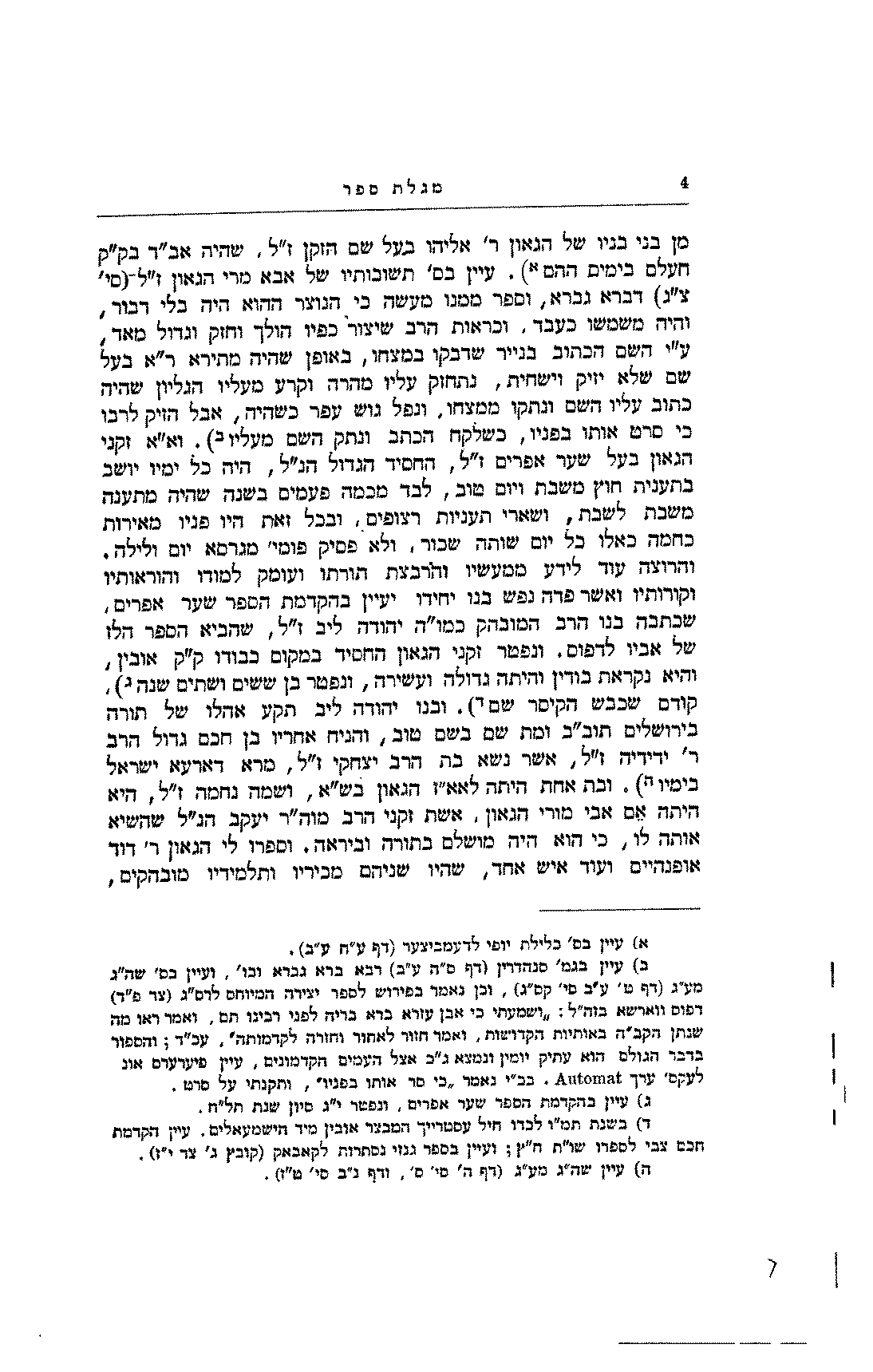
Page 5 (scan 13)
— and they told it as a marvel — how he knew all four parts of the Shulḥan Arukh by heart. A great miracle happened to him, as I will now tell in detail.
In the year 5408 [1648], a time of trouble for Israel in the land of Poland, Volhynia and Ukraine through Chmiel, the decree spread from there and reached the communities of Lithuania [a] ⟨S: "the holy …"(?)⟩. The holy community of Vilna, the praised and delicate, was driven from its nest. Before that it had dwelt in safety and at ease and was very rich — their household vessels were of silver — and in learning and standing it was renowned and praised above all the holy communities. Therefore, wherever they came in their wandering and displacement, in the German lands and the provinces, the scholars of Vilna were held in very high esteem — so the aged notable R. Ber Kohen, of blessed memory, told me [b] — for they rose to renown and glory above all the men of Poland.
Its scholars were men of renown, great students of Torah, who never departed from the tent, the great house of study, where they learned all day; and all night they did not rest from learning halakhot and the codes, expounding and searching out the truth of the Torah in Talmud and in practical ruling. They did not sleep in their own houses all the days of the week, only from Sabbath to Sabbath; and they became mighty warriors, lions in Torah, every one of them worthy to rule on law in Israel — besides the other outstanding scholars, officers and leaders. Among them were the perfect sage, the rabbi, the gaon, the pious priest, author of Sha'ar Efraim, of blessed memory, who was head of the court in Vilna; the gaon author of Birkat ha-Zevaḥ and other works, of whom they said that he knew the Ṭurim and the Beit Yosef by heart [c]; the rabbi author of the Shakh; and the pious rabbi and legal authority, author of Beit Hillel, of blessed memory [d]; besides other geonim. All of them went into exile, scattered over the earth to spread Torah in Israel, and they became great lights. MaHaRShaK became head of the court in Fürth, and from there he rose to the rabbinical seat of Frankfurt am Main and of Cracow. The rabbi of Beit Hillel was received as head of the court in Hamburg and Altona; the Shakh in Holešov in the land of Moravia; and the gaon Jacob, my father's father, with their whole household, also settled in Moravia. At first he was head of the court in Třebíč (Triebitsch) and lodged in the house of the well-known notable called Reich Kaufmann, of blessed memory, and there he taught this rich man's son. Afterwards he was head of the court in the holy community of Uherský Brod, and after that he was received again
Kahana's notes
- [a] The author of the Shakh, in his Megillat Eifah, written about the events of 1648–49, says: "Also from the end of the land of Lithuania they uprooted our borders and multiplied our slain." See Fuenn, Kiryah Ne'emanah (p. 302, no. 16).
- [b] On him see below, what he tells at length.
- [c] The author of Birkat ha-Zevaḥ was called R. Aaron Samuel Kaidanover, and was known as MaHaRShaK.
- [d] The author of the Shakh was R. Shabbetai Kohen, and his famous book on Yoreh De'ah is Siftei Kohen; the author of Beit Hillel was R. Hillel son of R. Naftali Hirz. See Kiryah Ne'emanah (p. 82).
והגידו להפליא איך ידע ארבעת חלקי ש"ע שהיו שגורים לו על פיו, ונעשה לו נס גדול כאשר אספר הנה הדברים בפרטות: ויהי בשנת ת"ח לפ"ק, עת צרה לישראל בארץ פולין וואליניה ואוקריינה ע"י חמיל, ומשם נתפשטה הגזרה ונמשכה לקהלות ליטא א, וק"ק ווילנא המהוללה והעדינה נדדה מקנה, אחרי שהיתה יושבת בטח ושאנן ועשירה מאד, עד כי כלי בית שלהם היו של כסף, בחכמה ומעלה לשם ולתהלה על כל ק"ק, ולכן, בכל מקום שהגיעו לשם בנודם וטלטולם בארץ אשכנז והמדינות, חכמי ווילנא היה נחשבים למאד, כך סח לי הישיש הק"ה ר' בער כהן ע"ה ב, כי עלו לשם ולתפארת על כל אנשי פולין בכלל. אמנם חכמיה אנשי השם לומדים גדולים, שלא משו מתוך האהל הבית המדרש הגדול, שהיה שם לומדים כל היום, וכל הלילה לא יחשו ללמוד הלכות ופוסקים, לדרוש ולחקור באמתה של תורה בתלמוד בהוראה, ולא היה ישנים בבתיהם כל ימות השבוע, כי אם משבת לשבת, ונעשו גבורי חיל אריות בתורה, כולם זכו להיות מורי הוראות בישראל, מלבד שאר לומדים מופלגים קצינים ומנהיגים; מהם היה החכם המושלם הרב הגאון החסיד שבכהונה בעל שער אפרים ז"ל, שהיה ראש ב"ד בווילנא, והגאון בעל ברכת הזבח ושאר חבורים, כאמרו עליו שהיה יודע טורים וב"י בעל פה ג, הרב בעל הש"ך והרב החסיד ובעל הוראה בית הלל זצ"ל ד, מלבד שאר גאונים כולם הלכו בגולה נפוצו בארץ להרביץ תורה בישראל, והיו למאורות גדולים. מהרש"ק נעשה אב"ד בפיורדא, ומשם נתעלה לישב על כסא הרבנות בפפד"מ וקראקא, והרב בית הלל נתקבל לאב"ד בהמבורג ואלטונא, והרב ש"ך בהעלישויא בארץ מעררין, והגאון יעקב אבי אבא עם כל בני ביתם נתישבו גם כן במעררין. מתחלה היה לאב"ד בטריבש ולן צדק בבית הקצין המפורסם בשם רייך קויפמאן' ע"ה, ושם למד אצלו בנו של העשיר הלז, והיה אח"כ אב"ד בק"ק ברודא, ואח"ז נתקבל שוב
- [א] בעל הש"ך בספרו מגילת עיפה שכתב בדבר ת"ח ות"ט, יאמר שם בזה"ל: "גם מקצה ארץ ליטא עקרו תחומינו והרבו חללינו", ועיין בס' קריה נאמנה לפין (צד ש"ב סי' ט"ז).
- [ב] אודותיו עיין להלן מה שהגיד באריכות.
- [ג] בעל ברכת הזבח נקרא בשמו: ר' אהרן שמואל קאידנובר, ונודע בשם מהרש"ק.
- [ד] הרב בעל הש"ך נקרא בשמו רבינו שבתי כהן, וספרו המפורסם על יורה דעה נקרא שפתי בהן; והרב בעל בית הלל היה שמו רבינו הלל כמוה"ר נפתלי הירץ. עיין בס' קריה נאמנה לפין (צד פ"ב).
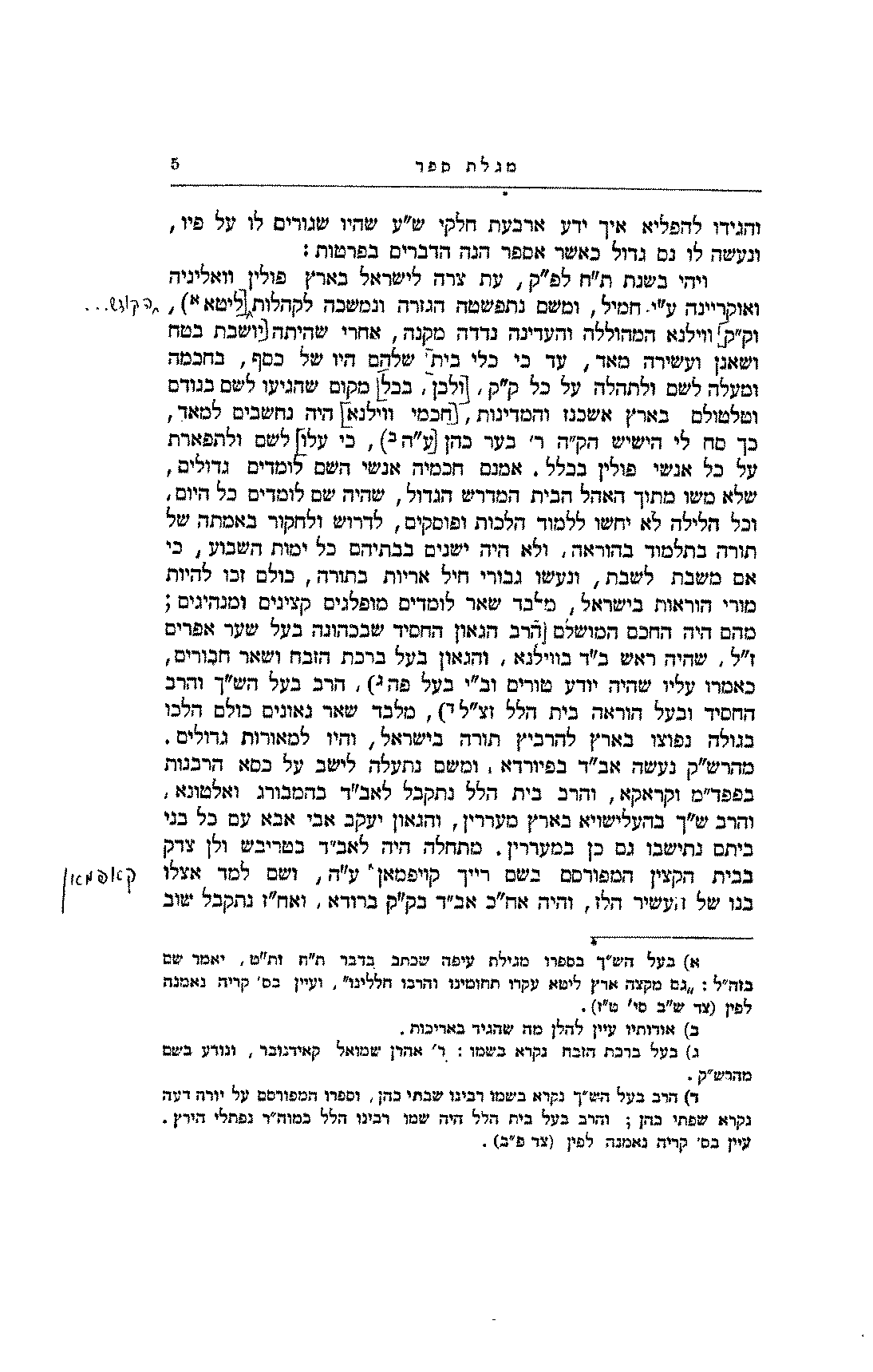
Margin readings in Scholem's copy (2)
| Printed anchor | Type (key sheet) | Mark | Reading | Certainty |
|---|---|---|---|---|
| ונמשכה לקהלות ליטא א) | V: omission | caret after ליטא, insertion in left margin | הקדוש... (or הקודש...; ends with "...") | uncertain |
| וקה"ק ווילנא / שהיתה (יושבת / שלהם / ולכן / חכמי ווילנא / עלו / ע"ה | — | pen brackets [ in the text (8 places), no margin text | - | sure (marks only) |
Page 6 (scan 14)
as head of the court in the holy community of Ofen, while it still stood on its foundations, very great in wealth and standing. He set up a yeshiva there, and his fame spread through all the land of Turkey nearby, and also in the Land of Israel [a].
But before they reached the rest and the inheritance (Deut. 12:9), many evils and dire troubles passed over them; their soul had almost dwelt in silence (Ps. 94:17) by "the oppressing sword" (Jer. 46:16) ⟨S: "the accursed Greeks, the oppressors, the Ishmaelites, the cruel ones, may their name be blotted out"⟩. Thus it happened to my grandfather, the rabbi R. Jacob, of blessed memory, who was then a young man. As they hurried to flee and escape for their lives from the oppressing sword, this perfect man was separated from his brothers ⟨S: the same word⟩ and from his young wife. She stayed with her father, who fled with his son and his wife to another land, so as not to sink into the pit of trouble.
And they met my grandfather R. Jacob, of blessed memory — the reckless ones ⟨S: "the unclean, the uncircumcised"⟩, who multiplied the slain, uprooted many communities of Israel, "left not a hoof behind" (Ex. 10:26), and shed the blood of righteous, innocent men, faithful to God, by thousands and by myriads, who were like sheep for the slaughter in the hands of the oppressors ⟨S: "of the sons [struck out] in the decree of Ukraine, and they thought to blot out the name of Israel from the land of Lithuania and Poland …"⟩. When they met this righteous man, the overseer of the captives [b] ordered him to kneel to the sword, to have his head cut off. And so he did: he stretched out his neck to the sharp sword for slaughter, to give his life to be killed for the sanctification of the Blessed Name.
While he was still on his knees to receive death by the stroke of the sword, and his soul had almost flown away, behold, an angel of the Lord touched him. For the Lord put mercy into the heart of the oppressing foe, and he pitied his tender years. Instead of drawing the sword across his neck with the sharp edge, his compassion was stirred, and he gave him a shove with the back of his weapon, in contempt, and said to him: "Get up, you dog of a boy, and go for your life!" So the Lord saved him from the sword of the wicked in a very wonderful way, and it became a great sign and wonder.
Afterwards he hid among the slain, so that those who passed by could not tell whether he was alive. By day, in the heat (Gen. 31:40), he lay among the dead who had been killed for the sanctification of the Name, and among the pools of water, covered with sackcloth; and by night, in the frost, he wandered about to look for something to live on, gathering herbs, the bitter fruit that grows among the grasses of the marsh, to keep himself alive.
He stayed in this state about eight days, until all those thirsty for blood ⟨S: "the gentile, uncircumcised and unclean"(?)⟩ had passed on; then he fled for his life and escaped from the reckless ones. Now while he lay among the holy slain, some men of our people were hiding there too. They stood at a distance and saw everything that happened to my grandfather: how he bowed his soul to the dust under the hand of the oppressor when he wished to strike him. They thought that his head had already been cut off as he knelt for the slaughter; and when they saw the oppressor's sword lying on his neck, they thought that he would not live after he fell
Kahana's notes
- [a] Among them the gaon R. Moses Galante, head of the court in Jerusalem; see his [great-grandfather's] book Sha'ar Efraim (§§ 71, 102); and the gaon R. Moses ibn Ḥabib of Jerusalem (ibid., § 74).
- [b] From the Talmudic phrase (Sanhedrin 104a) "a shabbai was following behind them", meaning the man in charge of the captives.
Translator's note. Kahana prints ḥerev ha-yonah, "the oppressing sword" (Jer. 46:16). The margin of Scholem's copy begins ha-yevanim ha-arurim, "the accursed Greeks", which suggests that the manuscript named the Cossacks as "Greeks" (i.e. Greek Orthodox) and that Kahana softened the passage. The same pattern recurs below (pp. 6–7): the collation restores insulting epithets for the attackers ("the unclean, the uncircumcised") that Kahana's printed text lacks. The mark at ha-yonah is an X, which by the key sheet means a substitution: the manuscript has these words instead of the printed ones. This is a censorship layer of Kahana's edition not described in the secondary literature we read.
לאב"ד בק"ק אובין, בהיותה עדיין עומדת על תלה, וגדולה מאד בעושר ובמעלה, וקבע שם ישיבה ושמעו הולך גם בכל ארץ טירקייא הסמוכה לשם, גם בארץ ישראל א. אך בטרם בואם אל המנוחה והנחלה, עברו עליהם רעות רבות וצרות צרורות על שכמם, כמעט שכנה דומה נפשם בחרב היונה. וכה אירע לאבי זקני הרב כמהו"ר יעקב ז"ל שהיה אז בחור בשנים, ובהחפזם לנוס ולהמלט על נפשם מפני חרב היונה, נפרד האיש השלם הלז מאחיו' ומאשתו הילדה, שנשארה אצל אביה שברח עם בנו ואשתו לארץ אחרת שלא יטבעו בבור צרה, ופגעו בו באא"ז מוה"ר יעקב ז"ל הפוחזים, אשר הרבו חללים, עקרו כמה קהלות ישראל, לא השאירו פרסה, שפכו דם צדיקים נקיים נאמנים לאלהים לאלפים ורבבות, אשר היו כצאן לטבח בידי הצרים, וכאשר פגעו באיש צדיק הלזה, וגזר עליו השבאי שיכרע לחרב להתיז ראשו ב, וכן עשה, פשט צוארו לחרב חדה לשחיטה, ולמסור נפשו להריגה על קדושת השי"ת, ובעודנו על ברכיו לקבל המיתה במכת חרב, וכמעט פרחה נשמתו, הנה זה מלאך ה' נוגע בו, כי נתן ה' רחמים בלב הצר הצורר וחמל על רכות שניו, ותחת שהיה רוצה להוליך החרב על צואר הנ"ל בצד החד, נכמרו רחמיו ועשה לו דחיפה בצד בקרנא של כלי חפצו בדרך בזיון, ואמר לו: קום לך כלב בחור ולך לנפשך! ויצילהו ה' מחרב רשע באופן נפלא מאד, ויהי לנס ולפלא גדול, ויתחבא אח"כ בין ההרוגים, ולא נכר להעוברים דרך שמה אם הוא חי, היה לחורב ביום, מוטל בין המתים הנהרגים על קדוש השם, ובין בצעי המים מתכסה בשק, ולקרח בלילה, היה נודד לבקש איזה מחיה וללקט עשבים מפרי מר הגדל בעשבים באגם, ולהחיות את נפשו. במצב הלז נשאר כשמונה ימים, עד תם כל הצמא לדם לעבור, אז ברח על נפשו וימלט מיד הפוחזים; והנה בהיותו בין ההרוגים הקדושים, היו שם איזה אנשים מבני עמנו מתחבאים גם הם, ועמדו מרחוק וראו כל מעשי של אבי זקני, איך שחה לעפר נפשו תחת יד הצורר ברצותו לפגוע בו, כסבורים שכבר הותז ראשו בכרעו לטבח, וכראותם חרב הצר מונחת על צוארו, חשבו כי לא יחיה אחרי נפלו
- [א] ובראשם הגאון ר' משה גאלנטי אב"ד מירושלים. עיין בספרו ש"א (ע"א, ק"ב) והגאון ר' משה בן הביב מירושלים (שם ע"ד).
- [ב] מלשון התלמוד (סנהדרין ק"ד) היה שבאי הורך אחריהם, ופירושו משגיח על השבוים.
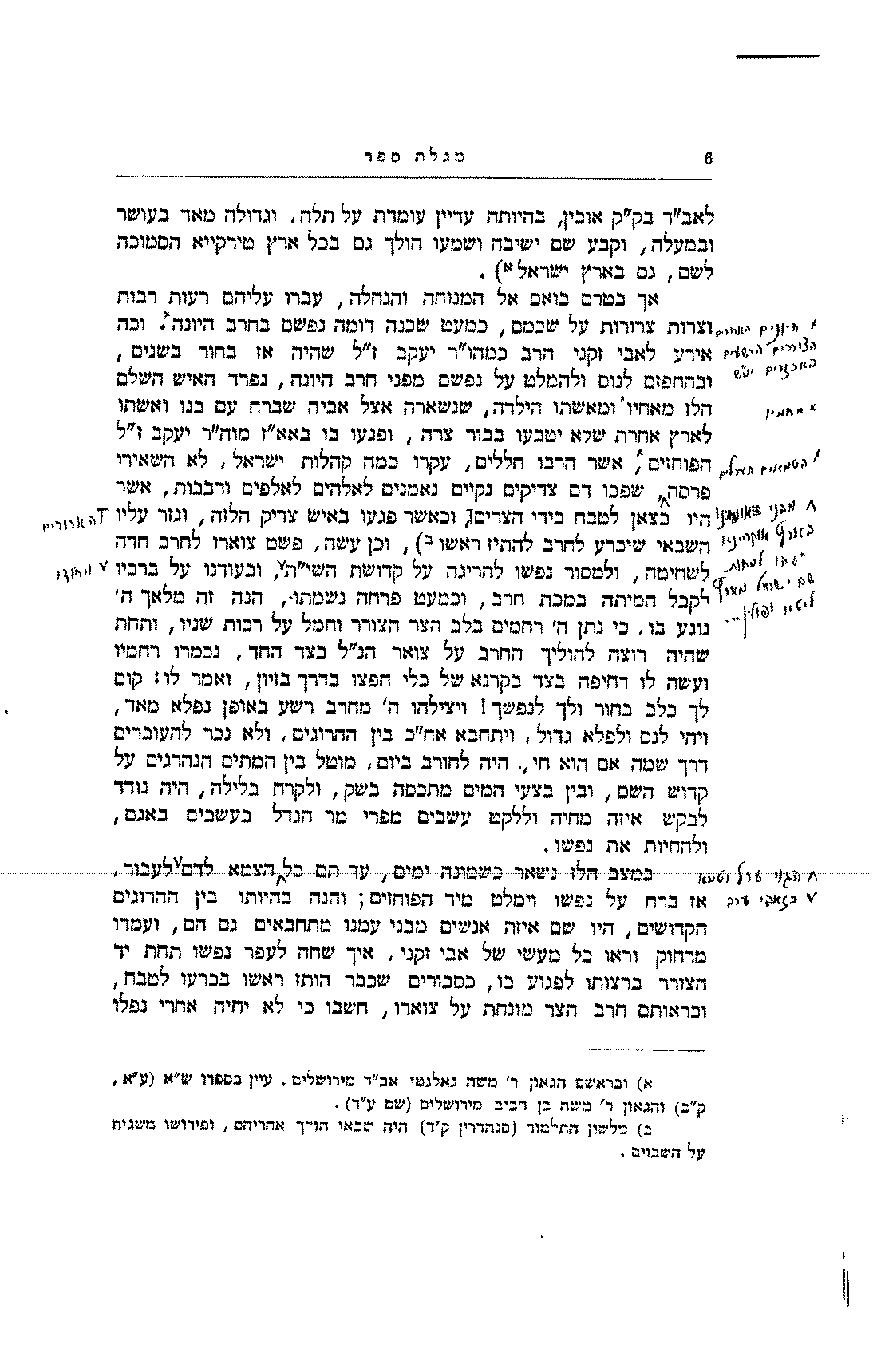
Margin readings in Scholem's copy (5)
| Printed anchor | Type (key sheet) | Mark | Reading | Certainty |
|---|---|---|---|---|
| כמעט שכנה דומה נפשם בחרב היונה* וכה | X: substitution | x mark after היונה; 3-line note in right margin | היונים הארורים / הצוררים הישמעאלים / האכזרים ימ"ש | fairly sure |
| הלז מאחיו' ומאשתו | X: substitution | x mark after מאחיו; note | מאחיו (the same word as the print) | fairly sure |
| ופגעו בו ... הפוחזים' אשר הרבו חללים | — | mark after הפוחזים; note | הטמאים הערלים | fairly sure |
| היו כצאן לטבח בידי הצרים | V: omission | caret before כצאן(?); 5-line note in right margin, partly cut by scan edge | מבני [struck out] / בגזרת אוקריינא / וחשבו למחות / שם ישראל מארץ / ליטא ופולין ... | fairly sure |
| כמצב הלז ... עד תם כל ^ הצמא לדם ^ לעבור | V: omission | 2 carets; 2-line note in right margin | הגוי ערל וטמא(?) / כצאני(?) ... | uncertain |
Page 7 (scan 15)
— with a shove to the ground with the back of the sword, which was no mortal blow at all. But those men, standing at a distance and watching in panic, with the terror of death fallen upon them, imagined that his head had been lifted off him and thrown to the ground — like the case the Sages discuss in the Gemara [a], where people saw a man struck by an arrow or a spear and thought he was certainly dead. And if you object that a single witness in time of war is not believed — here there were two; and they too spoke from assumption.
So when these men came to the town of Třebíč, the place of the gaon author of Sha'ar Efraim — after they had escaped from the enemies through the Lord's mercy and come to the land of Moravia, a quiet and secure place — my grandfather R. Jacob's place was empty (1 Sam. 20:25). They inquired about him among those survivors of the sword, whether they had seen him alive or dead; and those escaped men, honest men who went "in their simplicity" (2 Sam. 15:11), answered: "Jacob is dead, for we saw with our own eyes that he knelt to be killed and his head was cut off." They testified to what they had not truly seen. On their word, the great gaon of his generation, the famous R. Heschel, of blessed memory, permitted his wife Neḥamah to remarry, by way of a question and a ruling that permitted it, for the matter was very simple and as clear as Torah: "at the mouth of two witnesses shall the matter be established" (Deut. 19:15) — all the more so in the case of an agunah, for whom the Sages were lenient.
But his wife, a young woman and the fairest among women, refused to be comforted (Gen. 37:35) over the husband of her youth, who was alive. The righteous woman stood firm in her purity, to bring forth from herself a great chain, "a generation of the upright that shall be blessed" (Ps. 112:2), "a planting in which to glory" (Isa. 60:21). For after half a year the slain man came back on his own feet, and it became a sign and a wonder in Israel. From then on that gaon would not permit any agunah to remarry, in that generation and in the distress of those times, when there were many women chained by husbands lost in that upheaval, from the ravages of the reckless ones ⟨S: "the accursed Greeks"⟩. He feared a stumbling-block; so he took it upon himself never again to deal with releasing a woman, since such a stumbling-block had come about through him — that he had permitted a woman who was fully married. He said that in an evil time like that one may not rely even on two proper witnesses. And in him was fulfilled: "No mischief shall befall the righteous" (Prov. 12:21).
After this my father and master the gaon, of blessed memory, Tzvi, the glory of Israel, was born to the chosen couple, while they were still in Moravia. From there my great-grandfather, the gaon author of Sha'ar Efraim, came with his son-in-law, my grandfather R. Jacob [Mohari], of blessed memory, and their whole household, to Buda, which is Ofen, the capital of the kingdom of Hungary. He was rabbi and head of the court there for some years, for the important community that was there at that time. He held his office with great honour, married his sons and grandsons into the wealthiest families of the community, and spread Torah widely. His fame was great in all the land of Turkey and in the Land of Israel; many of the great men of the land sent him their letters with questions, as a man inquires of the word of God (2 Sam. 16:23).
My father and master, of blessed memory, while still a tender youth, studied Torah with his father and his grandfather, of blessed memory, with great diligence. He had a sharp mind
Kahana's notes
- [a] See b. Yevamot 114b.
בדחיפה על הארץ באחורי החרב, שלא היה מכת מות כלל, אך האנשים ההמה העומדים בית המרחק ורואים בבהלה ואימת מות נפלה עליהם, דימו שהורם ראשו מעליו והושלך לארץ, בענין שאמרו חז"ל בגמרא א, דחזו דמחי ליה בגירא או ברומחא וסברו ודאי מת, וא"ת עד אחד במלחמה אינו נאמן, אבל כאן שנים הם ואמרי ג"כ בדדמי, לפיכך כשהגיעו אלה האנשים לעיר טריבש למקום הגאון בעל ש"א, אחר שנמלטו מיד האויבים בחמלת ה' עליהם ובאו למדינת מעררין למקום שוקט ובוטח, ויפקד מקום אבי זקני מוה"ר יעקב ז"ל, וחקרו אחריו אצל פליטי חרב הנ"ל, אם ראו אותו חי או מת, ויענו האנשים הנמלטים ההם, הכשרים והולכים לתמם, ויאמרו יעקב מת, כי ראינו בעינינו שכרע להריגה והותז ראשו, העידו על מה שלא ראו לנכון, ועל פי דבריהם התיר הגאון הגדול בדורו המפורסם כמוה"ר העשיל זצ"ל את אשתו נחמה להנשא, ע"פ שאלת חכם והוראה להתיר, כי היה דבר פשוט מאד, ברור כתורה על פי שנים עדים יקום דבר, אף כי בעגונה שהקילו חז"ל אצלה; אך אשתו, כי היתה ילדה היפה בנשים, לא רצתה לקבל תנחומין על החי בעל נעוריה; הצדקת עמדה בטהרתה להוציא ממנה שלשלת גדולה, דור ישרים יבורך מטע להתפאר, כי אחר חצי שנה בא ההרוג ברגליו, ויהי לאות ולמופת בישראל. מן אז והלאה לא רצה הגאון הנ"ל להתיר שום עגונה בדור ההוא ובצוק העתים, שהיו שם עגונות רבות מבעליהן הנאבדים ברעש ההוא משוד הפוחזים, ונתירא ממכשול, על כן קבל עליו שלא להזדקק לשום התרת אשה, מאחר שהמכשלה הזאת תחת ידו, שהתיר אשת איש גמורה, ואמר שבעת רעה כמוה אין לסמוך כלל אפילו על שני עדים גמורים, ונתקיים בו לא יאונה לצדיק כל און. אחר זאת נולד אבא מארי הגאון ז"ל צבי תפארת ישראל, מהזוג הנבחר עודם בארץ מעררין, ומשם בא אא"ז הגאון בעל שער אפרים עם חתנו אא"ז מוהר"י ז"ל עם כל ביתם לבודין, היא אובין ראש מלכות אונגרין, והיה שם רב אב"ד כמה שנים לקהל החשוב, אשר היה שם בעת ההיא, והנהיג נשיאתו בכבוד גדול, והתחתן בעשירי הקהלה עם בניו ונכדיו, והרביץ תורה לרוב, ויהי שמעו בכל ארץ טורקייא ובארץ ישראל גדול שמו; רבים מגדולי הארץ מריצים אליו אגרותיהם בשו"ת כאשר ישאל איש בדבר האלהים. ואמ"ה ז"ל עודנו נער רך בשנים, למד תורה אצל אביו ואבי זקנו ז"ל בשקידה רבה, והיה לו לב חרוץ
- אן עיין במס' יבמות (דף קי"ד ע"ב).
Margin readings in Scholem's copy (1)
| Printed anchor | Type (key sheet) | Mark | Reading | Certainty |
|---|---|---|---|---|
| משוד הפוחזים' ונתירא | — | mark after הפוחזים; note in right margin | היונים הארורים | fairly sure |
Page 8 (scan 16)
and a great and very powerful memory. In his youth he went to Salonica to learn also the ways of the Sephardi sages, for there were great and mighty scholars there at that time, and he served above all the rabbi Elijah Covo, of blessed memory. From there he returned to Buda, to his father's house, already bearing a name like the great ones while still a young man.
Among his papers I found holy autograph letters of his grandfather, the pious gaon author of Sha'ar Efraim, of blessed memory, which he wrote to him in Salonica, urging him to diligence in his study and to constant inquiry with the Sephardi sages: to stand before them and serve them, to know the mind and the wisdom of each of them, and to bring back with him some of their novel teachings. In them he lavished praises and titles on his grandson, my father and master, as one writes to great men of renown.
From his childhood "the spirit of the Lord began to move" my father (Judg. 13:25). He wrote and composed long and broad responsa, of ten sheets of paper or more. One of them was the very first, when he began to answer a questioner on a matter of Torah, and there was another as well. They lay until now in his archive; it seems that because of their great length he set them aside and did not bring them to print in his book, part one. I too found it too heavy a task to go through them and study them — above all because they came into my hands out of season, having first passed through strangers' hands for many years, and who knows what is missing from them; and the script is Sephardi, and I can read them only with difficulty; add to that my many burdens. They were a load on me, and so of necessity they were laid aside, until a redeemer should come for them and bring them out to the light. Then there came here a young man, R. Hirschel of Glogau(?) ⟨S: "perhaps: of Glogau"⟩, and he pressed me to give them to him, so that he might have the merit of bringing them out to the light and to print. I agreed and handed them over to him.
My father and master was also of fine form and fair to look at, and with this he practised great piety from his youth. So mighty magnates sought him. He was betrothed to and married the daughter of a great rich man, one of the rich of the community of Old Buda, who settled much money on him, and my father was a man of standing and wealth in Buda. Afterwards he was rabbi and sage in the community of Sarajevo in the land of Bosnia, where there were also very rich men.
When the city of Buda was taken by the men of the emperor, may his majesty be exalted, the whole community went into captivity. My grandfather and grandmother — "their feet were put into fetters" (2 Sam. 3:34), and the commander of the Prussian troops, who had taken them captive and to whose share they fell, led them to Berlin; and they were parted in Berlin. My father was carried away from there by a miracle and a wonder, which had happened to him at the beginning, when the city came under siege. A ball of fire came from the great fire-tube that they call a cannon, and fell on the house where my father lived; it smote the house "into fragments and splinters" (Amos 6:11), and the ball took his first wife together with the little girl he had from her. He himself was in another room next to hers in the house, and it did him no harm at all; he was saved by the Lord's mercy, and it was a miracle. From there he fled and escaped. At that time he wrote the responsum printed in his book, about a woman who died and did not
וזכרון גדול עצום מאד, והלך לסאלוניקי בימי חרפו ללמוד גם דרכי חכמי הספרדים, אשר היו שם בעת ההיא חכמים גדולים ועצומים, ושמש את הרב אליהו קובו זצ"ל ביחוד, ומשם חזר לבודין אל בית אביו, ולו שם כשם הגדולים בעודו ילד בחור בשנים. ומצאתי ראיתי בין כתביו אגרות כ"י הקדושה של אבי זקנו הגאון החסיד בעל ש"א ז"ל שכתב לו לסאלוניקי להזכירו על שקידת למודו והתמדת חקירתו את חכמי הספרדים, לעמוד לפניהם לשמשם, ולדעת לב כל אחד מהם וחכמתו, ולהביא אתו מחידושיהם, ובו הרבה לנכדו אמ"ה ז"ל הלולים ותוארים, כדרך שכותבים לגדולים אנשי השם, ואמ"ה ז"ל מאז בילדותו החל רוח ה' לפעמו, וכתב וחבר שאלות ותשובות ארוכות ורחבות, בעשרה ידות נייר או יותר, ואחת שהיא הראשונה, שהתחיל להשיב שואלו דבר בתורה, וכן האחרת, והמה היו מונחים עד הנה בבית גנזיו, ונראה מפני גודל כמותן הניחן, ולא הביאן לדפוס בספרו ח"א, גם אנכי כבד ממני הדבר לעבור עליהן ולשום עיוני בהן, ביחוד שבאו לידי שלא בעונתן, שמתחלה עברו ע"י זרים שנים רבות, ומי יודע מה נפקד מהם וגם הכתב היא ספרדית ובקושי אוכל לקרותן, מצורף לטרדותי המרובות, והנם למשא עלי, לכן בהכרח הונחו אל הצד, עד שיבוא הגואל להם ויוציאם לאור, ושוב בא הנה ב"א ר' הירשל מגליגיו, והפציר בי לתתם לו, כדי לזכות בהם שיוציאם לאור ויביאם בדפוס, ונעתרתי לו ומסרתי בידו. גם היה אמ"ה יפה תאר ויפה מראה, ועם זה היה נוהג חסידות עצומה מנעוריו, לכן חשקו בו גבירים כבירים, ונשתדך ונשא בת עשיר גדול מעשירי קהל בודין הישנה, שהפריז לו ממון רב, והיה אמ"ה בבודין עשיר מסוים. אח"כ היה רב וחכם בקהל שאראי בארץ בוזנא, שהיו שם ג"כ עשירים מופלגים, וכאשר נלכדה העיר בודין מאנשי הקיר"ה, הלכו כל הקהל שבי, וזקני וזקנתי רגליהם לנחושתים הוגשו, והוליכם לברלין שר החיל של אנשי צבא פרייסן, ששבה אותם ונפלו לחלקו, ונפרדו בברלין, ואמ"ה נעתק משם בדרך נס ופלא, שנעשה לו בתחלה כאשר באה העיר במצור, ויבוא כדור של אש מקנה השרפה הגדול שקורין קאנאן, ויפול בבית שהיה דר שם אמ"ה ז"ל, ויך את הבית רסיסים ובקיעים, ויקח הכדור את אשתו הראשונה עם הילדה שהיה לו ממנה, והוא היה בחדר אחר הסמוך אתה בבית, ולא הזיק לו מאומה, ונצל בחמלת ה' עליו ויהי לנס, ומשם ברח וימלט. ובפרק ההוא כתב התשובה הנדפסת בספרו, על אודות אשה שנפטרה ולא חי
Margin readings in Scholem's copy (3)
| Printed anchor | Type (key sheet) | Mark | Reading | Certainty |
|---|---|---|---|---|
| ר' הירשל מגליגיו* | X: substitution | x mark; note in right margin | אולי: מגלוגא (Scholem's conjecture "perhaps: from Glogau"? not a MS reading) | fairly sure |
| lines 5-14 (כ"י הקדושה ... ח"א) | — | 6 short marks at the scan edge, cut off | - | not read (cut by scan edge) |
| בקהל שאראי בארץ בוזנא | V: omission | caret and v mark, short note cut by scan edge | - | not read |
Typed insert in Scholem's copy (scan 17), "belongs between pp. 8 and 9"
A typewritten sheet bound into the volume. It is not part of Kahana's edition. Its heading says: "Between leaves 3 and 4 of Megillat Sefer there is a slip half a page in size, numbered as leaf 117 of the manuscript, on which the following is written; it completes the life story of Emden's grandfather." Who typed it is not stated (probably made for Scholem from the Oxford manuscript). Bick's edition (Pninim text) prints the same passage in brackets at the end of book p. 10; its readings settled the doubtful words of the typescript.
My grandfather, with his wife my grandmother(?), after many wanderings had passed over them, came to Altona and saw their beloved son, my father and master(?), of blessed memory, in honour, after he had already married my mother, the rebbetzin, of blessed memory, as told above, with the help of Heaven. From there they travelled to the Holy Land by way of Poland, and were granted to settle in Jerusalem, may it be built and established speedily in our days.
A year later the wife of my grandfather's youth died. He was already an old man of more than seventy, and the sages who were there compelled him to take a wife in his old age, for in the holy city a man is not allowed to live without a wife, even if he is old and full of days. The Holy One, blessed be He, provided him there with a fitting second match, also a woman of a priestly family, of a family of distinguished lineage in Israel: she was the learned and outstanding old woman who had been there(?) before, and her name was Judith, daughter of the famous gaon R. Naftali who was in Lublin — the grandfather of my aged father-in-law, R. Naftali Katz, head of the court in Frankfurt am Main.
My grandfather R. Jacob also died in Jerusalem, at a good old age, seventy-three years old, and it was written from there to my father and master, of blessed memory. At the time of the righteous man's death God answered the Holy Land, and a great miracle happened. For the heavens had held back their waters; so they put with him in his grave a piece of cloth soaked in water, to make known their distress, that they needed water — so that he would plead for mercy for the living, that they might not die of thirst. And as they came back from his burial, rain came in abundance and watered the thirsty land, and everyone said: his merit protected them….
שייך בין עמ' 8 ועמ' 9 (בין הדפים 3 ו-4 של מ"ס נמצאת פתקא בגודל של חצי דף, המסומנת בתור דף 117 של כה"י, ובה כתובים הדברים הבאים, שהם השלמה לתולדות חייו של הסב של יעב"ץ:) וא"ז עם אשתו א"ז(?) אחר שעברו עליהם כמה גלגולים (typed: ולגולים; Pninim: גילגולים) באו לאלטונה וראו את בנם החביב א"ה(?) ז"ל בכבוד אחר שכבר נשא את מורתי הרבנית ע"ה כמש"ל בס"ד. ומשם נסעו (Pninim: נסע) לארץ הקדושה דרך ארץ פולין וזכו להתיישב בירושלים תוב"ב. ואחר שנה נפטרה אשת נעוריו [של] א"ז והוא כבר זקן יותר משבעים שנה והכריחוהו החכמים אשר היו שם ישא אשה בזקנותו כי אין מניחין בעיר הקדושה שבת אד[ם] (Pninim: שבת אדם) בלי אשה ואפילו יהא זקן ושבע ימים מאד. וזימן לו הקב"ה שם זווג שני הגון ג"כ אשה כהנת ממשפחה מיוחסת שבישראל היא היתה הזקנה המלומדת המופלגת שהיתה שמה מלפנים ושמה יהודית בת הגאון המפורסם כמ' נפתלי שהיה בלובלין זקנה של חותני הזקן כמו' נפתלי כץ אב"ד בפפד"מ. ונפטר אבי זקני כמוהר"י גם הוא בירושלים בשיבה טובה בן ע"ג שנה ונכתב משם לאמ"ה ז"ל. בעת פטירת הצדיק נעתר השם לארץ הקדושה והיה [נ]ס גדול (Pninim: נס) כי השמים נעצרו מלתת מימיהם ונתנו לו עמו בקברו חתיכת בגד טבול במים להודיע צערם שצריכים למים לבקש רחמים על החיים לא ימותו בצמא ובשובם מקבורתו בא מטר לרוב והרוה את הארץ הצמאה ואמרו כולם זכותו הגין בעדו....
Page 9 (scan 19)
[… about a woman who died, and whose child did not live] after her thirty days, within the years of "return" [a]. He was then received as rabbi in the holy community of Sarajevo, mentioned above, and he served that congregation until the end of the siege of Ofen; they treated him with great honour.
When the visitation of the city of Sarajevo drew near, and it too came under siege by the troops of the emperor, may his majesty be exalted — and also when he heard that his father and mother had been taken captive — my father left and turned away from that country and came to the German lands. On all that long road and heavy wandering he would not accept a gift from anyone, although he had a great name, and everywhere he came they hurried out to meet him; he made do with the little money he had with him. When he came to Venice he lodged in the house of the pious and outstanding gaon R. Samuel Aboab, of blessed memory, and great affection was shown to my father by him. There the money ran out of his vessels, and the last penny was almost gone from his purse. Then the Holy One, blessed be He, arranged for him, in a wonderful way, that one of the nobles of the land of Hungary, who owed him a certain sum, came there and happened to stay at the same inn, and he repaid my father his whole debt in full. So he did not have to abandon the trait of piety that he had held from his youth, to hate gifts — as the Sages said, "In the way a man wishes to go, he is led" (b. Makkot 10b) — for the Lord was with him. From there he passed on to the land of Ansbach.
At that time there happened the unclean affair of the very famous rich man in Ansbach. He was somewhat compelled by the word and the coercion of his ruler, who demanded that he marry a woman forbidden to him in the second degree by rabbinic law. He asked several rabbis to permit it to him, and found some of them in the land of Poland: he sent an agent there on a sinful errand, with a bag of money in his hand. Some of them were placated with pieces of silver (Ps. 68:31) to loosen the bond of the prohibition; some he bought with full money and obtained their signatures; and about some he lied.
Because of my father's standing there, he pressed him too, and entreated him to sign the ruling of permission as well; and he was ready to open his hand wide to him, to get what he wanted. But my father rebuked him and sent him away in reproof, and spat in his face for asking such an improper thing of him. What became of him in the end is known and famous in the world: after he had done the deed and married her, [he became very ill] and his limbs withered, so that Heaven kept them apart, and they could not come together in sin. It was a great sanctification of the Name, for it was seen eye to eye how great and weighty are the words of the Sages and the words of the Scribes, more than the words of the Torah. For every day we see men who transgress with a high hand, etc., and lenders at interest, robbers, extortioners, false swearers, men who shave their beards and transgress the Torah — and the Holy One, blessed be He, is long-suffering, sees His insult and keeps silent, and does not exact His debt from them
Kahana's notes
- [a] See the responsa Ḥakham Tzvi (§ 61). The question reads: "Reuben married a woman in Buda, where they do not follow the enactment of Speyer–Worms–Mainz, etc., but write a deed of return, which they call a shtar idur, etc." See there.
הזרע קימא אחריה שלשים יום בשנות החזרה א; ונתקבל לרב בק"ק שאַראי הנ"ל, ועמד לשרת את הצבור הלז עד תם מצור אובין, והנהיגו בו כבוד גדול. וכאשר קרבה פקודת העיר שאראי, ותבוא גם היא במצור מאנשי חיל הקיר"ה, גם כשמעו כי נשבו אביו ואמו, הלך לו אמ"ה ופנה מאותה מדינה, ובא לו לארץ אשכנז, ובכל הדרך הארוכה והטלטול הכבד לא רצה לקבל מתנה משום אדם, אע"פ שהיה לו שם גדול, ובכל מקום שהגיע לשם חרדו לקראתו, והיה מסתפק במעט הכסף הנמצא בידו. ובבואו לויניציאה התארח בביתו של הגאון החסיד המופלג כמהו"ר רש"א זצ"ל, וחיבה יתירה נודעת לאמ"ה ממנו. שם אזל הכסף מכליו, כמעט כלתה פרוטה מן הכיס, והזמין לו הקב"ה דרך פלא אחד מחורי ארץ הגר שהיה חייב לו סך מסוים, שבא לשם ונזדמן לפונדק אחד, ופרע לאמ"ה כל חובו משלם, באופן שלא היה צריך לעזוב מדת החסידות, שהחזיק בה מנעוריו להיות שונא מתנות, כענין שאמרו חז"ל: בדרך שאדם רוצה לילך מוליכין אותו, באשר ה' אתו. משם עבר אל מדינת אנשבאך. בעת ההיא אירע המקרה בלתי טהור עם העשיר המפורסם מאד באנשבאך, שהיה קצת אנוס ע"פ הדבור ובכפיה של השררה שלו, שבקש ממנו שישא שניה דרבנן לאשה, ובקש לכמה רבנים שיתירוה לו, ומצא כמה מהם בארץ פולין, ששלח לשם שליח לדבר עבירה וצרור הכסף בידו, ונתפייסו לו איזה מהם ברצי כסף, להפקיע חבל האיסור; קצתם קנה בכסף מלא והשיג חתימתם, ובקצתם שקר ענה. ובעבור כבוד אמ"ה ז"ל שם, השתדל הוא אצלו ג"כ, וחלה פניו שיחתום לו ג"כ על פסק ההיתר, ורצה להתיר לו פס ידו, למען השיג מבוקשו, ואמ"ה גער בו והוציאו בנזיפה, ורקק בפניו על ששאל ממנו דבר שאינו הגון כזה. מאי סלקא ביה במאד, דבר זה ידוע ומפורסם בעולם, כי אחר מעשה שעשה ונשאה, ]נחלה מאד[ ונשול איברים, באופן שמן השמים הפרישום שלא יזדקקו זה לזה בעבירה, והיה קדוש השם גדול, כי עין בעין נראה כמה גדולים וחמורים דברי חכמים ודברי סופרים מד"ת; שבכל יום אנו רואים עוברי עבירה בידים וכו', ומלוי ברבית והגזלנים וחומסים ונשבעים לשקר והמגלחים זקנם והעוברים על התורה, והקב"ה מאריך אפו, רואה עלבונו ושותק, אינו גובה מהם חובו
- [א] עיין שו"ת חכם צבי (מי' ס"א), וז"ל השאלה: ראובן נשא אשה בבודין ושם אין נוהגין תקנת שו"ם וכו', אלא כותבין שטר חזרה וקורין אותו שטר עידור וכו', ע"ש.
Page 10 (scan 20)
in this world; on the contrary, "He repays them to their face, to destroy them" (Deut. 7:10). But with the decrees and enactments of the Sages He does not forgo and does not wait: the punishment does not delay its coming, God save us, to show how dear they are — that all their words are like coals of fire. So we find in the chapter [of the Talmud] that He was stricter about the honour of the righteous than about His own honour. Such things have happened many times, as every clear-sighted Jew can know, who watches the history of the times and does not count them as chance; and as I will tell you further below, we saw and knew for certain that the end of one who transgresses the words of the Sages is death before its time, or poverty and ugly sufferings that are harder than death.
Let us return to the history of the righteous man. From there my father came to Prague, and his name kept growing. The rabbi R. Y., head of the court of the lands of Bohemia, wanted to give him his daughter Shifrah as a wife, with a great deal of money (she later married the head of the court of Prague); but he would not take her, because she was a widow. He went on as far as Berlin. And although many great rich men who had heard of his great fame — above all in the community of Hamburg — wanted to make a match with him and to settle much money on him, he did not set his eyes on money, and he chose a family of lineage. My uncle, the rabbi R. Ze'ev, of blessed memory, made the bond with him, that he should take his sister, the daughter of my grandfather, then head of the court of the Three Communities, namely R. Meshullam Zalman Neumark, of blessed memory [a]. She is my mother and teacher, the pious rebbetzin Mrs. Sarah, of blessed memory: for "a prudent wife is from the Lord" (Prov. 19:14), pure in the fear of the Lord, of the chosen stock of the famous Mirels family, of the pious of the old holy community of Vienna. That community was full of honoured men, nobles of the land, men of good deeds and great pietists, outstanding masters of Torah; and all the geonim of that generation of knowledge clung to them and married into them, for their standing was very great in Torah, in the fear of Heaven, in deeds, in wealth and property, in greatness, in good name and in lineage.
And my grandfather, the venerable elder mentioned above, lived long upon his reign in the Three Communities in peace and quiet, and led the community with uprightness and wisdom. The Three Communities grew in his days and rose to the top in wealth and honour. He saw about a hundred and fifty descendants or more; a fifth generation was also born to him in the land of Lithuania. All my mother's brothers, and the husbands of my [mother's] sisters(?), were men great in Torah and in deeds — some of them rabbis, some leaders in the lands of Poland and Lithuania. They filled the face of the world, "and the earth shone with their glory" (Ezek. 43:2).
My father had by my mother, the rebbetzin, of blessed memory, in the holy community of Altona, five sons
Kahana's notes
- [a] For the text of his tombstone see Wittkower, Agudat Peraḥim (p. 284). He died on 22 Kislev 5467 [1706] in Altona. See also Dembitzer, Kelilat Yofi (fol. 91b).
בעוה"ז, אדרבה משלם להם שכרם על פניהם להאבידם, ובגזירות חז"ל ותקנותיהם אינו מוותר ואינו ממתין, אין הפורענות שוהא לבוא ר"ל, כדי להראות חבתן, שכל דבריהם כגחלי אש, וכן מצינו בפ' שהחמיר בכבוד צדיקים יותר מכבודו, וכזה אירע פעמים רבות, כאשר יוכלדעת כל איש יהודי פקח, אשר ישגיח על תולדות הימים, ולא יחשבם למקרים, וכאשר אשמיעך עוד להלן שראינו וידענו בבירור, שסוף העובר על ד"ח - מיתה שלא בעונתה, או עוני ויסורים מכוערים דקשה ממיתה. נחזור לתולדותיו של צדיק: משם בא אמ"ה ז"ל לפראג והיה שמו הולך וגדול, ורצה הרב ר"י אב"ד דמדינות פיהם לתת לו לאשה בתו שפרה עם ממון רב, (שנשאת אח"כ להגאב"ד מפראג) ולא אבה לקחתה מחמת היותה אלמנה, ובא לו עד ברלין, ועם היות שרצו כמה עשירים גדולים, אשר שמעו שמעו הגדול, ביחוד בק' המבורג, להשתדך עמו, ולהפריז לו ממון רב, לא נתן עיניו בממון ובחר במשפחה מיוחסת. נתקשר עמו דודי הרב כמוהר"ר זאב ע"ה, לקחת את אחותו בת אבא רבה הגאב"ד דג"ק בעת ההיא, ה"ה כמו"ה משלם זלמן ניימרק זצ"ל א, היא אמי מורתי החסידה הרבנית מ' שרה ע"ה, כי מה' היתה לו לאשה משכלת יראת ה' טהורה, מגזע הנבחר משפחת מירלש המפורסמת, מחסידי ק"ק ווינא הישנה המלאה לה אנשים נכבדים נדיבי ארץ אנשי מעשה וחסידים גדולים, בעלי תורה מופלגים, וכל הגאונים שבאותו דור דעה דבקו בהם והתחתנו עמהם, כי גדלה מאוד מעלתם בתורה ביראה במעשים בעושר ובנכסים, בגדולה בשם טוב וביחסים. ואבא רבה מר קשישא הנ"ל האריך ימים על ממלכתו בג"ק בשלום ושלוה, והנהיג את הציבור במישור ובחכמה, וכן גדלו הג"ק בימיו, רבו למעלה ראש בעשירות ובכבוד, והוא ז"ל ראה בערך מאה וחמשים יוצאי חלציו או יותר, גם דור חמישי יולדו לו בארץ ליטא, וכל אחי אמי ובעלי אחיותי אנשים גדולים בתורה ובמעשים, מהם רבנים, מהם קצינים במדינת פולין וליטא מלאו פני תבל והארץ האירה מכבודם. ואמ"ה הוליד מאמי הרבנית ז"ל בק"ק אלטונא חמשה בנים
- [א] נוסח מצבתו עיין בס' אגודת פרחים לוויטטקאווער (צד רפ"ד), ונפטר כ"ב כסלו שנת תס"ז באלטונא, ועיין בס' כלילת יופי לדעמביצער ז"ל (ד' צ"א ע"ב).
Margin readings in Scholem's copy (1)
| Printed anchor | Type (key sheet) | Mark | Reading | Certainty |
|---|---|---|---|---|
| lines 4-12 and 25 | V: omission | marks at the scan edge (cut off), caret and v at line 25 | - | not read |
Page 11 (scan 21)
and five daughters. In this year 5512 [1752] they are still alive and well, thank God; may the Lord lengthen their days and years in goodness and pleasantness.
There in Altona the Blessed One built him "a sure house" (1 Sam. 2:35), and set up for him the great house of study, the Kloyz, which the magnates and rich men of the Three Communities founded for him, to spread true Torah, for its own sake. Outstanding students and rabbis from the lands of Poland and Lithuania gathered to him there, and studied Torah there with great diligence; day and night they did not cease to learn Gemara, Rashi and Tosafot, the codes, halakhot and aggadot. They also "filled their hands to the Lord" with other knowledge, until they became perfect in Torah and in wisdom. Many times they completed with him the whole Talmud and the Ṭurim, Bible and Midrash, and a book of grammar.
They also learned from him abstinence and caution, the way of true piety and inward fear of Heaven. For he hated unjust gain, and despised even money that other rabbis counted as honest. Never in his life did he take gifts of money from flesh and blood, from private persons, although many times the leaders of the people, the rich men of his generation — men great and important like princes and dukes — wanted to make him rich. Many times they brought him presents, precious vessels of silver and gold, and he sent them away empty-handed and would take nothing from them.
Who can tell the greatness of his deeds? They would not be believed if they were told — except by one who saw and knew and served him. Even now, at the time I write this scroll, there are still in the Three Communities some old men who served him and remember his deeds, his holy and upright conduct and his teaching; they are filled with joy and gladness when they speak of him. "To his name and to his memory is the desire of the soul" (Isa. 26:8) of those who knew him of old, for none like him was heard or seen in these lands since ancient years. Therefore he grew and prospered in the Torah and wisdom that he learned and taught; for all his Torah was for the sake of Heaven, not to make himself great or to find favour in the eyes of men. All his aim and desire was to increase the glory of his Creator and to raise up the pillars of the Torah, with all his heart, all his soul and all his might.
He had the heart of a lion to rescue the oppressed from the oppressor; he showed no favour in matters of Torah, and kept the command "You shall not be afraid of any man" (Deut. 1:17). Because of this trait some of the powerful "rams" of the city were always opposed to him, as I will write, with God's help — not enemies of his person, God forbid (except some worthless men, the insolent of the generation); for everyone knew and recognised that he was a man of God, holy and faithful to God. For this very reason they feared him: because he would not show them favour in anything that was not upright. There is no wonder in this. A man who would not take from a human being even if they gave him all the silver, gold and pearls in the world will surely not show partiality in judgement, and will do only what is right in the eyes of the Lord alone.
And the great wonder is that the lust for money and the love of silver, which "answers all things" (Eccl. 10:19), could not turn his heart towards it, although he was burdened with sons and daughters, and his house was empty of any large income. All the years he was rabbi in the Kloyz he had only sixty Reichstaler a year, a fixed sum, against very great and necessary expenses — in every
וחמש בנות. בשנת תקי"ב הזאת עודם חיים וקימים ת"ל, ה' יאריך ימיהם ושנותיהם בטוב ובנעימים; ושם באלטונא בנה לו הי"ת בית נאמן, והקים לו בה"מ הגדול קלויז, שיסדו לו גבירי ועשירי הג"ק, להרביץ בו תורה אמתית לשמה. ונאספו אליו שמה לומדים ורבנים מופלגים מארץ פולין וליטא, שהיו עוסקין שם בתורה בשקידה רבה, יום ולילה לא ישבותו ללמוד גפ"ת ופוסקים הלבות ואגדות. גם מלאו ידיהם לה' בשאר ידיעות, עד שנעשו שלמים בתורה ובחכמה, כמה פעמים גמרו אצלו ש"ם וטורים מקרא ומדרש וספר דקדוק. גם למדו ממנו ז"ל פרישות וזהירות, ומנהג חסידות אמיתית ויראה פנימית, באשר היה ז"ל שונא בצע, ומואס אפילו בממון שהוא של יושר אצל רבנים אחרים, ומימיו לא קבל מתנות ממון מב"ו מיחידים, עם שפעמים הרבה רצו להעשיר אותו קציני עם עשירי דורו, שהיו אנשים גדולים חשובים כמו שרים ודוכסים, ופעמים רבות הביאו לו דורונות, כלי כסף וכלי זהב יקרים, והשיב פניהם ריקם, ולא אבה לקבל מהם מאומה. מי יוכל לספר גדולות מעשיו לא יאומן כי יסופר, אם לא מי שראה וידע ושמש אותו, כאשר עדיין לעת הזאת שכתבתי מגלה זו נמצאים בג"ק איזה אנשים זקנים ששמשו אותו, וזוכרים מעשיו והנהגתו הקדושה והישרה ולמודי תורתו, המה מתמלאים שמחה וצהלה בדברם ממנו: לשמו ולזכרו תאות נפש מכיריו ויודעיו מלפנים, כי לא נשמע ולא נראה כמוהו בארצות הללו משנים קדמוניות; על כן גדל והצליח בתורה ובחכמה שלמד ולימד, כי כל תורתו לשם שמים היתה, לא להתגדל ולמצוא חן בעיני בני אדם, רק כל מגמתו וחפצו להרבות כבוד בוראו ולהקים עמודי התורה, בכל לבבו ובכל נפשו ובכל מאדו. והיה לו לב אריה להציל עשוק מיד עושקו, ולא נשא פנים בתורה, וקיים לא תגורו מפני איש. ומפני מדה זו היו לו תמיד איזה מתקיפי אילי העיר מתנגדים כמ"ש בס"ד, לא שונאים בנפש ח"ו (חוץ מאיזה קלי עולם חצופי הדור), כי הכל ידעו והכירו היותו איש אלקים, קדוש נאמן לאלהים, רק לסברה זו בעצמה נתיראו ממנו, לפי שלא נשא להם פנים בדבר בלתי ישר; ואין להפלא מזה, כי האיש, אשר אם היו נותנים לו כל כסף וזהב ומרגליות שבעולם, לא היה מקבל מבן אדם, ודאי לא יכיר פנים במשפט, ולא יעשה רק הישר בעיני ה' בלבד. והפלא הגדול שלא יכלה תאות הממון ואהבת הכסף, אשר יענה את הכל, להטות לבבו אליה, עם היותו ז"ל מטופל בבנים ובבנות, וביתו ריקן מהכנסה מרובה; כל ימי היותו רב בקלויז, לא היה לו רק ששים ר"ט לשנה, דבר קצוב והוצאה מרובה הכרחית עצומה מאד, בכל
Page 12 (scan 22)
two years a birth; this was quite regular (in all the days of [my mother's] childbearing there was no gap)(?). Above all, he was a very delicate and tender man, weak by nature and of a feeble constitution, so that he could not eat coarse and heavy foods. He trained his sons in the same way: he did not accustom them to luxuries, so that their nature should not become turbid and their minds dull; therefore he kept them from coarse foods. Together with giving up superfluities, he lived with all the frugality he could, so as not to need the gift of flesh and blood; for he was a man of trust and faith like none in all the land. I will tell only one thing out of all his great deeds in hating gifts.
Once the famous and generous leader, the honoured R. Hirtz Hanover, of blessed memory [a], happened to come to Altona. He was exceedingly rich — worth many times a hundred thousand Reichstaler, as is known — and with this he was very generous and free with his money in great abundance, and he loved worthy students of Torah as himself. He happened to come to visit my father in his house, having heard of his greatness in Torah, wisdom and fear of Heaven, and he stayed with him several hours and spoke with him about his business, to hear his advice as well. In the end he asked him to agree to study one hour every day on his behalf, and he would pay him for it. It would have cost him no trouble or toil and no loss of dignity at all, for in any case he was diligent in Torah day and night without rest; and no one but he would know of it or check on him. Only one word was lacking — to answer him, "Good, I will do so" — and then he would certainly have made him rich.
But hear now the answer; this is what he said to him: "Far be it from me to do this — to study for the sake of human beings, to increase my reward, God forbid! I study Torah only for the love of the Creator: to know the Torah, to keep it, to do and to fulfil it." The said leader wanted to give him a great gift, and he made his word as nothing, and said to him: "Let your gifts be to yourself, and give your rewards to another" (Dan. 5:17). And he went out from him disappointed, for he had not found what he sought from him: his intention had been to bring an offering of first-fruits to so great a scholar.
That honoured man wondered at the greatness of my father's heart, and said at his lodging to R. Zekli Wiener, parnas and leader of the community of Wandsbek [b]: "Can such a man be found, in whom is the spirit of God (Gen. 41:38)? I will not lay down my head nor lie down on a bed until I make him rich." For he devised plans to bring him wealth in some way or other, since this leader had a broad heart without equal in his time. But not a quarter of a year passed before the generous R. Hirtz, of blessed memory, died. Yet his words did not go out in vain; on this matter
Kahana's notes
- [a] See the memoirs of Glückel of Hameln, published by Prof. David Kaufmann (p. 258).
- [b] R. Zekli Wiener is also mentioned in Glückel's memoirs (p. 256).
שתי שנים לידה, זה היה ממש כסדר (כל ימי הורתי לא פקדה), ובפרטות שהיה ז"ל אדם ענוג ורך מאד, חלוש הטבע ורפה המזג, באופן שלא היה יכול לאכול מאכלים גסים ועבים. וכן הנהיג לבניו, עם שלא הרגילם בתענוגים, כדי שלא יהיה טבעם עכור וגם עבי השכל, לכן מנע אותם ממאכלים גסים, עם עזיבת המותרות, ונהג בהסתפקות האפשרית, למען לא יצטרך למתנת ב"ו, באשר היה בעל בטחון ואמונה אין כמוהו בכל הארץ, ורק דבר אחד בלבד אספר מכל מעשיו הגדולים בשנאת מתנות. פעם אחת נזדמן שבא לאלטונא הקצין הנדיב המפורסם כ"ה הירץ הנובר ע"ה א, שהיה עשיר עצום מאד מכמה פעמים מאה אלפים ר"ט כידוע, ועם זה היה נדיב לב גדול ותרן בממונו בשפע רב, ואוהב לומדי תורה ההגונים כנפשו, וקרה שבא לבקר את אמ"ה ז"ל בביתו, לשמע גדולתו תורתו וחכמתו ויראתו, ושהה אצלו כמה שעות, ודבר עמו דברים בעסקיו לשמוע עצתו ג"כ; סוף דבר בקש ממנו שיתרצה ללמוד בשבילו שעה אחת בכל יום, והוא יתן שכרו, וא"צ לזה לא טרחה ולא יגיעה, ואין בו העדר כבוד כלל, כי בלא"ה הוא שוקד על התורה יום ולילה לא ישבות, ואין אדם זולתו יודע מזה ולא משגיח עליו; לא היה חסר כי אם דבור אחד בלבד, להשיב אליו ולומר: טוב הדבר כן אעשה, כי אז היה מעשירו בוודאי; אך ישמע נא דבר התשובה, כה דבר אליו: חלילה לי מעשות זאת, ללמוד בשביל בני אדם להרבות שכר ח"ו, אינני לומד תורה אלא לאהבת הבורא, לידע התורה לשמור לעשות ולקיים. ורצה הק' הנ"ל לתת לו מתנה גדולה, ושם לאל מלתו ויאמר לו: מתנתך לך להויין ונבזביתך לאחרן הב, ויצא מלפניו בפחי נפש, כי לא מצא מבוקשו אצלו, שהיתה כוונתו להקריב מנחת בכורים לת"ח גדול כזה. ויתמה האיש הנכבד הלז על גודל לבבו של אמ"ה ז"ל, ואמר באכסניא שלו לר' זעקלי ווינר פו"מ דק' וואנזבעק ב: הנמצא כזה איש אשר רוח אלהים בו, אינני מניח ראשי ולא מזיגנא אבי סדיא עד שאעשירנו, כי חשב מחשבות לסבב לו עשירות באיזה אופן שיהיה, כי היה להק' הלזה לב רחב אין דומה אליו בזמנו, אך לא יצא רביע שנה ונפטר הנדיב ר"ה ע"ה. אמנם לא יצאו דבריו לבטלה, אך על דבר זה
- [א] עיין בספר זכרונות מרת גליקל האמיל שהוציא הפראפ' ר"ד קויפֿמאַנן (צד רנ"ח).
- [ב] ר' זעקלי ווינר נזכר ג"כ בספר זכרונות של גליקל הנ"ל (צד רנ"ו).
Page 13 (scan 23)
his intention was partly fulfilled, without design. For through his death disputes and quarrels broke out between his widow, to whom he had left his whole estate, and his son-in-law, who wanted the estate under his own control; he had married the only daughter and heiress of the said leader. My father was asked to set the matter right at the widow's request. He travelled to Hanover, stayed there some days, and made an order and settlement as seemed right to him. His words were accepted, so that the matter remained without dispute, and they gave him a thousand Reichstaler or more for his trouble.
Some years later, when my father passed through Hanover on his way to the rabbinate of Amsterdam, they again took counsel with him, as a man inquires of the word of God, since the first time they had found great benefit in his advice and settlement. Afterwards new quarrels broke out between them, and they asked him again, when he passed their way, to come back and support the matter and to set up a lasting arrangement for the future, so that no new damage would arise. He did his part and succeeded that time too, and they paid him his fee in full. But they did not keep to his advice and order, so afterwards the matter went badly wrong; they regretted that they had not listened to his good advice, and asked him about it a third time, when he left Amsterdam on his removal and again passed that way; but they did not succeed at that time, as I will write below [a]. And I return to where I was.
My father held a yeshiva and house of study in the Kloyz of Altona for nearly twenty years. There he spread Torah, wisdom and fear of Heaven, "and declared sound wisdom in abundance" (Job 26:3). He won a good name, not only in the Three Communities: his name went to the end of the world, his fame was great in all lands, and his net was spread even to Jerusalem. Many sages of Germany and Poland sent him their letters and questions on every matter that was hard for them in Torah and in practical ruling, "between judgement and judgement" (Deut. 17:8), matters of dispute and doubts that had newly arisen for them; and his judgement and ruling were held as if they had been decided and decreed in the Great Court. Sephardi communities too asked him and sought the word of the Lord: from him went forth Torah to all Israel, and "after his words they spoke not again" (Job 29:22). The public needs of the Three Communities of the Ashkenazim and of the Sephardi community in Hamburg were also laid upon him — to judge and rule between a man and his fellow, and between one community and another; they did not let him go.
Also when his father-in-law, my grandfather, the head of the court R. Zalman Mirels, mentioned above, reigned in the Three Communities, and my father was rabbi in the Kloyz, it was my father who went out and came in [and ran their affairs]. For his father-in-law, my grandfather, was a very honoured old man, and for some years he lay in his bed; all the affairs of the town rested on my father. All this was without any salary or fee: he was a servant to this people in the Three Communities, and served them with all his strength, for nothing, without money,
Kahana's notes
- [a] The abbreviation means "as I will write below"; see (p. 73) the matters in detail.
נתקיימה מחשבתו קצת בלי כונה, כי בסבת פטירתו נפלו הפרשות ומריבות בין אלמנתו, שהניח לה כל עזבונו בידיה, ובין חתנו שבקש העזבון תחת ידו, שהוא נשא בת יורשת יחידה של הק' הנ"ל, ונדבר אמ"ה ז"ל לתקן הענין ע"פ בקשת האלמנה, ונסע אמ"ה ז"ל להנובר ושהה שם איזה ימים, ועשה סדר ותיקון אשר ישר בעיניו, ונתקבלו דבריו, באופן שנשאר הדבר בלי קטרוג, ונתנו לו אלף ר"ט או יותר בשכר טרחו. ואחר עבור איזה שנים, בנסוע אמ"ה ז"ל דרך הנובר על הרבנות דאמשטרדאם, חזרו ונמלכו בו כאשר ישאל איש בדבר האלהים, באשר בפעם הראשון מצאו תועלת גדולה בעצתו ותיקונו; ואח"כ נפלו עוד הפרשות חדשות ביניהם, ובקשוהו עוד בעברו דרך אליהם, לחזור לתמוך הענין לעשות מעמד ומצב להבא, שלא יתחדש עוד דבר קלקול, ועשה את שלו והצליח גם בפעם ההיא; גם המה נתנו שכרו משלם, אבל לא התמידו להתנהג ע"פ עצתו וסדרו, לכן אח"ז נתקלקל הענין מאד, ושוב נתחרטו על שלא שמעו לעצתו הטובה, וחזרו לבקשו על זאת פעם שלישית, בנסעו העתקתו מאמשטרדאם ועבר ג"כ דרך שם, ולא עלתה בידם בעת ההיא במש"ל א. ואשוב למקום שהייתי בו. אמ"ה קבע ישיבה ומדרש בקלויז דאלטונא קרוב לעשרים שנה, שהרביץ בו תורה וחכמה ויראת שמים, תושיה לרוב הודיע, וקנה שם טוב לא לבד בג"ק, כי שמו הולך עד סוף העולם, ושמעו גדול בכל הארצות, ומצודתו פרוסה בירושלים, ורבים מחכמי אשכנז ופולין מריצים אליו אגרותיהם ושאלותיהם בכל דבר הקשה להם בתורה בהוראה בין דין לדין, דברי ריבות וספיקות שנתחדשו להם, והיה חשוב דינו ופסקו כאלו נפסק ונגזר בבית דין הגדול; גם מקהלות ספרדים שואלים אותו ודורשים דבר ה', מאתו תצא תורה לכל ישראל, אחר דברו לא ישנו; גם צרכי צבור דג"ק אשכנז וק' ספרדים שבהמבורג היו מוטלים עליו לדון ולהורות בין איש ובין רעהו, ובין קהל לקהל לא סרו מאחריו; גם בהיות חמיו מר אבא רבה הגאב"ד מהר"ז מירלש הנ"ל מלך בג"ק, ואמה"ג רב בקלויז, הוא היה המוציא והמביא, מחמת היות חותנו הרב זקני זקן נכבד מאד, כמה שנים מוטל בעריסה, וכל מילי דמתא עליה דמר אבא רמיין, וכל זה בלי שום שכר ונטילת פרס היה עבד לעם הזה בג"ק, עבד אותם בכל כחו בחנם אין כסף,
- [א] ר"ת: כמו שאכתוב להלן, ועיין (צד 73) הדברים בפרטות.
Page 14 (scan 24)
bearing their burden and their trouble. He also made many good enactments for them.
He was the first in a matter of holiness, to give them the merit of wine for Kiddush and Havdalah. Before him there was no kosher wine to be found in that place. He began to send men to Italy and France to make kosher wine for the commandment and to remove a stumbling-block ⟨S: "of gentile wine"⟩; and from then on kosher wine was to be had, good, choice and cheap.
He enacted for them that food for the Sabbath be kept hot in closed ovens in the bakers' houses; until those days they were lenient and kept food hot in embers in their houses, and stumbled into grave Sabbath prohibitions.
Until his days they were careless in the preparation of matzot, so that they almost ate leaven on Passover. He made a great enactment: to place at every ⟨S: "oven"⟩ where the Jews bake matzot a learned man, fit and God-fearing, to supervise the making of the matzot in a kosher way, according to law and halakhah. And so that poor and rich would be equal in this, without an undue burden on the poor man who cannot find workers, he arranged to collect a small amount for every pound that was baked; only the rich man paid double. Even so it came out cheaper for the rich than if they had hired workers on their own. With this money they hired common workers to make matzot for all who came to bake, rich and poor together, and the workers took their wage from all alike. [This sentence about the fee is missing in Bick's edition (Pninim text).]
He abolished the bad custom by which women delayed immersion for some months after their purification from childbirth, and withheld their marital times, which causes great harm. He removed prohibitions of interest in which many had stumbled until then.
He was a father to the needy and to every man in distress, and he got the rich used to giving much charity and doing kindness, for his words were heeded — all the more since he did not seek his own honour, for the Lord was with him, and he took no gift from private persons. And though the members of the communities were then at the height of prosperity, as I have written, silver was almost of no account (1 Kgs. 10:21). Because they trusted his righteousness and faithfulness, several rich men placed a certain sum in his hands, to distribute to poor people of good family and to the upright in his eyes, so as to gain the great merit that is highest of the levels of charity: the giver does not know to whom he gives, and the receiver does not know from whom he receives. They also deposited ready money with him, to lend to the poor on pledges as a loan of grace and kindness, as I can show by a receipt (Quittung).
His net was spread to Jerusalem too: his watchful eyes were upon them for good, that the money for the Land of Israel collected in the Three Communities should reach the hands of the poor of Jerusalem, and be distributed in order and honestly — not as in the other Ashkenazi communities, where all the money for the Land of Israel went to waste. It was eaten by their general treasurers (the great thieves, who enrich themselves from this charity money, while the poor of the Land of Israel grow poorer and are forced to leave their home in the Land and become wanderers for bread, exiles and drifters), who were appointed over it in Frankfurt am Main, in Vienna, in Venice and in Jerusalem. All of these were "companions of thieves" (Isa. 1:23); among them were consumed all
נשא משאם וטרחם, אף תקן להם תקנות רבות וטובות. הוא היה ראשון לדבר שבקדושה לזכותם ביין לקידוש ולהבדלה, שלא היה נמצא לפניו יין כשר במקום הלז, והוא התחיל לשלוח אנשים לאיטליא ולצרפת לעשות יין כשר למצוה, ולהסיר מכשול, כי מן אז והלאה היה מצוי יין כשר וטוב ומובחר ובזול; ותקן להם הטמנת חמין לשבת בתנורים סגורים בבית האופים, כי עד הימים ההם היו מקילים להטמין ברמץ בביתם, והיו נכשלים באיסורי שבת החמורים; ועד ימיו היו מזלזלים בתקון המצות, שכמעט היו אוכלים חמץ בפסח, ותקן תקנה גדולה להעמיד אצל כל שאופים שם היהודים מצות, למדן אדם כשר וירא שמים שישגיח על עשיית המצות בהכשר כדין וכהלכה, וכדי שיהיו עניים ועשירים שוין בכך, בלי הכבדה יתירה על העני שאינו מוצא פועלים, סדר לגבות מכל ליטרא שיאפו דבר מועט, רק העשיר יתן כפל. אעפ"כ עמד גם לעשירים בזול יותר מאלו היו שוכרים פועלים בפני עצמן, ומן המעות הללו היו שוכרים פועלים כוללים, לעשות לכל הבא לאפות מצות יחד עשיר ואביון, מכולם היו נוטלים הפועלים שכרם בשוה; הוא בטל המנהג הרע שהיו הנשים שוהות מלטבול כמה חדשים אחר טהרתן מלידתן, ומעכבות עונתן שגורמות רעה רבה; הוא סלק איסורי רבית, רבים שהיו נכשלים בהם עד עתה. הוא היה אב לאביונים ולכל איש מצוק, והיה מרגיל לעשירים בהרבות צדקה וג"ח, כי היו דבריו נשמעים, ביחוד שלא היה דורש כבוד עצמו, באשר ה' אתו ולא היה מקבל מתנה מיחידים, ועם היות בני הקהלות אז ברום המעלות כמ"ש, כמעט אין כסף נחשב. ולהיותם בטוחים בצדקתו ונאמנותו, היו כמה עשירים מוסרים בידו סך מסויים, לחלק לעניים בני טובים ולישרים בעיניו, כדי לזכות במעלה הגדולה שבמעלות הצדקה, שהנותן לא ידע למי נתן והמקבל לא ידע ממי מקבל. וכן היו מפקידים בידו ממון מזומן, להלות לעניים על משכנות הלואת חן וחסד, כמו שיש בידי להראות ע"י קוויטונג. והיתה מצודתו פרוסה בירושלים ג"כ, עיני השקפתו היה עליהם לטובה, שיגיעו מעות א"י הנגבים בג"ק ליד עניי ירושלים, ושיתחלקו כסדר וביושר, לא כשאר קהלות אשכנזים; שכל מעות א"י הלכו לטמיון, ואוכלים הגבאים הכוללים שלהם (הגנבים הגדולים המעשירים עצמם ממעות צדקה זו, ועניי א"י מתדלדלים מוכרחים לעזוב דירת א"י, ולהיות נודדים ללחם גולים ומטולטלים), שהיו ממונים על כך בפפד"מ בווינא ובוויניציאה ובירושלים, כל אלו היו חברי גנבים, ביניהם נתאכלו כל
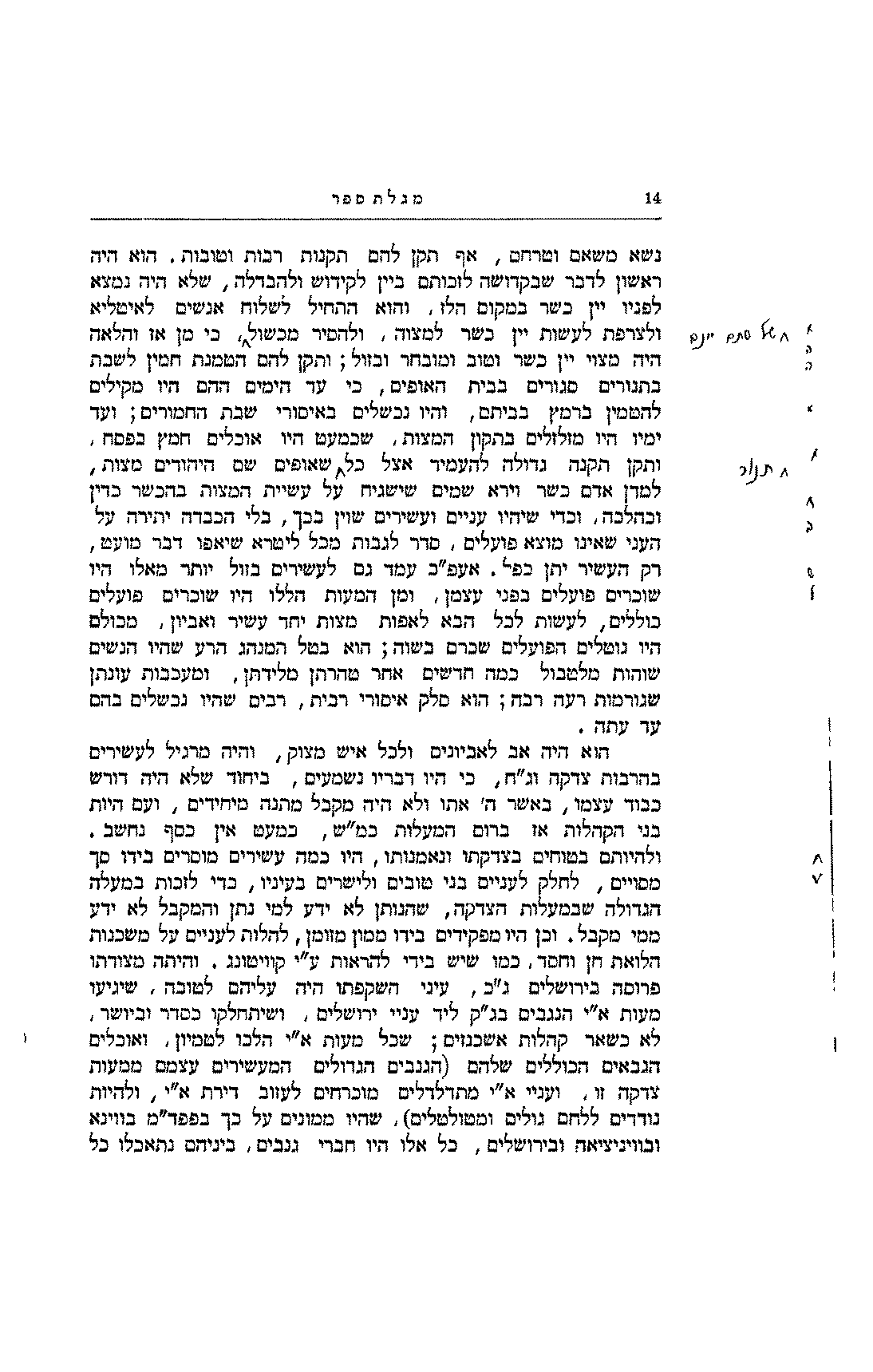
Margin readings in Scholem's copy (3)
| Printed anchor | Type (key sheet) | Mark | Reading | Certainty |
|---|---|---|---|---|
| ולהסיר מכשול ^, כי מן אז והלאה | V: omission | caret; note in right margin | של סתם יינם | sure |
| להעמיד אצל כל ^ שאופים שם היהודים מצות | V: omission | caret; note in right margin | תנור | sure |
| lines 3-12 and 27 | — | marks at the scan edge (cut off) | - | not read |
Page 15 (scan 25)
the many funds that went year after year from all the land of Germany, Bohemia, Moravia, Austria, Holland, England, France, Poland, Red Ruthenia, Lithuania, and from the whole Diaspora in these western lands that are included in Europe — a very great sum. That wealth "perished by an evil adventure" (Eccl. 5:13) with the robbers of the public, the devourers of the spoil of the poor, mentioned above. Through this, great debts were knotted together and came up upon the necks of the Ashkenazi poor in the Land of Israel. Because of this, for our many sins, the settlement of the Holy Land by Ashkenazim almost came to an end; no Ashkenazi was left with a holding or dwelling in Jerusalem, may it be built and established; and at this present time that Ashkenazi community has been uprooted altogether, because of the yoke of debts that they could not pay. Whenever one of the Ashkenazim came there, he was seized by the Ishmaelite creditors to pay the debts of the Ashkenazim — whereas all the Ashkenazim ought to have been rich, all the Ashkenazi dwellers in the Land being few in number, from the great money that went there year after year through the great treasurers mentioned above, had it come into the hands of the poor and been distributed properly.
But my father, being a father of Israel who looked after their needs, opened his eyes to this too: that the matter should be put right, at least as far as it depended on him and as far as possible. He sent the money given through him from that place by way of Livorno, to a certain rich magnate, reliable and trustworthy, and arranged with him to send it on from there to Hebron, to a worthy and fit sage known to him, so that it would be handed to him quietly and in secret, without the Ishmaelites living in Jerusalem knowing of it. He wrote to that sage of Hebron and asked him to take on this great commandment, and arranged for him how to act wisely and discreetly: to distribute the money to the Ashkenazi poor of Jerusalem in a fitting way, so that each of the needy poor would get his proper share according to his dignity, his need and his dependants. He asked him to do the commandment completely — to travel to Jerusalem and give each his due share fairly, and to take a written receipt from each of the recipients, written and signed in the recipient's name, stating how much he had received. And so the envoy did, faithful to those who sent him, as completely as possible.
So my father did ⟨S: perhaps "book"⟩ and in Amsterdam, when he was rabbi and head of the court there. I myself saw the receipt slips of the poor and needy, whoever they were, sent from there, which reached his holy hand by the post from Livorno. Each of the poor — scholars, orphans, widows — had signed his name on his slip in his own hand, declaring and testifying how much he had received through the sage of Hebron from the money sent into his hand from these places; each one recorded in true writing and signed with his name. Such a thing had not been done since Israel went into exile. Had the communities of the Ashkenazim in this western Diaspora had the merit to see to this from then on, the settlement of the Land of Israel by our Ashkenazi brothers would surely have grown ever stronger; they could have established important communities and houses of study there, and multiplied
הממונות הרבים, ההולכים מדי שנה בשנה מכל ארץ אשכנז, פיהם, מעררין, אוסטרייך, הואלאנד, ענגלאנד, צרפת, פולין, רייסין, ליטא, ומכללות הגולה בארצות המערביות הללו הנכללות בעאוראפי, שהיה עולה לסך גדול עצום מאד, ואבד העושר ההוא בענין רע אצל גוזלי הרבים, אוכלי שוד עניים הנ"ל, וע"י זה השתרגו עלו חובות גדולים על צוארי העניים האשכנזים שבא"י. על זה בעו"ה כמעט בטלה ישיבת הארץ הקדושה מן האשכנזים, ולא נשארה אחוזת דירה לשום אשכנזי בירושלים תוב"ב, בפרטות לעת הזאת נעקרה אותה קהלה אשכנזית לגמרי, מפני עול החובות שלא יכלו לצאת ידי חובתם; והיה בבוא אחד מבני האשכנזים לשם, נתפס מן הב"ח הישמעאלים שיפרע החובות של האשכנזים, תחת אשר ראויים להיות כל בני אשכנז עשירים, כל דרי א"י האשכנזים היותם מתי מעט, מן הממון הגדול שהיה הולך לשם, ע"י הגבאים הגדולים הנ"ל מדי שנה בשנה, אם היה בא ליד העניים ומתחלק כראוי. אך אמה"ג ז"ל באשר היה אביהן של ישראל ומפקח על צרכיהן, פקח עיניו גם על זאת, שיהא הדבר מתוקן בראוי מצד מקומו עכ'פ כאשר תשיג יד האפשרית, ושלח הכסף הנתן על ידו ממקום הלז דרך ליגורנה, לגביר מסוים עשיר בטוח ונאמן, וסדר לו שישלחנו משם לחברון לחכם הגון וכשר הידוע לו, שיומסר אליו בחשאי ובסוד, בלי יודע הדבר לישמעאלים יושבי ירושלים, וכתב לחכם ההוא של חברון ובקש ממנו שיטפל במצוה רבה זו, וסדר לו איך יתנהג בחכמה ובהצנע, לחלק המעות לעניי אשכנזים בירושלים באופן הנאות, כדי שיגיע לכל אחד מהעניים הנצרכים חלקו הראוי לפי כבודו וצרכו וטפולו, ובקש ממנו שיעשה המצוה בשלימות, ליסע לירושלים ולתת לכל אחד חלקו המגיעו כפי היושר, ושיקח לו כתב ראיה מכל אחד מהמקבלים, כתוב וחתום בשמו של המקבל כמה קבל, וכן עשה הציר נאמן לשולחיו בשלמות האפשרי; כה עשה אמה"ג ז"ל ובאמשטרדאם בהיותו רב ואב"ד שם, ואנכי ראיתי הפתקות של הקבלת כסף, מי ומי העניים והאביונים, שנשתלחו משם והגיעו לידו הקדושה על הפאסט מליגורנה, וחתומים עליהם כל אחד מעניים לומדים יתומים אלמנות, איש את שמו על פתקו בכתב ידו, מודיע ומעיד כמה קבל ע"י החכם מחברון מן המעות הנשלחים לידו מאלה המקומות, כל אחד רשום בכתב אמת וחתם שמו; דבר כזה לא נעשה מיום שהלכו ישראל בגולה, ואלו היו זוכים כללות ק"ק אשכנזים שבגולה המערבית הלז, ולפקח על כך מאז, ודאי היתה ישיבת א"י הולכת ומתחזקת מהאחים האשכנזים, והיו יכולים לקבוע שם קהלות חשובות ומדרשות, ולהרבות
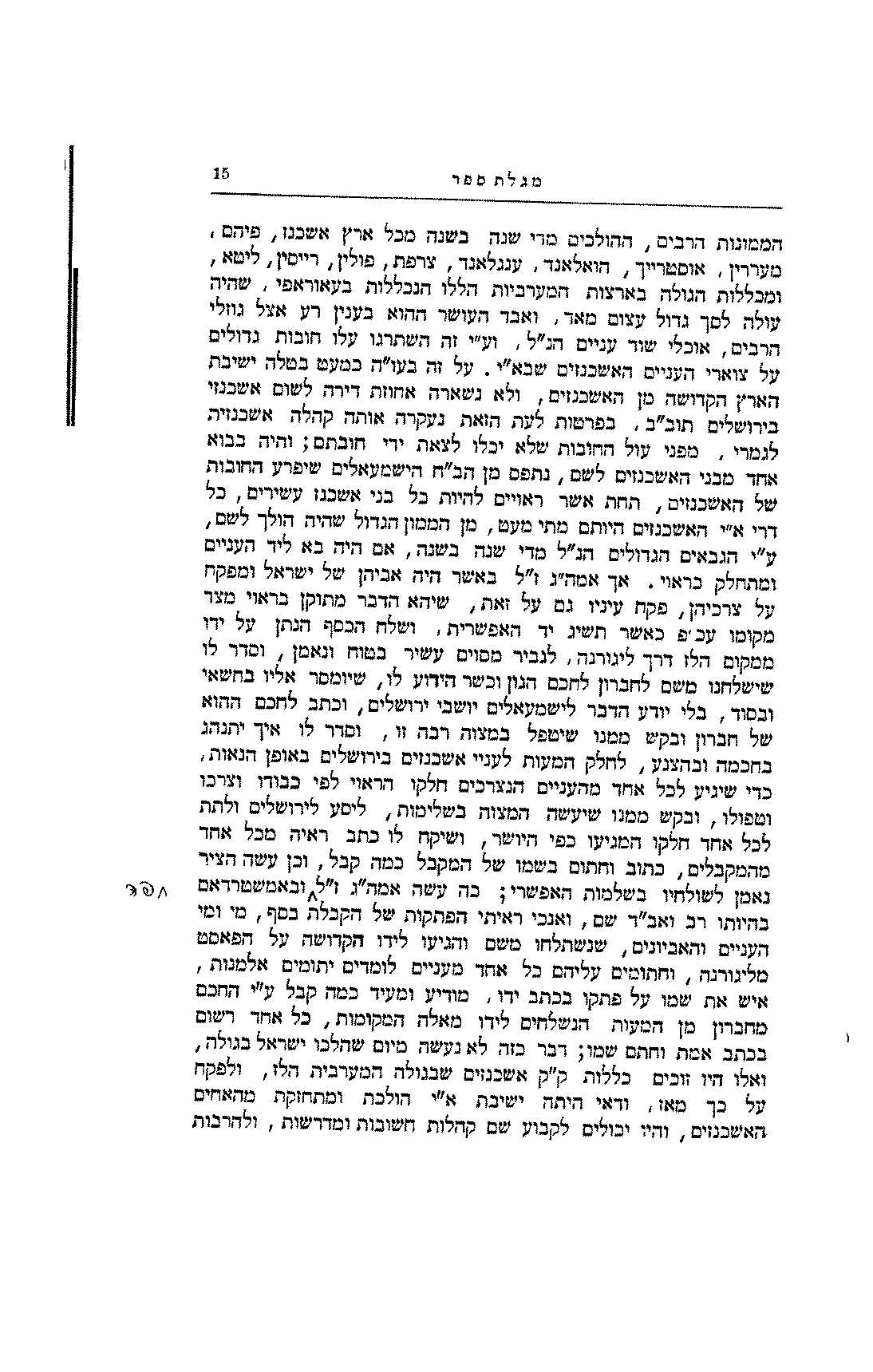
Margin readings in Scholem's copy (2)
| Printed anchor | Type (key sheet) | Mark | Reading | Certainty |
|---|---|---|---|---|
| כה עשה אמה"ג ז"ל ובאמשטרדאם | V: omission | caret after ז"ל, note in left margin | - | same note as the row for ז"ל ^ below (NLI: ספר(?)) |
| כה עשה אמה"ג ז"ל ^ ובאמשטרדאם | V: omission | caret; short note in right margin (same as row above for p. 25) | ספר(?) | uncertain |
Page 16 (scan 26)
yeshivot and spread Torah for its own sake in the Holy Land, "whose air makes wise" (b. Bava Batra 158b) — especially as they could have studied Torah constantly, without any distraction. So did some Sephardi communities and generous magnates of Amsterdam, London and the cities of Turkey: they saw to it that the charity money for the Land of Israel that came from their communities should not be lost and wasted. Therefore the houses of study, the yeshivot and the communities of the Sephardim in Jerusalem, Hebron and Safed grew and prospered, dwelling in quiet and ease, with none to make them afraid. But the sins of the generation caused the charity money to be used up and lost, together with the Ashkenazi community, from the Land of Israel; and a few scattered gleanings remained there in trouble and distress. May God have mercy on them, and on all the scattered of the exile.
Many times my father cried out about this, and laid his words before the great men of Germany, that they should exert themselves to remove this stumbling-block and to lock the door against the evil-doers — and it would have been worthy to bring the redemption nearer. But he cried out and no one paid attention; for "there is no family that has no tax-collector in it, or [else] it is all tax-collectors" (b. Shevu'ot 39a). These extortioners have families of powerful and violent men who cover for them and strengthen their hands, so as not to "bring out of their mouth what they have swallowed" (Jer. 51:44), and who acquire the money of the poor by "pulling" it from the public domain into their own, to increase the honour of their houses. How much great money sank into the hands of those men, and the Land of Israel is left desolate for ever, until the Lord is jealous for His land and for His people, for His name's sake.
Even in the holy community of Altona, the leader R. Ber Kohen opposed him, so that this great thing should not be carried out. He rose up as an adversary to this good matter, and withheld the good, so that they should not have the merit of this great commandment. (And now his descendants wander for bread (Job 15:23); no one breaks bread for them (Lam. 4:4), and there is no comforter.) Over this let all who grieve, grieve.
Let us return to the subject. "Lo, these are but the edges of his ways" (Job 26:14) — of the man of God, my father, of blessed memory. To explain them all is impossible: many sheets would be needed, much ink would be spilled and pens broken, and still they would not be enough to explain them, nor would they reach half of his praise. Part of his praise you will find written down by me from my childhood; I set it in the eulogy that I called Yatziv Pitgam.
The sum of the matter ⟨S: a four-line note, partly read: "he had a heart … great as a lion …"⟩: he was for the good and benefit of Israel, in his own place and outside it. He was available to every questioner, "to break the jaws of the wicked" (Job 29:17). Most of the Written and the Oral Torah was for him as if lying ready in a box, with a wonderful mastery of all the books of responsa. He also knew and could speak several languages — Spanish, Italian, Turkish, Hungarian, German — and understood every science. "He stood before kings" (Prov. 22:29), and the Lord gave him favour in the eyes of the authorities wherever he stood, as I have written a little of this, with God's help. He was also generous with his money and expert in worldly matters and in political conduct, and they had the benefit of his counsel and wisdom. Above all, he was a man holy to his God, a great pietist in all his ways and modest in all his affairs. He was
ישיבות ולהרביץ תורה לשמה בארץ הקדושה דאוירא מחכים, ביחוד שהיו יכולים לעסוק בתורה בהתמדה בלי שום טרדה. וכדרך שעשו איזה קהלות וגבירים נדיבים ספרדים מאמשטרדאם ולונדון ומערי טורקייא, שהשגיחו על זה שלא ילכו לאבוד ולהפסד מעות צדקה של א"י הבאות מק"ק שלהם, לכן גדלו והצליחו בתי מדרשיהם וישיבותיהם וקהלותיהם של ספרדים בירושלים חברון וצפת, יושבים בהשקט ושלוה ואין מחריד. אך עוונות הדור גרמו שכלה ואבד ממון הצדקה עם קהל אשכנזים מא"י, ואיזה גרגרים נפרדים שנשארו שם בצרה ובצוקה, המקום ירחם עליהם ועל כל פזורי הגולה בכלל. וכמה פעמים היה אמה"ג צווח על זה, ויציע דבריו לפני גדולי אשכנז, שיתאמצו בכך להסיר המכשלה הזאת, לנעול הדלת בפני עושי עולה, והיה כדאי לקרב הגאולה, אבל צווח ולית דמשגיח, כי אין משפחה שאין בה מוכס, או שכולה מוכסין, והמוכסנים הנ"ל יש להם משפחת תקיפים וגברי אלמי, המחפים עליהם ומחזיקים ידיהם, שלא להוציא בלעם מפיהם, ולקנות מעות של עניים במשיכה מרשות הרבים לרשותם להרבות בכבוד ביתם, וכמה ממון רב ועצום שקע בידי האנשים ההם, וא"י הרבה מכלי משים לנצח, עד שיקנא ה' לארצו ולעמו למען שמו. ואפילו בק"ק אלטונא היה הק' רב"ך מתנגד אליו, שלא להוציא לפועל הדבר הגדול הזה, וקם לשטן אל הענין הטוב הלז, ומנע הטוב שלא יזכו במצוה רבה זו (ועתה זרעו נודד ללחם פורש אין להם ולא מנחם). על זאת ידוו כל הדוים. נשוב לענין. הן אלה קצות דרכיו של האיש האלהים אמה"ג ז"ל. לבאר כולן אי אפשר, הרבה יריעות יצטרכון וכמה דיו ישתפך וקולמוסין ישתברון, ולא יספיקו לבארם ולא יגיעו לחצי שבחו, ומקצת שבחו תמצא רשום אצלי מילדותי, והעלתיו על ספר דרוש הספדו אשר קראתי "יציב פתגם"; כללו של דבר שהיה לטובת ולתועלת ישראל במקומו ושלא במקומו, היה נדרש לכל שואל לשבר מלתעות עול, ורובי תורה שבכתב ושבע"פ הוו דמי ליה כדמנחי בקופסא, עם בקיאות נפלאה בכל ס' שו"ת, גם היה מכיר ויודע לדבר בכמה לשונות, ספרדי, איטליאני, טורקי, הגרי, אשכנז, ומבין בכל חכמה, לפני מלכים יתיצב, ונתן ה' חנו בעיני השררות בכל מקום אשר עמד שם וכמש"ל קצת מזה בס"ד, גם היה ותרן בממונו ובקי במילי דעלמא ובהנהגה מדינית, והיו נהנין ממנו עצה ותושיה, ועל כולם היה איש קדוש לאלהיו, חסיד גדול בכל דרכיו, וצנוע בכל עניניו. היה
Margin readings in Scholem's copy (1)
| Printed anchor | Type (key sheet) | Mark | Reading | Certainty |
|---|---|---|---|---|
| כללו של דבר ^ שהיה לטובת ולתועלת ישראל | V: omission | caret; 4-line note in right margin | היה לו לב תורה(?) / גדול כארי ו... / לשמוע(?) ... / דבר | partial |
Page 17 (scan 27)
a great and faithful kabbalist in all the house of S"Ḥ [a] ⟨S: "S"H"(?), i.e. Sefer ha-Zohar; Bick reads "the book of the Zohar"⟩; the Tikkunim and the Ari were almost fluent on his lips. So too he was expert in the revealed Torah — Bible and Mishnah, halakhot and aggadot, the Talmud and the codes, and the four Ṭurim in general, and in many responsa, early and late, new and old. Books of Kabbalah, grammar, philosophy and other knowledge were his portion; all the gates of light, the chambers of the Torah, stood open before him. He was eloquent in speech and in writing, as can be seen from his printed book of responsa.
He also left a bundle of writings in great disorder, which lay in strangers' hands for many years. They had been handed to R. Efraim, of blessed memory, his disciple, to bring them to me; but he died in Lissa, and they stayed there in the hands of men I did not know. After inquiry and pressing they were sent to me, in great disorder, and I cannot know whether anything is missing from them. Nor could I turn my attention to them, to put them in order and sort them, because of my many burdens — and also because I was occupied with the work of Heaven that fell to my share, to compose works on the holy Torah, which were judged to be very much needed in these generations. The Lord put it into my heart to come near to the work for which my spirit had volunteered long ago, for great and abundant benefit, with God's help, as my Maker will grant me [b]. My brother-in-law, the rabbi in Amsterdam, also has some of his writings — above all what he corrected and added to his book of responsa, which he printed in his lifetime.
And in his free hours he would read external books and worldly matters.
Translator's note. So Kahana's print. According to Schacter (Ḥakirah 34, 2023), the Oxford manuscript (p. 122b) reads u-ve-sha'ei de-veit ha-kisse, "and in his times in the privy" he would read external books. Scholem's copy has no mark at this line. Bick (Pninim text) follows Kahana.
More of his godly traits: even if they had given him all the treasures of the world, he would not have gone back on his word. No word of jest or levity was ever heard from his mouth, although he was of a cheerful mind and spoke to every man with a pleasant face. With all this he was feared and held in awe, and loved and dear to all who knew him; and those who knew him held him bound(?) to strengthened holiness and purity and an extra spirit: little speech, little pleasure, little sleep (cf. Avot 6:6); full of the spirit of wisdom and fear of Heaven, discipline and humility. He did not look beyond his four cubits. "His delight was in the Torah of the Lord" all day and all night; in it he meditated, "in its love he was ever ravished" (Prov. 5:19). And though "the Torah made him hot" (b. Ta'anit 4a), still he was accepted by the people close to him, who knew his ways, because they knew that all his deeds were for the sake of Heaven, without any outward motive.
Therefore his friends and disciples devoted themselves to him: they cared for him and provided him with a livelihood with honour, so that he was not forced to leave the trait of piety that he had held from his youth, not to accept a gift. He did not enjoy an optional banquet; and they could not move him against his will to agree to accept presents — for several leaders wanted to make him rich, and came before him with gifts of vessels of silver and gold, as "they bring presents to a king" (Ps. 76:12) — but they did not succeed.
Kahana's notes
- [a] S"Ḥ abbreviates Sifrei Ḥen, "books of grace" [i.e. Kabbalah].
- [b] See above (p. 8).
מקובל גדול ונאמן בכל בית ס"ח א, ותיקונים והאר"י כמעט שגורים על פיו, כמו שהיה בקי בנגלה במקרא ומשנה הלכות ואגדות ש"ס ופוסקים וארבעה טורים בכלל, ובהרבה שו"ת קדמונים ואחרונים חדשים עם ישנים, וס' קבלה ודקדוק ופלוסופיא ושאר ידיעות היו לו למנה; כל שערי אורה חדרי תורה פתוחים לפניו, והיה צח לשון בדבור ובמכתב, כמו שיתראה מחבורו ס' שו"ת הנדפס. והניח עוד תכריך כתבים בערבוביא גדולה, והיו מונחים ביד זרים שנים רבות, כי נמסרו ביד כמ"ו אפרים ע"ה ת"י להביאם אלי, ונפטר בליסא ונשארו שם ביד אנשים אשר לא ידעתי, ואחר החקירה והפצרה נשתלחו לידי בערבוב רב, ולא אוכל לידע אם נפקד מהם מאומה; גם לא יכולתי לפקוח עיני עליהם לסדרם ולבררם מרוב טרדות, גם בהיותי עסוק במלאכת שמים שנפלה לחלקי, לסדר חבורים בתורה הקדושה, אשר שערום היותם נצרכים מאד בדורות הללו, ונתן ה' בלבי לקרבה אל המלאכה אשר נדבה רוחי מאז, לתועלת עצום ורב בעזה"י כאשר יחנני קוני ב. גם יש עוד ביד גיסי הרב באמשטרדאם קצת מכתביו, ביחוד מה שהגיה והוסיף על ס' שו"ת שלו שהדפיס בחייו. ובשעות פנויות היה מעיין בספרים חיצונים ועניני העולם. וממדותיו האלהיות עוד, אפילו אי יהבי ליה כל חללי דעלמא לא הוה משני בדיבוריה, ולא נשמע על פיו מעולם דבר שחוק וליצנות, אע"פ שהיה בדיהא דעתיה, ומדבר עם כל אדם בסבר פנים יפות, ועם זה היה יראוי ומאוים, ואהוב וחביב לכל מכיריו, ויודעיו חייבו חזוק קדושה וטהרה ורוח יתירא, מיעוט שיחה מיעוט תענוג, מיעוט שנה, מלא רוח חכמה ויראה מוסר וענוה, לא הסתכל חוץ לד"א, בתורת ה' חפצו כל היום וכל הלילה, בה יהגה, באהבתה ישגה, ואף אם אורייתא מרתחא ליה, מ"מ היה מקובל על הבריות הקרובים אליו ומכירים ענינו, בידעם שכל מעשיו לשם שמים בלי שום פנייה חיצונית, ולכן היו מוסרים נפשם עליו אוהביו ותלמידיו, והיו דואגים עליו וממציאים לו פרנסה בכבוד, באופן שלא היה מוכרח להניח לעזוב מדת חסידתו, שהחזיק בה מנעוריו שלא לקבל מתנה, ולא נהנה מסעודת הרשות, ולא יכלו להעבירו על דעתו, להתרצות ולקבל דורונות, שהיו כמה קצינים רוצים להעשירו, וקדמו פניו בתשורות כלי כסף וזהב, כמו למלך יובילו שי למורא, אבל לא עלתה בידיהם.
- [א] ס"ח ר״ת: ספרי-חן .
- [ב] עיין לעיל (צד 8).
Margin readings in Scholem's copy (3)
| Printed anchor | Type (key sheet) | Mark | Reading | Certainty |
|---|---|---|---|---|
| מקובל גדול ונאמן בכל בית ס"ח א) | — | note in left margin at line 1 | ס"ה(?) or ס"ג(?); Pninim/Bick reads 'ספר הזוהר', so most likely ס"ה = ספר הזהר, against Kahana's ס"ח (his note: ספרי חן) | uncertain |
| כאשר יחנני קוני ב) ^. גם יש עוד | V: omission | caret, no margin text visible | - | mark only |
| ובשעות פנויות היה מעיין בספרים חיצונים | — | no mark (manuscript reads ובשעי דבית הכסא, per Schacter) | - | checked |
Page 18 (scan 28)
Immediately after his wedding with my mother and teacher, the rebbetzin, of blessed memory, they gave him a partner who understood trade, to make a profit with it, so that he could be diligent in his study in the house of study while the partner did business with the money on his behalf. But the days were not long: his partner fled from here to Amsterdam after the money had been eaten up, and my father was suddenly, in an instant, left with nothing of his property, for all his money had been in the fugitive's hands, and nothing at all was left to him. Over this the worry grew so great in his heart that he fell into the black illness [melancholy], out of worry that he would need the help of other people. His cure became very hard; all the doctors in his town had already given up on him, and they advised him to go to a place of a spring of living water, called the bath of Ems, near the river Rhine. He did so: he travelled there to take the cure of the waters of that hot spring, between Passover and Shavuot, at great expense. By the Lord's mercy it helped him, so that he found balm for his illness through it, and he returned to health.
He also held a written guarantee and security from the fugitive's father, who was subject to the community of Altona. It happened that this man fell ill and took to his bed, and his illness was very severe. My father worried that perhaps it was because of the trouble his son had brought upon him ⟨S: "the debts"⟩ that the man had fallen ill to the point of death. So my father took the bills of debt and sent them to him torn up, so that he would not grieve or take to heart the matter of the flight; and the man recovered.
In the middle of Sivan in that period ⟨S: "the year [5]457 [1697]"⟩ I, Ya'avetz, was born, his first son. He called me by his father's name, Jacob, of blessed memory; but I sign myself Ya'avetz, by my father's instruction, as mentioned in the introduction to my book She'ilat Ya'avetz [a]. Three daughters had come before me, and he too was in great sorrow, for he had almost given up hope of having a male child — thinking that "three times make a presumption". He had already ordered and arranged another mohel in his place, if a son should be born to him while he was away from home. But he came back home, whole in body and in health, a day or two before the circumcision, and he brought me into the covenant and circumcised me himself, and it was a great joy to him. I look to the mercy of Heaven that his hope and joy at the time of my birth may be fulfilled in me; may it be His will that I shall not be ashamed or disgraced before my fathers.
And for all that his capital was spent and his money lost, he did not change his way: he made do with little, with great frugality, against his nature and habit, and he bore much sorrow over his livelihood. But there were then in the holy communities of Altona and Hamburg men of heart, generous men who "stand by generous things"
Kahana's notes
- [a] Thus he says there in his introduction: "A story: when I was a little child riding in the lap of my father and teacher, of blessed memory, the pious gaon Tzvi, the glory of Israel, I once asked him about his short signature, 'Tzvi', without mention of his father's name, of blessed memory. He answered me: Is it not the initials of Tzvi ben Ya'akov? And with his full mouth he said: When you, my son, are worthy to become wise in Torah and to write books and words of wisdom, sign your name in the same way, Ya'avetz, the initials of Ya'akov ben Tzvi." End of quotation.
והנה מיד אחר החתונה שלו עם אמי מורתי הרבנית ע"ה מסרו לו שותף מבין בסחורות להרויח בהן, כדי שיוכל לשקוד על למודו בבית הספר, והשותף יעסוק בעדו עם המעות בעצמו, אבל לא ארכו לו הימים, והשותף שלו ברח מזה לאמשטרדם אחר שנתאכלו המעות, ויצא אמ"ה ז"ל נקי מן נכסיו פתע פתאום, כי כל מעותיו היו ביד הבורח, ולא השאיר לו כל מאומה. ולזה רבתה הדאגה בלבו עד שנפל בחולי השחורה, מדאגה שלא יצטרך לבריות, עד שהיתה רפואתו קשה מאד, וכבר נתייאשו כל הרופאים ממנו במקומו, ויעצוהו שילך למקום באר מים חיים נובעים, הנקרא מרחץ של עמס סמוך לנהר ריין; וכן עשה, נסע לשם לעסוק ברפואות מי הבאר החם הנ"ל, בין דיבחא לעצרתא בהוצאה רבה, ובחמלת ה' עליו הועילה למצא ע"י זה צרי למחלתו ושב לבריאתו. וגם כי הי"ל כתב ערבות ובטחון מאביו של הבורח, שהיה משועבד של קהל אלטונא, ואירע שנפל האיש ההוא למשכב ויהי חליו חזק מאד, דאג אמ"ה ז"ל שמא מתוך צרת בנו שהשתרג עליו בסבתו חלה האיש עד מות, לכן לקח אמ"ה השט"ח ושלחם אליו קרועים, כדי שלא יצטער ולא ישים אל לבו דבר הבריחה, וחזר האיש לבריאתו. בחצי סיון בפרק ההוא נולדתי אני יעב"ץ בנו הראשון, וקראני בשם אביו יעקב ע"ה אכן אני חותם עצמי יעב"ץ, ע"פ צוואת אמ"ה כמוזכר בהקדמת ספרי שאילת יעב"ץ א - אחר שקדמו לפני שלש בנות, והיה ג"כ בצער גדול, כמעט שנתייאש מהיות לו בן זכר, כסבור בתלת זמני הוי חזקה, וכבר צוה וסדר מוהל אחר במקומו, אם יולד לו בן, בעודו נפרד מביתו; אך הוא חזר לביתו, ובא שלם בגופו ובריאותו יום או יומים לפני המילה, והכניסני לברית ומל אותי הוא ז"ל בעצמו, והיה לו שמחה גדולה, אצפה לרחמי שמים תקוים בי תקותו ושמחתו בעת מולדתי, ויהי רצון שלא אבוש ולא אכלם מאבותי. ועם כל זה שכלה קרנו ואבד מעותיו, לא שינה מדתו ונסתפק במועט ובצמצום עצום נגד טבעו והרגלו, וגלגל עצמו בצער בענין הפרנסה, אבל נמצאו אז בק"ק אלטונא והמבורג אנשי לבב, נדיבים על
- [א] וכה יאמר שם בהקדמתו לאמר: מעשה כשהייתי תינוק מורכב בחיקו של אבא מארי ז"ל הגאון החסיד צבי תפארת ישראל, ושאלתי פעם אחת על חתימתו הקצרה צבי בלי זכרון שם אביו ז"ל, והשיבני דבר הלא היא ר"ת צבי בן יעקב, ובפיו מלא לאמר: כשתזכה אתה בני להתחכם בתורה, ותכתוב ספרים ודברי חכמה, ותחתום שמך עד"ז יעב"ץ, ר"ת: יעקב בן צבי, עכ"ל.
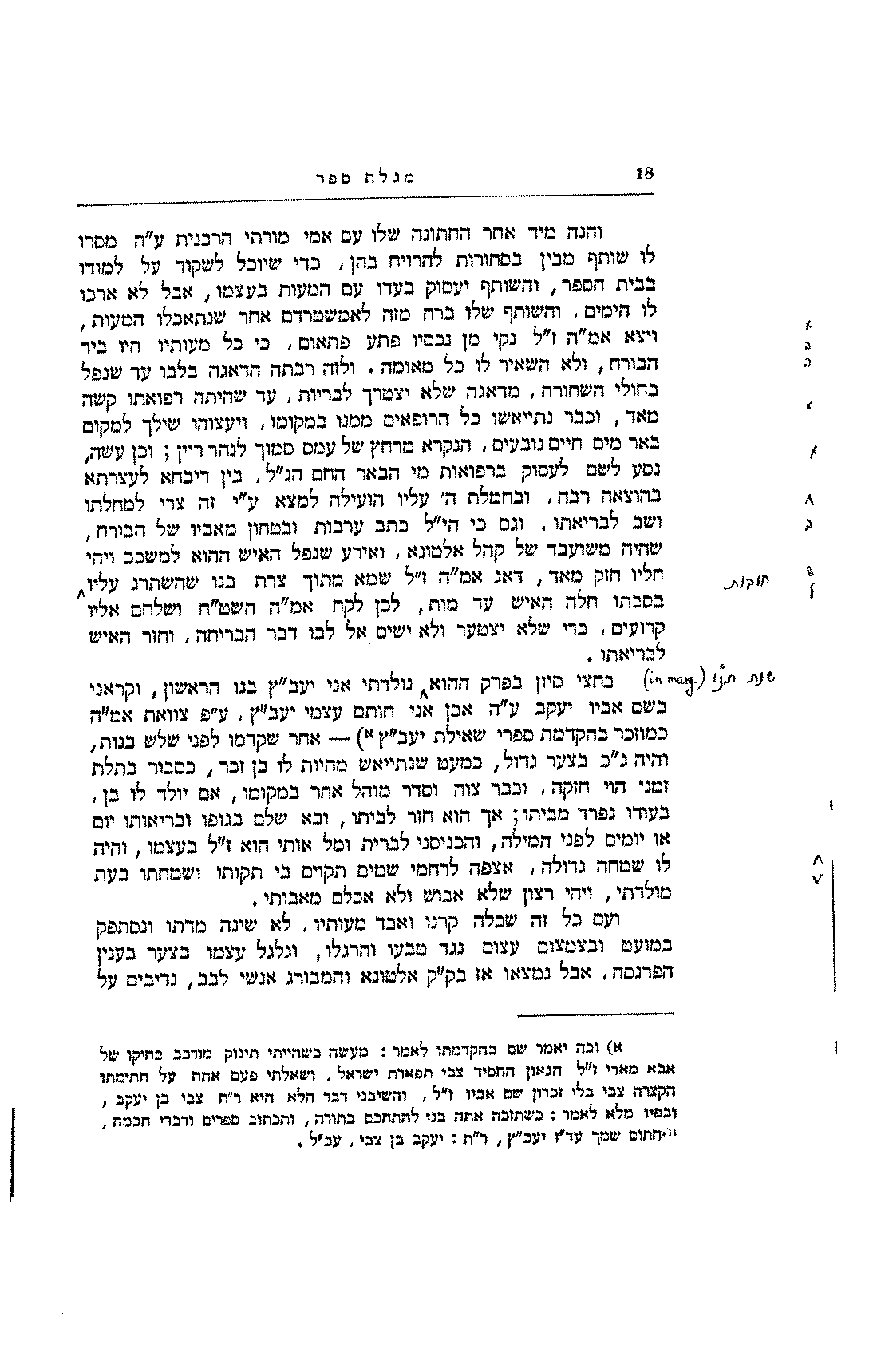
Margin readings in Scholem's copy (3)
| Printed anchor | Type (key sheet) | Mark | Reading | Certainty |
|---|---|---|---|---|
| מתוך צרת בנו שהשתרג עליו ^ בסבתו | V: omission | caret; one word in right margin | חובות | fairly sure |
| בחצי סיון בפרק ההוא ^ נולדתי | V: omission | caret; note in right margin | שנת תנ"ז (in marg.) | sure |
| תקוים בי תקותו ושמחתו | V: omission | caret and v at the scan edge | - | no note visible in the NLI image (HebrewBooks edge noise) |
Page 19 (scan 29)
(Isa. 32:8). They would put capital into his purse: they took from him some small sum of his own money, to trade with it ⟨S: a five-line note, partly read: on how to change his livelihood "without any gift"⟩, and within a short time they brought him back double and more of the principal. It was not that they gave up anything of their own to him — he had made them swear not to do so, but to deal with him in good faith — and they were bound to act honestly and not to add or give up anything to him of their own will. But the Lord sent blessing on the work of their hands. For example, if they took two or three hundred Reichstaler from him and bought, say, a fine string of pearls or other precious stones cheaply, because the Lord had put it in their way, they brought it to him and said: "This is what we found to buy for your money, sir; it is close to a good profit, with God's help." After some time a good buyer for this merchandise came their way; they took it from him and sold it dearly, and brought him, for example, eight hundred Reichstaler for his principal mentioned above. So they did many times, this way and that.
The well-known men who did business for him in this way were sons of distinguished and famous families in the holy community of Altona. First of all, the head and first in every matter of holiness, the leader, learned and outstanding in Torah and wisdom, the parnas and leader, the aged R. Moses, called R. Lipsch, who with his fathers was among the founders of the holy community of Altona. This man Moses was very great in all the land of Germany, the glory of his time; he left none like him among all the leaders of his generation. He had studied in the yeshiva of the great and famous gaon R. Heschel, of blessed memory, when the land of Poland was in its tranquillity. This important man understood and recognised at once my father's standing ⟨S: a note, not read⟩, when he came to live in Altona after he married my mother the rebbetzin, as mentioned. My grandfather was then already very old and heavy with years, while my father was still young at that time. This honoured parnas and leader wanted the whole business of the rabbinate to be handed to the son-in-law of the rabbi and head of the court, that is, my father, since the burden had become too heavy for my grandfather; the old head of the court would keep the salary of the rabbinate as before, and a salary of its own would be fixed by the community for my father, his son-in-law, for his service in ruling and in leading the community. But he did not succeed, because of the accusers who are always to be found, who oppose what is right; and there were then men of a certain family who leaned to another side, as I will write below with God's help.
The said magnate did, however, exert himself to set up a yeshiva for my father in Altona, in which my father spread Torah with great diligence, and from which rulings went forth. All the notable public affairs also rested on him, as mentioned, without any benefit or fee. Even so his livelihood came flying to him like a bird, through important, beloved and very generous men — though they gave up nothing to him from their own purses. They were not allowed to, even if they had wanted to make him a gift of their own in a generous spirit: he firmly prevented them. So they could not benefit him except by making a profit with his money in good faith, as said. And this kindness they did him: if some business came their way in which they saw profit and good reward to come, they left it to him and gave up their own gain
גדיבות יקומו, כי היו מטילים מלאי לכיסו, ולוקחים ממנו איזה סך, מעות דבר מועט משלו על מנת לסחור בו, ולזמן קצר היו מביאין אליו כפלי כפלים של הקרן, ולא שנתנו וויתרו משלהם כלום, כי השביעם שלא לעשות כן כי באמונה יעשו עמו, והיו מוכרחים לנהוג בנאמנות, שלא להוסיף ולוותר לו מאומה כרצונו, אבל שלח ה' ברכה במעשה ידיהם; כגון אם היו נוטלים ממנו שני מאות ר"ט או שלש, והיו קונים דרך משל חרוז מרגליות יפים או שאר א"ט בזול, כי הקרה ה' לפניהם, הביאו אותן אליו ואמרו: זאת מצאנו לקנות בעד מעותיו דמר' שהוא קרוב לשכר טוב בעז"ה, ואחר זמן מה נזדמן להם קונה טוב מזאת הסחורה, ולקחו ממנו ומכרוה ביוקר, והביאו לו ד"מ שמונה מאות ר"ט בעד הסך הקרן שלו כנ"ל. ככה עשו פעמים הרבה כזה וכזה, והאנשים הרשומים העוסקים בשבילו באופן זה היו בני משפחות מיוחסות מפורסמות שבק"א, הלא הראש והראשון לכל דבר שבקדושה, הקצין הרבני המופלג בתורה ובחכמה פו"מ הישיש כמו"ה משה ר' ליבש נקרא, שהיה הוא ואבותיו ממיסדי ק"א. זה האיש משה גדול מאד בכל ארץ אשכנז, פאר זמנו ולא הניח כמותו בין כל קציני דורו. הוא למד בישיבה לפני הגאון הגדול המפורסם כמו"ה העשיל ז"ל, בהיות ארץ פולין בשלותה. זה האיש החשוב הבין והבחין מיד מעלת אמ"ה ז"ל, בבואו לגור בק"א כשנשא הורתי הרבנית ז"ל כנ"ל, שכבר היה אא"ז זקן וכבד מאד, ועם היות אמ"ה ז"ל עדיין רך בשנים בעת ההיא, רצה הנכבד הפו"מ הנ"ל שימסרו כל עסק הרבנות ביד חתן הרב אב"ד הוא אמ"ה, כי כבד הדבר על אא"ז הרב ז"ל, ושיטול האב"ד הזקן הפרס מהרבנות כמקודם, ולקצוב לאמ"ה ז"ל חתנו פרס בפני עצמו מן הצבור, בעד שמושו בהוראה ובהנהגת הקהלה, אבל לא עלתה בידו, מפני המקטריגים המצוים תמיד המתנגדים לדבר ישר, והיו אז אנשי איזה משפחה הנוטים לצד אחר כמש"ל בס"ד אמנם התאמץ הגביר הנ"ל לקבוע לאמ"ה ז"ל ישיבה בק"א, שבה הרביץ תורה אמ"ה ז"ל בשקידה רבה, ויצאה ממנו הוראה, גם כל צרכי צבור הרשומים היו מוטלים עליו כנ"ל, בלי שום הנאה וקבלת פרס. ואעפ"כ היתה פרנסתו מעופפת לו כצפור ע"י אנשים חשובים אהובים נדיבים מופלגים, עם שלא וויתרו לו כלום מכיסם, כי לא היו רשאים, אף אם היו חפצים, לעשות לו חטיבה משלהם ברוח נדיבה, אבל מנע אותם בכח, לכן לא יכלו להנאותו, שהיו מרויחים במעותיו באמונה כאמור; וטובת הנאה זו עשו לו, אם הזדמן לפניהם איזה מו"מ שהיה רואים בו ריוח ושכר טוב העתיד לבוא, הניחוהו אליו, ומחלו על שכרם
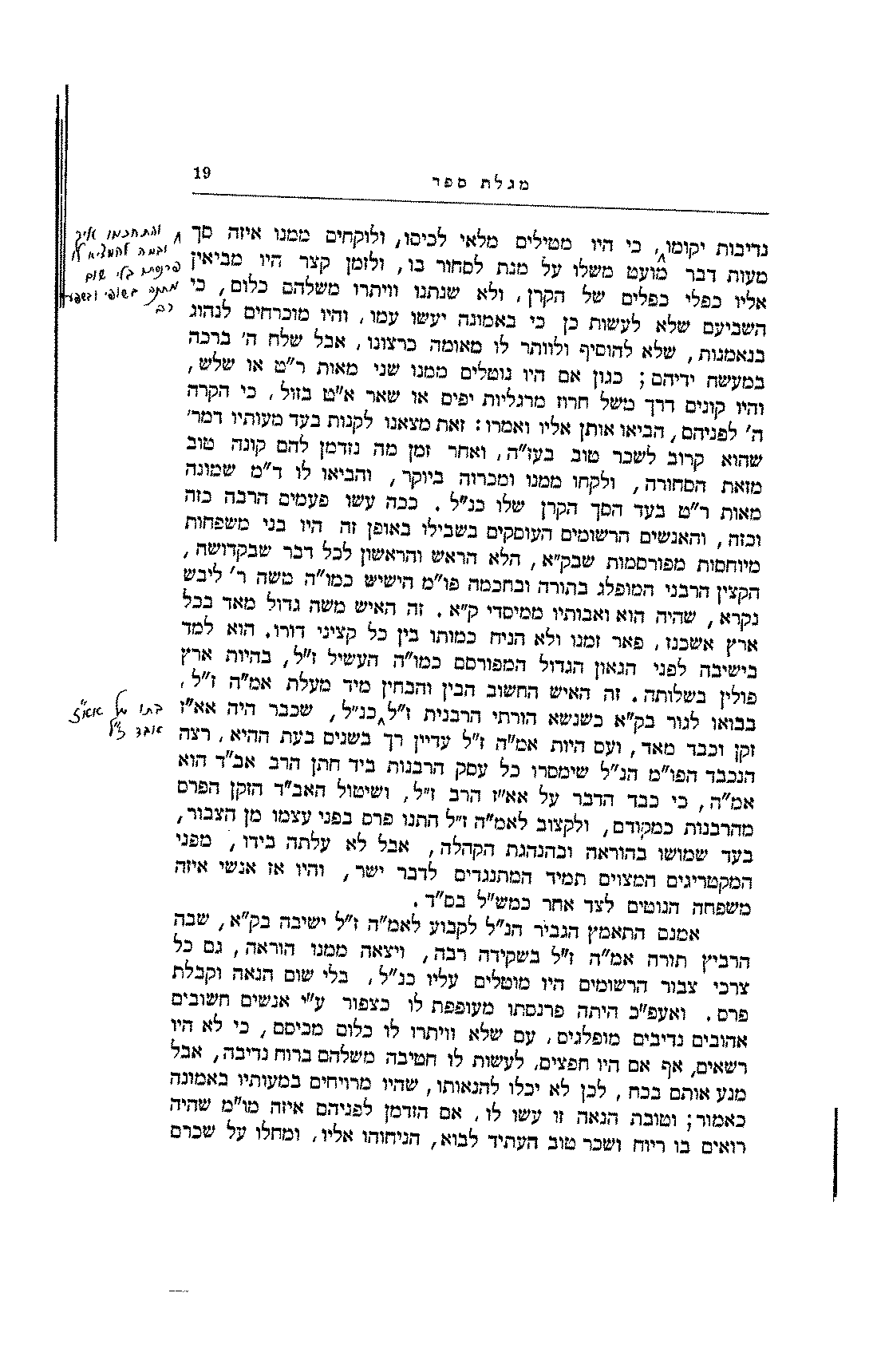
Margin readings in Scholem's copy (2)
| Printed anchor | Type (key sheet) | Mark | Reading | Certainty |
|---|---|---|---|---|
| ולוקחים ממנו איזה סך ^ מעות | V: omission | caret; 4-line note in right margin | ובתחכמו(?) ... / ובמה להחליף(?) / פרנסתו בלי שום / מתנה בשנים(?) וגו' ... / ... (cut at the page edge) | partial |
| מעלת אמ"ה ז"ל ^, בבואו לגור בק"א | V: omission | caret; 2-line note in right margin | בהיות(?) ... / ... (not read) | not read |
Page 20 (scan 30)
with good will and a willing soul; even if the merchandise was a real bargain, they passed it on to him and did not take it for themselves. May it be counted to them as righteousness for all generations for ever, for they did great things for him: the outstanding leader mentioned above, with his sons and sons-in-law, the leaders; and with them also the sons of his relative by marriage, the famous R. M. b. R. N., and his brother the magnate R. W. He did wonders of kindness for him, sending him from London, for his money, cheap merchandise — precious stones and pearls. The sons of the leader Itzik Falk, parnas and leader of the holy community of Hamburg, who had a close family connection with my father, also did him kindness of this kind. As I was told, this leader set aside a certain sum of his money for the dowry of my father's first daughter, my sister, of blessed memory. In this way my father earned enough for his livelihood and the needs of his household with ease, without accepting a present from any man.
The magnate, the parnas and leader R. Moses, mentioned above, also did this for him: he took out of his own purse some thousands of Reichstaler to bring kosher wine from France and Italy, and he entreated my father to take this in hand and to make an order and arrangement that the wine be made kosher according to halakhah, by men sent there from here; and all the profit and the fruits of this business would be my father's. So he did, and kept up this business for several years. It was both a commandment and a great profit, for he gave the public the merit of kosher and choice wine, the like of which never came here again after him; and he saw in it a good sign and a good reward for his toil.
Once he lost much of the wine because of the soldiers of the Swedish army. It was then a time of emergency and of war between kingdoms, and my father was forced to move his dwelling from Altona and live in Hamburg with all he had, until the fury of the men of war should pass. They "made" him wine worth eight hundred Reichstaler [i.e. they touched it and made it forbidden], and he ordered all the wine poured out and the barrels broken that had become forbidden by their touch; he would not sell them to a gentile and benefit from the money.
With all this, his "eye-salve" lacked nothing, so that he made his living with honour, without needing flesh and blood at all — although his salary from the house of study of the Kloyz, where he was head of the yeshiva as mentioned, was only a small thing, sixty Reichstaler a year, while he needed at least a thousand Reichstaler a year without any extravagance, for he was burdened with children. But all the time that his honour dwelt here, blessing was to be found: the profit of the trade of the members of the community was great, the work of their hands was blessed and the rich grew in number, and the communities kept growing in wealth and honour in his days — silver was truly of no account — and every day the wealth of the Three Communities grew beyond all the holy communities in Germany, until my father moved his dwelling from there. Then the people of the Lord went down into troubles, as I will write. Surely his merit, and the merit of his study of Torah for its own sake and of his holy conduct, drew down abundance, "satisfied with favour and full of the blessing of the Lord" (Deut. 33:23), in this place, all the time that his honour dwelt here. So too everyone who was worthy to serve him became rich — above all two attendants: one, Anshel Schuster in Altona, who was his paid servant, became rich with several thousands; and R. A. N., who served him for nothing, rose to the heights of wealth
ברצון טוב ובנפש חפצה, אפילו היתה הסחורה מציאה, המציאו אותה אליו ולא לקחוה לעצמם. ותחשב להם לצדקה לדור דור עד עולם, כי הגדילו לעשות עמו, הקצין המופלג הנ"ל עם בניו וחתניו הקצינים, ונלוו עליהם גם בני מחותנו הנ"ל המפורסם ר"מ בר"ן, ואחיו הגביר ר"וו'; הוא הפליא לעשות עמו בטובה, בשלחו מלונדון בעד מעותיו סחורה בזול א"ט ומרגליות; גם בני הקצין איצק פאלק פו"מ דק"ק המבורג, היה לו קצת שייכות קרובה עם אמ"ה ז"ל, עשו לו חסד כזה וכזה. וכפי שהוגד לי, זה הקצין הפריש מממונו סך מסויים לנדונית בתו ראשונה של אמ"ה ז"ל היא אחותי ע"ה. בדרך זה הרויח אמ"ה ז"ל די פרנסתו וצרכי ביתו בריוח, בלי שום קבלת דורון משום אדם. גם זאת עשה לו הגביר פו"מ ר"מ ז"ל הנ"ל, שהוציא ונתן מכיסו איזה אלפים ר"ט, להביא יין כשר מצרפת ואיטליא, וחלה את פני אמ"ה שישתדל בזה לעשות סדר ותיקון, שיהא היין נעשה בהכשר כהלכה, ע"י אנשים הנשלחים מכאן לשם, וכל הריוח והפירות שיבואו מעסק זה יהיו לאמ"ה ז"ל. וכן עשה והחזיק בעסק זה כמה שנים, והרי זה מצוה וריוח גדול, כי היה מזכה את הרבים ביין כשר ומובחר כמוהו, לא בא עוד לכאן אחריו, וראה בו סימן יפה ושכר טוב בעמלו. ופעם אחד נפסד לו הרבה מהיין בסבת אנשי חיל צבא שווידן, שהיתה אז שעת חירום ותגר מלכיות, והוכרח אמ"ה ז"ל לעקור דירתו מאלטונא ולהתגורר בהמבורג עם כל אשר לו, עד יעבור זעם אנשי המלחמה, שעשו לו יין בשמונה מאות ר"ט, וצוה לשפוך כל היין ולשבר החביות שנאסרו ממגעם, ולא רצה למכרם לגוי ולהנות מן הכסף, ועם כל זה לא חסרה קילורית שלו כלום, להתפרנס בכבוד בלי הצטרכות לב"ו כלל, אף אם פרס שלו מן הבית מדרש דקלויז, שהיה בו ראש ישיבה כנ"ל, היה לו רק דבר מועט ששים ר"ט לשנה, והוא היה צריך עכ"פ לאלף ר"ט לשנה בלי פזור, כי היה מטופל בבנים; אבל כל זמן שהיה כבודו שוכן פה, היתה הברכה מצויה ושכר פרגמטיא של בני הק"ק היה גדול, ומעשי ידיהם מתברכים והעשירים מתרבים, והקהלות הולכות ומתגדלות בעושר ובכבוד בימיו, ממש אין כסף נחשב, וכל יום גברה העשירות בג"ק על כל הק"ק שבאשכנז, עד אשר העתיק אמ"ה דירתו משם, אז ירדו לצערים עם ה' כמש"ל. ובודאי זכותו וזכות למוד תורתו לשמה והנהגתו הקדושה המשיכה השפע שבע רצון ומלא ברכת ה' במקום הלז; כל הזמן שהיה כבודו שרוי כאן וכן כל מי שזוכה לשמשו נתעשר. בפרט שני שמשים א' אנשיל שוסטר באלטונא, שהיה משרתו בשכר, נעשה עשיר מכמה אלפים, ורא"ן, ששמשו בחנם, עלה למעלות העושר
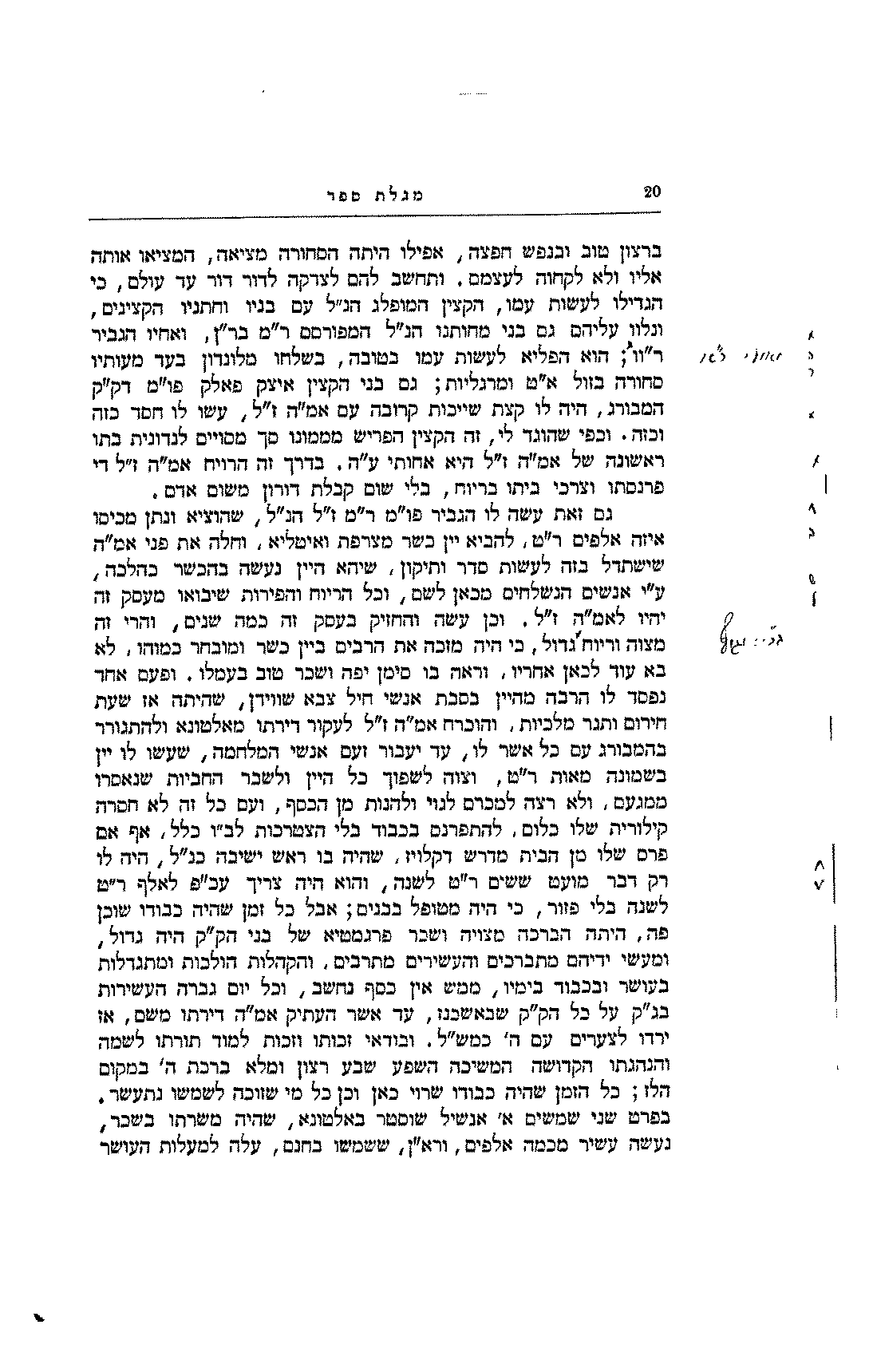
Page 21 (scan 31)
above all the rich men of his generation who are well known, besides others. My brother-in-law, too, the rabbi in Amsterdam, of blessed memory, rose to greatness because he served him — although by his learning he would not have been worthy of it — only because he served him like a slave. He also learned from him and gained some good qualities from him; that is what stood by him and his sons.
So he was loved by all the people, from end to end, though he was feared and held in awe, and the dread of him lay on them as of a holy man of God — except for one powerful man in the holy community of Altona: the famous leader R. Ber Kohen, of blessed memory [a]. This man was almost worshipped by most of the people of Altona because of his great wealth and great success. For he had come here wandering for bread, a poor and needy young man, and afterwards he became exceedingly rich. He also had no children until he was past fifty, and someone else had already been named as heir to his great wealth. After his first wife died he married a young woman and had a son by her; then she too died, and he married her sister and had sons and daughters, and he saw many joys in his sons and daughters. He made great matches: his eldest son took the daughter of the great leader of Vienna, the famous R. Samson [Wertheimer], of blessed memory.
That man prospered greatly in his old age: wealth, honour and greatness he had in huge abundance, the like of which was not heard or seen in these generations. All the members of the community bowed to him and obeyed his word — all the more since he was something of a scholar too. In truth he also had good habits: he was diligent at his book whenever he was free from business; he set up a house of study in his home and supplied the needs of its students amply and with great honour; and charity and kindness went out from his house to the poor of the city. But the main benefactions came through his wives, above all the last: she did much good without his knowledge. For in truth he was neither open-handed nor generous by nature; only his great wealth forced him not to be a miser. So, it seems, he did not serve as he should have, in keeping with his great standing.
He was also old and held in high regard by the authorities. Therefore, willingly or unwillingly, the people of Altona submitted to him and feared him greatly; for in his hands lay not only the leadership of the community but also the standing of private persons: the merchants and traders who bought on credit were in his power. Whoever he looked on with an evil eye, he cut off his livelihood, even if he stood well with great merchants and moneyed men who gave credit; not to speak of the tax assessment — whom he wished he burdened, and whom he wished he eased: "whom he would he raised up, and whom he would he put down" (Dan. 5:19), bringing a man down from his greatness and his office and humbling him, so that everyone
Kahana's notes
- [a] Emden mentioned this man earlier, saying: "So the aged leader R. Ber Kohen told me." R. Ber Kohen died on the first intermediate day of Passover 5488 [1728] and was buried in Altona. See his biography by Prof. D. Kaufmann in his monthly journal for 1896 (p. 220).
על כל עשירי דורו במפורסמים מלבד אחרים. גם גיסי הרב באמשטרדם ע"ה עלה לגדולה מחמת שמושו, עם שלא היה כדאי מחמת למודו, אלא לפי שהיה משמשו כעבד, גם למד ממנו והרויח ממנו איזה מדות טובות, היא שעמדה לו ולבניו. וכן היה אהוב לכל העם מקצה, עם שהיה יראוי ומאוים ואימתו מוטלת עליהם כמו איש אלהים קדוש, חוץ מאחד התקיף בעיר ק אלטונא, הוא הקצין המפורסם ר' בער כהן ע"ה א; שזה האיש היה כמעט נעבד מרוב בני ק"א, מחמת רוב עשרו והצלחתו הגדולה, כי בא לכאן נודד ללחם, בחור עני ודל, ואח"כ נתעשר עשירות מופלגת מאד; גם לא היו לו בנים עד שעברו שנת חמשים משנותיו, וכבר מדל ב"א להיות יורש עשרו הרב, אחר שמתה אשתו ראשונה, ונשא אשה ילדה והוליד ממנה בן, אחר מתה גם היא, ונשא אחותה והוליד בנים ובנות וראה שמחות רבות בבנים ובבנות. עשה שדוכים גדולים, בנו הגדול לקח בת הק' הגדול שבוין המפורסם ר' שמשון ע"ה, והצליח האיש ההוא בזקנותו מאד, גם עושר גם כבוד וגדולה היו לו כשפע עצום, לא נשמע ולא נראה בדורות הללו כמוהו, וכל בני הק' כפופים לו ונשמעים למאמרו, ביחוד בהיותו קצת למדן ג"כ; ובאמת היה לו גם הנהגות טובות שוקד על הספר בכל עת שהיה פנוי ממו"מ, גם קבע בה"מ בביתו, והיה מספיק להלומדים של בה"מ צרכם די ספוקם בכבוד גדול, גם צדקות וטובות היו לעניי העיר מביתו; אבל עיקר הנאות ע"י נשותיו, בפרט ע"י האחרונה: היא היתה עושה הרבה טובות בלי ידיעתו, כי באמת לא היה ותרן ולא נדיב בטבעו, כי רוב עשרו הכריחוהו שלא להיות כילי, לכן כמדומה כדבעי לא עבד לפי ערכו הגדול. גם היה זקן ונשוא פנים אצל השררה, על כן בטובתם של בני אלטונא ושלא בטובתם היו נכנעים אליו ויראים ממנו מאד, כי היה בידו ממש לא לבד הנהגת הצבור, כי גם מעמד יחידים, סוחרים ותגרים הלוקחים בהקפה היה מסור בידו. מי שהיתה עינו רעה בו היה מקפח פרנסתו, ואפילו היה במצב טוב אצל סוחרים גדולים ובעלי כיסין המקיפים, ואצ"ל בענין הטלת הערך, למי שהיה רוצה היה מכביד, ולמי שהיה רוצה היה מקיל, ומאן די הוה צבי הוה מרים ולמאן די הוה צבי הוה משפיל, ומוריד מגדולתו ומינויו ומשפילו, באופן שכל
- [א] את האיש הזה הזכיר יעב"ץ מקודם ואמר: כך סח לי הישיש הק' ר' בער כהן ע"ה, ונפטר הרב"ך ביום א' של חה"מ פסח שנת תפ"ח ונקבר באלטונא, עיין תולדתו שכתב הפראפ' ר"ד קויפמאן נ"י במכתב הירחי שלו לשנת תרנ"ו (צד ר"כ).
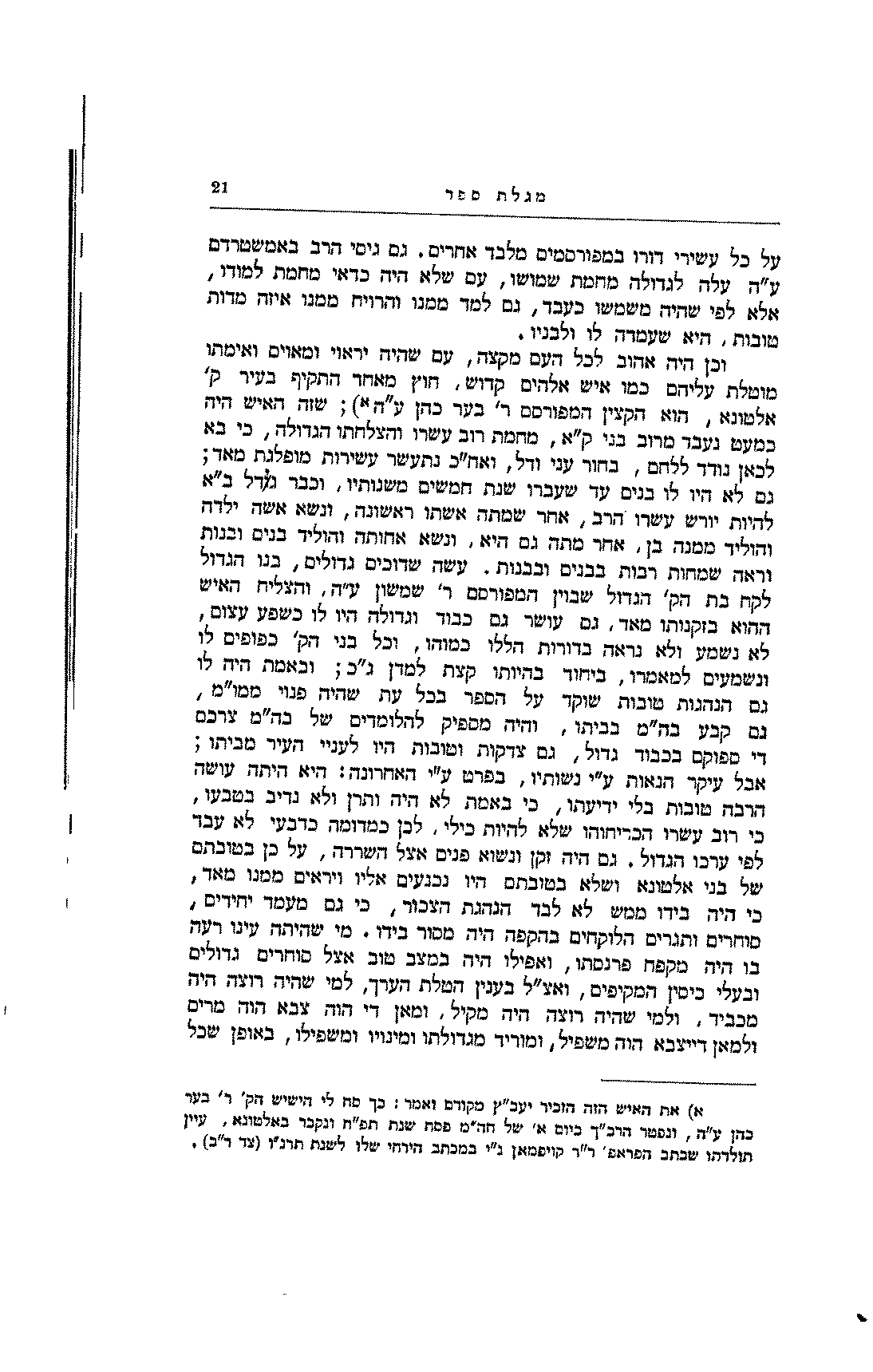
Page 22 (scan 32)
who set his eyes against him, he quickly took revenge on him and went down to [take] his life, because he did not submit to his authority. So he was like a parnas who casts excessive fear on the community. This mighty man, though he recognised my father's standing, opposed him in secret while showing him love openly, because my father did not flatter him or show him favour, and rebuked him to his face for what he knew of him that was not proper.
There was also a family in Hamburg called Fürst, in which there were many rich men of means but very poor in knowledge of Torah and in good deeds — almost every abomination of the Lord. Even so they attached themselves to Torah, to cover their shame and hide their deeds. Israel Fürst made a match with the gaon R. Z[iskind] Rothenburg, of blessed memory [a], who was head of the court in Witzenhausen and afterwards in Lublin: his eldest son, the outstanding R. Moses, of blessed memory, married the daughter of that leader [Fürst], who later lost his wealth in business, and the leader was left in utter want, as I will write.
These two families leaned towards this man Moses, to make him great and to vex my father. So after the death of my grandfather, the head of the court R. Zalman Mirels, of blessed memory, the people of the Three Communities at once set their eyes on my father, the son-in-law of the late head of the court, and at once appointed him chief head of the court and leader over them — that is, the rabbinate of the two communities of Hamburg and Wandsbek; these alone. Straight after they came back from my grandfather's burial they came to him and said: "Long live our lord the rabbi!"
But in the community of Altona his rival was then at his side: the rabbi R. Moses, mentioned above, the son-in-law of Israel Fürst. He and his family had a great and strong hand, rich men whose hand was mighty, and they made common cause with the great powerful man, R. Ber Kohen, mentioned above. Then the people of Altona were divided: half of them leaned ⟨S: "money"⟩ towards my father, and half towards R. Moses. They agreed that the two rabbis would hold office in Altona equally, in partnership, each for half a year. So my father held the rabbinate of the two communities mentioned, and half the rabbinate of Altona.
This went on until R. Moses went into a great bankruptcy: he sank into trade, took a large sum on credit, and became a fugitive. Then my father would no longer sit in judgement with him, for his own reasons — he wrote a long responsum and ruling on it — and also because of the Sabbath on which R. Mordel Wiener, of blessed memory, died in prison through R. Moses. R. Moses had caused him to be seized and put into cruel confinement, because he was his creditor; they had him jailed by gentiles and tormented him with hard and bitter sufferings until his soul went out. But the party of R. Moses, of blessed memory, together with that mighty man mentioned above, who supported them and whose hand was with them — not because he loved R. Moses, but because he hated my father — not
Kahana's notes
- [a] His name was R. (Mordecai) Ziskind son of R. Solomon Rothenburg. See Fuenn, Keneset Yisrael (p. 314), and Dembitzer, Kelilat Yofi (fols. 92–93).
מי שהיה נותן עיניו בו, חיש מהר היה מתנקם עמו ויורד עמו לחייו, לפי שלא סר למשמעתו; לפיכך היה כמו פרנס, המטיל אימה יתירה על הצבור, וזה הגבר אלים, עם שהיה מכיר מעלת אמ"ה ז"ל, היה מתנגד אליו בסתר, עם שהיה מראה לו אהבה בגלוי, מפני שלא החניף לו אמ"ה ולא נשא לו פנים, והוכיחו על פניו במה שידע ממנו שלא נהג כשורה. ועוד משפחה אחת היתה בהמבורג נקראים פוירשטן, שהיו בה עשירים רבים בעלי ממון, אבל עניים גדולים בדעת תורה ובמעשים טובים, כמעט כל תועבת ה', רק אעפ"כ נתדבקו בתורה, לחפות על קלונם ולכסות על מעשיהם, ונשתדך ישראל פוירשט עם הגאון ר"ז רויטן בורג ע"ה א, שהיה אב"ד בק"ק וויצנהויזן, אח"כ בלובלין, ונשא בנו הגדול המופלג כמו"ה משה ע"ה בתו של הק' הנ"ל, אשר אח"כ אבד עשרו ע"י מו"מ, וחסורי מחסרי הק' כמש"ל. ושתי משפחות הללו היו נוטים אחר זה האיש משה להגדילו, ולהקניט את אמ"ה ז"ל. לכן אחרי מות אא"ז הגאב"ד מהר"ז מירלש ז"ל מיד נתנו עיניהם אנשי ג"ק באמ"ה, חתנו של האב"ד הנפטר, ומינוהו מיד לראש אב"ד וקצין עליהם, דהיינו הרבנות של שני הקהלות המבורג וואנזבעק אלו לבד היו; תכף אחר שבאו מקבורתו של אא"ז ע"ה באו אצלו ואמרו לו יחי אדונינו הרב. אך בק' אלטונא שם היה נמצא אז צרתו בצדו, הוא הרב ר"מ הנ"ל חתנו של ישראל פוירשט, שהיו לו ולמשפחתו יד חזקה גדולה, עשירים וידם תקיפה, המה עשו עם התקיף הגדול רב"ך הנ"ל בעצה אחת, ואז נחלקו העם בק"א, חצים נטו אחר אמ"ה ז"ל, והחצי היו אחר ר"מ. והושוו לדעת אחת שינהגו שני הרבנים נשיאותם בשוה בק"א בשותפות, כל אחד חצי שנה. והיו ביד אמ"ה ממשלת הרבנות דשני קהלות הנ"ל, וחצי הרבנות דק"א, והתמיד הענין ככה, עד שהלך ר"מ הנ"ל לפליטה גדולה, כי נשתקע בעסק מו"מ ולקח בהקפה סך רב ונעשה בורח; אז לא רצה עוד אמ"ה ז"ל לישב עמו בדין מטעמו ונימוקו עמו, כאשר כתב על זה תשובה ארוכה ופסק; גם בשבת שמת ר' מאדל ווינר ע"ה בתפיסה ע"י ר"מ הנ"ל, שגרם לתפסו במאסר אכזרי, לפי שהיה בעל חוב שלו, וחבשוהו ע"י גוים וענוהו ביסורים קשים ומרים, עד שיצאה נפשו. אכן הצד של ר"מ ע"ה, בצרוף ההוא גברא אלמא הנ"ל, המחזיק בידיהם והיתה ידו עמם, לא מפני שהיה אוהבו של ר"מ, אלא שהיה שונאו של אמ"ה ז"ל, לא
- [א] נקרא כשם הר"ר (מרדכי) זיסקינד בה"ר שלמה רוטנבורג, עיין כנסת ישראל לפין (צד שי"ד), ובס' כלילת יופי לדעמביצער (ד' צ"ב, צ"ג).
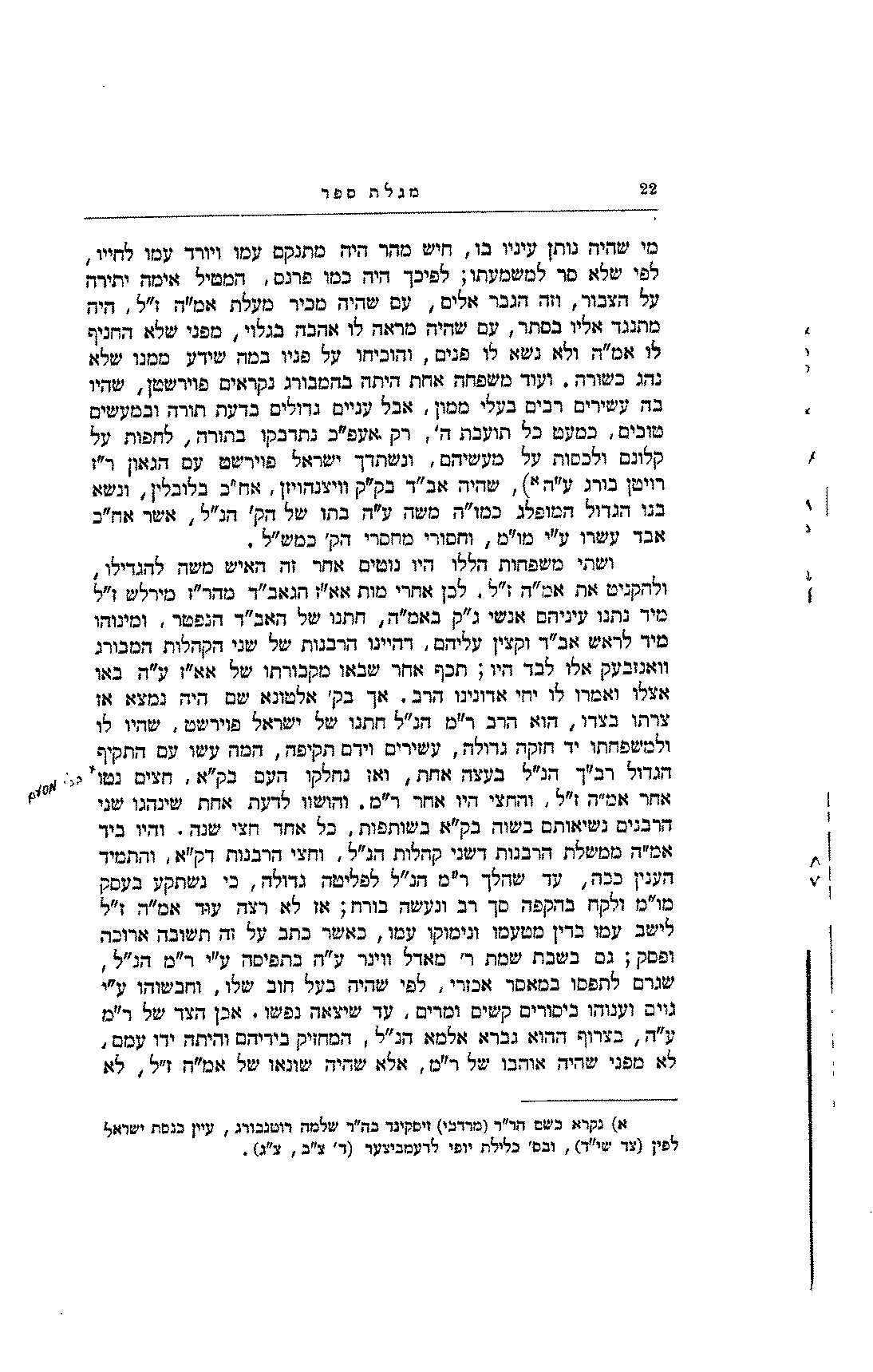
Margin readings in Scholem's copy (2)
| Printed anchor | Type (key sheet) | Mark | Reading | Certainty |
|---|---|---|---|---|
| ואז נחלקו העם בק"א, חצים נטו * אחר אמ"ה | X: substitution | x mark; short note in right margin | (כ"י:?) ממון | fairly sure |
| lines 5-10 and 25 | — | marks at the scan edge (cut off) | - | no note visible in the NLI image (HebrewBooks edge noise) |
Page 23 (scan 33)
with hatred in his heart, God forbid, but because he did not respect persons in judgement, and kept "you shall not be afraid of any man", and showed him no favour at all, but counted him as one of the other leaders — therefore he feared him. (So R. Ber Kohen told me himself, when I was staying in his house. These were his words when my father's memory came up before him; he said to me: "I knew and recognised the standing of your honour's father, of blessed memory, that he was unique in his generation. He had only one fault: he knew his own worth — the wise will understand — so he did not think much of anyone else." But his words to me were in the language of wisdom.) [So he would not consent] to leave all the greatness to him alone, for he knew that he would not show him favour, as most of the community, the court and the scholars in general did, for dread of him terrified them. Not so my father: the fear of flesh and blood never came upon his head at all, and in matters of judgement and public need he thought of him only as one of the people. Therefore R. Ber Kohen did not lean towards him, and did not want my father to hold his office on high and sit at the head alone, for he knew for certain that he would not show favour in any matter touching the public or a private person, and would not honour the great, as he had already found by experience.
For when his father-in-law, my grandfather the rabbi, reigned on the throne of the rabbinate in the Three Communities, my father was the one who went out and came in, as said above, because of the old age of his father-in-law, my grandfather the rabbi and head of the court, of blessed memory. Once, on the eve of Yom Kippur, he sent for him, and he came to his house; and he rebuked him for what he had done to certain householders: he cut off their livelihood by spreading bad reports about them, to make them small in the eyes of the moneyed men of Hamburg who gave credit to merchants. Many complained of him that he was grudging to others and cut off their livelihoods, and they had told my father. On this he rebuked him at length, told him of the outcry over their bread that others had against him, and warned him strongly to give up such deeds — if he did not listen, he would bring evil on himself and his house. His mouth was full of rebukes. The rich man heard all his words and was silent, but he kept a grudge against him and hated him in his heart. Therefore at this time R. Ber Kohen was my father's accuser, so that he should not have the greatness as an absolute inheritance in Altona too.
So when my father refused to sit in judgement with R. Moses, of blessed memory, Altona sent two messengers from among its parnassim — the leaders Joel Schwab(?) and Eli Falk — to my father, to warn him and tell him that if he did not agree to sit with R. Moses as before, he would no longer be their rabbi. He paid no attention to them or their words. He acted at once: he left the great synagogue of Altona, where he had gone since they had appointed him rabbi and head of the court after the death of his father-in-law the rabbi, as said, and went back to the Kloyz, his first place of honour. (Even now his yeshiva has not ceased from his house of study, which still exists; but no rosh yeshivah [a] has been appointed in it since my father moved from it, and today the students in it are a body without a head.) As when he was rosh yeshivah
Kahana's notes
- [a] R"Y abbreviates rosh yeshivah.
בלב ח"ו, אלא מחמת שלא היה מכיר פנים בדין, ומקיים לא תגורו מפני איש, ולא נשא פניו כלל, רק מחשבו כאחד משאר קצינים, לפיכך היה מתיירא ממנו (וכן אמר אלי רב"ך ע"ה ביחוד בהיותי מתארח בביתו, וכה היו דבריו כשעלה זכרונו ז"ל לפניו, אמר אלי: ידעתי והכרתי מעלת אבא של מעכ"ת ז"ל שהיה יחיד בדורו, רק חסרון אחד היה בו, שהיה מכיר עסק ערך עצמו וד"ל, לכך לא היה חושב אדם אחר הרבה, רק היו דבריו עמו בלשון חכמ ה להניח לו כל הגדולה לבדו, כי ידע כי לא ישא פניו, כדרך שנושאים לו פנים רוב הקהל והב"ד והלומדים בכלל, כי אימתו תבעת אותם; לא כן אמ"ה כי מורא ב"ו לא עלה על ראשו כלל, ולא היה מחשבתו בעסק דין וצרכי צבור אלא כאחד העם, על כן לא נטה רב"ך אחריו, ולא אבה שינהוג אמ"ה נשיאותו במרומים לישב בראש לבדו, בידעו בבירור שלא ישא פנים, בדבר הנוגע לצבור או ליחיד, לא יהדר פני גדול, כאשר היה לו מזה נסיונות בשכבר. גם בהיות חמיו הרב א"ז מלך יושב על כסא הרבנות בג"ק, הוא היה המוציא והמביא כנ"ל, מחמת זקנתו של חותנו הרב אב"ד זקני ע"ה, ופ"א בעי"כ שלח אחריו ובא לביתו, והוכיחו על אשר לא כן עשה לב"ב מסוימים שמקפח פרנסתם בהוצאת לעז עליהם, להקטין אותם אצל בעלי הממון בהמבורג המקיפים לסוחרים, והיו רבים מתרעמים עליו שעינו צרה בזולתו, ופסק לחיותיהן, והודיעו הדבר לאמ"ה ז"ל; ועד"ז הרבה להוכיחו ולהודיעו צעקת לגימה שיש לאחרים עליו, והזהירו באזהרה גדולה שיניח מעשים כאלה, ושאם לא ישמע יגרום רעה לעצמו ולביתו, ומלא פיו תוכחות, והאיש העשיר הנ"ל שמע כל דבריו ושתק, אבל נטר לו שנאה ושטם אותו בלבו, לכן לעת הזאת היה רב"ך קטיגורו של אמ"ה ז"ל, שלא תהא לו הגדולה מוחלטת לנחלה גם בק"א. ולפיכך כאשר מאן אמ"ה ז"ל לישב בדין עם ר"מ ע"ה, אז שלחו ק"א שני שלוחים מתוך פו"מ שלהם. ה"ה הק' יואל שוא ואלי' פאלק, אל אמ"ה ז"ל להתרות בו, ולהודיע שאם לא יתרצה לישב עם הנ"ל כמקודם, אזי אינו עוד רב שלהם. ולא השגיח בהם ובדבריהם, ומיד עשה מעשה ונפרד מבית הכנסת הגדולה שבאלטונא, שהיה הולך לשם מאז מינוהו לרב אב"ד אחרי מות חותנו הרב כנ"ל, וחזר והלך לקלויז מקום כבודו בתחלה, (וגם עתה לא פסקה ישיבתו מבית מדרשו שעדיין היא קיימת, אבל לא נתמנה בה עוד שום ר"י א אחר שנעתק אמ"ה ממנה, והנם היום הלומדים בה גוף בלי ראש) כמאז היותו ר"י
- [א] ר"י, ר"ת: ראש ישיבה.
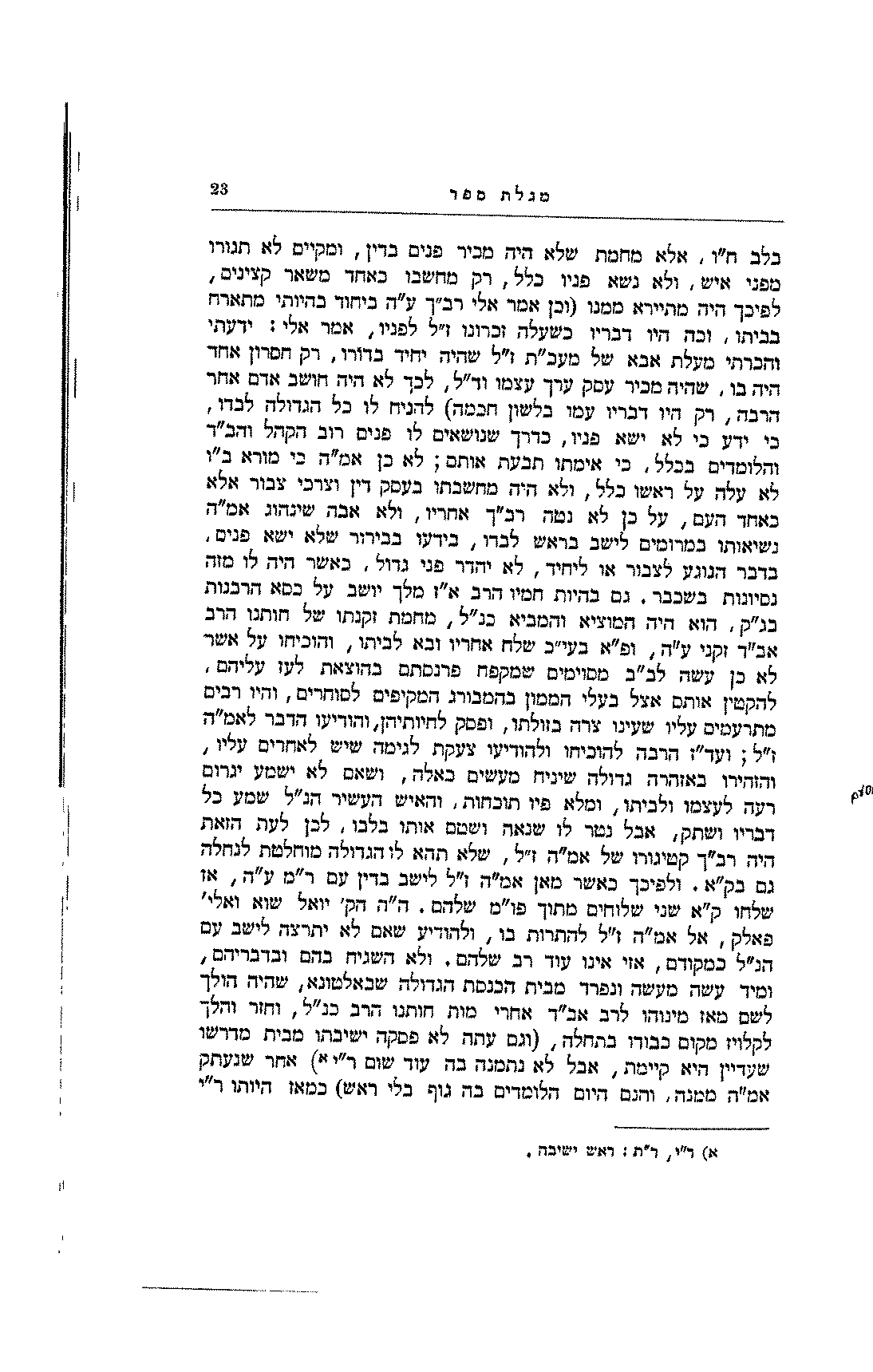
Margin readings in Scholem's copy (1)
| Printed anchor | Type (key sheet) | Mark | Reading | Certainty |
|---|---|---|---|---|
| ולהודיעו צעקת לגימה שיש לאחרים עליו | — | short note in right margin | - | no note visible in the NLI image (HebrewBooks edge noise) |
Page 24 (scan 34)
of the Kloyz alone. All the friends, the lovers and the relatives of my father could not persuade him to go against his mind, the mind of the Torah, for he had already concluded that the thing was not right, as said.
When the two messengers mentioned came back from their mission to the community chamber, to their colleagues, to bring word to those who had sent them, they told them of my father's decision and of the great deed he had done. Their hearts were divided: when the men of the community heard it they were grieved and regretted it, ashamed and confounded by their deeds, for they understood that they would gain no glory by this way — that they had thrust my father from his greatness for nothing, a man whose fame was in all the land, who had been to them a name and a glory for many years, and in whom they had found no trace of evil.
So they made a charge against the leader Joel Schwab, as if he had betrayed his mission and changed the words they had put in his mouth, and had added on his own that they would remove my father from the rabbinate if he persisted in his refusal. They denied it to his face, as if it had never been: they had only sent him, they said, to entreat my father to agree to sit again together in court with R. Moses, and they had not touched his honour at all. That is what they wanted R. Joel Schwab to say, to excuse them. For they were very much afraid of being burned by my father's coals: several times things had happened in which no man who opened his mouth and tongue against him went unpunished, for the Holy One, blessed be He, demands His honour, and punished and killed. So when they saw that they had made no fruit of their mission, they went back on it and regretted the deed — such a thing ought not to be done in Israel, to remove from his office so holy a man and so great a sage, whose like would not be found in his generation — and they feared for themselves that it would become a disgrace before their enemies. They would rather my father had not done such a thing, to leave his place of honour suddenly. So they wanted the messengers to deny the words of the mission, to cover for them, so that this stumbling-block should not be laid at their door.
Eli Falk, one of the messengers, did so, and flatly contradicted his colleague who had gone with him on the community's errand to my father. But Joel Schwab, as a man of truth, stood by his words: he had changed nothing; he had done what they commanded him and kept to the words they had put in his mouth, without turning to the right or the left; he had added nothing and taken nothing away, good or bad. For this they fined Joel Schwab six hundred Reichstaler, which he had to pay at once into the community chest; and he did so gladly. Besides this they gave him a bitter punishment: not only was he put out of the community chamber, it was decreed that he be barred from any office and never again come to any matter of holiness all his days, and that he sit in the synagogue with the mourners and the excommunicated. So he sat as a mourner and an excommunicate for several years. The leader bore it all and accepted it for the love of truth; and all the days of R. Ber Kohen's life Joel Schwab never again came to any office in community affairs. The story is long; it remained in writing with R. Joel Schwab and was kept in his archive as a memorial.
דקלויז בלבד, וכל אנשי שלומו אוהביו וקרוביו של אמ"ה ז"ל לא יכלו לפתותו להעבירו על דעתו דעת תורה, שכבר היה מוסכם אצלו שלא נכון הדבר כנ"ל. ושנים האנשים המשולחים הנ"ל בשובם משליחותם הנ"ל אל חדר הקהל אצל חבריהם להשיב לשולחיהם דבר, והודיעום הסכמתו של אמ"ה ז"ל ומעשה רב שעשה, וחלק לבם, כי אנשי הקהל כשמעם ויתעצבו ונתחרטו, בושו גם נכלמו ממעשיהם, בשערם כי לא תהיה תפארתם על הדרך הזה, אשר כה עשו לדחות אמ"ה ז"ל מגדולתו בחנם, אשר היה שמעו בכל הארץ, והיה להם לשם ולתפארת שנים רבות, ולא מצאו בו שמץ דבר רע; אשר על כן העלילו על הק' יואל שוא, כאלו מעל בשליחותו ושינה הדברים ששמו בפיו בשליחותם, והוסיף מדעתו לומר שמסירים לאמ"ה ז"ל מן הרבנות כשיעמוד בסירובו כנ"ל, והמה הכחישוהו על פניו, כאילו לא היו דברים מעולם, רק שלחוהו לחלות פני אמ"ה, שיתרצה לשוב לשבת יחדיו בב"ד עם ר"מ הנ"ל, ושלא פגעו בכבודו כלל, וכך היו רוצים שיאמר ר' יואל שוא כדי להתנצל בעדם. כי היו יראים מאד שלא להכוות בגחלתו של אמ"ה ז"ל, באשר ארעו כ"פ מעשים שאין איש ששלח פיו ולשונו לדבר בו ונקה, דקב"ה תבע ביקריה וענש וקטיל, ולכן בראותם שלא עשו פרי בשליחותם הנ"ל, חזרו בהם ונחמו על המעשה, לא יעשה כן בישראל, להעביר ממנויו איש קדוש וחכם גדול כזה, אשר לא ימצאו תמורתו בדורו, וייראו לנפשם פן תהא זאת לשמצה בקמיהם, והיה נוח להם שלא יעשה אמ"ה כזאת, לעזוב מקום כבודו פתע פתאום, לכן היו חפצים שיכחשו השלוחים הנ"ל דברי השליחות, כדי לחפות עליהם, שלא תהא המכשלה הזאת תחת ידיהם. ואלי' פאלק השליח האחד עשה כן, והכחיש בפה מלא את חבירו הנ"ל, שהלך עמו בשליחות אנשי הקהל אל אמ"ה כנ"ל, אך יואל שוא כאיש אמת עמד בדבריו, ואמר שלא שינה כלום, אך מה שצוו עליו עשה, והדברים אשר שמו בפיו אותו שמר לדבר, בלי נטות ימין ושמאל, לא הוסיף ולא גרע מטוב עד רע. על דבר זה קנסו ליואל שוא בשש מאות ר"ט, שהיה מוכרח לשלם מיד לקופת הקהל, וכן עשה בשמחה; נוסף על זה ענשוהו עונש מר, לא לבד שנדחה מחדר הקהל, נגזר עליו שיופסל לשום מינוי, ולא יבוא עוד לכל דבר שבקדושה כל ימיו, ושישב בבה"כ עם האבלים והמנודים. כך נהג לישב כאבל וכמנודה כמה שנים, את הכל סבל וקבל עליו הק' הנ"ל לאהבת האמת; וכל ימי חיי רב"ך, לא בא עוד יואל שוא לשום מינוי לדבר הקהל, והדברים ארוכים ונשאר הספור בכתב אצל ר' יואל שוא, והיה מונח בבית גנזיו לזכרון.
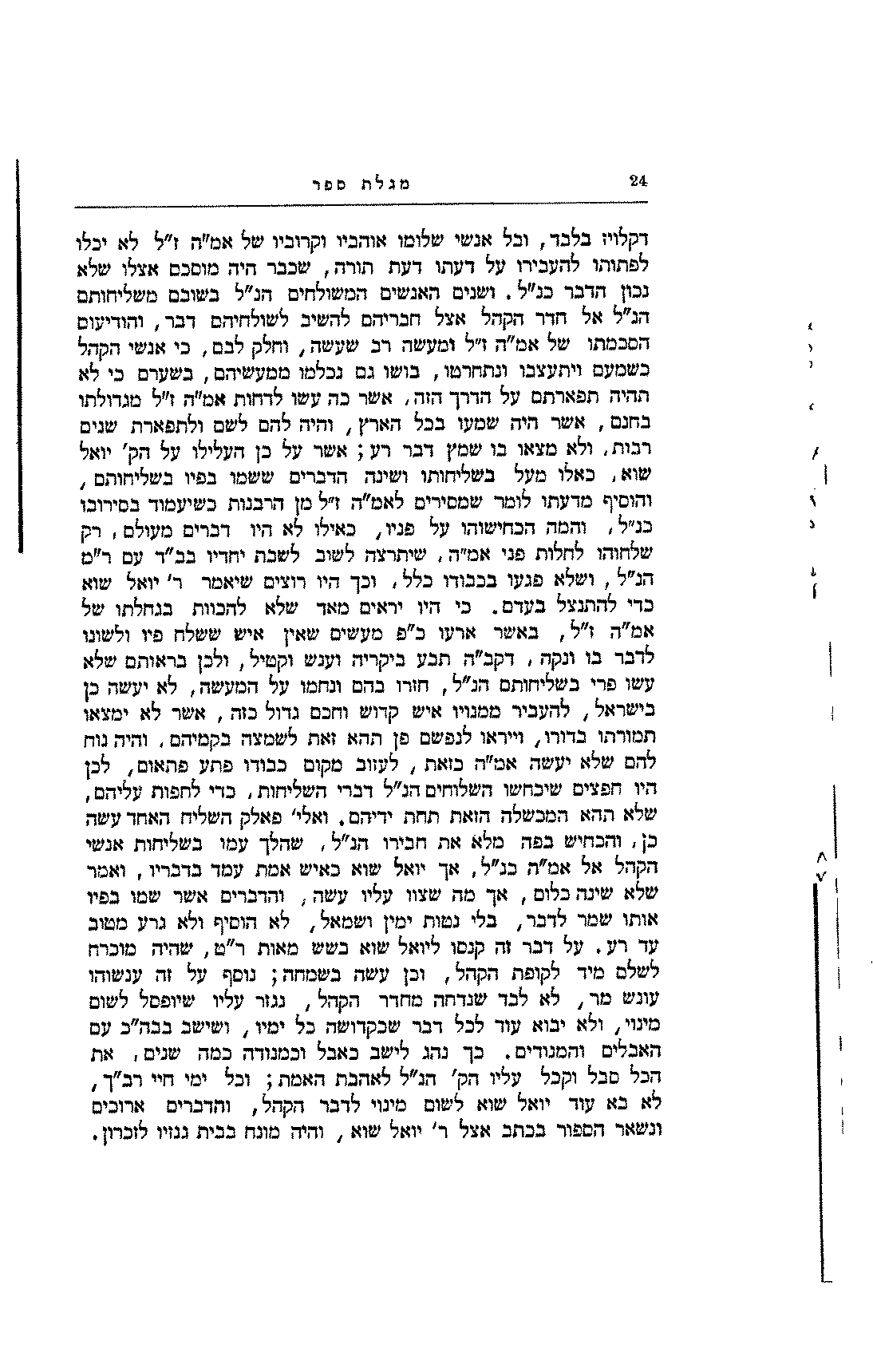
Margin readings in Scholem's copy (1)
| Printed anchor | Type (key sheet) | Mark | Reading | Certainty |
|---|---|---|---|---|
| lines 5-12 and 27 | V: omission | marks at the scan edge (cut off), caret and v at line 27 | - | no note visible in the NLI image (HebrewBooks edge noise) |
Page 25 (scan 35)
After this my father fell very seriously ill; they almost despaired of his recovery and had to let his blood. Then his spirit came back to him, for he saw that the affair had been the cause.
Let us return to my father's story. Not half a year passed after the affair mentioned, in which he gave up his honour and withdrew from the rabbinate of Altona, before a letter of appointment to the rabbinate came to him from the community of Amsterdam: "He withdraws not his eyes from the righteous" (Job 36:7). It was on the eve of the Sabbath of the portion Beshallaḥ; he was sitting in the synagogue wrapped in his tallit, reading the weekly portion twice with the Targum — the portion of the Song — from a Torah scroll, when the letter was brought to him with the good news.
But he wrote them an answer, and told them that unless they added to their salary for the rabbinate ⟨S: a five-line note, partly read: "which was fixed … and they added for him … to receive the rabbinate"⟩ he would not stand and serve before them. For they had formerly given their rabbi a small thing, about five hundred gulden only, and the main support of their rabbi and head of the court was "a staff of reed": gifts and presents from householders. He did not accept gifts from flesh and blood at all, as said; his household was large, and living in a great city like Amsterdam is hard; so of necessity they must add for him from the community chest, a livelihood with ease. They agreed, and fixed for him a set salary of a thousand Reichstaler in specie a year, which is two thousand five hundred Dutch gulden [a].
Then he moved his home from Altona and came to Amsterdam with great honour — not only from the Ashkenazi community, for the Sephardi community too showed him every honour, since he was very great in their eyes, and many of their sages had known him for a long time, having sent him their letters and their questions. Just as he had been to the Sephardi community in Hamburg a father and patron all the days he was there — they showed him great affection, recognising his godly qualities, his wisdom and his study of Torah in truth and for the sake of Heaven. He also spoke with them in their own language, a pure Spanish like theirs. So the head of the court of the Sephardi community of Amsterdam in particular sought him out with a letter full of praise, which went ahead of him, to welcome him before my father came to his dwelling in Amsterdam. When he came, the Sephardi community there too received him with honour such as had not been shown to any man before him. They esteemed no rabbi or sage of all the communities of Germany and Poland — only my father they held to be unique in his generation. All their great men came early to his door and held fast to his words; they did not leave him — until sin brought it about, and the time of the quarrel over Ḥayon came, may the name of the wicked rot. But before this the whole Sephardi community of Amsterdam, from small to great,
Kahana's notes
- [a] The letter of appointment from the parnassim of the holy community of Amsterdam, which they gave to the rabbi Ḥakham Tzvi, of blessed memory, is printed in Toledot Ya'avetz, in the appendix by A. Ḥ. Wagenaar; see there. After the gaon Ḥakham Tzvi left Altona in 5470 [1710] and went with his household to Amsterdam, the rabbi R. Moses Rothenburg remained sole head of the court in the Three Communities; but he did not live long, and died about 5473 [1713]. See Dembitzer, Kelilat Yofi (fol. 93).
אחר זה חלה אמ"ה ז"ל חולי כבד מאד, כמעט נתיאשו מרפואתו, והוצרכו להקיזו דם, אז שבה רוחו אליו, כי ראה שהמאורע היה הסיבה. נחזור לסיפורו של אמ"ה ז"ל. לא יצאה חצי שנה אחר המאורע הנ"ל, שהניח כבודו וסלק עצמו מהרבנות דק' אלטונא, עד שבא אליו כתב רבנות מק' אמשטרדם, לא יגרע מצדיק עינו. והיה זה בערב שבת פ' בשלח, והיה יושב בבה"כ מעוטף בטלית, קורא שמו"ת פ' השירה מתוך ספר תורה, אז הובאה אליו האגרת בבשורה. אך הוא ז"ל כתב לשם תשובה, והודיעם שאם לא יוסיפו לו בשכר הרבנות שלהם לעמוד לשרת לפניהם, באשר היו נותנים מתחלה לרב שלהם דבר מועט כחמש מאות זהובים בלבד, והיה לרב אב"ד שלהם עיקר סמיכת על משענת קנה: מתנות ודורונות מבעלי בתים, והוא ז"ל לא היה מקבל מתנות ב"ו כלל כנ"ל, וטיפולו היה מרובה וישיבת כרכים כאמשטרדאם קשה, לכן בהכרח להוסיף לו מקופת הקהל, מעמד פרנסה בשופי. ונתרצו לו וקצבו לו שכר קבוע אלף ר"ט שפעציא לשנה, שהם שני אלפים וחמש מאות זהובים האלענדש א. אז העתיק דירתו מאלטונא, ובא לאמשטרדם בכבוד גדול, לא בלבד אצל ק' האשכנזים, כי גם ק' ספרדים עשו לו כל הכבוד, כי גדול מאד היה בעיניהם, ורבים מחכמיהם הכירו אותו מאז, ע"י שהריצו אליו אגרותיהם ושאלות ספקותיהם. וכמו שהיה גם לק' ספרדים שבהמבורג, לאב ולפטרון, כל ימי היותו שם, חבה יתירה נודעת לו מהם, בהכירם מדותיו האלהיות וחכמתו ולמוד תורה לאמתה ולשם שמים. גם היה מדבר עמהם בלשונם ספרדית צחה כמוהם, ולזה האב"ד של ק' ספרדים דאמשטרדאם ביחוד שחר פניו בכתב מלא שבח ההולך לפניו, להקביל פניו בטרם בוא אמ"ה ז"ל למכון שבתו לאמשטרדאם; ובבואו נתקבל גם מק' ספרדים שם בכבוד, שלא נעשה כמוהו לשום אדם מלפניו, ולא היו מחשיבים לשום רב וחכם מכל ק' אשכנז ופולין, רק מאמ"ה ז"ל היו עושים יחיד בדורו; כל גדוליהם משכימים לפתחו, ומחזיקים בדבריו, לא סרו מאחריו, עד שגרם העון ובא עת התגר של חיון שר"י אבל קודם זה היו כל ק' ספרדים דאמשטרדאם בכלל, מקטן ועד גדול,
- [א] כתב הרבנות מאת פרנסי ק"ק אמשטרדאם, שנתנו להרב חכם צבי ז"ל, נדפס בספר תולדות יעב"ץ בהוספה מאת א"ח וואגנה ע"ש, ואחר שעזב הגאון חכם צבי בשנת ת"ע את אלטונא והלך עם ב"ב לאמשטרדם, נשאר הרב מו"ה משה רוטנבורג לבדו האב"ד בג' קהלות, אולם לא האריך ימים ונפטר סביב לשנת תע"ג, עיין בספר כלילת יופי לדעמביצער (ד' צ"ג).
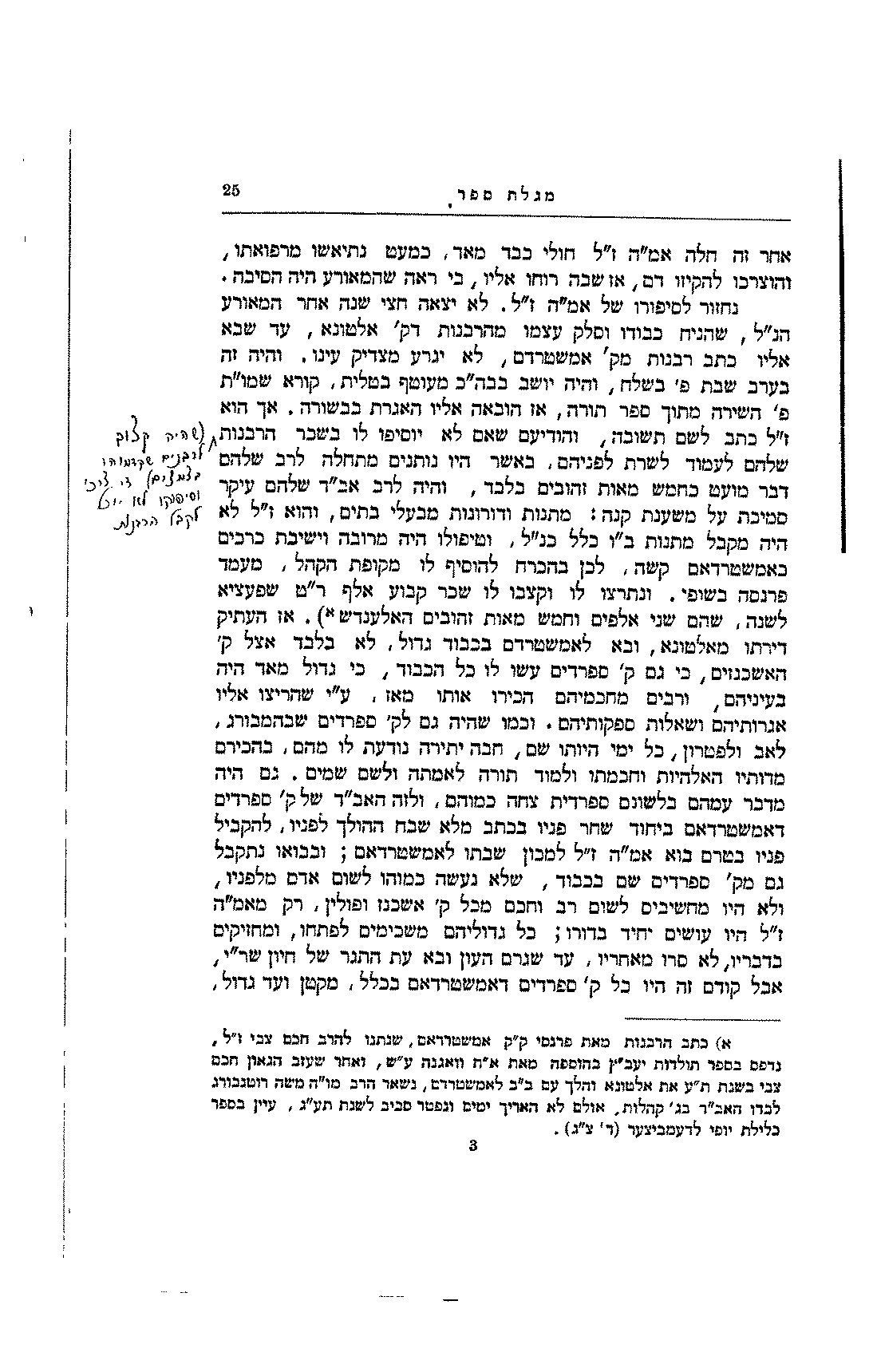
Margin readings in Scholem's copy (1)
| Printed anchor | Type (key sheet) | Mark | Reading | Certainty |
|---|---|---|---|---|
| אם לא יוסיפו לו בשכר הרבנות ^ שלהם | V: omission | caret; 5-line note in right margin | (שהיה קצוב / לרבנים שקדמוהו / בזמנים) די לו(?) / וסיפקו לו יותר(?) / לקבל הרבנות | fairly sure |
Page 26 (scan 36)
were faithful friends of my father. They were a wall for him in the war among the Ashkenazim, who split into two factions, as I will write with God's help. For the greatest of the Sephardi magnates had power and a name with the authorities, and their words were heeded by them; and they told the authorities about my father, that he was one without a second in Israel in his time in wisdom and in knowledge of the Torah, and that in leading the community with uprightness and justice "there is none like him upon earth" (Job 41:25). Proof of it came, for his name was great with the authorities too. All the days he was in Amsterdam, the rulers there would not deal with money cases of the Ashkenazi community between a man and his fellow — at a time when the rabbi and head of the court had no freedom there to judge by Jewish law. Of their own accord the authorities did this: when litigants from among the Ashkenazim came before them, they sent them away and said to them, "Go to your rabbi; let him decide between you and give you judgement", knowing that he was great in Torah, hated gain and showed no favour.
But although my father took up their cases and judged between a man and his fellow and his community, he took from them none of the fee-money fixed for him in the letter of appointment. A special box of the community stood on my father's table, locked with the lock of the community treasurer. When litigants came before him, they threw the fee-money fixed by the community for the rabbi's income into the box through a slot in the lid of the vessel, through which the coins fell into the box. When the treasurer saw that there was much money and the box was full, he and an official came and emptied the box of the money in it, and took the silver to the general chest of the community, from which the public needs are met. My father vowed the income of the fee-money to the community as soon as he came to Amsterdam.
He also set up a house of study for them, where students of Torah would sit and study constantly. He did much of his own and moved others to do, for he spoke to the hearts of select individuals, and some of the generous men of the community signed for him, each to give a fixed sum as a free-will offering; he signed at the head, to give like one of them a sum every year. Beyond this he gave over, for the support of the students in this house of study of his, all the income from divorces and ḥalitzot, for which there is a fixed sum from the community as income for the rabbi — I think twenty or thirty gulden for every bill of divorce, and the same for every ḥalitzah. My father did not benefit from any of this income all the days he was rabbi and head of the court in Amsterdam, for the parnassim took everything into their chest, as said. The money for arranging divorces and ḥalitzot went into the box of the students of the new house of study that he set up there, as said. They held it in his house: he gave them a place in the best of his rooms — though he rented a large house with his own money, for the community's house, which had been set aside for the rabbi before, did not suffice him, being too small to hold the household of my father, of blessed memory
אוהבים נאמנים לאמ"ה ז"ל. חומה היו לו מנחלה במלחמת האשכנזים, שנפרדו לשתי כתות, כמש"ל בס"ד. כי גדולי גבירי הספרדים להם יד ושם אצל השררה ודבריהם נשמעים אצלם מאד, והם הודיעו והגידו להשררה על אמ"ה ז"ל, שהוא אחד ואין שני לו בישראל בזמנו, בחכמה ובידיעות התורה, ומנהג הצבור ביושר וצדק אין על עפר משלו; ובא האות והמופת על זה, כי גדול שמו אצל השררה ג"כ, כי על כן כל ימי היותו באמשטרדאם, לא רצו בעלי השררה שם לטפל בדיני ממונות של ק' אשכנזים בין איש לרעהו, בעת שאין שם חירות לרב אב"ד לדון דין ישראל, אכן השררה מעצמה עשתה זאת, בבוא לפניהם בעלי דברים מאשכנז, שלחו אותם ואמרו להם: לכו אל הרב שלכם, שיפסוק ביניכם ויעשה דין לכם, בידעם היותו גדול בתורה ובשנאת בצע ובלתי נושא פנים. ואמנם אע"פ שנטפל אמ"ה ז"ל לדיניהם, ועשה משפטם בין איש ורעהו וקהלו, לא נטל מהם פסק מעות שקצבו לו בשטר הרבנות, אבל קופה מיוחדת לקהל היתה מונחת על שולחנו של אמ"ה, סגורה במנעול של גבאי הקהל. וכשבאו בעלי דינין לפניו ז"ל, היו משליכין הפסק מעות, הנקצב מן הקהל, בע"ד הכנסת של הרב, לתוך הקופה דרך חור שבדלתו של כלי שלמעלה, שדרך שם נופלים המעות לקופה, וכראות הגבאי כי רב הכסף ונתמלאה הקופה, בא הוא ופקיד ויערו את הקופה מן המעות שבתוכה, ויביאו את הכסף שמצאו לארגז הכללי של הקהל, שממנו מספיקים צרכי צבור. והכנסה של פסק מעות נדר אמ"ה ז"ל לקהל, תיכף לכניסתו באמשטרדאם. גם תקן להם בית המדרש, שיהיו יושבים בו לומדי תורה תמיד עוסקים בתורה, ועשה הרבה בשלו ועישה לאחרים, כי דיבר על לב יחידי סגולה, וחתמו לו על זאת מנדיבי הקהל, לתת כל אחד דבר קצוב נדבת לבו, והוא ז"ל חתם בראש לתת כאחד מהם דבר שנה בשנה; אבל נוסף על זה הפריז לצורך החזקת לומדי תורה שבבית המדרש שלו הלז כל ההכנסות של גטין וחליצות שיש שם קצבה על זאת מהקהל להכנסת הרב דבר מסויים, כמדומני עשרים או שלשים זהובים לכל גט, וכן מכל חליצה, ולא נהנה אמ"ה ז"ל משום דבר הכנסות הנ"ל, כל ימי היותו רב אב"ד באמשטרדאם, כי פו"מ היו לוקחים הכל לארגזם כנ"ל. ומעות של סדורי גו"ח היו נופלין לקופת תלמידי שבבה"מ החדש, שהקים הוא ז"ל שם כנ"ל, וקבעו בביתו שנתן להם מקום במבחר חדריו, עם היות ששכר לו בית גדול מממונו, כי לא הספיק לו הבית של הקהל, שהיה מיוחד להרב מקודם, כי קטן מהכיל בני ביתו של אמה"ג ז"ל
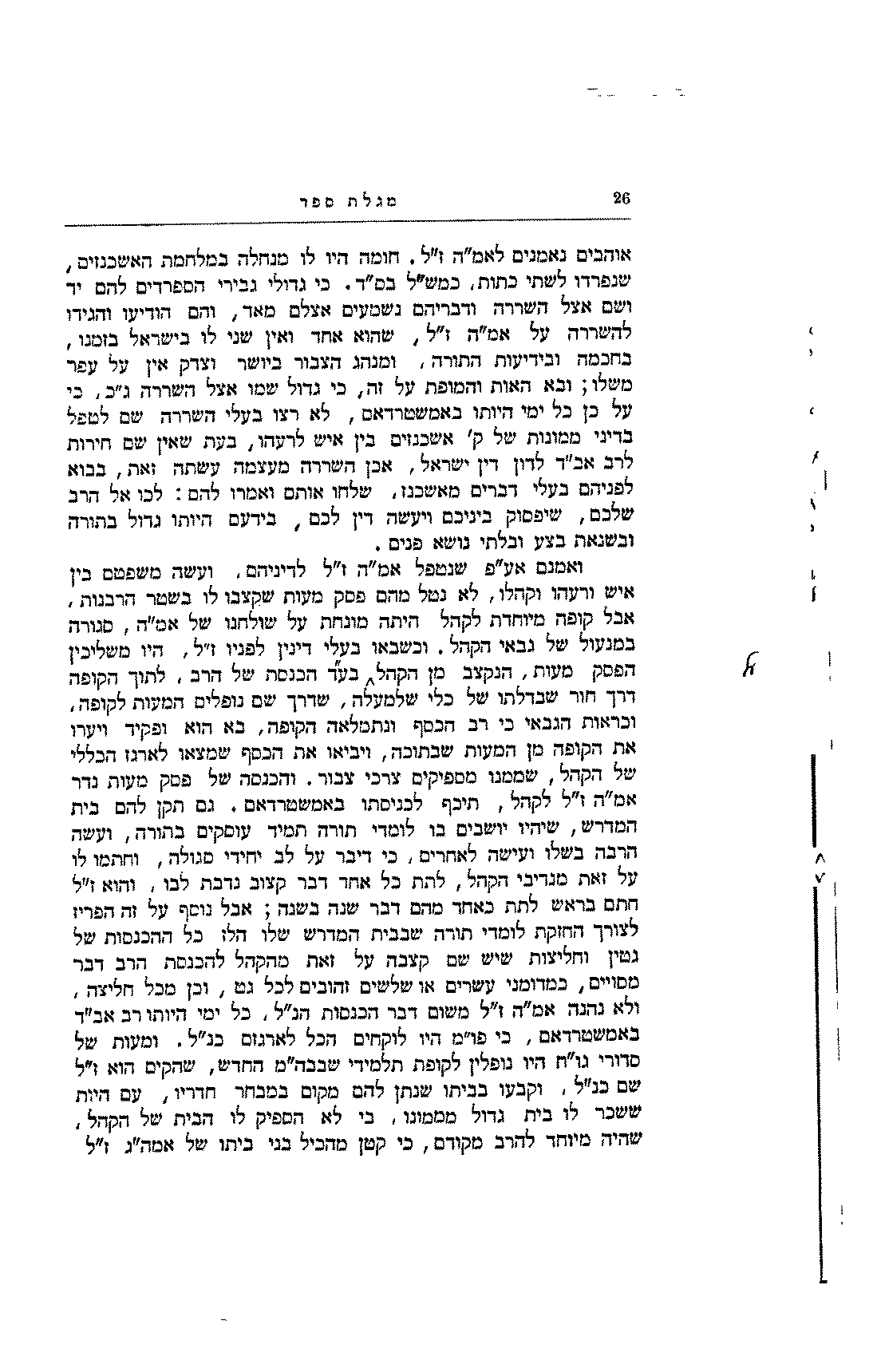
Margin readings in Scholem's copy (1)
| Printed anchor | Type (key sheet) | Mark | Reading | Certainty |
|---|---|---|---|---|
| הנקצב מן הקהל ^ בעד הכנסת של הרב | V: omission | caret; one letter or short word in right margin | - | no note visible in the NLI image (HebrewBooks edge noise) |
Page 27 (scan 37)
So he rented out the community's house for a small sum, and rented a large house for himself at a high price, five hundred gulden, and the community gave him no help at all with the rent. Even so he cleared a large room in the house as a synagogue and a place of study for the students of his house of study, and the men of the house of study slept there; and he studied with them Bible, Gemara–Rashi–Tosafot and the codes every day.
Another new income came to the community on the very first night he arrived there. The men of the community had prepared a great feast, to dine with him and rejoice with him; and he said to them: "I will not eat until I see your slaughterer's knife." The slaughterer was called to show him the slaughtering knife, and it was found notched like a saw. They tested it many times to see whether he could feel it; and the slaughterer said that his knife was certainly good. So it became known that this slaughterer, called Leizer Shochet, who had been the town slaughterer there for some forty years, had been feeding Israel forbidden carcasses, for he had no feeling [in his fingers] at all. Therefore my father removed him from his craft that very night, and other expert slaughterers came in his place. The old slaughterer had received a salary from the community of eight gulden every week for his trouble, besides the payment he took from the gentile butchers, who gave him the fat and the entrails, the head and the feet, which were worth a certain sum and came to a large account. So after the old slaughterer was removed and lost his hold, the community sold the slaughtering rights to a fit and worthy slaughterer; and not only did he take nothing from the community for his hire, he even paid a thousand Reichstaler into the community purse for this appointment. So the coming of the righteous man to his place made a great mark on the community's income, changing it for the better — and at once "a double blessing" to the scholar, for body and soul: he removed from them the great stumbling-block, and they gained much more than the burden of the rabbi's salary that they had raised for him, as said. Another fixed gain came to the community's income at that time through the ritual bath, which they also let out. The community had formerly paid from its own purse a set wage to whoever lived in the community's mikveh free of charge and took all the income for himself; now they gained in this too. The community's position was very good, and all were glad of my father, their new rabbi, through whom great reforms came about.
But "a fat tail with a thorn in it". Besides the fact that the good deed done in removing the slaughterer drew on him enemies who surrounded him with hatred — for that slaughterer lost his living by it, and also his large household and the relatives who depended on him and lived from him while his living was plentiful, as said; so they spoke of going down after my father's life — there was another evil, greater than this, at the time when my father came to Amsterdam. The community was in flames, the fire of strife was burning among them: their hearts were divided over the two cantors, R. L.
על כן השכיר הבית של הקהל בדבר מועט ושכר לו בית גדול בסך רב בעד חמש מאות זהובים, ולא סייעו לו הקהל מאומה בשכר הדירה, ועכ"ז פנה חדר גדול שבבית למקום בית הכנסת וישיבה ללומדי תורה שבבית מדרשו, ואנשי בית המדרש ישנים שם, והיה לומד עמהם מקרא גפ"ת ופוסקים בכל יום. עוד באה להקהל הכנסה חדשה, בלילה הראשון שהגיע לשם, באשר הכינו אנשי הקהל כרה גדולה, לסעוד אצלו ולשמוח עמו, ויאמר להם לא אוכל עד אם אראה סכינו של שוחט שלכם. ונקרא השוחט להראות סכין השחיטה אליו, ונמצאת פגומה כמגרה, ובדקו פעמים רבות לראות אולי ירגיש, ואמר השוחט כי סכינו יפה הוא ודאי, באופן שנודע כי השוחט ההוא, שהיה נקרא ליזר שוחט, שהיה שם כארבעים שנה שוחט דמתא, האכיל נבלות לישראל, שלא היה בו הרגשה כלל. לכן העבירו אמ"ה ז"ל מאומנתו בלילה ההוא, ובאו שוחטים אחרים מומחים במקומו, ותחת שהיה להשוחט הקדום פרס מן הקהל שמונה זהובים מדי שבוע בשבוע שכר טרחו, נוסף על השכר שקבל מאת הקצבים ערלים, שנתנו לו השמן והקרבים הראש והרגלים, שהיה שוה סך מסוים, ועולה לחשבון גדול. לכן, אחר שעבר השוחט הישן ואבד חזקתו, מכרו הקהל השחיטה לשוחט הגון וכשר, ולא די שלא לקח מן הקהל כלום בשכירתו, אף הוא נתן להם בעד מינויו זה אלף ר"ט לכיס הקהל, באופן שביאת הצדיק למקומו עשה רושם גדול בשינוי מצב הכנסת הקהל לטובה, ותיכף לת"ח ברכה כפולה לגוף ולנפש, כי הסיר מהם המכשלה הגדולה, והרויחו הרבה יותר ממה שהעמיסו עליהם בשכר הרבנות שהעלו לו כנ"ל, וכן בא לו עוד ריוח אחר מסוים להכנסת הקהל ע"י המקוה שהשכירוה ג"כ בעת ההיא; תחת שהיו הקהל נותנין מתחלה מכיסם שכר רשום למי שהיה דר במקוה של הקהל בחנם ולקחת כל ההכנסה לעצמו, עתה הרויחו גם בזאת, והיה מצב הקהל טוב מאד, והיו הכל שמחים עם אמה"ג ז"ל הרב החדש שלהם, שנתגלגלו על ידו תקנות גדולות. אכן אליה וקוץ בה. כי מלבד שמעשה הטוב הנ"ל, שאירע עם העברת השוחט, משך אחריו שונאים בנפש יקיפו עליו, כי השוחט ההוא נתקפחה פרנסתו ע"י כך, גם בני ביתו רבים גם קרובים שהיו תלוים בו, ומתפרנסים ממנו ע"י שהיתה פרנסתו מצויה בשפע רב כנ"ל, על כן אמרו לירד לחיי אמ"ה ז"ל, אבל עוד רעה אחרת גדולה מזאת היתה באותו פרק, שבא אמ"ה ז"ל לאמשטרדם: בהיות הקהל בלהבה ואש המריבה לוהט בם, חלק לבם על דבר שני החזנים ר"ל
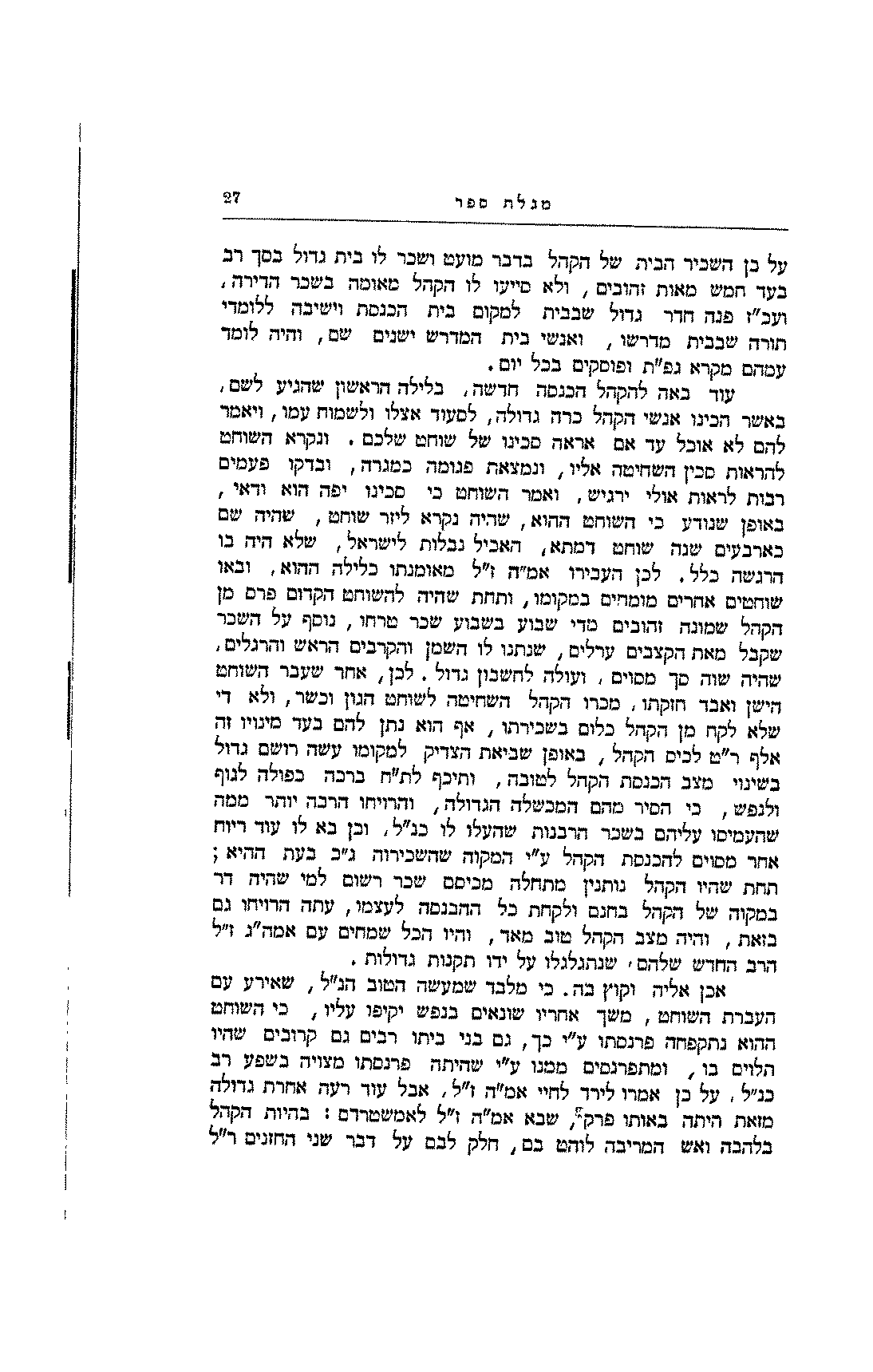
Page 28 (scan 38)
and R. A. ⟨S: "variant reading"⟩, who were famous in the world. Many lives and much money had sunk into this quarrel for several years before my father came there. Things went so far that on the Sabbath of Repentance 5469 [1708], a year before my father came — the rabbi R. Leib Kalisher was then head of the court there [a] — the two sides, who were fighting over which of the two cantors would lead the prayers in the great synagogue on that Sabbath, came to blows, until blood was spilled on them. They used the stands for the prayer books, which they call Ständer, throwing them and beating one another with them, as if to kill each other. For our many sins this house, a "little sanctuary", became like a den of robbers on the holy day, at the time set for repentance, when the rabbi was to preach reproof and rouse the people to repentance. Because of the great terror, trembling and alarm that fell on their head of the court at that time, he took to his bed as soon as he came home and did not rise again: he fell ill of the illness of which he died. After him the rabbi R. Saul, of blessed memory, was received, and he died on the way, in Glogau; and after him my father was received, in the year 5470 [1710].
The sword of quarrel did not rest, and the fire of strife blazed in the community up to the heart of heaven; the rain of peace did not fall on the earth. They did not rest or keep quiet, but thought only to swallow one another alive. They had already brought their strong reasons before the authorities in Amsterdam, and scattered very much money of their own and from the purse of the community's income. The hand of the side of the cantor R. L. was strong, for in it were the great moneyed men of that time, above all the famous brothers Gokkes — violent men who had won great wealth not by right, and such was their end too; above all Aaron Gokkes, who in his last days was a villain, as is well known in the world; and many householders hung on them. These strong-armed men fought against the weak side of the cantor R. M., in which there were men of standing, men of truth, lovers of uprightness who pursued justice, and who were weary of bearing the yoke of the said tyrants, who lorded it over the community not for the sake of Heaven. Though their soul had almost dwelt in silence, they could not stand against those bold men, who spent much money on that war from the community chest that was in their hands; while the others, few and weak in comparison with the other side, had to spend on it from their own purses and their own money, in the manner of the world. So the war lay heavy upon them, and they had all but bowed down and fallen before the others, their enemies and persecutors, who rose up against them to destroy and make an end of them, to leave them neither root nor branch. And it is impossible that there should be such great hatred
Kahana's notes
- [a] He is the gaon R. Leib Kalisch, author of the book Gur Aryeh. He sat on the rabbinical seat in Amsterdam only about a year and a half, and on 7 Kislev 5470 [1709] his soul went up to heaven. See Dembitzer, Kelilat Yofi (fol. 98b).
ור"א המפורסם בעולם. כמה נפשות וממון שקעו במחלקת הזאת מכמה שנים טרם בוא אמ"ה לשם, ונתגלגל הענין עד שבשבת שובה תס"ט, שנה לפני בוא אמ"ה, ואז היה הרב ר"ל קאלישר אב"ד שם א, באו שני הצדדים, שהיו מריבין על אודות איזה מהחזנים הנ"ל יתפלל בבהכ"נ הגדולה באותו שבת, לכלל הכאה עד שפך דם עליהם, עם בסיסי ספרי סידורי התפלות שקורין שטענדר, שהיו זורקין וחובטין זה את זה, דמו להרוג אלו את אלו. בעו"ה היה הבית הזה בית מקדש מעט כמערת פריצים ביום הקדוש, ובעת המוכן לתשובה ולדרוש הרב תוכחה לעורר העם בתשובה ומחמת האימה הגדולה וחרדה ובהלה, שנפלה על הרב אב"ד שלהם בעת ההיא הנ"ל, מיד נפל למשכב בבואו לביתו ולא הוסיף לקום, כי חלה חליו אשר מת בו, ואחריו נתקבל הרב מ' שאול ז"ל, ומת בדרך בגלוגא, ונתקבל אחריו אמה"ג בשנת ת"ע. לא שקטה חרב הקטטה ואש המחלוקת מתלקחת בתוך הקהל עד לב השמים, ומטר השלום לא נתך ארצה, לא שקטו ולא נחו רק חשבו לבלוע איש את רעהו חיים, וכבר הגישו עצומותיהם לפני השררה באמשטרדם, ופזרו ממון רב מאד משלהם ומשל כיס הכנסת הקהל. ויד של צד החזן ר"ל היתה תקיפה, באשר היו בה בעלי כיסים גדולים שבאותו זמן, בפרטות האחים המפורסמים גאקישגיז, גברי אלמי שהשיגו עושר רב לא במשפט, וכן היה סופם. ביחוד ארון גאקיש באחריתו היה נבל כמפורסם בעולם, שהיו רבים מבעלי בתים נתלים בהם. ואלה בעלי זרוע נלחמו עם הצד החלוש של החזן, הוא ר"מ אשר בה היו בעלי צורה, אנשי אמת ואוהבי יושר רודפי צדק, ונלאו לסבול עול העריצים הנ"ל, המתגאים על הצבור שלא לשם שמים, אף שכמעט שכנה דומה נפשם, ולא יכלו עמוד נגד עזי נפש הנ"ל, שהיו מוציאים על המלחמה ההיא מעות הרבה מקופת הקהל שהיתה בידם, והאחרים עם מעוטם וחולשתם בערך הצד האחר היו מוכרחים להוציא על זה מכיסם וממון עצמם במשפט העש"ג. לכן היתה המלחמה כבדה עליהם, וכמעט קט כרעו ונפלו לפני האחרים שונאיהם מנדיהם, הקמים עליהם לאבדם ולכלותם, שלא לעזוב להם שורש וענף. ואי אפשר להיות כל כך שנאה עצומה
- [א] הוא הגאון מו"ה ליב קאליש בעל מחבר ספר גור אריה וישב על כסא הרבנות באמשטרדם רק כשנה ומחצה, וביום ז' כסליו שנת ת"ע עלתה נפשו דשמים עיין בס' כלילת יופי לדעמביצר (ד' צ"ח ע"ב).
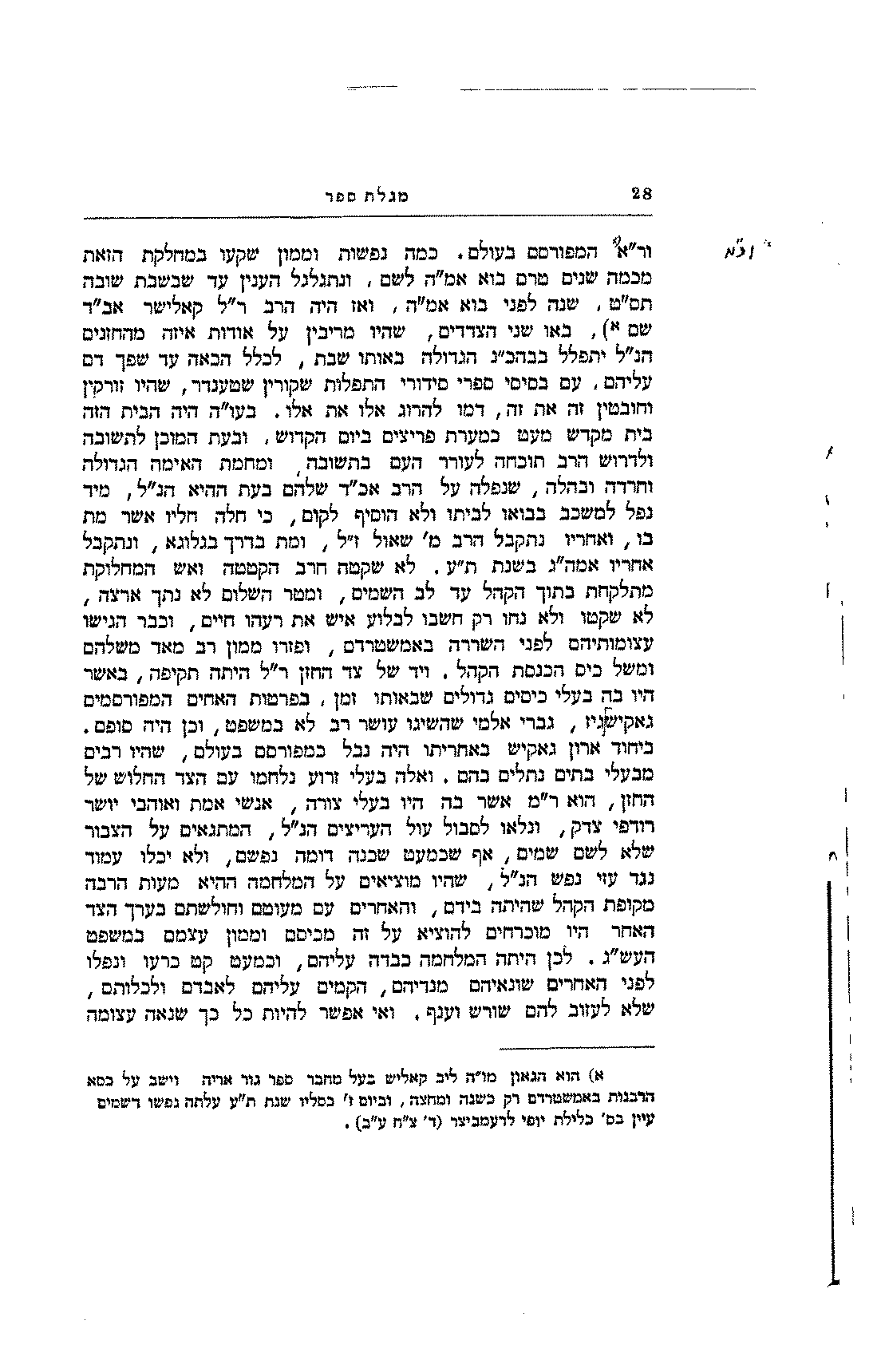
Margin readings in Scholem's copy (2)
| Printed anchor | Type (key sheet) | Mark | Reading | Certainty |
|---|---|---|---|---|
| ור"א המפורסם בעולם (the hazzan R. A.) | X: substitution | x mark over ר"א; note in right margin | נ"א (= variant reading; the variant itself not written or not read) | fairly sure (marker only) |
| lines 12-14 and 26 | — | marks at the scan edge (cut off) | - | no note visible in the NLI image (HebrewBooks edge noise) |
Page 29 (scan 39)
between two nations whose faiths are divided and separate, as the enmity grew between these two sides of the cantors.
When my father drew near the city, the side of the powerful men mentioned above went out first and sent their messenger ahead of them — the sexton R. L. R. A., a man of words — to explain their case and put it into my father's heart, so that he would be drawn after them and find them in the right in their quarrels, and help them in pursuing the other side, to uproot them and root them out and destroy them from the border of Israel, so that they would not come to any matter of holiness; and also to make known the strength and might of that side, being the rich, with many with them, and with the power to defeat their opponents. So if he would support them and stand at their right hand to justify them, it would be well with him.
My father promised to help them when justice was with them, and to act according to the Torah; but he must hear the words of both parties, and when he came to the city and heard what the factions themselves had to say, he would judge justly between side and side, as was his duty. When some days had passed, the men of the strong faction saw that they had not found with my father what they sought, for he loved uprightness and truth, and would not hand over the weak faction to its opponents for slaughter. Even so the hand of the prevailing faction did not slacken from seeking ways to bring my father into the bond of their covenant and their conspiracy, to cut off the side that opposed them. They promised to give him twenty thousand gulden in ready money if he would lean towards them and join his hand with them, to gain their wished-for victory and to overcome the other faction — to throw them down from their place, thrust them from their position and trample them. On the other hand, if he still refused to do the will of the strong, let him know that they would turn into his enemies and bring the face of the war against him, and there would be no standing for him or for them; for they had already lavished and set apart a great sum of their money to fight their enemies, and with them were a great multitude, silver and gold and weapons of war; "they have set their mouth against the gate", and no man would stand before them.
When they had wearied themselves with their schemes and laboured in vain to overcome my father — to turn him from his mind and make him leave his holy way and his godly conduct; for all his days he was a father to the needy and strength to the powerless, and the cause he did not know he searched out (Job 29:16); he did not mingle with those given to change (Prov. 24:21); he did not respect persons in judgement; he would not show favour to any rich man for a ransom of pearls; silver was counted in his eyes as stones, and gold as dust; he was not afraid of any man and did not turn back before anyone from doing justice to the poor and oppressed; in him all the crushed in spirit found rest; he broke the jaws of the unrighteous and plucked the prey from his teeth (Job 29:17) — he made their word as nothing. He would not answer to their voice nor be dismayed by their fear; he laughed at dowry and gift, and would not consent though they multiplied bribes. Then they declared a holy war against him, and sought to push him out of the rabbinate and to remove him when his three years were completed, "as the years of a hireling" (Isa. 16:14). They turned their backs on him and hated him, archers [shot at him] (Gen. 49:23), and they thought to make him odious to the authorities. But "many are the plans in a man's heart, but the counsel of the Lord, that shall stand" (Prov. 19:21). For the men who had lifted their hand against him
בין שתי אומות והאמונות חלוקות ונפרדות, כמו שרבתה המשטמה בין שני אלו הצדדים של החזנים. ויהי כאשר קרב אמה"ג ז"ל אל העיר, הקדימו עצמן צד התקיפים הנ"ל, ושלחו שליחם לפניהם הוא השמש ר"ל ר"ע, איש דברים שיטעים דבריהם ויכניסם בלב אמ"ה ז"ל, למען ימשך אחריהם ויצדיקם בדיניהם, ולסייעם ברדיפות הצד השני, לעוקרם ולשורשם להשמידם מגבול ישראל, שלא יבואו לשום דבר שבקדושה, ולהודיע ג"כ כחם וגבורתם של צד ההוא, בהיותם העשירים, ורבים אשר אתם, ויש לאל ידם לנצח לשכנגדם, על כן אם יתמוך בידם, ויעמוד לימינם ולצדקם אז טוב לו. ואמ"ה הבטיחם להיות בעזרם כשיהיה הצדק אתם, וכתורה ועשה, רק צריך לשמוע דברי שני בעלי הריב, והיה בבואו העירה ושמע מה בפי הכתות עצמן, אזי ישפוט צדק בין צד לצד כמוטל עליו. וכאשר עברו איזה ימים, ראו אנשי הכת העצומה הנ"ל, כי לא מצאו אצל אמ"ה מה שבקשו, כי הוא אוהב היושר והאמת, ולא רצה למסור הכת החלושה ביד שכנגדם לטבח. מ"מ לא רפתה יד הכת המתגברת מלבקש דרכים, להביא את אמ"ה במסורת הברית שלהם וקשרם, להכרית הצד המתנגד להם, והבטיחו לתת לו עשרים אלפים זהובים מעות במזומנים, אם ירצה להטות אחריהם, ולהיות ידו עמהם להשיג חפץ נצחונם, ולהגבר על הכת האחרת להרסם ממצבם ולהדפם ממעמדם ולרמסם; ונגד זה, אם עדיין יסרב מלעשות רצון התקיף, ידע כי יתהפכו לו לאויבים, לסבב אליו פני המלחמה ולא תהיה לו ולהם תקומה, שכבר הפריזו והפרידו ממונם סך רב, כדי ללחום עם אויביהם, ואתם המון רב וכסף והזהב וכלי קרב שות שתו השערה, ולא יעמוד איש בפניהם. וכאשר נלאו ממועצותיהם ולריק יגעו לנצחו לאמ"ה ז"ל, להעבירו על דעתו ולעזוב מדתו הקדושה ומנהגיו האלהיים, אשר היה כל ימיו אב לאביונים, ורב כח לאין אונים, וריב לא ידע יחקרהו, בל יתערב עם שונים, לא יכיר פנים במשפט, לא ישא פני כל כופר ורב פנינים, הכסף נחשב בעיניו כאבנים ועפרות זהב לו, לא יגור מפני איש ולא ישוב מפני כל לעשות משפט עניים ונלחצים, בו מצאו מנוח כל דכאי רוח ישבר מתלעות עול, משניו השליך טרף, לכן שם לאל מלתם, מקולם לא יענה מפחדם לא יחת, וישחק למוהר ומתן, לא יאבה כי ירבו שוחד - אז קדשו עליו מלחמה ובקשו לדחותו מהרבנות, ולהעבירו במלאות לו שלש שנים כשני שכיר, ויהפכו לו עורף וישטמוהו בעלי חצים, וחשבו להבאיש את ריחו אצל השררה. אבל רבות מחשבות בלב איש ועצת ה' היא תקום, כי האנשים אשר נשאו את ידם בו
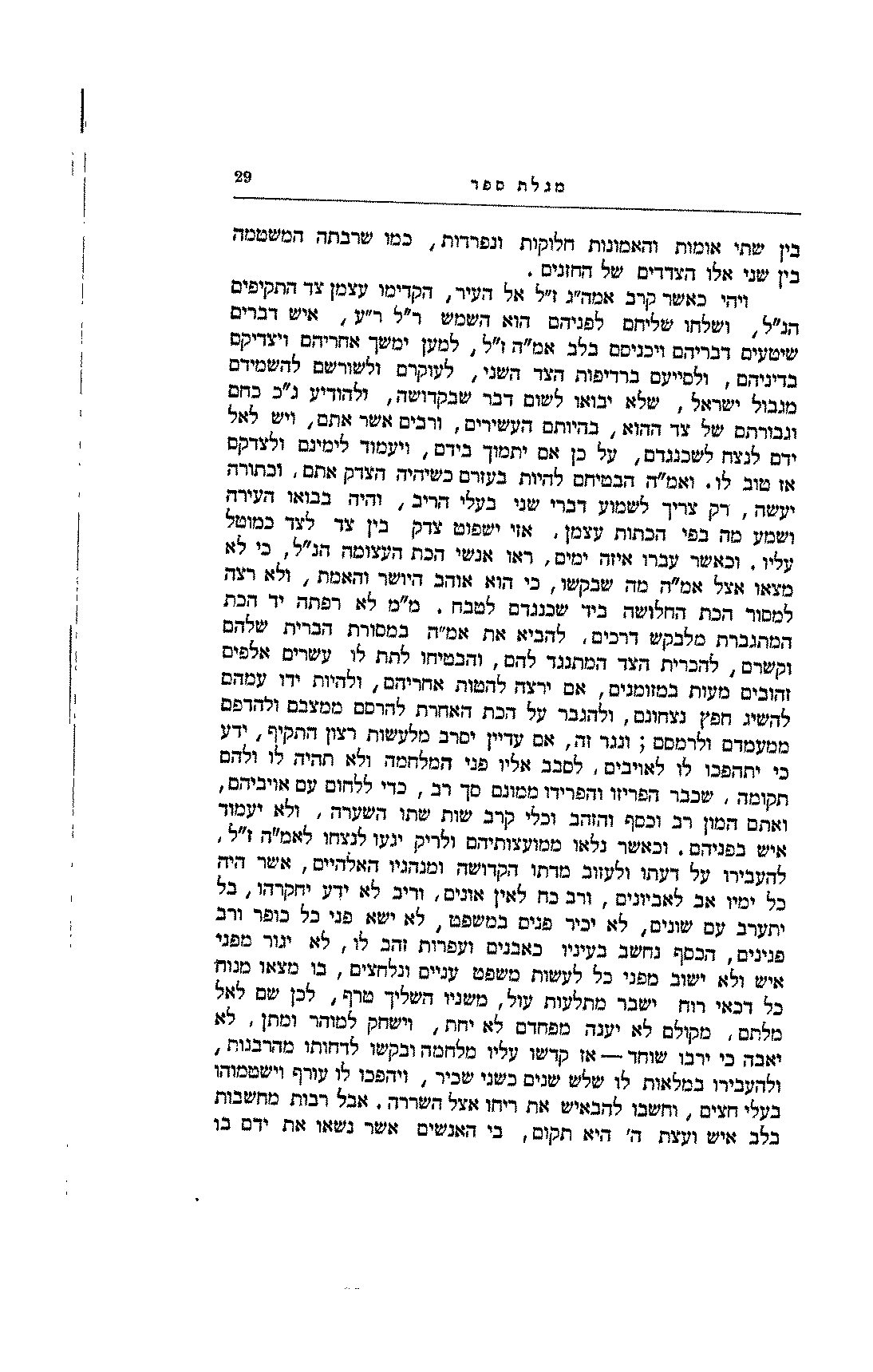
Page 30 (scan 40)
their plan turned back on their own heads. They were pushed out and removed from the offices of parnas: as they had intended to do, so it was done to them. These were three sinners of Israel: Aaron Gokkes, who raised a dog and called it by the name K.; Yuda Prinz; and Zalman Kopernam. These were the parnassim in those days, and they were removed in the middle of their term and brought down from their honour. The hand of the weak side prevailed: its case came to light before the authorities, and it defeated the rich and strong faction — for the rulers did not take bribes — and by order of the authorities three good and upright parnassim from the weak side were at once appointed in their place. And for my father his letter of appointment was confirmed in full force: all the days of his life they would not be allowed to remove him, for his name was great among the gentiles too, and his learning and his faith were proclaimed. Above all, the rich men and magnates of the Sephardi community in Amsterdam were on my father's side at that time; they were great and powerful men in the city, beloved by the councillors of the place.
So when the strength of the powerful Ashkenazi side had passed, though they sought to carry out their plot against my father with all their might and strength, they could not stand before him, for the Lord thrust them from their position, as said. Yet the opposing faction lay in wait for him like bears and wolves; the coals of quarrel and rivalry burned under the ashes, and the sword of strife did not rest. On the contrary, the enmity grew over the three parnassim, "no good for Israel", petty men, who were cut off "in one month" (Zech. 11:8), who fell from their height and were brought low, for they were removed from office in the middle of their term, as said — though it was not in their power to harm him at all, because of the great men of the Sephardi community who held to my father's stronghold.
Yet "the wicked, like the troubled sea" (Isa. 57:20), stood on watch, longing for the woeful day — "and their end as a bitter day" (Amos 8:10) — until sin brought it about, and Satan came and confounded the world: he is the evil inclination, he is the serpent, the viper, the abominable Ḥayon the Tziv'oni [the hypocrite] [a], who threw the Sephardi community into confusion together with the Ashkenazim. Then the heart of all the people was divided in two, some going to the right and some to the left. At first the whole Sephardi community was as one man with one heart towards their Father in Heaven. They were the ones who stirred up and awakened the love — "if a man would give all the substance of his house" (Song 8:7) — and they came to my father to judge the case of this hypocrite, a man of violence, and to examine his unfit and defective book, which stood like a man with a blemish (Lev. 21:18). They wished to rely on my father in particular, knowing and recognising him as a man of faith, with whom were wisdom and understanding; and they disqualified their own rabbi, R. Solomon Ayllon ⟨S: the spelling "Ayllion"⟩, at the outset [b], because he was already under suspicion in their eyes, on account of an unclean incident of the same kind
Kahana's notes
- [a] Genesis (36:2) [the name Zibeon, a pun on tzavu'a, "hypocrite"].
- [b] So he signed his name on the ruling of the Amsterdam court against Ḥakham Tzvi, in these words: "Solomon son of R. Jacob Ayllion, of blessed memory." That ruling is printed at the beginning of the book Ha-Tzad Tzvi; see there.
שבה מחשבתם בראשם, נדחו והוסרו ממינוי פרנסות, כאשר דמו לעשות נעשה להם; הם שלושה פושעי ישראל, ארון גאקיש, שהיה מגדל כלב וקורא לו שם כ', יודא פרינץ, זלמן קופרנעם, אלה הם פרנסים בימים ההם, והועברו בתוך זמנם הורדו מכבודם, וגברה יד הצד החלש, שיצא לאור משפטם אצל השררה, ונצח את כת העשירה והחזקה. כי בעלי השררה לא היו לוקחי שוחד, ועל פי השררה נתמנו מיד תחתיהם שלשה פרנסים טובים וישרים מאנשי צד החלש. ולאמ"ה ז"ל נתקיים שטר רבנות שלו בכל תוקף ועז, כל ימי חייו לא יורשו להעבירו, כי גדול שמו בגוים ג"כ, שתורתו ואמונתו מכרזת. ובפרטות עשירי עם גבירי ק"ק ספרדית שבאמשטרדאם היתה ידם עם אמ"ה ז"ל בעת ההיא, והמה תקיפים גדולים בעיר, אהובים אל שרי יועצי המקום, לכן לעת עברו כח הצד התקיף של אשכנזים, להפיק זממם נגד אמ"ה בכל כחם ואונם, ולא יכלו עמוד מפניו כי ה' הדפם ממצבם כנ"ל, אף הכת המתנגדת צודדת היתה לו כדובים וזאבים, וגחלי רתמי התגרות והתחרות בערו תחת האפר, וחרב הקטטה לא שקטה, אבל אדרבה רבה משטמה, על אודות השלשה פרנסים בלתי טובים לישראל קטני הערך שנכחדו בירח אחד, שנפל מהם ונעשו שפלי ברך, כי הוסרו ממינוים תוך זמנם כנזכר, אף אם לא היה ביכלתם להרע לו מאומה, מחמת גדולי ק"ק ספרדים שהחזיקו במעוז אמ"ה ז"ל. אף הרשעים כים נגרש, עמדו על המשמר, מתאוים ליום אנוש, ואחריתם כיום מר, עד שגרם העון, ובא שטן וערבב את העולם, הוא היצר הוא הנחש הצפעוני, התועב חיון הצבעוני, א אשר בלבל ק"ק ספרדים עם אשכנזים יחד. אז יחלק לב כל העם לשנים, מיימינים ומשמאילים; אמנם מתחלה היה כל ק"ק ספרדים כאיש אחד לב אחד לאביהם שבשמים, והם שהעירו ועוררו את האהבה, אשר אם יתן כל הון ביתו וגו', ובאו אל אמ"ה ז"ל לדון דינו של זה הצבוע, איש זרוע, ולחקור את ספרו הפסול וגרוע, עומד כחרום ושרוע, ברצותם לסמוך דווקא על אמ"ה ז"ל, בידעם והכירם אותו לאיש אמונה, עמו החכמה והתבונה, ופסלו את רבם ר"ש אאילין בראשונה, ב מפני שכבר היה נחשד בעיניהם, מחמת מקרה אחד בלתי טהור כיוצא בו,
- [א] בראשית (ל"ו, י"ב).
- [ב] כן חתם את שמו על הפסק של בית דין מאמשטרדם נגד החכם צבי, וז"ל: שלמה בן כמהור"ר יעקב אאילייון זלה"ה, והפסק דין ההוא נדפס בראש הספר הצד צבי ע"ש.
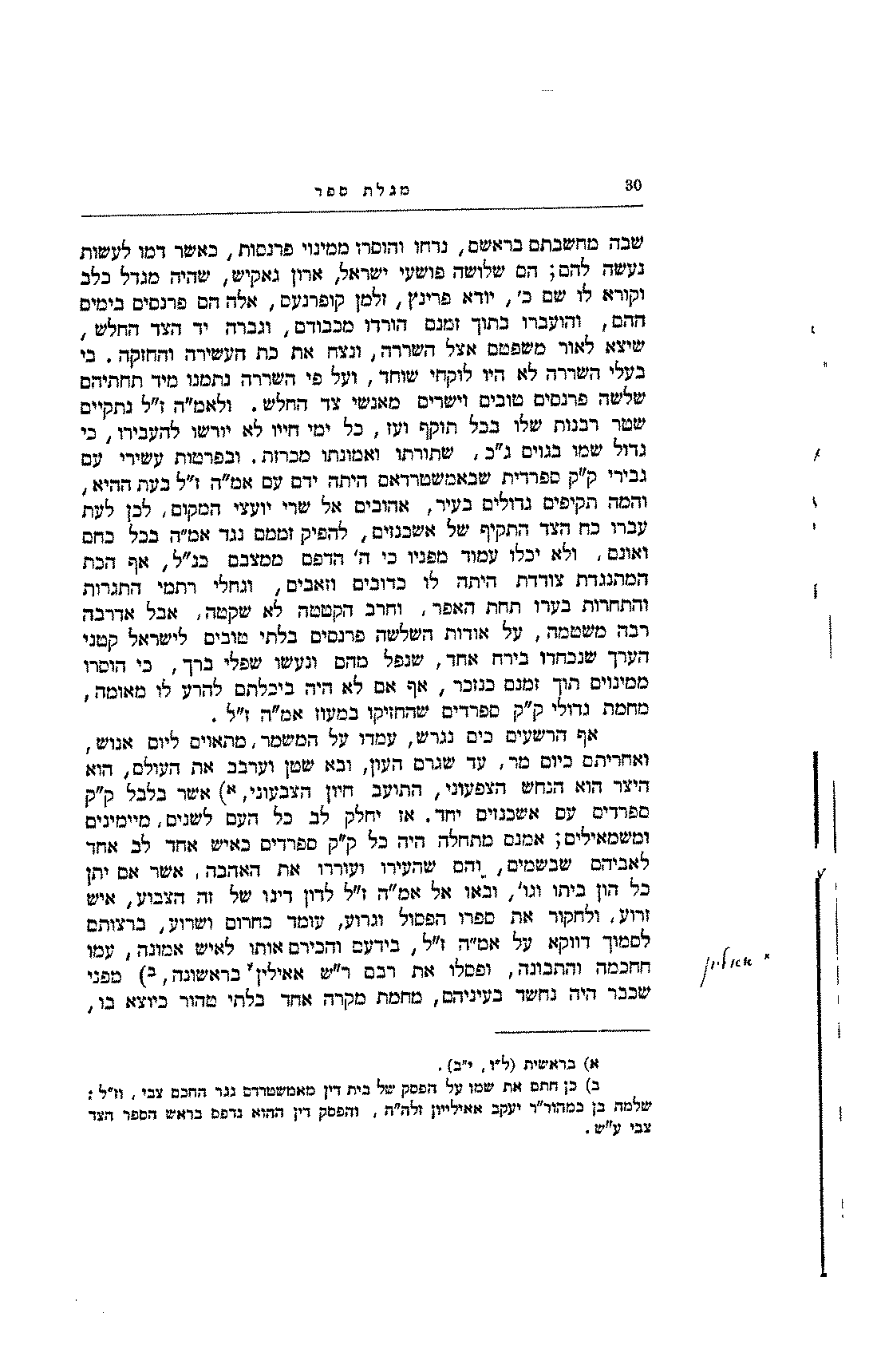
Margin readings in Scholem's copy (1)
| Printed anchor | Type (key sheet) | Mark | Reading | Certainty |
|---|---|---|---|---|
| ופסלו את רבם ר"ש אאילין x בראשונה | X: substitution | x mark; one word in right margin | אאיליון (spelling of the name Ayllon) | fairly sure |
Page 31 (scan 41)
that had come before this evil affair: the matter of the heretical writings of the heretic Cardozo, which had been brought to Amsterdam the year before the one in which Ḥayon ⟨S: "may the name of the wicked rot"⟩ came. They were written in the Spanish vernacular, and the whole mass of Jewish people murmured against them; whoever read them, the hair of his flesh stood up at the great heresy revealed in them. Their teacher mentioned above declared them fit, and said that they were good, holy and pure. But it did not help him then: the members of the Ma'amad burned them in his presence, for they all understood them, since they were written in their own script and Spanish language. From then on that false teacher was suspected in the matter — that the filth of the lying faith of Sh[abbetai] Ts[evi] ⟨S: "may the name of the wicked rot"⟩ clung to him. As is told in the books Milḥamah la-Shem and Shever Posh'im, it was made clear that he had actually been one of them in the past; and although he had already ⟨S: "afterwards"⟩ broken away from them and returned to the Jewish religion, a grudge of it remained in his heart, and "kind found kind" and woke.
So now, when this evil affair of Ḥayon ⟨S: "may his name be blotted out"⟩ arose anew, they would not rely on him at all at first, and did not trust him in a matter of faith so grave and so precious. They agreed with one voice to send to my father, to hear his opinion and follow his counsel and act by his ruling, for his name and his affairs were great among them as unique in the world in ruling for the upholding of religion. When they had done so, and handed him the book ⟨S: "the unclean"⟩ to study for a while — for it had come into their hands by a great stratagem and by force, for a short time only; see the story of the affair in the pamphlets mentioned [a] — they gave the sword into my father's hand to do judgement on that man ⟨S: "the wicked"⟩, the enemy of the Lord, who thought to lead the whole Jewish people astray with his newly invented faith, and set out to tear up the root of Israel, the tradition of the fathers. All this was made clear in all the courts of Israel, east and west; they all agreed with my father, that he had been zealous for the Lord and had executed sharp judgement on that troubler of Israel, to drive him out of the border of Israel. After the event many more of his abominations came to light: he incited, and did the deed of Balaam, and defiled the Holy Land; the earth could not hold all his words. All this has already appeared in print in several pamphlets.
But in the Sephardi community Satan danced among them at that time, and yet a very little while in their eyes. After they had taken back the said book from my father's hand, accepted his words and done a great deed by his word — expelling the abominable Ḥayon from their synagogue — they took counsel again to tear down all they had built. Their heart turned to hate my father; they turned their backs on him and would not listen to him to do judgement on that man ⟨S: "the scoundrel"⟩,
שקדם למאורע הרע הלז, בענין כתבי מינות של האפיקורוס קרדוזו, שהובאו לאמשטרדאם בשנה שלפני זו, שבא בה חיון, והיו כתובים בלעז ספרדי, ולעזה עליהם מדינה כל המון האיש הישראלי, בקרא אותם תסמר שערת בשרו מגודל האפיקורסות המתגלה בתוכם, והמורה שלהם הנ"ל הכשיר אותם, ואמר שהם טובים קדושים וטהורים, אבל לא הועיל אז, כי שרפום אנשי מעמד בפניו, שכולם היו מבינים אותם, לפי שהיו כתובים בכתבם ולשונם ספרדית. ומן אז והלאה היה מורה שקר הנ"ל חשוד על הדבר, שדבקה בו זוהמת אמונה כוזבת של ש"ץ, וכפי שמוזכר בספר „מלחמה לה", ו"שבר פושעים", נתברר שכבר היה מהם ממש לשעבר, ואע"פ שכבר נפרד מהם וחזר לדת יהודית, מ"מ נשארה [טי]נא בלבו, ומצא מין את מינו וניעור. לכן עתה בהתחדש ענין הרע הלז של חיון, לא רצו לסמוך עליו כלל מתחלה, ולא בטחו בו בדבר האמונה החמור מאד ויקר במציאות, ולכן הסכימו פה אחד, לשלוח אל אמ"ה ז"ל לשמוע דעתו, ולילך אחר עצתו לעשות כהוראתו, כי גדול שמו ועניניו אצלם כיחיד בעולם לענין ההוראה לקיום הדת. וכאשר כה עשו ומסרו בידו הספר לעיין בו זמן מה, כי בתחבולה גדולה ובכפיה בא לידם על שעה מועטת, ועיין ספור המעשה בקונטריסים הנ"ל, א ונתנו החרב ביד אמ"ה לעשות דין האיש ההוא, אויב ה', אשר חשב להדיח כללות יהודית באמונתו הבדויה החדשה, ויצא לעקור ביצתן של ישראל מסורת אבות, כאשר נתברר הכל בכל בתי דינין שבישראל ממזרח וממערב; כולם הודו לאמ"ה ז"ל, על אשר קנא קנאת ה' ועשה משפט חרוץ באותו עוכר ישראל, להרחיקו מגבול ישראל, ואחר מעשה נתגלו עוד הרבה מתועבותיו, כי הסית ועשה מעשה בלעם וממא את הארץ הקדושה, לא תכיל הארץ כל דבריו, וכבר בא כל זה בדפוס בכמה קונטריסים. אכן בק"ק ספרדים רקד השטן ביניהם בעת ההיא, ועוד בעיניהם כמעט קט. אחר שחזרו ולקחו הס' המירם הנ"ל מיד אמ"ה ז"ל, קבלו דבריו ועשו מעשה גדול על פיו, לגרש התועב חיון מבה"כ שלהם, שוב נמלכו לסתור כל מה שבנו, הפך לבם לשנוא אמ"ה ז"ל, ויפנו אליו עורף ולא אבו שמוע אליו, עשות משפט באיש ההוא,
- [א] כוונתו על ספר מלחמה לה', וספר שבר פושעים, ושם הספר של חיון נקרא: עוז לאלהים, ונדפס בשנת תע"ג בעיר ברלין בהסכמות רבנים רבים.
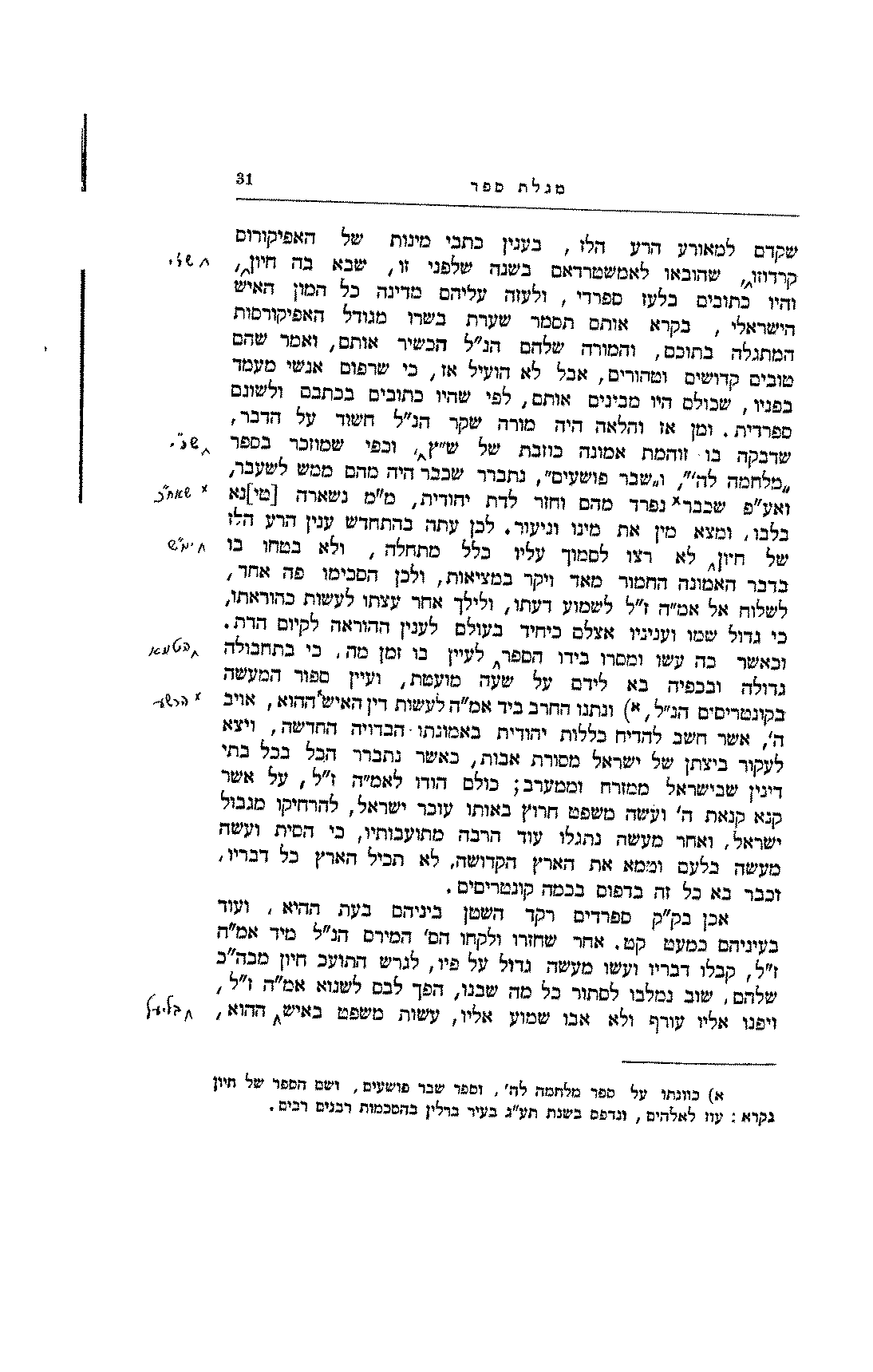
Margin readings in Scholem's copy (7)
| Printed anchor | Type (key sheet) | Mark | Reading | Certainty |
|---|---|---|---|---|
| שבא בה חיון ^, | V: omission | caret; one word in right margin (Kraken read it as a line) | שר"י | sure |
| זוהמת אמונה כוזבת של ש"ץ ^ | V: omission | caret; short note | שר"י | fairly sure |
| ואע"פ שכבר x נפרד מהם | X: substitution | x mark; one word | שאח"כ (= שאחר כך) | fairly sure |
| ענין הרע הלז של חיון ^ | V: omission | caret; one word | ימ"ש | sure |
| ומסרו בידו הספר ^ לעיין בו | V: omission | caret; one word | הטמא | fairly sure |
| לעשות דין האיש x ההוא | X: substitution | x mark; one word | הרשע | sure |
| עשות משפט באיש ^ ההוא | V: omission | caret; one word | הבליעל (Kraken: תבלידל) | fairly sure |
Page 32 (scan 42)
even after they had acted on my father's words and expelled Ḥayon ⟨S: "may the name of the wicked rot"⟩ from the synagogue in great disgrace ⟨S: "[…] treated by him as one banned and excommunicated"⟩, and banished him according to my father's ruling and decision. After this they went back on it, tore down what they had built, declared him fit to enter their congregation, and did him great honour.
The main cause was this. Their teacher mentioned above, who was bound and tied to Ḥayon and did his deeds in the dark in one counsel with him, went to each of the parnassim of the Ma'amad at his home, threw himself at their feet, wept and implored them, saying: Even if he ⟨S: "if"⟩ was a sinner and guilty, should they not have pity on his honour, which was their own honour? Where would they carry their shame, where take their disgrace — to confirm the suspicion and rumour about him that he was of the sect of Sh[abbetai] Ts[evi] ⟨S: "may the name of the wicked rot"⟩, and to raise the standing of the rabbi of the Ashkenazim above the sage of the Sephardim — they who claim superiority and eminence over the Ashkenazim?
For since the community was founded, the Ashkenazim had been lowly and subordinate to the Sephardi community in Amsterdam, the Sephardim being the majority in building and in number, in wealth and honour, lineage and greatness. They also have priority in time. For it was through the Spanish anusim who fled from Spain and settled in Amsterdam — almost ⟨S: "a little"⟩ when the country of Holland became free in its own right, having thrown off the yoke of the king of Spain, and all the inhabitants of the land became free men and gave permission to people of all different faiths and religions to settle among them — that the anusim of Spain first found rest there, through a Jew from Emden who brought them there to Amsterdam, circumcised them and taught them the Jewish religion. After them Jews from the German lands also were drawn there and settled in the city. So the Ashkenazim left them their honour, to give them precedence in everything — above all because of the wealth of the first Sephardim who came to live in Holland, for they had been among the great men of the kingdom in Spain, and they brought their silver and gold with them, very great riches; so they were esteemed and honoured by the authorities. The Ashkenazim who came there at first were lowly beside them, being of small account in wealth and greatness in those days. "And now terrors are turned upon them" (Job 30:15): the order has changed — the lowest on top and the highest below.
So and so that man spoke, and he stole their heart, which at first had been whole with the Lord, with the smoothness of a foreign tongue and the flattery of mocking parasites, to turn their minds after him. He said to them: "Although the law is not so, the hour requires it" — to cover their honour and the honour of their first-founded community, not to accept the decree of the ruling of the rabbi of the Ashkenazim, and to regret what they had done at first lawfully and properly, without showing favour in Torah. By weeping, entreaties, pleas, prostrations and wiles, by deceit, by soft words and smooth lips, he led them astray, deceived them and prevailed over them: to go back and tear down the building of their first counsel, and to repent of the good. Their feet sank in the mire, and "a soft tongue breaks the bone" (Prov. 25:15) of their virtue, so that they agreed to do this thing,
ואחר שכבר עשו מעשה כדברי אמ"ה ז"ל, ודחו לחיון, מבה"כ בבזיון גדול, והרחיקו אותו כפסקו והוראתו של אמ"ה, אחר זאת חזרו בהם וסתרו בניינם והכשירוהו לבוא בקהלם, ועשו לו כבוד גדול. ועיקר הסבה מחמת שהלך המורה שלהם הנ"ל, שהיה אחוז וקשור בחיון, ועשה במחשך מעשיו בעצה אחת, בא אצל כל אחד מפרנסי המעמד לביתו, והתנפל לרגליהם, בכה והתחנן להם, באמור אליהם: אף הוא חוטא ואשם, והלא יש להם לחום על כבודו שהוא כבודם, ואנה ישאו חרפתם, איה יוליכו כלימתם, לקיים החשד והלעז שעליו היותו מכת ש"ץ, ולהגדיל איפת מעלת רב האשכנזים על חכם הספרדים, והטוענים שיש להם יתר שאת ומעלה על אשכנזים: מאז הוסדה הקהלה היו האשכנזים ירודים ומוכנעים תחת ק' ספרדים שבאמשטרדאם, בהיותם רוב בנין ורוב מנין בעושר גם כבוד יחם וגדולה, גם יש להם דין קדימה בזמן, כי ע"י הספרדים האנוסים, הנמלטים מארץ שפניא שקבעו דירתם באמשטרדאם, כמעט שנעשית מדינת הולאנד חפשית לעצמה, כי פרקה מעל צווארה עול מלך ספרד, ונעשו כל יושבי הארץ בני חורין, ונתנו רשות לכל אנשי אמונות ודתות שונות להתישב בתוכם; ששם מצאו להם מנוח אנוסי ספרד בתחלה, ע"י איש יהודי מעמדין שהביאם שם לאמשטרדאם, ומל אותם והורה להם דת יהודית; אחריהם נמשכו גם היהודים מארץ אשכנז ונתיישבו בעיר. לכן הניחו להם כבודם להקדימם בכל דבר, ביחוד מחמת עשרם של הספרדים הראשונים, הבאים לגור בארץ הולאנד, כי היו מגדולי המלכות בספרד, והביאו כספם וזהבם אתם, עשירות גדולה מאד, לפיכך היו חשובים ומכובדים אצל השררה. והאשכנזים שבאו לשם מתחלתם שפלים כנגדם, בהיותם קטני הערך בענין העושר והגדולה בימים ההם - ועתה ההפך עליהם בלהות נתחלפה השטה, תחתונים למעלה ועליונים למטה. וכזה וכזה דבר האיש ההוא, וגנב לבבם אשר היה שלם עם ה' מתחלה בחלקת לשון נכריה ובחנפי לעגי מעוג, להטות דעתם אחריו, באמור להם: אע"פ שאין הדין כך, השעה צריכה לכך, לחפות על כבודם וכבוד קהלתם הראשית, שלא לקבל עליהם גזרת הפסק של רב האשכנזים, ולהתחרט על מה שעשו בראשונה כדין וכשורה, שלא לישא פנים בתורה עתה; ע"י בכיות תחנות ובקשות והתנפלות והתנכלות בגנבת דעת, ע"י רכות אמרים וחלקת שפתים הדיחם השיאם ויכול להם, לשוב לסתור בנין עצתם הראשונה, על הטובה להנחם, הטבעו בבוץ רגליהם ולשון רכה תשבר גרם המעלות, שהסכימו לעשות כדבר הזה,
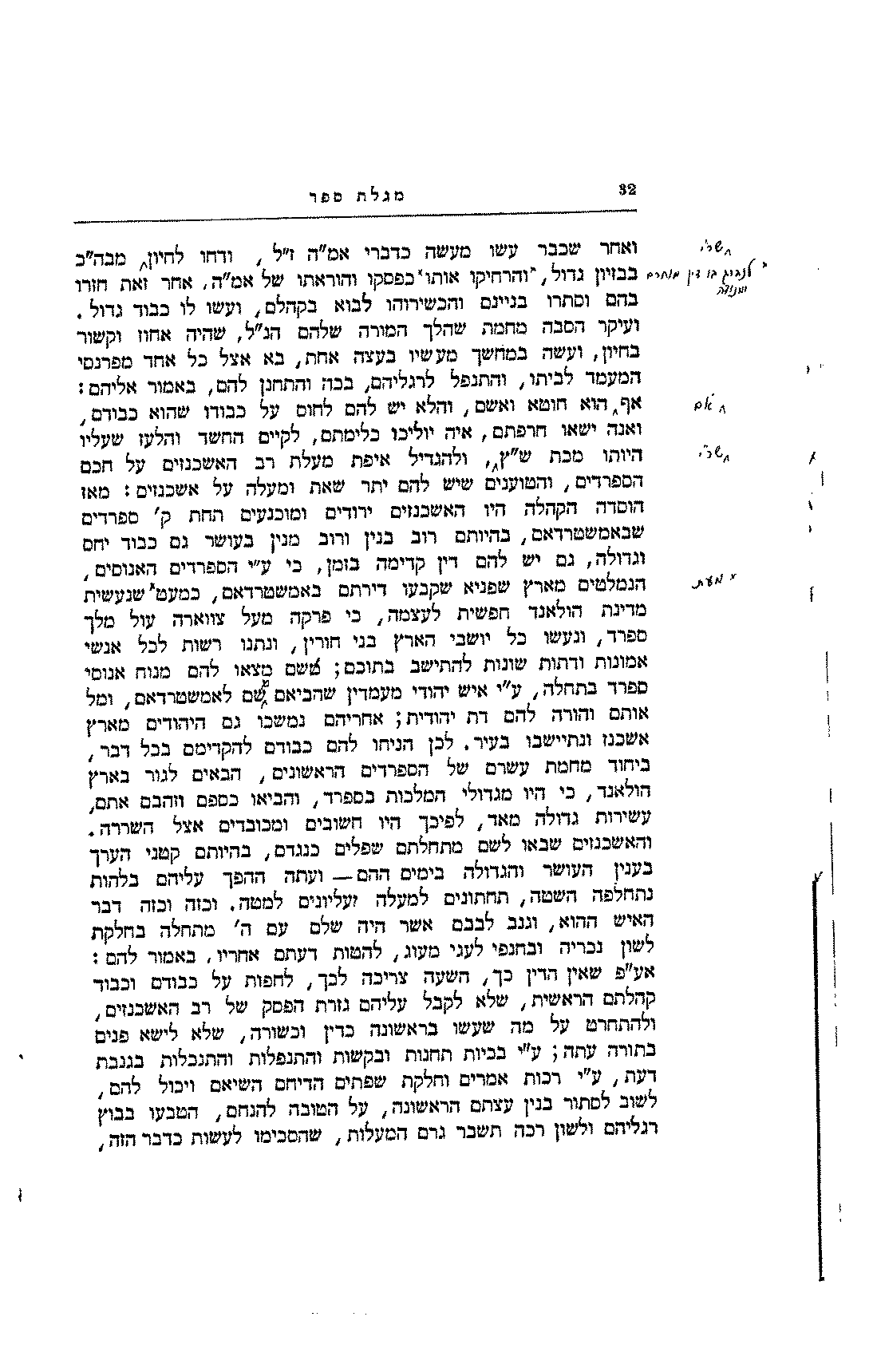
Margin readings in Scholem's copy (5)
| Printed anchor | Type (key sheet) | Mark | Reading | Certainty |
|---|---|---|---|---|
| ודחו לחיון ^ מבה"כ | V: omission | caret; short note | שר"י | fairly sure |
| בבזיון גדול x והרחיקו אותו | X: substitution | x mark; 2-line note | [...]נהוג בו דין מוחרם / ומנודה (start cut at the page edge) | fairly sure |
| אף ^ הוא חוטא ואשם | V: omission | caret; short note | אם | fairly sure |
| היותו מכת ש"ץ ^ | V: omission | caret; short note | שר"י | fairly sure |
| כמעט x שנעשית מדינת הולאנד | X: substitution | x mark; one word | מעט | fairly sure |
Page 33 (scan 43)
which ought not to be done in Israel. By enticement he compelled them; and the wisdom of a false statecraft, which they call "politics", was what incited them to turn back to falsehood ⟨S: perhaps "silence"⟩ in their faith, catching them in the net of error so as to defeat them. The account of what happened in all this — the stratagems, the weapons of many strange kinds, the bitter lies ⟨S: "despicable"⟩ that were made and came about in the matter — is already known and heard among those still living, who remember well the events of that hard affair, which is not yet fifty years old. It was also published in several works and pamphlets printed on it at the time of that heavy war, which lasted about a whole year; above all the man famous by the name of Ḥakham Ḥagiz, of blessed memory, who was the first to enter this fight, set it in print and laid out the story in the pamphlets Milḥamah la-Shem and Shever Posh'im, and others. It is too heavy for me to set out all those details and put them into this book of mine here; they would fill many sheets and still not be finished. Besides, later troubles make one forget the first, and "sufficient to the trouble is its hour". (Even our own affair, the very one that roused me to put this scroll into writing — to give a memorial of the wonders and kindnesses of the Blessed One, new and old; "the father to the children shall make known Your truth" (Isa. 38:19), and all that happened to the fathers happened to the sons — even that we cannot write in full, in all its details and all its laws.) So I will not deal with this, which is now more than forty years past [a].
Also, I was young in knowledge at that time — though I had begun to blossom like the young priests who would split the skull of a stranger who served [in the Temple], and like the young Levites I raised my voice, the voice of Jacob, and put my hand and finger between the strings — to set down in a book a memorial of that affair without turning right or left. Only the essence, the centre around which the poles of this delicate and tender scroll of mine turn, have I set before you, beloved reader, in truth and in faith, because it is so well known: to save you from the pitfalls of stumbling and to give you a blessing today; and to know and make known that as it happened to my father, so it happened to me in the affair of Eybeschütz ⟨S: perhaps "the abominable …" (cut off)⟩ — truly like for like; what happened to the father happened to the son. At first the people of the Three Communities handed him over to me, to make known his judgement and the nature of his amulets; afterwards the side that prevailed by falsehood repented of it, with the evil weapons mentioned above, which they used in our affair too, twice over and more. It would not be believed if it were told that its like had ever happened: with lies and deceit they kicked at me, denied the Blessed One and profaned His honour, and exchanged His honour for the honour of flesh and blood, "whose breath
Kahana's notes
- [a] He means that forty years had passed since the works of R. Moses Ḥagiz were printed. This does not contradict what he said before, "fifty years", for there he meant the affair as a whole.
אשר לא יעשה בישראל; בפיתוי הכריחם ודעת הנהגה מדינית שקרית שקורין פוליטיקא היא שהסיתה אותם להיותם נסוגים אחור לשקר באמונתם, לכדם ברשת הטעייה לנצחם. פרשת הדברים שאירעו בכל זה, ותחבולות, וכלים מכלים שונים ומשונים שקרים מרים שנעשו ונתהוו בענין כבר נודעו ונשמעו בין החיים עדנה, וזוכרים היטב עניני המאורע הקשה ההוא, שעדיין לא נתיישן חמשים שנה; גם נתפרסם בכמה חבורים וקונטריסים, שנדפסו על זאת בעת המלחמה הכבדה ההיא, שנמשכה כמו שנה תמימה; וביחוד קבעם בדפוס המפורסם בשמו חכם חגיז ע"ה, הנכנס בתגר הזה ראשונה, והציע ספורי המעשה בקונטרס „מלחמה לה“, ו„שבר פושעים", וזולת; וכבד עלי להציג כל הפרטים ההם, ולהעלותם על ספרי זה הנה, יכילו כמה יריעות והמה לא יכלו. גם צרות אחרונות משכחות את הראשונות, ודיה לצרה בשעתה (ואפי' המאורע הלז שלנו בעצם אשר עוררני להעלות על ספר מגלה זו, לתת זכר לנפלאותיו של הי"ת וחסדיו, חדשים עם ישנים, אב לבנים יודיע על אמתו, וכל מה שאירע לאבות אירע לבנים, אין אנו מספיקים לכתבו כולו, בכל פרטיו לכל משפטיו, ולכן לא אטפל בזה שכבר עבר יותר מארבעים שנה א. וגם כי קטון בדעת הייתי באותה שעה, עם שהתחלתי לפרוח כפרחי כהונה, המפציעים מוחו של זר שישמש, וכצעירי הלוים הרימותי קולי קול יעקב, ונתתי ידי ואצבעי בין הנימין, להעלות זכרון בספר מעין המאורע ההוא, בלי להטות ימין ושמאל, רק העיקר והמרכז שעליו יסובו קוטבי מגלתי זאת הענוגה והרכה הצגתי לפניך קורא אהוב באמת ובאמונה לרוב פרסומו, למען הציל אותך ממהמורות המכשלות, ולתת לך היום ברכה, ולידע ולהודיע כי כמקרה אמ"ה ז"ל גם ככה קרני במקרה של אייבשיץ, ממש דומה בדומה, מה שאירע לאב אירע לבן: שמתחלה מסרוהו בידי אנשי ג"ק להודיעם משפטו וטיב קמיעותיו, אחר כך נחמו על זה הצד המתגבר בשקר, ובכלים רעים הנ"ל שנשתמשו בהם גם במאורע שלנו כפלי כפלים, לא יאומן כי יסופר שאירע מעולם דוגמתו, בכחש ובכזב, ובעטו בי, כחשו ב"ה ויחללו כבודו, וימירו כבודם מפני כבוד בשר ודם, אשר נשמה
- [א] כוונתו שעברו ארבעים שנה מן העת שנדפסו החבורים של מהר"ם חגיז, ואין בזה סתירה למה שאמר מקודם חמשים שנה, כי שם כוונתו על ענין המאורע בכלל
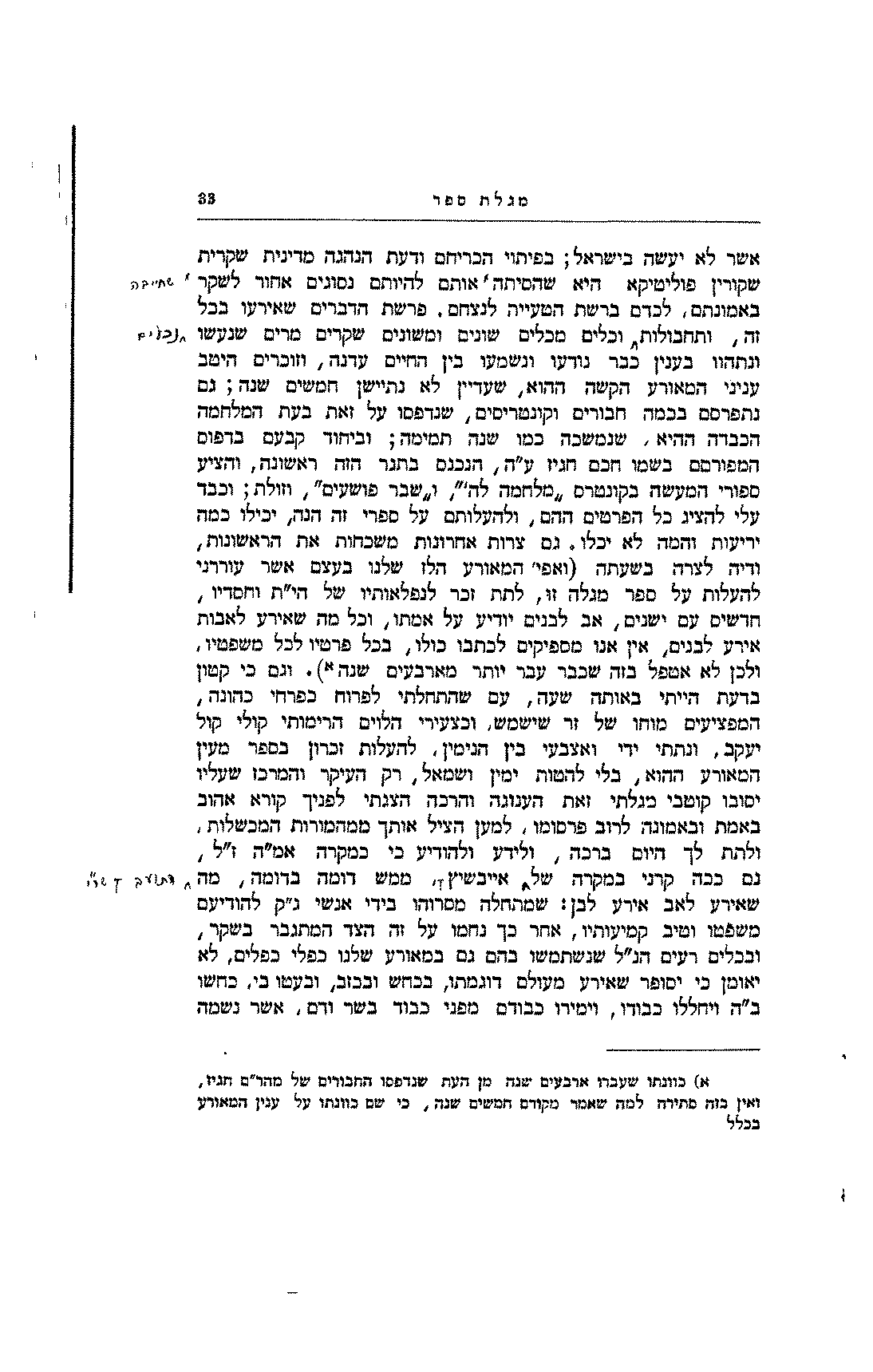
Margin readings in Scholem's copy (3)
| Printed anchor | Type (key sheet) | Mark | Reading | Certainty |
|---|---|---|---|---|
| להיותם נסוגים אחור לשקר ^ באמונתם | V: omission | caret; one word in right margin | שתיקה(?) | uncertain |
| שקרים מרים שנעשו ^ | V: omission | caret; one word | נבזים | fairly sure |
| במקרה של ^ אייבשיץ | V: omission | caret; note in right margin | התועב(?) ... (cut at the page edge) | uncertain |
Page 34 (scan 44)
is in his nostrils" (Isa. 2:22), "who tears himself in his anger" (Job 18:4), and is a man only in bodily form. In their folly their hand found a reed pen to cover me with things that are not so, without shame, in their brazenness against the Lord and their presumption. Later, though, the prominent ones among them thought again and recognised their bad ways, and lamented that they had sunk in the mire of folly and blindness up to the crown of their heads; and some of them returned to the Lord with all their heart and might, as I will write with God's help.
Let us return to where we were. The Sephardim wanted to win at all costs and to achieve their wish of covering their shame. When they saw that they could not force my father to turn from his opinion, for all their enticements and threats, they brought him to judgement before the gentile courts and asked them to judge this case, to see who was in the right. Woe to the eyes that see such things and the ears that hear them — how far the love of victory had prevailed in these men, who had grown up in the customs of the nations ⟨S: perhaps "the great"⟩, to hand over the religion of the faith to the councils of gentiles, that they should judge between the Jews and decide with which of the two factions the law lay. (Eybeschütz ⟨S: "the abominable"; and "may the name of the wicked rot"⟩ did the same, and much worse: he called on gentile ⟨S: "uncircumcised"⟩ professors from several places to testify about us to His Majesty ⟨S: perhaps "which you received"⟩ that he was in the right in his case. So it was actually done, and they set their words in print; and one of them wrote to the king that he knew for certain ⟨S: "what they do not believe …" (cut off)⟩ that the said man was a complete Christian, as was also his master Ḥayon ⟨S: perhaps "the accursed"⟩, his heart whole in their faith according to the Zohar [a]; therefore His Majesty was bound to save him from his persecutor on account of his faith, and ought to persecute them for opposing him, hindering him and preventing him from defending himself.)
So when my father saw their stiff necks — that even the Sephardim, his friends at first, had rebelled against him and grown so brazen that the opposing faction of the Ashkenazim mentioned above joined them, rejoicing at calamity: "the mouse and the cat made a feast on the fat of the unlucky kid" — he feared that the name of Heaven would be profaned, that he would be forced to show in a printed book, by an author who was called a Sage of Israel and carried approbations from the great sages of the generation, strange and bitter things against the faith of Israel ⟨S: "(in it, too, were found things that hold the Christian faith outright, God save us)"⟩. So he turned from there and left his place of honour. He uprooted his home with all his household, whom he sent ahead of him to the nearby holy community of Emden ⟨S: probably the same note⟩. We crossed by sea in a ship — our mother the rebbetzin, of blessed memory, and her young children — in the middle of the winter days; and he travelled to London, at the request and urging of the Sephardi magnates of London, who wished to see him and enjoy his splendour and glory (before he moved from that country and travelled to the land of Poland, as he had decided. From then on the burden of the war began to rise
Kahana's notes
- [a] The abbreviation means "according to the book of the Zohar". The one who wrote this to the king was Prof. David Megerlin of Frankfurt am Main (see Edut be-Ya'akov, fol. 19b).
באפו, טורף נפשו ואינו רק בצורה חומרית אדם, ובטפשותם מצאו כקן קולמוסא ידם, לחפות עלי דברים אשר לא כן בלי בושה בהצותם על ה' ובהזידם, אף שוב נמלכו הרשומים שבהם, והכירו דרכיהם הבלתי טובים, והתאוננו על שנשקעו בטיט הכסלות והעורות עד קדקדם, וקצתן שבו אל ה' בכל לבבם ומאודם, וכמש"ל בס"ד. נשוב למקום שהיינו. כי הספרדים ברצותם לנצח על כל פנים, ולהשיג חפצם בכסוי קלונם, ולהמיר קלון בכבוד קונם, ובראותם כי לא יכלו לכוף את אמ"ה ז"ל, להחזירו מדעתו בכל הפיתויים והגוזמות, הגישוהו אל המשפט בערכאות, ובקשו מהם, שהם ידינו דין זה לראות מי הצדיק, אוי לעינים שכך רואות ואזנים שכך שומעות, עד כמה גברה אהבת הנצחון באנשים האלה, אשר גדלו בנימוסי הא"י', למסור דת האמונה ביד אגוריאות של נכרים, המה ישפטו בין היהודים ויכריעו ויפסקו הדין עם מי משני הכתות (כזה וכזה עשה ג"כ אייבשיץ, וגרוע הרבה מאד, כי קרא לפרופעסארס של נכרים מכמה מקומות, להעיד עלינו אל המיר"ה, שהוא הצדיק בדינו, וכן עשה בפועל, וקבעו דבריהם בדפוס, ואחד מהם כתב למלך שהוא יודע ודאי בהנ"ל, היותו נוצרי גמור כמו שהיה ג"כ חיון רבו לבו שלם באמונתם עפס"ה א, לכן מחוייבת המיר"ה להצילו מיד רודפו, על אודות האמונה שלו, וצריך שירדוף אותן על היותם מתנגדים לו לעכבו ולמנעו מהתנצ ח. לכן בראות אמ"ה ז"ל קושי ערפם, ושגם הספרדים אוהביו מתחלה מרדו בו, והעיזו פניהם כל כך שנלוו עליהם גם הכת המתנגדת של האשכנזים הנ"ל שהיו שמחים לאיד: עכברא ושונרא עבדו הילולא מתרבא דביש גדיא; ונתיירא שלא יתחלל שם שמים, שיהיה מוכרח להראות בספר נדפס ממחבר שנקרא בשם חכם ישראל, עם הסכמות מחכמים גדולי הדור, דברים זרים ומרים באמונת ישראל; לפיכך פנה משם עזב מקום כבודו, ועקר דירתו עם כל בני ביתו, ששלחם לפניו אל ק"ק עמדן הסמוכה. ועברנו דרך ים כה בספינה, אמנו הרבנות ע"ה וילדיה הרכים באמצע ימי החורף, והוא ז"ל נסע ללונדון, על פי בקשת והפצרת הגבירים אנשי ספרדים מלונדון, שהיו חפצים לראותו וליהנות מזיוו והדרו (בטרם יעתיק מאותה מדינה וליסע אל ארץ פולין, כאשר הסכימה דעתו, מן אז החלה לעלות
- [א] ר"ת: על פי ספר הזוהר, ומי שכתב זאת למלך הוא הפראפ' דויט מעגרלין מפד"מ (עיין בס' עדות ביעקב דף י"ט ע"ב).
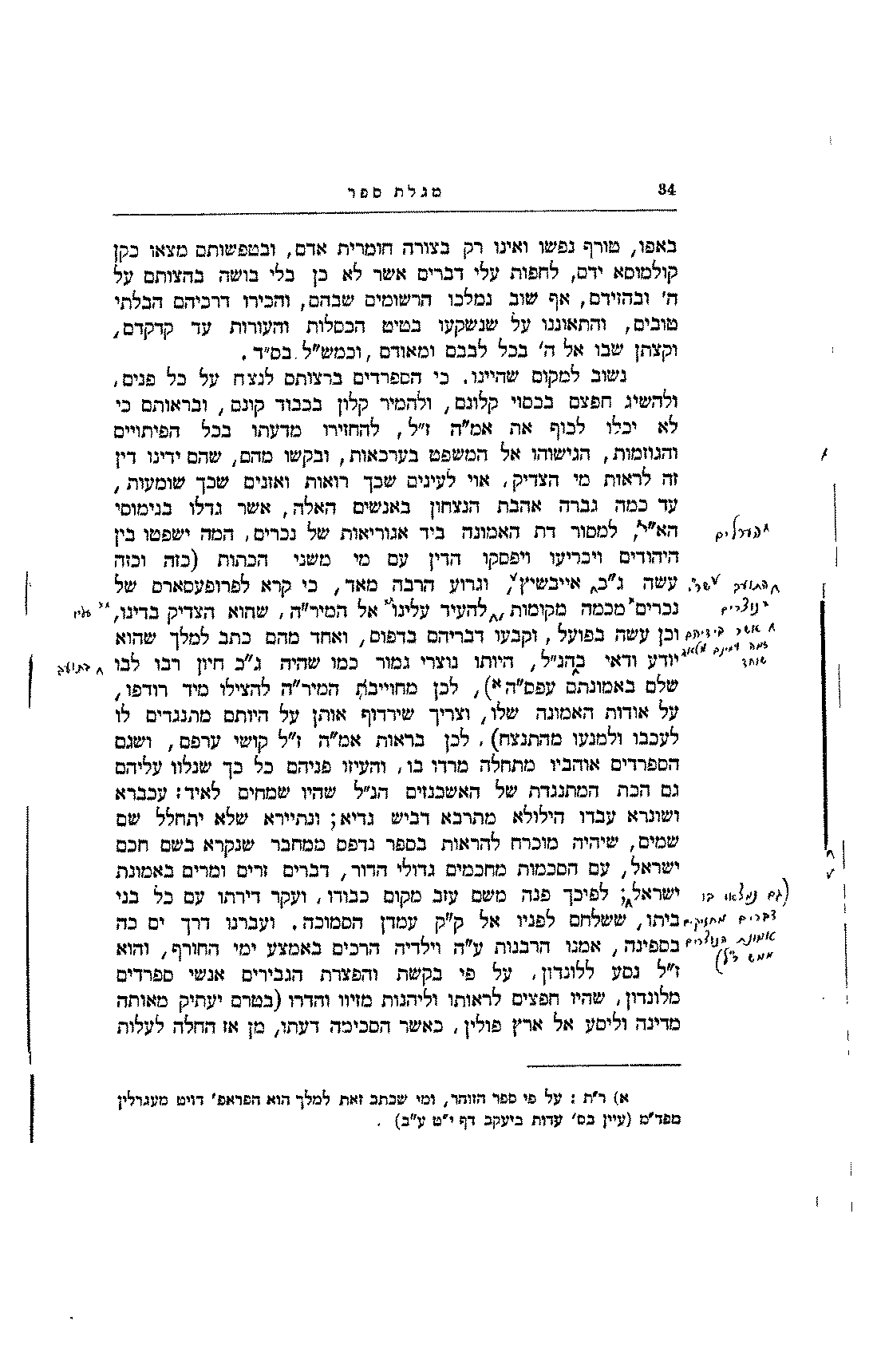
Margin readings in Scholem's copy (8)
| Printed anchor | Type (key sheet) | Mark | Reading | Certainty |
|---|---|---|---|---|
| אשר גדלו בנימוסי ^ הא"ה | V: omission | caret; one word | הגדולים(?) | uncertain |
| (כזה וכזה ^ עשה ג"כ אייבשיץ | V: omission | caret; short note | התועב; and a v after אייבשיץ: שר"י | fairly sure |
| כי קרא לפרופעסארס של ^ נכרים | V: omission | caret; one word | ערלים | sure |
| להעיד עלינו ^ אל המיר"ה | V: omission | caret; note | אשר קיבלתם(?) | uncertain |
| ואחד מהם כתב למלך שהוא ^ יודע | V: omission | caret; 3-line note | מה שאינם מאמ[ינים ...] / שותו(?) (cut at the page edge) | partial |
| כמו שהיה ג"כ חיון רבו ^ לבו שלם | V: omission | caret; one word | הארור(?) | uncertain |
| דברים זרים ומרים באמונת ^ ישראל | V: omission | caret; 2-3 word note | (גם נמצאו בו / דברים מחזיקים(?) / אמונת הנוצרים / ממש ר"ל) | fairly sure |
| ששלחם לפניו אל ק"ק עמדן הסמוכה | — | 3-line note in right margin | probably the same note as the previous row (NLI shows one note here) | uncertain |
Page 35 (scan 45)
and the enmity grew), for his name and his good report were very great among them, even from the time when he was rosh yeshivah and rabbi in the Kloyz of Altona.
For it happened then that Ḥakham Nieto, head of the court of the Sephardim in London, preached a sermon on Nature, that it is the Blessed One Himself. Strife arose against him over this, for there too there were two divided and separate sides; the men of one side were enemies of Ḥakham Nieto and lay in wait to find in him some sin of heresy, God forbid. They made a scandal and an uproar in their congregation over the sermon, and they agreed to write to my father that he should judge and decide between them, and whatever he decreed would stand. So they did. He "filled his hands to the Lord" and wrote them a responsum and ruling on the matter; it is in his book, § 18 [a]. When his lofty responsum came out in print, also in the Spanish vernacular ⟨S: a five-line note, read: "in London they rejoiced(?) …, for then the two sides were reconciled in love, and in London(?) the responsum was published"⟩, all this people came to its place in peace.
The men of the Ma'amad of the Sephardi congregation in London wanted to receive him as rabbi and head of the court over them, and promised him a large salary — "ask me never so much dowry and gift" (Gen. 34:12): they fixed for him five hundred pounds from the community chest, and for another fifty pounds they would stand surety, so that his income would come to at least a thousand pounds sterling a year — in the hope that he would agree. He did not accept ⟨S: a ten-line note, partly read: "to my father, his salary in full, but he would not accept …, for they held him in great love and affection …, for the Sephardi community of London wanted [him]"⟩, for he said: "I am an Ashkenazi, and I want my children and descendants to stay raised and guided in the ways of the Ashkenazim." He feared that his sons and daughters would learn the ways of the people of the lands across the sea, God forbid; so he held back from it, and remained rosh yeshivah in the Kloyz of Altona, from which he had no income but sixty Reichstaler a year, until the death of his father-in-law, the old rabbi, head of the court of the Three Communities.
The Sephardi community of Livorno also called him to be their head and leader, and fixed a very large salary for him; and he did not listen to them either, for the same reason. The spirit of the ruler did not rise against him, and he did not leave his place (Eccl. 10:4). Silver and gold did not turn his heart a hair's breadth to leave his godly way; he chose the keeping of the commandments of the Torah of his God, for himself and his descendants, that they should not stumble in the customs of those lands, above thousands of gold and silver (Ps. 119:72).
Let us return to the matter. Because of this and the like (he also did [kindness] ⟨S: "good"⟩ for the Ashkenazi community in London, where a quarrel had arisen over a bill of divorce given there: because of a light word that R. Mordecai Hamburger [b] had said, those who hated him without cause wanted to swallow him alive for nothing, and my father saved him from two lions, to both of whom he had almost been prey; the whole affair is told in a pamphlet called Ma'aseh Rav) — they remembered his kindness; old love does not rust. And when they heard all that was done to him
Kahana's notes
- [a] That is his book of responsa, Ḥakham Tzvi; see there. R. David Nieto wrote the book Matteh Dan, which is like a second part of the Kuzari and has been printed many times.
- [b] See what Emden tells below (p. 76).
משאת המלחמה ורבה משטמ ה, כי גדול מאד שמו ושמעו הטוב אצלם, גם מאז בהיותו ר"י ורב בקלויז דאלטונא. כי אירע אז שדרש חכם ניטו האב"ד של ספרדים שבלונדון דרוש על ענין הטבע שהוא הי"ת בעצמו, ועל דבר זה נתעוררו עליו מדנים, לפי שהיו שם ג"כ שני צדדים חולקים ונפרדים, שאנשי הצד האחד היו לו אויבים לחכם ניטו, ואורבים למצא לו עון אשר חטא מינות ח"ו, ועשו שערוריה ורעש בקהלם על אודות הדרשה הנ"ל, ונתרצו לכתוב לאמ"ה שידין ויכריע ביניהם, וכאשר יגזור אומר כן יקום, וכן עשו, והוא ז"ל מלא ידיו לה', וכתב אליהם תשובה ופס"ד על זה הענין, הלא הוא בספרו סימן י"ח א, ובבוא דבר תשובתו הרמתה בדפוס גם בלעז ספרדי, באופן שכל העם הזה על מקומו יבוא בשלום. ורצו אנשי מעמד דקהל ספרדים בלונדון לקבלו לרב והאב"ד עליהם, ונדרו לו שכר גדול, הרבו עליהם מוהר ומתן, קצבו לו חמש מאות לטרין מקופת הקהל, ובעד חמשין לטרין אחרים רצו להיות ערבים בדבר, באופן שתעלה הכנסתו לפחות אלף לטרין שטערלינג לשנה, אולי יתרצה להם, ולא קבל עליו, כי אמר אשכנזי אנכי, ורוצה שישאר זרעי וי"ח גדלים ומונהגים בדרכי אשכנזים. והיה ירא שלא ילמדו בניו ובנותיו דרכי בני מדינת הים ח"ו, לכן נמנע מזה, ונשאר ר"י בקלויז דאלטונא, שלא היה לו ממנה הכנסה רק ששים ר"ט לשנה, עד מות חמיו הרב הזקן אב"ד דג"ק. וכן קראוהו גם קהל ספרדים דליגורנא להיות להם לראש ולקצין, וקבעו לו שכר גדול מאד, ולא שמע אליהם ג"כ מטעם הנ"ל. רוח המושל לא עלה עליו, מקומו לא הניח, הכסף והזהב לא הטו את לבבו כמלא נימא לעזוב מדתו האלהית, בבחרו שמירת קיום מצות תורת אלהיו לו ולזרעו, שלא יכשלו במנהגי הארצות ההם, מאלפי זהב וכסף. נשוב לענין. כי בגלל הדבר הזה וכיוצא בו (עשה ]חסד[לק"ק אשכנזים שבלונדון, שנולדה שם ג"כ מריבה על אודות גט הנתן שם, שבשביל דבור קל שאמר כי מרדכי המבורגר ב רצו שונאיו חנם לבלעו חיים על לא דבר, ואמ"ה הצילו משני אריות, אשר כמעט היה טרף לשניהם, ונזכר כל המאורע בקונטרס נקרא "מעשה רב") זכרו לו החסד, אהבה ישנה לא העלתה חלודה, וכשמעם כל הנעשה עמו
- [א] הוא ספרו שו"ת חכם צבי ע"ש, ור' דוד ניטו חבר ספר "מטה דן" שהוא ככוזרי חלק שני ונדפס הרבה פעמים.
- [ב] עיין מה שהגיד יעב"ץ להלן (צד 76).
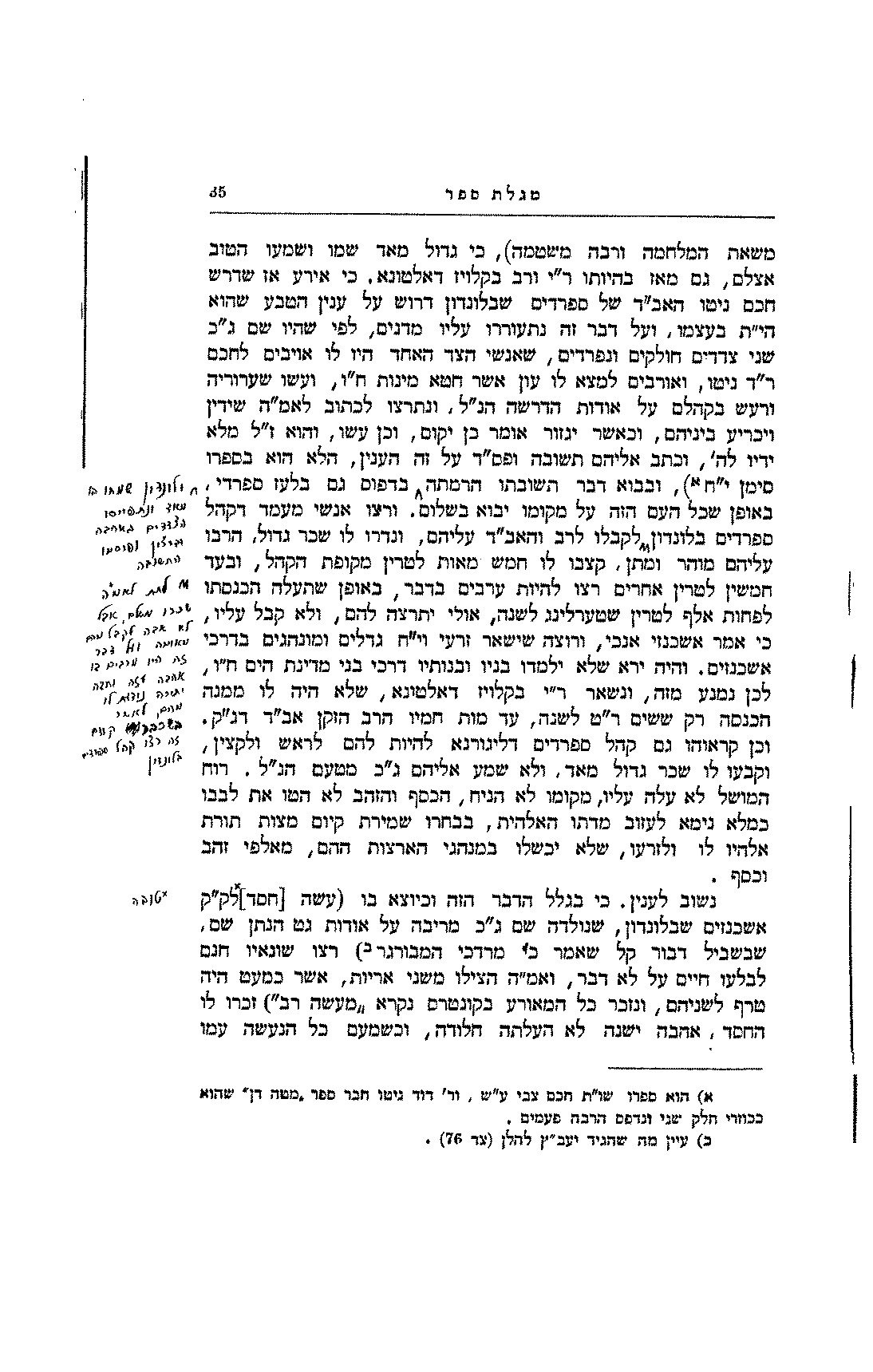
Margin readings in Scholem's copy (3)
| Printed anchor | Type (key sheet) | Mark | Reading | Certainty |
|---|---|---|---|---|
| בדפוס גם בלעז ספרדי ^, באופן | V: omission | caret; 5-line note in right margin (Kraken fragments: שאז ונתפייסו / הצדדים באחדה / ופרסמו / התשובה) | בלונדון שמחו(?) ... / שאז ונתפייסו / הצדדים באהבה / ובלונדון(?) נפרסמו / התשובה | fairly sure |
| ולא קבל עליו ^, כי אמר אשכנזי אנכי | V: omission | caret; 10-line note in right margin (Kraken fragments: שכרו משם אבל / לא אבה לקבל / היו ... בו / אהבה וחבה / יתירה נודעת לו / מהם, באשר ... / ספרדי / לונדון) | לאמ"ה / שכרו משלם, אבל / לא אבה לקבל מה / שאומה(?) ... / כי היו מקובים(?) בו / אהבה וחבה / יתירה נודעת לו / מהם, לאמר / בשכבר(?) קודם / כי רצו קהל ספרדי / בלונדון | partial |
| (עשה [חסד] לק"ק | X: substitution | x mark; one word | טובה | fairly sure |
Page 36 (scan 46)
in Amsterdam, and that he had agreed to move his home from there and go to live wherever he might find a place, they longed very much to see him and to greet the Divine Presence, to gain the merit of the commandment, and they entreated him to come to them too before he travelled to Poland. He agreed to their request and travelled to London for a few days, alone ⟨S: perhaps "without his wife"⟩. There almost royal honour was done to him: the heads of the Sephardi congregation went out to meet him in royal boats, and all the people, the mass of the Jews in the city of London from end to end, came a long way to be first to greet him on the road; the great city of London was in an uproar from the noise of the great crowd, many people gathering to greet him. Their neighbours asked them: "What is this, and why? What is this day above other days? Has your Messiah perhaps come?"
The whole Sephardi congregation, with the Ashkenazim, their rich men and magnates, did him great honour, the like of which had not been heard; each one strove to show him more honour and love than his fellow. They came early to his lodging, in the house of the leader R. Joseph Levi, to ask after his welfare, to enjoy the radiance of his appearance and delight in hearing his wisdom; and when they left him they gave a hundred blessings to the host, who had the merit of having such a godly man staying with him. Many magnates and mighty leaders entreated him and came before him as before the face of God, with gifts and presents, each according to the gift of his hand. They sought an outlet for their silver, to bring tribute to him who was to be feared — only that they might have the merit of his taking a blessing from them, and in return receive a blessing from his hand; it would be counted in their eyes like bringing first-fruits to the man of God.
But he would not change his way even in that hour of distress, and would not accept a gift from any private person, though he was in great straits at that time, for the money was gone from his vessels. Even his silver vessels, which he had brought with him to Amsterdam, he had had to sell there for a thousand Reichstaler or more to support his household, for the rabbi's salary and fixed income were not enough for him, his household being large. Now, as he set his steps on a long road, with all his household — a very heavy burden, perhaps more than twenty souls, adults and small ones and tender children — he needed of necessity very great expenses. So, though he cast his burden on the Lord with all his heart, he bent his shoulder to bear the decree of the Omnipresent and to accept from the Sephardi congregation as a whole what they brought him as a free-will gift in one purse: five hundred pounds sterling.
The well-known R. Aberle told me that if my father had agreed to accept from private persons themselves, as they had asked, as said — R. A. also pressed him on this, and it did not help — several magnates were ready to give him almost that sum each: say three hundred, four hundred or five hundred pounds sterling a man. So he could have won great wealth there, perhaps ten thousand pounds instead of the five hundred he received from them all, had he been eager for wealth. Only the sum
באמשטרדם, ושהסכים להעתיק דירתו משם ללכת לגור באשר ימצא, השתוקקו מאד לראותו ולהקביל פני שכינה לזכות במצוה, ויחלו פניו שיבוא גם אליהם בטרם נסעו לפולין. גם הוא ז"ל נעתר להם נמצא לבקשתם, ונסע ללונדון על ימים אחדים הוא לבדו, ונעשה לו שם כמעט כבוד מלכות, כי הלכו הראשים מקהל ספרדים לקראתו באניות מלוכה, וכל העם המון ישראל שבעיר לונדון מקצה באו מהלך רב להקדים עצמן לבוא לקבל פניו בדרך, ותהום הקריה לונדון רבתי עם מקול ההמון הגדול, ועם רב נאספים להקביל פניו. ושאלו אותם השכנים מה זה ועל מה זה, מה יום מיומים, ושמא משיח שלכם בא. וכל קהל ספרדים עם האשכנזים עשיריהם וגביריהם עשו לו כבוד גדול לא נשמע כמוהו, וכל אחד התאמץ להראות לו כבוד וחבה יותר על חבירו, והיו משכימים לבית אכסניא שלו, שהיה בבית הקצין כ' יוסף לוי, לדרוש שלומו וליהנות מזוהר תמונתו ולהשתעשע בשמע חכמתו. ובצאתם ממנו נתנו מאה ברכות להאכסניא, שזכה לכך להיות איש אלקי כזה שרוי אצלו. והנה חלו פניו רבים גבירים וקצינים כבירים, לקדם פניו כפני אלקים, בתשורות ודורונות איש כמתנת ידו, בקשו לתת לכסף מוצא, יובילו שי למורא, רק שיהא להם הזכיה שיקח ברכה מאתם, ותמורתה יקבלו הברכה מידו, שיהא נחשב בעיניהם כהקרבת בכורים לאיש האלקים, אך הוא לא רצה לשנות מדתו אפילו בשעת הדחק הלזו, ולא חפץ לקבל מתנה משום בן אדם פרטי, אף ע"פ שהיה דחוק מאד בעת הזאת, כי הכסף אזל מכליו, שאפילו כלי כספו אשר הביא בידו לאמשטרדם הוצרך למכור שם בעד סך אלף ר"ט או יותר לפרנס את ביתו שם, כי לא הספיק לו שכר הרבנות והכנסה הקצובה, לפי שהיה טפולו מרובה, ועתה בשומו לדרך רחוקה פעמיו, עם כל בני ביתו משא כבד מאד, אפשר יותר מעשרים נפשות, גדולים וקטנים וילדים רכים, היה צריך להוצאה גדולה מאד בהכרח; לכן עם שהשליך על ה' יהבו בכל לבבו נטה שכמו לסבול גזרת המקום, ולקבל מכללות הקהל ספרדים את אשר הביאו אליו נדבה בכיס אחד, חמש מאות ליטרין שטערלינג. והגיד לי ר' אברלי הידוע, שאם היה אמ"ה מתרצה לקבל מיחידים בעצמם כמו שבקשו על זאת כנ"ל - וגם ר"א הפציר בו על דבר הזה ולא הועיל- אז היו כמה גבירים רוצים לתת לו קרוב לזה הסך מאחד מהם, ר"ל ד"מ שלש מאות, ארבע מאות, או חמש מאות ליטרין שטערלינג לאיש אחד, באופן שהיה יכול להשיג שם עשירות גדול, אפשר עשרת אלפים ליטרין בעד החמש שקבל מכללם, אם היה נבהל להון. רק את הסך
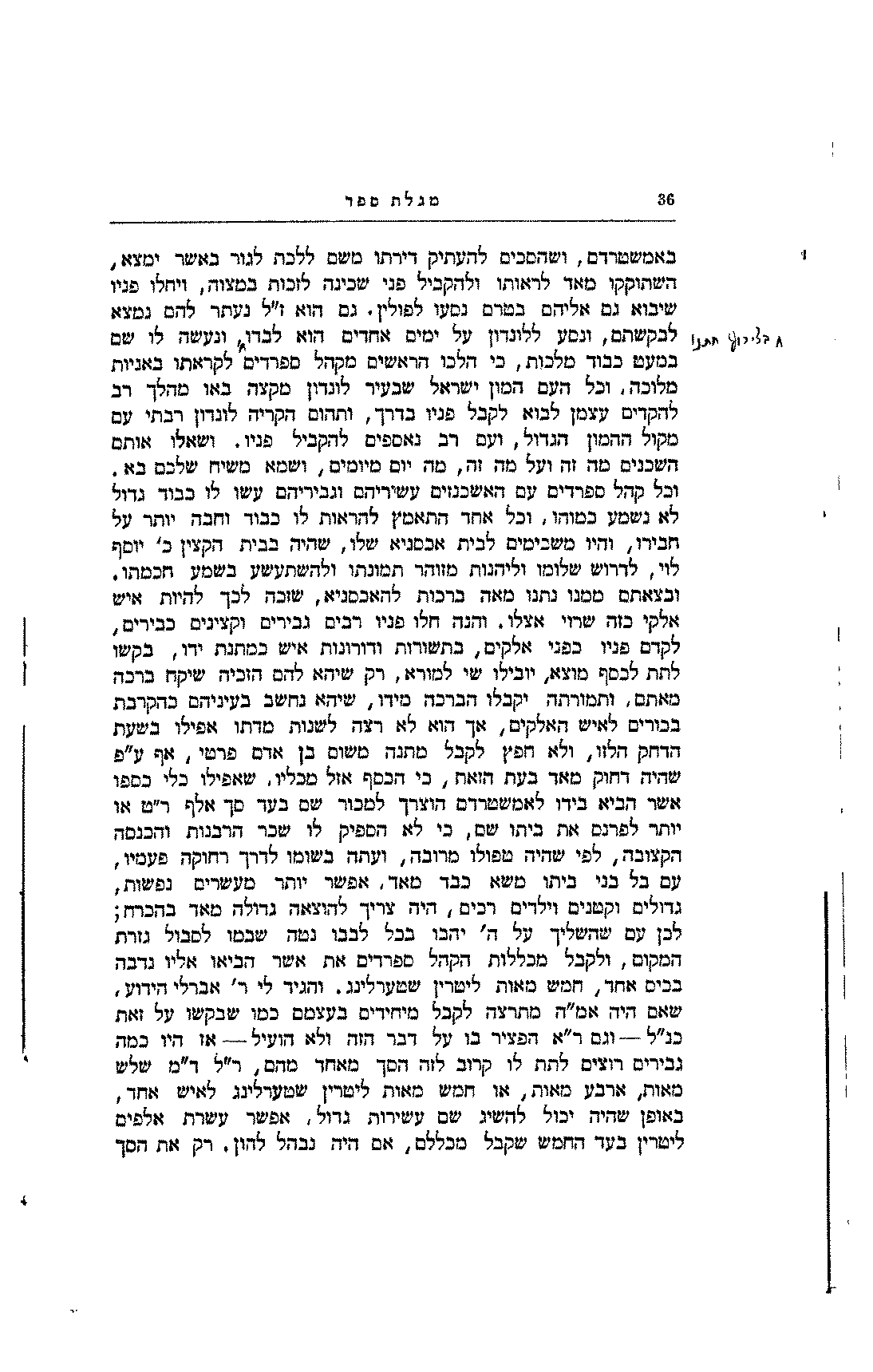
Margin readings in Scholem's copy (1)
| Printed anchor | Type (key sheet) | Mark | Reading | Certainty |
|---|---|---|---|---|
| ונסע ללונדון על ימים אחדים הוא לבדו ^ | V: omission | caret; 2-word note in right margin (Kraken: זלייוף אגנו) | בלי זוגתו(?) | uncertain |
Page 37 (scan 47)
mentioned did he accept from the parnassim of the congregation on behalf of them all, and this because of great necessity. After this he took his leave of them, and they sent him off with great honour, as at his coming. Likewise, when the news of his death reached there, they did him great honour at his death: they made a memorial of a black coffin, the whole synagogue was hung with black, and the congregation sat on the ground weeping and lamenting him, as one mourns for a king and a prince.
One more thing I will tell, which happened to him in London before he left. The parnassim of the Sephardi congregation, out of great affection and strong love, asked him to leave them his likeness, "painted with vermilion" (Jer. 22:14), as a good memorial and a dear remnant. For all their urging he did not listen to them, for in his eyes it was a strange thing. Even so they did not rest or keep quiet until they gained their request and heart's desire, by a great stratagem, through a wonderful artist who stole his likeness without telling him: someone talked with him, while the artist set up his tools outside, in another room. My father did not notice or know of it at all until the work was finished; and the artist's hand was able to paint his likeness with a great resemblance, a marvel in the eyes of those who knew him. When I first saw his painted picture in London, I drew back as if he stood there alive. Copies were made of it, and they were sold dearly and could be found at the Exchange in London. See She'ilat Ya'avetz, § 171, what I wrote on this matter, with God's help.
From London my father returned to his household, and came to Emden close to Purim. He told us of the miracles the Blessed One had done for him, for he had been in great danger at sea. He stayed there until the winter days had passed. There my father buried a little daughter.
Let me tell what happened. After Passover he set out from there with all his household. "And he sent Judah before him to show the way" (Gen. 46:28) to the land of Poland — that is my brother-in-law R. L. [a] … (There the head of the court of Prague, R. David Oppenheim, was present at that time, and my father rebuked him to his face before all the leaders standing there, for helping Ḥayon and supporting him in secret.) He and his household were held up on the way in Hanover for some weeks, until after Shavuot, for the lady Serche, widow of the late generous leader R. Hirtz Hanover mentioned above [b], kept him there. She thought to keep him with her for several months, so that he would set right her tangled affairs with her son-in-law, with whom she was embroiled in lawsuits and great disputes, because she had not listened to my father, who had advised her for her good: the first time she listened to him and acted on his advice, and it went well with her; afterwards she turned from the way and took
Kahana's notes
- [a] He was called Aryeh Leib; he was afterwards rabbi in Amsterdam, and his name was great in Israel.
- [b] Mentioned earlier (p. 12).
הנ"ל קבל מאת פו"מ הקהל בעד כולם, וזה מפני ההכרח העצום. אחר זאת נתפטר מהם ושלחוהו בכבוד גדול כביאתו. וכן כשהגיעה לשם שמועת פטירתו עשו לו כבוד גדול במותו, ועשו לו זכר ארון אחד שחור, וכל בית הכנסת מלובש שחור, וישבו הקהל לארץ בוכים ומספידים עליו, כמתאבלים על מלך ונשיא. רק עוד אחת אספר, מה שקרה עמו בלונדון בטרם נסע משם: כי פו"מ ק"ק ספרדים לרוב חבה יתירה ואהבה עזה בקשו ממנו שישאיר להם דמות דיוקנו חקוק משוח בששר, לזכרון טוב ושארית חביב, ועם כל הפצרתם לא הקשיב לדבריהם, כי היה בעיניו ז"ל מעשה זר, ועם כל זה הם לא שקטו ולא נחו, עד שעלתה בידם בקשתם וחפצם הלב בתחבולה גדולה ע"י אומן נפלא, שגנב צורתו בלי הגיד לו ע"י שספר עמו, וכלי אומנתו הכין לו בחוץ בחדר אחר. ואמ"ה לא הרגיש ולא ידע מזה כלל, עד שגמר המלאכה, ומצאה ידו די הציור דמות תבניתו בשווי גדול, מופלא מאוד בעיני מכיריו ויודעיו, אשר מתחלה בראותי תמונתו המצוירת בלונדון, נרתעתי לאחור כאלו עומד חי, ונעשו ממנו העתקות, ונמכרים ביוקר ומצוים על הבערש בלונדון. ועיין שאילת יעבץ סימן קע"א מ"ש מזה הענין בס"ד. מלונדון חזר אמ"ה אל בני ביתו, ובבאו לעמדן סמוך לפורים, וספר לנו מהניסים שעשה לו הי"ת, כי היה בסכנה גדולה על הים, ושהה שם עד עבור ימות החורף. שם קבר אמ"ה ז"ל בתו קטנה. ואספרה נא את אשר קרה: אחר הפסח נסע משם עם כל בני ביתו. ואת יהודה שלח לפניו, להורות לפניו ארצה פולין, הוא גיסי ר"ל א עכב"ב. (שם נמצא בעת ההיא הגאב"ד מפראג מהר"ד אופנהיים, והוכיחו אמ"ה על פניו נגד כל הקצינים העומדים שם, על שהיה עוזר לחיון ומחזיק ידיו בסתר) והוא ז"ל עם ב"ב נשתהה בדרך בהנובר איזה שבועות, עד אחר חג העצרת, כי עכבתו הקצינה סערכי, אלמנת הקצין המנוח הנדיב ר"ה הנובר הנ"ל ב, כי חשבה להחזיקו אצלה מספר ירחים, על דעת שיתקן לה עניניה המסובכים עם חתנה, שנטרדה עמו במשפטים וסכסוכים גדולים, על אודות אשר לא שמעה בקולו של אמ"ה אשר יעצה לטובתה, ובפעם הראשון שמעה אליו והתנהגה ע"פ עצתו וטוב לה, ואח"כ נטתה מן הדרך וקבלה
- [א] נקרא אריה ליב והיה אחרי כן רב באמשטרדם וגדול שמו בישראל.
- [ב] נזכר מקודם (צד 12).
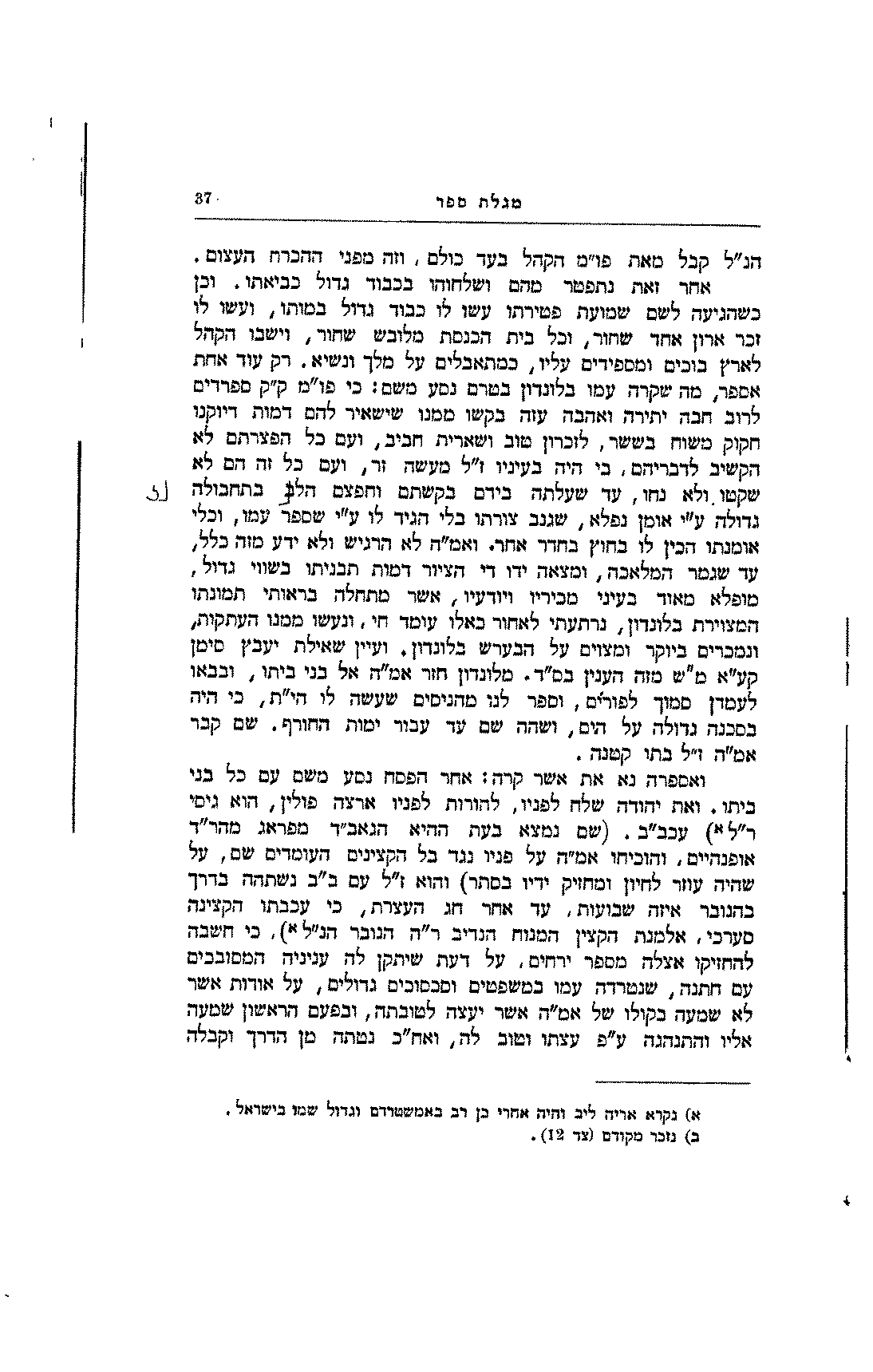
Margin readings in Scholem's copy (1)
| Printed anchor | Type (key sheet) | Mark | Reading | Certainty |
|---|---|---|---|---|
| בקשתם וחפצם הלב ^ בתחבולה | V: omission | caret; one word | לב(?) | uncertain |
Page 38 (scan 48)
other advisers, who advised her in their own way; so the whole building that my father had built for her at first fell apart, as mentioned. So now, because my father's honour was passing her way, she wanted to keep him there, and heaped on him very great dowry and gift to turn his mind to it. He had already agreed to grant her request on these conditions: she bound herself to give him one thousand five hundred Reichstaler on condition that he stay four or six weeks at the least, and within that time he would receive his whole fee of fifteen hundred Reichstaler [a], whether or not he accomplished anything for her good. In addition she bound herself to give him a hundred ducats for every marriage of a son or a daughter, if he would agree to stay in Hanover and deal with her quarrel with her son-in-law during that time. On this my father came to terms with her.
But this woman asked one improper thing: that while my father stayed in her house to work on her affair, he should send his wife, my mother the rebbetzin, of blessed memory, with all his household to the community of Peine, a small town some leagues from there. Because of this improper request the whole matter was cancelled. When my father heard it, it was very evil in his eyes that she should think of sending his wife and children away from him, and he said that even if she gave him all her silver and gold he would not agree to do this. So he left her and went his way.
He set his face towards Poland. He passed through Halberstadt, and the leader R. Benjamin ⟨S: a name, perhaps "Aaron"⟩ did him great honour and received all his household joyfully for some days. There the rabbi R. M[ichel], author of Nezer ha-Kodesh [b], wrote him objections to a responsum in manuscript that my father had given him to examine; and he had no chance to answer him on the road. I took this writing of objections into my own hands, to study them as far as my reed pen would reach, and to answer him. From there he came to Berlin, and we stayed in the house of my late uncle, a righteous and perfect man, R. Wolf Mirels ⟨S: a word, not read⟩, of blessed memory [c], for some weeks. On the road we had great anxiety because of the troops of the king of Prussia, who were passing along that road, so that at times we had to stop on the way at an inn; and blessed be He who saved us from every adversary and every evil chance. There, in my uncle's house, I put my hand and finger to writing a reply to the objections of the said R. M., and I told no one what I was doing, until we came to Breslau and my father saw it. Then he took time
Kahana's notes
- [a] The abbreviation means fifteen hundred Reichstaler.
- [b] He is the rabbi R. Jehiel Michel of Glogau; see Shem ha-Gedolim, Ma'arekhet Gedolim (fol. 97b, § 194).
- [c] Son of the head of the court of Hamburg, R. Meshullam Zalman Mirels; see the memoirs of Glückel of Hameln (p. 218).
מיועצים אחרים אשר יעצוה לפי דרכם, על כן נתקלקל כל הבנין שבנה לה אמ"ה מתחלה כנזכר; לכן עתה בעבור כבוד אמ"ה דרך עליה חשקה לעכבו שם, והרבתה עליו רעים עם מהר ומתן מאד, כדי להטות דעתו לכך, וכבר היה נסכם לתת שאלתה ע"פ התנאים האלה, דהיינו שהתחייבה לתת לו אלף וחמש מאות ר"ט, על מנת שיתעכב שבועות ארבעה או שש לכל הפחות, ובתוך זמן זה יקבל שכרו טו"מ ר"ט משלם א, בין יעשה ויפעל דבר לטובתה בין לא; נוסף על זאת התקשרה לתת לו לכל נישואי בן ובת מאה אדומים, אם יתרצה להשהות בהנובר ולעסוק בעניני הריב שלה עם חתנה משך זמן הלז, ועד"ז הושווה אמ"ה עמה; אך דבר אחד בלתי הגון שאלה זאת האשה, והוא שבתוך זמן זה שיתעכב אמ"ה ז"ל בביתה לשקוד על תקונה ישלח את אשתו היא אמי הרבנות ע"ה עם כל ב"ב לק"ק פאן, עיר קטנה רחוקה משם איזה פרסאות, ובשביל דבר זה ששאלה שלא כהוגן נתבטל כל הענין. כי כשמוע אמ"ה ז"ל הרע בעיניו מאד, שיעלה זאת עה"ד לשלוח מעל פניו אשתו ובניו, ואמר, שאפילו תתן לו כל כספה וזהבה לא יסכים לעשות הדבר הזה. על כן הניחה והלך לו באשר ילך. מגמת פניו פולניא, ועבר דרך הלברשטט, והק' ר' בנימן עשה לו כבוד גדול, וקבל כל בני ביתו בשמחה ימים אחדים. ושם כתב אליו הרב ר"מ בעל נזר הקודש ב השגות על תשובה אחת כ"י שמסר לו אמ"ה לעיין בה, ולא מצאה ידו די השיב לו בדרך, ולקחתי אני כתב השגות הלז תחת ידי לעיין בהם כאשר תמצא כקן קולמוס ידי ולהשיבו דבר; משם בא לו לברלין, נתארחנו בבית דודי המנוח איש צדיק תמים כמו' וואלף מירלש' ע"ה ג, ושהינו שם איזה שבועות. ובדרך היה לנו אחריות גדול מפני חיל מלך פרייסן, שהיו עוברים בדרך ההוא, לכן לפעמים היינו מוכרחים להתעכב בדרך במלון, וב"ה שהצילנו מכל שטן ופגע רע. שם בבית דודי נתתי ידי ואצבעי לכתוב תשובה להשגותיו של מהר"מ הנ"ל, ולאדם לא הגדתי מה אני עושה, עד שבאנו לברעסלוי וראה אותה אמ"ה; אז לקח לו פנאי
- [א] ר״ת: ט"ו מאות ר״ט.
- [ב] הוא הרב מהר"ר יחיאל מיכל מגלויגא, עיין שה"ג מ"ג (דף צ"ז ע"ב סימן קצ"ד).
- [ג] בנו של האב"ד מהמבורג מו"ה משלם זלמן מירלש, ועיין בספר זכרונות מרת גליקל האמיל (צד רי"ח).
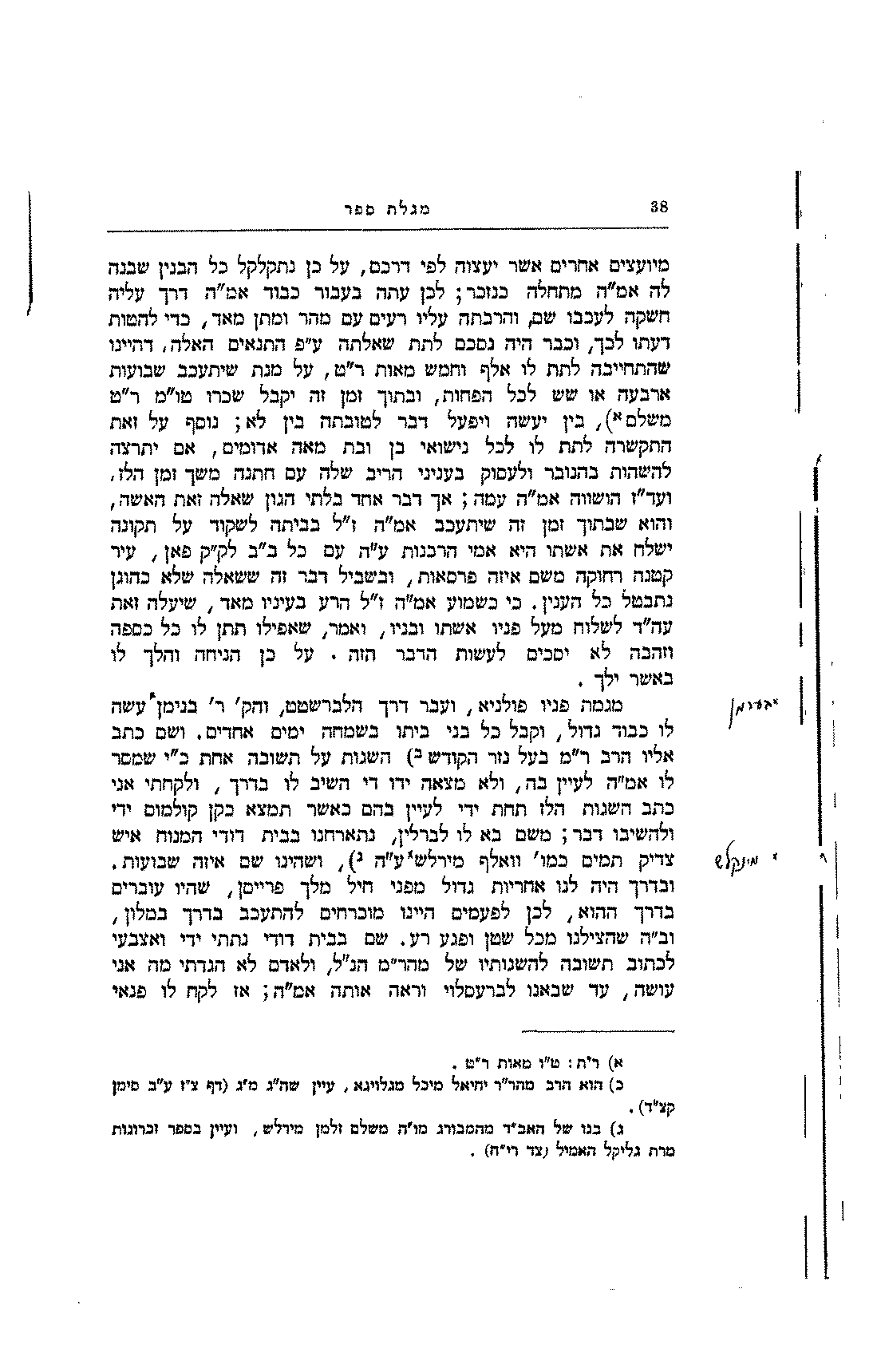
Margin readings in Scholem's copy (2)
| Printed anchor | Type (key sheet) | Mark | Reading | Certainty |
|---|---|---|---|---|
| והק' ר' בנימן x עשה לו כבוד | X: substitution | x mark; one word | אהרן(?) (Kraken: הראן) | uncertain |
| וואלף מירלש x ע"ה | X: substitution | x mark; one word | מינקלש(?) (Kraken: אינקלש) | uncertain |
Page 39 (scan 49)
and studied it together with my brother-in-law mentioned above. It pleased him very much; he kissed me on my head and recited over me the verse: "He kisses the lips who gives a right answer" (Prov. 24:26). It is written in the book She'ilat Ya'avetz; I was then about sixteen years old. But I did not finish it at that time, for it grew wide and wound ever upward, and it lay unfinished for several years, until I had become a man and sat on the seat of ruling; then I set my mind to it and completed it, with God's help.
From Berlin my father travelled with all his household, and we came to Breslau and stayed there some months, until after the festival. There he arranged a match for me. Although people spoke to me of honourable matches with great leaders who wished to join themselves to his family, his heart did not go after money. He betrothed me to the granddaughter of the gaon R. Naftali Katz, of blessed memory. The gaon himself had power and authority from an outstanding leader of Vilna to examine and test me and to make a match with me, for a dowry of several thousand; but he made himself matchmaker for his own son's daughter. For he had a great and well-known affection and closeness of mind with my father, especially after the evil affair of Ḥayon, because of which my father left Amsterdam and his place of honour. My old father-in-law [grandfather-in-law] mentioned above had also suffered many wrongs over that controversy for the sake of Heaven, and he too wandered from his place and was like a stranger in the land. So they loved each other very much, and the gaon R. Naftali Katz longed to marry one of his descendants to one of my father's sons.
When he came to know me, his soul clung to me, to give me as wife the daughter of his son, the rabbi R. Mordecai Katz, of blessed memory, who was then head of the court in Brod [a]. He disclosed the matter to my father — how upright and good I was in his eyes — so, if the match was as proper in my father's eyes as in his, "it is better that I give her to you than to another man" (Gen. 29:19), his granddaughter; for he wanted "the son of Jacob", which was a fitting and acceptable thing for his family. From their asking each other "How much will you give your daughter?" and so on, they quickly came to terms, agreed and bound themselves together. They wrote the conditions, made binding by word of mouth: that I would take the daughter of the son of the gaon R. Naftali Katz as my wife; that he would settle a dowry of a thousand Reichstaler and bind himself to support me for four years; and that my father would give me clothes and gifts for the bride in keeping with his honour only, nothing more. She was my first wife. The wedding was set for the following year. The gaon was very glad of me, as if he had found a great treasure, and said that it was a match made in heaven, high and exalted; for my bride's name was Rachel, fitting for the name "worm Jacob" (Isa. 41:14).
Kahana's notes
- [a] Afterwards he was head of the court and head of the academy in the holy community of Posen and its district. In 5493 [1733] he gave his approbation to the responsa Even ha-Shoham. See Dembitzer, Kelilat Yofi (fol. 70).
ועיין בה בחברת גיסי הנ"ל, והנאהו מאד ונשקני על ראשי, וקרא עלי המקרא הזה: שפתים ישק משיב דברים נכוחים, הלא היא כתובה על ספר "שאילת יעב"ץ", ואני אז כבן שש עשרה שנה. אכן לא גמרתיה בעת ההיא, כי רחבה ונסבה למעלה, והיתה מונחת כמה שנים בלתי נשלמת, עד שהייתי לאיש וישבתי על כסא ההוראה, אז נתתי אל לבי עליה והשלמתיה בעזה"י. מברלין נסע אמ"ה עם כל ב"ב, ובאנו לברעסלוי וישבנו שם איזה חדשים עד אחר החג. שם עשה עמי שידוך, ועם שדברו בי נכבדות להשתדך עם קצינים גדולים, שהיו רוצים להדבק בזרעו, לא נטה לבו אחר הכסף, ושדך אותי לקחת לי לאשה את נכד הגאון מו"ה נפתלי כ"ץ זצ"ל, שהוא עצמו היה לו כח והרשאה מקצין מופלג מווילנא לבדוק ולנסות אותי ולעשות עמי שידוך, ולקבל כמה אלפים בנדוניא. הוא היה ז"ל שדכן לבת בנו, כאשר היתה לו חבה יתירה נודעת וקירוב הדעת עם אמ"ה ז"ל, ביחוד אחר המאורע הרע של חיון, שבעבורו העתיק אמ"ה מאמשטרדם ועזב מקום כבודו. גם חותני הזקן הנ"ל סבל אונאות הרבה על דבר המחלוקת לשם שמים הלזו, וכן היה גם הוא ז"ל נודד ממקומו וכגר כארץ, על כן היו אוהבים זה את זה מאד וחשקה נפשו של הגאון כמוהר"ן כ"ץ להתחתן בי"ח עם אחד מבני אמ"ה, וכאשר הכירני דבקה נפשו בי להשיא לי בת בנו הרב כמו"ה מרדכי כ"ץ ז"ל, שהיה אב"ד בק' ברודא בעת ההיא א. וגלה הדבר אל אמ"ה, איך ישר וטוב אני בעיניו, בכן אם כשר הדבר לפניו כמוהו, טוב תתו בתו נכדתו אלי מתתו אותה לאיש אחר, כי חפץ הוא בבן יעקב, שהוא דבר נאה ומתקבל אל משפחתו. מתוך הדברים ששאלו זא"ז כמה אתה נותן לבתך כו', מיד נתפשרו נתרצו ונתקשרו יחד, עמדו וכתבו הדברים הקנינים באמירה, שאקח בת בנו של הגאון כמוהר"ן כ"ץ הנ"ל לאשה, ושהוא יפריז לנדן סך אלף ר"ט, ונתחייב לי מזונות ארבעה שנים, ואמ"ה ז"ל יתן לי מלבושים ומתנות לכלה לפי כבודו בלבד לא זולת, היא היתה זוגי הראשונה, וקבע זמן החתונה לשנה הבאה, ושמח הגאון הנ"ל בי מאד, כאלו מצא מציאה גדולה, ואמר שהוא זווג מן השמים, עליון מאד נעלה, באשר היה שם בת זוגי רחל נאה לשם תולעת יעקב.
- [א] ואחרי כן היה אב"ד ור"ם בק"ק פוזנן והגליל, ובשנת תצ"ג בא בהסכמתו על הס' שו"ת אבן השוהם, עיין בס' כלילת יופי לדעמביצער (דף ע').
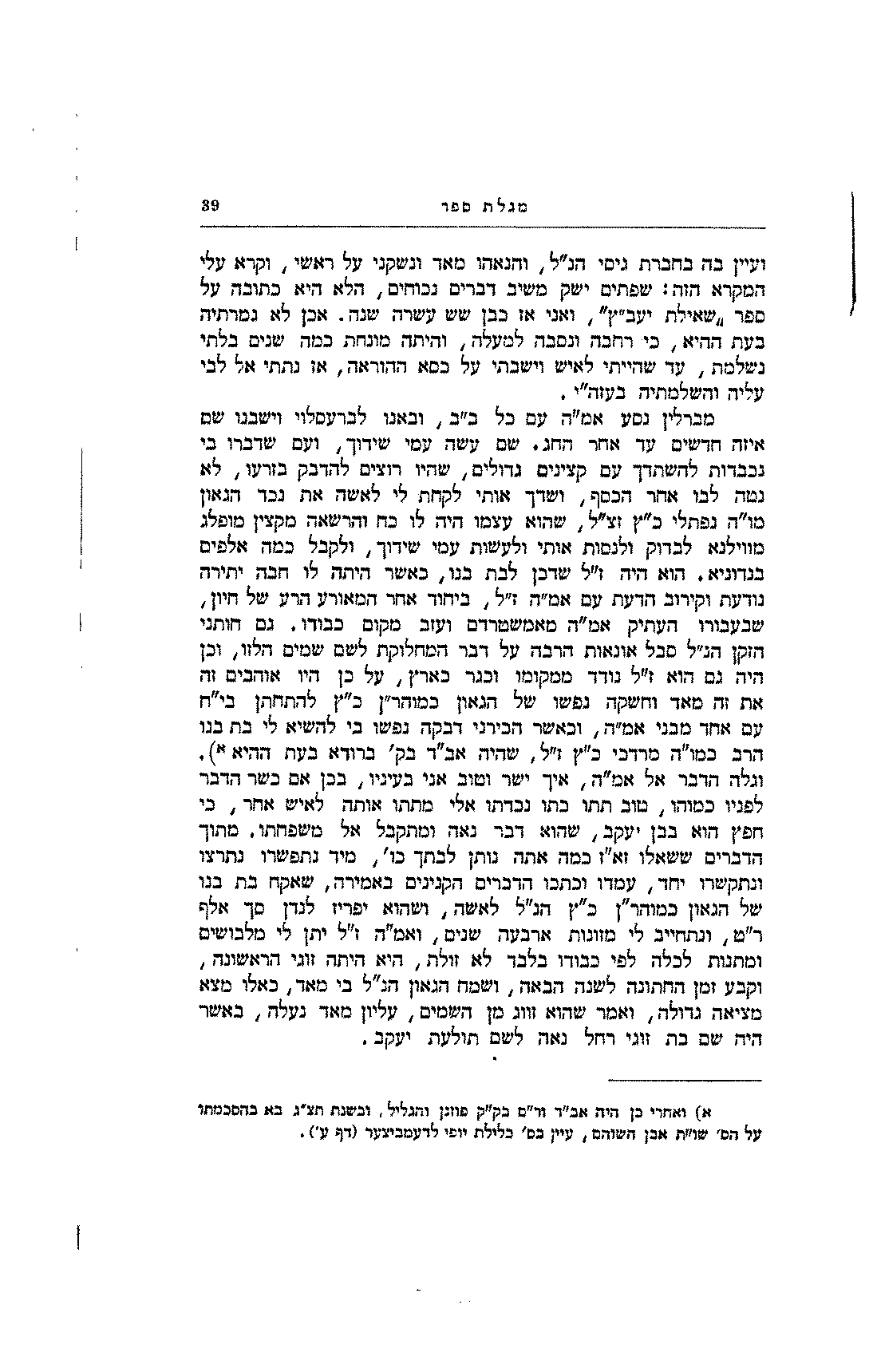
Page 40 (scan 50)
From Breslau he set out with this wife of his, his household and all he had, for Poland, "to a people whom we had not known", whose language we did not understand. It was the beginning of the winter, and my mother and teacher the rebbetzin, may her soul be bound in the bond of life, went the whole way of that hard road and heavy wandering. Her days to give birth were already near. Drawn by cords of love to the Omnipresent, she did not complain, God forbid, against my father for casting the rabbinate of Amsterdam behind his back and going into exile with twenty souls or more, not knowing where the spirit of the Lord would carry him, to look for a resting-place with so heavy a company. She accepted and bore it all, and her face was not sad or angry at all — not like the "women that are at ease … careless ones, for the gathering shall not come" (Isa. 32:10) [a]. She was of one counsel, one consent and one heart with him for Heaven, to take on the yoke of a full exile and to come to the land of Poland. She did not hold back from setting her steps on the road, though she was then in the eighth and ninth month of her pregnancy; she went after him in a land she did not know, and when the cold came, rain and snow did not stop her.
My sister, the pious Mrs. Neḥamah, may she live, reached the age of a maiden to be married; she was betrothed to the grandson of the learned leader R. H. Witschitz of Opatów (Apta) [b]. Meanwhile the holy community of Apta burned to the ground, and my father had to wander and settle in one of the villages near it. There my mother the rebbetzin bore a daughter. She was the last: after she had borne my father fifteen children she ceased to bear. There he married off my sister mentioned above.
After this a special courier came to him from Hamburg, sent by the leader R. Aberle London [and E. P., his brother-in-law], who were suing each other. Each claimed that his opponent owed him a very great sum, and they brought their pleas ⟨S: "for he was quarrelling(?) with his brother-in-law, perhaps Falk, … money of a partnership"⟩ before the men of the community of Altona. The community decided that neutral rabbis should judge between them, chosen in the usual way, each side choosing one; for they did not trust their own rabbi and judges in so great and weighty a matter, in which each side wanted to extract a very great sum of money from the other. So R. Aberle chose my father, whom he had known and recognised for many years, on whom he could rely as on an iron pillar in knowledge and in the wisdom of the Torah, to whom the gates of light were open, in searching out the law and the love of truth ⟨S: "and all the obstacles in the world did not move him from his place, from judging a true judgement truly"⟩, upright knowledge, counsel and wisdom, seeking judgement and swift in righteousness. R. A. wrote to him that he would fulfil his every wish as payment for his trouble and toil in taking on the long journey, though it was the middle of winter: only let him not hold back, and not delay to ride and come to Hamburg in time [c], as soon as possible, to the place of the judgement.
Kahana's notes
- [a] A phrase of Isaiah (32:10).
- [b] She died in 5531 [1771]. See the text of her tombstone in Toledot Ya'avetz (pp. 51–52). Now it is known whose wife she was, which was hidden from R. A. Ḥ. Wagenaar, author of Toledot Ya'avetz.
- [c] The abbreviation means "in time".
מברעסלוי נסע עם אשתו זו ביתו וכל אשר לו לפולין, אל עם אשר לא ידענו ולא שמעו לשונו. והיה זה בתחלת ימי החורף ואמי מורתי הרבנית תנצב"ה מלאה הלכה בכל הדרך הקשה והטלטול הכבד הלז. וכבר קרבו ימיה ללדת, נמשכה בחבלי עבותות אהבה למקום, לא נתרעמה ח"ו על אמ"ה שהשליך הרבנות דאמשטרדם אחר גוו, והלך גולה עם עשרים נפשות או יותר אל אשר לא ידע אנה ישאהו רוח ה', לתור לו מקום מנוחה עם חיל כבד כזה; את הכל קבלה וסבלה, ולא היו פניה רעים וזועפים כלל, לא כנשים שאננות תרגזנה בוטחות אוסף בלי יבוא א; אבל היא היתה בעצה אחת ובהסכמה אחת ולב אחד לשמים עמו ז"ל, לקבל עול גלות שלמה ולבוא לארץ פולין; אכן לא נמנעה לשום לדרך פעמיה, גם כי היתה אז בחודש שמיני ותשיעי להריונה, הלכה אחריו בארץ לא ידעה. ובעת הקור הגיע לא עצרה הגשם והשלג, להגיע אל פרק בתולה נשאת, היא אחותי החסידה מ' נחמה תחי', שנשתדכה לנכדו של הק' הרבני ר"ה וויטשיז מאפטא ב. בתוך כך נשרפה ק"ק אפטא עד היסוד, והוכרח אמ"ה ז"ל לנוד ולגור בארץ באחד הכפרים הסמוכים לה. שם ילדה אמי מורתי הרבנית בת, היא היתה האחרונה אחר שהולידה לאבי חמשה עשר ילדים, ותעמוד מלדת, ושם השיא את אחותי הנ"ל. אחר זאת בא אליו רץ מיוחד מהמבורג, ששלח אליו הק' ר' אברלי לונדון ]וא"פ גיסו[ שהיו תובעים זה את זה, כל אחד טען את חבירו שמגיע לו משכנגדו סך עצום מאד, והגישו עצומותיהם לפני אנשי הקהל דאלטונא, והעמידו הקהל שידונו ביניהם רבנים ממוצעים לפניהם, כאשר יבחר להם בזבל"א וזבל"א, כי לא בטחו ברב ודיינים שלהם, לענין גדול וכבד כזה, שכל אחד מהצדדים רצה להוציא מחברו, סך ממון עצום ורב מאד; בכן בחר לו ר' אברלי את אמ"ה ז"ל, שידעו והכירו משנים רבות, שיכול לסמוך עליו בעל עמוד ברזל בענין הידיעה וחכמת התורה שגלויין לו שערי אורה, וחקור דין ואהבת האמת, ודעה ישרה עצה ותושיה, דורש משפט ומהיר צדק, וכתב אליו ר"א שימלא לו כל רצונו בשכר טרחו ועמלו לקבל עליו טלטול הדרך הרב, גם כי היה באמצע החורף, רק אל יעמוד אחור, ולא יעצור לרכוב לבוא אל המבורג ע"ז ג האפשרי למקום המשפט.
- [א] מליצת ישעיה (ל"ב י').
- [ב] מתה בשנת תקל"א. עיין נוסחת מצבתה בס' תולדות יעב"ץ (צד נ"א וצד נ"ב) וכעת נודע אשת מי היתה אשר נעלם מרא"ח וואגנה מחבר הספר תולדות יעב"ץ ז"ל.
- [ג] ר"ת: על זמן.
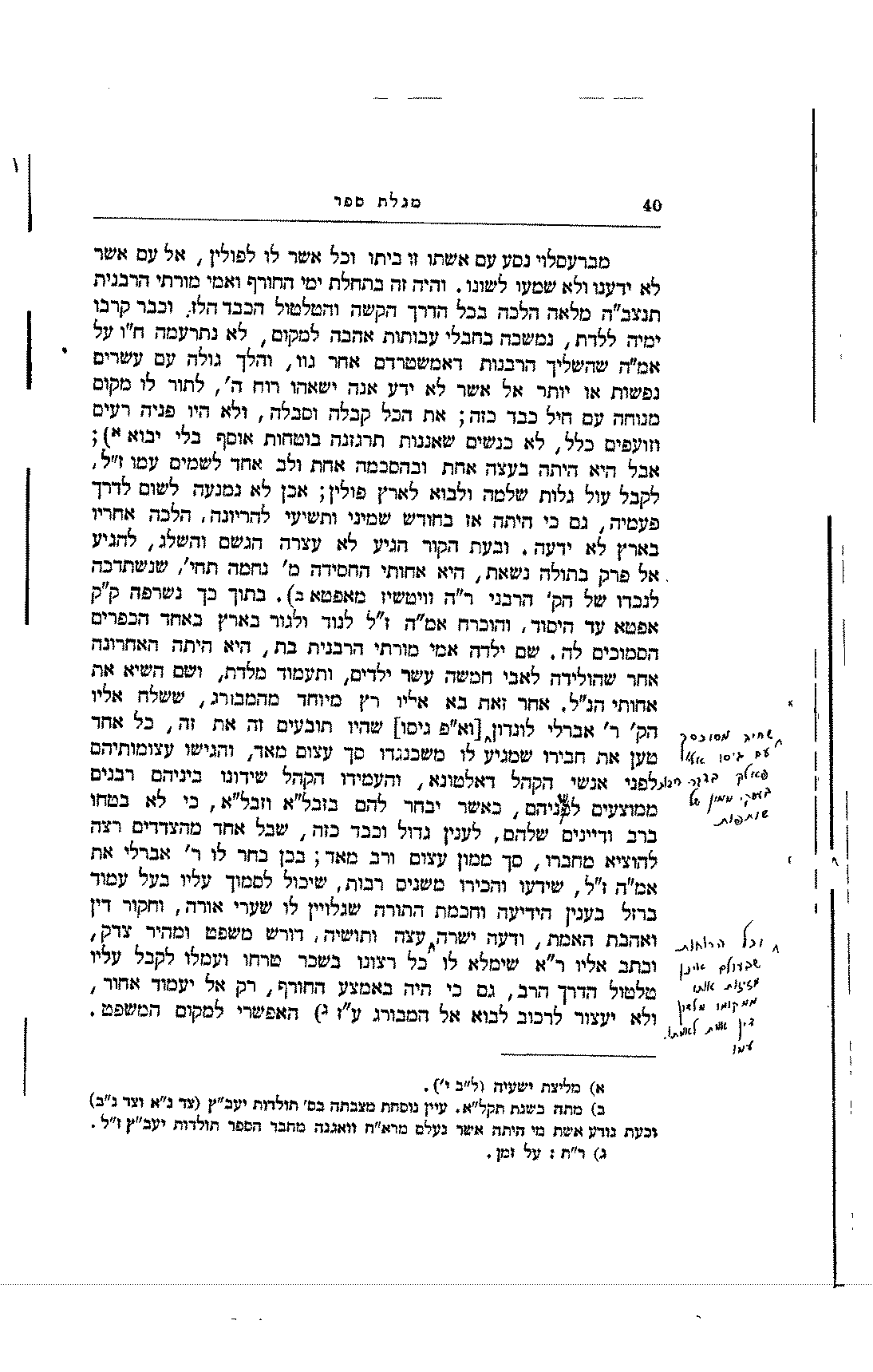
Margin readings in Scholem's copy (2)
| Printed anchor | Type (key sheet) | Mark | Reading | Certainty |
|---|---|---|---|---|
| ר' אברלי לונדון [וא"פ גיסו] ... והגישו עצומותיהם ^ | V: omission | caret; 5-line note in right margin (Kraken fragments: שחיה אסוכסך / גיסו) | שחיה מסוכסך(?) / עם גיסו אולי / פאלק ... / ... ממון של / שותפות | partial |
| וחקור דין ואהבת האמת ^ | V: omission | caret; 6-line note in right margin (Kraken fragments: וכל ... / שהעולם אינו / ... אותו / ממקומו מלבוא) | וכל הרואות(?) / שהעולם אינו / מניעות(?) אותו / ממקומו מלדון / דין אמת לאמתו | fairly sure |
Typed insert for p. 41 (scan 52)
A second typewritten sheet bound into Scholem's copy, headed "for p. 41". It belongs after the words "my father too had great sorrow and much worry because of me" on p. 41, where a caret is marked in Scholem's copy. Kahana does not print it; Bick prints it in brackets at the same place. Doubtful words of the typescript are read with Bick's help.
When we reached Berlin he took care of me with some medicines that he got from the doctors, and they did not help me at all. This ailment afflicted me for several years after that. Though I also asked doctors and received remedies from them, no healing came to my illness, until after many years I felt in myself that it was nothing but an excess of thick blood that had gathered in me. That is what caused it, for my sins; it brought this trouble on me, and brought on me a branch of melancholy that would not let me sleep. For many years I suffered this illness: I hardly tasted the taste of sleep, and I tossed on my bed from side to side in worry, grief and sighing. "So am I made to possess months of vanity, and wearisome nights are appointed to me" (Job 7:3) — more than twenty years, until I was truly weary of my life.
With this, a stopping of the breath and shortness of breath were habitual with me, until the Lord saw my affliction and the "golden vein" [haemorrhoidal bleeding] opened for me. Then the pain of the melancholy eased somewhat, and the shortness of breath came and went at intervals; but it did not leave me for about forty years. And for all that, strange times passed over me. Evils without number surrounded me, and troubles like the hairs of my head; hard and binding events gathered year upon year, joined together without pause, "great plagues, and of long continuance" (Deut. 28:59). Blessed is He who gives strength to the weary to stand in all these. "Is my strength the strength of stones?" (Job 6:12). Why should my spirit not be impatient? I wait for the God of my salvation: may He show me good in my old age, and make my end better than my beginning.
(לעמ' 41) ובהגיענו לברלין [ע]סק עמו (בי"ק: עמי) באיזה תרופות שלקח מהרופאים ולא הועילו לו (בי"ק: לי) מאומה. המיחוש הלז הת[עו]לל (בי"ק: התעולל) בי אחרי זאת כמה שנים, ועם ששאלתי ג"כ לרופאים וקבלתי מהם רפואות לא עלתה ארוכה למחלתי עד אחר שנים רבות, והרגשתי בעצמי שלא היה ד"א רק ריבוי דם העב שנאסף בי, הוא גרם לי בעוונות, הביא עלי הצרה הזאת, שהשך(?) (בי"ק: שהביא) עלי סעיף ממרה שחורה ולא הניח לי לישון. והרבה שנים עברו עלי בזאת המחלה שכמעט לא טעמתי טעם שינה, והייתי מתגולל על המטה מצד אל צד בדאגה יגון ואנחה. כן הנחלתי לי ירחי שוא ולילות עמל מנו לי יותר מעשרים שנה, עד אשר ממש קצתי בחיי. ועם זה היה עוצר הנשימה וקוצר רוח מורגל אצלי, עד שראה ה' בעניי ונפתח לי גיד הזהוב, ואז הקל מיחוש השחורה קצת, וגם קוצר הרוח והנשימה היה נוסע ובא לפרקים, אבל לא [ע]זבני (בי"ק: עברו) כמו ארבעים שנה. ובכל זאת עברו עלי עתים משונים, אפפו עלי רעות עד אין מספר וצרות כ[ש]ערות ראשי, וקורות צרורות קשות אספו על השנות מתחברות בלי הפסק, מכות גדולות ונאמנות. וברוך הנותן ליעף כח לעמוד בכל אלה. אם כח אבנים כחי, מדוע לא תקצר רוחי? אוחילה לאלהי ישעי, יראני טוב בזקנתי, וייטיב אחריתי מראשיתי.
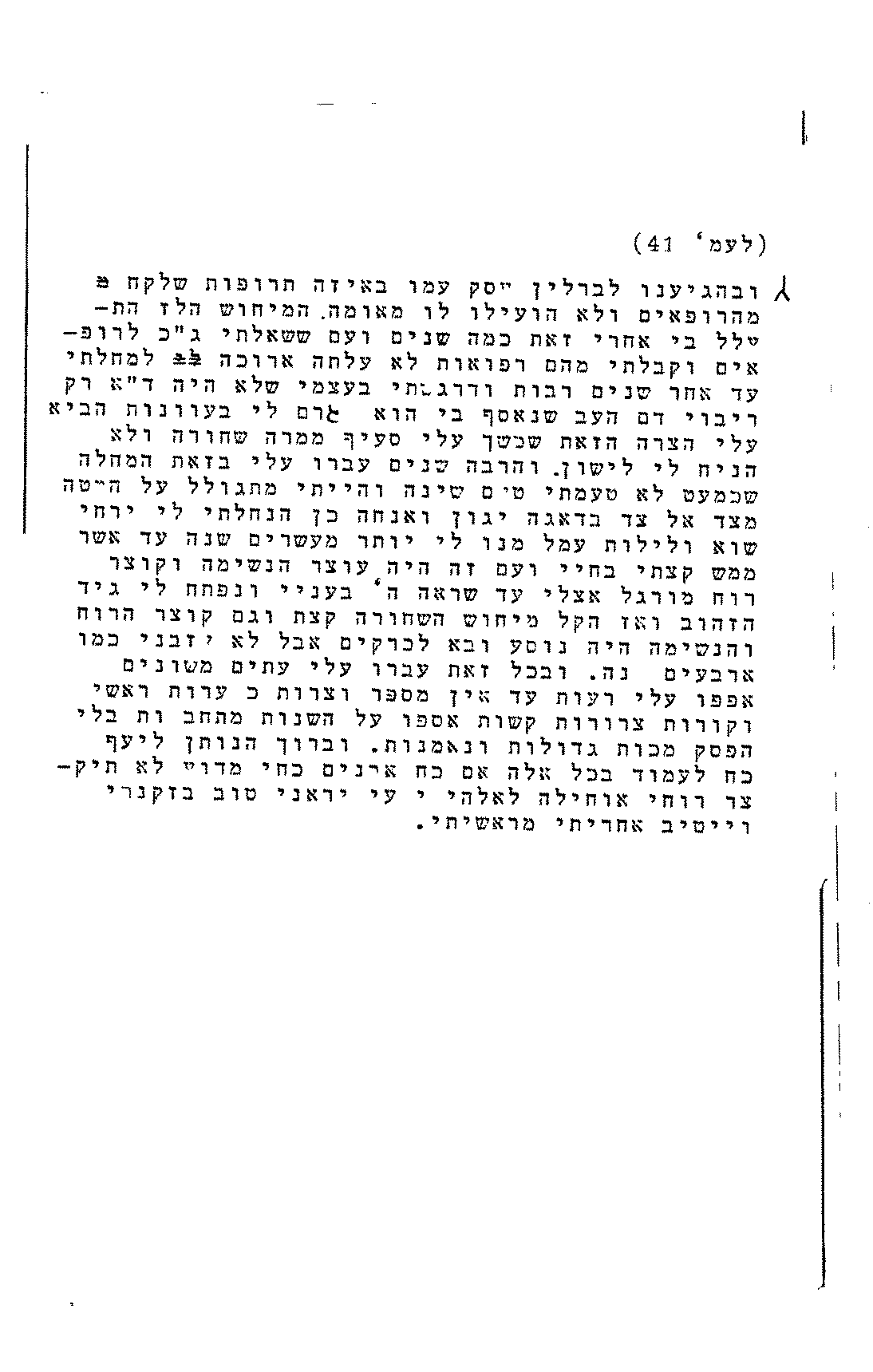
Page 41 (scan 53)
My father agreed with him for a fee of seven hundred good and full-weight ducats, besides the expenses of the road and the lodging, which also came to a large sum. Then my father, of blessed memory, travelled from Apta to Hamburg, and with him went his son-in-law, my brother-in-law R. L., and I, who was betrothed, as said. It was in the depth of winter. On this journey "the prince of cold" struck me, and my breath stopped several times; "my groaning is heavier than my stroke" (Job 23:2); fear and trembling seized me. My father, too, had great sorrow and much worry because of me [a] ⟨S: a caret, pointing to the typed sheet⟩.
We reached Hamburg with honour and in great peace. Then my father made peace with the leader R. Ber Kohen, mentioned above, who had been an adversary to him. In R. Ber Kohen's hands was still held back part of my father's salary as rabbi from the time he was rabbi and head of the court in Altona, as said, which had stayed with the community because of the controversy; now he had them pay him in full everything that was owed him. At R. A.'s urging, peace was made between them; my father agreed and was reconciled with him without any recompense. R. Ber Kohen had not been able to obtain this from him when my father moved his household from Altona to Amsterdam. Then R. Ber Kohen had tried to buy peace with him at a high price, and wanted to give him a thousand Reichstaler and more, only to be allowed to greet him before he left, to part from him in love and receive his blessing; and all the intermediaries could not bring it about. All his effort was in vain, with all the money he offered to make peace with him; and now he reached it without toil, without trouble and without paying anything at all. So R. Ber Kohen's luck rose all the days of his life, to get what he wanted in any case.
With all this, though my father was at peace with R. Ber Kohen — from whom came "the nail and the corner-stone" (Zech. 10:4) of every notable thing done in the community between a man and his fellow; and the new rabbi of the Three Communities, R. Y. Ḥ. [b], did not lift hand or foot to do anything without R. Ber Kohen's counsel and consent, as is known. If I set out to tell even the edges of the ways of this head of the court, who lowered the honour of the Torah to the dust ⟨S: a thirteen-line note, read: "and famous in the Three Communities; that head of the court was related to R. Ber Kohen …, 'his elder', as the magnates call their brothers 'elder' in the Polish tongue; and in every case of the community and of private persons brought before their head of the court, he first asked what his elder said"⟩, for our many sins, the story would be very long and would need a great work of its own, for several flying scrolls would not hold his conduct and his affairs. In short: from the day he came to Altona the paths of the town changed. Then the people of the Lord in the Three Communities went down into their troubles: "the land was as the garden of Eden before him, and behind him a desolate wilderness" (Joel 2:3). Nearly twenty years before his death the power was taken from him to judge the people of the holy community of Hamburg by Jewish law, a power they had formerly held in full force from the authorities of Hamburg, as from His Majesty in Altona. But the perversion of justice cried out to heaven, and bribery was treated as fully permitted in his court; and since the upright authorities of Hamburg could no longer bear the cry of those who were wronged, they took from him
Kahana's notes
- [a] See below (p. 59).
- [b] He means the rabbi R. Ezekiel Katzenellenbogen, who wrote the responsa Keneset Yeḥezkel; and see below, in detail, about him.
והתרצה לו אמ"ה בשכר שבע מאות אדומים דוקאטין טבין ותקילין, מלבד הוצאות הדרך והאכסניא שעולה ג"כ לחשבון גדול. אז נסע אמ"ה ז"ל מאפטא להמבורג, והלך עמו חתנו גיסי הר"ל ואני שהייתי משודך כנ"ל, והיה בתוקף ימות החורף. בדרך הזה פגע בי שר של צנה, ונעצרה ממני הנשימה כמה פעמים, ידי על אנחתי כבדה, קראני פחד ורעדה, גם אמ"ה ז"ל הי"ל צער גדול בעבורי ודאגה רבה א. הגענו להמבורג בכבוד ובשלום גדול. אז נתפייס אמ"ה ז"ל עם הקצין רב"ך ע"ה הנ"ל, שהי"ל לשטן והיה מעוכב בידו עדיין משכירות הרבנות של אמ"ה ז"ל מאז היותו רב אב"ד בק"ק אלטונא כנ"ל, ונשאר ביד הקהל מפני המחלוקת הנ"ל, ועכשיו עשה שפרעו לו כל מה שהיה מגיע לו משלם, וע"פ הפצרות ר"א לתוך השלום ביניהם, ונעתר אליו אמ"ה ז"ל, והתרצה אליו בלי שום גמול, מה שלא השיג אצלו רב"ך, כשהעתיק אמ"ה ביתו מאלטונא לאמשטרדם; שבקש רב"ך לקנות השלום עמו בדמים יקרים, ורצה לתת לו אלף ר"ט ויותר, רק למען יהא רשאי לקבל פניו טרם נסעו מזה, להתפרד ממנו באהבה ולקבל ברכתו, ולא יכלו כל המשתדלים, להוציא דבר זה מכח אל הפועל, לריק היה כל יגיעתו, בכל ממון שפסק לו להשלים עמו, ועתה הגיע לזה בלי עמל בלי יגיעה, ובלי מתן דמים כל עיקר. כך היה מזלו של רב"ך עולה כל ימי חייו, להשיג מבוקשו על כל פנים. והנה עם כל זה שהיה אמ"ה בשלום עם רב"ך, אשר ממנו יתד ממנו פנה בכל דבר רשום הנעשה בקהלה בין איש לרעהו, והרב החדש דג"ק הוא די"ח ב לא הרים ידו ורגלו לעשות שום דבר, מבלעדי עצת והסכמת רב"ך כידוע; ואם אמרתי אספרה קצות דרכי האב"ד הלז, אשר השפיל כבוד התורה עד לעפר בעו"ה, יאריך הספור מאד ויצטרך לחבור עצום בפ"ע, כי לא יכיל כמה מגלות עפות מהנהגותיו ועניניו, בקצור מיום בואו לאלטונא נשתנו שבילי דמתא, אז ירדו לצערם עם ה' בג"ק, אשר היה כג"ע הארץ לפניו, ואחריו מדבר שממה; וכבר נלקח ממנו קרוב לעשרים שנה לפני מותו הכח לדון ולשפוט בד"י את בני ק"ק המבורג, שהיו לפנים בכל תוקף מהשררה דהמבורג, כמו מהמיר"ה בק"א, אבל עוות הדין צעק למרום, והשוחד היה כהיתר גמור בב"ד שלו, וכי לא יכלה השררה הישרה דהמבורג, לסבול עוד צעקת הנדחים, נטלו ממנו
- [א] עיין להלן (צד 59).
- [ב] כוונתו על הרב ר' יחזקאל קצנלבוגן שחבר ספר כנסת יחזקאל שו"ת ועיין להלן בפרטות אודותיו.
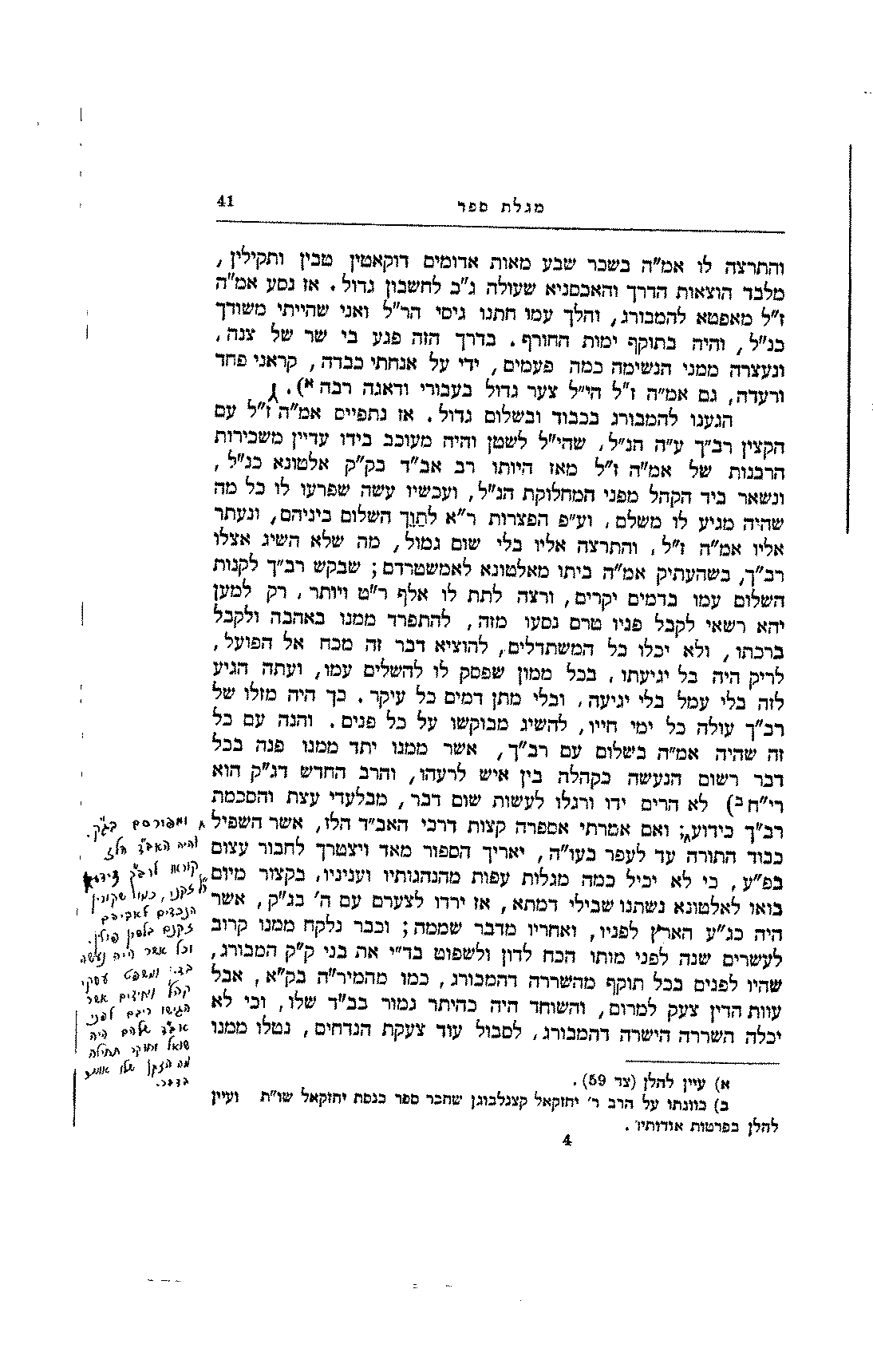
Margin readings in Scholem's copy (2)
| Printed anchor | Type (key sheet) | Mark | Reading | Certainty |
|---|---|---|---|---|
| ודאגה רבה א) ^ | V: omission | caret after the note call; refers to the typed sheet for p. 41 (scan 52) | (see typed insert, scan 52) | sure |
| אשר השפיל ^ כבוד התורה (on the new head of court, R. Ezekiel Katzenellenbogen) | V: omission | caret; 13-line note in right margin (Kraken fragments: כמו שקורין / הנגידים לאחיהם / וכל אשר היה נעשה / ... עסקי / הקהל ויחידים אשר / הגישו ריבם לפני / אב"ד שלהם היה / שואל ... תחילה) | ומפורסם בג"ק / והיה האב"ד הנ"ל / קרוב לרב"ך ... / בזקנו, כמו שקורין / הנגידים לאחיהם / בזקנם בלשון פולין / וכל אשר היה נעשה / בדין ובמשפט עסקי / קהל ויחידים אשר / הגישו ריבם לפני / אב"ד שלהם היה / שואל ומוקי(?) תחילה / מה הזקן שלו אומר / בדבר | fairly sure |
Page 42 (scan 54)
the power to judge in Hamburg, so that R. Y. Ḥ. could no longer compel anyone living in Hamburg to stand trial before him. So Jewish law has ceased in Hamburg these nearly thirty years.
Let us return to the matter. For that reason, in this lawsuit of R. A. and E. P., my father toiled greatly to win the case for R. A., who was in the right, and did not succeed. Though he wrote him a responsum explaining the correct ruling by the law of the Torah, it did not help: he "cried out like a crane" and toiled for nothing; for the head of the court, R. Y. Ḥ., with the other arbiter, were of one counsel and one mind to find against him.
While we were in Hamburg the ailment of melancholy ⟨S: a word, perhaps "awoke"⟩ grew strong in me. Before Shavuot the time of my wedding drew near; my father turned back after Passover, and we went back from Hamburg to Breslau for my wedding. He would not put off the date, above all because the rabbi my father-in-law and his father, the gaon mentioned above, pressed him not to let the commandment pass and go stale. They also feared — idle men had really frightened them — saying that my father meant to make another match for me with a leader there, and that this was why he had taken me with him to Hamburg. This had never entered his mind. God forbid my father: even if they had given him all the treasures of the world, he would not have gone back on his word — all the more in this matter, in which all precious wealth was loathsome in his eyes, and all his aim was only to join his descendants to good and well-born families. But my father would not delay the joys of his first son and hold back the commandment, God forbid, even if they had given him all the money in the world. So in the middle of the lawsuit he left Hamburg and travelled to Breslau to make my wedding.
As we passed the customs house in the land of Brandenburg, his chest was taken, which held silver vessels given to me as gifts in Hamburg, and he had to spend money to get it back. We reached Breslau for the festival of Shavuot, and my wedding day fell in the days before the festival — but it was not the day of the joy of my heart ⟨S: an eight-line note, partly read: "for at the time … I did not have a man's strength, and I was in distress … and I was at that time seventeen years old"⟩ (for I was weak and feeble then).
At the time of my wedding there was a great flood in Breslau, which did great damage in the city, such as there had not been since it was founded; but it did not come near us. Blessed be the Helper and Saviour! I spent some weeks in the house of my lord father-in-law, my wife's grandfather, the gaon mentioned above, eating at his table, and he treated me with great honour. But "there is no marriage contract without a quarrel". Besides the fact that my father-in-law the rabbi, of blessed memory, could not keep his vow, the obligation of the dowry — several hundred were missing, and my father almost made me swear not to forgive it; and though my wife's grandfather promised to pay the rest in instalments, it never came into my hands — he also, with all due respect, did me wrong. Not only did he take into his hands what the leaders of Vienna gave as a wedding present, as is customary, and hide it all and keep it for himself, so that I received nothing of it; but also one item that had not come into his hands, which the leader R. U. P. sent to his brother R. F. P., who was my groomsman,
כח הדיינות בהמבורג, באופן שלא יכול עוד רי"ח לכוף שום אדם מדרי המבורג לעמוד לפניו בדין, על כן בטל ד"י בהמבורג זה קרוב לשלשים שנה. נחזור לענין. כי על כן בעסק המשפט של ר"א וא"פ הלז הי"ל לאמ"ה יגיעה רבה לזכות את ר"א הצדיק בדינו, ולא עלתה בידו, ואע"פ שכתב לו תשובה לבאר הפסק הישר ע"פ דין תורה, לא הועיל, צווח ככרוכיא וטרח בכדי; כי האב"ד רי"ח עם הנברר האחר, היו בעצה והסכמה אחת לחייבו. בהיותנו בהמבורג גברה עלי מיחוש השחורה, וקודם חג השבועות קרב זמן חתונה שלי, וחזר אמ"ה ז"ל על עקבו אחר הפסח, ושבנו מהמבורג לברעסלוי על נישואין שלי, ולא רצה לדחות הזמן, ביחוד כי הרב חמי וחו' הגאון הנ"ל היו דוחקים אותו שלא לעבור ולהחמיץ המצוה; גם כי יראו, כאשר הפחידום באמת אנשים בטלנים, באמרם איך שבדעת אמ"ה ז"ל, לעשות עמי שידוך אחר עם קצין שם, ושמפני כך לקחני עמו להמבורג, מה שלא עלה על דעתו ז"ל מעולם, וחס ליה למר אבא, אפילו יהבו ליה כל חללי דעלמא, לא הוה משני בדבוריה, כ"ש בעסק הזה שנמאס בעיניו כל הון יקר חרוץ, וכל מגמתו היתה רק לדבק זרעו בטובים ובמיוחסים. אבל אמ"ה לא רצה להשהות שמחות בנו הראשון, ולעכב המצוה ח"ו, אפילו היו נותנין לו כל ממון שבעולם, לכן באמצע עסק המשפט עקר מהמבורג, ונסע לברעסלוי לעשות לי חתונה. בעברנו על בית המכס במדינת ברנדיבורג נלקח הארגז שלו שהיו בו כלי כסף שנתנו לי מתנות בהמבורג, והוצרך לפזר ממון על זאת. באנו לברעסלוי על י"ט של עצרת, ובימי הגבלה היה יום חתונתי, אבל לא יום שמחת לבי, (כי חלוש ורפה אונים הייתי אז). בעת הנשואין שלי היה בברעסלוי שטף מים רבים, ועשה הזיק גדול בעיר שלא היה כמוהו מיום הוסדה, רק אלינו לא יגיע. ברוך העוזר ומושיע! והייתי איזה שבועות בביתו של אדוני חותני, זקן זוגתי הגאון הנ"ל, סועד על שלחנו, והיה נוהג בי כבוד גדול. אבל ליכא כתובה דלא רמי בה תיגרא, כי מלבד שחמי הרב ע"ה לא יכול לקיים את נדרו התחייבות הנדן, כי היה חסר כמה מאות, וכמעט השביעני אבי שלא אמחול, ועם שהבטיח חותני לשלם המותר לזמנים, מעולם לא בא לידי גבוי אבל עוד העביר עלי את הדרך במ"כ, כי לא לבד שלקח תחת ידו מה שנתנו קציני ווינא לדורון על החתונה כנהוג, את הכל העלים ועכב לעצמו, ולא קבלתי ממנו מאומה, אך עוד פרט אחד שלא בא לידו, אבל שלחו הק' רע"פ לאחיו רפ"פ שהיה שושבין שלי
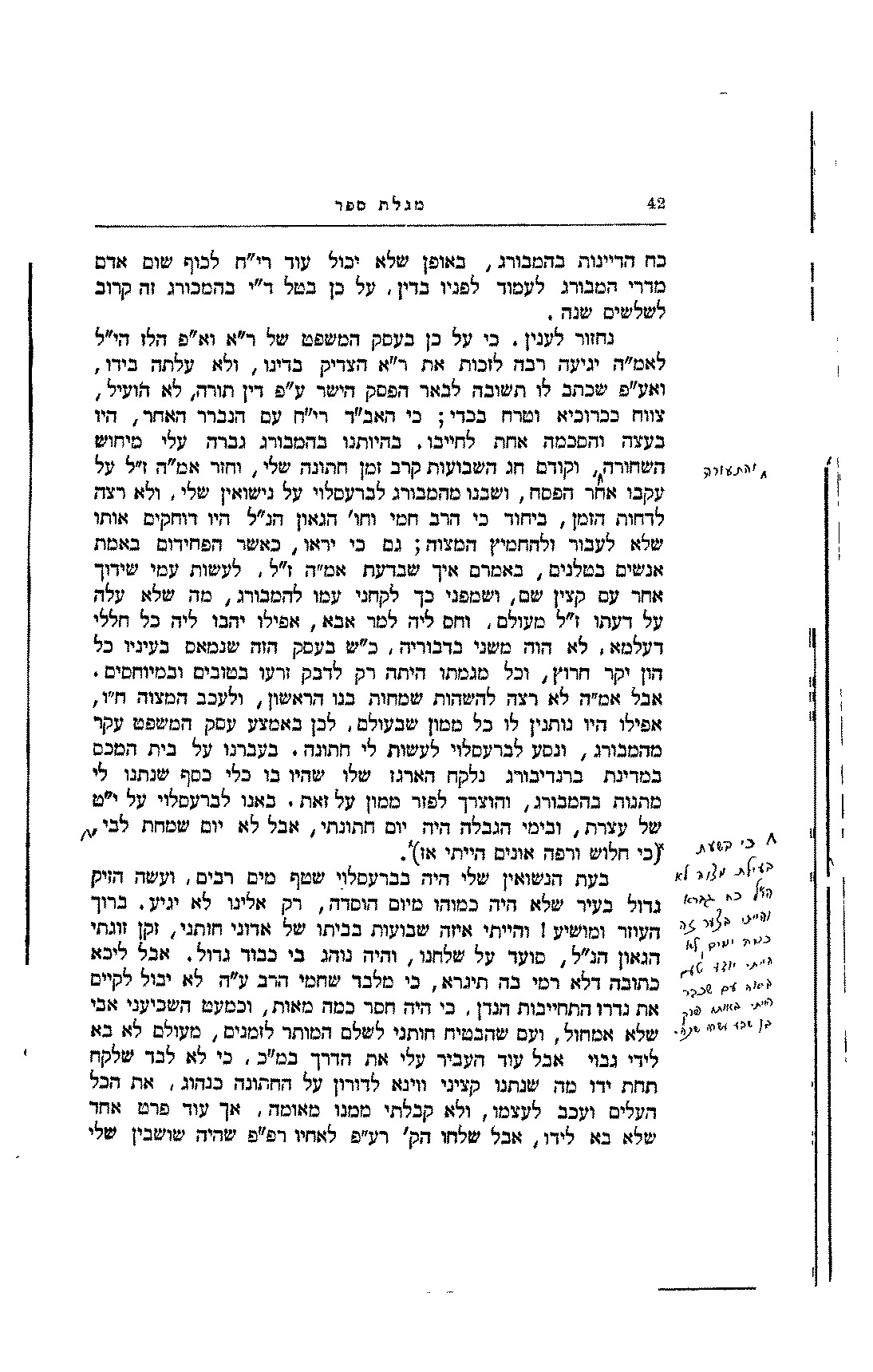
Margin readings in Scholem's copy (2)
| Printed anchor | Type (key sheet) | Mark | Reading | Certainty |
|---|---|---|---|---|
| גברה עלי מיחוש ^ השחורה | V: omission | caret; one word | והתעורר(?) (Kraken: והתעורה) | uncertain |
| אבל לא יום שמחת לבי ^ (כי חלוש ורפה אונים הייתי אז) | V: omission | caret; 8-line note in right margin replacing or expanding Kahana's parenthesis (Kraken fragments: כי השעה / ... לא / היה לי כח גברא / והייתי בצער ... / ... / ... שכבר / והייתי באותו פרק / בן שבע עשרה שנה) | כי השעה ... לא / היה לי כח גברא / והייתי בצער ... / ... והייתי באותו פרק / בן שבע עשרה שנה (partly read) | partial |
Page 43 (scan 55)
to hand it to me, and so he did. My father-in-law pressed me to give it to him, thinking that everything given to me from Vienna was his. But I did not listen to him in this, to have taken from me by force what was properly mine. Over this some estrangement arose between us, for he was very angry about it; and so was I, seeing that he asked of me something improper and wanted to make a fool of me by force. It almost caused a quarrel and strife between me and my wife, his daughter, of blessed memory, who also pressed me with many enticements to do her father's will at all costs. But the words did not enter my ears, for that is not what I had seen and learned in my father's house: rather, to give up much of one's own to one's children, and all the more not to set one's eyes on what is not one's own.
When my father made the wedding of his first daughter, the guests of the Three Communities gave great and many presents, several hundred lot of silver, intended above all in honour of my father, since they had never yet been able to benefit him — never in his life did he take any gift for himself. He also spent very much on that first wedding he made, for he invited to the wedding feast several hundred souls, all the notables of the Three Communities with their wives and children, perhaps a thousand souls, and he had to spend much money to honour them properly. So they too filled their hands with great gifts and presents for the bride and groom; and it never entered my father's mind to touch anything, small or great. On the contrary, he added to them from his own, and bore the burden of the couple and their children for many years — above all his first son-in-law: though he gave him a very great sum for his station, not only did he not reduce the dowry written for him, but for many years, almost all the time my father lived, he was almost a charge on him; and even after his death he lived from his estate, as I will write, which would take too long to explain here. So this new custom was very strange to me.
My father knew nothing of all this. Only the money of my dowry — I received eleven hundred gulden in cash — he handed to the groomsman R. F. P., on his promise that he would make the sum bear fruit, more or less, in a permitted way. After this my father set out on his road and went back to Hamburg to finish R. A.'s case. Then I parted from my father, of blessed memory, and never saw him again; and I travelled with my wife and my father-in-law to the land of Moravia ⟨S: "as I will write, with God's help, in the part of the stories that concern me in particular"⟩.
Let us return to my father's affairs. The said lawsuit dragged on. The first three arbiters could not finish it, and they had to add two more arbiters; and nothing helped, for "the refiner refines in vain, for the wicked are not removed" (Jer. 6:29): they were a majority against him and found against R. A., though my father cried out that they were doing him wrong and violence. He toiled with them in vain, and they left R. A. stripped of his property. I will not dwell on this, for I was not there that time. I will also be brief about what happened in my presence the first time I was there with him, when my father rebuked the head of the court R. Y. Ḥ. for some mistaken rulings he gave then in other matters and in questions about women. I will only tell that
למסרו לידי, וכן עשה, הפציר בי חמי לתתו אליו, בחשבו שכל הניתן לי מווינא שלו הוא; אבל לא שמעתי אליו לדבר הזה, להוציא ממני בכח את המוחזק בידי כראוי, ועד"ז נעשה קצת פירוד לבבות בינינו, כי הוא חרה לו מאד על הדבר הזה, וגם אנכי בראותי ששואל ממני דבר שלא כהוגן, ולעשות ממני שוטה בכח, וכמעט גרם קטטה ותחרות ביני ובין זוגתי בתו ע"ה, שהרבתה ג"כ פתויים לעשות רצון אביה עכ"פ, אבל לא נכנסו הדברים באזני, כי לא כן ראיתי ולמדתי בבית אבא, כי אם לוותר לבניו הרבה משלו, כ"ש שלא לתת עיניו במה שאינו שלו; ואמ"ה ז"ל כשעשה חתונה לבתו הראשונה נתנו בני ג"ק הקרואים ג"כ דורונות גדולות ורבות כמה מאות לויט כסף, ונתכוונו ביחוד לכבוד אמ"ה ז"ל, באשר לא נהנה מהם עדיין, מימיו לא קבל לעצמו שום מתנה, וגם עשה הוצאה רבה וכבדה מאד לצורך החתונה הראשונה שעשה לי"ח, כי הזמין וקרא לסעודת ושמחת הנישואין כמה מאות נפשות, כל נכבדי הג"ק עם נשיהם ובניהם, אפשר היו אלף נפשות, והוצרך לפזר ממון רב לכבדם כראוי, לכן גם הם מלאו ידיהם במתנות ודורונות גדולות לחתן וכלה, ולא עלה על דעת אמ"ה ז"ל ליגע בדבר קטן או גדול, אדרבה הוסיף עליהם משלו, ונשא עול טורח הזוג עם בניהם שנים רבות; ביחוד חתנו הראשון עם שנתן לו סך רב עצום מאד בערכו, לא זו בלבד שלא פיחת לו מהנדן שכתבו לו, אבל כמה שנים כמעט כל זמן שהיה אמ"ה ז"ל בחיים, כמעט היה מוטל עליו, וגם אחר מותו נתפרנס מעזבונו כמש"ל, מה שיארך לבאר כאן, על כן היה מנהג זה החדש זר אצלי מאד. ואמ"ה לא ידע בכל אלה, רק מעות הנדוניא שלי, שקבלתי י"א מאות זהובים מזומנים, אותן מסר להשושבין רפ"פ על הבטחתו, שיעשה הסך הלז פירות, עכ"פ בין רב למעט בדרך היתר. אחר שם אמ"ה לדרך פעמיו, ושב להמבורג, לגמור את הדין של ר"א. אז נפרדתי מאמ"ה ז"ל, ולא יספתי לראותו עוד, ונסעתי עם זוגתי וחמי לארץ מעררין. נחזור לענינו של אמ"ה. והנה עסק משפט הנ"ל נתארך, ולא יכלו השלשה נבררים הראשונים לגמרו, והוצרכו להוסיף עוד נבררים שנים אחרים, והכל לא הועיל, כי לשוא צרף צרוף ורעים לא נתקו, כי רבו עליו לחייב את ר"א, אף אם צווח אמ"ה ז"ל שעושין לו עול וחמס, לריק יגע עמהם והוציאו את ר"א נקי מנכסיו, ולא אאריך בזה שלא הייתי שם בפעם ההוא, גם אקצר במה שאירע בפני בפעם הראשון שהייתי שם עמו ז"ל, שהוכיח אמ"ה את האב"ד רי"ח, באיזה הוראות של טעות, שהורה אז בענינים אחרים ובשאלת נשים, רק אספר כי
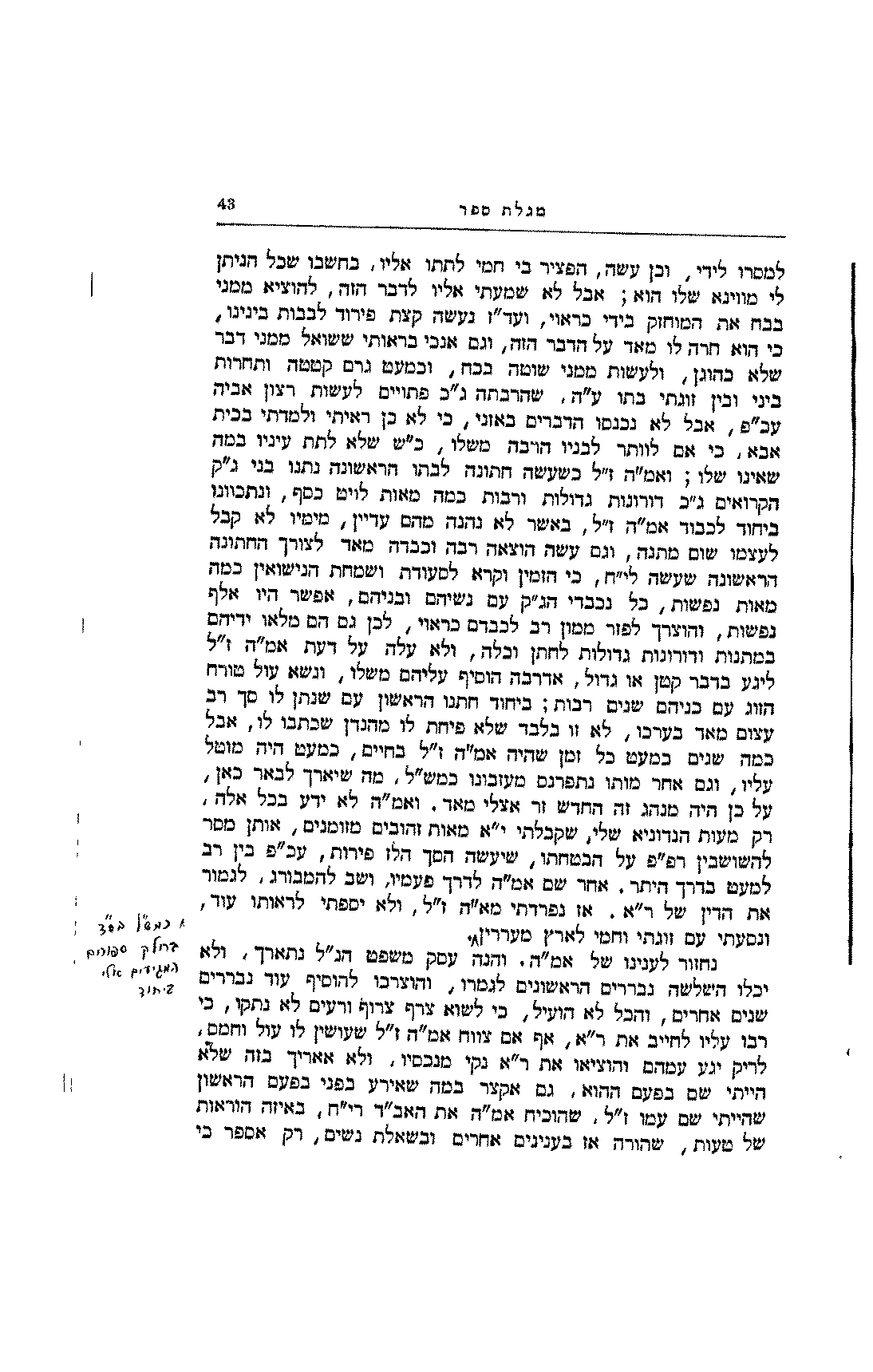
Margin readings in Scholem's copy (1)
| Printed anchor | Type (key sheet) | Mark | Reading | Certainty |
|---|---|---|---|---|
| ונסעתי עם זוגתי וחמי לארץ מעררין ^ | V: omission | caret; 4-line note in right margin (Kraken: כאש"ל הס"ד / בחלק ספורים / המגיעים אלי / ביחוד) | כאשר אכתוב(?) בס"ד / בחלק ספורים / המגיעים אלי / ביחוד | fairly sure |
Page 44 (scan 56)
when my father parted from R. A. and left Hamburg to go back home to Poland, these were his words of comfort to him; he said: "I know that they have wronged you and perverted justice against you" (what happened there — "the bed is too short", so I keep silent, as said) — "but I am sure that not many days will pass before the Blessed One makes up your loss and you rise up again." And he laid his hand on his head and blessed him.
He went his way to the land of Poland, and lived sometimes in a village, sometimes in the town of Apta, which had burned and was then beginning to be rebuilt a little. At that time a calamity happened in Apta over a quarrel in the community with the powerful family called Witschitz. Because of it two men of standing, important scholars, were hanged, through false charges laid against them on account of those violent men [a]. Because they were always men of strife and quarrel with everyone, the nickname "Korahites" was attached to them there; that is their name, known and famous to this day. So when the hour came for the head of the family, R. H. Witschitz, to depart from the world (my father had made a match with him: my sister Neḥamah was married to his son's son), he sent for my father, his relative by marriage, to see him before his death; and my father would not come to him. He said: "Am I a companion to informers?" His grandson, my father's son-in-law, was also killed, God save us, after my father's death, and had no children. My sister, Mrs. Neḥamah, may she live, was left a sorrowful widow; all the days of her life she would not marry again and belong to another man.
After my father had lived like this, the Lord put it into the heart of an important leader among the notables of Poland, well known for good, R. Israel of Rytwiany. He was the official called oeconom ⟨S: a spelling of the word⟩ of the great lord Sieniawski, who had wide lands and many towns, like a province of Poland, and great estates. Over all his property this R. Israel was appointed official, governor and ruler; all the income and expenses of the lord were made through him; he was the one who went out and came in, and so he was a man of great means. And this man was God-fearing and of upright mind. He set his heart on gaining the commandment of taking my father and his household under the wings of his office. He travelled to him and entreated him to agree to come with his household and live with him, settling in one of the places under his rule, Staszów or Rytwiany. He gave him a large house to live in for nothing, and gave him a watchman day and night and a servant ready for all the needs of the house; he gave him cows too, enough milk, butter and cheese "for his food, for the food of his household, and for the maintenance of his maidens" (Prov. 27:27); he sent him wood and fire for heating, enough for his needs; and also fowl, and live fish in plenty from the ponds under his office,
Kahana's notes
- [a] See Shevirat Luḥot ha-Aven (fol. 50), which says: "This Korah and his company came to annul the counsel of the Lord, etc. The father of this one was the cause of the killing of two righteous and good men, outstanding scholars, R. Y. Deichs and his companion, may God avenge their blood, who were hanged on a tree because of him, though they had done no violence, as is known." End of quotation.
כשנפרד אמ"ה ז"ל מר"א, ונסע מהמבורג לשוב לביתו לפולין, כך היה דבריו אליו לנחמו א"ל: הנה נא ידעתי שהעבירו עליך את הדרך, ועשו לך עוות הדין (ומה שאירע שם קצר המצע, לכן אחריש כנ"ל), אבל מובטח אני שלא יצאו ימים רבים, עד שימלא השי"ת חסרונך, ותחזור לעלות למעלה והניח ידו על ראשו וברכו, והוא הלך לדרכו אל ארץ פולין, והיה מתגורר פעם בכפר, פעם בעיר אפטא השרופה אז אחר שהחלה להכנות מעט. בעת ההיא אירע דבר תקלה באפטא ע"ד מחלוקת שהיה בקהל עם משפחה התקיפה הנקראת וויטשיז, ובגללה נתלו שני אנשים בעלי צורה לומדים חשובים, ע"י עלילות שקר ששמו עליהם בסיבת גברי אלמי הנ"ל א. שבעבור היותם בעלי מחלוקת ומריבה תמיד עם הכל, טפלו להם שם כינוי קרחם. הוא שמם עד היום נודעים ומפורסמים, ולכן כשהגיעה שעה של ראש המשפחה הוא ר"ה וויטשיז (שהשתדך אמ"ה עמו, אחותי נחמה נשאת לבן בנו) ליפטר מן העולם, שלח אחר מחו' אמ"ה ז"ל להתראות קודם מותו, ולא רצה לבוא אליו, אמר וכי חבר אני למוסרות, גם נכדו הנ"ל חתנו של אבא נהרג ר"ל אחרי מות אמ"ה ז"ל ולא היה לו בנים, נשארה אחותי מ' נחמה תי' אלמנה עגומה, כל ימי חייה לא רצתה להנשא ולהיות לאיש אחר. אחר שהתגורר אמ"ה ז"ל כנ"ל נתן ה' בלב קצין אחד חשוב מנכבדי ארץ פולין, המפורסם לשבח ר' ישראל ריטפין, שהיה פקיד שקורין אַקאנאם של השררה הגדולה שינאווסקי, לה ארץ רחבת ידים, ועיירות רבות כמדינת פולין ועבודה רבה. על כל נכסיה נתמנה ר"י הלז פקיד נגיד ומושל בכל ההכנסות והוצאות של השררה הנ"ל, על ידו היו נעשים, הוא המוציא והמביא, על כן היה בעל יכולת גדול, והיה האיש ההוא ירא שמים ובעל דעת ישר. הוא שם אל לבו לזכות במצוה, לקחת את אמ"ה ובני ביתו תחת כנפי פקידותו, ונסע אליו חילה פניו שיתרצה לבוא עם ב"ב לדור עמו במקומו, להתישב באחת המקומות אשר תחת ממשלתו, בסטאשוב או בריטפין, ובית גדול נתן לו לדור בתוכו בחנם, ומסר לו שומר משמרת יום ולילה, עבד מוכן ומזומן לכל צרכי הבית, גם פרות נתן לו די חלב וחמאה וגבינה, ללחמו לחם ביתו וחיים לנערותיו, ועצים ואש להסקה שלח לו די ספוקו, גם עופות ודגים חיים לרוב, מן הבריכות מים שתחת מינוי פקידתו,
- [א] עיין בס' שבירת לוחת האון (דף נ') וז"ל: בא זה הקורח ועדתו לבטל עצת ה' וכו', ואביו של זה היה סבה להרוג שני אנשים צדיקים טובים ולומדים מופלגים ר"י דייכש ורעהו הי"ד נתלו על עץ בעבורו, על לא חמס עשו כנודע. עכ"ל.
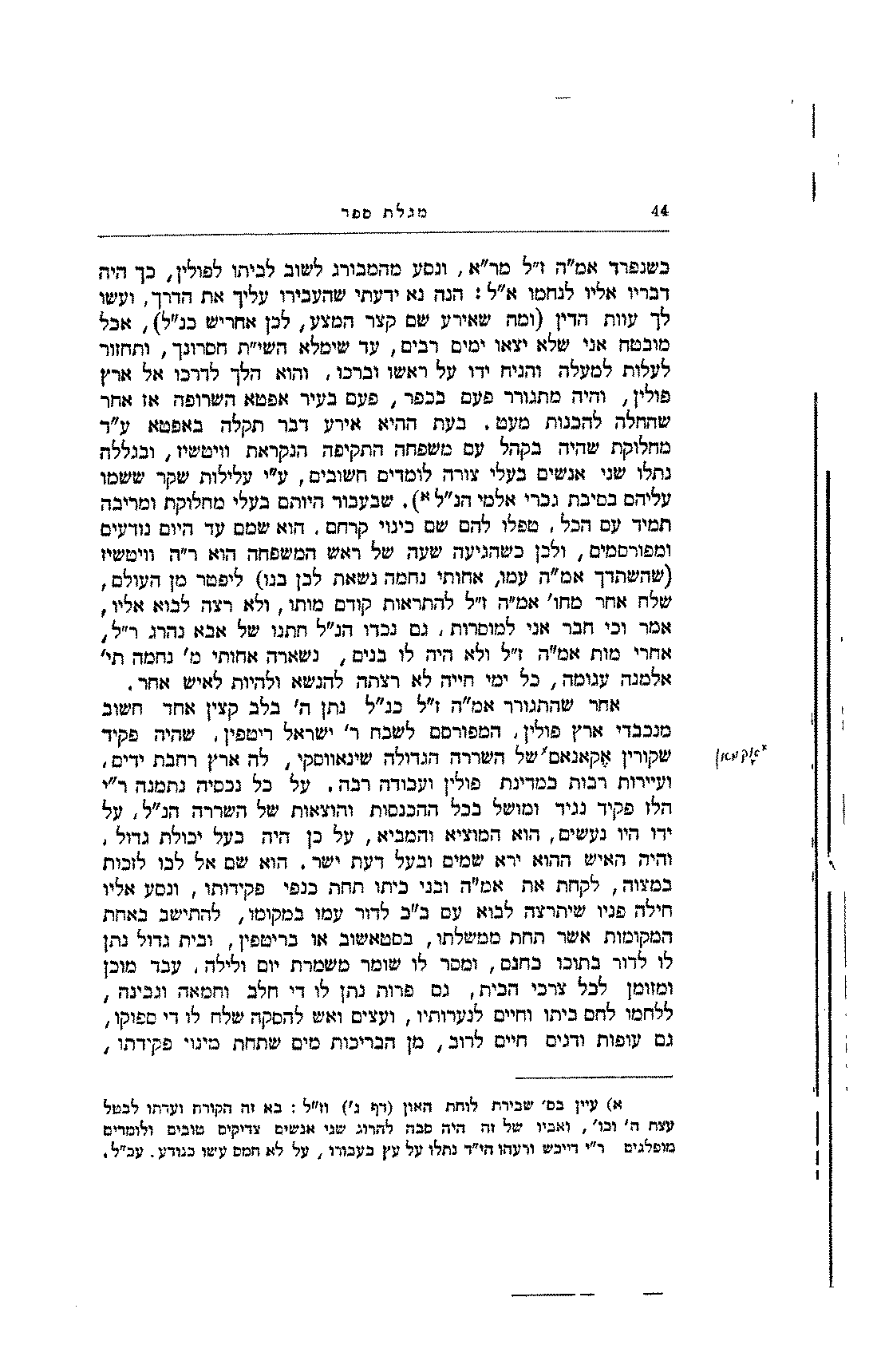
Margin readings in Scholem's copy (1)
| Printed anchor | Type (key sheet) | Mark | Reading | Certainty |
|---|---|---|---|---|
| פקיד שקורין אַקאנאם x | X: substitution | x mark; one word | אָקאָנום(?) (spelling) | uncertain |
Page 45 (scan 57)
all for nothing, without money; so that he supplied almost all his needs. Only other things, which are not the essentials of a living, and clothes, my father bought with his own money. Moreover, the said magnate sent my father many presents from time to time, of every kind of delicacy — spices, sugar and sweets — whatever he could get, to give him pleasure and find favour in his eyes. All this R. Israel gave with a generous eye and great eagerness. For several years all my father's wants were met by him, with love and good will and a very pleasant face, until the year 5478 [1718], when my father was received as rabbi of the province of the holy community of Lwów and its district. Then the leader R. Israel grieved over the great commandment that was lost from his house, which had been a lodging of the Torah for several [years].
If I set out to tell all that happened to him in Lwów, the matter would be long — although, for our many sins, his days there were not long, for he was there not even a quarter of a year. He left behind him a good name, which several great rabbis before him who stayed there for long years did not gain. When he travelled to take up the rabbinate a great miracle was done for him: he crossed the river Vistula at the end of the winter, when the ice was already weak and thin, close to melting; he crossed it in a carriage, and immediately after him a wagon crossed it with other travellers ⟨S: "uncircumcised"⟩; the ice broke under it and they drowned.
The honour they did him in the holy community of Lwów cannot be told; a swift scribe could not reach half of the honour he actually had. Not only from the community did he receive all this great honour: non-Jews ⟨S: "the uncircumcised"⟩ too came early to his door and greeted him with gifts. In the short time he was there he made great reforms for the community and raised its horn to renown and glory. He executed judgement on men of violence, and the presumptuous submitted before him. He also removed from office a parnas, a violent man, R. Zelig, when it was proved against him that he had robbed community money and eaten the spoil of the poor. This man went and informed against my father to the lord and the bishop there, and my father was summoned before them. Great fear came upon the community, and trembling fell on them, for the Jews there greatly feared the dread of the rulers. But my father went to them and stood before them, spoke with them in Italian, and the lords did him great honour, the like of which had not been done before him: the bishop had him sit on the chair beside him and keep his hat on his head. The Lord gave him favour in their eyes, and they gave him permission and power almost to judge capital cases in his community as he saw fit. He went out from before them in great honour and took his leave in peace.
Then the dread of him fell on all the informers, and the scoundrels there submitted to his authority and bowed to him, for the fear of him fell on them; and the whole community had honour, glory and greatness. Even that other violent man, R. Moses Yeḥiels, a great power, before whom the whole community of Lwów had trembled until my father came there — he too submitted to his authority and accepted his judgement and decree; not
הכל חנם אין כסף; כמעט שהספיק לו כל צרכיו, רק דברים אחרים שאינן עיקר פרנסה ומלבושים היה קונה אמ"ה ממעותיו, ואף גם זאת עשה הגביר הנ"ל לאמ"ה הרכה דורונות לפרקים ככל מיני כיבודים בשמים צוקר ומגדים, שהיה יכול להמציא, כדי לעשות נחת רוח לפניו ולמצוא חן בעיניו, את הכל נתן ר"י הנ"ל בעין טובה ובחשק גדול. כמה שנים היה כל מחסורו של אמ"ה עליו באהבה וברצון ובסבר פנים יפות מאד, עד שנת תע"ח שנתקבל אמ"ה ז"ל לרב מדינה דק"ק לבוב והגליל; אז נצטער הק' ר"י הנ"ל על המצוה הגדולה שאבד מביתו, שהיה אכסניא של תורה כמה ]שנים[. אם באתי לספר מכל מה שאירע עמו בק"ק לבוב יארך הענין, אף אם בעו"ה לא ארכו לו שם הימים, כי לא היה שם כרביע שנה, והניח שם טוב אחריו, מה שלא השיגו כמה רבנים גדולים לפניו אשר האריכו שנים שמה. בנסעו על הרבנות נעשה לו נס גדול, כי עבר את הנהר ווייקסיל בסוף ימי החורף, שכבר היה הקרח חלוש וקלוש קרוב להיות נמס, והוא עבר עליו בקרון; אחריו מיד עברה עליו עגלה עם נוסעים אחרים, נשבר הקרח תחתה ונטבעו. הכבוד שעשו לו בק"ק לבוב אי אפשר לספרו, כי לא יספיק סופר זריז להגיע לחציו של כבוד שהיה לו בפועל. ולא מן הק"ק בלבד הי"ל כל הכבוד הגדול, כי גם אינם יהודים השכימו לפתחו והקדימו פניו בתשורות. ובתוך הזמן הקצר הנ"ל שהיה שם תקן לק"ק תקנות גדולות והרים קרן הקהלה לשם ולתפארת, ועשה דין באנשי חמס, ובעלי הזדון נכנעו מפניו, והעביר גם פרנס אחד גברא אלמא ממינויו ר' זעליג, על שנתברר עליו שגזל ממון הקהל ואכל שוד עניים. והלך זה ומסר את אמ"ה ז"ל אצל השררה וההגמון שם, ונתבע אמ"ה ז"ל לפניהם, והיתה אימה גדולה בקהל וחרדה נפלה עליהם, כי שם פחדו מאד היהודים מאימת המושלים; אבל אמ"ה ז"ל הלך אצלם ועמד לפניהם, דיבר עמהם בלשון איטלייאני, ועשו לו השררות כבוד גדול שלא נעשה כמוהו מלפניו, כי הצריכו ההגמון לישב על הכסא סמוך לו, ולהניח כובעו בראשו, ונתן ה' חנו בעיניהם, ונתנו לו רשות וכח כמעט לדון דיני נפשות בקהלו, כאשר יישר בעיניו, ויצא מלפניהם בכבוד גדול ונפטר מהם בשלום. אז נפלה אימתו ז"ל על כל המוסרים, ואנשי הבליעל שהיו שם סרו למשמעתו ונכנעו אליו, כי נפל פחדו עליהם, ולכל הקהל היה יקר ותפארת וגדולה; ואפילו ההוא גברא אלמא אחרינא ר' משה יחיאל'ם, שהיה תקיף גדול, וכל הקהל בלבוב רועדים מפניו עד בוא אמ"ה לשם, גם הוא סר למשמעתו וקבל דינו וגזרתו, לא
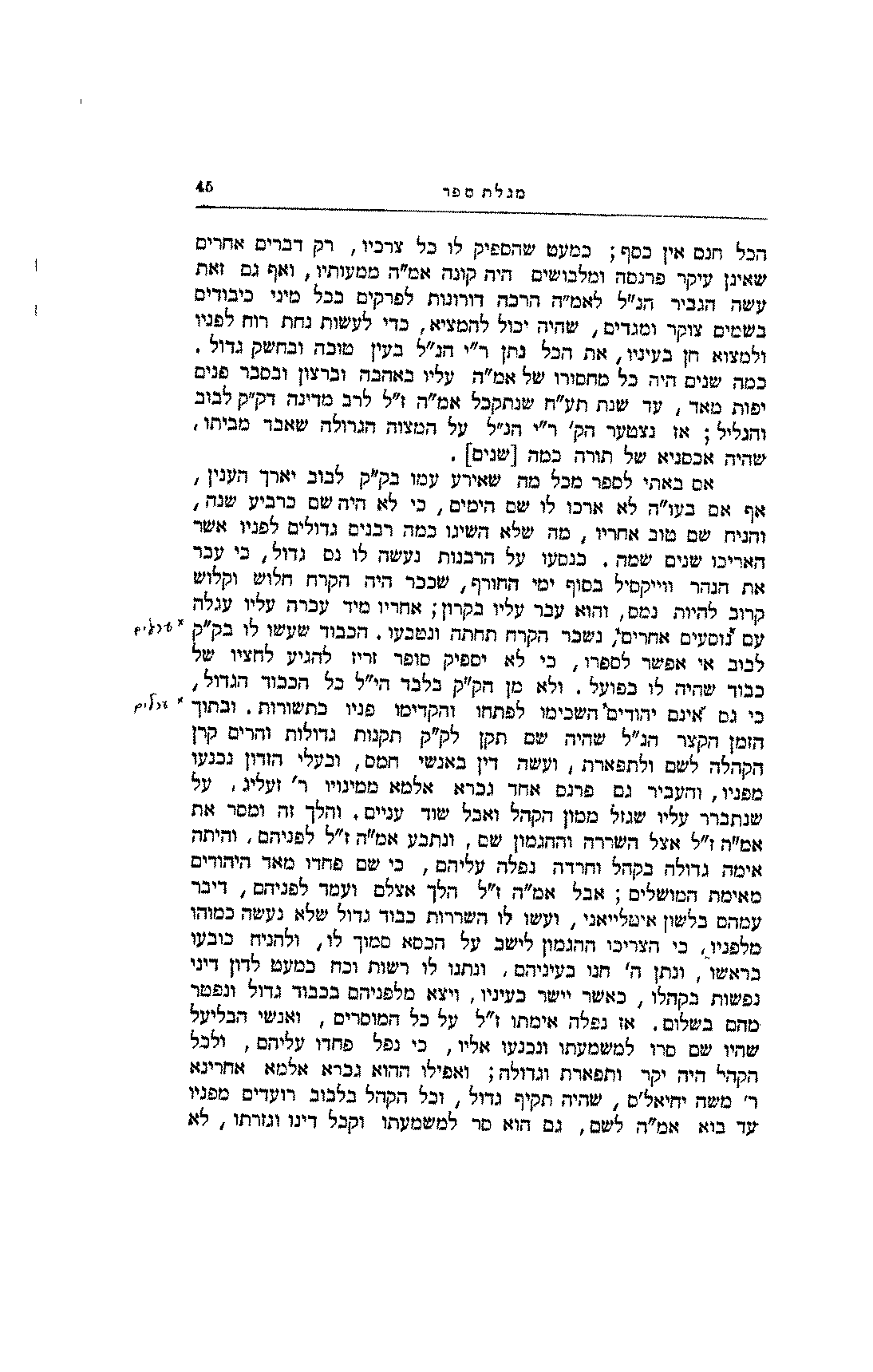
Margin readings in Scholem's copy (2)
| Printed anchor | Type (key sheet) | Mark | Reading | Certainty |
|---|---|---|---|---|
| עברה עליו עגלה עם נוסעים אחרים x | X: substitution | x mark; one word (Kraken read it as a line: שרלים) | ערלים | fairly sure |
| כי גם אינם יהודים x השכימו לפתחו | X: substitution | x mark; one word | ערלים | fairly sure |
Page 46 (scan 58)
question him, for they knew him to be a holy man, and all his deeds done in faith and for the sake of Heaven alone. Once that strong-armed man, R. M. Y., had a case before my father and lost; he did not open his mouth, but was his faithful friend all his days. So too it happened with his relative by marriage who had brought him to the rabbinate of Lwów, the ḥaver R. Ḥ. Leizerl [a]. He was exceedingly rich and respected in the community for his wealth and his lineage, and also in his own right, for he was a man of great standing, handsome and wise. He had a lawsuit before my father, and my father tore up a bond he had produced against someone; for in his wisdom he saw that he had "let iniquity dwell in his tent" (Job 11:14). So he showed him no favour and tore it up in front of him. The judges stood astonished at this, and he too cried out at first, why had he done this to him; and my father laughed at him and mocked him. Afterwards he admitted of his own accord that it was a mere potsherd, and that he had only drawn it up on an old loan; even so he accepted his judgement gladly.
All the world knew that "the wisdom of God was in him to do judgement" (1 Kgs. 3:28), and his name kept growing, also among the neighbours ⟨S: "the uncircumcised"⟩, until some of them too came before him to have their cases judged. Greek merchants came to him, each bringing his present, and he spoke with them in the language of Ishmael. In short, this merit had never fallen to any rabbi in the land of Poland, for his name was great among the nations.
"And the Jews had light" (Esth. 8:16), for he was a father of Israel, looking after the affairs of the public and of private persons. In general and in particular he set all his mind on making them all content and orderly, guided with uprightness by the religion of Moses and Israel — both in the affairs of the community and the assessment of the heavy taxes, and in matters between a man and his fellow — to set true justice in the land without respect of persons.
So too in the study of Torah he set his heart to correct the general error among the Ashkenazim. Above all in Poland the order of study had been corrupted: they had abandoned the study of the Bible altogether, so that "little foxes" become rabbis who have not even read Scripture, do not know the Mishnah, are not expert in the shape of a tradition, and have never seen the early codifiers. That righteous man grieved over this all his days. When the Blessed One granted him to sit at the head, as rabbi of the province in Lwów and its district, he at once remembered this, to make a great reform in the order of study and its uprightness: that they should proceed properly, according to the Mishnah, "at five years old to Scripture", and so on, so that the children and the students would succeed in their studies. He had already called to him all the teachers in the community of Lwów and set them their manner of teaching: Scripture first, with grammar. Had they been worthy, and had he sat in the Council of the province, the assembly of the district and the Four Lands of Poland, he would surely have reformed the whole diaspora in this matter too, the proper order of study,
Kahana's notes
- [a] He was the relative by marriage of the gaon Ḥakham Tzvi, of blessed memory; see what Emden writes below (p. 64).
הרהר אחריו, שהכירו לאיש קדוש, וכל מעשהו באמונה ולשם שמים בלבד. ופעם היה לו לאיש זרוע רמ"י הלז משפט לפני אמ"ה ז"ל והפסיד, לא פצה פה אך היה לו לאוהב נאמן כל הימים. וכן אירע עם מחותנו שהביאו על הרבנות דלבוב, הוא החבר ר"ח ליזרל א, שהיה עשיר מופלג ונשוא פנים בקהל מחמת עשרו ויחוסו, גם מצד עצמו לפי שהיה אדם מסוים מאד, גם בנוי ובחכמה, והיה לו עסק דין לפני אמ"ה, וקרע לשט"ח שהוציא על אחד, כי הוא ז"ל השיג בחכמתו שהשכין באהלו עולה, לכן לא נשא לו פנים וקרעו בפניו, ועמדו הדיינים משתוממים על ככה, גם הוא צוח מתחלה על מה עשה לו ככה, ואמ"ה שחק ולעג עליו; אח"כ הודה מעצמו שהיה חספא בעלמא, רק על מלוה ישנה נקטיה, מ"מ קבל עליו דינו בשמחה. וידעו כל העולם, כי חכמת אלהים בקרבו לעשות משפט, והיה שמו הולך וגדול גם בין השכנים, עד שבאו מהם גם לפניו לעשות משפטם. והיו באים אליו סוחרים יונים מביאים איש מנחתו אליו, והוא מדבר עמם בלשון ישמעאל. בקיצור זאת הזכייה לא היתה לשום רב במדינת פולין מעולם, כי גדול שמו בגוים. וליהודים היתה אורה, לפי שהיה אביהן של ישראל, לפקח על עסקי הרבים והיחידים. בכלל ובפרט שם כל מעיינו, שיהיו כולם מאושרים ומסודרים, מונהגים ביושר כדת משה וישראל, הן בעסקי הקהל ובערכי המסים הכבדות, והן בדברים שבין אדם לחברו, לשום משפט אמת בארץ בלי משא פנים. וכן בעניני למוד התורה, שם אל לבו לתקן המעות הכללי שבין האשכנזים; ביחוד בפולין נתקלקל סדר הלמוד, ובעזבם למוד המקרא לגמרי, באופן שנעשים רבנים שועלים קטנים, דאפילו מקרא לא קרו, גם במשנה לא ידעו ולא בקיאי בצורתא דשמעתא, ופוסקים ראשונים לא ראו. על דבר זה נצטער אותו צדיק כל ימיו, וכאשר זכהו הי"ת להושיבו בראש ורב מדינה בלבוב והגליל, מיד עלה בזכרונו דבר זה לעשות תיקון גדול בענין סדר הלימוד והיושר, שיתנהגו כראוי והגון כפ"ד המשנה בן חמש למקרא וכו', באופן שיצליחו הבנים והתלמידים בלמודם. וכבר קרא אליו כל המלמדים שבקהל לבוב, וסדר להם אופן למודם במקרא תחלה ע"פ הדקדוקים, ואם היו זוכין, והיה יושב אצל הועד מדינה, ואסיפת הגליל וד"א דפולין, אזי ודאי היה מתקן כל הגולה גם בענין הלז של סדר הלמוד ביושר
- [א] הוא מחותנו של הגאון חכם צבי ז"ל, ועיין מה שכתב יעב"ץ להלן (צד 64) .
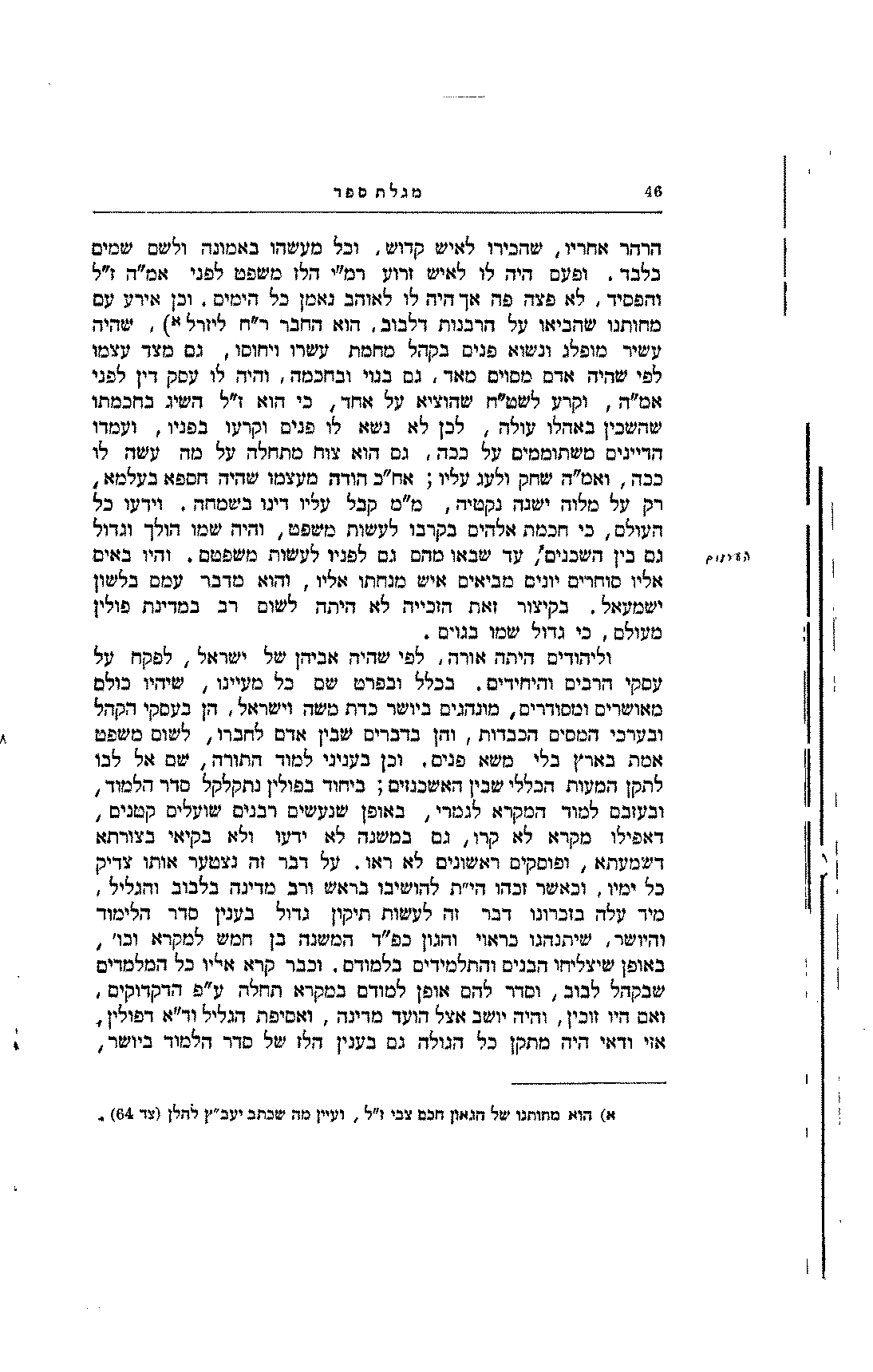
Margin readings in Scholem's copy (1)
| Printed anchor | Type (key sheet) | Mark | Reading | Certainty |
|---|---|---|---|---|
| והיה שמו הולך וגדול גם בין השכנים x | X: substitution | x mark; one word (Kraken: הערמום) | הערלים | fairly sure |
Page 47 (scan 59)
as in the other great reforms he meant to introduce for the good and benefit of all Jewry, which would surely have been worthy to bring the redemption near, had the generation merited to see his plan carried out and to live by his godly ways. But sins caused his sun to set before its time: he lived there only about a quarter of a year. Suddenly the destroyer came. On the New Moon of Iyar 5478 [1718] the lamp of Israel of the holy community of Lwów went out; their light was darkened, their joy turned to mourning, and all the land of Poland wept and mourned at the evil news. They mourned and lamented him as the one unique in his generation; even the lords of the provinces of Poland lamented him.
It is impossible to set down in a book the good name that my father left among Israel and among the neighbours ⟨S: "the uncircumcised"⟩; it would not be believed if it were told. For our many sins, it was heard that the lords said: "The Messiah of the Jews came to Poland, and they killed him." So I heard when I passed there half a year later, travelling to visit my father's grave ⟨S: a word, not read⟩; and all along the long road I heard people telling wonders of him ⟨S: a four-line note, partly read: "… and he did good things in Lwów …"⟩. Most of them I have forgotten because of all that befell me afterwards.
When the news of his death reached Germany, they lamented him in all the communities with great bitterness, and said: "Woe to the generation that has lost its leader and captain!" The Sephardi community in London also did him great honour at his death [a] ⟨S: a three-line note, partly read: "as is done for kings …"⟩. And a trustworthy man who was in Amsterdam told me that at the time they eulogised my father there, Ḥakham A. [b] cried out with a full mouth: "Truly I have sinned against Ḥakham Tzvi, of blessed memory!" Several of the famous rabbis ⟨S: a long note, partly read; its place is not certain: "[the synagogue] hung with black, and all … the parnassim and the elders sat on the ground … mourning, lamenting and eulogising him like the mourning for the destruction of Jerusalem"⟩ in the land of Poland — namely the geonim R. Joshua, who is now head of the court of the holy community of F[rankfurt], and R. … [c] ⟨S: "Eleazar"⟩, who was afterwards head of the court in the holy community of Amsterdam, and R. Meir, head of the court of Tykocin — tore their garments for him and sat on the ground, keeping mourning for one day. And my ears heard one of the great men of the generation say of my father that the world was not worthy to use so holy a vessel, in whom was the soul of one of the early Tannaim.
For our many sins his days were evil, as we have seen from a little of much of his affairs, and from the hard events and fearful times that passed over him. He was persecuted and insulted many times by the thorns of our people "at the edge of the camp", because of his uprightness, righteousness and integrity, for he showed no favour in Torah. For this godly trait the presumptuous and the moneyed men multiplied against him; they "embittered him, and shot at him, and hated him, the archers" (Gen. 49:23); "those given to change"
Kahana's notes
- [a] See above (p. 37).
- [b] The abbreviation means Ḥakham Ayllon: he is the rabbi of the Sephardim, R. Solomon Ayllon, mentioned earlier (p. 30).
- [c] The name of this rabbi is left out in the manuscript. In my opinion it is perhaps the rabbi R. Eleazar of Brody, who was rabbi in Amsterdam from 5495 to 5500 [1735–1740]. See She'erit Yisrael, ch. 34 (fol. 140), in Judeo-German.
כמו בשאר תקנות גדולות שהיה בדעתו לחדש לטובת ותועלת כלל היהדות, שהיה כדאי לקרב הגאולה בלי ספק, אם היה הדור זוכה שיצא מחשבתו לפועל, להתנהג ע"פ מדותיו האלהיות; אך העוונות גרמו ששקעה שמשו שלא בעונתו, לא האריך ימים שם כי אם כרביע שנה; פתאום בא השודד, בר"ח אייר תע"ח כבה נר ישראל ק"ק לבוב, חשך אורם נהפך לאבל ששונם, וכל ארץ פולין בוכים ומתאבלים לקול השמועה הרעה, ויעשו לו אבל יחיד בדורו ומספד, ואפילו שרי מדינות פולין קוננו עליו, וא"א לבאר על ספר שם הטוב, שהניח אחריו אמ"ה ז"ל בין ישראל ובין השכנים, לא יאומן כי יסופר בעו"ה נשמע שאמרו השרים: משיח היהודים בא לפולין והמה המיתוהו; וככה שמעתי, בעברי שם אחר חצי שנה, שנסעתי שם לבקר על קבר אמ"ה ז"ל, ובכל הדרך הארוך שמעתי מספרים ממנו נפלאות, ורובם שכחתי מחמת כל הקורות אותי אחר זאת. ובבוא שמועתו לארץ אשכנז, הספידוהו בכל הקהלות במרירות גדולה, ואמרו: אוי לדור שאבד מנהיגו וקברניטו! גם ק"ק ספרדים שבלונדון עשו לו כבוד גדול במותו א, גם הגיד לי איש אמת שהיה באמשטרדאם, בעת שהספידו שם את אמ"ה ז"ל, וצעק ח"א ב בפה מלא: אמנה אנכי חטאתי לחכם צבי ז"ל! וכמה מהרבנים המפורסמים בארץ פולין ה"ה הגאונים מו"ה יהושע שהוא כעת אב"ד דק"ק פ ומו"ה ג, שהיה אח"כ אב"ד בק"ק אמשטרדאם, ומו"ה מאיר אב"ד דטיקטין קרעו בגדיהם עליו וישבו על הארץ, נהגו אבילות יום אחד; ושמעו אזני מגדול הדור אחד שאמר על אמ"ה ז"ל, שלא היה העולם כדאי להשתמש בכלי קדוש כזה, שהיתה בו נשמת איזו תנא מתנאים קדמונים. ובעו"ה היו ימיו רעים, כאשר ראינו מעט מהרבה מעניניו, ומהמקרים הקשים והעתים המבעתים שעברו עליו, והיה נרדף ונעלב פעמים הרבה מקוצי בני עמנו שבקצה המחנה, בעבור ישרו וצדקתו ותומתו, שלא נשא פנים בתורה; ועל מדתו האלהית הזאת רבו עליו אנשי הזדון ובעלי ממון וימררוהו ורובו וישטמוהו בעלי חצים, שונים
- [א] עיין לעיל (צד 37).
- [ב] ר"ת: חכם אילין, הוא הרב של הספרדים ר"ש אילין הנזכר מקודם (צד 30).
- [ג] נשמט בכ"י שם הרב הזה. ולדעתי אולי הוא הרב ר' אלעזר מבראדי שהיה רב באמשטרדם משנת תצ"ה עד שנת ת"ק. עיין בס' שארית ישראל פרק ל"ד (ד' ק"מ) בלשון יהודית אשכנזית.
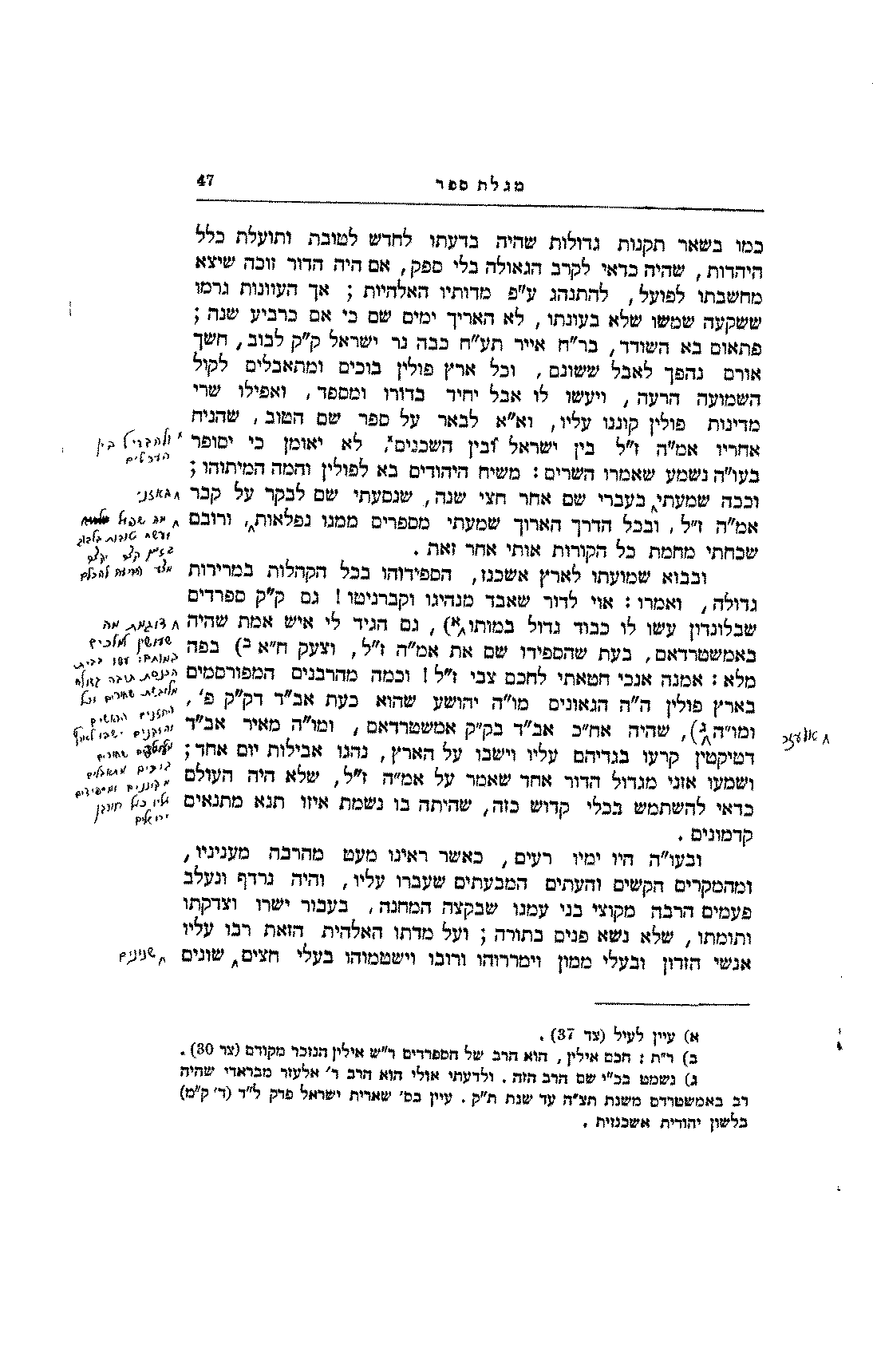
Margin readings in Scholem's copy (6)
| Printed anchor | Type (key sheet) | Mark | Reading | Certainty |
|---|---|---|---|---|
| שהניח ... בין ישראל ובין השכנים x | X: substitution | x mark; 2-word note (Kraken: הדרלים) | ... הערלים | fairly sure |
| שנסעתי שם לבקר על קבר ^ אמ"ה | V: omission | caret; short note | not read | not read |
| שמעתי מספרים ממנו נפלאות ^, ורובם | V: omission | caret; 4-line note (Kraken: ועשה טובות בלבוב) | ... ועשה טובות בלבוב ... (partly read) | partial |
| גם ק"ק ספרדים שבלונדון עשו לו כבוד גדול במותו ^ | V: omission | caret; 3-line note (Kraken: שעושין למלכים) | כדוגמת מה / שעושין למלכים / ... (partly read) | partial |
| וכמה מהרבנים המפורסמים (position approximate) | — | long note in right margin (Kraken: מלובשת שחורים וכל / ... הפרנסים / והזקנים ישבו לארץ / ... מתאבלים / מקוננים מספידים / עליו כאבל חורבן / ירושלים) | [the synagogue] dressed in black, and all ... the parnassim and the elders sat on the ground ... mourning, lamenting and eulogizing him like the mourning for the destruction of Jerusalem (partly read) | partial |
| ומו"ה ^ ג), שהיה אח"כ אב"ד בק"ק אמשטרדאם | V: omission | caret; one word (Kraken: אועזר) | אלעזר (the name missing in Kahana; Kahana's note guesses R. Eleazar of Brody) | fairly sure |
Page 48 (scan 60)
joined together against the eye of judgement — the eye that executed the attribute of justice in the world, they sought to blind it. But there was not one who waged war against him who was not burned by his coals: in the end he was struck in body and in money, for the Holy One, blessed be He, demands His honour. It would take long to tell all that befell several who stood at a very high and lofty level, whom his curse reached: in the end they came down from their wealth to the lowest level, and several were uprooted, God save us, they and their households. I will tell only two or three grains of it for the last generation, so that they may know, understand and consider this, and see how true are the words of the Sages, "beware of their coals" (Avot 2:10) and "wherever the Sages set their eyes" and so on, as we have seen many times with our own eyes; and let them take to heart that it is a fire that burns "both soul and body" (Isa. 10:18) to touch the Lord's anointed, His faithful servants, who keep His covenant and do His work in faith, who repair the breaches of the religion and set it on its foundation, and engage in Torah for its own sake.
The first, who received his punishment in public, the like of which has not been heard, and who is very well known in the world, is Aaron Gokkes, parnas for several years in the Ashkenazi community of Amsterdam. He was rich many times a hundred thousand gulden, the strongest and mightiest in the whole community, mentioned (for our many sins) together with his two companions, Yuda Prinz and Mordecai Kohen. These were the three sinners of Israel who were removed from the office of parnas for keeping up the controversy of the cantors, as mentioned above. For that reason they were enemies of my father too, because he would not help them in a sinful thing — to uproot and root out the weak faction as they wished — as I have written above at length. From then on they turned into his enemies, and did my father every insult and disgrace they could, to wound the heart of the righteous; and Gokkes more than them all, because of his great and enormous insolence by nature. They mocked him, also on the strength of their great wealth — though it too had been made dishonestly; therefore that wealth "perished in an evil venture" (Eccl. 5:13): as it came, so it went. He raised a dog and called its name … In short, they rose up against my father's life.
As for his two companions mentioned above, it was not long: immediately after the man of God left there, they lost their possessions and died an evil death. Judah Prinz was strangled. Another parnas whom we saw, whose name I do not wish to mention [a], who was also of the faction of his enemies, fell from a post wagon and broke his neck. But with Gokkes the Blessed One was long-suffering: for several years after this he remained in greatness, went back to his office and his standing as before, gathered the wealth of Korah and behaved with great insolence and brazenness. The world wondered, since they had seen with their own eyes that all my father's enemies had fallen and been broken, snared and caught in their own pits; they thought that the Omnipresent was being indulgent with him, for He waited for him
Kahana's notes
- [a] In my opinion it is Zalman Kopernes, whom Emden mentioned earlier (p. 30).
ומשנים, נזדווגו אל עין משפט, עין שעשתה מדה"ד בעולם בקשו לסמותה, אבל אין אחד שהתגרה בו מלחמה שלא נכוה בגחלתו, סוף שלקה בגופו וממונו, דקב"ה תבע ביקריה, ויארכו הדברים לספר, כל מה שקרה לכמה שהיו במעלה עליונה רמה מאד, שפגעה בהם קללתו, לסוף ירדו מנכסיהם לדיוטא תחתונה, וכמה נעקרו ר"ל הם וביתם. רק שנים שלשה גרגרים אספר לדור אחרון, למען ידעו ויבינו וישכילו זאת, וראו כמה נאמנים דברי חז"ל הזהר בגחלתן וכו', וכל מקום שנתנו בו חכמים עיניהם וכו', כאשר ראינו כ"פ בעינינו, וישימו על לב, כי אש שורפת היא מנפש עד בשר, ליגע במשיחי ה' עבדיו הנאמנים, שומרי בריתו עושי מלאכתו באמונה, לחזק בדקי הדת להעמידה על תלה ועוסקים בתורה לשמה . והאחד שקבל ענשו בפומבי, מה שלא נשמע דוגמתו, מפורסם מאד בעולם, הוא ארון גאקיש, פרנס כמה שנים בק"ק אשכנזים דאמשטרדם, והיה עשיר מכמה פעמים מאה אלפים זהובים, תקיף ועצום שבכל הקהל שנזכר בעו"ה ממנו ומחביריו השנים יודא פורינץ ומרדכי כהן. אלה היו ג' פושעי ישראל, שהוסרו ממינוי פרנסות ע"י שהחזיקו במחלוקת של החזנים כנז"ל, ועד"ז היו לו לאויבים גם לאמ"ה ז"ל, מחמת שלא היה מסייעם לדבר עבירה, לעקר ולשרש את הכת החלושה כחפצם לראות בם כמש"ל באורך, מאז נהפכו לו לאויבים, ועשו לאמ"ה ז"ל כל הבזיונות והקלונות שיכלו לעשות, להכאות לב צדיק, וגאקיש יותר מכולם כלפי חוצפתו הגדולה העצומה בטבעו; והיו מלעיגים עליו, גם מצד עשרו הרב, אם אמנם היה ג"כ עשוי שלא ביושר, על כן אבד העושר ההוא בענין רע, כאשר בא כן הלך. הוא גדל כלב וקרא שמו... בקיצור עמדו על חייו של אמ"ה ז"ל. ולשנים האחרים, חבריו הנ"ל, לא ארך הזמן, כי מיד אחר נסע איש האלהים משם ירדו מנכסיהם נקיים ומתו בענין רע: יהודה פרינץ נחנק. עוד פרנס אחר שראינו, שאיני רוצה להזכיר שמו א, שהיה ג"כ מכת שונאיו, נפל מעגלה של פאשט ונשברה מפרקתו. אך לגאקיש האריך הי"ת: כמה שנים אחר זאת נשאר בגדולה, וחזר לפרנסתו ומעלה כבתחלה, ואסף עשרו של קרח והתנהג בחוצפה גדולה ועזות, והיה העולם מתמיהים, מאחר שראו בחוש שכל שונאי אמ"ה ז"ל נפלו ונשברו נוקשו ונלכדו בשחיתותם, כסבורים המקום וותרן הוא לו, כי המתין לו
- [א] ולדעתי הוא זלמן קופרנעס שהזכיר יעב"ץ מקודם (צד 30).
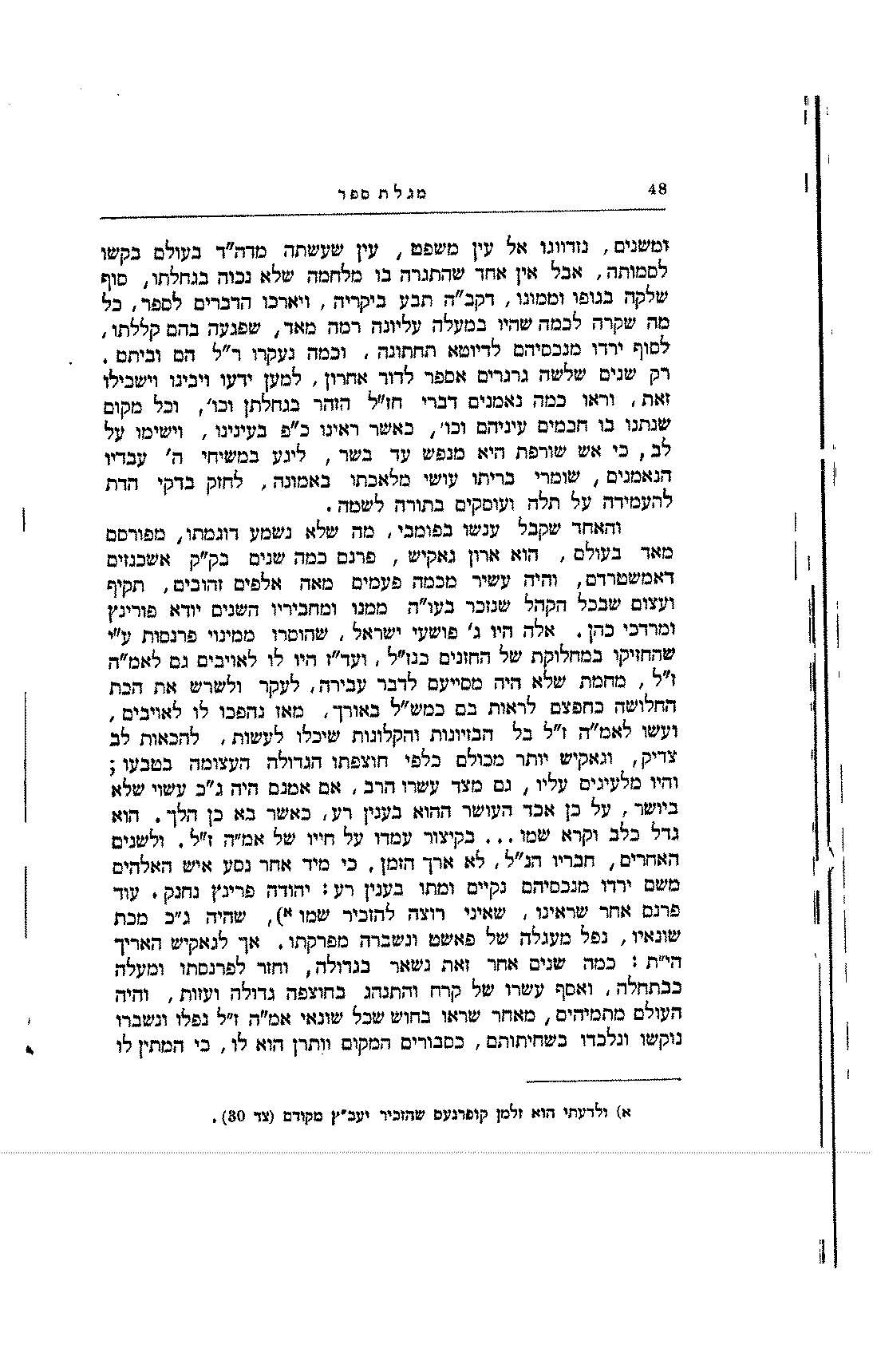
Page 49 (scan 61)
more than twenty years after them. But suddenly his ruin came, the time of his reckoning. Over a small, empty matter he was arrested by the magistrate of Amsterdam. At first he could have settled it for a small sum; even afterwards he could have bought himself free for some hundreds of gulden; but "the rich man answers roughly" (Prov. 18:23). Later he wanted to give ten thousand gulden to be released from prison, and the magistrate, who had set his eyes on the large sum, was already willing; but it was from heaven that he had come into an evil net from which he could not get out — "and the ox fell", and so on. For the authorities decreed that he be kept in prison; "the iron entered into his soul" and his feet were put in the stocks (Ps. 105:18); he was condemned to death as an outright thief. They brought him out on the holy Sabbath to judge him and put him to death like a villain; they broke the staff over him and read out his sentence before him at the place of judgement by the gallows, in the sight of tens of thousands of people.
After this they did him the "kindness" of leaving him a life worse than death. They stripped him naked and flogged him with rods — they executed judgements on him — and left him his life as a spoil. They took him back to prison and sentenced him to the hard labour of sawing Brazil wood [a], which is as hard as stone, with a saw that weighs several hundred pounds: with it they punish those condemned to death who have been shown mercy. So it was decreed that he stay in that prison all the days of his life and do this work day by day, as was set for him; and he was already an old man of more than seventy. There in the prison he ended his life after two years. His money was lost: though the authorities did not lay a hand on his money, it all went to waste; and several of his sons went to evil ways.
At first, when the trouble came on him, he thought little of it, for it was a light thing at the beginning, as said; it was like a joke in his eyes. Afterwards, when he saw the matter growing worse, what he had done to my father rose a little in his thoughts, and he worried a little, and sent a small sum to Lwów to gather a quorum of ten Jews to ask forgiveness for him at the grave of the righteous man, my father. But he received his due in full, as I wrote, and became a byword and a taunt in all the world; for he was very famous in all the countries, among the neighbours ⟨S: a word, perhaps "the uncircumcised"⟩ as among the Jews, for his extreme wealth. Several works and books were printed about this affair in the vernacular ⟨S: perhaps "in the language of the gentiles"⟩, and in them is also told plainly what he did to my father, together with all his other deeds. It was a great sanctification of the Name in the world, for everyone saw and admitted that this trouble came on him because of what he had done to the righteous man: "this was from his hand". Many saw it and feared, and said: "How great and true are the words of the Sages — the righteous are greater in their death." That such a mark should be made on so marked a man — the like of it was not known.
Kahana's notes
- [a] He means wood from Brazil.
יותר מעשרים שנה אחריהם; אך פתאום לפתע בא שברו עת פקודתו, ועל דבר קטן של הבל נתפס מן השופט דאמשטרדאם; בתחלה היה יכול לפצותו בדבר מועט, גם אחר כך היה יכול לפדות עצמו באיזה מאות זהובים, אך הוא העשיר יענה עזות, ושוב רצה לתת עשרת אלפים זהובים שישלחהו חפשי מבית האסורים, וכבר היה נאות לו השופט שנתן עיניו בממון הרב, אך מן השמים היה שבא במצודה רעה, שלא יכול לצאת ממנה ונפל תורא כו', כי השררה גזרה לעכבו בבית הסוהר, ברזל בא נפשו וישם בסד רגלו, ונדון במשפט מות כגנב מוחלט, והוציאוהו ביום שבת קודש לדונו ולהמיתו כמות נבל, ושברו המקל עליו, וקראו לפניו גזר דינו במקום המשפט אצל התלייה לעיני רבבות ב"א. אח"ז עשו לו חסד להניחו בחיים גרועים ממות, והפשיטוהו ערום והלקוהו בשבטים, עשו בו שפטים, והשאירו לו נפשו לשלל, וחזרו והוליכוהו לתפיסה, וגזרו עליו לענותו בעבודה קשה של הנסירה בעצי בראזיל א הקשים כמו אבן, שהמגרה משקלה כמה מאות ליטרין; בה מענישים לחייבי מיתה שהשיגו חסד. ככה נגזר עליו שיעמוד בבית הכלא ההוא כל ימי חייו ויעשה המלאכה הנ"ל דבר יום ביומו כאשר קצבו לו, וכבר היה זקן יותר מבן שבעים שנה. שם בבית הסוהר חתם חייו אחר שנתיים ימים, וממונו אבד, אע"פ שלא שלחה השררה ידי' בממונו, הלך הכל לטמיון, ומבניו כמה שיצאו לתרבות רעה ומתחלה כשבאה עליו הצרה לא חשבה, כי היה דבר קל בראשיתו כנ"ל, אך הוא היה כמצחק בעיניו; אח"כ כשראה הענין ברע מתגבר, עלה קצת ברעיוניו ממה שעשה לאמ"ה ז"ל, ודאג מעט ושלח לק"ק לבוב דבר מועט, לאסוף מנין עשרה מישראל שיבקשו בעדו מחילה על קברו של הצדיק אמ"ה ז"ל, אבל נטל אפופסין שלו משלם כמש"ל, ונעשה למשל ולשנינה בכל העולם, כי היה מפורסם מאד בכל המדינות, בין השכנים כמו בין הישראלים בהפלגת העושר . ונדפסו מן המאורע הלז כמה חבורים וספרים בלעז, ובתוכם נזכר ג"כ מה שעשה לאמ"ה ז"ל בכל שאר מעשיו בביאור, והיה קדוש השם גדול בעולם, שהכל ראו והודו, כי בסבת מה שעשה לצדיק באה עליו הצרה הזאת, מידו היתה לו זאת, ראו רבים וייראו ואמרו: כמה גדולים דברי חכמים ונאמנים, כי גדולים צדיקים במיתתן, וכל שנעשה רושם הזה באיש רשום הזה, מה שלא נודע כיוצא בו.
- [א] הכונה עצים מן בראזיליען.
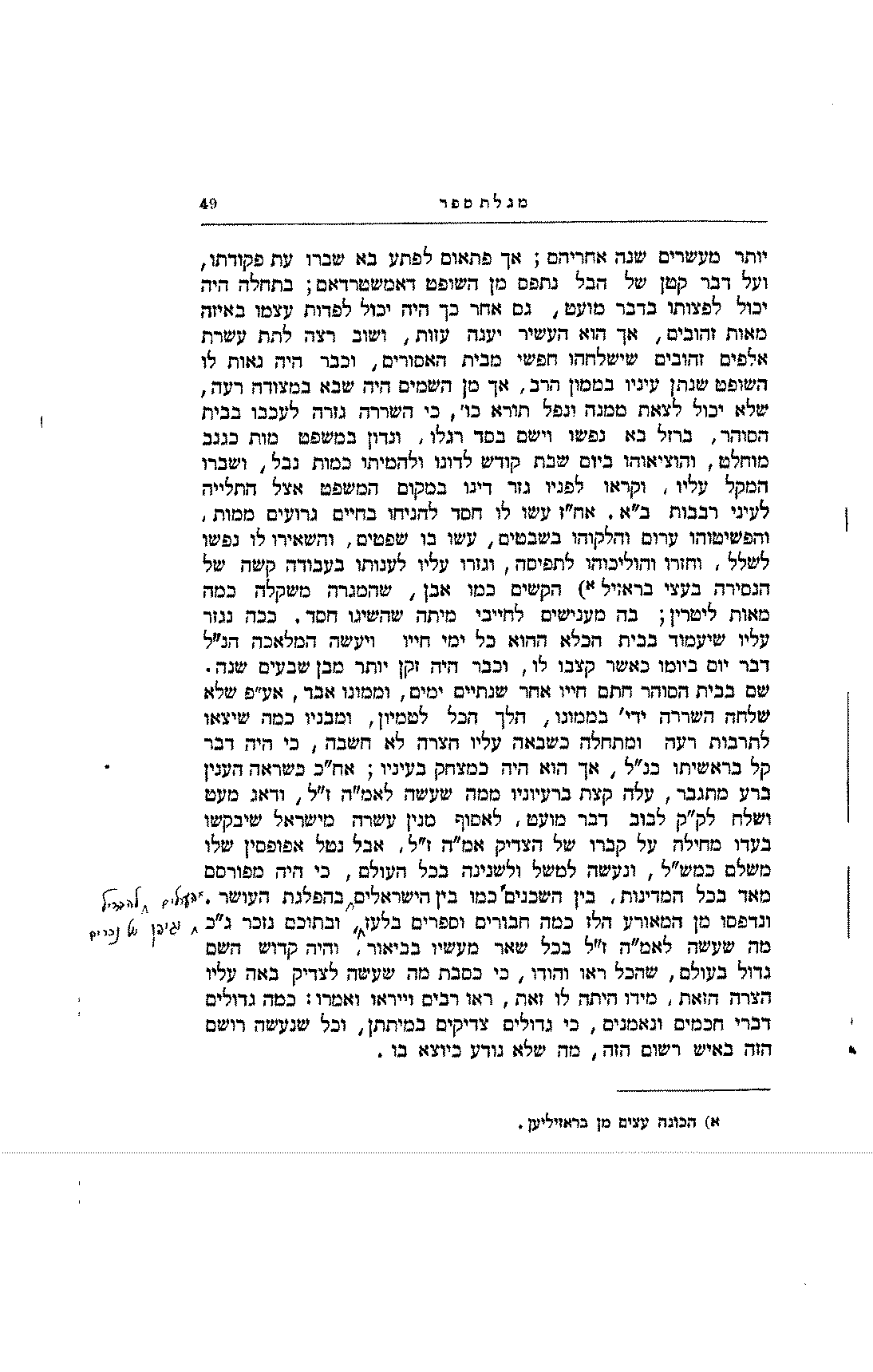
Margin readings in Scholem's copy (2)
| Printed anchor | Type (key sheet) | Mark | Reading | Certainty |
|---|---|---|---|---|
| בין השכנים x כמו בין הישראלים ^ בהפלגת העושר | X: substitution | x mark and caret; 2-word note | ...ערלים(?) | uncertain |
| ונדפסו ... כמה חבורים וספרים בלעז ^ | V: omission | caret; 3-word note | בלשון(?) של נכרים(?) | uncertain |
Page 50 (scan 62)
And as his curse did not return empty, but tore the strong-armed "with the crown of the head" (Deut. 33:20) — the sons of tumult it punished and killed — so his blessing was whole and did not go out empty, but brought great abundance of good and plenty: "the blessing of the Lord, it makes rich" (Prov. 10:22). I will set out only two faithful witnesses as examples.
The first is my kinsman R. A. N., who at the time my father left Amsterdam was his attendant. He did not depart from his tent, and served the rabbi without expecting a reward, though he was roaming after his own living to seek his bread; he had no benefit from my father's money. He also had to support his old and poor father and mother and bring them their food. Even so he did not leave my father, and stood before him at all times to serve him, doing his needs and the needs of his house day by day, more than any day-labourer. When my father set out on his journey towards Poland, this man, who had feared God from his youth, wanted to leave his father and mother and come with my father to serve him on the way, following him to a land he did not know, so as not to leave the righteous man without service. But my father ⟨S: a four-line note, partly read⟩ would not let him travel with him and turned him from his purpose; so he stayed in Amsterdam, as I will tell further, with God's help.
The second is the leader R. Aberle London, who was blessed by him when he parted from Hamburg, where my father had sat some days over his lawsuits with his brother-in-law E. P., as said. R. Aberle had been left empty of all his wealth, stripped of his possessions because of the hard judgement and the hard opponent mentioned above; and my father, in his blessing, assured him not to worry, for he was sure that his fortune would rise and quickly flourish for good. And so it was, for no word left his mouth in vain: not many days passed before R. Aberle earned several times a hundred thousand Reichstaler. R. Aberle himself recognised that the righteous man's blessing had stood by him; so when he heard of my father's death he vowed a hundred ducats to his orphans — but his vow was not kept, as I will write, with God's help.
These are the edges of the ways of that great man, my father, who left none like him in Torah, in fear of Heaven and in character — above all in hating gain and loving justice there was none on earth like him. In practical ruling he was unique in his time; all the sages of his generation in Germany and Poland drew living water from his spring, and "after his words they spoke not again", as a man inquires of the word of God. For all the gates of light stood open in his memory: Bible, Mishnah and Gemara, the Ṭurim, the codifiers early and late, responsa old and new ⟨S: a five-line note, partly read: "… books of …, grammar and philosophy …"⟩, and other knowledge. He was expert in several languages, all as if lying ready in a box; eloquent; of very great memory, a sharp heart and an upright mind, deliberate and conclusive. And above all, his piety, his holiness and his care over every detail of the commandments, with great precision, pursuing their fulfilment with all his heart and all his soul; all his aim was to bring merit to the many. He was diligent in study day and night without rest; no one ever found him other than engaged in Torah. His sleep was about three or four hours at most in twenty-four, and his eating and drinking like the eating and drinking of a small child. With this, the radiance of his appearance was like that of a man of God: handsome
וכמו שקללתו לא שבה ריקם וטרפה בעלי זרוע עם קדקוד, בני שאון עניש וקטיל, וככה ברכתו היתה שלימה לא יצאה ריקנית, אבל הביאה שפע רב טוב ושבע, ברכת ה' היא תעשיר, ואפרט רק שני עדים נאמנים לדוגמא: האחד ש"ב רא"ן, שהיה באותו זמן שנסע אמ"ה מאמשטרדם משרתו, לא מש מתוך אהלו ושמש את הרב שלא ע"מ לקבל פרס, עם שהיה שט אחר פרנסתו לבקש לו טרפו, ולא נהנה משל אמ"ה ז"ל, גם היה צריך לכלכל את או"א הזקנים ועניים ומביא מזונם לפניהם, עכ"ז לא עזב אמ"ה ז"ל, ועמד לפניו בכל עת לשמשו, לעשות צרכיו וצרכי ביתו, דבר יום ביומו יותר מכל שכירי יום; ובנסוע אמ"ה ז"ל לדרכו ושם פניו ללכת אל ארץ פולין, רצה הירא הלז מנעוריו לעזוב או"א, לבוא עם אמ"ה לשמשו בדרך, ולילך אחריו אל ארץ אשר לא ידע, שלא לעזוב את הצדיק מלשרתו, אבל אמ"ה לא הניחו ליסע עמו והחזירו מדעתו, על כן נשאר באמשטרדם, כאשר נספר עוד בעזה"י. והשני הוא הק' ר' אברלי לונדון, שנתברך ממנו בפרידתו מהמבורג, שישב אמ"ה מדת ימים על עסק המשפטים שלו עם גיסו א"פ כנ"ל, ונשאר ר"א ריקם מכל עשרו, שיצא נקי מנכסיו בסבת דין ובע"ד הקשה הנ"ל, ואמ"ה בברכתו הבטיחו שאל ידאג כי הוא מובטח שיעלה מזלו ויצמח לטוב מהרה, וכן היה, כי לא יצא מפיו ז"ל דבר לבטלה: לא ארכו הימים והרויח ר"א כמה פעמים מאה אלפים ר"ט, והכיר ר"א בעצמו כי ברכת הצדיק עמדה לו, לכן בשמעו מפטירת אמ"ה נדר ליתומיו מאה אדומים, אבל לא נתקיים נדרו כמש"ל בס"ד. הן אלה קצות דרכי האדם הגדול אמ"ה ז"ל, אשר לא הניח כמותו בתורה, ביראה ובמדות, ביחוד בשנאת בצע ואהבת צדק אין על עפר משלו; ובהוראה היה יחיד בזמנו, וכל חכמי דורו באשכנז ופולין שאבו ממקורו מים חיים, אחרי דברו לא שנו, כאשר ישאל איש בדבר האלקים, כי היו פתוחים בזכרונו כל שערי אורה, במקרא במשנה בגמרא, בטורים בפוסקים ראשונים ואחרונים, וש"ת קדמונים חדשים עם ישנים, ושאר ידיעות, ובקי בכמה לשונות, הכל כמונח בקופסיה, וצח לשון, בעל זכרון עצום מאד, ולב חריף ושכל ישר מתון ומסיק, ועל כולם חסידותו, קדושתו וזהירתו בכל דקדוקי מצות בדיוק גדול, ומחזר אחר קיומן בכל לב ובכל נפש, וכל מגמתו לזכות הרבים, והיה שוקד על הלמוד יום ולילה לא ישבות, לא מצאו אדם אלא עוסק בתורה, שינתו כשלש או ארבעה שעות לכ"ה בכ"ד שעות, ואכילתו ושתיתו כאכילת ושתית תינוק קטן, ועם זה זוהר תמונתו כאיש אלקים, יפה
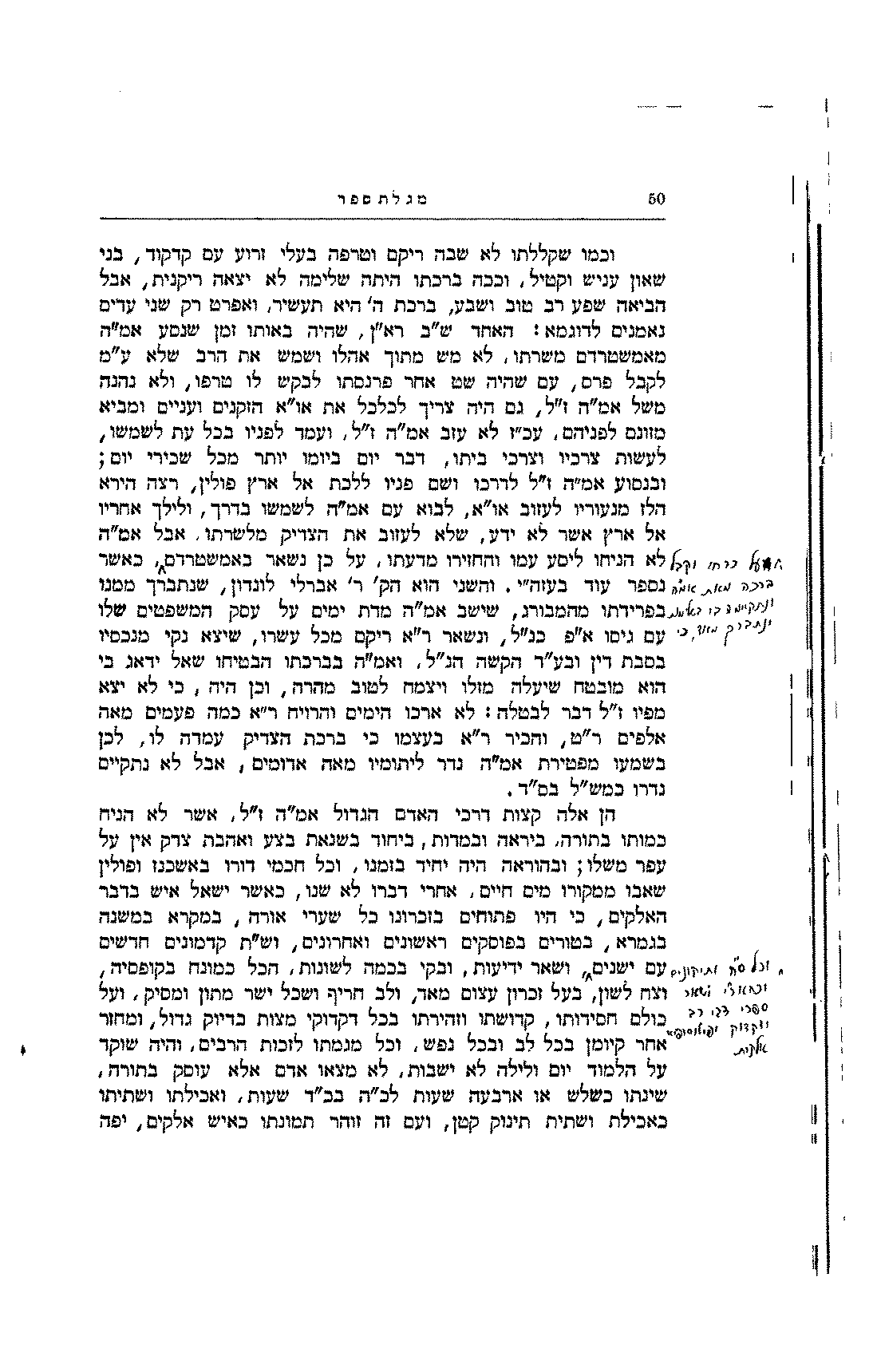
Margin readings in Scholem's copy (2)
| Printed anchor | Type (key sheet) | Mark | Reading | Certainty |
|---|---|---|---|---|
| אבל אמ"ה ^ לא הניחו ליסע עמו | V: omission | caret; 4-line note in right margin | partly read (Kraken: א כיח / היכה ... / ק"ו) | partial |
| וש"ת קדמונים חדשים עם ישנים ^ | V: omission | caret; 5-line note in right margin (Kraken: ... / ספרי ... / ודקדוק ופילוסופיא / ...) | וכל ספרי ... / ... / ספרי ... / ודקדוק ופילוסופיא / אלקות(?) (partly read) | partial |
Page 51 (scan 63)
in form, in features and in looks, splendid. His face tended to roundness, his complexion white and ruddy; his forehead large; his nose a little long, "in its sheath" [a] below (?); his mouth small and very handsome, always closed; his lips lilies; his cheeks free of hair, as if shaved. His beard ran around from ear to ear, like a crown under his jaws, "like beds of spices" (Song 5:13); the point of the beard long, thin and sharp, divided in two, broad in its fullness. His hair was the colour of gold and curled; his flesh soft and tender, and no hair was to be seen on his chest. His appearance as a whole was like an angel of God, awesome, and fearsome in the gaze of his eyes [b]. He received every man with a pleasant face. His speech was eloquent, "his lips speak clearly" (Job 33:3) ⟨S: a seven-line note, partly read⟩. He knew several languages, as said; and the language of his writings in the holy tongue likewise "is ready to speak plainly" (Isa. 32:4), clear and brief.
He was gentle to every man, merciful and a father to the poor, and hard as iron against the stiff-necked, to break the iron sinew of the strong-armed; he was not dismayed before them, "to relieve the oppressed" (Isa. 1:17), to break the jaws of the unrighteous and make him drop the prey from his teeth. He was pious and humble towards those who feared the Lord, and humbled the pride of the presumptuous and the arrogant; with those who speak haughtily he spoke harshly. He showed no favour in Torah, and the fear of flesh and blood never came upon his head. The pen would weary of telling all his awesome deeds, his godly qualities and his cleaving to the Lord — to serve Him and keep His charge with all the heart, all the soul and all the might. I already set down a little of it in my youth, and it came out in print in the pamphlet Yatziv Pitgam, the sermon of his eulogy; and I did not reach half of his honour.
The Blessed One also granted him to bring to print in his lifetime the first part of his responsa, in a fine and excellent printing on good paper, while he was still on the rabbinical seat of Amsterdam. The book is precious and very highly regarded by the learned, as one of the books of the early responsa, and it sells dearly. He also left a collection of manuscripts of Torah novellae, responsa, notes on Gemara, Rashi and Tosafot, and homilies; but strangers' hands took control of them. For a long time they lay in Lissa. Afterwards my wife, of blessed memory, brought them, and I did not touch them; they lay with her these twenty-seven years, "like a stone that no one turns over", until the end of the year 5517 [1757]. Then R. H. came here ⟨S: a word, not read⟩, who had been received as head of the court in London, and pressed me to give them to him, on condition that he bring them out to the light of print, and since he bore his name; and I handed them over to him.
As I wrote, he sometimes had controversies for the sake of Heaven with the Ashkenazi sages of his generation, as can be seen in his responsa, § 2 — above all, that he wrote bitterly against R. Abraham Broda, who was then head of the yeshivah in Prague [c]. The matter that caused
Kahana's notes
- [a] From the Sages' phrase (b. Gittin 76b?) "the sun from its sheath".
- [b] See above (p. 37).
- [c] See Shem ha-Gedolim, Ma'arekhet Gedolim (fol. 3b, § 30), and the memoirs of Glückel of Hameln (pp. 323–324).
צורה תואר ומראה מהודרים, פרצופו נוטה לעיגול ומראהו לבן אדמדם, מצחו גדול, חוטמו מעט ארוך בנרתיק א התחתיתו (?) ופה קטן נאה מאד ועצום תמיד, שפתותיו שושנים, לסתות פנויות משערות כאילו היה מגולח, וזקנו עשוי מקיף מאוזן לאוזן, כעטרה מתחת לחייו כערוגות הבושם, ושבולת הזקן ארוך דק מחודד מחולק לשנים, מעברתו רחבה בדיקניה, שערותיו כגוון הזהב ומסולסלים, בשרו רך וענוג ולא נראה לו שער על חזהו, תוארו בכלל כמלאך האלקים נורא, ומאוים בהבטת עיניו ב, ומקבל את כל אדם בסבר פ"י, דבורו צח שפתו ברור מללו, ומכיר בכמה לשונות כנ"ל, וכן לשון כתיבותיו בלה"ק תמהר לדבר צחות ברור וקצר, נוח לכל אדם רחמן ואב לאביונים, וקשה כברזל כנגד קשה עורף, ולשבר גיד ברזל בעל זרוע, מפניהם לא ייחת לאשר חמוץ, ולשבר מתלעות עול ישליך מפיהם טרף, חסיד ועניו לירא ה', ומכניע גאון זדים וגאים, ועם המדברים גבוהה ידבר קשות, לא נשא פנים בתורה, ומורא ב"ו לא עלה על ראשו מימיו, ילאה. הקולמוס לבאר כל מעשיו הנוראים, ומדותיו האלקיות ודבקותו בה', לעבוד עבודתו לשמור משמרתו בכל לב ובכל נפש מאד, וכבר רשמתי ממנו קצת בילדותי, ובאו בדפוס בקונטרס "יציב פתגם" דרוש הספדו, ולא הגעתי לחצי כבוד. גם זכהו הי"ת להביא לדפוס בחייו ח"א מס' תשובותיו, בדפוס נאה ומשובח ונייר טוב, עודנו על כסא הרבנות דאמשטרדם. והספר יקר חשוב מאד בעיני המשכילים, כאחד מספרי תשובות הקדמונים, ונמכר ביוקר, והניח גם קבוצת כת"י מחידושי תורה ושו"ת ובגפ"ת ודרוש, אך שלטו בהן ידי זרים. זמן רב היו מונחים בליסא, אחר הביאתם זוגתי ז"ל, ולא נגעתי בהם והיו מונחים אצלה זה שבע ועשרים שנה כאבן דאין לה הופכים עד סוף שנת תקי"ז; בא הנה, ר"ה שנתקבל לאב"ד בלונדון, והפציר בי לתתם אליו ע"מ שיוציאם לאור הדפוס ובהיותו נקרא על שמו, ומסרתי בידו. כמש"ל היה לו לפעמים איזה מחלוקות לשם שמים עם חכמי דורו האשכנזים, כמו שנראה בס' שו"ת שלו ס"ב, ביחוד שכתב מרורות נגד מהר"א ברודא, שהיה אז ר"י מפראג ג. והענין שגרם
- [א] מלשון חז"ל (גיטין ע"ו, ע"ב) חמה מנרתיקה.
- [ב] עיין לעיל (צד 37).
- [ג] עיין שה"ג מע"ג (דף ג' ע"ב סי' ל'), ועיין בספר זכרונות מרת גליקל האמיל (צד שכ"ג ושכ"ד).
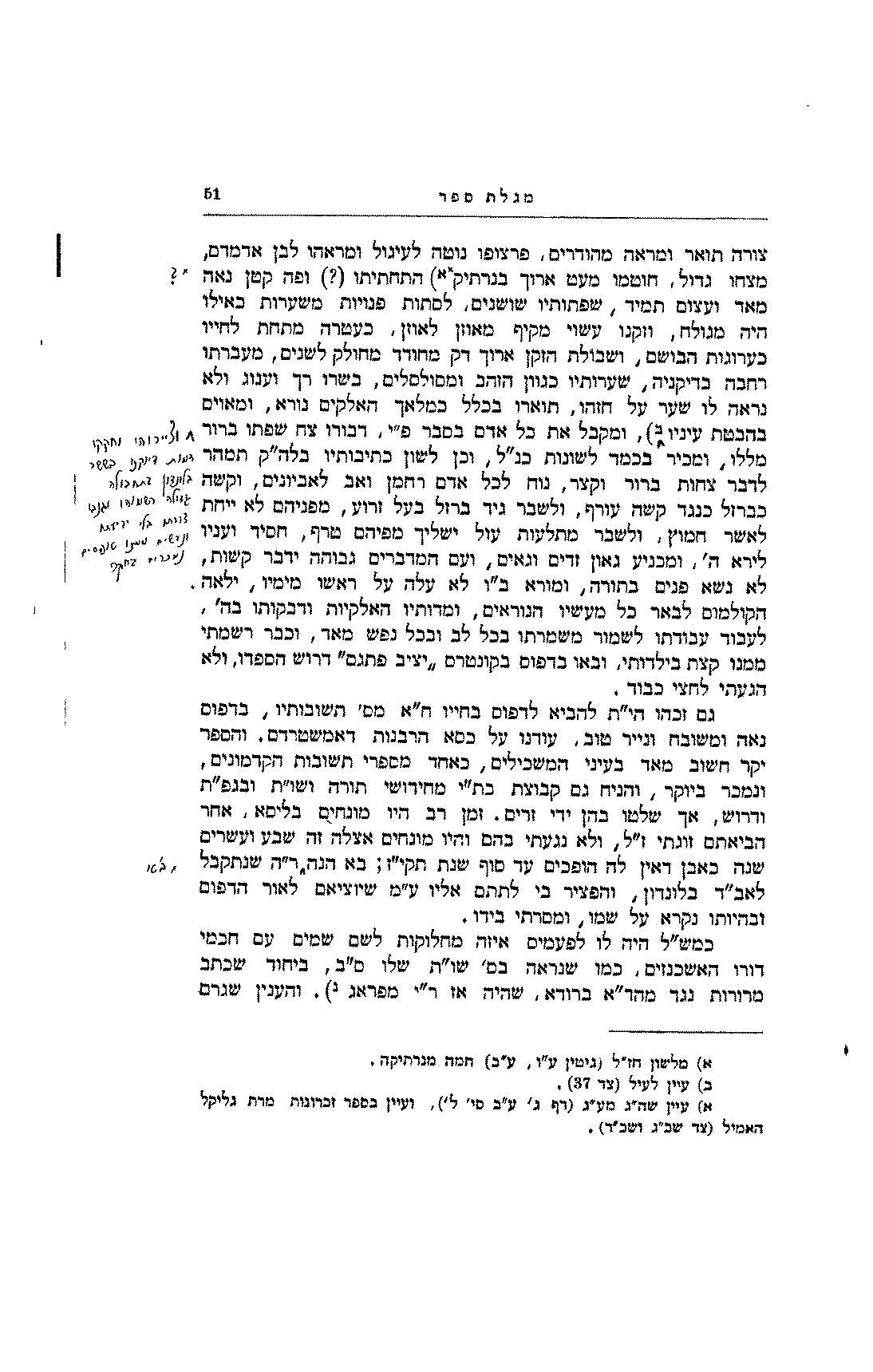
Margin readings in Scholem's copy (2)
| Printed anchor | Type (key sheet) | Mark | Reading | Certainty |
|---|---|---|---|---|
| דבורו צח שפתו ברור ^ מללו | V: omission | caret; 7-line note in right margin | partly read (Kraken fragments not usable) | partial |
| בא הנה ^ ר"ה שנתקבל לאב"ד בלונדון | V: omission | caret; short note | not read | not read |
Page 52 (scan 64)
strictness between them. I will tell here something that happened, a story I heard from the holy mouth of my father. The said rabbi made a match for his son with the daughter of Israel Fürst, and he was in Hamburg for his son's wedding. My grandfather, the rabbi R. Zalman Mirels, then sat on the rabbinical throne of the Three Communities; he made a feast in honour of the rabbi R. Abraham, his son and his relative by marriage. My father was then in his year of mourning for his own father, so he did not go to the feast. But during the feast my father went, uninvited, to his father-in-law's house, to greet the visiting scholar and ask after his welfare; and he took with him his students, the outstanding scholars of the Kloyz of Altona. They greeted R. Abraham, and he asked my father: "Why has the master not greeted me until now, coming first to visit me at the house of his relative?"
As soon as my father heard that he sought greatness for himself so openly, before all who stood there, he was stirred by it, and answered wisely: "I know Mishnah and Gemara. There is the story in the first chapter of Ḥagigah, of Rabbi and R. Ḥiyya who were walking on the road. They said: 'If there is a young scholar here, let us go and greet him.' They were told: 'There is one, and he is blind' — and they went to him, and so on [a]. From this we learn that the law is that the guest goes first to greet the scholar of the town." And he went on: "You must admit that you are not greater in our generation than our holy Rabbi was in his; and surely I am at least of no lesser standing in this generation than that young scholar in that one. Rabbi, of necessity, did not know of that scholar at all and had never heard his name — that is why he asked 'Is there a young scholar here?' — so his existence was quite unknown to Rabbi; whereas you, sir, at least knew that I am here. So the law would have it that you come to me and greet me first, at the least. For Rabbi asked 'Is there a young scholar here? Let us go and greet him', and though Rabbi was the prince of all Israel, he wished to go and greet the scholar of the town, whoever he might be. So you asked improperly; and I acted beyond the letter of the law in coming here this time. As for my not coming to the feast to which I was invited, at which a scholar is reclining: it is forbidden to me to attend an optional feast because of my mourning. Even so, for your honour I have come now."
When R. Abraham heard that my father had bested him with his triumphant answer, he spoke to him again: "If so, the master should have sent his students to me to greet me and ask after my welfare. That is what I did for a great man who came to my town: I did not go to him myself, but sent my students in my place to ask after his welfare." My father answered him: "I have no students." R. Abraham spoke again and said: "Then who are these who came with your honour?" My father answered: "These are my colleagues." And with this
Kahana's notes
- [a] Ḥagigah (fol. 5).
קפדנות ביניהם, אספרה הלום מעשה שהיה, ספור ששמעתי מפה קדוש אמ"ה ז"ל: הרב הנ"ל השתדך עם בנו לבת ישראל פערשט, והיה בהמבורג על נישואי בנו, אז יש]ב[ אמ"ז הרב מהר"ז מירלש על כסא הרבנות דג"ק, הוא עשה סעודה על הרב מוהר"א ז"ל ובנו ומחו', ואמ"ה ז"ל היה אז בשנת אבלו על אביו ז"ל, על כן לא הלך לסעודה הנ"ל, אך בתוך הסעודה הנ"ל הלך אמ"ה ז"ל לבית חמיו בלי קריאה, ולהקביל פני הת"ח האורח ולשאול לו שלום, ולקח עמו תלמידיו הלומדים מופלגים שבקלויז דאלטונא, ונתנו לו שלום למוהר"א, וישאלהו לאמ"ה ז"ל עד האידנא מ"ט לא שאל לי מר לשלמא, להקדים לבוא אליו להקביל פניו בבית מחותנא. מיד כשמוע אמ"ה ז"ל כי בקש גדולה לעצמו בפה מלא. לנגד כל העומדים עליו נתפעל מזה, וענה בחכמה: אנא מתניתא וגמרא ידענא, ההוא עובדא דפ"ק דחגיגה דרבי ור"ח דאזלי באורחא, אמרי אי איכא צורבא מרבנן הכא ניזיל ונקבל אפיה, א"ל איכא חד ומאור עינים הוא אזלו לגביה וכו' א, ש"מ שדין האורח שילך לקבל פני הת"ח שבעיר תחלה. ויוסף ויאמר אליו: הנה על כרחך תודה שאינך גדול בדורנו מרבינו הקדוש בדורו, גם ודאי שאני עכ"פ איני פחות הערך בדור הזה מההוא צ"מ בדור ההוא, בהכרח כי אותו ת"ח לא ידע ממנו רבי כלל, ולא שמע שמו מעולם, כי על כן שאל איכא צ"מ הכא, מכלל שנעלמה מציאותו לגמרי מרבי, ומר ידע ממני עכ"פ שאני מצוי פה, א"כ הדין היה נותן שיבוא אלי ויקבל פני תחלה לפחות, שהרי רבי שאל איכא צ"מ הכא, ניזיל ונקבל אפיה, אע"פ שהיה רבי נשיא של כל ישראל, רצה לילך להקביל פני ת"ח שבעיר, יהא מי שיהא, לכן שאל מר שלא כהוגן, ואני לפנים משורת הדין עשיתי, שבאתי הלום הפעם הזאת; ולהתנצל על שלא באתי לסעודה שנקראתי אליה, שת"ח מסב בה, כי אסור לי לבוא על סעודה של רשות מחמת אבלי, ואעפ"כ לכבודו באתי עתה. אז כשמוע מוהר"א ז"ל שקפחו אמ"ה ז"ל בתשובתו הנצחת, הוסיף עוד לדבר אליו: א"כ היה לו למר לשלוח תלמידיו אלי לקבל פני ולדרוש שלומי, וכך עשיתי אני לגדול אחד שבא למקומי, ולא הלכתי בעצמי אליו, אלא אך שלחתי את תלמידי במקומי לד"ש. ויענהו אמ"ה ז"ל אני אין לי תלמידים. ויוסף עוד מוהר"א לדבר אליו ויאמר, ומי הם אלה שבאו עם מעכ"ת, השיב אמ"ה ז"ל, אלה הם חברי, ובזה
- [א] חגיגה (דף ה').
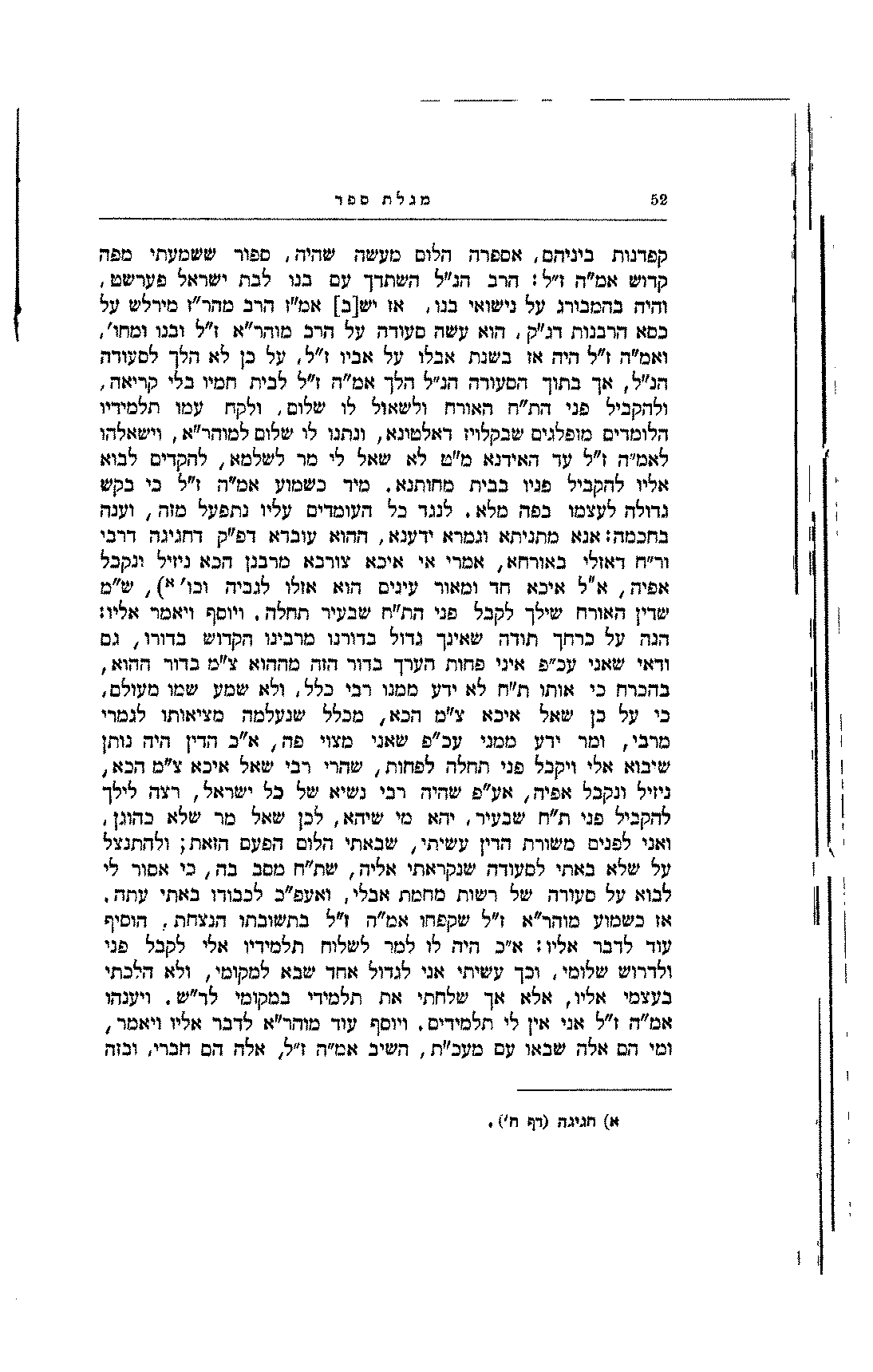
Page 53 (scan 65)
they let that subject drop. Then my father began on the previous day's discourse. On the holy Sabbath R. Abraham had preached in the synagogue of Altona, and my father was there too; he listened and kept silent, for he turned his face to the wall and would not enter into debate and argument with him in the synagogue. That was his way and his custom with preachers: not to pay attention to them, whether they said good or bad. Only this time he found reason to take offence, "because an excessive spirit" (Dan. 6:4) he saw in R. Abraham's mind. So my father said to him: "Yesterday, in your sermon, you answered a difficulty" (I do not know what it was) "and it is a mistake and an error." They entered into debate, until R. Abraham grew weary and called to his son the bridegroom: "Moses, answer him!" My father had no son at that time, and his little daughter was there in my grandfather's house. So my father called: "Miriam, my daughter, come and answer him!" And they parted in anger.
But in the end there was love after all: the next day R. Abraham sent a scholar to my father to ask forgiveness on his behalf, and let him know that he had taken upon himself to fast one day for having provoked him. From this we see that R. Abraham too was a pious man, though his spirit was not lowly; and from then on they were reconciled, and "the rabbis made peace". Even so, when R. Abraham's responsum reached my father, he said: "He fell at once" — to show that he should not have been so haughty towards him.
By the way I will also tell what happened another time. The rabbi R. A., son-in-law of ⟨S: "and there was also the rabbi R. …, head of the court of N.S., who married his son to the daughter of"⟩ Mordecai Kohen, preached, and the rabbi R. M. G. rebuked R. A., because in his opinion he had preached something blameworthy. R. A. mocked him and said: "If what I said and expounded were really improper, Ḥakham Tzvi would not have let it pass in silence" — my father, who was known [not] to show favour in Torah — "and he was present on that occasion and kept silent." When they told my father these words, he said: "From now on what I am doing is not good, for people stumble through my silence and take it for agreement." From then on he no longer went to the synagogue at the time of a sermon.
השתיקו מענין זה. אז פתח אמ"ה ז"ל בשמעתא דאתמול, כי ביום ש"ק דרש הרב מוהר"א ז"ל בבה"כ דאלטונא, והיה שם אמ"ה ז"ל ג"כ, ושמע ושתק, כי היסב פניו אל הכותל, ולא רצה להכניס עמו בפלפול וויכוח בבה"כ. כך היה דרכו ז"ל ומנהגו עם הדורשים, שלא להשגיח בהם אם טוב אם רע יאמרו; רק הפעם מצא מקום להקפיד, כל קבל די רוח יתירא חזא בדעתיה דמוהר"א, לכן א"ל אמ"ה: אתמול בדרשה שלו תירץ קושיא (ולא ידעתי מה היתה) והוא טעות ושיבוש, ונכנסו בפלפול, עד שנתייגע הרב מוהר"א, וקרא לבנו החתן: משה תענה אותו! ואמ"ה ז"ל לא הי"ל בן בעת ההיא, ובתו הילדה היתה אז שם בבית א"ז. אז קרא אמ"ה: מרים בתי בואי ותעני אליו! ונפרדו בכעס. אבל מ"מ היה אהבה בסוף, כי כעת מחר שלח מוהר"א ז"ל למדן אחד אל אמ"ה ז"ל לבקש ממנו מחילה בעדו, והודיעו שקבל עליו להתענות יום אחד על שהקניטו. מכאן נראה שהיה ג"כ חסיד מוהר"א ז"ל, אף ע"פ שלא היתה רוחו שפלה, ומאז נתפייסו ועבדו רבנן שלמא. מ"מ כשבאה תשובת מוהר"א ז"ל לאמ"ה ז"ל, אמר נפל מיד להראות שלא הי"ל להתגאות עליו כל כך ואגב אספר ג"כ מה שאירע עוד: שדרש הרב ר"א חתנו של מרדכי כהן, וגער הרב מוהר"ג בהרב ר"א, שלפ"ד דרש איזה דבר של דופי. ור"א לעג עליו וא"ל: אם היה באמת הדבר שדברתי ושאמרתי שלא כהוגן, לא היה שותק לי חכם צבי, אמ"ה ז"ל שידוע שהוא ]איננו[ נושא פנים בתורה, והוא היה באותו מעמד ושתק. וכשהגידו הדברים לאמ"ה אמר: מעתה לא טוב הדבר שאני עושה, כי בני אדם נכשלים בשתיקתו וחושבים כהודאה, ומאז והלאה לא הלך עוד לבה"כ בשעת דרשה.
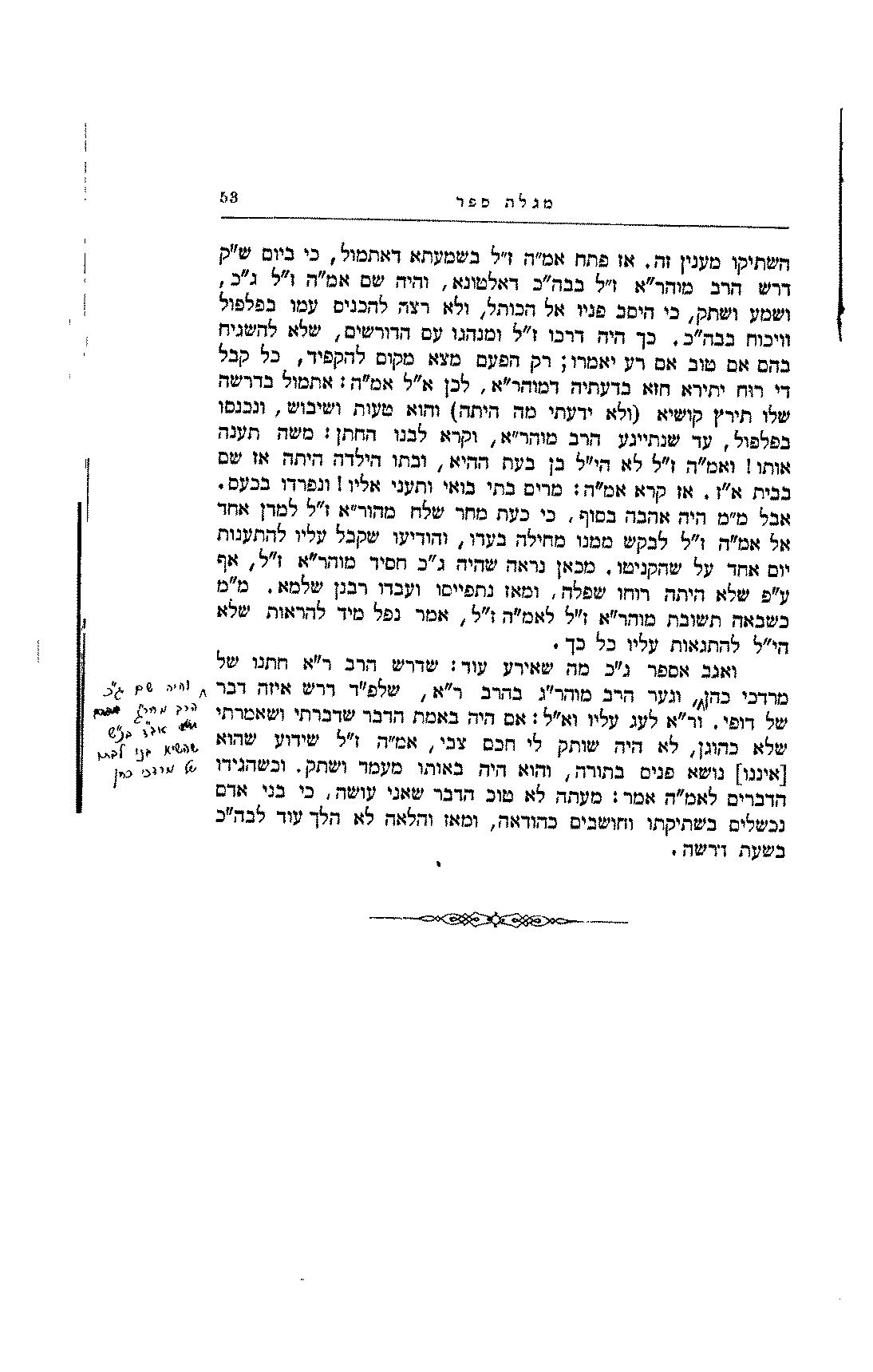
Margin readings in Scholem's copy (1)
| Printed anchor | Type (key sheet) | Mark | Reading | Certainty |
|---|---|---|---|---|
| שדרש הרב ר"א חתנו של ^ מרדכי כהן | V: omission | caret; 5-line note in right margin (Kraken: ... אב"ד בנ"ש / שהשיא בנו לבתו / של מרדכי כהן) | והיה שם ג"כ / הרב ... / ... אב"ד בנ"ש / שהשיא בנו לבתו / של מרדכי כהן | partial (lines 3-5 fairly sure) |
Page 54 (scan 66) — end of chapter 1, beginning of chapter 2
So far my account of my father has come: what remained in my memory, gleanings only. For much I heard and forgot, and beyond that there is what I never knew at all; I was seventeen years old when I parted from him, and in most of my father's affairs I was a child. All the more I could not know the details of his life, much of which came before I existed: he was nearly forty when I was born, and by the time I reached the age of bar mitzvah he was already over fifty. All my service of him was in four or five years, in great distress, in the troubles of the controversy; and much of that time passed in exile, in hard wandering, and in evil and lasting illnesses, and in many changes and mishaps. What I knew by hearsay I have mostly forgotten, because of the many changes of the fearful times that passed over me; "when I remember, I am dismayed" (Job 21:6). Because of the many and evil events ⟨S: a seven-line note, partly read: "… the ever-renewed … which never let me go … many events"⟩ I doubt whether I can tell them; "they are more in number than the sand" (Ps. 139:18) if I recall them; and if I set out to write them all, pens, sheets and ink would not suffice, were they streams of water. So I will tell them briefly, climbing step by step.
Before I begin the story of my own life, I declare faithfully that I did not come to this in order to make my name and my praise known. I know of myself that I have no deed, no Torah, no wisdom, and no greatness as an inheritance, in which to glory and pride myself; would that I do not set down on my pages what reveals my faults. But "all the gate of my people knows" (Ruth 3:11) that I chose lowliness from the day I came to understanding, knowing my worth and my blemish. For this very reason I do not care or mind that my lowliness becomes known to all, for I love only the truth. For three reasons I came to this practice of setting down my experiences in writing, and I will not hold back from making known to my descendants [a] all my affairs, as far as possible; and if I do not reach all of it, at least I will mention all that I remember at this time, and what has passed over me until now.
The strongest reason that moved me to it is to make known the Lord's kindness to me from my youth. Though "many a time have they afflicted me" (Ps. 129:1), it would not be believed if told; I would say even of a mighty man that a man can bear only one in a thousand of them — "Is my strength the strength of stones? Is my flesh of brass?" (Job 6:12) — all the more since I was tender and delicate in my father's and my mother's eyes, and weak. I was in almost every evil, every hard event and mishap, without a moment's pause; and from all of them the Blessed One saved me and helped me until now,
Kahana's notes
- [a] The abbreviation means "to my descendants".
עד הנה הגיע ספורי זה על אודותיו של אמ"ה ז"ל, מה שנשארו בזכרוני עוללות, כי הרבה שמעתי ושכחתי, ויתר מזה מה שלא ידעתי כל עיקר, כי בן שבע עשרה שנה הייתי בהפרדי מאתו ז"ל, וברוב מילי דאבא קטן הוינא. כ"ש שלא יכולתי לדעת פרטי מאורעותיו, שהרבה קדמוני בטרם הייתי, שכבר היה קרוב לארבעים בלדת אותי, ועד שהגעתי לכלל בר מצוה כבר היה יותר מבן חמשים, וכל שמושי אותו היה בארבע וחמש שנים, בצער גדול בצרי המחלוקת, ומהם עבר זמן רב בגלות טלטול קשה, ומחליים רעים ונאמנים, וכמה תמורות ופגעים, ומה שידעתי מפי השמועה רובו שכחתי בסיבת המון שינוי העתים המבעתים שעברו עלי, אשר אם זכרתי ונבהלתי, עד שמחמת הסבות הרבות והרעות מסופקני אם אוכל לספרם, כחול ירבון אם אזכרם, ואם באתי לכתוב כולן אין מספיקים, קולמוסין ויריעות ודיוטות אם יהיו מי אפיקים; לכן אספרם דרך קצרה, מטפס ועולה. קודם שאתחיל בספור קורותי, אודיע נאמנה שלא באתי לכלל זה, למען ספר שמי ותהלתי, כי יודע אני בעצמי, שאין בי שום מעשה לא תורה לא חכמה, לא גדולה היתה לי לנחלה, שאתפאר ואתגדר בה, הלואי שלא אעלה על גליוני, מה שיגלה חסרוני, אך יודע כל שער עמי שבחרתי בשפלות, מיום עמדי על דעתי היותי מכיר ערכי ומומי, על כן מזה הטעם עצמו לא אכפת לי ולא אחוש, נודע לכל שפלותי, כי רק האמת אהבתי. ומחמת שלש טעמים באתי לידי מדה זו, לבאר בכתב קורותי, ולא אמנע מלהודיע לי"ח א כל עניני כפי אשר תשיג יד האפשרות, ואם לא אגיע לכולו, לפחות אזכור כל הנזכר אצלי בעת, ואשר עבר עלי עד הנה; ואמנם הסבה החזקה שהניעה אותי לזה היא להודיע חסד ה' עלי מנעורי, אף אם רבות צררוני, לא יאומן כי יסופר אמר על בן בגבורים דאפשר לאדם לסבול אחת מני אלף, האם כח אבנים כחי אם בשרי נחוש, וכל שכן שהייתי רך לאבי ולאמי ענוג וחלוש, וכמעט הייתי בכל רע, ומקרה קשה ופגע, בלי הפסק רגע, ומכולם הצילני הי"ת ב"ה, ועזרני עד כה,
- [א] ר"ת: ליוצא חלצי.
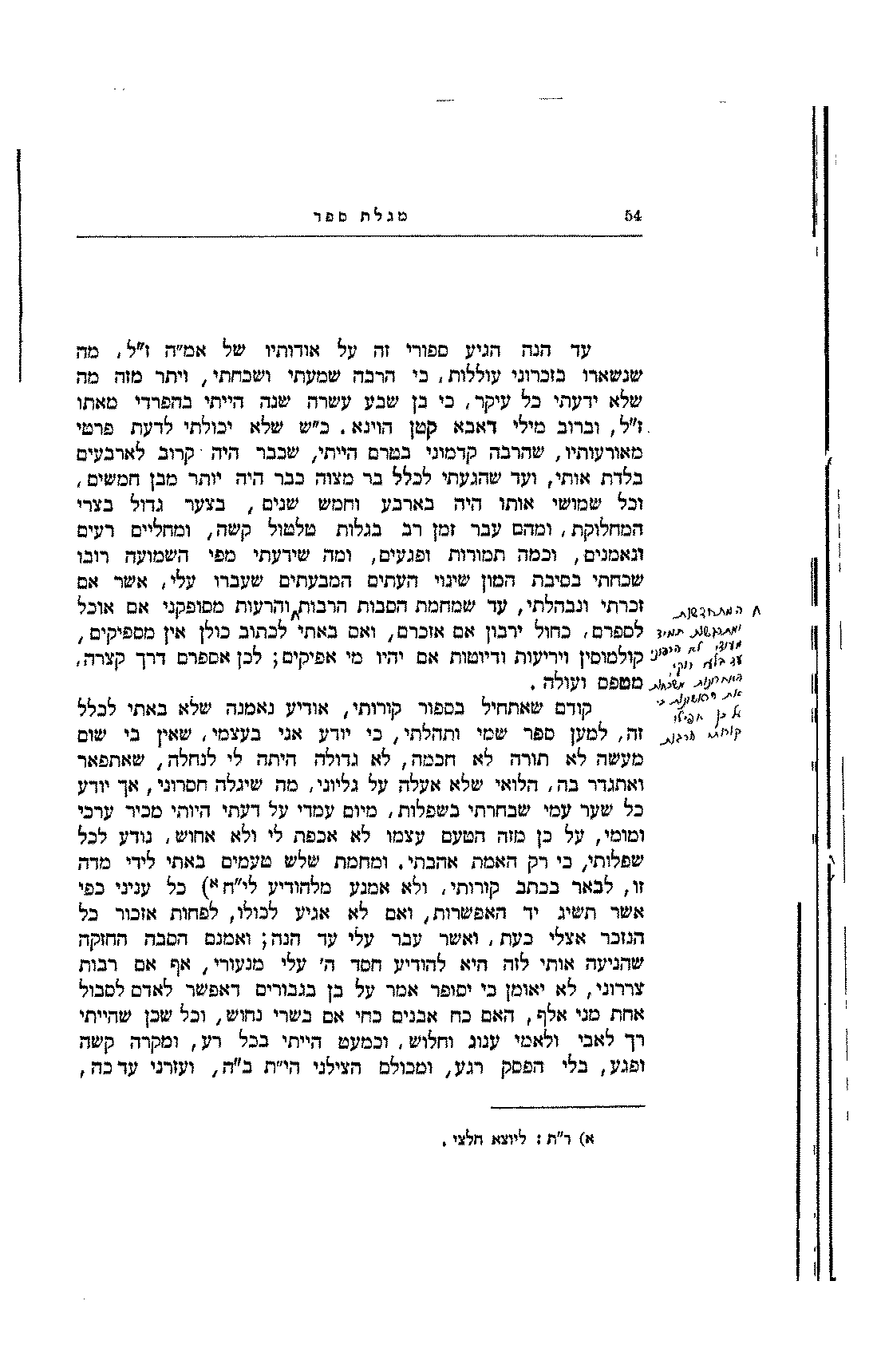
Margin readings in Scholem's copy (1)
| Printed anchor | Type (key sheet) | Mark | Reading | Certainty |
|---|---|---|---|---|
| שמחמת הסבות הרבות ^ והרעות | V: omission | caret; 7-line note in right margin (Kraken: ... / מעודי לא הרפוני / ...) | המתחדשות(?) / ... / ... מעודי לא הרפוני(?) / ... / קורות מרובות(?) (partly read) | partial |