Chapter 3 From Amsterdam to Emden, and the rabbinate there
Jacob Emden, Megillat Sefer · Hebrew (Kahana, Warsaw 1896/97) with an English draft translation · work in progress
Page 100 (scan 116)
Levi. And there was a great woman there, distinguished and very intelligent, the daughter of the leader, the learned R. L[evi], peace be upon him, and the daughter-in-law of the said leader. She took me in to eat bread and to lodge in her house. She acted valiantly in her wisdom to speak to the heart of her father-in-law and her husband and all the members of the community; in general she strove with all her strength to keep me with them. They told me nothing, but acted at once: they gathered the whole community and agreed with one mind, and accepted me on the intermediate days of the festival of Passover — for I had come there for the festival of Passover, to stay until after the time of the festival and to go on from there immediately after Passover — and appointed me over them as head, rabbi and teacher. Suddenly the messengers of the community came to me and informed me of their agreement, and many entreated me to grant their request.
And I let myself be found by them and by their request, although it was against the desire of my heart, as said above; but I saw with my own eyes that it was from Heaven, since it had never entered my mind at all, and I had not approached a single one of them about this matter, and the Lord put into them one heart and one mind, by their own awakening, willingly and eagerly. They also needed a teacher, for they were "like sheep without a shepherd" (Num. 27:17). I said: "Is it not a little one?" (Gen. 19:20) — I could apply myself to my study as my heart desired without hindrance, and with this I would bring merit to the many, with God's help. I wrote to my wife, peace be upon her, to come to me to Emden with my children, may they live, and all that I had. And the Holy One, blessed be He, brought them as "on eagles' wings" (Ex. 19:4), whole and well: my wife the rabbanit and my two sons Meir and Zalman, may they live — the first, my firstborn, was then about twelve years old, the second about six — and my daughter, may she live, a little girl, with household goods, movables and books, from a very long way ⟨S: "without any mishap"⟩, at the beginning of the summer of [5]489 [1729]. Praise and thanks to the Master of kindness and wonders, blessed be He "who does great things past finding out" (Job 9:10) and awesome things!
But the said sufferings from the urine, though they had lessened a little, still went on tormenting me and troubling me day and night; "my sleep fled from my eyes" (Gen. 31:40) and "my soul was sore troubled" (Ps. 6:4). My wife, peace be upon her, was also in great distress on my account over this, for hardly any vigour rose in me, as if "the caperberry had failed" (Eccl. 12:5), God forbid; and so I had no offspring from her all the days that I stayed in Emden. Perhaps the cause was also the sickness and ailment of my wife, peace be upon her, which came upon her anew there, as written above. But before I moved my dwelling from there the Lord gave her conception, and she bore a son in Altona.
For all that, I was diligent at my study, and "the night shone for me like the day" (Ps. 139:12), with God's help, in Scripture, Mishnah, Gemara, Rashi and Tosafot, halakhot and decisors, and the other holy books of the early authorities, revealed and hidden; and regular lessons "in their order" with students, young men of the city, and my sons, may they live. I also "filled my hand to the Lord" (Ex. 32:29) with "the scribe's inkhorn" (Ezek. 9:2), to make handles for the Torah (cf. b. Eruvin 21b) in some works, some of which I had already begun in Brod. In Emden I finished the first part of my book Leḥem Shamayim on two orders of the Mishnah; also the book Mor u-Ketzi'ah on the Tur Oraḥ Ḥayyim I brought there to nearly half — I had also begun it in my youth, and was occupied in copying it and in a second recension; also much of the book She'ilat Ya'avetz I made there, besides writings
לוי, ושם היתה אשה גדולה חשובה ומשכלת מאד, בת הק' התורני ר"ל ע"ה, וכלתו של הק' הנ"ל, היא החזיקה בי לאכל לחם ולהתאכסן בביתה. ותעש חיל בחכמתה לדבר על לב חמיה ואישה וכל בני הק', בכלל השתדלה בכל כחה להחזיקני אצלם, ולי לא הגידו מאומה, ועשו מעשה מיד וקבצו כל הקהל והסכימו לדעת אחת, וקבלוני בח"ה חג פסח, — כי על י"ט הפסח באתי שם, להתעכב עד אחר זמן החג, וללכת משם מיד אחר הפסח, — ומנו אותי עליהם לראש לרב ומורה, ופתאום באו אלי שלוחי הקהל והודיעוני הסכמתם, וחלו פני רבים לתת את שאלתם. ונמצאתי להם ולבקשתם, אע"פ שהיה נגד חשק לבבי כנ"ל, אך ראיתי בעיני כי מן השמים היא, מאחר שלא עלתה על דעתי לגמרי, לא פייסתי אחד מהם על הדבר הזה, וה' נתן בלבם לב אחד ודעה אחת, בהתעוררות עצמן ברצון ובחשק, וגם היו צריכין לאיש מורה, כי היו כצאן בלי רועה; אמרתי הלא מצער היא ואוכל לשקוד על תלמודי כחפץ לבבי בלי מונע, ועם זה אהיה מזכה את הרבים בעזה"י. וכתבתי לאשתי ע"ה שתבוא אלי לעמדן עם בני שיחיו וכל אשר לי. והביאם הקב"ה כעל כנפי נשרים שלמים וטובים, זוגתי הרבנית ושני בני מאיר וזלמן שי'. הראשון הוא בכורי היה אז כבן י"ב שנה, השני כבן שש, ובתי תי' ילדה קטנה, עם כלי בית מטלטלים וספרים מדרך רחוקה מאד בתחלת קיץ תפ"ט. שבחות והודאות לבעל החסד והנפלאות, יתברך עושה גדולות אין חקר ונוראות! אך היסורים הנ"ל מן השתן עם שנתמעט קצת, מ"מ עדיין היו מתמידים להתעולל בי, ולהטרידני יומי ולילי, ותדד שנתי מעיני ונפשי נבהלה מאד; גם זוגתי ע"ה היתה בצער גדול בעבורי על זאת, כי כמעט לא קמה בי רוח, כאלו הופרה האביונה ח"ו, וכן לא היה לי זרע ממנה כל הימים שעמדתי בעמדן, אולי היתה הסבה גם חולי ומדוה זוגתי ע"ה, שנתחדש לה שמה כמש"ל; אכן קודם שהעתקתי דירתי משם נתן לה ה' הריון ותלד בן באלטונא. ואנכי עם כל זה הייתי שוקד על למודי, ולילה כיום יאיר לי בעזה"י, במקרא משנה גפ"ת הלכות פוסקים, ושאר ספרי קודש בנגלה ונסתר הראשונים, ותמידין כסדרן ללמוד עם תלמידים בחורים מבני העיר ובני שי'. גם מלאתי ידי לה' בקסת הסופר לעשות אזנים לתורה באיזה חבורים אשר קצתן התחלתי בהם עוד בברודא, ובעמדן גמרתי ח"א מספרי לח"ש על שני סדרי משניות, גם ס' מו"ק על טא"ח הגעתי שם קרוב למחציתו, שהתחלתי ג"כ בילדותי ועסקתי בהעתקה ומהדורא שנית, גם הרבה מס' שי"ע עשיתי שם, מלבד כתיבות
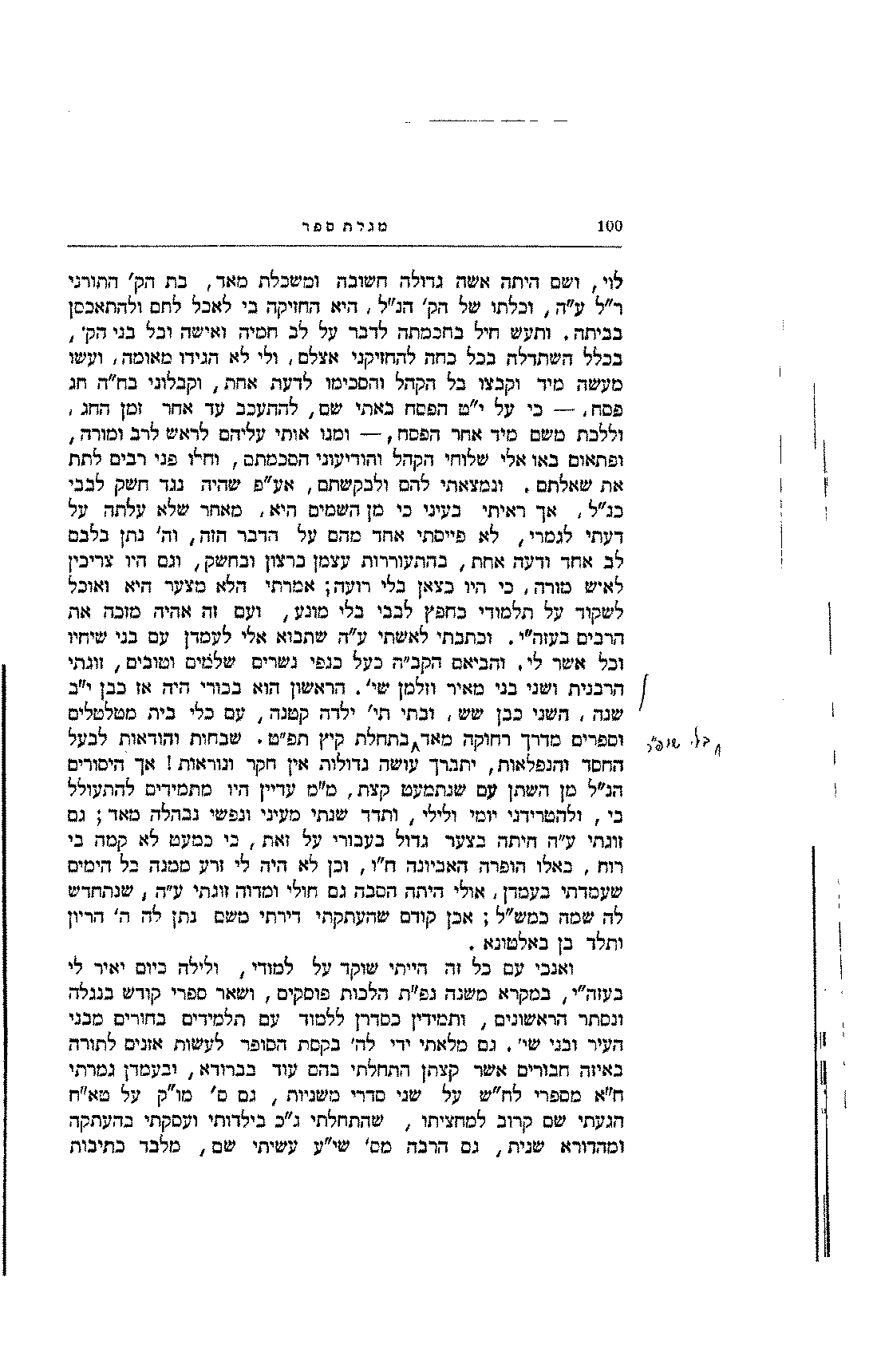
Margin readings in Scholem's copy (1)
| Printed anchor | Type (key sheet) | Mark | Reading | Certainty |
|---|---|---|---|---|
| וספרים מדרך רחוקה מאד ^ בתחלת קיץ תפ"ט | V: omission | caret; 2-word note in right margin (Kraken read it as a line) | בלי שופ"ר (= בלי שום פגע רע, "without any mishap") | fairly sure |
Page 101 (scan 117)
many and various on the Gemara and other necessary books, in which I made corrections and new insights. Also the book Ha-Kishurim(?), sermons and plain interpretations, I composed there. I led the community for the sake of Heaven; thank God, I made many excellent and important ordinances for them, to remove the stumbling-blocks over which they used to stumble before, as some of them are mentioned in the letter I wrote on the matter to R. M. Ḥ. [Moses Ḥagiz], an answer to his letter in which he informed me that [the man] complained of me that I was far too strict with them, "excess of dignity" (Gen. 49:3); see there. I did judgment and justice for the needy with all my strength and ability, without price. I also taught students, sons of exceedingly rich men, and would accept nothing from them as payment for teaching — even from the son of the leader R. Jonathan Levi the elder, who was a very rich man, worth at the least a hundred thousand. He sent me a fine gift because his son studied with me, and I would not accept it. Even for the sermons I preached to them on the Great Sabbath and the Sabbath of Return I did not take a single penny, although their custom before this was to give 22 Reichstaler for each sermon, and although they took great pleasure in my preaching, and each time I spoke at length for many hours, and each sermon is like a small work in itself, and my words were very sweet to them. The intelligent among them swore — [even men who had studied] in the yeshiva of Prague [a] — that their ears had never heard such wonderful and delightful sermons as they heard from me, and they praised me far and wide, saying there is no preacher in the world like me.
But for my part it was "a provocation of my anger and my fury" (Jer. 32:31) to waste time on the study of homiletics, with which I had never occupied myself in my life except out of necessity. For nothing was sweet to my soul but the study of Gemara and decisors, and understanding Scripture and Midrashim, to know and to gain insight in the holy Torah, "to keep, to do" and to fulfil — not to be proud, God forbid, much less to adorn myself with them before people, which was abhorrent to me — but only to grow wise in the Torah for the perfection of my soul alone. "My soul breaks for the longing" (Ps. 119:20) at all times; "in her love be ravished always" (Prov. 5:19). Nevertheless, with God's help, I saw a good sign in my study, also in the study of homiletics and novellae on aggadah: when I needed them, the Blessed One in His kindness provided me with fine and delightful words, sweet and pleasant to the hearers and close to the truth. I have no doubt that the Blessed One graciously let me clothe many wondrous aggadot, very strange at first glance, in adorned garments and ornaments more precious than fine gold. "I will sing to the Lord, for He has dealt bountifully with me" (Ps. 13:6), and I will give thanks to Him, blessed be He, for my portion.
I will further mention, about my conduct with the community, that I showed no favour to the great and was "not afraid of the face of any man" (Deut. 1:17); small and great, poor and rich, were equal in my eyes. In short, in a little time my name went out as "one of the great men that are in the earth" (2 Sam. 7:9), and my fame went
Kahana's notes
- [a] See p. 112, and see Edut be-Ya'akov (fol. 13b).
שונות רבות בגמרא ושאר ספרים הכרחיים, שהגהתי וחדשתי בהם דברים, גם ס' הקשורים מדרשות ופשטים חברתי שמה; והנהגתי את הצבור לשם שמים, ת"ל תקנתי להם תקנות רבות מעולות וחשובות, להסיר המכשולות שהיו נכשלים בהם מלפנים, כאשר קצתן נזכרים באגרת שכתבתי מענין להרמ"ח, תשובה על מכתבו שהודיעני שמתרעם עלי שהחמרתי עליהם הרבה יתר שאת ע"ש, ועשיתי משפט וצדק לנצרכים בכל כחי ויכלתי בלי מחיר, גם למדתי עם תלמידים בני עשירים מופלגים, ולא רציתי לקבל מהם מאומה בשכר תלמוד, אפילו מבנו של הק' כ' יונתן לוי הזקן שהיה עשיר גדול מכ"פ מאה אלפים, ושלח לי מוהר יפה בעד שלמד בנו אצלי, לא אביתי לקבל, ואפילו בעד הדרשות שדרשתי להם בשבת הגדול וש"ש לא נטלתי אפילו פרוטה אחת, עם שהיה מנהגם לפני זאת לתת בעד כל הדרשה כ"ב ר"ט, ואע"פ שהיה נהנים מאד מדרוש שלי, והארכתי בו כל פעם שעות הרבה, וכל דרוש הוא כמו חבור קטן בפ"ע, וערבו להם דברי מאד; נשבעו המשכילים בהם, [אפילו אנשים שלמדו] בישיבת פראג א, שלא שמעה אזנם מעולם דרושים נפלאים ונחמדים כמו ששמעו ממני, והפליגו בשבחי למרחוק, אמרו שאין דרשן בעולם כמוני, אבל אני לעצמי היתה לי על אפי ועל חמתי, לבלות זמן בלמוד דרוש, אשר לא עסקתי בו מימי, רק על פי ההכרח, כי לא היה ערב לנפשי רק למוד גמרא ופוסקים, ולהבין במקרא ומדרשים לדעת להשכיל בתורה הקדושה, לשמור לעשות ולקיים, לא להתגאות ח"ו, כ"ש שלא להתנאות בהם לבני אדם, והיה דבר מתועב אצלי, רק להחכים בתורה לצורך שלמות נפשי בלבד גרסה נפשי לתאבה בכל עת, באהבתה תשגה תמיד. מ"מ בעזה"י ראיתי סימן יפה בתלמודי גם בלמוד הדרוש וחדושי אגדה, כשהוצרכתי להם הזמין לי הי"ת בחסדו דברים נאים ונחמדים, ערבים ומתוקים לשומעם וקרובים לאמת, ואין לי שום ספק שחנני הי"ת להלביש כמה אגדות מופלאות זרות מאד בהבטה ראשונה בבגדים מקושטים ותכשיטין יקרים מפז, אשירה לה' כי גמל עלי, ואודה לה' לו ית' על חלקי. עוד אזכיר מענין הנהגתי עם הקהל, כי לא נשאתי פנים לגדול ולא יגורתי מפני איש, והיו שוים בעיני כקטן כגדול כדל כעשיר. בקיצור יצא שמי בזמן קטן כאחד מן הגדולים אשר בארץ, ושמעי הולך
- [א] עיין צד 112, ועיין עדות ביעקב (דף י"ג ע"ב).
Page 102 (scan 118)
and grew great in all the countries (cf. Esth. 9:4). Needless to say, I was beloved by all the people of my community, from small to great; I was in their eyes like an angel of God before them; no one rebelled against my word and no one opposed even a hint of mine. Only one man was something of an adversary to me at the beginning of my stay, and a thorn in it. For the leader R. Jonathan the elder mentioned above, although he had agreed from the start to my being accepted as rabbi and head of the court, thought that I would be submissive to him in particular, because of the extent of his great wealth. And when he saw that I did not esteem him more than any one of the rest of the people — before my coming there he had been used to command and decree on everything that happened in the community, doing all he pleased without asking, as a strong man and a man of violence; and not only in the business of the community, in worldly matters, but also in matters of Heaven the fear of a rabbi and teacher had never been upon him. For only the tutor whom he used to keep in his house for his sons gave the rulings; by his word was done everything that was doubtful for an individual or for the public, and the tutor had to do all his will and strive to find favour in his eyes, for he was esteemed by him also as [one of] ⟨S: a note with doubtful alternatives, "le'umah (or le'imah, or le'omno) bar A."(?)⟩ the friends of his son R. A.(?).
And when I began to lead the community in a straight path, as I had seen from my father and teacher the gaon, of blessed memory, and to cast awe upon them while showing them great affection, they too treated me with honour and awe in complete love; the awe of me lay upon all the people of itself ⟨S: "from above"(?)⟩, for the Lord put the fear and honour of me in their heart, and all of them together, rich and poor, loved me with a strong love. Only this man ⟨S: "the rich"⟩, old and poor in understanding, did not find what he had thought at first, according to his habit from before, as said. The tutor who was in his house at that time also took it ill that I should hold authority in the community, and in his opinion what was due to him was robbed from him through me. So he "devised evil against me while I dwelt securely with him" (Prov. 3:29), and did what he could to make me odious to his household — so an emissary from the holy city of Hebron, who was there at that time, revealed to me in secret — and he produced "the fruit of his scheming" (cf. Isa. 10:12) in the heart of the said man, to slight my honour. I paid no heed: "I walked in my integrity, I trusted in the Lord" (Ps. 26:1).
Once it happened that a blind Kohen came as a guest and lodged in the house of the said leader. On the holy Sabbath a Kohen bought [the call-up] ⟨S: "deputy"(?)⟩, and he sent to his tutor in my presence, while I was there in the synagogue — it seems he meant to provoke me — to ask him whether it was permitted to call the blind man up to the Torah in the count of the seven who are called; and he permitted it, "and did not ask at my mouth" (Josh. 9:14). I was very angry over the matter; I came to anger and a quarrel with him, and afterwards we were reconciled. On the question of the ruling, whether it is permitted to call a blind man to the Torah scroll or not, I wrote a long and broad responsum with Heaven's help, clarifying its prohibition from several sides; it is in the book She'ilat Ya'avetz, no. 41. About the event the sage R. M. Ḥ. [Moses Ḥagiz], may he rest in Eden, wrote to me at that time, to tell me that the said man was spreading slander about me; and he wrote about me what he had written to Hamburg, to cast fear on me; and I answered him. ⟨S: two words, perhaps "these words"(?)⟩ These are my words, to defend myself from this burden:
Translator's note. Kahana gives no text of the defence after the colon (see his note [a] on p. 103: the letter is missing in his manuscript). Bick's text gives a short bracketed passage from it here.
וגדול בכל המדינות, אצ"ל שהייתי חביב לכל בני קהלתי מקטן ועד גדול, הייתי בעיניהם כמלאך אלקים לפניהם, אין ממרה את פי ואין מתנגד אפילו לרמיזתי; רק אחד הי"ל לשטן קצת ובראשית ישיבתי, וקוץ בה, כי הק' כ' יהונתן הזקן הנ"ל, עם שהוא הסכים מתחלה על קבלתי לרב אב"ד, סבור היה שאהיה מוכנע לו בפרטות, מחמת הפלגת עשרו הגדול, ויהי כראותו שלא הייתי מחשיבו יותר מאחד משאר העם, והוא היה נוהג קודם ביאתי לשם, לצות ולגזור בכל ההוה בקהלה, היה עושה כל חפצו מבלי שאלה וכתקיף וגברא אלמא, ולא לבד בעסקי הקהל במילי דעלמא, אלא גם במילי דשמיא לא היה עליו אימת רב ומורה מעולם, כי רק המלמד שהיה רגיל להחזיק בביתו לבניו הוא, היה המורה הוראה, על פיו נעשה כל דבר שיסתפק ליחיד או לרבים, והמלמד היה מוכרח לעשות כל רצונו, ולהשתדל למצוא חן בעיניו, כי גם לאוהבי בנו ר"א היה שביח אצלו, וכאשר התחלתי להתנהג את הצבור בדרך ישרה, כאשר ראיתי מאמ"ה ז"ל, ולזרוק בהם מרה עם הראותי להם חבה יתירה, גם הם נהגו בי כבוד ומורא באהבה גמורה, והיתה אימתי מוטלת על כל העם מעצמה, כי נתן ה' מוראי וכבודי בלבם, וכולם יחד עשיר ואביון אהבוני אהבה עזה; רק זה האיש הזקן ומסכן בדעתו היה לא מצא מה שחשב מתחלה כפי הרגלו מאז כנ"ל. גם המלמד שהיה בעת ההיא בביתו היה רע בעיניו שאשתרר בקהלה, ולפ"ד נעשק ממנו הראוי ע"י, לכן היה חורש עלי רעה ואני יושב לבטח אתו, ועשה מה שיוכל להבאישני אצל ב"ב שלו; וכן גלה לי בחשאי שליח מעה"ק חברון שהיה שם בעת ההיא, ועשה פרי מחשבתו בלב האיש הנ"ל להקל בכבודי, ולא שמתי אל לבי, אני בתומתי הלכתי בה' בטחתי; ופ"א אירע שבא אורח כהן סומא ונתארח בביתו של הק' הנ"ל, ויהי ביש"ק קנה כהן, ושלח אל המלמד שלו על פני בהיותי שמה בבה"כ, כמדומה נתכוון להקניטני, לשאול אותו אם מותר לקרוא הסומא לעלות לתורה במנין ז' הקרואים, והתירו, ואת פי לא שאל, וחרה לי מאד על הדבר; באתי לכלל כעס ומריבה עמו, ושוב נתפייסנו. ועל ענין ההוראה, אם מותר לקרות סומא לס"ת אם לא, כתבתי תשובה ארוכה ורחבה בס"ד, לברר אסורו מכמה פנים, הלא בס' שאילת יעב"ץ סי' מ"א, וע"ד המאורע כתב אלי החכם רמ"ח נ"ע בעת ההיא, להודיעני שהנ"ל מוציא עלי לעז, וכתב עלי מה שכתב לה"ב להטיל עלי אימה, והשיבותיו. אלה דברי להתנצל ממשא זה:
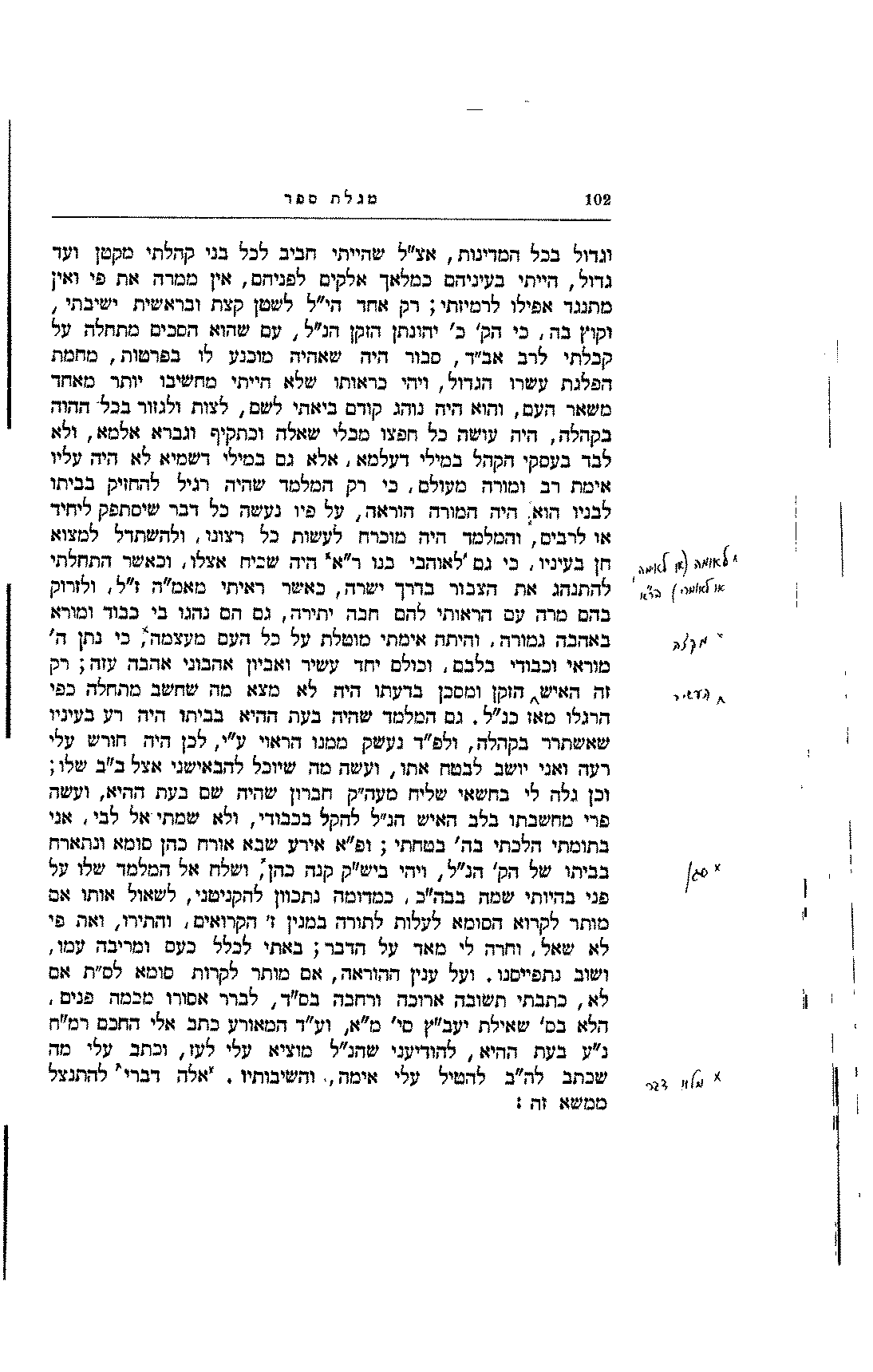
Margin readings in Scholem's copy (5)
| Printed anchor | Type (key sheet) | Mark | Reading | Certainty |
|---|---|---|---|---|
| כי גם x 'לאוהבי בנו ר"א' היה שביח אצלו | X: substitution | x mark; the printed words bracketed by hand; 2-line note in right margin | לאומה (או לאימה, או לאומנו) בר"א | uncertain |
| והיתה אימתי מוטלת על כל העם מעצמה x | X: substitution | x mark; one word | מעלה(?) | uncertain |
| זה האיש ^ הזקן ומסכן בדעתו | V: omission | caret; one word | העשיר | fairly sure |
| ויהי ביש"ק קנה כהן x | X: substitution | x mark; one short word | סגן(?) | uncertain |
| והשיבותיו. x 'אלה דברי' להתנצל | X: substitution | x mark; the printed words bracketed by hand; 2-word note | אלו(?) דבר(?) | uncertain |
Page 103 (scan 119)
And this is the copy of the letter of defence that I wrote to this sage, to clear myself of this sin, copied here [a].
I wanted to leave the rabbinate and abandon my place of honour, and travel from Emden at that time. [For in truth] [b] I had taken this yoke upon myself against my will in the first place, and now I had found a pretext to be rid of them: "neither them nor their reward" (b. Berakhot 5b) did I seek. But the love of the community for me was very strong, and they did not let me have my wish; they pressed me hard to turn back from my intention, and compelled me by their much persuasion to nod my head to them, for the whole community, to its very end, gave their lives for me and held on to me with all their might.
Not many days after this the daughter of the leader R. Jonathan the elder, mentioned above, died. He had married her off a little before I came there, and she died in childbirth; and he lost his daughter and his money, a large sum that he had given her as dowry, and he had gone to great expense, for she was the first daughter of the wife he had at that time. For she left a little child, viable, who lived for a while; afterwards he too died, and his father inherited this bond of debt. Also the tutor who was in his house, who had given the ruling as said above and caused the estrangement between me and the said leader, died at that same time while still young in years, and I was greatly grieved over it. After this the love with the said old leader returned to its strength, and I was beloved by the whole community with an exceeding love. The son of the leader also, an outstanding and dear young man, studied with me, together with other young men, sons of the rich of the community; and I would never take anything from any man as payment for teaching, as I had done from the beginning in Brod, as said above. My deeds, thank God, brought me near; thank God, there was fulfilled in me, blessed be the Name: "When a man's ways please the Lord" (Prov. 16:7). Especially my measure and my conduct in money matters shut the mouth of my adversary, and he was turned into another man, and into a friend who told my praises; and I had no more adversary there, nor evil occurrence (1 Kgs. 5:18) from the occurrences and plagues of men.
But I found no rest in Emden: "behold, for peace I had great bitterness" (Isa. 38:17), especially as regards the state of bodily health. For all the years that we lived there, I, my wife, my sons and my daughter were all sick and weak there because of the tertian or quartan fever, to which we were prone, God save us, all the days I was there, because of the air, the water and the food, which did not suit our constitution. Therefore all our days there were evil, and were not counted as life, because of the sufferings that ruled in our bodies. From long before until I came to Emden, no river fish at all were to be had there, for that land, Friesland, was ruined by the waters of the flood that had been there in that country seventeen years before, when the sea broke its bound and flooded that district, and the land became salt, whereas before it had been a land of good pasture and fat soil. From then on it was spoiled
Kahana's notes
- [a] This letter is missing in the manuscript, and a pity.
- [b] See the book Edut be-Ya'akov (fol. 13b).
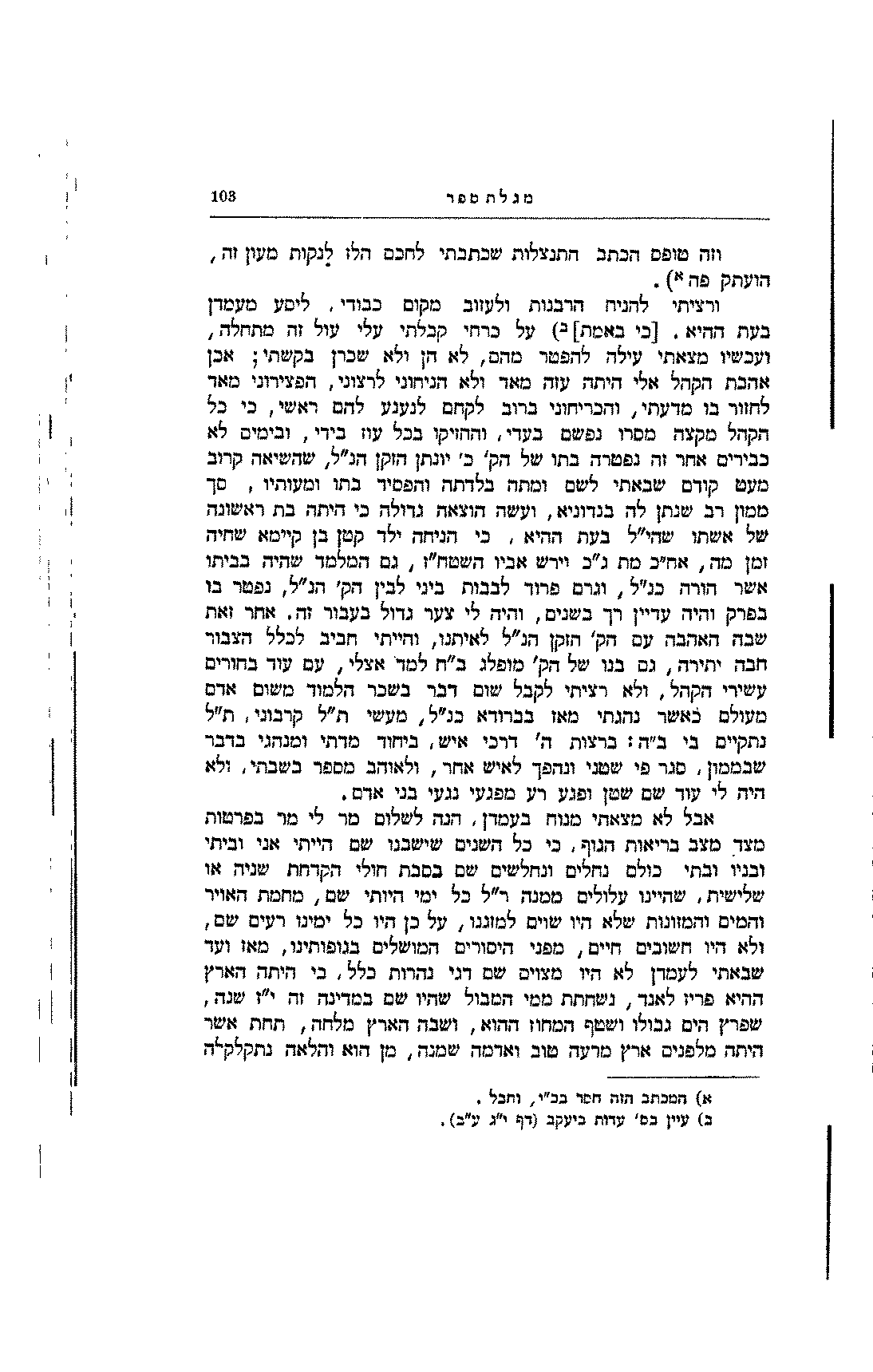
וזה טופס הכתב התנצלות שכתבתי לחכם הלז לנקות מעון זה, הועתק פה א. ורציתי להניח הרבנות ולעזוב מקום כבודי, ליסע מעמדן בעת ההיא. [כי באמת] ב על כרחי קבלתי עלי עול זה מתחלה, ועכשיו מצאתי עילה להפטר מהם, לא הן ולא שכרן בקשתי; אכן אהבת הקהל אלי היתה עזה מאד ולא הניחוני לרצוני, הפצירוני מאד לחזור בו מדעתי, והכריחוני ברוב לקחם לנענע להם ראשי, כי כל הקהל מקצה מסרו נפשם בעדי, והחזיקו בכל עוז בידי, ובימים לא כבירים אחר זה נפטרה בתו של הק' כ' יונתן הזקן הנ"ל, שהשיאה קרוב מעט קודם שבאתי לשם ומתה בלדתה והפסיד בתו ומעותיו, סך ממון רב שנתן לה בנדוניא, ועשה הוצאה גדולה כי היתה בת ראשונה של אשתו שהי"ל בעת ההיא, כי הניחה ילד קטן בן קיימא שחיה זמן מה, אח"כ מת ג"כ וירש אביו השטח"ז, גם המלמד שהיה בביתו אשר הורה כנ"ל, וגרם פרוד לבבות ביני לבין הק' הנ"ל, נפטר בו בפרק והיה עדיין רך בשנים, והיה לי צער גדול בעבור זה. אחר זאת שבה האהבה עם הק' הזקן הנ"ל לאיתנו, והייתי חביב לכלל הצבור חבה יתירה, גם בנו של הק' מופלג ב"ח למד אצלי, עם עוד בחורים עשירי הקהל, ולא רציתי לקבל שום דבר בשכר הלמוד משום אדם מעולם כאשר נהגתי מאז בברודא כנ"ל, מעשי ת"ל קרבוני, ת"ל נתקיים בי ב"ה: ברצות ה' דרכי איש, ביחוד מדתי ומנהגי בדבר שבממון, סגר פי שטני ונהפך לאיש אחר, ולאוהב מספר בשבתי, ולא היה לי עוד שם שטן ופגע רע מפגעי נגעי בני אדם. אבל לא מצאתי מנוח בעמדן, הנה לשלום מר לי מר בפרטות מצד מצב בריאות הגוף, כי כל השנים שישבנו שם הייתי אני וביתי ובניו ובתי כולם נחלים ונחלשים שם בסבת חולי הקדחת שניה או שלישית, שהיינו עלולים ממנה ר"ל כל ימי היותי שם, מחמת האויר והמים והמזונות שלא היו שוים למזגנו, על כן היו כל ימינו רעים שם, ולא היו חשובים חיים, מפני היסורים המושלים בגופותינו, מאז ועד שבאתי לעמדן לא היו מצוים שם דגי נהרות כלל, כי היתה הארץ ההיא פריז לאנד, נשחתת ממי המבול שהיו שם במדינה זה י"ז שנה, שפרץ הים גבולו ושטף המחוז ההוא, ושבה הארץ מלחה, תחת אשר היתה מלפנים ארץ מרעה טוב ואדמה שמנה, מן הוא והלאה נתקלקלה
- [א] המכתב הזה חסר בכ"י, וחבל.
- [ב] עיין בס' עדות ביעקב (דף י"ג ע"ב).
Page 104 (scan 120)
and lost all its goodness. Even the river fish were gathered away (cf. Zeph. 1:3), because of the saltness of the sea water, which was not healed; "the water is bad and the land miscarries" (2 Kgs. 2:19), a land "that eats up its inhabitants" (Num. 13:32). But in that very summer when I settled there, at once the blessing returned to the fish, for [the waters] began to grow sweet, and sweet river fish came back and were to be bought in plenty and cheaply. And the community said: "The rabbi has brought us the luck of fish!" For they had not tasted the taste of a good fish, apart from sea fish, which were always to be had there.
There was also abundance of trade in the time I lived with them. I too earned something in trade without trouble or bother: I only wrote to acquaintances in Amsterdam, and they sent me some goods I asked for, which I knew sold quickly in Emden, and I gave them into the hands of an honourable householder, who dealt in them for half the profit and shared with me the gains that came into his hand. Thank God, I lost nothing, but saw profit from it without toil.
For all that, we were not at ease there, all of us together — I and my wife, my sons and my daughter; we all fell sick because of our delicate constitution, for the air was not easy and good for our health. Had I been able to refuse the community, who were all wholly united with me and always pressed me not to leave them, I would already have moved my dwelling from there several times, long before. But every time it came into my thoughts, and every day that I said "I will go", to my native town, the holy community of Altona, they always constrained me with words of appeasement and conciliation and soft speech, until they turned me back from my intention. Even so I kept watching without letting my mind off it, for a fit time and hour to come my way, to go out from this place in peace.
My wife the rabbanit, peace be upon her, also fell very gravely ill of the fever to which she was continually prone, all the days we stayed there, as said above. She was in great danger from a flow of blood from the source, which flowed in great abundance without stopping. I sent her to Amsterdam, and she travelled to Leiden and received remedies there from a great professor; she came back to us, and the flow of blood returned as before. Even so, before our journey from Emden she had already conceived.
I also saw that there was no future there for my sons, may they live. My firstborn son had already become bar mitzvah [a] there, in the first year that he came to Emden, and I studied with him myself for about three years. Afterwards I sent him to Hamburg, and from there he travelled to Poland to my wife's grandfather, the rabbi in Brod, peace be upon him, and he made a fitting match for him with the daughter of an exceedingly rich man of Lissa; and through this came about the rabbinate of Posen and the province for my father-in-law the rabbi, peace be upon him, for the bride's father was a great power there in the province. I sent my wife the rabbanit, peace be upon her, to the wedding, and I stayed here, for the thing was too heavy for me; she too [wished] to see the face [of her father], "rejoicing as a strong man to run a race" (Ps. 19:6). She came back to Altona and found me there, as written above.
Kahana's notes
- [a] Initials of bar mitzvah.
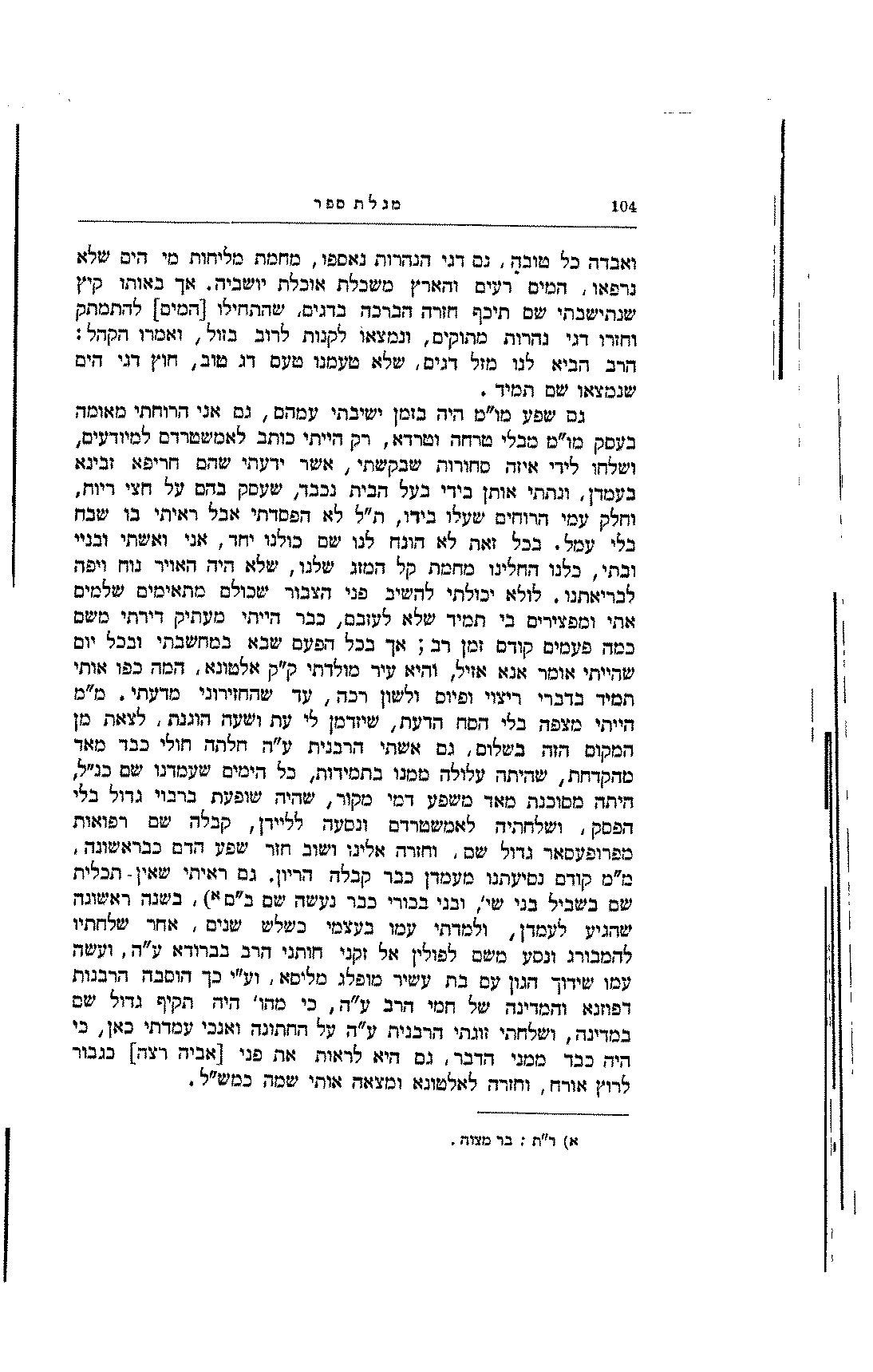
ואבדה כל טובה, גם דגי הנהרות נאספו, מחמת מליחות מי הים שלא נרפאו, המים רעים והארץ משכלת אוכלת יושביה. אך באותו קיץ שנתישבתי שם תיכף חזרה הברכה בדגים, שהתחילו [המים] להתמתק וחזרו דגי נהרות מתוקים, ונמצאו לקנות לרוב בזול, ואמרו הקהל: הרב הביא לנו מזל דגים, שלא טעמנו טעם דג טוב, חוץ דגי הים שנמצאו שם תמיד. גם שפע מו"מ היה בזמן ישיבתי עמהם, גם אני הרוחתי מאומה בעסק מו"מ מבלי טרחה וטרדא, רק הייתי כותב לאמשטרדם למיודעים, ושלחו לידי איזה סחורות שבקשתי, אשר ידעתי שהם חריפא זבינא בעמדן, ונתתי אותן בידי בעל הבית נכבד, שעסק בהם על חצי ריוח, וחלק עמי הרוחים שעלו בידו, ת"ל לא הפסדתי אבל ראיתי בו שבח בלי עמל. בכל זאת לא הונח לנו שם כולנו יחד, אני ואשתי ובניי ובתי, כלנו החלינו מחמת קל המזג שלנו, שלא היה האויר נוח ויפה לבריאתנו. לולא יכולתי להשיב פני הצבור שכולם מתאימים שלמים אתי ומפצירים בי תמיד שלא לעזבם, כבר הייתי מעתיק דירתי משם כמה פעמים קודם זמן רב; אך בכל הפעם שבא במחשבתי ובכל יום שהייתי אומר אנא אזיל, והיא עיר מולדתי ק"ק אלטונא, המה כפו אותי תמיד בדברי ריצוי ופיוס ולשון רכה, עד שהחזירוני מדעתי. מ"מ הייתי מצפה בלי הסח הדעת, שיזדמן לי עת ושעה הוגנת, לצאת מן המקום הזה בשלום, גם אשתי הרבנית ע"ה חלתה חולי כבד מאד מהקדחת, שהיתה עלולה ממנו בתמידות, כל הימים שעמדנו שם כנ"ל, היתה מסוכנת מאד משפע דמי מקור, שהיה שופעת ברבוי גדול בלי הפסק, ושלחתיה לאמשטרדם ונסעה לליידן, קבלה שם רפואות מפרופעסאר גדול שם, וחזרה אלינו ושוב חזר שפע הדם כבראשונה, מ"מ קודם נסיעתנו מעמדן כבר קבלה הריון. גם ראיתי שאין תכלית שם בשביל בני שי', ובני בכורי כבר נעשה שם ב"ם א, בשנה ראשונה שהגיע לעמדן, ולמדתי עמו בעצמי כשלש שנים, אחר שלחתיו להמבורג ונסע משם לפולין אל זקני חותני הרב בברודא ע"ה, ועשה עמו שידוך הגון עם בת עשיר מופלג מליסא, וע"י כך הוסבה הרבנות דפוזנא והמדינה של חמי הרב ע"ה, כי מהו' היה תקיף גדול שם במדינה, ושלחתי זוגתי הרבנית ע"ה על החתונה ואנכי עמדתי כאן, כי היה כבד ממני הדבר, גם היא לראות את פני [אביה רצה] כגבור לרוץ אורח, וחזרה לאלטונא ומצאה אותי שמה כמש"ל.
- [א] ר״ת: בר מצוה.
Page 105 (scan 121)
Added to the above: after three years, "as the years of a hireling" (Isa. 16:14), another contention arose between me and the said old man [a]. The matter was on Rosh Hashanah: the old man asked that his son, a mere lad with a shaven beard, should blow the shofar, and I did not agree to allow it — that such a foolish lad should discharge the obligation for them on the holy day. So the hatred between us grew great again, and he thought to take revenge, and would not pay me my salary, and I was as one who keeps silent.
After this the said old man did a foolish thing, and nearly put himself in danger with the authorities. The matter was that he ordered a proclamation to be announced in the synagogue which was displeasing to the authorities, for he relied on his power and thought that no one would dare to approach and reveal the thing to the authorities. But the enemy he had in the community lay in wait for him; he did not sleep and did not keep silent, but went at once and revealed the matter of the proclamation to the authorities. All the men of the community were summoned to come before the authorities, so that each one by himself should tell what he knew and had heard of this proclamation. I too was summoned to come to the authorities, to tell what I had heard.
Now my name was great with them and my reputation very good, especially because of my good and upright conduct in money matters: not only was I not greedy after it like others, nor "hasty after wealth" (Prov. 28:22), but I was generous in giving up what was mine. And whenever a gentile ⟨S: "an uncircumcised man"⟩ had a lawsuit with a Jew before their courts, they would call me to sit with them in judgment, and they would pay my fee. Once I made a compromise for a Jew who was sued by a gentile ⟨S: "an uncircumcised man"⟩ before them, and I said that if he would not be appeased, I would give for him what I had ruled against him, to free him from an oath. That man refused to keep my compromise, so I kept my word and paid for him as I had said, and became surety for him. In short, this and the like, many, many times. The one who brought the words to the ears of the authorities made me a name like the name of the great, among Jews and gentiles ⟨S: "Jews and uncircumcised"⟩.
When that matter of the said proclamation happened, the one who brought the words to the ears of the authorities, the enemy of R. Jonathan, supposed that I would take revenge on this old man for all the opposition he had shown me all the days I was there, since the Lord had brought him into my hand and cast him into the net, so that I could collect my debt from him. So it was plain in the mind of that man, the enemy of R. Jonathan and my faithful friend. Therefore he advised the authorities to examine me, to tell the truth; then they would know, and it would be clear to them, that his words about the proclamation were true. For it was known that I am a man of faith who fears no one, and "if one gave me all the space of the world" I would not change my words; therefore I would not hide the truth from them when they asked me and wished to get at the truth. Not so most of the people of the community of Emden, who were submissive to this rich man and afraid of him, because of his power and his violence, and would suppress their testimony. That man also came to me before I went before
Kahana's notes
- [a] He means the magnate Jonathan Levi the elder, who was in Emden, mentioned before.
מצורף אל הנ"ל אחר שלש שנים כשני שכיר אירע עוד תחרות ביני ובין הזקן הנ"ל א. והענין היה בר"ה: בקש הזקן שיתקע בנו נער מנוער מגולח הזקן, ולא הסכמתי להניחו, שנער טפש כזה יוציאנו י"ח ביום הקדוש, וחזרה השנאה להגדיל בינינו, וחשב להתנקם ולא רצה לשלם לי שכירותי ואהיה כמחריש; אחר זה עשה הזקן הנ"ל דבר טפשות, כמעט נסתכן בעצמו נגד השררה. הענין הוא שצוה להבריז בבה"כ כרוז שהיה רע בעיני השררה, כי היה סומך על תקיפותו, וחשב שלא יערב אדם אל לבו לגשת לגלות הדבר להשררה, אבל השונא שהי"ל בקהל אורב לו, לא ישן ולא החריש, הלך מיד וגלה דבר הכרוז אל השררה, ונקראו כל אנשי הקהלה לבוא לפני השררה, שיגיד כל אחד בפני עצמו, מה שידע ושמע מכרוז הלז. גם אנכי נקראתי לבוא אל השררה שאגיד מה ששמעתי, ובאשר היה שמי גדול אצלם ושמעי טוב מאד, ביחוד מחמת מנהגי הטוב והישר בדבר שבממון, שלא די שלא הייתי להוט אחריהם כאחרים ולא נבהל להון, אבל הייתי טוב עין לוותר משלי, וכל פעם שהי"ל דין ודברים לנכרי עם ב"י לפני ערכאות שלהם, היו קוראים אותי לישב עמהם בדין, והיו נותנין שכרי. ופ"א עשיתי פשרה בשביל ב"י אחד שנתבע מנכרי בפניהם, ואמרתי שאם אינו מתפיים, אני נותן בעבורו מה שפסקתי עליו לפטרו משבועה, ולא רצה האיש ההוא לקיים דברי פשרתי, ושמרתי דבורי ושלמתי בעדו כמו שאמרתי, ונכנסתי ערב בעבורו, בקיצור זה וכיוצא כמה וכמה. המביא הדברים לאזני השררה עשה לי שם כשם הגדולים בין יהודים ונכרים. וכשאירע הענין ההוא של הכרוז הנ"ל, המביא הדברים לאזני השררה השונא של כ' יונתן היה סובר שאתנקם מן הזקן הלזה בעד כל התנגדות שעשה לי כל ימי היותי שם, כי הביאו ה' לידי, הפילו ברשת לגבות חובי ממנו, כך היה פשוט בדעתו של אותו אדם השונא לכ' יונתן ואוהב נאמן שלי, לכן יעץ הוא להשררה שיחקרו אותי להגיד האמת, אז ידעו ויתברר להם כי כנים דבריו בענין הכרוז, כי ידוע שאני איש אמונה ולא יגור מפני מי שהוא, ואי יהיב לי כל חללי דעלמא איני משנה בדיבורי, לפיכך לא אעלים האמת מהם כשישאלוני וירצו לעמוד על האמת. משא"כ רוב בני קהל עמדן היו מוכנעים לאיש עשיר הלזה ויראים מפניו, מחמת תקיפותו ואלמותו ויכבשו עדותם; גם האיש ההוא בא אלי קודם שהלכתי לפני
- [א] כוונתו על הגביר יונתן לוי הזקן שהיה בעמדן הנזכר מקודם.
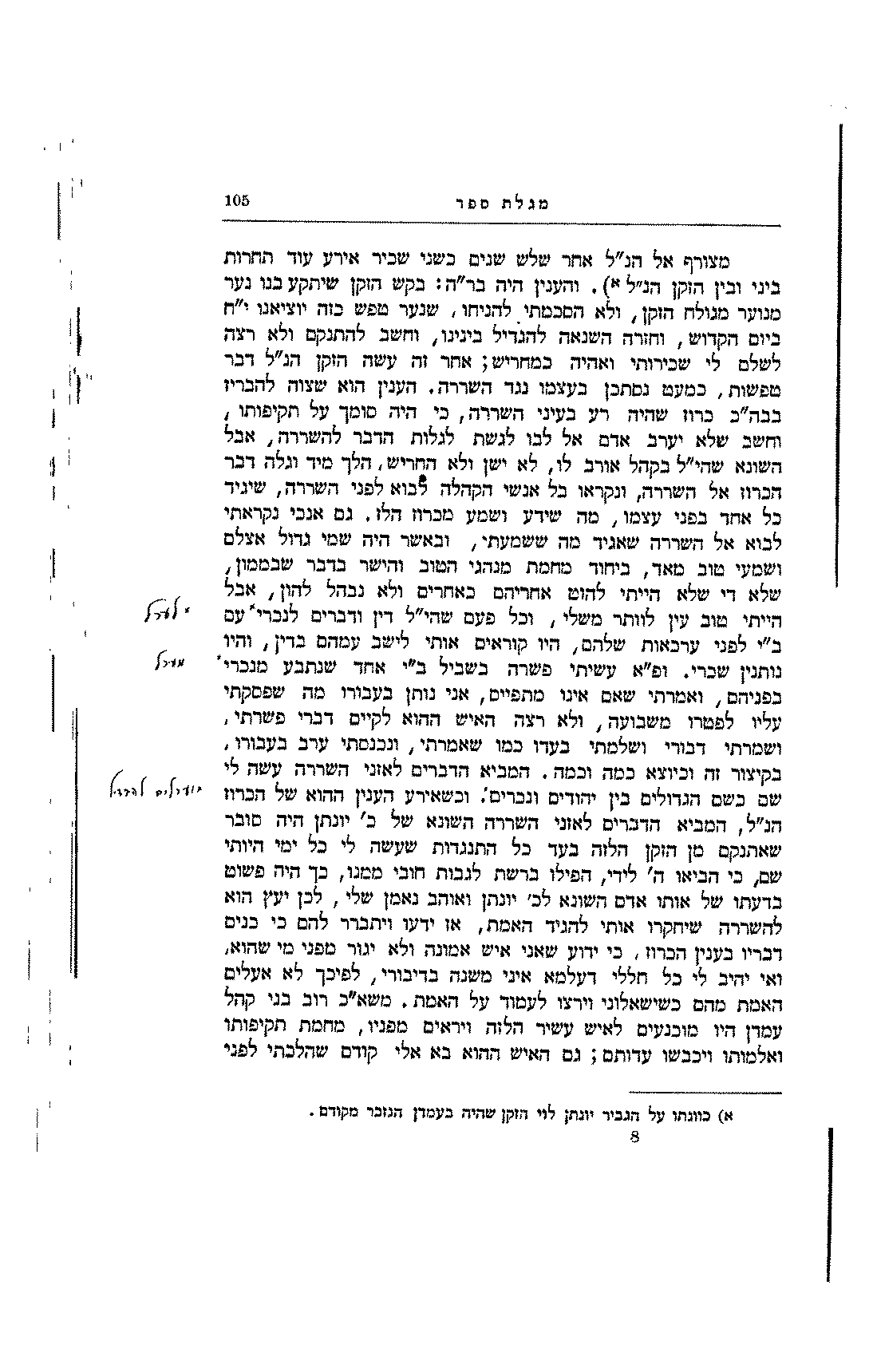
Margin readings in Scholem's copy (3)
| Printed anchor | Type (key sheet) | Mark | Reading | Certainty |
|---|---|---|---|---|
| וכל פעם שהי"ל דין ודברים לנכרי x עם ב"י | X: substitution | x mark; one word in left margin | לערל | fairly sure |
| ב"י אחד שנתבע מנכרי x בפניהם | X: substitution | x mark; one word in left margin | מערל | fairly sure |
| עשה לי שם כשם הגדולים בין יהודים ונכרים x | X: substitution | x mark; 2-word note in left margin | יהודים וערלים | fairly sure |
Page 106 (scan 122)
the authorities, to put the words in my mouth and explain them in a favourable sense, as one confident in me, since he had found me an occasion to collect my debt: "though wickedness be sweet in my mouth, I will not hide it under my tongue" (cf. Job 20:12). And he said to me: "Now you will see what I will do to my enemy, whom the Lord has delivered into my hand" (cf. Ex. 21:13). I encouraged him in this intention, so that his hands would not slacken from striving to have me called, in order to bring to nothing his scheme to swallow up and destroy the said leader. I was called to the authorities, and they asked me particularly to tell what I knew of this matter and to hide nothing from them. Although all the individuals called before them in this matter had to swear that they would tell the truth, I excused myself and asked them to exempt me from the oath, since I am careful in this and have never sworn in my life — even a true oath is a grave thing to me. They granted me this request and exempted me from swearing, and trusted me that without an oath I would hide nothing and would not cover up for my enemy.
When they asked me whether I had heard the proclamation, my answer to them was: "I did not hear it and I knew nothing of it at all." They said to me: "Were you not in the synagogue that day?" I said: "Even if I was in the synagogue, and the beadle calls out some proclamation by order from time to time, I pay no attention to these affairs, which do not concern my appointment and the duty of my office. For I stand in the synagogue wrapped in my tallit with my face to the wall, occupied with my thoughts and with the matters of prayer, and then I pay no attention to other things; and I did not set my mind on what the community proclaims in their affairs, which are their own charge." The men of the authorities examined and questioned me much on this matter, to draw from me some word against the said leader, to find a pretext against him; but they gained nothing and did not succeed — rather the opposite of what they thought. "I did not suffer my mouth to sin" (Job 31:30), and I kept "the door of my lips" (Ps. 141:3), for the informer's thoughts are not my thoughts.
This declaration before the authorities decided the matter of R. Jonathan and turned it for him from evil to good. Then the spirit of the authorities abated (cf. Judg. 8:3) because of me, for all the rest of the men who told [things] truly to harm him were not so trusted by the authorities, and they counted them his haters, saying: "enemies have put it out as a rumour". So he was dismissed by them in peace. Were it not for this, his wealth would not have helped him, and he might have come out stripped of his property over this bad business. When he saw me coming to the authorities ⟨S: a four-line note, partly read: "… for he knows that I am held very trustworthy by the authorities"⟩, he thought he saw his slaughterer about to cut off his head — a creditor who had found an occasion to collect his debt. But when the courts gave him a copy of what I had declared before the authorities about him, he began to sing and to praise me with a full mouth, and said: "From this one sees the quality and nature of a true scholar, and what difference there is between a quarrel with an ignoramus and one with a scholar." He blessed me with all blessings, because through me he had escaped a great evil that was prepared for him, and was saved from "the fowler's snare" (Ps. 91:3) because of me — not according to his treatment of me. After this event this leader was a faithful friend to me all the days: "When a man's ways please the Lord" etc. (Prov. 16:7). Until I parted from Emden he did not cease to cherish me. On the contrary,
השררה, לשים הדברים בפי ולהסבירם בטעם לשבח, כבטוח בי שהמציא לי מקום לגבות חובי, אם תמתיק בפי רעה לא אכחידנה תחת לשוני, ואמר לי עתה תראה מה אעשה לאויבי אשר מה' אנה לידי, והטיבותי לבו במחשבה זו, למען לא ירפו ידיו מזה להשתדל שיקראוני, כדי לבטל מחשבתו לבלע ולהשחית הק' הנ"ל. ונקראתי אל השררה, ובקשו ממני ביחוד, שאגיד מה שידעתי בזה הענין ולא אכחד מהם דבר. ועם היות שכל היחידים הנקראים לפניהם בדבר זה הוצרכו לשבוע שיגידו האמת, אני התנצלתי עצמי ובקשתי מהם שיפטרוני מן השבועה, מפני שאני נזהר בזה ולא נשבעתי מימי, אפילו שבועת אמת חמורה היא אצלי, ונתנו לי שאלתי זאת ופטרוני מלשבוע. ובטחו בי שבלא שבועה לא אעלים דבר ולא אכסה על אויבי. וכששאלו אותי מהכרוז אם שמעתי, היתה תשובתי אליהם: לא שמעתי ולא ידעתי מזה מאומה, אמרו לי וכי לא הייתי בבה"כ באותו יום, אמרתי אפילו הייתי בבה"כ וגם קורא השמש איזה כרוז בפקודת כפעם בפעם אינני משגיח בעסקים האלה, שאינם נוגעים אלי למינוי שלי וחובת פקידתי, כי אני עומד בבה"כ מעוטף בטליתי ופני אל הקיר, טרוד בעיוני ובעניני תפלה, ואיני משגיח אז בדברים אחרים, ולא שמתי מחשבתי על מה שמכריזים הקהל, בעסקים שלהם המוטלים עליהם. וחקרו אנשי השררה ודרשו אותי הרבה בענין זה, להוציא ממני דבור מתנגד להק' הנ"ל, למצוא לו עילה ולא הועילו ולא עלתה בידם, אלא ההפך מה שחשבו, לא נתתי לחטוא חכי ואצרה על דל שפתי, כי לא מחשבת המלשין מחשבותי. וזאת ההגדה בפני השררה הכריע הענין של כ' יונתן, והפך אותו מרעה לטובה. אז רפתה רוחם של השררה ממני, כי כל השאר מן האנשים שהגידו באמת להרע לו לא היו נאמנים כל כך אצל השררה, וחשבום לשונאיו אמרו אויבים דאפקוה לקלא. לכן נפטר מהם בשלום. לולי זאת לא היה מועיל לו עשירות ויכול היה לצאת נקי מנכסיו, על אודות עסק ביש הלז. והיה כראות אותי בא אל השררה, והיה חושב שרואה שוחט שלו להתיז ראשו, מצא ב"ח מקום לגבות חובו אך כאשר נתנו לו הערכאות העתק ממה שהגדתי בפני השררה על אודותיו, אז התחיל לרון ולשבח אותי בפה מלא, ואמר מכאן נראה מה טיבו וטבעו של ת"ח אמתי, ומה בין מחלוקת עם ע"ה או עם ת"ח, וברך אותי בכל הברכות, לפי שנמלט על ידי מרעה גדולה שהיתה מעותדת אליו, ונצל מפח יקוש בסבתי לא כגמולו אתי; ואחר המאורע הלזה היה לי הק' הלז אוהב נאמן כל הימים. ברצות ה' דרכי איש וגו', עד שנפרדתי מעמדן לא זז מלחבבני. אדרבה
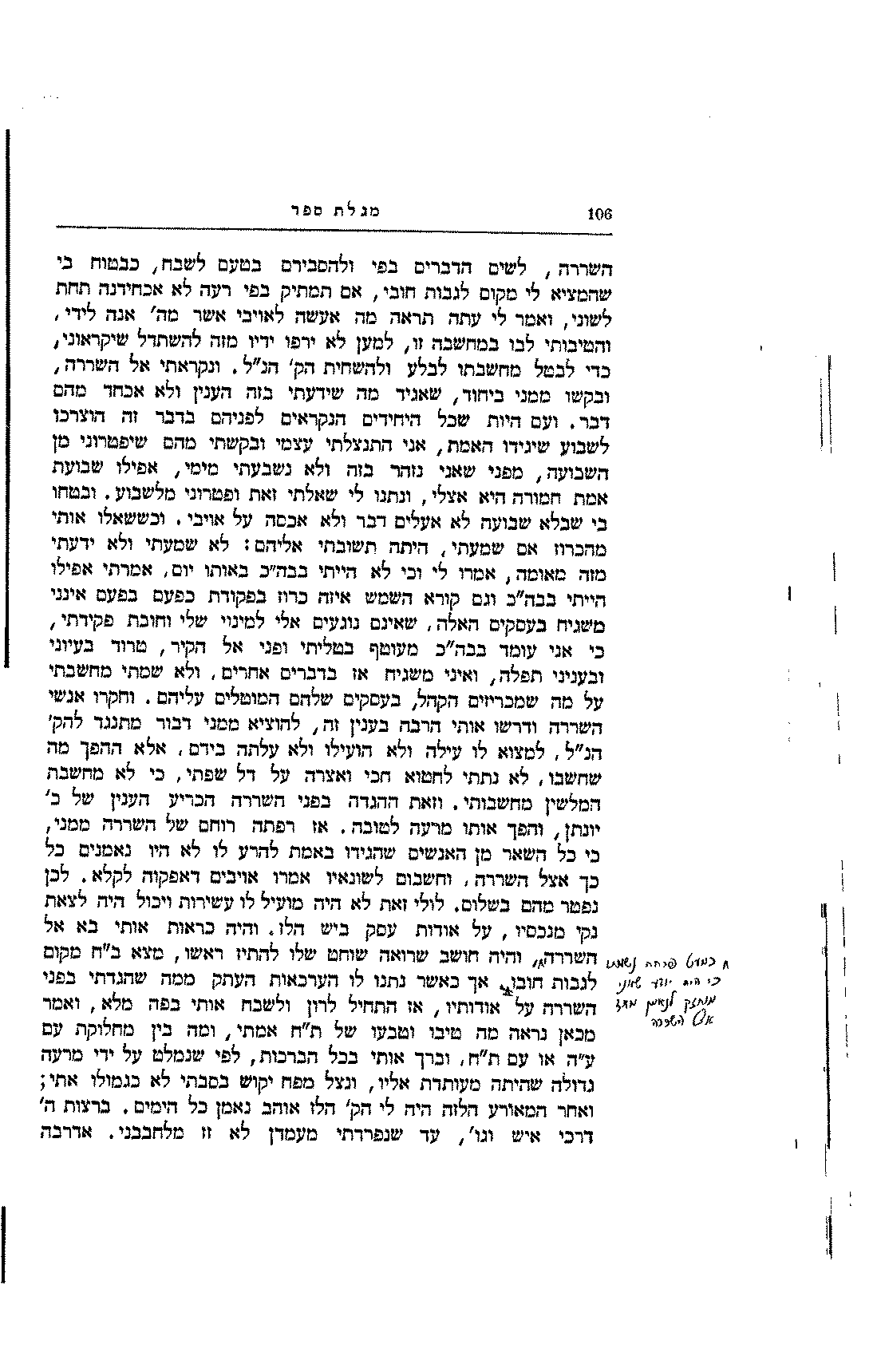
Margin readings in Scholem's copy (2)
| Printed anchor | Type (key sheet) | Mark | Reading | Certainty |
|---|---|---|---|---|
| והיה כראות אותי בא אל השררה ^, והיה חושב | V: omission | caret; 4-line note in right margin | כמדומה(?) ... / כי הוא יודע שאני / מוחזק לנאמן מאד / אצל השררה | partial |
| מצא ב"ח מקום לגבות חובו ^ אך כאשר | V: omission | caret-like mark under the line; no margin text | - | sure |
Page 107 (scan 123)
when I agreed to uproot my dwelling from there, he spoke to me and warned me not to go and settle in Altona. He said that he was an old man, experienced, and knew the people of Altona better than I — for I was a child when I left Altona — and that I had no acquaintance with them; and he was worried for me that I would regret it after the fact. With these words and the like he warned and cautioned me to turn back from my intention and not to leave Emden; but I would not listen to his voice, for my heart was always bound to my birthplace — especially because of the poor health of my household in general, and also because I saw that my nature and the nature of the leaders were not alike: for they want one to submit to them and to have benefit from them, so as to be enslaved to them after their custom and habit, and I had never in my life brought my neck under the yoke of flesh and blood. Therefore "my soul loathed" it (Zech. 11:8).
And there happened further, in the summer of [5]482 [1722] ⟨S: a two-line note, partly read: "so in the MS, but … [5]492"⟩, half a year before I moved from there, a thing that strengthened my desire to hate the rabbinate and made final my decision to move my dwelling from there and fix my residence in Altona. For behold, there came to the holy community of Emden sinful men(?), "a band of evil angels" (Ps. 78:49), who spread the report that they came on a mission of the holy community of Minsk in Lithuania, on account of a bad business, an evil decree and a great confusion that had arisen there — which these emissaries had invented out of their own heart, "putting the branch to their nose" (Ezek. 8:17), to mislead Israel and to defraud, to plunder the charities and to take "the bundle of their money" (cf. Gen. 42:35), so as to save the said whole community, who were in very great distress according to their words. They brought in their hands writings of iniquity and falsehood, as if the heads of the said community had written to the communities of Israel to make known their distress in public, pleading for their lives that they should come to their help; and [saying] that those named in the writing had been appointed from among them to "walk through the land in its length and in its breadth" (Gen. 13:17), to collect money from all places and bring it in their hands, to "deliver those that are drawn to death" (Prov. 24:11).
It is known and notorious in all the communities of Germany what these robbers did, sharp and clever at deceit: they emptied the charity boxes of the poor of the world, and deceived many Ashkenazi communities, also the Sephardim in London and Amsterdam. These last especially did them great honour and gave to them with an open hand what all the upright had never obtained from them; for it was under a ban among them not to give from the charity purse to the poor of the Ashkenazim, whoever they might be. I remember that it once happened, at the beginning of my father's stay in Amsterdam, of blessed memory, that true emissaries of the holy community of Lublin arrived there, men of standing and faithful to those who sent them. My father worked hard for their good and pleaded also with the Sephardi community there to be a help to them in trouble; and through urging and vigorous effort — for they could not turn him away empty, especially at that time when he was very great in their eyes, like an angel of the Lord before them — they gave in to him, of blessed memory, and put into his holy hand some sum as their gift, to give to those emissaries of Lublin, so that it should count as if they had given a gift to him, of blessed memory, since he was considered
כשהסכמתי לעקור דירתי משם הוא אמר אלי והתרה בי, שלא אלך להתישב באלטונא, ודבר בפיו שהוא זקן בקי ומכיר אנשי אלטונא יותר ממני — שהייתי ילד כשפרשתי מאלטונא — שאין לי הכרה בהם. והוא דואג עלי שלא אתחרט לאחר מעשה. בדברים האלה וכאלה היה מזהיר ומתרה בי, לשוב מדעתי שלא לעזוב עמדן, ולא אביתי לשמוע בקולו, כי היה לבבי קשור תמיד במקום מולדתי. בפרטות מחמת חסרון בריאות ב"ב בכלל, וגם בראותי שאין טבעי וטבע הקצינים שוה, כי הם מבקשים להבנע אליהם וליהנות מהם כדי להשתעבד להם כמנהגם וכהרגלם; ואנכי לא הבאתי צוארי בעול ב"ו מימי, לכן בחלה נפשי. ועוד אירע בקיץ תפ"ב חצי שנה לפני העתקתי משם דבר, שהגביר בי חושקתי לשנוא הרבנות, ולהחליט הסכמתי להעתיק משם דירתי, ולקבוע באלטונא ישיבתי, כי הנה באו ק"ק עמדן לוקחי חטאים משלחת מלאכי רעים, שהוציא להם שם, שבאים במלאכות ק"ק מינסק דליטא על עסק ביש גזרה רעה ובלבול עצום שנתהווה שם, אשר בדו מלבם אלה השלוחים השולחים הזמורה אל אפם להטעות את ישראל ולהונות לשלול הצדקות, ולקחת צרור כספם כדי להציל קהלה שלמה הנ"ל, שהם בצרה גדולה מאד לפי דבריהם. וכתבי און ושקר שהביאו בידיהם, כאלו כתבו ראשי ק' הנ"ל לקהלות ישראל, להודיע צערן ברבים ומבקשין על נפשם לבוא בעזרתם, ושנתמנו מהם אלה הנקובים בשם תוך הכתב, להתהלך בארץ לארכה ולרחבה, ללקט הכסף מכל המקומות, ולהביא בידם להציל לקוחים למות; ונודע ומפורסם בכל קהלות אשכנז, מה שעשו אלה השודדים החדודים וחריפים לרמות, שהריקו קופות הצדקות של עניי עולם, והטעו כמה קהלות אשכנזים, גם ספרדים שבלונדון ובאמשטרדם. ואלה אחרונים ביחוד עשו להם כבוד גדול, והתנדבו אליהם ביד פתוחה מה שלא השיגו אצלם כל הכשרים מעולם, כי היה בחרם אצלם שלא יתנו ויהנו מכיס של צדקה לעניי אשכנזים יהיו מי שיהיו. וזכורני פ"א אירע בראשית ישיבת אמ"ה ז"ל באמשטרדם, הגיעו שמה שלוחי ק"ק לובלין אמתיים, אנשים של צורה ונאמנים לשולחיהם, והשתדל אמ"ה לטובתם מאד, המליץ גם אצל ק' ספרדים שם שיהיו להם עזרה בצרה, וע"פ הפצרה והשתדלות נמרצה, כי לא יכלו להשיב פניו ריקם, מה גם בעת ההיא שהיה גדול מאד בעיניהם כמלאך ה' לפניהם, על כן נעתרו לו ז"ל, ונתנו בידו הקדושה איזה סך מתנת ידם, לתת לאותן שלוחים דלובלין, שיהא חשוב כאילו נתנו מתנה אליו ז"ל, שהיה חשוב
Margin readings in Scholem's copy (1)
| Printed anchor | Type (key sheet) | Mark | Reading | Certainty |
|---|---|---|---|---|
| ועוד אירע בקיץ תפ"ב x חצי שנה לפני העתקתי | X: substitution | x mark; 2-line note in left margin, end of line 1 cut off at the edge | כך בכ"י אך ... / תצ"ב | partial |
Page 108 (scan 124)
a Sephardi too in their eyes; that is to say, so as not to transgress their resolution not to donate to the Ashkenazim — so strictly did they keep guard over this. But these cheats and forgers found favour in their eyes, and they gave to them in great abundance — "with these in mind they did not vow" — and did not keep their word this time. From this one sees that there was fulfilled in them, and in many of the leaders of Germany, the curse of Jeremiah the prophet, "let them be made to stumble" (Jer. 18:23) by unworthy people (cf. b. Bava Kamma 16b).
In the end the men came to me, into my hands, in the community of Emden. I sensed that all their substance was deceit and forgery; even so I drew them near at first, especially because one of them was my relative on my father's side. But in the end the thing came to light: he was the son of R. H. Wilner [a], one of those who sat in the house of study of Mannheim, of the sect of R. Y. Ḥ. [b] ⟨S: "who were found sunk in the filth of the heresy of Sh[abbetai] Tz[vi], may the name of the wicked rot, up to their necks"⟩ — and I have no cause to claim kinship with him; that counts for nothing, since the generation has long since divided. He was a handsome man of fine appearance and something of a scholar, and he was dear and pleasant to me before the forgery came to light. But the other was a master of practical kabbalah who knew how to work with [divine] names; I looked into the jug and found him a pot of urine, a man of blood and deceit, an ignoramus and a boor; and as I suppose, they are certainly of the sect of Shabbetai Tzvi.
They took with them in their company one from Minsk, who was also a young man in years, of good intelligence, who knew the books with understanding, Gemara, Rashi and Tosafot, and other knowledge, and was of a family of great pedigree in Lithuania. He had separated from his wife, whom his relatives had married to him when he was a minor; he despised her and dealt treacherously for several years with the wife of his youth (cf. Mal. 2:14), and lived in the land of Germany. This one they took with them to testify to their honesty and trustworthiness, for he was known in the land of Germany as an important scholar, and nothing bad was found in him except what was explained about his wife, as said above. Perhaps he had his reason and ground with him: that he did not intend to leave her chained, God forbid, but was ready to release her with a bill of divorce and pay her ketubah, only the hindrance was on her side, since she did not want to be divorced. I too drew him near — he came near to me — and I loved him, for I saw in him signs of wisdom. Though he was young in years, I said: this little one will become great in the length of days.
And behold, some days after the forged emissaries had been with us in Emden, my uncle came to me, the brother of my mother the rabbanit, peace be upon her, on the father's side. He was from the land of Lithuania, from Horodna, and his name was R. Benjamin: "I had not thought to see his face" (Gen. 48:11). But even had he been at the end of the world, the Holy One, blessed be He, moved him and brought him into our hands. When he dined at my table, we came to talk of two emissaries who were with us here at the time, travelling on account of an evil decree that had befallen the community of Minsk; and this uncle of mine, a simple man who talked in his innocence, when he heard
Kahana's notes
- [a] See the book Torat ha-Kena'ot (p. 119), where he says: "R. Y. son of R. H. Kohen, who was my relative on my father's side, who made himself an emissary of the holy community of Minsk in the company of two cheats."
- [b] Initials of Judah Ḥasid. See my article "The Society of Judah Ḥasid", printed in Keneset Yisra'el, first year (p. 775).
Translator's note. Kahana prints both footnote calls on this page as א; the second refers to his note ב.
בעיניהם ספרדי ג"כ, ור"ל כדי שלא לעבור על החלטתם, שלא להתנדב אל האשכנזים, כך הם חזקו השמירה בזה. אך אלה הרמאים המזייפים מצאו חן בעיניהם, ונתנו להם בשפע גדול ואדעתא דהנהו לא נדרו, ולא שמרו דברם בפעם הזאת. מכאן נראה שנתקיימה בהם ובהרבה מקציני אשכנז קללות ירמיהו הנביא הכשילם בב"א שאינם מהוגנים. סוף הדברים באו אלי האנשים לידי בק' עמדן, הרגשתי שכל עינינם מרמה וזיוף, מ"מ קרבתי אותם בתחלה, ביחוד לפי שהאחד מהם היה קרובי מצד אבי, אך לסוף אגלאי מילתא שהוא בן ר"ה ווילנר א, אחד מיושבי בה"מ דמנהיים מכת רי"ח א, ואין לי להתייחם בקורבתו — זה נחשב בשגם כבר איתפלג דרא — ואדם נאה יפה צורה ולמדן קצת, והיה חביב ונחמד אצלי קודם שנתברר הזיוף. אך האחר בעל קבלה מעשית ויודע לפעול בשמות, ותהיתי על קנקנו ומצאתיו עביט של מ"ר, איש דמים ומרמה ובור ע"ה, וכפי שאני סבור ודאי הם מכת ש"ץ, והיו מוליכים עמהם בחברתם אחד ממינסק, שהיה גם הוא איש בחור בשנים, ובעל שכל טוב יודע ספר בעיון גפ"ת ושאר ידיעות, והיה ממשפחת מיוחסים גדולים שבליטא, ונפרד מאשתו שהשיאוהו קרוביו כשהיה קטן, והוא מאס בה ובגד בה כמה שנים באשת נעורים, והיה מתגורר במדינת אשכנז, את זה לקחו עמם להעיד על כשרותם ונאמנותם, כי היה ניכר בארץ אשכנז ללמדן חשוב, ולא נמצא בו דבר רע זולת מש"פ מאשתו כנ"ל, אולי היה טעמו ונימוקו עמו, שאין כונתו לעגנה ח"ו, אבל הוא מוכן לפטרה בגט ולסלק כתובתה, אלא שהמניעה מצדה שאינה רוצה להתגרש. גם אנכי קרבתיו נגש אלי ואהבתיו, כי ראיתי בו סימני חכמה, עם שהיה רך בשנים אמרתי זה הקטן גדול יהיה ברוב הימים. והנה אחר איזה ימים שהיו האנשים המשולחים המזוייפים אצלינו בעמדן, בא אלי דודי אחי אמי הרבנית ע"ה מאב, והיה מארץ ליטא מן הורודני, שמו ר' בנימן, ראה פניו לא פללתי. אבל אפילו היה בסוף העולים הסיעו הקב"ה והביאו לידינו, וכשסעד על שלחני באנו לספר משני משולחים הנמצאים אתנו פה כעת, הנוסעים על דבר גזרה רעה שאירעה בק' מינסק, ודודי זה איש פשוט מסיח לפי תומו, וכשמעו
- [א] עיין בספר תורת הקנאות (צד קי"ט) וז"ל: ר"י בן ר"ה כהן שהיה קרובי מצד אבי, שעשה עצמו שליח ק"ק מינסק בחברת שני רמאים.
- [ב] ר"ת: יהודה חסיד, ועיין במאמרי חברת יהודה חסיד הנדפס בכנסת ישראל שנה ראשונה (צד תשע"ה).
Margin readings in Scholem's copy (2)
| Printed anchor | Type (key sheet) | Mark | Reading | Certainty |
|---|---|---|---|---|
| אחד מיושבי בה"מ דמנהיים מכת רי"ח א) ^, ואין לי | V: omission | caret; 3-line note in right margin | אשר נמצאו שקועים / בטנופת מינות ש"ץ / שר"י עד צוארם | fairly sure |
| אך האחר בעל קבלה מעשית ויודע לפעול בשמות | — | underlining, with a brace in the left margin; no margin text | - | sure |
Page 109 (scan 125)
stood astonished and did not believe our report. For he said to us: "What is this thing they are saying, that there is an evil decree in Minsk, and I knew nothing of it at all? How long is it since I came — and that city is near me — and nothing of this was known; nothing at all was heard in our country of any decree, small or great." And according to the liars' words the invented decree was already a year old, while he had come from there only recently. Therefore I concluded that the thing was an invented lie and a great falsehood.
The matter entered my ears, and I put these men to the test. I took the writing of the decree that was in their hands, which the leaders of the community of Minsk had signed, and said to them: "If you are honest men (cf. Gen. 42:11), I will help you with all my ability, for I too wish to merit such a commandment, the redemption of souls, as you ask and more. But hereby you shall be proved (cf. Gen. 42:15), to put away from you 'a froward mouth and perverse lips' (Prov. 4:24): we will make you a donation here too, and you hand over to us the money you have collected from the communities in Germany, Holland and England, in order to send it to Breslau; and we will arrange that the money comes to your community by a straight and safe way, to a great leader whom you will choose, and we will give you [a document] written and signed with full force, to do it in the best manner, to save you from the slander of the country and the evil report of the people. What you have received as gifts for yourselves shall be yours, and something will be added to it too; only the money designated for the poor of your community we will make sure is safe for them. Then it will be well with you, and it will be a double commandment; why should you bear the risk of the road? All trustworthy emissaries have always done so, to be 'guiltless before the Lord and before Israel' (Num. 32:22); by this you will have glory before God and before men."
But with all the force of words "right to him that understands, and upright" (cf. Prov. 8:9) to the upright in heart, I could not make this matter enter their deaf ears, to bring their swallowed spoil out of their mouth (cf. Jer. 51:44); and with all that I said to them, soft and hard, not to refuse a fit and proper thing, I came up with a potsherd in my hand. The two men, who spied secretly (cf. Josh. 2:1), were "subtle as serpents" to steal everyone's mind with persuasive words and a smooth tongue, until even my great friend was caught in the net of their deceit — for one of the emissaries sent to Azazel lodged with him, and the other in the house of his old father mentioned above. He had been from first to last a friend "that sticks closer than a brother" (Prov. 18:24), who had risked his life for me and had been against his father for my sake at all times. But this time he too opposed me, strengthening the hands of evildoers (cf. Jer. 23:14), and swore in the holy sanctuary, in the synagogue, that the men were honest and trustworthy and that I was slandering them for nothing. Then I knew that "an ignoramus is not pious" (m. Avot 2:5), and one should not live in his neighbourhood, for he swore in vain and for nothing, only on the lying words and smooth lips of suspect men. "The hypocrites in heart heap up wrath" (Job 36:13). Especially most of the leaders of Germany in this generation are simpletons, believing every hypocritical cheat, and they stumble through unworthy people who lodge in their houses, "hypocritical mockers for a cake" (Ps. 35:16), stealing their minds and their money; and by this they make others stumble too, with letters of
עמד משתומם לא האמין לשמועתינו, כי אמר אלינו מה הדבר הזה אשר אומרים, יש גזרה רעה במינסק ואנכי לא ידעתי מזה מאומה, וכי כמה זמן שבאתי, והעיר ההיא קרובה אלי ולא נודע דבר מזה, לא נשמע בארצנו כלל מגזרה קטנה או גדולה, והגזרה הבדויה כבר עברה שנה עליה לפ"ד השקרנים, והוא בא משם עתה מקרוב. על כן החלטתי הדבר לשקר בדוי וכזב עצום. הדבר נכנס באזני והעמדתי האנשים האלה על הבחינה, ולקחתי כתב גזרה שבידי שהיו חתומים עליו מנהיגי ק' מינסק, ואמרתי להם אם כנים אתם, אני אסייע אתכם בכל יכולתי, כי גם אנכי רציתי לזכות במצוה כזה פדיון נפשות כפי בקשתכם ויותר. אך בזאת תבחנו להסיר מכם עקשות פה ולזות שפתים, נעשה לכם גם כאן נדבה, ואתם תמסרו בידינו המעות שגביתם מהקהלות באשכנז ובהולנד וענגלאנד, וכדי לשלחו לברסלוי, ואנו נסדר שיבוא המעות לקהלתכם בדרך ישר ובטוח, ועל קצין גדול שתבחרו אתם, ואנחנו נתן לכם כתוב וחתום בכל תוקף, לעשות על אופן היותר טוב, להצילכם מלעז מדינה ודבת עם. ומה שקבלתם מתנות לעצמכם יהי שלכם ונוסף גם עליו, רק המעות המיוחדים לעניי קהלתכם, נעשה שיהיו בטוחים להם. אז טוב לכם ותהא מצוה כפולה, מה לכם באחריות הדרך. וכל המשולחים הנאמנים מעולם, זה דרכם לעשות להיות נקיים מה' ומישראל, בזה יהיה לכם תפארת מן המקום ומן הבריות. אבל בכל יפוי כח דברים נכוחים למבין וישרים לישרים בלבותם לא יכולתי להסביר הדבר הזה באזניהם החרשים, להוציא בלעם מפיהם, ובכל אשר דברתי אליהם רכות וקשות, שלא לסרב לדבר הגון ויפה, העליתי חרס בידי. ושני האנשים המרגלים חרש היו ערומים כנחשים לגנוב דעת כ"א בפיתוי דברים וחלקת לשון, עד שנלכד ברשת מרמתם גם האוהב הגדול שלי, שאחד מהמשולחים לעזאזל היה שרוי אצלו באכסניא, והשני בבית אביו הזקן הנ"ל. והוא היה מתחלה ועד סוף אוהב דבק מאח אלי, אשר מסר נפשו עלי והית כנגד אביו בשבילי בכל עת. אך זה הפעם התנגד לי גם הוא, לחזק ידי מרעים ונשבע בהיכל הקודש בבה"כ, שהאנשים כנים ונאמנים, ושאני מוציא עליהם לעז בחנם. אז ידעתי כי לא ע"ה חסיד, ואין לדור בשכונתו כי נשבע על שוא ולבטלה רק ע"פ דברי שקר ושפתי חלקות של החשודים, חנפי לב ישימו אף; וביחוד רוב קציני אשכנז בדור הזה פתאים המה, מאמינים לכל הרמאים החנפים, ונכשלים בבני אדם שאינם הגונים, המתארחים בבתיהם בחנפי לעגי מעוג, גונבים דעתם ומעותיהם, וע"י זה מכשילים גם לאחרים בכתבי
Page 110 (scan 126)
recommendation that they put into their hands, helping transgressors, corrupting themselves and others, testifying to what they do not know — only from their dealers in fine words and their hunting gear.
I am much grieved over the said faithful friend, whose end, for our many sins, was bitter. He lost his wealth in a bad affair; and above all, the wife of his youth, a very intelligent woman, died some time after I uprooted from there, and he took another wife, who lost all his property. After a few days he too died, and his new wife took what she could and went to another man; and what she had brought him went to perdition as it had come, and she too died; and his children were left poor orphans, for our many sins. Over this my heart is sick when I remember the righteousness of the woman, their mother, peace be upon her; and who knows whether the vain oath was not what stood against him and destroyed him and his house? Let leaders hear and take instruction, and not trust in their wealth. Enough of this.
Here is the end of the story of the said forged emissaries, who were expert at striking fools with the fist of flattery, and at catching men, "for there was hunting in their mouth" (cf. Gen. 25:28). Therefore they escaped from my hands from Emden, and I could get nothing out of them; they received a great deal more donation money there too, and it was a laughing-stock in my eyes, the doing of fools who waste their money on [un]worthy people. Nevertheless I did not rest until I had finished the matter, to get at the truth clearly. What did I do? I took from them the writing of proof that they had from Minsk for the business of their mission, to "deliver those taken to death" and to come with money to annul an evil decree in their community, on which the leaders of the holy community of Minsk were signed. I sent the writing by post to Altona, into the hand of my faithful friend at that time, Ḥakham Ḥagiz, peace be upon him, and asked him to investigate this — for no scheme "can be withheld from him" (Job 42:2) — to find there some of the Lithuanians who are commonly to be found there, who would recognise whether the signatures were genuine, and whether anything was known there of that decree in the said community.
And now hear a wonder: at once the sage, of blessed memory, found a parnas from Minsk whose name was also signed on the said writing, and who had come to Altona at that very time. He was an honourable man, advanced in years, who had never before been in the land of Germany; only in his old age he had come down from his property and was forced to wander, and he came here in the very week that the forged writing of the cheating emissaries arrived there. The sage called him to his house and showed him the writing with his signature, and said to him: "Discern, I pray, whose is this signet" (Gen. 38:25). The man stood aghast and said: "Who is this man, and where is he, that dared presume in his heart to do so (cf. Esth. 7:5), to forge a writing and signatures and invent out of his heart a harsh decree, which never was nor was created?" And when the answer came from the sage with the news of this wonderful event — that the Lord had brought before him one particular man of those named who had signed the emissaries' forged writing, and the Lord had appointed this honourable man to travel from the end of the world at that very time, to make clear the falsehood and the forgery; and from the Lord it shone forth for the truth of my words — I showed it
המליצה שנותנין בידיהם לסייע עוברי עבירה, מקלקלין לעצמן ולאחרים, להעיד על שאינן מכירים, רק ממהדורי מילי מעלייתא ובכלי הציד שלהם. יצר לי מאד על אוהב נאמן הנ"ל, שבעו"ה היה סופו מר, אבד עשרו בענין רע, ועל כולם אשת נעוריו המשכלת מאד נפטרה איזה זמן אחר שעקרתי משם, ולקח אשה אחרת שאבדה כל הונו. ולימים מועטים מת גם הוא, ואשתו החדשה לקחה מה שיכולה והלכה לאיש אחר, ואשר הבניסה לו כאשר בא כן הלך לטמיון ונפטרה גם היא, ונשארו בניו יתומים עניים בעו"ה. על זה דוה לבי בזכרי צדקת האשה אמם ע"ה, ומי יודע אם לא השבועה של שוא היא היתה בעוכריו וכלתו ואת ביתו. ישמעו קצינים ויקחו מוסר, ולא יבטחו בעשרם ודי בזו; כאן סוף דבר המשולחים המזוייפים הנ"ל, שהיו בקיאים להכות כסילים באגרופה של חנופה, ולצוד ב"א כי ציד בפיהם. על כן נמלטו מידי מעמדן, ולא יכולתי להוציא מהם דבר אבל קבלו עוד הרבה מעות נדבה גם שם, והיה לשחוק בעיני על מעשה השוטים, המאבדים מעותיהם אצל ב"א [שאינם] מהוגנים. מ"מ לא שקטתי עד אם כלותי הדבר, לעמוד על האמת בבירור. מה עשיתי: לקחתי מידם הכתב ראיה שבידם ממינסק על עסק שליחותם להציל לקוחים למות, ולבוא בדמים לבטל גזרה רעה שבקהלתם, והיו חתומים על הכתב ההיא מנהיגי ק"ק מינסק, שלחתי הכתב על הפאשט לאלטונא, ליד אוהבי הנאמן בעת ההיא חכם חגיז ע"ה, ובקשתיו שיחקור את זאת כי לא יבצר ממנו מזימה, למצוא שם איזה מאנשי ליטא המצוים ושכיחי התם, שיכירו החתימות אם אמתיים הם, ואם נודע שם מענין הגזרה ההיא שב"ק הנ"ל. ועתה תשמע דבר פלא, כי מיד מצא החכם ז"ל פרנס אחד שיש מן מינסק, ושמו חתום ג"כ על הכתב הנ"ל, ובא באותו פרק לאלטונא. והיה איש נכבד בא בימים, לא היה קודם זה בארץ אשכנז מימים, רק לעת זקנותו ירד מנכסיו, והוכרח לטלטל את עצמו ובא עד הלום באותו שבוע שהגיע המכתב המזוייף של המשולחים הרמאים לשם, וקרא אותו החכם לביתו והראהו הכתב עם חתימתו, ואמר לו הכר נא למי החותמת, ויעמוד האיש נבהל ויאמר, מי האיש זה ואיזהו אשר מלאו לבו לעשות כן, לזייף כתב וחתימות ולבדות מלבו גזרה קשה, מה שלא היה ולא נברא; וכבוא דבר התשובה מאת החכם בבשורה מהמאורע הנפלא, כי הקרה ה' לפניו אחד מיוחד מן הנקובים בשמותם, הבאים עה"ח בכתב המשולחים הזיפים, וה' הוכיח להסיעו לאיש נכבד הלז מסוף העולם בו בפרק, כדי לברר השקר והזיוף ומה' הופיעו על אמתת דברי, והראיתיו
Page 111 (scan 127)
to my friends. But not only did it make no impression on them, to take from their hands the robbery of the poor and the violence done to the charities; on the contrary, they gave them many more gifts and sent them away in peace and with honour.
I, however, still warned those men, who were going to spy out the land to empty yet another purse of charity. I testified to them for their own good that they should not go to Altona, for there they would be caught in the net; but they did not listen to my counsel. They relied on their success in their deceit until then, and thought that in the Three Communities too there were simpletons such as they had found in Emden, to blind their eyes and steal their hearts with smooth words; so they trusted and went there. But though in Emden no one listened to me, my net was spread in the community of Altona, and "as I interpreted to them, so it was" (cf. Gen. 41:13): at once on their arrival the net was already spread for their feet to catch them, by order of the parnassim and leaders of the community. They threw them into prison and charged them the costs of the imprisonment and arrest; but they could not rescue the money of the poor that was in their hands and bring out the robbery they had hidden. Only, they were driven out from there with great mockery and scorn — "evil shall hunt them to overthrow them" (Ps. 140:12) — and they became "an abhorring" (Isa. 66:24) to all cheats like them.
And the man R. Wolf, whom they had taken with them as a false witness, as said above, then separated from them and repented; he confessed and was not ashamed, as is mentioned in my book She'ilat Ya'avetz [a], that he confessed his sin and acknowledged his transgression in this, in the question he sent me on a matter of Torah law.
I will mention the matter briefly, before I finish my experiences in the community of Emden: the Blessed One prepared for me yet another great commandment there. For the Lord brought before me [a man] [b] ⟨S: "who had become defiled among the gentiles"⟩ who came to me to show him the way of his repentance. He had already despaired of marrying a wife, since he was already old; but among the prescriptions of repentance that I gave him, I laid on him as a full obligation that he should marry a wife within a year. He did so and prospered, and was granted sons before he died. I would not take any benefit for this from the great wealth he had brought with him. He wrote me the good news that he had been granted a son when I was already in Altona, and he called on me(?) then, and I remembered the event.
I return to my story. This event too added strength to my earlier intention to leave this place, since I saw that even my great friend's heart was not wholly with me. In addition I sensed a change of mind in him when he came back from Hamburg, where he had travelled for a few days on his business ⟨S: a five-line note, partly read: "and on his return home he thought that I would come to him to ask after his welfare, and I did not do so, for not …"⟩. I had seen my father, of blessed memory, behave so, and [to do otherwise] was in my eyes a profanation of the honour of the Torah. Then his anger burned against me, as I was told, saying that in Hamburg he had been like "a wayfarer that turns aside to tarry for a night" (Jer. 14:8), and the old rabbi, the head of the court of the Three Communities, had come to him to greet him; while I, compared with him like a child, and rabbi of a small community, considered myself
Kahana's notes
- [a] Initials of She'ilat Ya'avetz.
- [b] See Hit'avkut (fol. 62).
למאהבי. אך לא בלבד שלא עשה רושם אצלם, לקחת מידם גזל עניים וחמס הצדקות, אדרבה הרבו להם דורונות ופטרום לשלום בכבוד. אמנם אנכי מ"מ התריתי באנשים ההם, ההולכים לתור את הארץ להריק עוד כים של צדקה. העידותי בם לטובתם שלא ילכו לאלטונא, כי שם ילכדו ברשת, ולא שמעו לעצתי סמכו על הצלחתם במרמתם עד הנה, חשבו גם בג"ק פתיים כמו שמצאו בעמדן, לעור עיניהם ולגנוב לבבם בחלקלקות, על כן בטחו והלכו שמה. אבל עם היות בעמדן אין שומע לי, מצודתי היתה פרוסה בק' אלטונא, ויהי כאשר פתרתי להם כן היה, כי מיד בבואם כבר היתה המצודה פרושה לרגלם לתפשם, בפקודת פו"מ הקהל, והשליכום בבית הסוהר והוציאו עליהם הוצאות המאסר והתפיסה, אבל לא יכלו להציל מעות העניים שבידיהם, ולהוציא הגזל שהעלימו. אך נדחו משם בלעג וקלם גדול, יצודום למדחפות והיו דראון לכל הרמאים כיוצא בהם. והאיש ר' וואלף שהוליכו עמם לעד שקר כנ"ל אז נפרד מהם וחזר בו הודה ולא בוש, וכמו שמוזכר בספרי שי"ע א, שהתודה על עונו ומכיר את חטאתו בזה, בשאלתו שהריץ אלי על ד"ת. אזכיר אני הענין בקצרה, טרם אכלה מאורעי בק' עמדן, מה שהזמין לי השי"ת עוד מצוה רבה שם. כי הקרה ה' לפני [איש אחד] ב שבא אלי להורות לו דרך תשובתו, וכבר התייאש מלישא אשה לפי שכבר היה זקן, ואני בתוך תקון תשובה שמסרתי לו, הטלתי עליו בחיוב גמור שישא אשה תוך שנה, וכן עשה והצליח וזכה לבנים בטרם ימות, ולא רציתי ליהנות בעד זה מממונו הרב שהביא עמו, וכתב אלי בשורה שזכה לבן בהיותי כבר באלטונא, וקרא אותי אז וזכרתי את המאורע. אשוב לספורי. כי גם המאורע הלז הוסיף לחזק דעתי הקדומה לצאת מן המקום הלז, מאחר שראיתי שאפילו האוהב הגדול שלי אין לבו שלם עמי; נוסף לזה הרגשתי בו שינוי דעה בבואו מהמבורג, שנסע לשם על ימים אחדים לעסקיו. ראיתי לאמ"ה ז"ל נוהג כך, והיה נחשב אצלי חלול כבוד התורה. אז חרה אפו עלי כאשר הוגד לי באמרו שהיה בהמבורג אורח נטה ללון בא אצלו הרב הזקן האב"ד דג"ק להקביל פניו, ואני נגדו כמו ילד ורב בקהל קטן, אחשיב עצמי
- [א] ר"ת: שאילת יעב"ץ.
- [ב] עיין התאבקות (דף ס"ב).
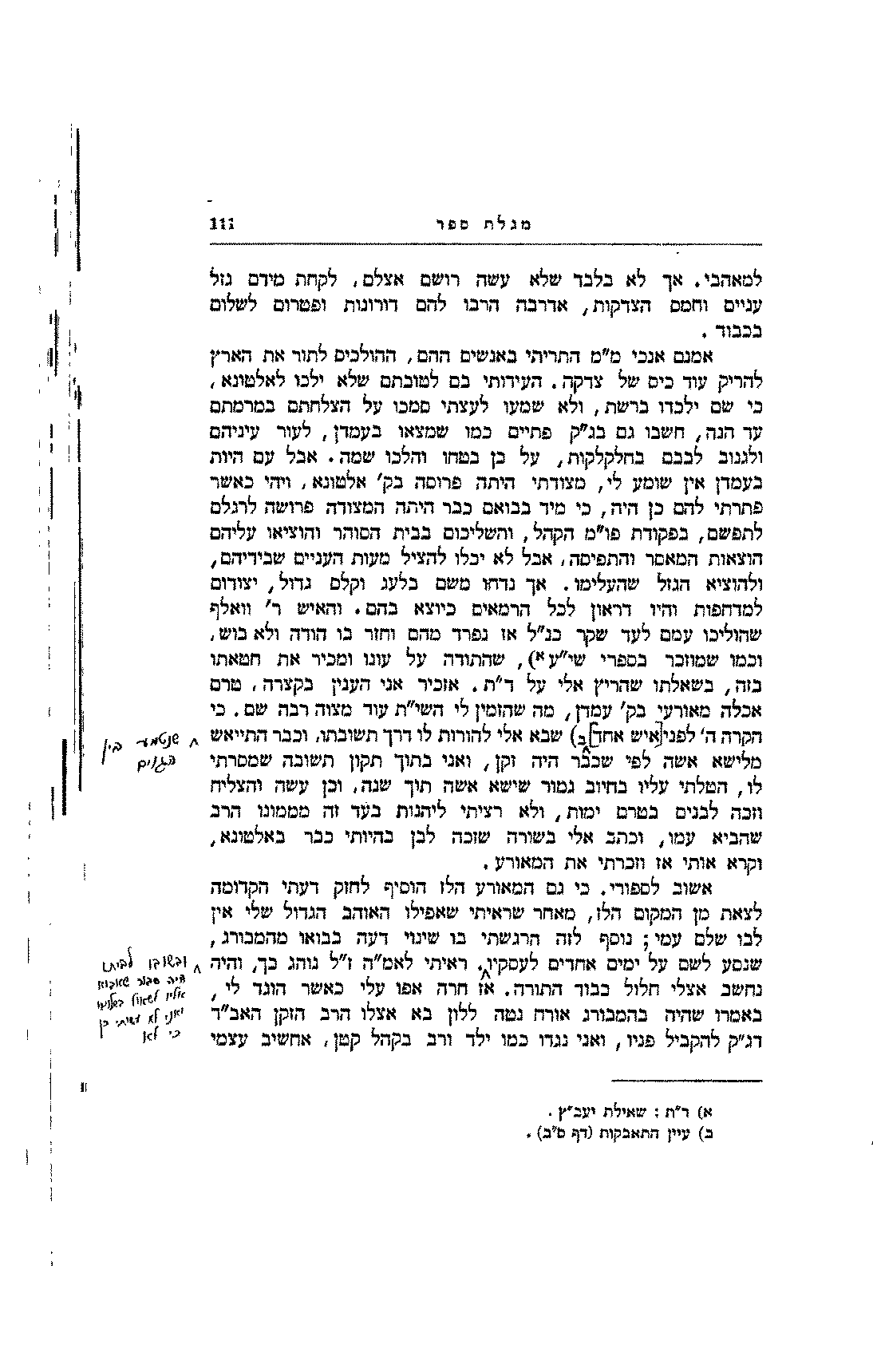
Margin readings in Scholem's copy (2)
| Printed anchor | Type (key sheet) | Mark | Reading | Certainty |
|---|---|---|---|---|
| הקרה ה' לפני [איש אחד] ב) ^ שבא אלי להורות לו | V: omission | caret; 2-line note in left margin | שנטמא בין / הגוים | sure |
| שנסע לשם על ימים אחדים לעסקיו. ^ ראיתי לאמ"ה | V: omission | caret; 5-line note in left margin, left edge partly cut off | ובשובו לבית[ו] / היה סבור שאבוא / אליו לשאול בשלומו / ואני לא עשיתי כן / כי לא ... | partial |
Page 112 (scan 128)
more than a great and famous rabbi like that one — all the more so since he was the most honoured man in the community. Through this he was turned into another man, and the fire of love between us cooled. When I heard this, I made a firm decision to move my dwelling from Emden at all events, by whatever means possible, and not to go back on it. I chose to be a free man, to live in my native town as a private person and not to be a servant to this people — as I had wished, I who fled from greatness and chose lowliness, and this was established and confirmed — and not to bear the burden of flesh and blood, especially the arrogance of German leaders, above all in small places, where they make strange gods of them; something I had not experienced before: the yoke of men had never come upon me. And I said: better for me "to dwell in a corner of the housetop" (Prov. 21:9) than in this servitude, whose master is answerable for others, for every error and mistake; and "better is a dinner of herbs" (Prov. 15:17) and quiet there, and "better is a dry morsel" etc. (Prov. 17:1) — although I had all honour there, and fear of me lay upon the whole community, and a comfortable livelihood.
And this although I did not have so much income from the community as to provide for my household, especially since I was not hasty after money. I did not pursue gain even from what was permitted; I did not involve myself in any private business, or in matchmaking as the rabbis of the time do, much less rise early to the doors of the generous to increase my gifts — for that is what they were after. I accepted nothing at all as payment for teaching students, and returned to them what they sent me. All the days I stood to serve I took nothing for all my sermons, although they were very sweet to them, and they swore that their ears had never heard their like in their lives. Even men who had studied in the yeshiva in Prague, before the gaon R. Abraham Broda, of blessed memory, confirmed their words with an oath that they had not heard their like in Prague either, for sharpness, erudition and sweetness, even from the great men in the land there. So too I was much beloved in all that country around Emden; how greatly they longed to shelter under my wings! Every question of Torah law and ruling, every matter too hard for them, they would ask me, and send their letters to me for rulings. For all that, I did not turn to honour and greatness; had I sought them, I could easily have risen rank after rank.
In short, as I had planned, so I did in deed, with God's help. At the end of the year [5]492 [1732] I arranged to rent a house in Altona, after I had given notice of it to the notables of the community of Altona, and they answered me that I should come with joy. I sent all that I had by sea, here, by ship, and I travelled from there with my household by land. My wife the rabbanit, peace be upon her, had already travelled some months before to the wedding of my firstborn son, may he live, and was then in Posen with her father the rabbi, peace be upon him. The people of Emden, with all the strength of their urging, could not turn me from my intention — especially the said old leader and his son the leader R. A., who again spoke to my heart to give up this plan. Even the gentiles ⟨S: "the uncircumcised"⟩ among the great men of the town reproached the Jews when they heard of my moving from there, and shamed them, saying to them: "What are [you] doing? Where are your wisdom and understanding? Where will you find
יותר מרב מפורסם גדול כזה, ומה גם היותו הנכבד שבקהלה; ועד"ז נהפך לאיש אחר ונתקרר אש האהבה בינינו. וכשמעי את זאת עשיתי הסכמה חזקה להעתיק דירתי מעמדן עכ"פ עי"מ האפשרי ולא אשוב ממנה, ובחרתי להיות בן חורים לישב בעיר מולדתי כאיש פשוט, ולא עבד לעם הזה, כאשר חפצתי שברחתי מן הגדולה ולבחור בשפלות, היות קבל וקיים, ולא לסבול משא ב"ו, בפרטות גאות קצינים אשכנזים, ביחוד במקומות הקטנים שעושין מהם אלקי נכר, מה שלא נסיתי מתמול שלשום, לא עלה עלי עול ב"א. ואמרתי אני טוב לשבה על [פינת גג] מעבדות הלז, אשר בעליה חב באחריות אחרים לו משגה ושוגג, וטוב ארוחת ירק ושלוה שם, וטובה פת חרבה וגו', אע"פ שהיה לי כל הכבוד שם, ומוראי היה מוטל על פני כל הצבור ופרנסה ברוח, עם שלא היה לי כל כך הכנסה מהקהל כדי לפרנס ביתי ביחוד, כי לא הייתי בהול אחר הממון, לא רדפתי אחר הבצע אפילו מן המותר, לא הכנסתי עצמי בשום עסק יחידים, או בשידוכים כמנהג רבני הזמן, כ"ש שלא השכמתי לפתחי נדיבים, כדי להרבות לי מתנות, כי אותה היו מבקשים, וגם שכר למוד עם תלמידים לא קבלתי מאומה, והחזרתי להם מה ששגרו לי, כל הימים אשר עמדתי לשרת לא לקחתי מאומה בעד כל דרשותי, ואע"פ שערבו להם מאד, ונשבעו שלא שמעה אזנם כמותן מימיהם, אפילו אנשים שלמדו בישיבה בפראג, בפני הגאון מוהר"א ברודא ז"ל, חזקו דבריהם בשבועה שלא שמעו גם בפראג דוגמתם בחריפות ובקיאות ומתיקות, אפילו מהגדולים אשר בארץ שמה, וכן הייתי חביב מאד בכל המדינה ההיא סביבות עמדן, מה מאד חשקו לחסות תחת כנפי וכל דבר שאלה בד"ת והוראה, כל הדבר אשר יקשה מהם היו שואלים אותי, ומריצים אגרותיהם אלי להורותם, עכ"ז לא פניתי אל הכבוד והגדולה, אם הייתי מבקש הייתי יכול להשיג בקלות מעלה אחר מעלה. בקיצור כאשר זממתי כן עשיתי בפועל בעזה"י שלהי שנת תצ"ב סדרתי לשכור לי בית באלטונא, אחר שנתתי ידיעה מזה לנכבדים בק"א, והשיבוני דבר שאבוא ברנה. ושלחתי כל אשר לי דרך ים כה בספינה, ואני נסעתי משם עם ב"ב דרך יבשה, וזוגתי הרבנית ע"ה כבר נסעה איזה חדשים מקודם על חתונת בני הבכור שי', והיתה אז בפוזנא אצל אביה הרב ע"ה; ואנשי עמדן בכל עוצם הפצרתם לא יכלו לי להחזירני מדעתי, ובפרטות הק' הזקן הנ"ל ובנו הק' ר"א חזרו ודברו על לבי לשוב ממחשבה זו, גם אפילו הנכרים מאנשי העיר הגדולים גינו את היהודים בשמעם העתקתי משם, והכלימום, באמרם להם: מה [אתם] עושים, היכן חכמתכם ובינתכם, איה תמצאו
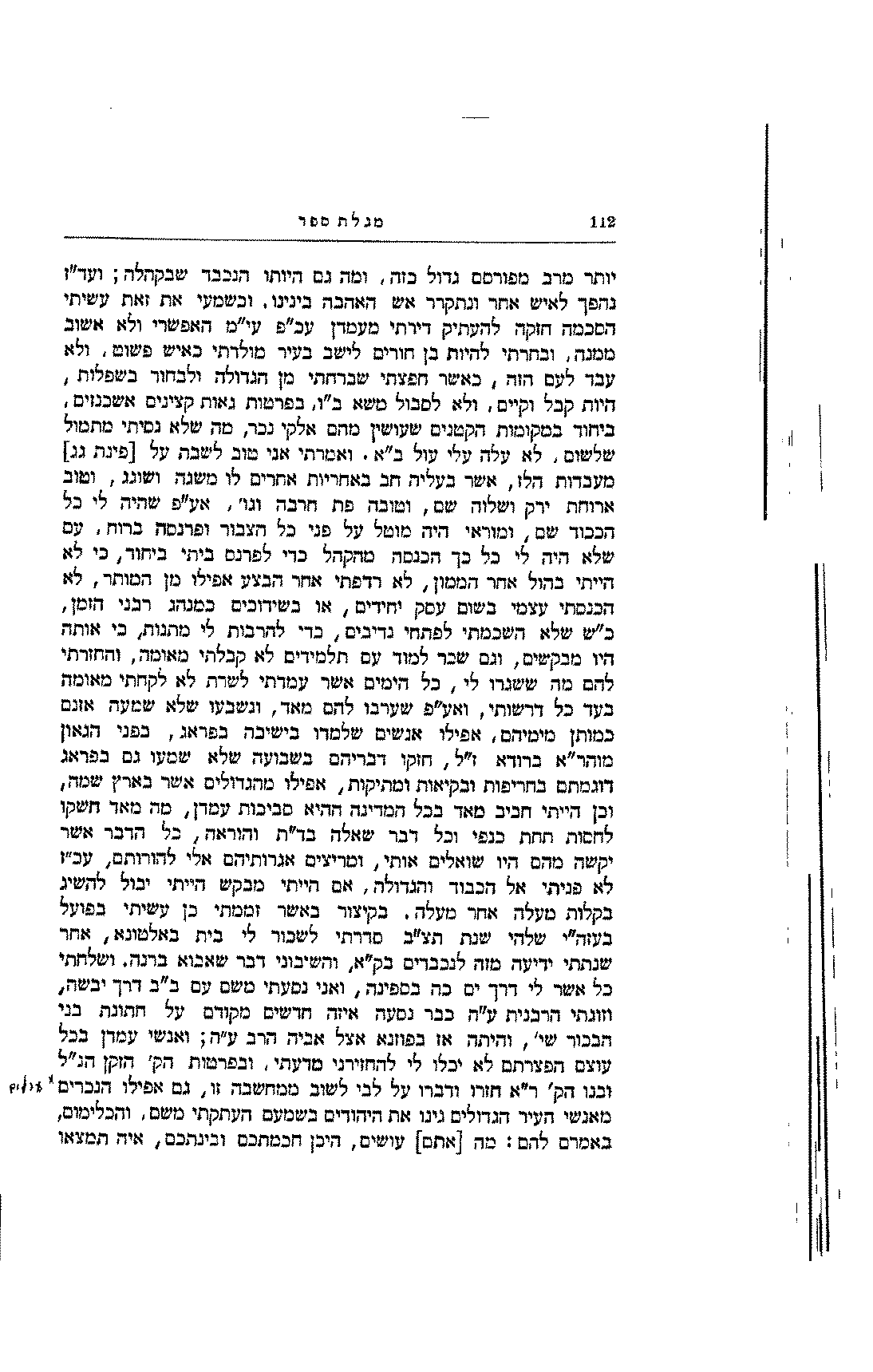
Margin readings in Scholem's copy (1)
| Printed anchor | Type (key sheet) | Mark | Reading | Certainty |
|---|---|---|---|---|
| גם אפילו הנכרים x מאנשי העיר הגדולים | X: substitution | x mark; one word in left margin | ערלים | sure |
Page 113 (scan 129)
another man like this, to stand and serve before your community?" But it was not on their side at all; all their words of appeasement were of no avail with me and achieved nothing, and I travelled from there to life and peace, and they did me great honour when I left the town.
Even so they thought that the deed was only for appearance, and that in the end I would return to them. And I saw with my own eyes that, although I myself wrote to them and asked them on behalf of someone from here .... at that time, they answered me that they did not want to accept a rabbi. For they held to this thought for several years; that is why they would not accept another rabbi. They made known their mind that no reasoning and understanding of another man would be sweet to them, to lead the rabbinate after me, whoever he might be; for their love and affection had not departed from me, and they were waiting and hoping that I would yet return to them and take the rabbinate, and they would add honour and glory and much salary for me. But I answered them with kind words, that after the deed nothing [can be done], and "out of doubt a man does not uproot himself"; and that had I not had weighty reasons, as said above, I would surely not have moved my dwelling from them, for they were exceedingly dear to me, [as it is said:] "as in water face answers face" etc. (Prov. 27:19). And God knows that even if I could have obtained the greatest rabbinate in the communities of Germany — as indeed it had already come to my ears that glorious things were being said of me in "the city and mother in Israel" (2 Sam. 20:19), the holy community of Frankfurt on the Main, who desired me — I would not have exchanged the community of Emden for it; [it was precious] in my eyes, so that I could apply myself to Torah and worship. Nor did my heart go after "great matters and things too wonderful" (Ps. 131:1), to pursue honour and lord it over great communities, to [receive] much money and increase my honour and glory; only necessity drove me to hate the rabbinate, for the weighty reasons mentioned above.
For all that, their spirit did not slacken for some time. After I moved from there this thought did not leave their minds, for they hoped for me — they hoped for vain ways — that they would persuade me to come back and live with them. Even after some seven or eight years had passed they wrote to me again with request and supplication, that I should consent to come to them and dwell in honour in their community, and they would add to my salary double and redoubled; for all the householders volunteered each to give a fixed sum for my needs, and to provide for me abundantly year by year, each taking it on himself according to his means as a full obligation. Besides this they promised to obtain for me the rabbinate over the whole province as well, which would be under my hand and authority, so that I would rule with absolute rule, without anyone to disturb or make afraid, for they all yearned and longed for me. They sent the letter through the leader R. David Lewerdin, a shrewd man and wise in affairs, and entreated him to do all in his power to speak to my heart to agree to their wish; and they would do all my will — whatever I would ask and request further of them they would fulfil, all with their heart's desire; besides what my friends wrote to me privately, that I should not turn them away empty. But all this did not enter my ears. They waited for me about ten years and would not accept any other rabbi; had it not been for the urging of my brother-in-law the rabbi, for whose sake they agreed to accept
עוד איש כזה, לעמוד לשרת לפני קהלכם? אך לא מצדם כלל, וכל דברי ריצוי לא הועילו אצלי ולא פעלו כלום, ונסעתי משם לחיים ולשלום, ועשו לי כבוד גדול בצאתי את העיר. אעפ"כ חשבו שהמעשה אינו אלא לפנים, ולסוף אשוב אליהם, וראיתי בעיני שאע"פ שאני בעצמי כתבתי להם ובקשתי מהם בעד אחד מכאן.... באותו זמן, והשיבוני דבר שאינם רוצים לקבל רב, אחר כי היו עומדים במחשבה זו כמה שנים, כי על כן לא רצו לקבל רב אחר, וגילו דעתם שלא ימתקו לחכם שום טעם ודעת אדם אחר, להנהיג רבנות אחרי יהא מי שיהא, כי אהבתם וחבתם לא זזה ממני, והנם ממתינים ומצפים שעוד אשוב אצלם לקבל הרבנות, ויוסיפו לי כבוד והדר ושכר הרבה. אמנם אנכי השיבותי אותם בדברים טובים, שאין אחר מעשה כלום ומספיקא לא עקר אינש נפשי', ואלמלא היו לי טעמים עצומים כנ"ל, בודאי לא הייתי מעתיק דירתי מהם, שהיו חביבים עלי עד לאחת, [כנאמר] כמים הפנים וגו', והשם יודע שאפילו הייתי יכול להשיג רבנות הגדולה שבקהלות אשכנז, כאשר באמת כבר הגיע לאזני, שמדברים בי נכבדות בעיר ואם בישראל ק"ק פפד"מ שהיו חושקים בי, לא הייתי מחליף עם ק' עמדן, [שיקרה] היתה בעיני, למען אוכל לשקוד על התורה והעבודה, ולא לבי הלך בגדולות ובנפלאות, לרדוף אחר הכבוד להשתרר בקהלות גדולות, כדי [לקבל] ממון הרבה ולהרבות כבודי והודי, רק הנחוץ השיאני לשנוא את הרבנות מטעמים עצומים הנ"ל. עם כל זה לא רפתה רוחם איזה ימים, אחרי אשר העתקתי משם לא יצאה מחשבה זו מדעתם, כי לי יקוו הליכות שוא קוו למו, שיפייסוני לילך לשוב לשבת אצלם. גם אחר שעברו כשבע או שמונה שנים חזרו וכתבו אלי בבקשה ותחנונים, שאתרצה לבוא אליהם לשכון כבוד בקהלם, ולהוסיף לי שכירות כפלי כפלים, כי כל היחידים התנדבו לתת איש איש דבר מסוים לצרכי, ולהספיק לי בשפע דבר שנה בשנה, ולקבל עליהם איש כערכו בחיוב גמור. נוסף לזה הבטיחוני להשיג גם הרבנות על כל המדינה. שתהיה תחת ידי ורשותי, שאמשול בממשלה מוחלטת בלי מטריד ומחריד, כי כולם נוהים וכמהים אחרי. ושלחו האגרת ע"י הק' כ' דוד לווערדין איש פקח ומשכיל על דבר, וחלו פניו שיעשה כל מה שביכלתו, לדבר על לבי שאסכים לדעתם, ולעשות כל רצוני מה שאבקש ואשאל עוד מהם, ימלאו הכל בחפץ לבם; מלבד מה שכתבו אלי עוד אוהבי ביחוד, שלא אשיב פניהם ריקם, וכל זה לא נכנס באזני. והמתינו לי כעשר שנים, ולא היו רוצים לקבל עוד שום רב, לולי עבור הפצרת גיסי הרב נאותו לו לקבל
Page 114 (scan 130)
his son-in-law. They offered me many advantages, good ones and greater than what I had had there at first, and this was a great trial on my part. For although I already sensed that there was no great future for me in staying in Altona — since the little money I had here in jewels(?), which the leaders N[or]dshi(?) held for me, had already gone down and dwindled greatly at that time, and it had been small from the start — for all that I could not change my mind: "if the spirit of the ruler rise up against" me, my place I will not leave (cf. Eccl. 10:4); especially after I had already bought a dwelling house in Altona and spent much on it to repair it and set it in order, so that it cost me dear.
In the matter of bodily health too I saw at any rate a good sign here: the fever to which all my household had been prone all the days we were in Emden left them here, and I became another man in Altona; though I was still somewhat prone to continual passing of water, still it lessened. My wife the rabbanit, peace be upon her, also had renewed vigour, although she was already pregnant before she travelled from Emden and went from there to my son's wedding, as said above; she came back to us on the second day after I arrived at Altona with my household. Even after this, in the days of her pregnancy, the flow of blood returned to her in great abundance, very much, like a rushing stream, so that her soul almost flew away in a faint because of the great loss of blood, and they had already given up hope; yet the Blessed One saved her from death. This happened to her several times in Altona while she was still pregnant. The first time she used the remedies of the physician R. Simḥah. I showed him the prescriptions that the doctor in Leiden had drawn up for her, and when he saw them he stood astonished and said that he had put her in great danger; he wondered greatly that she had been able to endure that remedy, which carried enormous risk and was closer to harm than to benefit. But his remedies did not help her either, for after a short time the flow of blood assailed her again, as mentioned, and her hope was almost lost — had it not been for the kindnesses of the Lord, who heard the voice of our cry that went up on high; and she returned to her strength. Afterwards she bore a whole male child; but for our many sins he did not survive, though he had already reached his seventh year, as said above. After two years she bore my daughter Esther, may she live, and after her she bore me two more daughters, who did not survive. There remained to me from her only my two sons the rabbis, may their light shine, and two daughters, may they live. Two little sons died to me in Moravia, and two daughters in Altona in her lifetime, and a son and a daughter died after her death; so that few were left of many — the Lord be over them, may they live.
I will return to tell in order from the beginning of my stay here in Altona. When I arrived here, all the people of the community came to me to receive me with honour and love, and asked me to request of them whatever was good in my eyes, and they would do my request with all their ability. I said to them: "Thanks, 'grace, grace' (Zech. 4:7), for the good will and the generous spirit that has moved from you towards me, which counts in my eyes as a deed, and I am as if I had received it. 'One thing have I asked, that will I seek: that I may dwell in the house of the Lord all the days of my life' (Ps. 27:4); to serve the Lord is my desire, and on Him I cast my burden
חתנו. והציעו לפני מעלות רבות טובות ויתרות על מה שהיה לי שם בתחלה, וזה היה נסיון גדול מצדי, כי אע"פ שכבר הרגשתי שאין כל כך תכלית לפני בישיבת אלטונא, באשר המעט ממוני שהי"ל פה בא"ט, והחזיקו בידי הק' נורדשי, כבר ירד ונתמעט מאד בעת ההיא, גם כי מצער היה מתחלה, עם כל זה לא יכולתי לחזור בי, אם רוח המושל יעלה עלי מקומי בל אנח, בפרט אחר שכבר קניתי בית דירה באלטונא, והוצאתי עליו הרבה לתקנו ולהעמידו על מכונו, באופן שעמד לי בדמים קרים; גם בענין בריאות הגוף ראיתי עכ"פ סימן יפה כאן, כי חולי הקדחת שהיו עלולים בו כל ב"ב, כל ימי היותינו בעמדן, עזב אותם פה, ואנכי חזרתי לאיש אחר באלטונא, עם שעדיין הייתי עלול קצת מהתמדת הטלת מים, מ"מ נתמעט. גם אשתי הרבנית ע"ה היתה לה עדנה, אף כי כבר היתה הרה בטרם נסעה מעמדן, והלכה משם על נשואי בני כנ"ל, ושבה אלינו ביום שני שהגעתי לאלטונא עם ב"ב, וגם אחר זה בימי הריונה חזר לה שתיתת הדמים בשפע גדול ורב מאד כנחל שוטף, כמעט שפרחה נשמתה בעלוף בסבת רוב יציאת הדם, וכבר היתה לאחר יאוש, עכ"ז הציל אותה הי"ת ממות וקרה לה כך איזה פעמים באלטונא עודה הרה; ובפעם הראשון נשתמשה ברפואות של הרופא ר' שמחה, והראיתי לו פתקי הרפואות שסידר לה הרופא בליידן, וכראותו עמד משתומם ואמר שהכניסה בסכנה גדולה. והתפלא מאד על שיכלה לסבול אותה הרפואה, שהיה בו אחריות עצום וקרוב להפסד יותר מתועלת, אבל גם רפואותיו לא הועילו לה. כי אחר זמן מועט חזר להתעולל בה יציאת הדם כנזכר, וכמעט אבדה תקותה. לולי חסדי ה' ששמע קול צעקתינו שעלה למרום ושבה לאיתנה, ואחר ילדה בן זכר שלם, אבל לא נתקיים בעו"ה עם שכבר השיג השנה השביעית כנ"ל. אחר שתי שנים ילדה בתי אסתר שתי', ואחריה ילדה לי עוד שתי בנות, ולא נתקיימו, לא נשאר לי ממנה רק שני בני הרבנים נר"ו ושתי בנות שי', אך שני בנים קטנים מתו לי במעררין, ושתי בנות באלטונא בחייה, ובן ובת נפטרו אחר מותה, באופן שנשארו מעט מהרבה ה' עליהם יחיו. אשוב לספר כסדר מתחלת ישיבתי פה אלטונא. בהגיעי לכאן באו אלי כל בני הקהלה לקבל פני בכבוד ובאהבה, ושאלו ממני שאבקש מהם דבר הטוב בעיני, ויעשו בקשתי בכל יכלתם. ואמרתי להם תשואות חן חן בעד הרצון הטוב, ורוח נדיבה אשר נסע מאתם אלי, שנחשב בעיני כמעשה, והריני כאלו התקבלתי, רק אחת שאלתי אותה אבקש, שבתי בבית ה' כל ימי חיי לעבוד ה' חפצתי, ועליו יהבי