Chapter 6 The printing press
Jacob Emden, Megillat Sefer · Hebrew (Kahana, Warsaw 1896/97) with an English draft translation · work in progress
Page 168 (scan 188)
These things I did and did not leave them, "to beautify the house of my sanctuary" (Isa. 60:13). And further, as I wished, in my "House of God" I included many moral teachings, which I poured out, since they are much needed to arouse hearts, especially of our brethren the Ashkenazim: to keep them far from the matters of the gentiles and to remove from them every blemish, so as to bring them to the happiness of success, to make them happy. But men who hate rebuke "repaid me evil" (Ps. 35:12) in return for my pursuing their good and their true benefit.
And behold, at first a name went out at once for this work, and it found favour in the eyes of all who saw it, until whoever saw it, "while it was yet in his hand he swallowed it" (Isa. 28:4); and almost as soon as the first part of it was finished, they already longed to buy it. And it was this that troubled me. For through this zealots fell upon me, "a brood of sinful men" (Num. 32:14), who "laid wanton charges against me" (Deut. 22:14); for they searched and found that I had written, in the laws of conduct and of commerce, what the sages, of blessed memory, said in the Mishnah, that a man should not teach his son to be a shopkeeper; and I had stealthily added some words in my own words: "And woe [to the money-changers] in these generations" [a]. By this they were filled with fury and wrath, and the anger of the money-changers, brazen-faced, [was such that] they almost thought to swallow me for nothing. They raged so, and said with full mouth, as I heard from behind truthful men, that if they met me they would lay hands on me; and "blessed be the Lord, who delivered the soul of the needy from the hand of evildoers" (Jer. 20:13)!
Indeed, these "sinners against their own souls" (Num. 17:3) bound themselves in a conspiracy of the wicked against me, and came as one man to the chamber of the community by day, and roused the parnassim with outcry and great commotion, saying that I was bringing them into danger. They spoke much evil of me, and asked them to command that the printed book be taken from my hand and the page torn out of it; and to cover the nakedness of their shame with the garment of traitors, "the proud forged a lie against me" (Ps. 119:69), that many things were found in this book that cause danger to all Jewry. They also complained about two of the readings of the prayer texts in it. All this they did to multiply the shrill chatter against me; and the parnassim acceded to them, to seat R. Y. Ḥ. and the court to look into this book of mine, whether they could find a pretext against me.
Yet I had already gone ahead myself: immediately after the end of the first part, called Ammudei Shamayim, I had sent it to the hand of the said old head of the court to obtain an approbation from him, as is the custom. And I made a condition, intending not to take an approbation from him at the beginning of the printing on the strength of a page or two that he had seen, as is the custom of most authors of books in this generation; I did not want that, but only that he should testify from what he had seen of most of it, as of all of it. The said first part was in his hand several weeks, to study it all, before he gave me the approbation. Afterwards he sent it into my hand with praise and the glory of the signature by his hand, except that I saw that he had cut short somewhat the merits of the work. I went back and sent to him that it would be fitting for him to add some lines to his approbation, to make known in explaining the great benefits that come from this work, beyond what was mentioned
Kahana's notes
- [a] See the book Edut be-Ya'akov (p. 15b) and the book Shevirat Luḥot ha-Aven (p. 42b).
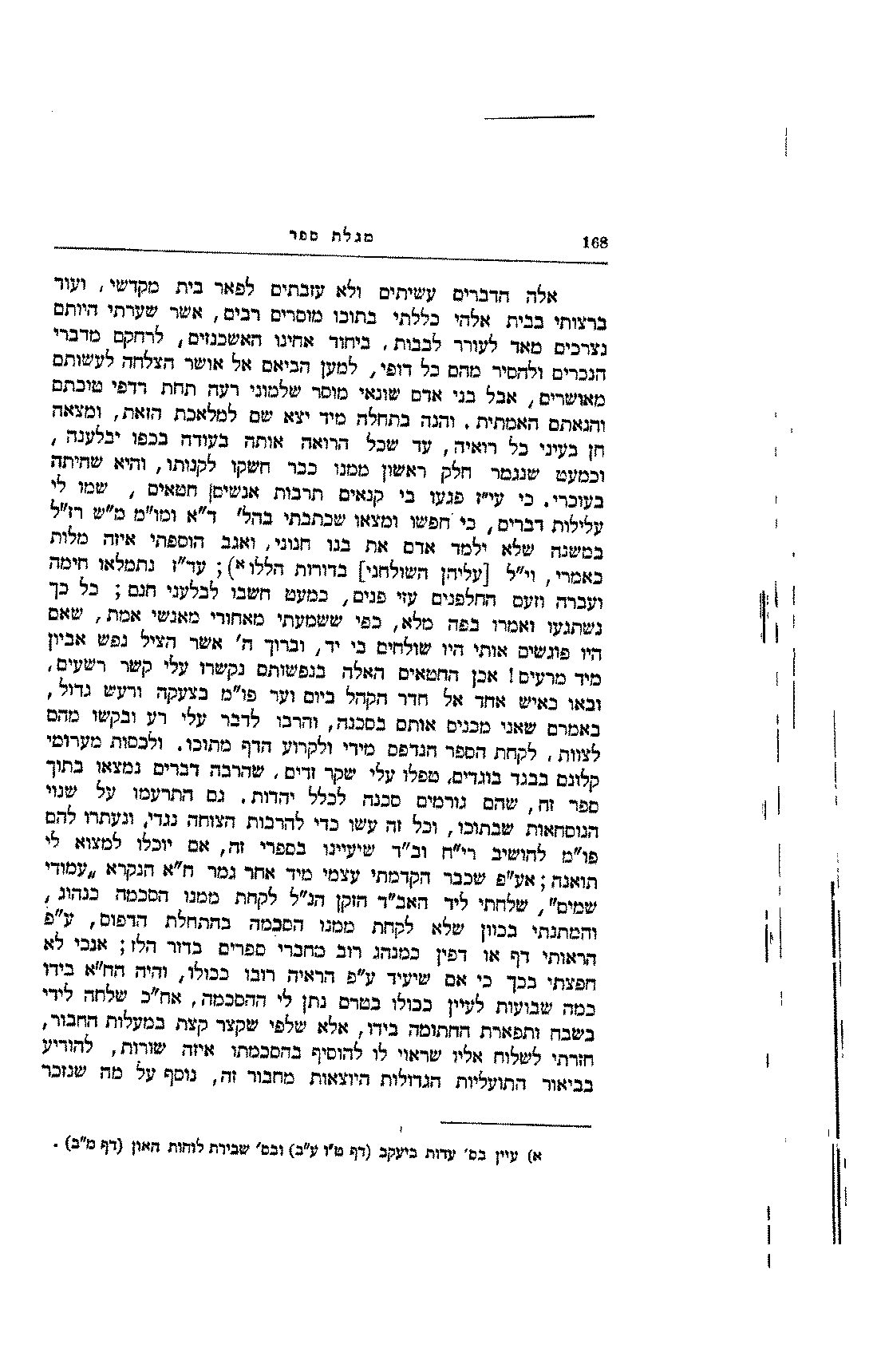
אלה הדברים עשיתים ולא עזבתים לפאר בית מקדשי, ועוד ברצותי בבית אלהי כללתי בתוכו מוסרים רבים, אשר שערתי היותם נצרכים מאד לעורר לבבות, ביחוד אחינו האשכנזים, לרחקם מדברי הנכרים ולהסיר מהם כל דופי, למען הביאם אל אושר הצלחה לעשותם מאושרים, אבל בני אדם שונאי מוסר שלמוני רעה תחת רדפי טובתם והנאתם האמתית. והנה בתחלה מיד יצא שם למלאכת הזאת, ומצאה חן בעיני כל רואיה, עד שכל הרואה אותה בעודה בכפו יבלענה, וכמעט שנגמר חלק ראשון ממנו כבר חשקו לקנותו, והיא שהיתה בעוכרי. כי עי"ז פגעו בי קנאים תרבות אנשים] חטאים, שמו לי עלילות דברים, כי חפשו ומצאו שכתבתי בהל' ד"א ומו"מ מ"ש רז"ל במשנה שלא ילמד אדם את בנו חנוני, ואגב הוספתי איזה מלות כאמרי, וי"ל [עליהן השולחני] בדורות הללו א; עד"ז נתמלאו חימה ועברה וזעם החלפנים עזי פנים, כמעט חשבו לבלעני חנם; כל כך נשתגעו ואמרו בפה מלא, כפי ששמעתי מאחורי מאנשי אמת, שאם היו פוגשים אותי היו שולחים בי יד, וברוך ה' אשר הציל נפש אביון מיד מרעים! אכן החטאים האלה בנפשותם נקשרו עלי קשר רשעים, ובאו כאיש אחד אל חדר הקהל ביום וער פו"מ בצעקה ורעש גדול, באמרם שאני מכנים אותם בסכנה, והרבו לדבר עלי רע ובקשו מהם לצוות, לקחת הספר הנדפס מידי ולקרוע הדף מתוכו. ולכסות מערומי קלונם בבגד בוגדים, טפלו עלי שקר זדים, שהרבה דברים נמצאו בתוך ספר זה, שהם גורמים סכנה לכלל יהודות. גם התרעמו על שנוי הנוסחאות שבתוכו, וכל זה עשו כדי להרבות הצוחה נגדי, ונעתרו להם פו"מ להושיב רי"ח וב"ד שיעיינו בספרי זה, אם יוכלו למצוא לי תואנה; אע"פ שכבר הקדמתי עצמי מיד אחר גמר ח"א הנקרא „עמודי שמים", שלחתי ליד האב"ד הזקן הנ"ל לקחת ממנו הסכמה כנהוג, והמתנתי בכוון שלא לקחת ממנו הסכמה בהתחלת הדפוס, ע"פ הראותי דף או דפין כמנהג רוב מחברי ספרים בדור הלז; אנכי לא חפצתי בכך כי אם שיעיד ע"פ הראיה רובו ככולו, והיה הח"א בידו כמה שבועות לעיין בכולו בטרם נתן לי ההסכמה, אח"כ שלחה לידי בשבח ותפארת החתומה בידו, אלא שלפי שקצר קצת במעלות החבור, חזרתי לשלוח אליו שראוי לו להוסיף בהסכמתו איזה שורות, להודיע בביאור התועליות הגדולות היוצאות מחבור זה, נוסף על מה שנזכר
- [א] עיין בס' עדות ביעקב (דף ט"ו ע"ב) ובס' שבירת לוחות האון (דף מ"ב).
Page 169 (scan 189)
in his first approbation. And so he did: he set his hand a second time to write a new approbation as I wished (?). So there were in my hands two signed approbations and the licence of the king, may his majesty be exalted, for the printing, so that it was not enough to ... against them (?), that they should not obtain, by order of the parnassim through messengers, a protest in my hands against finishing the printing before they gave permission especially for it. When they did so, through their beadle, to make known to me that they had decreed on me as said, they wanted me to hand over from my books six copies of this first part that was finished, to deliver them to a doubled court: that is, six that they chose, three added to the fixed court of three, besides the head of the court, so that one book would be in the hand of each one of them, to study in it all they needed. They did not set a time for the matter, when the thing would come to an end and conclusion; each one of them took it to his house to examine as far as his hand reached, and by their word the judgment of the book would be given.
Although I said: behold, I already have in my hand a double approbation from the old head of the court, which he had in his hand already, and how could he pull down what he had built? — or would the others be able to answer in a quarrel? — my words of self-defence did not help. And though I could have laughed at them, I did not want to quarrel with the many, and I made myself ready to fulfil their request. I handed over the books they wanted from me into the hand of their beadle, with an answer by word of mouth: although I am not obliged in this, behold, I do this willingly, and the examining judges will give me satisfaction if they look into it with fine care; and where I have erred, let them make me understand, and let them blot it out of my book, and I will be grateful to them [for good] if they save me from the stumbling that is under my hand, God forbid. Therefore say to them in my name, as a request, that they should not stumble over it, and it will be counted to me for good, "for in these things I delight" (Jer. 9:23).
In truth that day was hard for me, when the said sinners "prepared war" (Joel 4:9) against me; perhaps they would go down with me to my life, for I had spent several thousands on a holy and great work, and how much sorrow and weariness I had until the first part was finished and most of the second near to completion! It was almost for nothing, God forbid. I greatly feared the accusers in this work of the Lord, from which a great name had gone out for me, "and it did not cease" (Deut. 5:19), lest, God forbid, it should not come to completion. Therefore I made haste the next day to return to the work, and commanded my workman to hold fast to his work and not let go until it was all completed, with God's help. And so it was done, without hindrance or further mishap. For the opponents had thought that there was still time to hold up the spread of the book in the world, once they found something they wanted with the judges examining my book, who they were sure would find what they wished, evil enough and more, in a short time. Indeed, out of worry over a hindrance, God forbid, I made many abbreviations in the last half of the second part, called Sha'arei Shamayim and Ir ha-Elohim, to include many words under one abbreviation. So quick was I this time in the work of this composition, so that no further delay or hindrance should come into my hand; and this is what caused difficulty of understanding in places of its said last half. Before Rosh ha-Shanah of the year [5]508 [1747] it was finished, thank God,
בהסכמתו הראשונה, וכן עשה, הוסיף שנית ידו לכתוב הסכמה מחדש כחפצי מח"י, נמצאו היו בידי שתי הסכמות חתומות ורשיון של המיר"ה על דפוס, שלא היה מספיק להתרים כנגדם, שלא להשגיח בצווי פו"מ ע"י שלוחים למחות בידי גמר הדפוס, בטרם יתנו רשות פרטי על זאת, כאשר כה עשו ע"י שמש שלהם להודיעני שגזרו עלי כנ"ל, ושרוצים שאמסור מספרי זה ח"א הנגמר ששה חתיכות כדי למסרם לב"ד כפול, דהיינו של ששה שבחרו, עוד שלשה נוספים על ב"ד של שלשה הקבוע מלבד האב"ד, למען שיהא ביד כל אחד מהם, ספר אחד לעיין בו כל צרכם, ולא בקשו זמן לדבר מתי יהא גמר וסוף לדבר; לקחהו כל איש מהם לביתו לבדוק עד מקום שידו מגעת, ועל פיהם יהיה דין הספר. ואע"פ שאמרתי הלא כבר יש בידי הסכמה כפולה מאב"ד הזקן שהיה בידו כבר, ואיך יוכל לסתור את אשר בנה, או היוכלו האחרים לענות על ריב, לא הועיל דברי התנצלותי, ועם שיכולתי לשחק בם לא רציתי לחלוק עם הרבים, ונמצאתי לבקשתם ומסרתי מספר ספרים שרצו ממני ביד השמש שלהם, ומענה בפי אף ע"פ שאינני מחויב בכך, הנני עושה זה בחפץ לבי, ונחת רוח יעשו לי הדיינים החוקרים, אם יעיינו בו היטב הדק, ומה שגיתי יבינו לי ואמחנו מספרי, ואחזיק להם [טובה] אם יצילוני מהמכשלה שתחת ידי ח"ו; לכן אמור להם בבקשה משמי, שלא יתרשלו בזו ולטובה תחשב לי, כי באלה חפצתי, ובאמת היה קשה לי היום ההוא, שקדשו עלי מלחמה האנשים הפושעים הנ"ל, אולי ירדו עמי לחיי, כי כמה אלפים הוצאתי, על מלאכה קדושה וגדולה הלזו, וכמה צער ויגיעה רבה היה לי עד שנגמר ח"א, ורובו של שני סמוך לגמרו עצורו, כמעט היה לריק ח"ו, ויראתי מאד מן המקטרגים במלאכת ה' זו, שיצא לי שם גדול ולא יסף, פן ח"ו לא תבוא לגמר; על כן נזדרזתי ביום השני לשוב למלאכה, וצויתי לפועל שלי שיאחז במלאכהו לא ירפה, עד תשלם כולה בעזה"י, וכן נעשה בלי שטן ופגע רע עוד; כי המתנגדים חשבו שיש עוד זמן לעכב פזור הספר בעולם, כשימצאו חפצם אצל הדיינים הבודקים וחוקרים בספרי, שהיו בטוחים שישיגו תאותם הרעה די והותר בזמן קצר; אמנם מדאגה מדבר העיכוב חלילה עשיתי הרבה ר"ת בחצי האחרון ח"ב הנקרא „שערי שמים ועיר האלקים", כדי לכלול תיבות רבות תחת ר"ת אחת. ככה הייתי מהיר בפעם הזאת במלאכת החבור הלז, שלא יבוא עוד לידי שיהוי ועיכוב, והוא שגרמה בו הבנה קשה במקומות מחציו האחרון הנ"ל. קודם ר"ה שנת תק"ח נגמר ת"ל
Page 170 (scan 190)
the book, with no one to hinder or trouble. In the meantime and after it — which was more than half a year, for in the week in which the Ninth of Av fell [a] this hard event befell me — until near the end of the month [of Shevat] [5]509 [1749] the said judges had not finished their work, who sat and examined to know the judgment of the book and its deed. All this time I kept sending my messenger to the head of the court and to the parnassim, that they should let me know whether they had found in it any trace of a thing, so that "I should not let iniquity dwell in my tents" (Job 11:14), God forbid. But I could not get to the bottom of their manner, for each one pushed me off to the other. And I understood that, although they had made some objections against me according to their opinion and their mistake, or as the plotters had asked of them — for they were their hired men without doubt — even so they were afraid of me, and did not trust themselves that their words would stand against me; therefore they hid from me what they had written to weaken the force of the book. The parnassim too kept silent and made themselves as if they did not know; though several householders bought the book from me, they did not protest at all. As it seemed, they were regretting it and thinking, "Would that they had not begun with me"; for the parnassim knew and felt the weakness of the things written against me, and worried lest no honour come to them, but only disgrace and shame to the court in general; for they had tested its strength and understood that they could not stand against me. Therefore they chose silence, for the sake of honour: they said neither forbidden nor permitted, and left me to sell and the householders to buy, with no one to protest or object.
Also, at once after the event, some of the money-changers themselves came and bought the first part of the book from me at a high price; and so great was the fear of me upon them that at once their anger cooled somewhat. The head of the ruffians too, Aaron Berliner, sent to ask my forgiveness. But my mind was not set at rest by their silence, and I did not stop sending to the parnassim week after week that they give me the objections of the judges: I would know whether there is substance in their words, and I would set right what was crooked; and if there is iniquity in me and a guilt known to me, as the law is, then I would bow my head to do according to the law and the Torah; and if I am clean of all blame and fault, they cannot make me forget it: until when shall this be a snare to me? I cannot leave this slander standing, God forbid, and I cannot let the slander rest. Then, after half a year had passed from the beginning of the objection, when they sat and examined my book, my request was granted at Passover — for at that time, through the many troubles, they gave me what I had asked, to let me know my sin, so that I would know whether "my error remains with me" (Job 19:4). And so the beadle of the community was sent to me, with a copy in his hand of what the judges had handed to the parnassim: some claims and objections found in my book in their opinion. Then I asked whether they would give me permission to answer in writing too, on those claims and supposed objections that the scholars had found against me in their eyes, so that we might know who is in the right. But he would not permit it and give explicit permission; he only said, I do not know
Kahana's notes
- [a] Abbreviation of: the Ninth of Av.
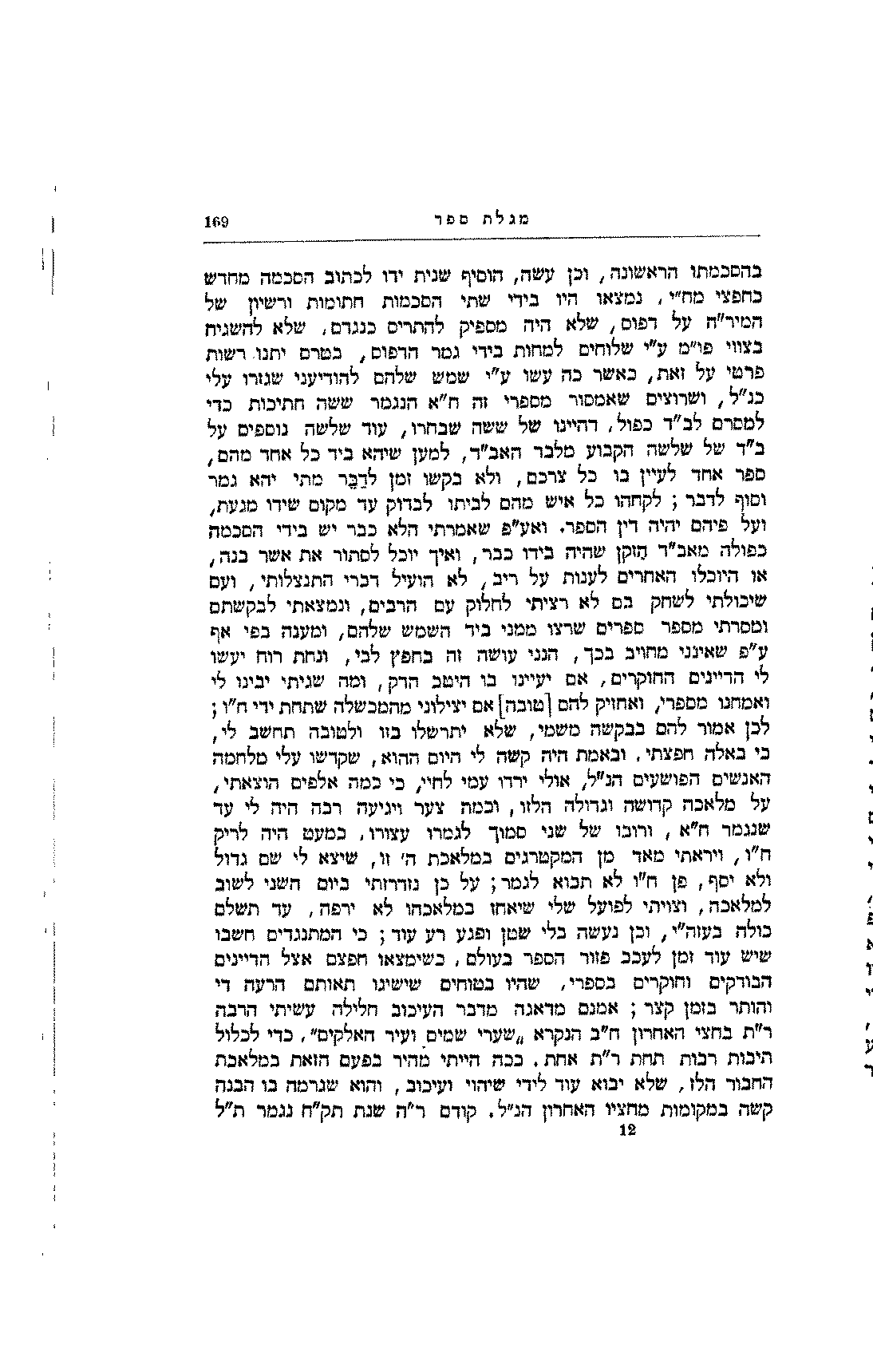
הספר בלי משטין ומטריד, ובתוך זה ואחריו שהיה יותר מחצי שנה, כי בשבוע שחל ט"ב בתוכה א, אירע לי זה המקרה הקשה, ועד קרוב סוף חדש [שבט] תק"ט לא גמרו מלאכתם הדיינים הנ"ל, שישבו ובדקו לדעת משפט הספר ומעשהו, ובכל זמן זה הייתי משכים ושולח שלוחי לאב"ד ולפו"מ שיודיעוני אם מצאו בו שמץ דבר, ולא אשכין באהלי עולה חלילה, ולא יכולתי לעמוד על אופיין שלהם, כי כל אחד דחה אותי לזולתו, והבנתי שאע"פ שעשו איזה השגות לנגדי כפי דעתם והשגתם, או כפי שבקשו מהם המעלילים, כי שכורים היו מהם בודאי, מ"מ היו מתייראים ממני, ולא בטחו בעצמם שיעמדו דבריהם נגדי, לכן היו מעלימים ממני מה שכתבו לגרוע כח הספר; גם הפו"מ שתקו ועשו עצמם כבלתי יודעים, אע"פ שכמה ב"ב קנו ממני הספר לא מיחו כלל, וכמדומה היו מתחרטים והיו חושבים, הלואי שלא התחילו עמי, כי ידעו והרגישו פו"מ בחולשת הדברים שכתבו נגדי, ודאגו פן לא לכבוד יגיע להם אך לחרפה ולקלון לכללות ב"ד, שבחנו כחם והבינו שלא יכלו עמוד נגדי, לפיכך היו בוחרים בשתיקה מפני כבודם, לא אמרו לא איסור ולא היתר, והניחו לי למכור ולב"ב לקנות, באין מוחה ומערער. גם מיד אחר המעשה באו קצת מן החלפנים עצמן, וקנו הספר ח"א ממני בדמים יקרים, וכל כך היתה אימתי מוטלת עליהם, עד שתכף ומיד נתחרטו קצתן. גם ריש בריוני ארון ברלינר, שלח לבקש ממני מחילה. אבל אנכי לא נתקררה דעתי בשתיקה שלהם, ולא עזבתי מלשלוח לפו"מ מדי שבוע בשבוע שיתנו לי השגות הדיינים, ואדעה אם יש ממש בדבריהם אתקן המעוות, ואם יש בי עון ואשמה ידוני כדין, אז אכוף ראשי לעשות כשורה כהלכה וכתורה, ואם נקי אנכי מכל עלה ושחיתא לא יכלו להשכחה לי, א"כ עד אן תהא המכשלה הזאת ת"י להשאיר הלעז ח"ו, ולא אוכל להניח הלעז; אז אחר שעבר החצי שנה, מתחלת הערעור שישבו ועיינו בספרי, נעתר לי פה"ח שבאותו זמן לרוב הפצרות, לתת לי בקשתי להודיעני חטאתי, ואדעה אם תלין אתי משוגתי; בכן שלח אלי שמש הקהל ובידו העתק מה שמסרו הדיינים לפו"מ, איזה טענות וערעורים שנמצאו בספרי לפי דעתם; אז שאלתי אם נותן לי רשות להשיב ג"כ במכתב, על אותן הטענות והשגות מדומות שמצאו חכמים בעיניהם נגדי, ונדעה דבר מי יצדק, אבל לא רצה להתיר ולתת רשות מפורש, רק אמר איני יודע
- [א] ר״ת : ט' באב.
Page 171 (scan 191)
about it. And I understood that their will was not to stir up this matter any further, but only to send me away empty ⟨S: a five-line note, partly read: "against his will … the claims of the opponents, mostly(?) … could not"⟩; in any case he no longer had any rest to hide the matter altogether. Therefore I too chose the way of silence, so as not to give a pretext to cast a "quarrel" upon me, since they were no longer stirring up the matter. But in any case, between me and myself, "I took the writer's inkhorn" (Ezek. 9:2) in my right hand, and answered the plaintiffs on their heels, to their shame; for in complete truth they did not know their right hand from their left. In all that they wrote, though it is a mere trifle ⟨S: a word, perhaps "and a lad"(?)⟩, not even one settled and correct claim came into their hand — although they could have found many correct claims and victorious answers, for I felt myself that the book had not escaped various errors because of the haste. But they, "smitten with blindness" (Gen. 19:11), saw in it no real blemish, light or heavy; everything crooked was straight to them. They only put wanton charges upon me, with vain and bitter pretexts, and uncovered the nakedness of shame and the bared buttocks of folly (cf. Isa. 20:4). They went into this war to their shame, as I proved in a clarification in a booklet I devoted to it, and called it Zikkaron ba-Sefer ("A memorial in the book", Ex. 17:14), also Ma'aseh Amalek. "Is it not laid up in store with me" (Deut. 32:34)? I showed it to the eyes of the beadle, [to show] that they had not understood me and had not reached the end of my meaning at all, and had searched out their own blemishes with lamps, to reveal their shame. But I left the booklet hidden away to this day, so as not to multiply hostility.
Also, He who did not let the wrong done to the king of Edom wait (cf. Amos 2:1) did not let the wrong done to me wait. For at once after the event of the objection of the brazen-faced money-changers — two of whom were the heads in objecting and being zealous over this matter: the first was called Aaron Berliner, who was ... (?); but more than this he is held to be like one who robs the public, and he endangers Israel in the business of clipping coins, which is also a prohibition ⟨S: "ban"⟩ of the ancients [a]. Therefore this red one, whose hair is like the colour of the red of the vine ⟨S: "the ancient"(?)⟩ and fit for dyeing, is notorious for it — this is the thief whose hat burns, as the common proverb goes. To him another like him joined, called Hirsch Munden; this latter I did not know at all, and I never in my days ⟨S: "and they did not know about him"(?)⟩ saw such a wicked man as the first; and he was reputed rich and abounding, and respected, and honoured in the community, as they told me about him. They together made the uproar and the great tumult against me, as said.
And at once there was another event: in that week his first son fled with a purse of his father's money, and was caught. Then the red one repented ⟨S: two words, read as "with … (?)"⟩ of the evil of his deeds against me, and sent R. A. Tabor to appease me and to ask my forgiveness, and to let me know that he too was ready to come himself to fall at my feet. But I did not want to look at him or see him, unless he would stand in public in the great synagogue and confess, and ask forgiveness from God first, and afterwards for what he had sinned against me; for repentance
Kahana's notes
- [a] That is the ban (ḥerem) of Rabbenu Gershom; see what is said below (p. 173).
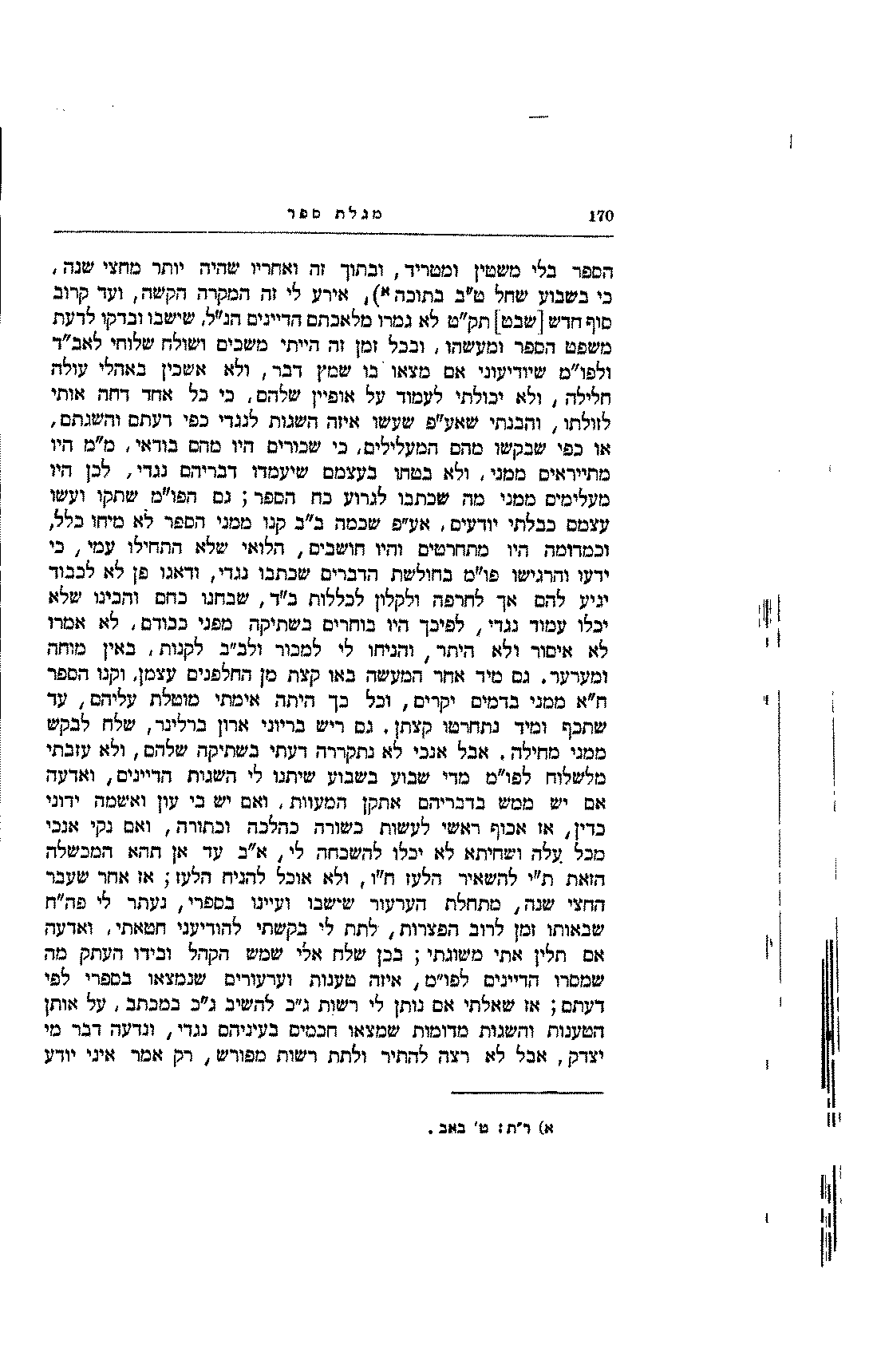
מזה, והבנתי שרצונם שלא לעורר עוד דבר זה רק להשיב פני ריקם, מ"מ היה נוח לו יותר להעלים הענין מכל וכל; בכן בחרתי גם אני בפלך השתיקה, שלא לתת פ"פ להטיל בי דופי „פלגאה", מאחר שהם אינם מעוררים עוד הדבר; אבל מ"מ ביני לבין עצמי, אחזתי קסת הסופר בימיני, ואשיב להטוענים על עקב בשתם, כי באמת גמור לא ידעו בין ימינם לשמאלם, בכל מה שכתבו אף כי מעט מזער הוא, לא עלה בידם אפילו טענה אחת מיושבת ונוכחת. עם היות שהיו יכולים למצוא הרבה טענות נכוחות ותשובה נצחת, כאשר הרגשתי מעצמי שלא נמלט הספר משגיאות שונות בסבת המהירות, אבל הם מוכי העורון, לא ראו בו מום גמור, בקל או חמור, כל העקב היה למישור, רק שמו לי עלילות דברים, בתואנות מהבלים מרים, וגלו ערות שבושם וחשופי שת הפתיות, הלכו במלחמה כזו לבשתם, כאשר הוכחתי בבירור בקונטרס שייחדתי לכך, וקראתיו בשם „זכרון בספר" גם „מעשה עמלק", הלא הוא כמוס עמדי, והראיתי לעיני השמש שלא הבינו לי, ולא ירדו לסוף דעתי כלל, וחפשו מומי עצמם בנרות לגלות קלונם, אך הנחתי הקונטרס בבית גנזי עד היום הזה, שלא להרבות משטמה. גם מאן דלא שהייה לאוניתיה דמלכא דאדום, לא שהייה לאוניתא דידי, כי מיד אחר מאורע הערעור של החלפנים עזי פנים, אשר שנים מהם היו ראשים לערער ולקנא על הדבר הזה, הא' נקרא ארון ברלינר, אשר היה כ"פ לפליטה, אבל יותר מזו מוחזק הוא כגוזל את הרבים, ומסכן את ישראל בעסק גלוח מעות, בשגם הוא איסור קדמון א, עכ"ז האדום הלז, ששערותיו כגוון אדמוני הכרום וערך לצבוע, מפורסם הוא בכך, זה הגנב בוער כובע שלו כמשל הדיוט, נלוה אל אחד שכמותו היה נקרא הירש מונדן, זה האחרון לא הכרתיו כלל, ולא ראיתי מימי כ"כ ש"ר כראשון, והיה בחזקת עשיר משופע ונשוא פנים, ונכבד בקהלה כפי שאמרו לי עליו, המה ביחד עשו לי הרעש והמהומה הגדולה כנ"ל, ותיכף אחר מעשה באותו שבוע ברח בנו של הראשון, עם כים מעות של אביו ונתפס; אז נתחרט האדמוני על רוע מעלליו נגדי, ושלח ר"א טאבור אלי לפייסני ולבקש ממני מחילה, ולהודיעני שגם הוא מוכן לבוא בעצמו להתנפל לרגלי; אכן לא רציתי להביט אליו ולראותו, אם לא שיעמוד ברבים בבה"כ הגדולה, ויתודה ויבקש מחילה מה' תחלה, ואח"כ מה שחטא נגדי; כי התשובה
- [א] הוא חרם דרבינו גרשון. עיין מה שאמר להלן (צד 173).
Margin readings in Scholem's copy (6)
| Printed anchor | Type (key sheet) | Mark | Reading | Certainty |
|---|---|---|---|---|
| רק ^ להשיב פני ריקם | V: omission | caret; 5-line note in left margin | על אפו וחמתו / ... שלא ... גלה(?) ... / טענות המתנגדים / ע"פ רוב דקשה(?) / לא יכול (partly read) | partial |
| אף כי מעט מזער הוא ^, לא עלה בידם | V: omission | caret; one word in left margin, with a question mark by the annotator | ונער(?) (with a question mark in the margin) | uncertain |
| בשגם הוא איסור x קדמון | X: substitution | x mark; one word in left margin | חרם | sure |
| כגוון אדמוני הכרום x וערך לצבוע | X: substitution | x mark; one word in left margin | הקדום(?) | uncertain |
| ולא ראיתי מימי ^ כ"כ ש"ר כראשון | V: omission | caret; 3-word note in left margin | ולא ידעו(?) עליו | uncertain |
| נתחרט האדמוני על ^ רוע מעלליו | V: omission | caret; 2-word note in left margin | עם(?) הצונה(?) | uncertain |
Page 172 (scan 192)
and the repair, of blessed memory, must be like the sin; and there are those who heard this and did not hear that. Therefore he must make his repair in a great congregation; then I would forgive my insults — not otherwise. The second one's end was very bad: for after some days he fled from here, and it was "a great escape" (Gen. 45:7), for he had robbed his fellow money-changers; and he thought he had already escaped to the place free for refugees and fugitives, under the hand of the king, may his majesty be exalted. But the authorities of that place pursued him with letters of their complaint before the king, may his majesty be exalted, and overtook him, and brought him out of the city of refuge to which he had fled, where he had thought to hide under the wings of the king, may his majesty be exalted; and all the expenses he laid out to obtain his freedom did not help him. He was shut up again in the hand of his oppressors, and his oppressors and officers ⟨S: "… the oppressors of the gentiles"(?)⟩ brought him bound in fetters on the way going and returning to the capital(?), and he died on the way ⟨S: "among the uncircumcised; he did not see the face of a Jew"⟩.
Before that his daughter, whom he had married off the past year with great importance, like one of the great rich, died at her first childbirth; afterwards his son, a young man, died, for our sins. And some years after, in the midst of the quarrel of Eybeschütz ⟨S: "may the name of the wicked rot"⟩, his other son did evil and violence to a gentile in the street, and was caught as a thief and brought to judgment like one of the worthless fellows; he was crushed and afflicted with hard sufferings, and was imprisoned in fetters a long time, and they almost wanted to sentence him to death, had not the mercies of the courts been moved toward his old father, still alive, who went ⟨S: "to the governor"⟩ [to ask mercy] for him. They sentenced him to cruel blows and many lashes with whips, and so he was beaten nearly until his blood flowed from him; afterwards they put him into the prison to do hard labour there, to spin flax and wool, for several years [a]; and at its end he would be expelled from the country. In this state he is there; his death is better than his life. This is he who used to curse me with grievous curses at the time of the said quarrel, and always carried in his purse abominable writings, pasquinades against me; and he did not take a lesson from what befell his father. So may be the end of all the brazen.
But this hard matter of the money-changers, who rose against me and incited to swallow me for nothing — though the Blessed Name showed me vengeance on them, and did not let them harm me, even so a seed of hostility of the hard-faced remained in their heart, for they were angry for nothing; only "the evil spirit" [b] that rattled within them "terrified them" (cf. 1 Sam. 16:14), and their end was full of regret, as said. But I could not uproot the roots of hostility from the heart of all. And for all that I showed my self-defence to those who came to my house — that it had not entered my mind to speak evil against them, God forbid, but only that good counsel is what I teach, for the benefit and pleasure of whoever wishes to listen to my voice; and in the said booklet I filled pages on this — and those who had dealings with me and were close to me, the words entered
Kahana's notes
- [a] Abbreviation of: for several years.
- [b] "R. R.", abbreviation of: evil spirit.
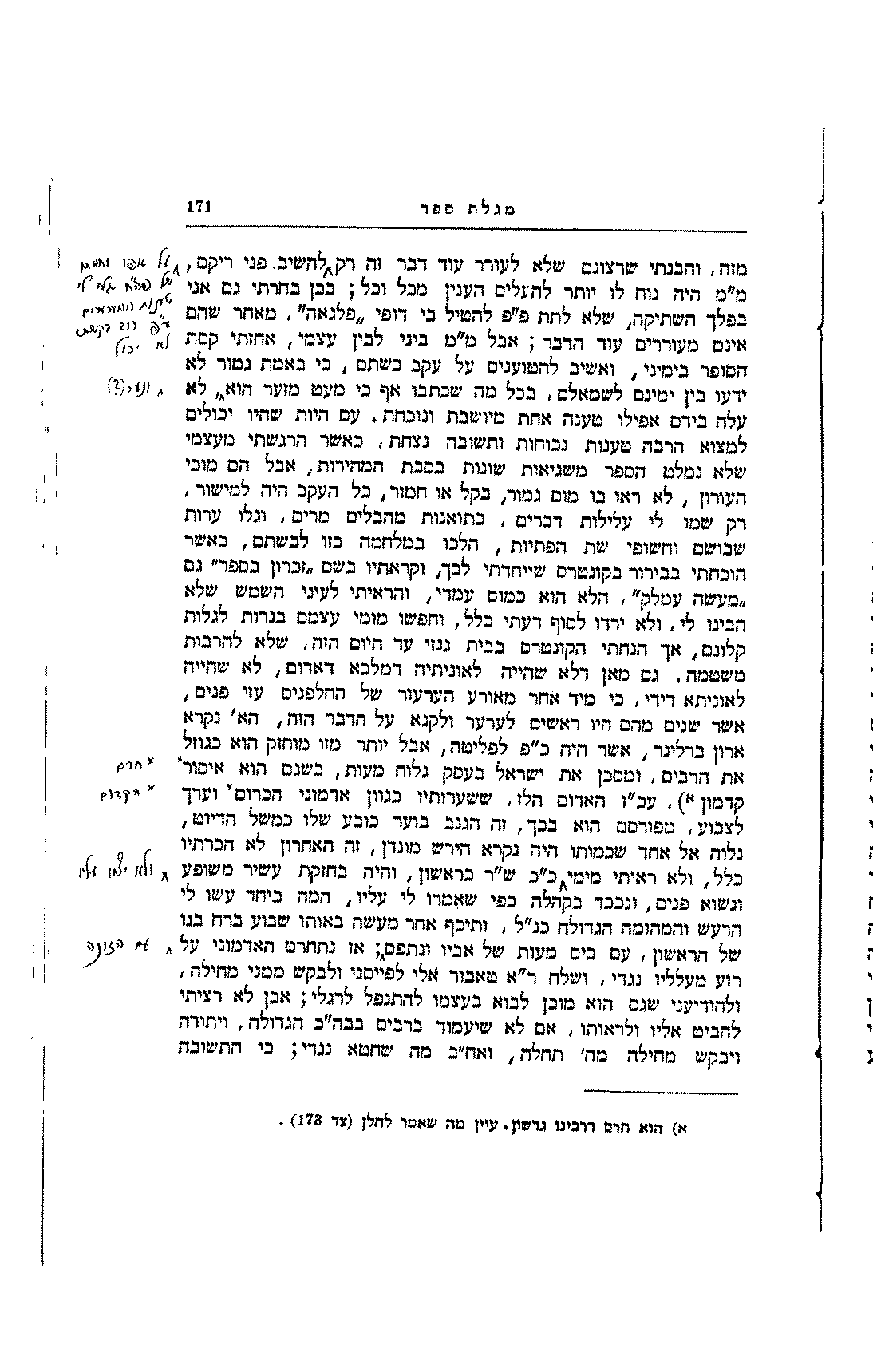
והתיקון צ"ל מעין החטא, ואיכא דשמע בהא ולא שמע בהא, לכן בהכרח שיעשה תיקונו בקהל רב, אז אמחול עלבוני לא זולת; והשני היה סופו רע מאד, כי אחר ימים אחדים ברח מזה והיה לפליטה גדולה, שעשק לחביריו החלפנים, וכסבור היה שכבר נמלט אל מקום חפשי לנסים ולבורחים תחת יד המיר"ה, אך השררה של המקום הב' רדפוהו בכתבי תלונתם לפני המיר"ה והשיגוהו, והוציאוהו מעיר מקלטו אשר נס שמה, וחשב להסתתר תחת כנפי המיר"ה, ולא הועילו לו כל הוצאות שעשה על כך ע"ד להשיג החפשיות, ושוב נסגר ביד נוגשיו והביאוהו נוגשיו ושוטרים אסור בנחשתים בדרך ההולכה והחזרה להב', ומת בדרך; וקודם שברח מתה בתו ראשונה, שאותה בלבד השיא בשנה שעברה, בחשיבות גדולה כאחד הגדולים בעשירות, ונפטרה בלדה ראשונה; אח"כ מת לו בן בחור בעו"ה; ואחר איזה שנים בתוך הריב של אייבשיצר, בנו אחר עשה הרע וחמס לנכרי על הרחוב, ונתפס כגנב והוגש אל המשפט כאחד הריקים, והיה מדוכא ומעונה כה ביסורים קשים וכלוא בנחושתים זמן רב, וכמעט שרצו לגמור דינו להריגה, לולי שנכמרו רחמי הערכאות על זקנו עודנו חי, שהלך [לבקש רחמים] בעדו, ופסקו עליו הכאות אכזריות וחבוטים הרבה בשוטים, וכן חובט כקצח עד שזב דמו מעליו, אח"כ נתנוהו בית הסוגר לעבוד שם עבודת פרך, לטוות פשתים וצמר ע"כ שנים א, ובהשלימו זה יגורש מן הארץ. בזה המצב הוא שם, טוב מותו מחייו. זהו שהיה רגיל לקלל אותי קללות נמרצות בעת הריב הנ"ל, ותמיד הי"ל בכיסו כתבי פלסתר שקודין פאסקווילין עלי, ולא לקח מוסר במ"ש לאביו, ככה יהא סופם של כל החצופים. אך הענין הקשה הלז מן החלפנים, שקמו נגדי והסיתו לבלעני חנם, עם היות שהראני הי"ת נקמתו בהם ולא נתנם להרע עמדי, מ"מ זרע משטמה בלבם של קשי פנים הללו, שכעסו על לא דבר, רק ר"ר המקשקשת בקרבם היה מבעתם ב, וקצתם מלאו חרטות כנ"ל, אבל לא יכולתי להוציא שרשי המשטמה מלב כולם; ועם כל הראות התנצלותי אל הבאים לביתי, כי לא עלה ע"ד דבר רע נגדם ח"ו, רק עצה טובה קמל"ן, לתועלת ולהנאת החפץ לשמוע בקולי, ובקונטרס הנ"ל מלאתי מלין על זאת; ואשר הי"ל עסק עמדי וסמוכים אלי, נכנסו הדברים
- [א] ר"ת: על כמה שנים.
- [ב] ר״ר, ר״ת : רוח רעה.
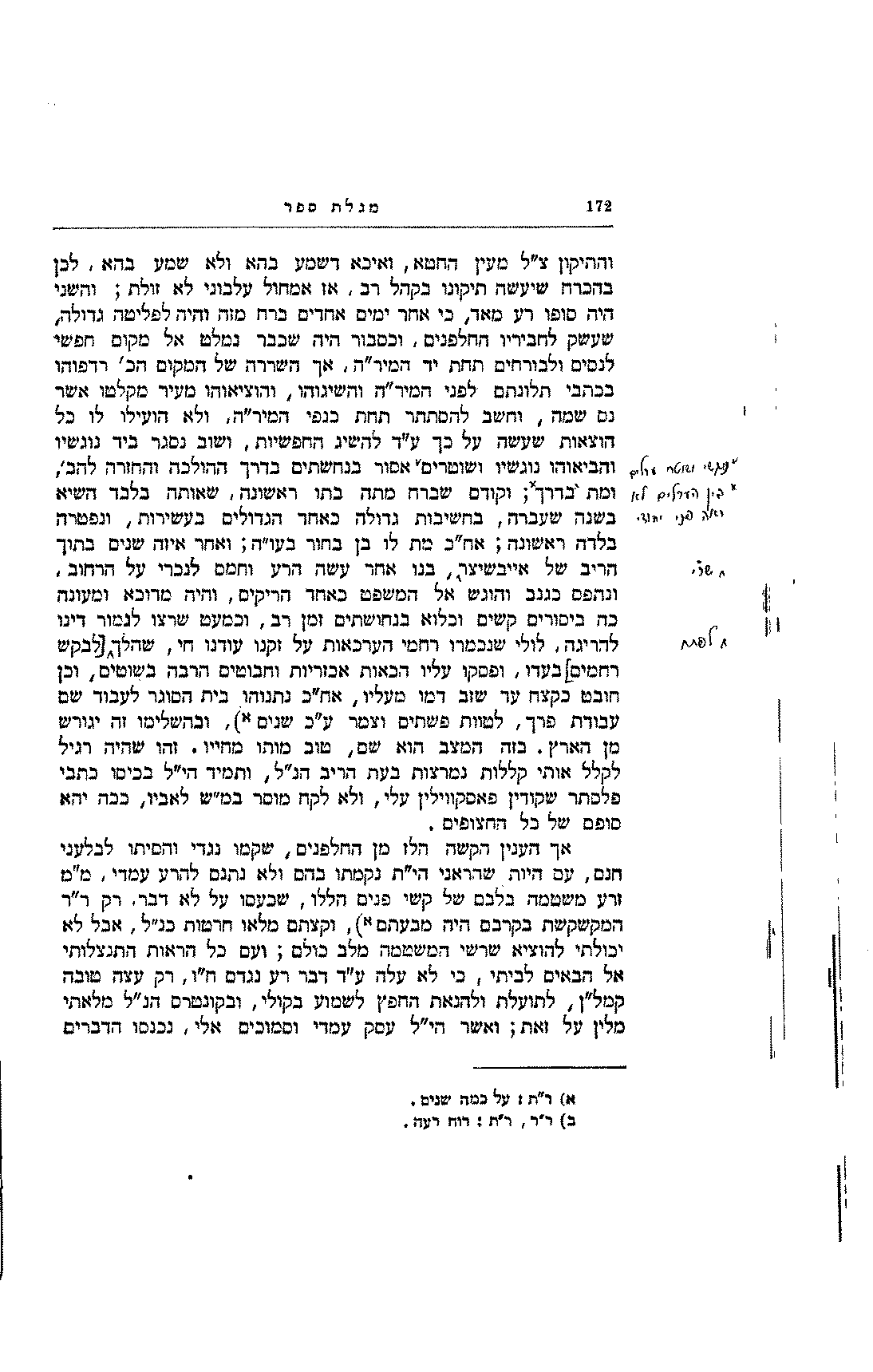
Margin readings in Scholem's copy (4)
| Printed anchor | Type (key sheet) | Mark | Reading | Certainty |
|---|---|---|---|---|
| והביאוהו נוגשיו ושוטרים v אסור בנחשתים | V: omission | v mark; short note in right margin | נוגשי ושוטרי ערלים(?) | fairly sure |
| ומת x בדרך x; וקודם | X: substitution | x marks before and after the word; 2-line note in right margin | בין הערלים לא / ראה פני יהודי | fairly sure |
| בתוך הריב של אייבשיצר ^, בנו אחר | V: omission | caret; one abbreviation in right margin | שר"י | sure |
| שהלך ^ [לבקש רחמים] בעדו | V: omission | caret; one word in right margin | לפחה | fairly sure |
Page 173 (scan 193)
their hearts; it made no impression at all. But I could not speak with all of them; therefore a seed of hatred remained in the hearts of the rest, who did not know my way. And why should I multiply proofs and arguments that my intention was only for their good and benefit? Were not all my moneys, most of the days, deposited in the hand of R. Y. P., without any benefit or enjoyment for me, for all the enjoyment was his — and not only with a money-changer as rich and secure as R. Y. P.; for I also used to lend purse money to my neighbour R. Zalman Munden, brother-in-law of the said Berliner, so that he could deal in money-changing (which is the craft by which he earned his living) to provide for his household. Though he was a poor man, I did not ask of him even a pledge, nor did he write even a mere receipt, for he was reputed trustworthy with me. And I took no benefit from him worth a perutah or more for my money, God forbid [a], though he wanted to let me benefit of his own will. I said to him: "Far be it from me to take anything from you; behold, whenever I have money lying idle in my hands, it is before you for all your needs, to profit by it. And I have the benefit in this, since I do not know how to do anything with it that yields fruit, and you know how — why should I withhold good from its owners, where this one gains and that one loses nothing?" If so, why should I make another stumble with your [pl.] money, if I thought evil of [the money-changers] altogether? Only because of [the wicked] was it necessary to mention such things.
The chief community in the region of Ashkenaz was almost destroyed because of the money-changers, who corrupted their deeds in these years. The Three Communities too were fined several times with great and heavy fines because of the bad and worthless men who deal in clipping coins and transgress the ban of Rabbenu Gershom, Light of the Exile; and in the Three Communities they used to renew the ban every month with a great excommunication. And the good and upright were punished for our sins, as Scripture says: "Did not Achan" etc. "and that man did not perish alone in his iniquity" (Josh. 22:20). The middling folk too, the poor and needy, orphans and widows, cry out violence before the robbers of the public, through whom the debts of the Three Communities increased. For were it not for these wicked men, they could bear the yoke of the government and the needs of the community at ease, without pressing the poor; perhaps it would be in their power to leave something over and improve the purse of the community, had not these worms been within them. They needed to take much money at interest, which devours them, until they did not know how to go out free from this heavy burden. And for this reason the poor and bitter of soul are pressed: not only can they not fulfil their duty, with the poor who cry for bread, but they are forced to strip the skin from their bones, to pay their debts and the debts of their fathers. Especially when the turn of marriage comes for one of the sons of the poor, their decree is harder than Pharaoh's, and they do not let them marry until they give as
Kahana's notes
- [a] (Printed with the label c.) "M. Sh. P.", abbreviation of: worth a perutah.
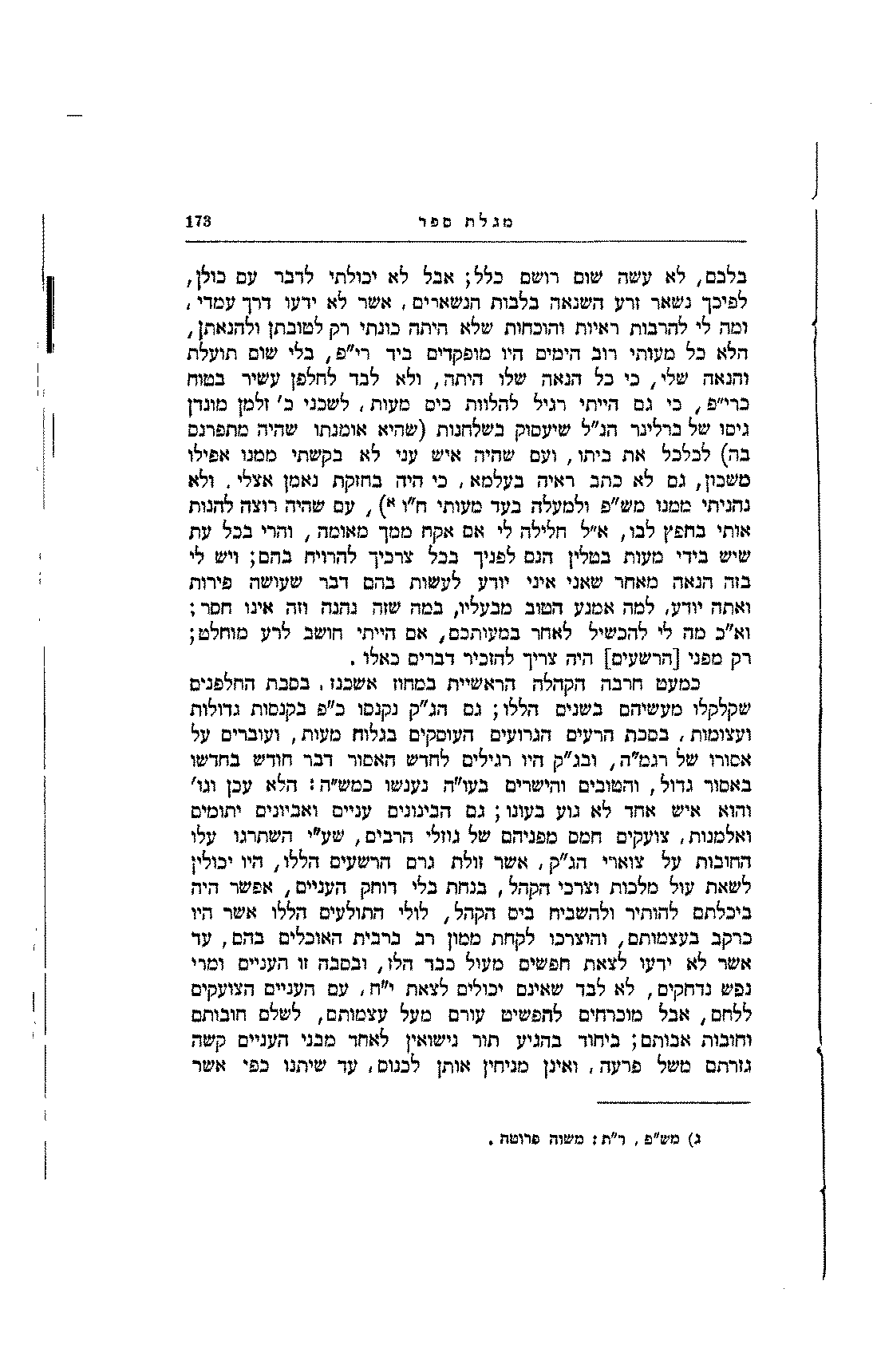
בלבם, לא עשה שום רושם כלל; אבל לא יכולתי לדבר עם כולן, לפיכך נשאר זרע השנאה בלבות הנשארים, אשר לא ידעו דרך עמדי, ומה לי להרבות ראיות והוכחות שלא היתה כונתי רק לטובתן ולהנאתן, הלא כל מעותי רוב הימים היו מופקדים ביד רי"פ, בלי שום תועלת והנאה שלי, כי כל הנאה שלו היתה, ולא לבד לחלפן עשיר בטוח כרי"פ, כי גם הייתי רגיל להלוות כים מעות, לשכני כ' זלמן מונדן גיסו של ברלינר הנ"ל שיעסוק בשלחנות (שהיא אומנתו שהיה מתפרנס בה) לכלכל את ביתו, ועם שהיה איש עני לא בקשתי ממנו אפילו משכון, גם לא כתב ראיה בעלמא, כי היה בחזקת נאמן אצלי, ולא נהניתי ממנו מש"פ ולמעלה בעד מעותי ח"ו א, עם שהיה רוצה להנות אותי בחפץ לבו, א"ל חלילה לי אם אקח ממך מאומה, והרי בכל עת שיש בידי מעות בטלין הנם לפניך בכל צרכיך להרויח בהם; ויש לי בזה הנאה מאחר שאני איני יודע לעשות בהם דבר שעושה פירות ואתה יודע, למה אמנע הטוב מבעליו, במה שזה נהנה וזה אינו חסר; וא"כ מה לי להכשיל לאחר במעותכם, אם הייתי חושב לרע מוחלט; רק מפני [הרשעים] היה צריך להזכיר דברים כאלו. כמעט חרבה הקהלה הראשיית במחוז אשכנז, בסבת החלפנים שקלקלו מעשיהם בשנים הללו: גם הג"ק נקנסו כ"פ בקנסות גדולות ועצומות, בסבת הרעים הגרועים העוסקים בגלוח מעות, ועוברים על אסורו של רגמ"ה, ובג"ק היו רגילים לחדש האסור דבר חודש בחדשו באסור גדול, והטובים והישרים בעו"ה נענשו כמש"ה: הלא עכן וגו' והוא איש אחד לא גוע בעונו; גם הבינונים עניים ואביונים יתומים ואלמנות, צועקים חמס מפניהם של גוזלי הרבים, שע"י השתרגו עלו החובות על צוארי הג"ק, אשר זולת גרם הרשעים הללו, היו יכולין לשאת עול מלכות וצרכי הקהל, בנחת בלי דוחק העניים, אפשר היה ביכלתם להותיר ולהשביח כים הקהל, לולי התולעים הללו אשר היו כרקב בעצמותם, והוצרכו לקחת ממון רב ברבית האוכלים בהם, עד אשר לא ידעו לצאת חפשים מעול כבד הלז, ובסבה זו העניים ומרי נפש נדחקים, לא לבד שאינם יכולים לצאת י"ח, עם העניים הצועקים ללחם, אבל מוכרחים להפשיט עורם מעל עצמותם, לשלם חובותם וחובות אבותם; ביחוד בהגיע תור נישואין לאחד מבני העניים קשה גזרתם משל פרעה, ואינן מניחין אותן לכנוס, עד שיתנו כפי אשר
- [ג] מש"פ, ר״ת: משוה פרוטה.
Page 174 (scan 194)
is imposed on them, in any way they can. So the poor are found groaning and sighing because of the wicked robbers; and since then "the people of the Lord went down to the gates" (Judg. 5:11), and the abundance stopped, for our sins. The property of householders goes down to ruin, "and the rich sit in a low place" (Eccl. 10:6), and poverty grows stronger, for our sins.
All this stirred me to do some small thing, just to arouse the heart of the upright; perhaps I would merit to lessen the stumbling. And in the way the sages, of blessed memory, made mention of the shopkeeper and his fellows, although it is impossible to abolish them from the world — and what is the difference between a shopkeeper and a money-changer? Are they not brothers? "A trader, the balances of deceit are in his hand; he loves to oppress" (Hos. 12:8): these with kinds of food and those with silver and gold. How much more now, when these latter have made their deeds worse, and their evil touches the public with real danger to life — all the more must one mention and arouse them. Yet for all that I did not touch, even by a hair's breadth, the honour of any individual among them, for surely there are honoured men among them too, as in all crafts. But those known robbers in this burnt-out craft, "the thief whose hat burns", made all that great and mighty commotion against me. And although they could not take away the force of my book from its strength and its good name, even so they produced bitter fruit, to damage my purse; for all my toil and labour and the many expenses I spent for the delight of Heaven went for nothing. Besides this, the money-changers made a treacherous conspiracy among themselves not to buy my books; and they also turned away the heart of the people in general, here and abroad, and gave me a bad name in my own neighbourhood. Therefore I had to squander [them] and send them abroad, even to distant countries, to Italy, to Barbary, to Poland and to other places; most of them, as good as all, were lost, and I have not seen a perutah from them to this day. May the Omnipresent fill my lack.
Even so I did not withdraw my hand from the commandment I had begun, and I did not leave the work of the Lord. All the time that I had money in my hands to spend ⟨S: "on"⟩ the work of printing — for it is a great one — and as long as time and season did not oppose me, I did not hold back one hour from making the Torah great in Israel in this way, so that near and far would gain merit by it. Immediately after the end of the order of prayer, in the year [5]508 [1748], I began the work needed after it. For the work of the Siddur is bound up with the days of the world, that is, the order of the week and the months of the year; afterwards I joined to it the order of the years of a man's life, from the day he comes out into the air of the world, and how to know the times of the changing soul, and what is bound up with them of the commandments according to the order of the years. I called it Migdal Oz u-Virkat Shamayim, and I joined to it a great book of morals, very long and broad, composed from all the moral books of my predecessors, with an explanation of their words and many additions; also several upper chambers that I added, by the kindness of the Lord upon me, who helped me to build Beit Middot and Aliyyot Meruḥim. And whereas in the said book of prayer evils found me because of the moral teachings that I brought into it — they joined together against an eye that had done justice in the world (?) and sought to blind it — even so in this book Beit Middot I set my hand to the Lord a second time, to arouse and to add and to choose moral teachings like these. But this time they were dumb; ashamed and confounded were the devisers
הושת עליהן בכל אופן שיוכלו, נמצא העניים נאנחים ונאנקים ע"י הגזלנים הפושעים, ומן אז ירדו לשערים עם ה', ונפסק השפע בעו"ה; נכסי ב"ב יורדין לטמיון ועשירים בשפל ישבו, והדלות מתגברת בעו"ה. כל זה העירני לעשות דבר קל בעלמא לעורר לב הישרים, אולי אזכה להמעיט המכשלה, וכדרך שעשו חז"ל מזכרת בחנוני וחביריו אף ע"פ שא"א לבטלם מן העולם, ומה בין חנוני לשולחני הלא אחים הם מעולם, כנען בידו מאזני מרמה לעשוק אהב, הללו במיני מאכל והללו בכסף וזהב, כ"ש עתה כי אלה האחרונים הרעו מעשיהם ביותר, ורעתם נוגעת לכלל ממש סכנות נפשות, עאכ"ו שצריך להזכירם ולעוררם, ועכ"ז לא נגעתי כמלא נימא בכבוד פרטיהם כי בודאי יש בהם גם נכבדים כמו בכל האומניות. אך אותן החמסנים הידועים באומנות מכוערת הלזו, בוער כובע שלהם, ועשו לי כל הרעש הגדול העצום הלז, ואף ע"פ שלא יכלו להוציא כח ספרי מחזקתו ושמועתו הטובה, מ"מ עשו פרי מר להזיק לכיסי; לריק היה כל יגיעי ועמלי והוצאותי המרובות שעשיתי לחפץ שמים זה, כי מלבד שעשו החלפנים קשר בוגדים ביניהם שלא לקנות מספרי, אך גם הם הניאו את לב העם בכלל כאן ובמ"א, השיאוני שם רע בשכונתי, לכן הוצרכתי לבזבזם ולשלחם למ"א גם למדינות רחוקות, לאיטליא ולברבריאה ולפולין ולשאר מקומות, רובם ככולם נפסדו ולא ראיתי מהם פרוטה ע"ע, המקום ימלא חסרוני. אעפ"כ לא משכתי ידי ממצוה שהתחלתי בה, ולא עזבתי מלאכת ה', כל זמן שהיו בידי מעות להוציא מלאכת הדפוס כי רבה היא, וכל עוד שלא התנגדה לי העת והעונה, לא מנעתי עצמי שעה אחת מלהרביץ תורה בישראל, בדרך זו שיזכו בה קרובים ורחוקים, ותיכף אחר גמר הסדר תפלה שנת תק"ח, התחלתי במלאכה הצריכה אחריה, כי מלאכת הסידור קשור בימי עולם, דהיינו על סדר שבוע וחדשי השנה; אח"ז צרפתי סדר שנות חיי האדם מיום צאתו לאויר העולם, ואיך לדעת זמני נפש המשתנים, ואשר נקשר בהם מן המצות על סדר השנים, קראתיו „מגדל עוז וברכות שמים", וצרפתי אליו ס' מוסר גדול ארוך ורחב מאד, מחובר מכל ספרי המוסר שקדמוני עם באור דבריהם והוספות רבות, גם כמה עליות שהוספתי בחסד ה' עלי, אשר עזרני לבנות בית מדות ועליות מרוחים, ואם בספר תפלה הנ"ל מצאוני רעות בסבת המוסרים שהכנסתי בתוכו, נזדווגו אל עין שעשתה מה"ד בעולם בקשו לסמותה, אעפ"כ בספר זה „בית מדות" הוספתי שנית ידי לה', לעורר ולהוסיף ולברר מוסרים כהנה; אבל בפעם הזאת נאלמו, בושו גם נכלמו חרשי
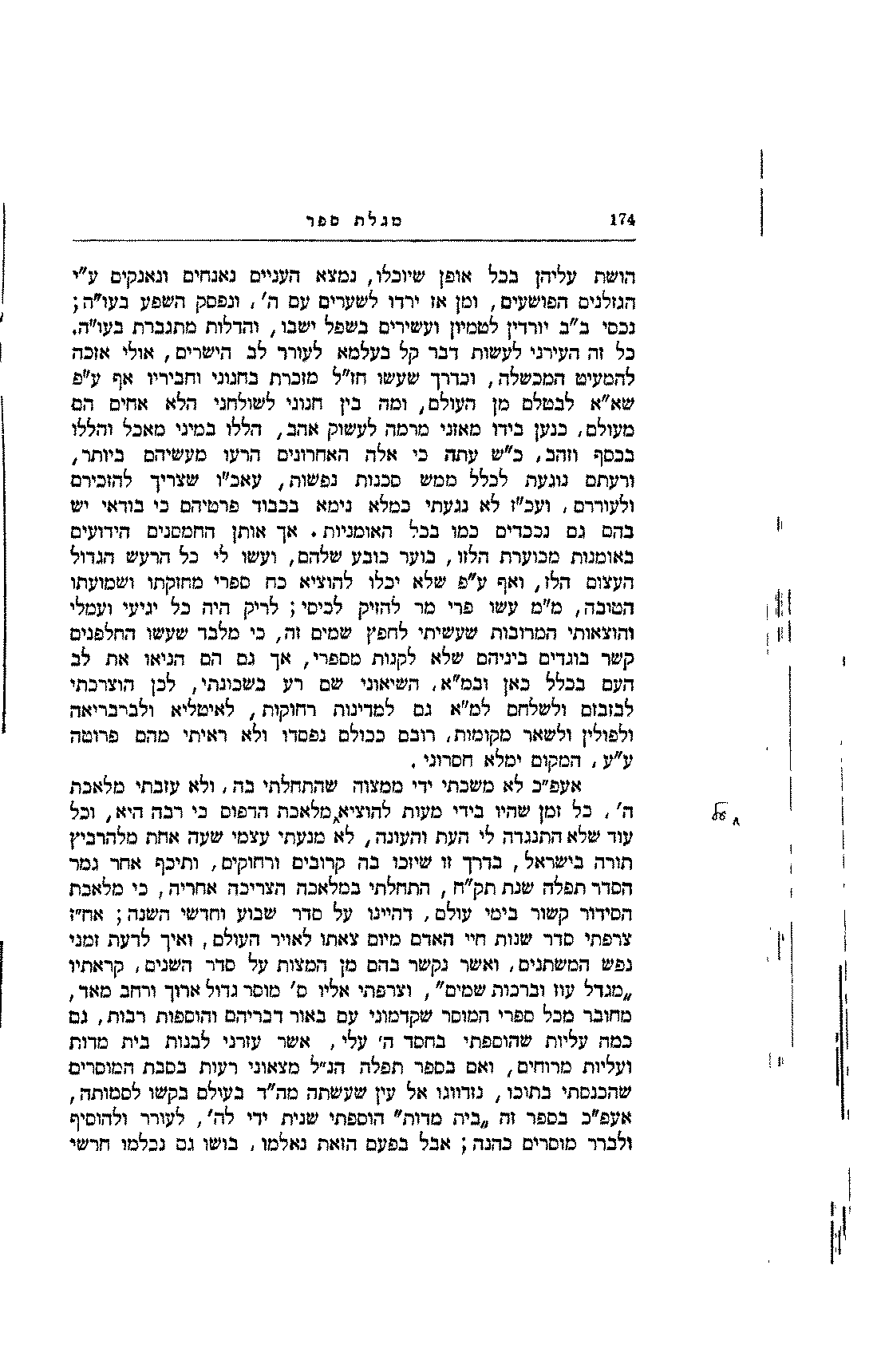
Margin readings in Scholem's copy (1)
| Printed anchor | Type (key sheet) | Mark | Reading | Certainty |
|---|---|---|---|---|
| כל זמן שהיו בידי מעות להוציא ^ מלאכת הדפוס | V: omission | caret; one word in right margin | על | fairly sure |
Page 175 (scan 195)
[of evil] (cf. Prov. 6:14); "pangs and pains seized" (Isa. 13:8) all my accusers and zealots, and my haters "came to an end, were consumed" (Ps. 73:19). And this work of mine found favour especially in the eyes of all who saw it, and was praised in the gates beyond anything; in any case I gained only a mere little ⟨S: "that I sold"⟩, for the buyers of new books had become few. Even so I did not turn back from printing and bringing out to the light of the world the work of the Lord, to which I held fast for the benefit of the soul and the needs of my life, and for the benefit of those who measure their lack and need as I do. I went back and printed also the second part of the great Beit Middot; and I have not yet reached its end, for it is broad and winds ever upward, and it is too great for me to contain it in one volume, and I had to divide it into parts and sections. I had already brought up on the altar of printing about ten sheets of the second part of the said book, but I have not yet completed it; for while I was still busy with it, the man ⟨S: a four-line note, partly read: "the crooked serpent(?), son of … he, the accursed worm, Eybeschütz, may the name of the wicked rot"⟩ Eybeschütz stopped me, who came into my border to break through the fence of the world, to pull down the building of the fathers and to uproot the foundations of religion. "I was at ease, and he broke me asunder; he seized me by the neck, and dashed me to pieces, and set me up for his target" (Job 16:12); for the parnassim of the Three Communities gave me this hairy one to wrestle with. And although, by the kindness of the Most High, he could not prevail over me — for the Blessed Name saved me from the hand of those who overpowered me, "and made me a polished shaft, in His quiver He hid me" (Isa. 49:2), and all the world knew my righteousness, that I am upright and clean — even so he caused me great losses. And it is not enough that they did not make good to me my losses and damages that he and his helpers caused me for evil, but "the treacherous dealt treacherously" (Isa. 24:16), and went on to plunder my tents, as I will tell with God's help. And I ceased from business of trade altogether: from the time the arrogant one came until now I could not engage in real business, so as to earn anything to support my household, "and my life was given me for a prey" (Jer. 21:9). Blessed be the Helper and Saviour until now; in Him I trusted. He will not let my foot slip, He has established my steps, "and He put a new song in my mouth, praise to our God; many shall see and fear, and shall trust" in Him (Ps. 40:4)!
I will not lengthen here on what befell me in the said affair of the fool, for I have already devoted to this event a separate book, which I called Megillat Purim u-Milḥemet Tannin ("The Scroll of Purim and the War of the Dragon") [a]. But I reached only its half, with what happened until my return from my exile ⟨S: "to Amsterdam"⟩ to my house [b]; and what befell me with it from then on, time has not yet allowed me to set down in a book — especially since I was busy with printing my books in two parts [c], the first to clarify the matter of the small amulet and the law of the scribe, and the second part called Teshuvat ha-Minin ("Answer to the Heretics") [d], to answer him ⟨S: "the heretic"⟩
Kahana's notes
- [a] See the book Hit'avkut (p. 13) and his book Edut be-Ya'akov (p. 3b); he says it was a large book of forty or fifty sheets.
- [b] "B-M-Sh", abbreviation of: with what happened.
- [c] "B-Ḥ", abbreviation of: in two parts. The name of the book is missing here; its name was Akitzat Akrav. See Edut be-Ya'akov (p. 18b), and see the book Hit'avkut (p. 16b), and see Toledot Ya'avetz by Wagenaar (p. 59, § 218).
- [d] This book did not come to print; it was large in quantity, holding thirty quires of paper (see the book Hit'avkut, p. 15).
צירים, וחבלים יאחזמו לכל משטיני ומקניאי, ומנאצי ספו תמו, ומלאכתי זאת ביחוד נשאה חן בעיני כל רואיה, ויהללוה בשערים באין מכלים דבר; מ"מ מעט מזער שכחתי כי נתמעטו הקונים ספרים חדשים, עכ"ז אחור לא נסוגיתי מלהדפיס ולהוציא לאור עולם מלאכת ה', שהחזקתי בה לתועלת הנפשית וצרכי חיי רוחי, ולתועלת המשערים חסרונם וצרכם כמוני, וחזרתי והדפסתי עוד ח"ב מבית מדות הגדול, שלא הגעתי עדין לתכליתו כי רחבה ונסבה למעלה, וגדולה היא אלי לכללה בכרך אחד, והוצרכתי לחלקה לחלקים ומקצועות. וכבר העליתי על מזבח הדפוס עשרה בוגין מח"ב בס"ד, אבל עדיין לא השלמתיו, כי עודני עסוק בו, הפסיקני האיש אייבשיצר, שבא לגבולי לפרוץ גדר עולם, ולהרוס בנין אבות ולקעקע יסודות הדת, שלו הייתי ויפרפרני, אחז בערפי ויפצפצני ויקימני לו למטרה, כי פו"מ ג"ק נתנו לי שעיר זה להאבקי עמו, ועם כי בחסד עליון לא יכול לי, כי השי"ת בצל ידי החביאני והשימני לחץ ברור באשפתו הסתירני, וכל העולם ידעו צדקי, כי אני ישר ונקי, רק מ"מ הפסידני הרבה, ולא די שלא החזירו לי הפסדי ונזקי שגרם לי הוא ועוזריו לרעה, אבל הבוגד בוגד והוסיף לשדוד אהלי כאשר אספר בעזה"י. ומעסק מו"מ בכלל השביתני, מעת בא זדון ועד הנה לא יכולתי לעסוק בד"א, שאוכל להרויח מאומה לכלכל את ביתי, והיתה לי נפשי לשלל. יתברך העוזר ומושיע עד כה, בו בטחתי, לא יתן למוט רגלי, כונן אשורי, ויתן בפי שיר חדש תהלה לאלהינו, יראו רבים וייראו ויבטחו בו! ולא אאריך כאן במה שקראתני במקרה הכסיל הנ"ל, שכבר יחדתי למאורע הלז ספר בפ"ע, קראתיו „מגלת פורים ומלחמת תנין" א, אבל לא הגעתי רק למחציתו, במ"ש עד שובי מגלותי, לביתי ב; ובמה שאירע עמי משם ואילך עדיין לא נתנני הזמן לעסוק בו להעלותו על ספר, ביחוד כי הייתי טרוד בהדפסת ספרי ב"ח ג, הראשון לברר ענין הקמיע הקטנה ודין הסופר, וח"ב נקרא „תשובת המינין" ד, להשיב לו
- [א] עיין בס' התאבקות (דף י"ג) ובספרו עדות ביעקב (דף ג' ע"ב), יאמר שהיה ספר גדול מארבעים או חמשים בוגין.
- [ב] במ"ש, ר"ת: במה שהיה.
- [ג] ר"ת: ב' חלקים, ושם הספר חסר פה, אך שמו היה „עקיצת עקרב", עיין בס' עדות ביעקב (דף י"ח ע"ב) ועיין בס' התאבקות (דף ט"ז ע"ב), ועיין תולדות יעב"ץ לוואגנה (צד נ"ט סי' רי"ח).
- [ד] הספר הזה לא בא בדפוס, והיה גדול בכמותו, שהיה מחזיק שלשים ידות נייר (עיין בס' התאבקות דף ט"ו).
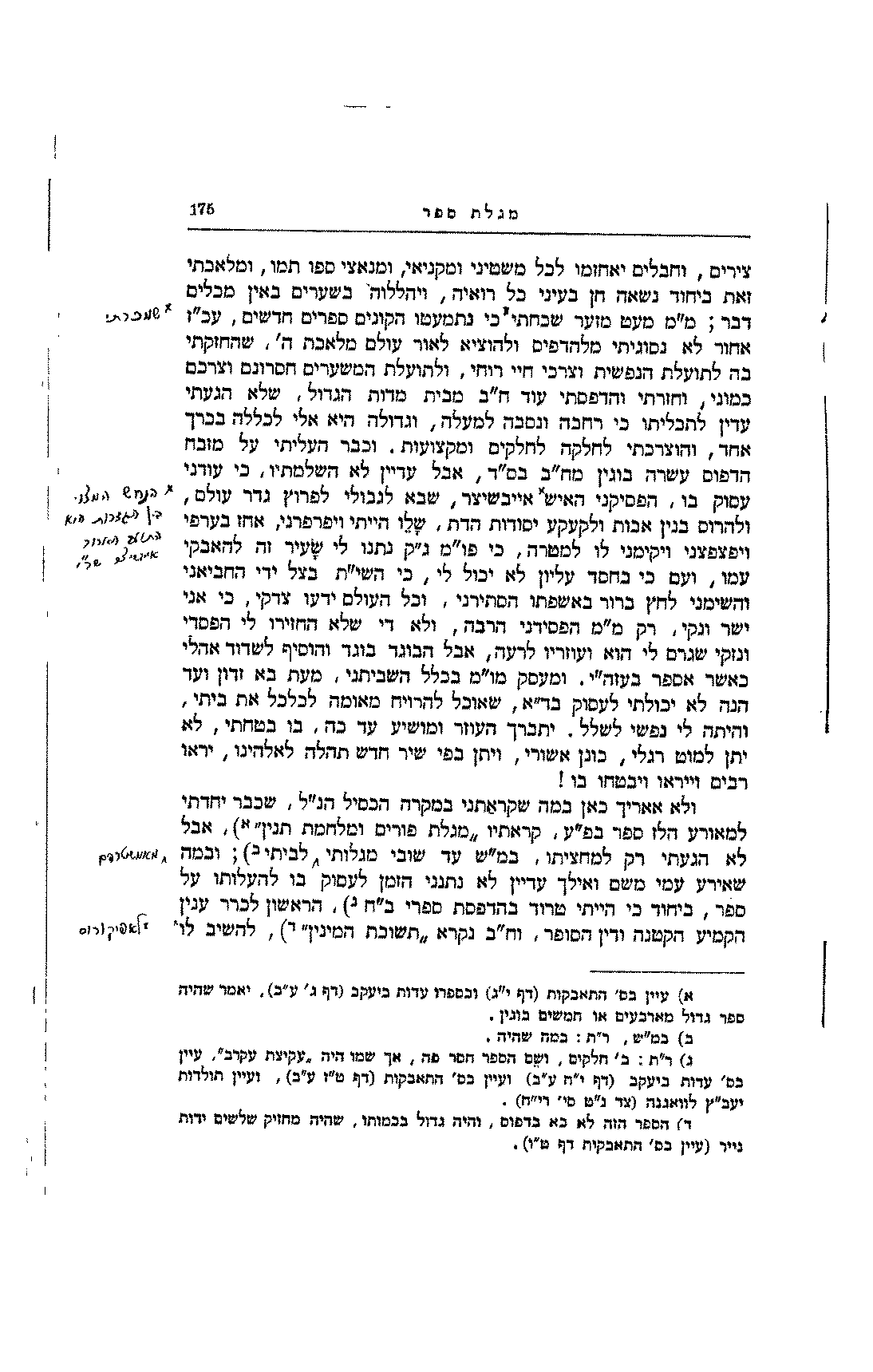
Margin readings in Scholem's copy (4)
| Printed anchor | Type (key sheet) | Mark | Reading | Certainty |
|---|---|---|---|---|
| מ"מ מעט מזער שכחתי x כי נתמעטו | X: substitution | x mark; one word in left margin | שמכרתי | fairly sure |
| הפסיקני האיש x אייבשיצר | X: substitution | x mark; 4-line note in left margin | הנחש הנלוז(?) / בן ה... הוא / התולע הארור / אייבשיצר שר"י | partial |
| עד שובי מגלותי ^ לביתי | V: omission | caret; one word in left margin | לאמשטרדם | fairly sure |
| להשיב לו x | X: substitution | x mark; one word in left margin | לאפיקורוס | fairly sure |
Page 176 (scan 196)
concerning a large amulet that he gave to the daughter of R. G. [a] ⟨S: a four-line note: "for … came to him, the hand of Absalom, to rise against his Father in Heaven"⟩, which his pupil ⟨S: "an apostate"⟩ Karl Anton brought to print, who wrote on his behalf [b] — and the author himself, as was made clear by a scribe ⟨S: a three-line note, partly read: "and this one is … the said … he"⟩ who translated it for him into German; and they sent it to the hand of ⟨S: "the apostate"⟩ the said [man], and with the knowledge of his kinsman, S. B., the said book was printed [c] ⟨S: a five-line note: "to taunt the armies of Israel over their faith, their customs and their commandments, and to speak good of the apostate(?) of Israel(?)"⟩ — to speak good of Eybeschütz to the king, may his majesty be exalted, to ask him to take him under his wings, since he is a good man ⟨S: a note cut off, partly read: "good(?) …"⟩; therefore he is obliged to save him at once from his pursuers. And me the said man blackened before the king, may his majesty be exalted, and put wanton charges on me, saying that my wife the rebbetzin had already said such a thing — before he came here ⟨S: a two-line note: "vomit of shame(?), the said oppressor"⟩ she boasted: "Let Eybeschütz come; my husband Jacob has already sharpened the knife to cut his throat." Such words he set in print in the said book, and I will answer him on all the words he hung on me, and on his explanation of the said amulet ⟨S: a four-line note, partly read: "I also brought to print the book Torat ha-Kena'ot(?) and the book … and Luḥot(?) … in the years of the said quarrel"⟩. But the book Teshuvat ha-Minin ⟨S: a word, cut off, perhaps "p. a."⟩, the said second part, was left aside in the middle of the work, because of the said man ⟨S: "Amalek"⟩ who disturbed my rest [d]; also "the money was gone from my vessels", and my hands did not reach enough for the work, until the Lord accepts the work of my hands (cf. Deut. 33:11) and grants me to bring them to completion. "The Lord will complete it for me" (Ps. 138:8); may He not let go the work of my hands!
Now I will return to my stories in the order of the years, and what happened with my third marriage, with my brother's daughter, as said, whom I despaired of ⟨S: "married"⟩ for the sake of peace in the house. But all the time that my daughters by my first wives were dwelling with me in my house, I was more lacking in peace, for our sins, than at the time before. And I saw with the eye of reason that what the sages, of blessed memory, said — "Your sons and your daughters shall be given to another people" (Deut. 28:32): this is the stepmother [e] — has no remedy. And whereas I had thought that when I married my brother's daughter she would yield to me and would have pity on my daughters and on my honour, in truth she was worse than those before her in this matter, for the sword of strife did not rest all the days she was here with me, although she was a pious, modest and excellent woman, surely
Kahana's notes
- [a] That is the parnas R. Gottschalk. R. Y. Eybeschütz hinted at this amulet in his book Luḥot Edut (p. 2b), saying: "I also wrote here an amulet for one woman, and she was the daughter of a rich man etc.; they opened this amulet and they also laboured to set interpretations on it in a confusion of tongues", end of quotation. The amulet was printed at the end of the book Shevirat Luḥot ha-Aven, and also at the end of the book Sefat Emet, first edition.
- [b] The king wished this amulet of the daughter of R. G. to be translated for him, and so R. Y. Eybeschütz did; see the book Hit'avkut (p. 14b and p. 8).
- [c] So Ya'avetz says in his book Hit'avkut (p. 15): "and he hid there in the house of his kinsman S. B., where they joined together against the Lord"; and so he says further in his book Petaḥ Einayim (p. 12b): "and it was when he travelled to Brunswick to his pupil, where in the house of his kinsman they took counsel together and made their secret sweet", end of quotation. His kinsman there was a butcher (kassav), and for this reason Ya'avetz called him S. B.
- [d] The said man is Karl Anton, mentioned before; and in his book Edut be-Ya'akov Ya'avetz says there (p. 13): "the said man etc. fled the country with a great sum of money that he extorted from the Christians who trusted him."
- [e] Yevamot (p. 63).
על אודות קמיע אחת גדולה שנתן לבת ר"ג א, שהביא לדפוס תלמידו קארל אנטאן על שמו ב והמחבר עצמו, כאשר נתברר ע"י סופר שתרגמו לו בלע"ז אשכנזי, ושלחו ליד הנ"ל, ובידיעת מחו' ס"ב נדפס הספר הנ"ל ג, לדבר טוב על אייבשיצער אל המיר"ה, לבקש ממנו שיחסה תחת כנפיו, באשר הוא איש טוב, בכן מחוייב הוא להצילו מיד רודפיו, ואותי הבאיש ריחי לפני המיר"ה, ושם לי עלילות דברים לאמר: שזוגתי הרבנית כבר הגידה כזאת, טרם בואו הנה התפארה: יבוא אייבשיצער כבר השחיז בעלי יעקב הסכין לחתוך צוארו. כדברים האלה קבע בדפוס בתוך ס' הנ"ל, ואשיב אותו דבר על כל דברי התוליו עמדי, ועל באורו לקמיע הנ"ל, אך הספר תשובת המינין ח"ב הנ"ל, הונח מן הצד באמצע המלאכה, מחמת האיש הנ"ל שהשבית מנוחתי ד גם הכסף אזל מכלי ולא השיגה ידי די העבודה למלאכה עד ירצה ה' פעלי ויזכני להביאו לשלימות, ה' יגמור בעדי ומעשי ידי אל ירף! עתה אשוב לספורי ע"ד השנים, ומ"ש עם זווגי השלישי ב"א הנ"ל, אשר נואשתי משום שלום בית, אך כל זמן שהיו בנותי מנשיי הראשונות שרויות אצלי בביתי, הייתי יותר חסר שלום בעו"ה מבזמן הקודם. וראיתי בעין השכל כי מ"ש חז"ל עה"פ בניך ובנותיך נתונים לעם אחר, זו אשת האב ה, אין לה תרופה; ותחת שהייתי סבור כשאשא ב"א ילדה תהיה כפופה לי ותחום על בנותי ועל כבודי, באמת מגרע גרע מהקודמת לה בענין זה, כי לא שקט חרב הקטטה כל ימי היותה פה עמדי, עם היותה זולת זה אשה חסידה צנועה ומעליא, ודאי
- [א] הוא פו"מ ר' געטשליק, ועל הקמיע הזאת רמז מהר"י אייבשיץ בספרו לוחות עדות (דף ב' ע"ב) לאמר: גם כתבתי כאן קמיע לאשה אחת וכו', והיתה בת נגיד וכו', פתחו קמיע זו וחתרו ג"כ להעמיד בו פירושים בבלבול לשונות, עכ"ד; והקמיע ההיא נדפסה בסוף הספר „שבירת לוחות האון", וגם בסוף הספר „שפת אמת" הוצאה הראשונה.
- [ב] הקמיע הזאת של בת ר"ג חפץ המלך שיתרגם לו, וכן עשה מהר"י אייבשיץ, עיין בס התאבקות (דף י"ד ע"ב ודף נ"ח).
- [ג] וכה יאמר יעב"ץ בספרו התאבקות (דף ט"ו) והתאכסן שם בבית מחותנו סא"ב, שמה נוסדו יחד על ה'; וכן אמר עוד בספרו פתח עינים (דף י"ב ע"ב) בזה"ל: והיה בנסעו לברונשווייג אל תלמידו, ששם בבית מחותנו נועצו יחדו והמתיקו סוד, עכ"ד, ושם מחותנו היה קאסאב ומטעם זה קרא אותו יעב"ץ ס"ב.
- [ד] האיש הנ"ל, הוא קארל אנטאן הנזכר מקודם, ובספרו עדות ביעקב יאמר יעב"ץ שם (דף י"ג) האיש הנ"ל וכו', שברח מן הארץ עם ממון רב שעשק מן הנוצרים שהאמינוהו.
- [ה] יבמות (דף ס"ג).
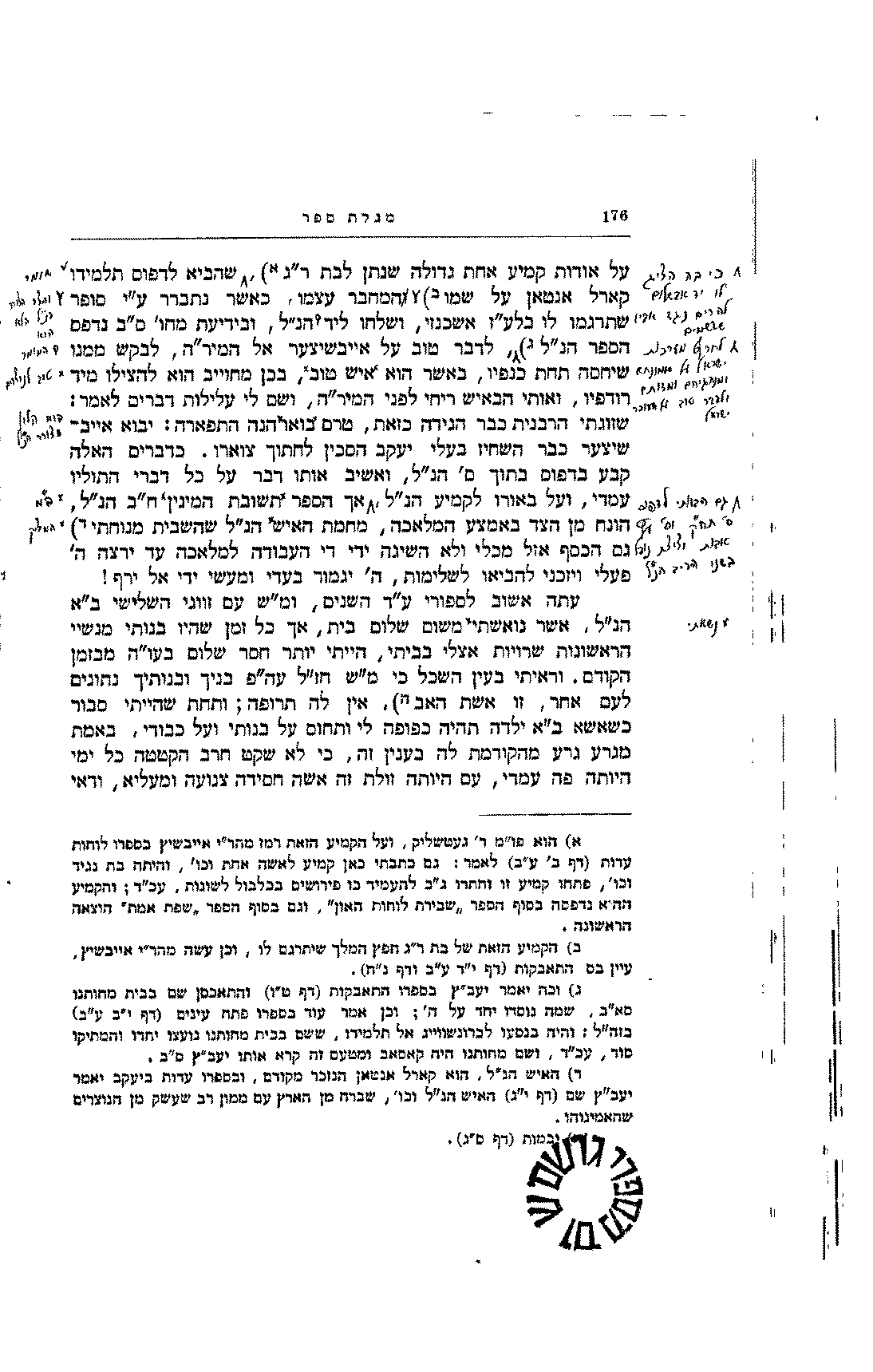
Margin readings in Scholem's copy (11)
| Printed anchor | Type (key sheet) | Mark | Reading | Certainty |
|---|---|---|---|---|
| שנתן לבת ר"ג א) ^, שהביא לדפוס | V: omission | caret; 4-line note in right margin | כי בא הליג(?) / לו יד אבשלום / להרים נגד אביו / שבשמים | fairly sure |
| שהביא לדפוס תלמידו v קארל אנטאן | V: omission | v mark; one word in left margin (cut off) | מומר | fairly sure |
| Y והמחבר עצמו, כאשר נתברר ע"י סופר Y | — | two Y marks; 3-line note in left margin (cut off) | והלז הוא / רב"ל(?) הוא / הוא (partly read) | partial |
| ושלחו ליד ? הנ"ל, ובידיעת מחו' ס"ב | — | mark like a question mark; one word in left margin | המומר | fairly sure |
| ובידיעת מחו' ס"ב נדפס הספר הנ"ל ג) ^, לדבר טוב | V: omission | caret; 5-line note in right margin | לחרף מערכות / ישראל על אמונתם / ומנהגיהם ומצותם / ולדבר טוב על המומר(?) / ישראל(?) | fairly sure |
| באשר הוא איש x טוב x, בכן מחוייב | X: substitution | x marks before and after the word; note in left margin (cut off) | טוב(?) לנ... (cut off) | partial |
| טרם בוא ^ הנה התפארה: יבוא אייבשיצר | — | mark in the line; 2-line note in left margin | קוא קלון(?) / הצורר הנ"ל | uncertain |
| ועל באורו לקמיע הנ"ל ^, אך הספר | V: omission | caret; 4-line note in right margin | גם הבאתי לדפוס / ס' תה"ק וס' ... / ... ולוחות(?) ... / בשני הריב הנ"ל | partial |
| הספר תשובת המינין x ח"ב הנ"ל | X: substitution | x mark; one word in left margin (cut off) | פ"א(?) | uncertain |
| מחמת האיש x הנ"ל שהשבית מנוחתי | X: substitution | x mark; one word in left margin | עמלק | fairly sure |
| אשר נואשתי x משום שלום בית | X: substitution | x mark; one word in right margin | נשאתי | sure |
Page 177 (scan 197)
my sins caused it, in the joining of the nature of the people of Poland and their well-known pride; therefore I have not seen good until now. I hope for the mercy of Heaven, that it will make me glad in the time of old age and have mercy on me in the days of grey hair, and that I will grieve no more!
After my marriage to my brother's daughter on 8 Iyyar 5504 [1744], in the first year she miscarried, and in the second year she bore me a healthy male child; I called him Mordecai. He survived and lived a year and a half, and died on 8 Marḥeshvan 5508 [1747]. After (two) [three] years she bore again, and bore me a male child, fit for life and peace: he is my chosen one, in whom my soul delights (Isa. 42:1), Judah, may he live, "who prevailed above his brothers" (1 Chr. 5:2). He was born to me, for good luck, on 8 Ḥeshvan 5511 [1750], on the holy Sabbath; may the Lord give him life and sustain him for His service, and may I merit to raise him to Torah, to the wedding canopy and to good deeds, and to see sons and sons of sons, as befits; so may it be His will, amen.
After this the days of the quarrel for the Lord began, with that Eybeschütz [a] ⟨S: an eight-line note, partly read: "the accursed abomination, Eybeschütz, may his name be blotted out, may his spirit expire, this wicked one, this proud fool … that I was not at ease, nor quiet, nor had I rest (Job 3:26); this turmoil came"⟩, who has troubled me in war more than seven years. And in this year in which we stand, [5]518 [1758] ⟨S: a four-line note, partly read: "when … etc., and it was fulfilled in me in this"⟩, I had thought I would sit in peace this time; but I was summoned to an obligatory war, against my will and not for my good, as I set out in the book Megillat Purim and in Edut be-Ya'akov. Therefore I will not lengthen on this hard event, which weighs as much as all that has befallen me and passed over me; I devoted several books to it, and I have not yet reached the half of the story. And who knows what will yet be renewed with me? For, for our sins, its like has not been seen nor heard: a wicked man who does evil a hundred times and prolongs his wickedness all these many years — he has no fellow in this affair of the fool. May the Lord act for the honour of His name ⟨S: a six-line note, partly read: "that he should not be reckoned also … this troubler of Israel"⟩, and may we merit to see the consolation of His people and His will in the coming of the Redeemer.
At the end of Iyyar [5]511 [1751] I fled by night, on the night after the Sabbath, from Altona, and travelled to Amsterdam. What befell me during the days of my flight and my exile from my house I have recorded in the said book Megillat Purim. After several changes and hard events had passed over me in Amsterdam, by the kindness of the Lord my judgment went out innocent before the king, may his majesty be exalted, and I was called to return to my house. I returned to my house in mid-Av [5]512 [1752], whole in body and in property. I found, thank God, all my household healthy and well; and they told me that my son Judah had already passed through the illness of smallpox, God save us, and escaped (but some years later the illness of the pox came back on him, as I will write with God's help); nothing was missing, thank God. My friends who desired my honour received me with honour and great joy. On the very day I returned to my house, with God's help, in great publicity, my enemies' hearts almost died within them, for within some days, not many, after my return, the authorities of the two [communities] decreed to take the honour of the rabbinate of the two [communities] from Eybeschütz ⟨S: "may the name of the wicked rot"⟩ altogether; and so
Kahana's notes
- [a] In his book Beit Yehonatan ha-Sofer (p. 1) Ya'avetz says of Eybeschütz that the beginning of his greatness was in the land of Moravia, a son of poor folk, in Holleschau.
עונותי גרמו בצרוף טבע אנשי פולין וגדולם הידוע; על כן לא ראיתי בטובה ע"ע. אקוה לרחמי שמים שישמחני לעת זקנה, וירחמני בימי שיבה, ולא אוסיף עוד לדאבה! אחרי נישואי ב"א בח' לאייר תק"ד, הנה בשנה ראשונה הפילה ובשנה שניה ילדה לי זכר שלם, קראתיו מרדכי, נתקיים וחי שנה ומחצה, ונפטר בח' מרחשון תק"ח. אחר (שתי) [שלש] שנים חזרה וילדה לי בן זכר הגון לחיים ולשלום, הוא בני בחירי רצתה נפשי יהודא שי', גבר באחיו יהיה, איהו נולד לי למז"ט ח' חשון תקי"א ביש"ק, ה' יחייהו ויקיימהו לעבודתו ית', ואזכה לגדלו לתורה ולחופה ולמע"ט, ולראות בנים ובני בנים הגונים כי"ר, אמן. אחר כך התחילו ימי הריב לה', עם אייבשיצר הלז א, אשר הטריד אותי במלחמה זה יותר משבע שנים, ובשנה זו שאנו עומדים תקי"ח, סבור הייתי לישב בשלוה הפעם, והוזמנתי למלחמת חובה ע"כ שלא בטובתי כמש"ב בס' „מגלת פורים" וב„עדות ביעקב", על כן לא אאריך במאורע הקשה הלז, ששקול כנגד כל מה שאירע לי ושעבר עלי מעודי, ויחדתי לו כמה ספרים ועדיין לא הגעתי למחצית הספור, ומי יודע מה יתחדש עמי עוד, כי בעו"ה לא נראה ולא נשמע דוגמתו. רשע עושה מאת ומאריך ברעתו כל כך שנים רבות, אין לו חבר במקרה הכסיל. ה' יעשה ע"ד כבוד שמו, ונזכה לראות בנחמת עמו וארצו בב"א! בסוף אייר תקי"א, ברחתי לילה מוש"ק מאלטונא ונסעתי לאמשטרדם, ומה שהיה לי במשך ימי בריחתי וגלותי מביתי, הזכרתי בס' „מגלת פורים" הנ"ל, ואחר שעברו עלי כמה תמורות וקורות צרורות באמשטרדם, ובחסד ה' עלי יצא דיני זכאי מלפני המיר"ה, ונקראתי לשוב לביתי, וחזרתי לביתי חצי אב תקי"ב שלם בגופי ובממוני. ומצאתי ת"ל כל ב"ב בריאים וטובים, והודיעוני שבני יהודא כבר עבר חולי בלאטרן ר"ל ונמלט, אבל אחר איזה שנים חזר עליו חולי אבעבועות הנ"ל כמש"ל, לא נפקד דבר ת"ל, ונתקבלתי מאוהבי החפצים ביקרי בכבוד ובשמחה רבה. בעצם היום שבתי לביתי בעזה"י בפומבי גדול, ואויבי כמעט מת לבם בקרבם, שבתוך איזה ימים לא כביר אחרי שובי, גזרו השררה דהב' לטול כבוד הרבנות דהב' מאייבשיצר לגמרי, וכן
- [א] בספרו בית יהונתן הסופר (דף א') יאמר יעב"ץ על אייבשיצר, שתחלת גדולו היה בארץ מעררין בן עניים בהעלישויא.
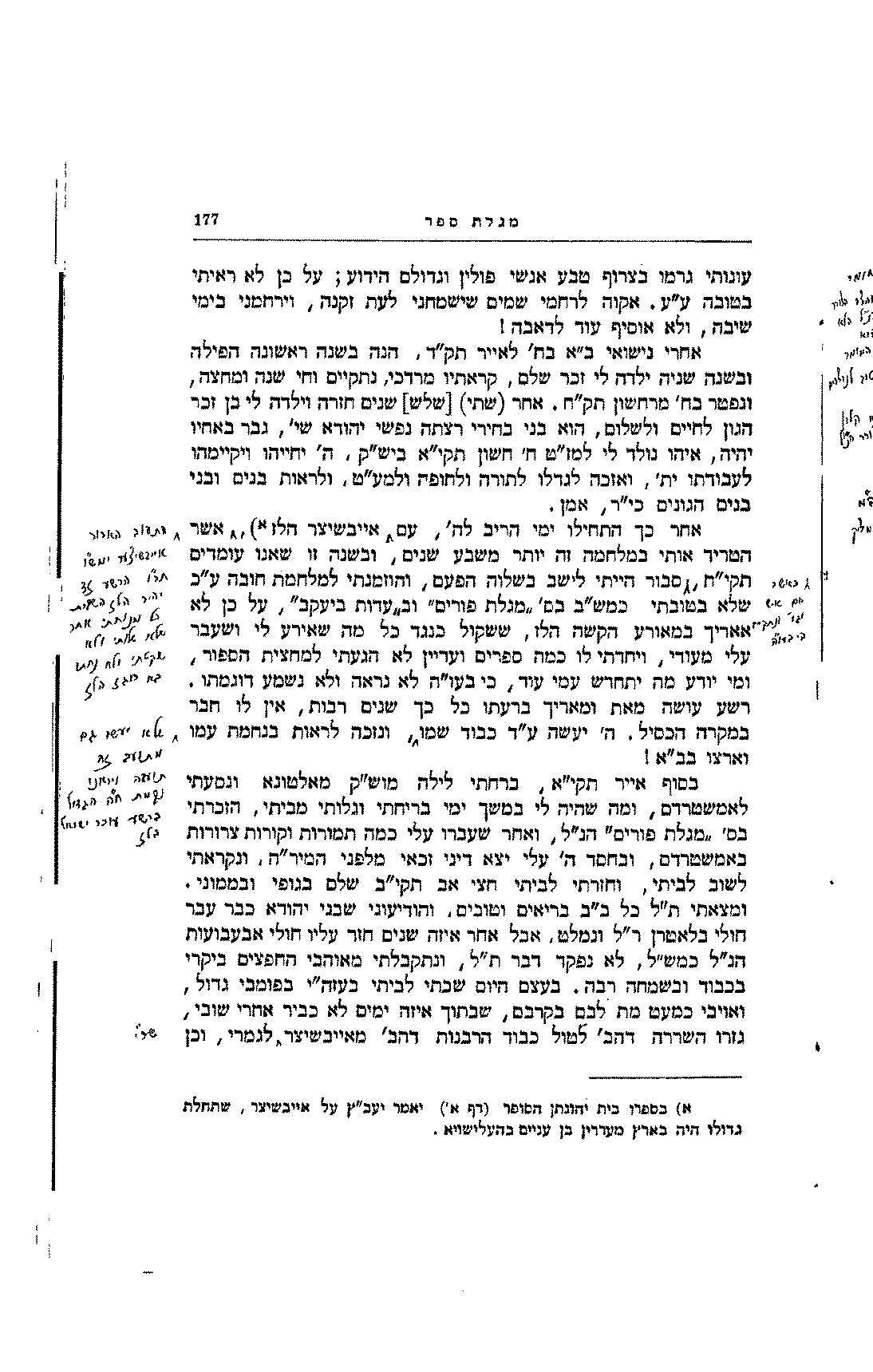
Margin readings in Scholem's copy (5)
| Printed anchor | Type (key sheet) | Mark | Reading | Certainty |
|---|---|---|---|---|
| ימי הריב לה', עם ^ אייבשיצר הלז | V: omission | caret in the line | - | - |
| אייבשיצר הלז א) ^, אשר הטריד אותי | V: omission | caret; 8-line note in left margin (cut off) | התועב הארור / אייבשיצר ימ"ש / תר"ו הרשע הלז / יהיר הלז השוטה / ט' מניתי(?) ... / שלא שלותי ולא / שקטתי ולא נחתי / בא רוגז הלז (mostly read) | fairly sure |
| ובשנה זו שאנו עומדים תקי"ח ^, סבור הייתי | V: omission | caret; 4-line note in right margin | כאשר / יום אור(?) ... / וגו' ונתקיים / בי בזה (partly read) | partial |
| ה' יעשה ע"ד כבוד שמו ^, ונזכה | V: omission | caret; 6-line note in left margin (cut off) | שלא יחשב גם / מחשבה זה(?) / תועה ויותר(?) / נשמת חיה ... / ... עוכר יש[ראל] / הלז (partly read) | partial |
| לטול כבוד הרבנות דהב' מאייבשיצר ^ לגמרי | V: omission | caret; one abbreviation in left margin | שר"י | sure |